Saturday, January 31, 2026

Panama court annuls Hong Kong firm’s canal port concession


By AFP

anuary 30, 2026


The Port of Balboa at the Pacific entrance of the Panama Canal in Panama City on October 6, 2025 - Copyright AFP/File MARTIN BERNETTI

Panama’s Supreme Court annulled on Thursday the concession allowing Hong Kong-based CK Hutchison to operate ports at the Panama Canal, a year after US President Donald Trump threatened to seize the crucial passageway claiming China controlled it.

The case came after Trump threatened just days into his second term to take back the canal — built by the United States and handed to Panama in 1999 — as he said China was effectively “operating” it.

The Supreme Court found the laws which allowed CK Hutchison Holdings to operate two of the five ports of the canal “unconstitutional,” according to a court statement.

The CK Hutchison subsidiary concerned by the ruling rejected the judgement, saying that it “lacks legal basis”.

The ruling “jeopardizes not only PPC (Panama Ports Company) and its contract, but also the well-being and stability of thousands of Panamanian families who depend directly and indirectly on port activity,” it said.

The lawsuit to cancel the concession was brought before the Panamanian high court last year on allegations that it was based on unconstitutional laws and that the Hong Kong business was not paying taxes.

Panama Ports Company — a CK Hutchison Holdings subsidiary — manages the ports of Cristobal on the canal’s Atlantic entrance and Balboa on the Pacific side.

The concession was automatically renewed in 2021 for another 25 years.

Shares in CK Hutchison declined more than 4 percent in morning trading on the Hong Kong stock exchange on Friday.

CK Hutchison Holdings is one of Hong Kong’s largest conglomerates, spanning finance, retail, infrastructure, telecoms and logistics.

It has sought to sell the Panama Canal ports to a consortium led by US asset manager BlackRock. The status of that proposal is unclear following the court ruling.


– ‘Taking it back’ –


Chinese state media has previously slammed the proposed sale, while Beijing officials have urged parties involved to exercise “caution”, warning of legal consequences should they proceed without their clearance.

In April, the Panamanian Comptroller’s Office accused the firm of allegedly failing to pay the state $1.2 billion from its operations, according to an audit by the agency in charge of overseeing public spending.

Panama has been trying to avoid being dragged into what President Jose Raul Mulino last year called a “geopolitical conflict.”

Mulino has insisted the canal’s neutrality is intact and has urged Washington not to entangle Panama in its rivalry with Beijing.

Still, Panama has taken steps to ease the pressure from Washington.

Last year it withdrew from China’s Belt and Road Initiative, and earlier this month it announced new joint US-Panama canal defense drills — the fourth since 2025 — aimed at boosting readiness around the 50‑mile (80‑kilometre) trade route.

The canal has become a recurring flashpoint as Trump pursues what he calls the updated “Donroe Doctrine,” asserting expanded US authority in the Western Hemisphere.

In his inauguration address, the US president said: “We didn’t give it to China, we gave it to Panama. And we’re taking it back.”

At the same time, Beijing has sharply criticized moves against its assets in Panama, including the demolition late last year of a monument honoring Chinese workers who helped build the canal and the 19th‑century railway that preceded it.

The United States and China remain the canal’s top users, with around five percent of global maritime trade transiting from there.

Maersk to take over Panama Canal port operations from HK firm


By AFP
January 30, 2026


Balboa port on the Pacific side of the Panama Canal - Copyright AFP Sameer Al-DOUMY

Danish firm Maersk will temporarily take over operation of two ports on the Panama Canal from Hong Kong company CK Hutchison, whose concession has been annulled, the Panama Maritime Authority (AMP) said Friday.

Panama’s Supreme Court on Thursday invalidated Hutchison’s contract following repeated threats from President Donald Trump that the United States would seek to reclaim the waterway he said was effectively being controlled by China.

The canal, which handles about 40 percent of US container traffic and five percent of world trade, was built by the United States, which operated it for a century before ceding control to Panama in 1999.

On Friday, the AMP said port operator APM Terminals, part of the Maersk Group, would be a “temporary administrator” of the Balboa and Cristobal ports on either end of the waterway.

It would take over from the Panama Ports Company (PPC) — a subsidiary of CK Hutchison Holdings — which has managed the ports since 1997 under a concession renewed in 2021 for 25 years.

The Supreme Court found, without providing reasons, that the PPC and Hutchison’s role was “unconstitutional.”

The United States on Friday welcomed the decision.

But Chinese foreign ministry spokesman Guo Jiakun said Beijing “will take all measures necessary to firmly protect the legitimate and lawful rights and interests of Chinese companies.”

For its part, PPC said the ruling “lacks legal basis and endangers… the welfare and stability of thousands of Panamanian families” who depend on its operations.


– Continuity –


The annulment of the PPC contract was requested last year by the office of the comptroller — an autonomous body that examines how government money is spent.

It argued the concession was “unconstitutional” and said Hutchison had failed to pay the Panamanian state $1.2 billion due.

The PPC argues it is the only port operator in which the Panamanian state is a shareholder and says it has paid the government $59 million over the past three years.

“It is very hard to imagine that (the court ruling) was not influenced by persistent US pressure on canal ownership,” said Kelvin Lam, a China-focused economist at the consultancy Pantheon Macroeconomics.

He said foreign investors would likely be increasingly cautious about committing capital “to strategic infrastructure projects in the United States’ backyard.”

Panama has always denied Chinese control over the 50-mile waterway, which connects the Atlantic and Pacific oceans and is used mainly by the United States and China.

Panamanian President Jose Raul Mulino, who has called the CK Hutchison contract “extortionate,” said Friday the canal will continue operating “without disruption.”

He added there would be a transition period leading up to a new concession “under terms and conditions favorable to our country.”

Mulino did not specify when a new concession will be put on offer.

APM Terminals said in a statement earlier Friday it was “willing” to operate the ports “to support operational continuity” and to mitigate any risks to essential services.

CK Hutchison Holdings — founded by Hong Kong’s richest man Li Ka-shing — announced in March 2025 it would offload a 90 percent stake in PPC and sell a slew of other non-Chinese ports to a group led by US asset manager BlackRock.

But the transaction fizzled out after China protested.

‘Superman’ Li Ka-shing, Hong Kong billionaire behind Panama ports deal


By AFP
January 30, 2026


Hong Kong tycoon Li Ka-shing, a rags-to-riches billionaire, and his CK Hutchison conglomerate are at the centre of US-China rivalry after deciding to sell their ports concessions in strategic Panama - Copyright AFP/File ANTHONY WALLACE


Tommy WANG

Hong Kong tycoon Li Ka-shing and his conglomerate CK Hutchison have been tied up in global US-China rivalry since announcing a controversial $19 billion sale of strategic ports in Panama last year.

The Li family owns 30 percent of CK Hutchison, which controls ports, retail, infrastructure and other businesses in dozens of countries and reported revenue of $61.4 billion in 2024.

Li was Asia’s ninth-richest man, according to the Bloomberg Billionaires Index in January, with a total net worth of more than $42 billion.

Nicknamed “Superman” for his business acumen, the 97-year-old and his companies are woven into the fabric of Hong Kong life through everything from internet services to supermarket chains.

A Panama Supreme Court decision to annul CK Hutchison’s concession there on Thursday showed how container ports in geopolitically strategic locations have become a prized global currency.


– From refugee to billionaire –


Li was born in the southern Chinese city of Chaozhou in 1928.

A refugee from the Sino-Japanese War who fled mainland China to Hong Kong, he started a business in 1950 manufacturing plastic flowers and named it Cheung Kong after China’s Yangtze River.

He reaped big profits in the 1960s after diversifying into property, and extended his businesses into many sectors in the following decades.

Li also had a longstanding interest in overseas markets, making investments in the Canadian property and energy sectors in the 1980s.

He swam against the tide after Beijing crushed the pro-democracy movement in Tiananmen Square in 1989, becoming the largest Hong Kong investor in mainland China, primarily in the property sector, while foreign businesses fled.

He continued to invest heavily on the mainland during the 1990s, the dedicated capitalist courting Beijing’s communist leaders as China began to emerge as an economic superpower.

The extent of Li’s investments served as a powerful catalyst for foreign capital entering China in the following decades, propelling its economic miracle.

Li also supported China’s education and healthcare sectors through substantial philanthropic funding.

He enjoyed close ties with three generations of Chinese leaders, including Deng Xiaoping, the architect of China’s economic opening up.


– Weakening ties –


That closeness to China’s leadership weakened after Xi Jinping took power in 2012.

Beijing hardened its stance towards tycoons under Xi, including those from Hong Kong, and Li found his commercial and political manoeuvres under increasing criticism by government-affiliated media.

He has offloaded major property investments in China in recent years in a move seen as part of a quest for stability and a sign of being less reliant on the mainland.

Li announced a sweeping reorganisation of his vast business empire in 2015 following the sale of some Chinese assets.

Many of the more recent expansions were instead overseas, with CK Hutchison now operating in some 50 countries across telecoms, ports, infrastructure, and retail.

Li and his family are also reportedly thinking of spinning off and selling assets across its units.

Chinese state media have criticised Li for his apparent decision to divest from some mainland markets and for supposedly showing sympathy to pro-democracy protesters in Hong Kong in 2019.

Beijing authorities intensified pressure on CK Hutchison last year, repeatedly criticising the conglomerate’s sale of its Panama Canal ports.

The Beijing-based authority overseeing Hong Kong affairs reposted a newspaper editorial titled “Great entrepreneurs have always been outstanding patriots” after the sale plan was announced in March.

There has been slow progress in the CK Hutchison port sale negotiations since then, with analysts telling AFP that political factors have become a drag.

Panama’s Supreme Court found the laws that allowed CK Hutchison to operate two of the five canal ports “unconstitutional”, ending its decades-long concession.

The ports operator, CK Hutchison subsidiary Panama Ports Company, said the decision “lacks legal basis” and threatens thousands of livelihoods.

Italian officials to testify in trial over deadly migrant shipwreck


By AFP
January 30, 2026


The migrant boat smashed into rocks off southern Italy in February 2023 - Copyright AFP Alessandro SERRANO
Alexandria SAGE

Six members of Italy’s police and coastguard went on trial Friday, accused of failing to intervene in a 2023 shipwreck that killed at least 94 migrants.

The disaster off Calabria was Italy’s worst in a decade, and set off a firestorm of criticism against far-right Prime Minister Giorgia Meloni’s tough stance on the thousands of migrants who arrive by boat each year from North Africa.

Thirty-five children were among those killed when the boat crashed on the rocks off the southern tourist town of Cutro on February 26, 2023.

On the opening day of trial in the courtroom of Crotone, all defendants — four officers from the Guardia di Finanza (GDF) financial crimes police, which patrols Italy’s seas, and two members of the coastguard — said they planned to testify, Italian news agency ANSA reported.

They are accused of involuntary manslaughter and “culpable shipwreck”, a crime in the Italian penal code punishing negligent actions or omissions leading to a shipwreck.

The overcrowded boat had set sail from Turkey carrying people from Afghanistan, Iran, Pakistan and Syria. Around 80 people survived.

Dozens of bodies and the wreckage of the boat later washed up along the beach. The victims’ coffins filled much of a nearby sports hall — with white caskets for the children — as relatives from around the world arrived to claim their dead.

Authorities say more people may have perished in the shipwreck. Their bodies have never been found.


– Four hours –


The charges against the officers relate to a rescue operation that never came, despite officials having been aware of the boat for hours.

A plane from European Union border agency Frontex spotted the boat just after 11:00 pm (2200 GMT), some 38 kilometres (24 miles) off the coast and flagged it to Italian authorities.

But a vessel subsequently dispatched by the GDF turned back due to the bad weather, and the migrant boat smashed against rocks near the beach some four hours later.

Prosecutors accuse both the police and coastguard of poor communication and dragging their feet after the boat was first assessed as meriting a maritime police operation.

Bad weather and worsening conditions should have prompted its reassessment as a search-and-rescue operation, they say.

One defendant “ignored the offer of assistance” from the coastguard — which has sturdier vessels capable of operating in bad weather — and failed to monitor the approaching boat, meaning that no one helped guide it to a safe harbour, prosecutors charge.

Such monitoring would also have alerted authorities to the many migrants on board, prompting an emergency operation.

All those on trial worked from various control centres far from the site of the shipwreck.


– More migrants feared dead –


Charity groups that operate search-and-rescue boats in the Mediterranean, including SOS Humanity and Mediterranea Saving Humans, are civil parties to the case.

They say the tragedy points to the policy of Meloni’s hard-right government of treating migrant boats as a law enforcement issue rather than a humanitarian one.

Human Rights Watch’s acting deputy director for Europe and Central Asia, Judith Sunderland, said it was not only the individual officers on trial, but also “Italian state policies that prioritise deterring and criminalising asylum seekers and migrants over saving lives”.

Visiting Cutro after the tragedy, Meloni put the onus for the disaster squarely on the shoulders of human traffickers, announcing toughened penalties for those who cause migrant deaths.

A Turkish and a Syrian man were sentenced to two decades in prison in 2024 for being the migrants’ traffickers.

In December 2024, two Pakistanis and a Turkish man were also convicted, receiving sentences from 14 to 16 years.

Around 66,000 migrants landed on Italy’s shores last year, similar to 2024, down from more than 157,000 in 2023, according to Italian government officials.

At least 1,340 people died while crossing the central Mediterranean last year, according to the UN’s International Organization for Migration (IOM).

On Monday, the agency said it feared for the lives of over 50 people missing after a shipwreck off the coast of Libya during the recent Storm Harry.

Artist chains up thrashing robot dog to expose AI fears


By AFP
January 30, 2026


Robot dogs on display at Unitree's retail store in Beijing 
- Copyright AFP/File Adek BERRY


Katie Forster

The agile robot dog springs up on all fours, takes a step forward and charges at the tense crowd at a Tokyo exhibit, held back by a simple yet strong metal chain.

The silver mechanical creature then starts thrashing around violently, to gasps and exclamations from spectators at the installation, designed to probe humanity’s relationship with increasingly realistic machines.

The Japanese media artist behind it told AFP he hoped the audience would consider the dangers posed by artificial intelligence but also feel “pity” for the struggling robot.

“Our future is going to be stressful, because people treat robots as objects, but we feel empathetic stress with these movements and reactions,” said Takayuki Todo, 40.

Global tech giants are investing vast sums into humanoid and other lifelike robots, with grand plans for factory automation, home help and other futuristic “physical AI” services.

But so far actual use cases remain scarce and fully automated robots are still a rare sight, with most impressive displays — including Todo’s — relying on remote operators to control the robot’s movements.

For the artist, the point of the three-day installation at the Tokyo Prototype festival is to provoke thought.

Like the metal leash, “we are protected by an unreliable, thin chain of ethics. And if it’s cut off, we will be killed by this technology,” said Todo.

– ‘Robot abuser’ –

For his installation, titled “Dynamics of a Dog on a Leash” and first shown last year, Todo purchased three robot canines made by Chinese startup Unitree, costing thousands of dollars each.

One is already broken and repairs are needed for another, as the dogs often get tangled in the chain and end up crashing onto the floor.

Todo, who said he had been attacked online “as a robot abuser”, visited Unitree in China last year to excuse himself for the unconventional treatment of their device.

The short hourly display, on show through Saturday in a business district skyscraper, is drawing large crowds, with many spectators including children curious to see a robot of this kind for the first time.

“It gave me the chills,” said 34-year-old student and food service worker Kimie Furuta.

“Imagining it actually attacking like that… it could be terrifying to face.”

On the brighter side, robots and AI could one day help ease staff shortages, including in the catering sector, she said.

Anatol Ward, a Tokyo resident in his 50s, said the robot reminded him of a guard dog.

“In some sense it was scary. But also it was fascinating — like, what the robot was capable of.”

Todo said that “of course” he was afraid of military uses for such robots, but noted it is not just a future concern.

“Robots and drones are killing soldiers in Ukraine or Palestine,” he said.

“We feel it’s a distant place, but as an artist we have to imagine it’s in front of us.”
Polar bears bulk up despite melting Norwegian Arctic: study

By AFP
January 29, 2026


Greenland is experiencing a record heatwave, forcing polar bears to wander further for food. - Copyright AFP/File EVARISTO SA


Julien MIVIELLE

Their icy hunting grounds are rapidly shrinking, but polar bears in Norway’s remote Svalbard archipelago have defied the odds by bulking up instead of wasting away, a study said Thursday.

The Barents Sea has lost sea ice faster than other areas with polar bears as temperatures have risen there more than in other Arctic regions, according to the research published in the journal Scientific Reports.

But instead of growing leaner like polar bears in other parts of the Arctic where the sea ice where they hunt is retreating, those in Svalbard have gained body fat.

“The increase in body condition during a period of significant loss of sea ice was a surprise,” Jon Aars, the study’s lead author and a scientist at the Norwegian Polar Institute (NPI), told AFP.

Polar bears in Svalbard have become plumper by feasting on land-based prey such as reindeer and walruses — species that have recovered after being over-exploited by humans, the study said.

Warmer temperatures have also made it easier for them to hunt ringed seals that now crowd in smaller sea ice areas.

– Rapid warming –


The scientists analysed the body condition index (BCI) of 770 adult bears between 1995 and 2019 to determine how much — or how little — fat they carry.


As the ice around them disappears, polar bears in Norway’s remote Svalbard archipelago have survived by getting plump – Copyright AFP Brendan SMIALOWSKI

They found that their BCI fell until 2000 but increased in subsequent years despite a period of rapid loss of sea ice.

The total polar bear population of the Barents Sea was estimated at between 1,900 and 3,600 in 2004 and may have increased since then, the study said.

The increase in air temperature has been two to four times higher in the Arctic than the global average over recent decades.

The Barents Sea has experienced even greater increases in temperature than other regions in the Arctic over the past four decades, rising by up to 2C per decade in some areas, the study said.

The area has also lost sea ice habitat at a rate of four days per year between 1979 and 2014, more than twice as fast as other regions hosting polar bears, it said.

The Svalbard findings “may seem surprising because they contradict the results of studies conducted in other polar bear populations”, said Sarah Cubaynes, a researcher at French environmental research centre CEFE who was not involved in the study.

The physical condition of polar bears in Hudson Bay, for example, “has greatly declined due to warming”, Cubaynes told AFP.

– Bleaker future –

Had he been asked to predict when he started working at NPI in 2003 what would happen to the bears, Aars said he would have declared at the time that they “would likely be skinnier”.

“And we see the opposite, bears are now in better condition, even though they are forced to be on land much more of the time, without the ability to hunt ringed seals,” he said.

A deterioration in body condition is usually a sign of future demographic problems for these Arctic animals.

“When conditions get worse, with less access to food, we anticipate to first see that bears get skinnier, that they do not accumulate so much fat reserves,” Aars said.

“This we expect to see before things get even worse, and survival and reproduction decreases significantly,” he said.

The unexpected results in Svalbard underscore the importance of not extrapolating findings from one region to another, the study said.

The situation in Svalbard “indicates a complex relationship between habitat, ecosystem structure, energy intake, and energy expenditure”, the authors wrote.

While Aars said the good body condition of Svalbard’s polar bears is “good news”, the study warned that they are “likely to be negatively affected in the near future” by a warming planet and shrinking sea ice.

The bears may still be able to prey on walruses and reindeer, but “we think they still depend on hunting seals on the ice”, Aars said.
In new letter, Orthodox rabbis say Jewish law forbids 'conversion therapy'


(RNS) — About 100 Orthodox rabbis from the U.S. and Israel say the practice is harmful and doesn't work.


Marchers carry a large rainbow flag during the annual Pride parade in Portland, Maine. (Photo by Mercedes Mehling/Unsplash/Creative Commons)


Yonat Shimron
January 28, 2026
RNS


(RNS) — A group of Orthodox rabbis from the U.S. and Israel issued a strongly worded letter condemning discredited practices that try to “convert” LGBTQ+ people to heterosexuality — a rarity for an establishment that still largely sees queer people as sinful.

The letter, which was drafted years ago but released earlier in January in Israel, includes the signatures of prominent modern Orthodox rabbis, including Yitz Greenberg, Shmuly Yanklowitz and Daniel Sperber, as well as a number of female rabbis. It does not include Haredi rabbis, the most strictly observant of the Orthodox strain of Jewish life.

When the letter was first published online, 75 rabbis listed their names, but that has since grown to 100 rabbis. They are not tied to an organization.


“We the undersigned,” it begins, “believe that it is forbidden according to Halakhic principle and ethos, for anyone, including a rabbi, rabbanit, educator, or therapist to recommend to any person to undergo treatment for the purpose of changing a person’s sexual orientation, commonly known as ‘conversion therapy. This is because conversion therapy is harmful, does not work, and because same-sex attraction is not a mental health problem.”

More liberal streams of U.S. Jewish life, such as the Reform and Conservative movements, have extended full equality to LGBTQ+ Jews, allowing them to be married and ordained. However, Orthodox Jewish denominations have only made limited strides toward reinterpreting texts that condemn gay love as a transgression, with most of that shift seen in Modern Orthodox circles.

“What they are really trying to do is press the rest of the Orthodox community to recognize what is obvious — that gay people are not sick, nor are they suffering a character flaw,” said Rabbi Steve Greenberg, one of the signers and a gay, married man who co-founded Eshel, a New York-based nonprofit whose mission is to build LGBTQ+ inclusive Orthodox Jewish communities. “They are just built differently by their Creator.”

More than 20 U.S. states and the District of Columbia fully ban “conversion therapy,” and other states partially ban it. But in October, the Supreme Court heard a case challenging the constitutionality of Colorado’s statewide restrictions on the practice for minors, based on free speech claims. A majority of the court’s justices seemed skeptical of the ban, which is expected to be ruled upon this June and could have implications for more than 20 other states with similar laws.

Israel bans “conversion therapy” by medical professionals, including psychologists and social workers, but religious counselors may engage in it.

“To my deep embarrassment, conversion therapy is still awash, certainly in Israel in the religious sector, and it was impossible just to stand by,” said Rabbi Yitzhak Ajzner, an Israeli rabbi who began drafting the statement years ago. “It’s impossible just to stand idly by watching our friends and loved ones go through such torture. They’re so traumatized. In many cases, their entire lives are ruined.”


In 2012, the Rabbinical Council of America, the body that represents modern Orthodox rabbis in the U.S., withdrew support of the Jewish conversion therapy organization Jews Offering New Alternatives for Healing, better known by its acronym, JONAH. But organizers of the letter said their statement makes clear they believe the practice is “outright forbidden” by halachah, or Jewish law.

Orthodox institutions in the U.S. have made very halting steps toward LGBTQ+ equality. Last year, Yeshiva University in New York said it would recognize an LGBTQ+ student club on campus but then reversed course and banned the organization 50 days later, saying the club was “antithetical to the Torah values of our yeshiva.”

Yanklowitz, of Scottsdale, Arizona, published the letter on the website of Torat Chayim, a rabbinical association of progressive Orthodox rabbis that he founded. He said many Orthodox rabbis are privately opposed to conversion practices but are afraid of publicly saying so because they believe it will damage their reputation and careers.

“I regularly get blowback for supporting things like this, but the risk to this population is so high that it felt imperative to me to sign on given this is often a saving-life issue for people who are humiliated and really deeply hurt and damaged by attempts to engage in conversion therapy,” he said.


The hidden power of grief rituals


(The Conversation) — Grief can inspire concrete acts of loyalty and generosity.


Shared rituals of grief bring people together.
 (onuma Inthapong/E+ via Getty Images)


Claire White
January 20, 2026

(The Conversation) — In Tana Toraja, a mountainous region of Sulawesi, Indonesia, villagers pour massive resources into funeral rituals: lavish feasts, ornate effigies and prized water buffaloes for sacrifice.

I witnessed this funeral ritual in 2024 while accompanying scholar Melanie Nyhof on her fieldwork. Families were expected to stage funerals that matched the social standing of the dead, even if it meant selling land, taking out loans or calling on distant kin for help.

In my own work of studying communal mourning rituals, I take part in ceremonies to see how they unfold.
At one of the ceremonies I attended in Tana Toraja, hundreds gathered as gongs echoed through the valley. Guests were served meals over several days, dancers in bright headdresses performed for the crowd, and water buffalo – the most valuable gift a family can give – were led into the courtyard for sacrifice. Mourners described these acts as ways of honoring the deceased.

It wasn’t just in the villages of Tana Toraja that families and clans used rituals to express loyalty for people they knew personally. I saw the same dynamics in cities, where national funerals can draw millions of strangers into a shared experience of unity and loss for a person they never met.

As a scholar who also studies the psychology of rituals, I found that rituals can be one of the most powerful ways humans bond with one other.
How rituals unite

In 2022, my colleagues and I surveyed more than 1,600 members of the British public a few days after Queen Elizabeth II’s funeral – both those who had traveled to London to be part of the crowds, and others who had watched the ceremony live on television.

Spectators reported intense grief and a connection with fellow mourners when they viewed the ceremony. On average, they described their sadness as intense. Most also said they felt a strong sense of unity – not only with people standing alongside them, but even with strangers across the nation who shared in the moment.

The effects were especially pronounced for those who had attended in person.

To see whether that sense of unity translated into action, we also used a behavioral measure using a mild deception task. All participants would receive a digital £15 (US$20) voucher for completing the survey, which would be emailed to them 48 hours later.

Toward the end of the survey, however, participants were asked whether they would be willing to donate money from their voucher for taking part in the survey. They indicated this via a sliding scale, from £0-£15 ($0 to $20.25) in £1 ($1.35) increments. Participants were led to believe that the funds would go to a new U.K. charity designed to educate future generations about the importance of the monarchy.

At the end of the study, participants were debriefed: The charity was fictional, and no money was actually taken; so regardless of how much they thought they were donating, all participants received the full compensation.

The results were striking. Those who felt the strongest grief also reported greater connection to both fellow mourners and fellow citizens; they were more likely to pledge to the monarchist cause. We later tested whether these effects fade quickly or leave a lasting imprint.

In a forthcoming study, we followed British spectators for up to eight months after Queen Elizabeth II’s funeral. Those who experienced the most sadness during the ceremony formed especially vivid emotional memories, which prompted months of reflection. That reflection, in turn, reshaped how people saw themselves – a personal identity shift that predicted enduring feelings of unity with others who had shared the experience.

Crucially, this sense of “we-ness” was strongest among those who had been physically present together and continued to predict willingness to volunteer long after the funeral ended.

In other words, grief didn’t just wash over people passively; it mobilized them toward concrete acts of loyalty and generosity. And importantly, this wasn’t limited to those who had traveled to London. Even people who only watched the funeral on television still showed some of the same effects, though less strongly.

Anthropologists have long reported that funerals and other rituals can create a profound sense of bonding that can outlive the ceremony itself. Our research suggests that shared rituals of mourning can foster unity at scale, reaching far beyond those physically present.

Furthermore, shared suffering forges identity and binds people together long after the ritual itself has passed.

Anthropologist Harvey Whitehouse’s research shows that when people endure intense suffering together, they don’t just feel closer – they come to see one another as if they were family. This kinlike bond helps explain why groups who undergo hardship together often display extreme loyalty and self-sacrifice. This is true even for strangers.
When rituals divide

But are those bonds always open-ended? Or do they sometimes channel generosity inward, toward one’s own group?

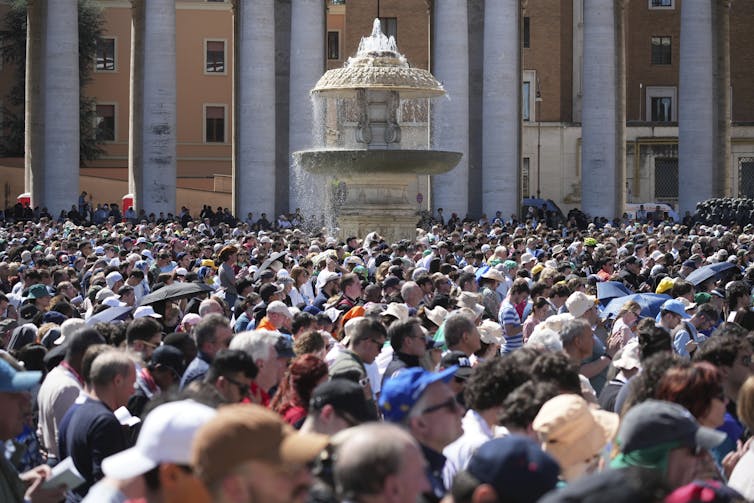
At Pope Francis’ funeral in 2025, we surveyed 146 people immediately after they had viewed his body lying in state in St. Peter’s Basilica. We asked them to rate the extent of their discomfort waiting in line.


Mourners at Pope Francis’ funeral felt motivated to offer more to charities.
Andrew Medichini/AP Photo

Some had waited overnight without food or water, and all had queued for hours in the unrelenting Roman sun. At the end of the survey, participants were invited to donate to one of two charities: a new Catholic aid organization or the International Red Cross.

As we predicted, the people who rated their experience waiting in line as the most uncomfortable also pledged the most money. But there was a twist. Almost all of that generosity flowed to the Catholic charity. Donations to the Red Cross were strikingly low, even though Red Cross volunteers had been circulating through the crowd, offering water and assistance. The difference in giving was not due to a difference in awareness or salience. What mattered was whether the cause felt part of the shared experience people had just endured.

This finding aligns with the work of my collaborator, anthropologist Dimitris Xygalatas, who has demonstrated that group rituals both “bind and blind.” These ceremonial rituals blind by narrowing generosity, channeling it mainly toward one’s own group, such as through the funerary ritual studies we conducted.
When shared suffering bridges divides

But shared suffering can sometimes do the opposite – not narrowing solidarity, but expanding it.

In other research I conducted after the catastrophic earthquakes in Turkey in 2023, with my colleague, anthropologist Sevgi Demiroglu, we surveyed 120 survivors across some of the most heavily impacted regions. Nearly half had lost a loved one, a third had lost their homes, and the vast majority showed signs of post-traumatic stress.

Participants were asked how intensely they had felt negative emotions such as fear and anxiety during the quakes; crucially, how much they believed those emotions were shared by others – whether family members, other Turkish survivors or Syrian refugees who were also affected.

Survivors who felt their suffering was shared reported a stronger sense of oneness, with those groups. And that sense of bonding predicted action. Even after losing nearly everything, many said they were just as willing to volunteer time to help fellow Turkish survivors as if they were their own families. Strikingly, this willingness extended even to ethnic communities often regarded with suspicion, suggesting that shared suffering can temporarily override social and political divides.

In this case, there were no collective grief rituals to help process loss. Yet the same underlying mechanism was visible: Shared suffering brought people together like kin. Grief rituals can take this raw bond and stabilize it – giving shared loss a durable social form.

Perhaps, grief rituals remind us that in grief, as in life, we are not alone.


(Claire White, Professor of Religious Studies, California State University, Northridge. The views expressed in this commentary do not necessarily reflect those of Religion News Service.)


The Conversation religion coverage receives support through the AP’s collaboration with The Conversation US, with funding from Lilly Endowment Inc. The Conversation is solely responsible for this content.
Cuba's Santeros offer gifts and ask deities for peace as tensions rise with US

HAVANA (AP) — Cuba is currently experiencing a radical tightening of U.S. sanctions, strangling its economy to pressure for a change in its political system, and U.S. President Donald Trump has directly threatened the island.


Andrea RodrÍguez
January 28, 2026

HAVANA (AP) — As tensions rise between the United States and Cuba and the island braces for more economic difficulties, priests and priestesses of the Afro-Cuban religion known as Santería held several ceremonies on Sunday, offering gifts to deities and asking for peace.

Several leading figures in the Santería community prayed for the “spiritual healing” of the Cuban people and an end to the violence and conflicts that, according to their predictions in late December, would characterize this year.

They chanted in ancient Yoruba, brought to the island by enslaved Africans and passed down orally. African and Spanish traditions syncretized, giving rise to Cuba’s strong Afro-Cuban identity.

“We…believe that through sacrifices and prayers we can alleviate the impact of harmful issues,” said Lázaro Cuesta, a renowned priest who organized the ceremony in the courtyard of an old house.

On Jan. 2, Cuban Santería priests known as babalawos predicted the possibility of war and violence that would affect Cuba and the world using traditional divining methods.

A day later, on Jan. 3, the United States struck Venezuela’s capital, Caracas, and arrested then-President Nicolás Maduro. Thirty-two Cuban soldiers from Maduro’s personal security detail died in the operation.

Venezuela is one of Cuba’s main political, ideological and commercial allies, and the attack shocked the island’s population.

Cuba is currently experiencing a radical tightening of U.S. sanctions, strangling its economy to pressure for a change in its political system, and U.S. President Donald Trump has directly threatened the island.

“As religious people, we always try to distance ourselves from anything negative that comes into our lives,” said Yusmina Hernández, a 49-year-old homemaker, as she participated in the ceremony.

At the foot of a leafy mango tree swaying in the breeze, a hen, a rooster and a dove were sacrificed. Around them, several dozen babalawos raised their voices in prayer, repeatedly asking Eggun, the deity of the ancestors, for permission to invoke his power and presence.

Then, the priests and parishioners moved to a large room in the house for the second part of the ceremony.

Dressed in white, wearing necklaces and headdresses, they made their offering to Azowano, one of the forms Saint Lazarus takes in their religion. They knelt before a large basket and bowls filled with beans, corn, and even two eggs, a generous offer since they are expensive in Cuba.

Afterward, several hundred people formed a single file, circled the basket and were finally “cleansed” after being swept with two live chickens while the attendees chanted in Yoruba.

“This is being done for the good of society, so that there is no conflict or violence, so that there is harmony and health,” said Eraimy León, a 43-year-old babalawo.

___

Follow AP’s coverage of Latin America and the Caribbean at https://apnews.com/hub/latin-america

Associated Press religion coverage receives support through the AP’s collaboration with The Conversation US, with funding from Lilly Endowment Inc. The AP is solely responsible for this content.


Cubans queue for fuel as Trump issues energy ultimatum


By AFP
January 30, 2026


Drivers wait in line to refuel at a gas station in Havana - Copyright AFP Sergei GAPON
Jordane BERTRAND

Cubans queued around the block for fuel Friday, as the island’s Communist government decried US efforts to “suffocate” the already‑stricken economy with a virtual oil blockade.

Hours after US President Donald Trump approved punitive tariffs against countries supplying oil to Cuba, lines formed at stations in the Cuban capital.

“This will directly hit ordinary Cubans sooner or later — that’s clearly the intention,” said Jorge Rodriguez, a 60‑year‑old IT worker, as he waited in line.

“They need to sit and negotiate with Trump,” he told AFP.

Trump’s executive order was denounced by the authorities in Havana as an attempt to throttle an economy already suffering blackouts of up to 20 hours a day.

The decree effectively forces Cuba’s partners to choose whether they want to trade with the world’s largest economy, or with an impoverished island of 11 million people.

Cuban President Miguel Diaz-Canel said the order was an attempt by Trump a “fascist, criminal and genocidal” US cabal to “suffocate” Cuba.

Cubans already face acute shortages of food, fuel, and medicine — the country’s most serious economic crisis since the 1991 collapse of its principal benefactor, the Soviet Union.

Until recently, the Cuban economy spluttered by on cheap supplies of Venezuelan oil.

But they have completely dried up since US special forces swooped into Caracas and deposed that country’s leader, Nicolas Maduro, on January 3.

In 2025, Cuba generated only half of the electricity it needed, according to official statistics analyzed by AFP.


– Escalation –


Trump, his Cuban-American Secretary of State Marco Rubio, and their allies have made no secret about their desire to bring regime change in Havana.

Trump has urged Havana to “make a deal soon” or face unspecified consequences. “NO MORE OIL OR MONEY FOR CUBA: ZERO!” he stated, claiming that Cuba is “ready to fall.”

Several top US officials have close ties to Florida politics, where toppling the regime is an article of faith — they include Rubio, White House chief of staff Susie Wiles and Attorney General Pam Bondi.

“It’s now or never,” said US lawmaker Maria Elvira Salazar, calling for the White House to make a final push to topple Diaz-Canel and the Communist party which has ruled Cuba for seven decades.

Trump’s trade ultimatum also named Cuba as an “extraordinary threat” to US national security, raising the specter of potential military action.

The order alleges that Cuba “aligns itself with — and provides support for — numerous hostile countries, transnational terrorist groups, and malign actors adverse to the United States,” including Russia, China, and Iran, as well as the militant groups Hamas and Hezbollah.

Since late 2025, the United States has maintained an armada of naval assets in the Caribbean, including warships, fighter jets, and thousands of military personnel.


– ‘Humanitarian crisis’ –


Trump’s latest gambit is a particular problem for Mexico, which is both one of the few countries still sending oil to Cuba and highly dependent on US trade.

Mexican President Claudia Sheinbaum warned Friday that sanctions “could trigger a far-reaching humanitarian crisis directly affecting hospitals, food supplies, and other basic services for the Cuban people.”

But Sheinbaum said she had instructed her foreign minister to make contact with the US State Department to seek clarity on Trump’s decree.

While reiterating her “everlasting solidarity” with the Cuban people, the president added, “We don’t want to put our country at risk in terms of tariffs.”

Trade experts say that deliveries of oil from Mexico to Cuba have already slowed in recent months and Sheinbaum has not refuted reports that state oil firm PEMEX plans to halt shipments.

Cuba’s traditional allies have offered rhetorical support, but announced no concrete plans for help.

“China stands firmly against moves that deprive the Cuban people of their rights to subsistence and development and inhumane practices,” said foreign ministry spokesman Guo Jiakun.

Diaz-Canel has said there were no talks with Washington and vowed the Caribbean island’s residents were “ready to defend the homeland to the last drop of blood.”


Trump’s framing of Nigeria insurgency as a war on Christians risks undermining interfaith peacebuilding

(The Conversation) — President Donald Trump described a Dec. 25 airstrike on suspected insurgent camps as a ‘Christmas present’ from the US. Many in Nigeria are not viewing it as such.


Mosques, as well as churches, in Nigeria are targets of insurgent groups.
 (Kola Sulaimon/AFP via Getty Images)


Aili Mari Tripp
January 29, 2026


(The Conversation) — Nigeria “must do more to protect Christians,” a senior U.S. State Department official demanded on Jan. 22, 2026, during a high-level security meeting in the African nation’s capital, Abuja.

The comment followed an attack just days earlier in which more than 160 worshipers were kidnapped from three churches in Nigeria’s northern Kaduna state.

The security meeting came a month after the United States, in cooperation with the Nigerian government, launched an airstrike from a U.S. Navy ship in the Gulf of Guinea on the northwest Sokoto state. During the Christmas Day incident, 16 Tomahawk missiles costing around US$32 million hit several locations the U.S. claimed were being used by extremist groups.

There were no verifiable casualties, although the strike did send a signal that the U.S. administration is willing to take military action when it is deemed necessary. President Donald Trump heralded the attack a “Christmas present” to Christians and later warned that there would be more strikes if the killings of Christians continued.

As a scholar of African politics, I know that calling the insurgency in Nigeria a persecution of Christians – as the U.S. administration has repeatedly done – is simplistic and ill-informed. Yes, Christians have been killed and kidnapped as part of the prolonged terrorism campaign by Boko Haram and other extremist groups. But so too have other groups in the country, including Muslims. Moreover, the religious identity of the victims masks other motives of the militant groups involved.

I recently carried out interviews in Maiduguri, Borno State – the epicenter of Boko Haram activities in northeast Nigeria – as part of research into interfaith efforts to counter threats from Islamic extremists. For many of those interviewed, the insurgency and violence have often served to unite Nigerians with different religious identities against a common enemy: the groups making their life a misery. The danger of Trump’s narrative of this being a war on Christians is that it could undermine such efforts to build cross-community trust.
A complex conflict

Since 2009 there have been 54,000 deaths related to the violence in Nigeria and the surrounding Lake Chad region, according to independent violence monitor ACLED.

The Christmas airstrike by the U.S. was in northwest Nigeria, targeting a small group of Lakurawa militants. But 85% of all incidents related to Islamic fighters in 2025 were in northeast Nigeria, according to ACLED.

Northern Nigeria is primarily populated by Muslims, in contrast to the whole of the country, whose 240 million people are split roughly 56%-43% between Muslims and Christians.

Many of those killed and abducted in the insurgency in the north have been Christian. But the exclusive focus on Christians by the U.S. administration overlooks the complex realities behind the violence in Nigeria, which incorporates not just extremist groups but also farmer-herder tensions, land and water disputes exacerbated by climate change, ethnic rivalries, poverty and organized criminal gangs referred to as “bandits.”

Boko Haram, which regards the Nigerian state as its main target, has killed both Christians and Muslims, as has the Ansaru, an al-Qaida affiliate. The Islamic State – West Africa Province, another major insurgency group, targets state forces and Christians.

While the most recent high-profile attacks have been on churches, Boko Haram also targets markets, mosques and homes. They are opportunistic attacks that don’t discriminate between Muslims and Christians.

To be sure, the Nigerian government’s response to the insurgency has been inadequate. But again, the reasons are complex and the result of a confluence of factors, including corruption in the security sector, negligence and the difficulty of targeting groups that employ guerrilla tactics outside of government control, which make them especially elusive. Political factors may also be at play, since elements within the Nigerian government may be complicit with northern politicians backing some of the land-grabbing and kidnapping bandits.

Even with these barriers, some progress has been made. According to the Africa Center for Strategic Studies, Boko Haram attacks have declined by 50% since 2014-2016, when they were most active, although rates have been increasing again since 2023.
Interfaith efforts

The Nigerian government itself has welcomed assistance from the U.S. targeting insurgents, but with the proviso that Nigeria’s sovereignty and territorial integrity be respected.

The concern is that military action on the part of the U.S. under the guise of protecting Christians in Nigeria could make matters worse. It risks exacerbating tensions within the country and giving credence to those in Nigeria and abroad who focus only on the killing of Christians for their own narrow purposes.

At the same time, it could undermine the efforts of civil society organizations and women’s associations, in particular, that have worked hard to build interfaith trust between Muslims and Christians to tackle the insurgency threat.

Some of these organizations, such as the Women of Faith Peacebuilding Network, have been at the forefront of the fight against militant groups. An interfaith movement founded in 2011, it now comprises over 10,000 Christian and Muslim women. It carries out vocational training and promotes interfaith dialogue and strategies to reduce conflict.


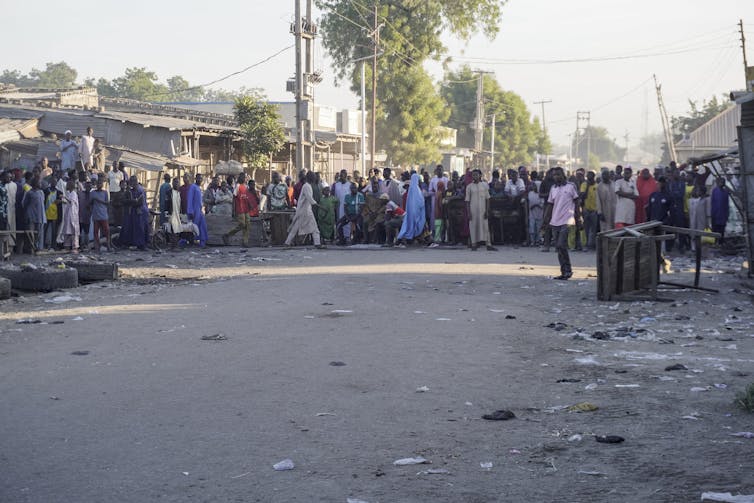
Residents gather near the scene of the explosion at a mosque in the Gamboru market in Maiduguri on Dec. 25, 2025.
Audu Marte/AFP via Getty Images

Following the abduction of over 300 schoolgirls by Boko Haram in Chibok, Borno State, in 2014, a coalition of women’s rights organizations – comprising both Christian and Muslim members – mobilized to protest the kidnappings.

The Federation of Muslim Women’s Associations in Nigeria, or FOMWAN, is another organization that is actively engaged in interfaith initiatives nationwide. In a January 2024 interview, a FOMWAN member based in Maiduguri told me that the Boko Haram crisis has united women across religious divides more than ever before.

Maryam, whose name I have changed along with other interviewees to protect their identity, explained: “FOMWAN has been in existence for many years before the insurgency. And in our activities we had been teaching our Muslim women religious tolerance in Borno. But the insurgency has made us put more efforts into making sure there is religious tolerance among Muslims and Christians.”

A Christian evangelist preacher, Mary, told me that working together had significantly reduced the mutual fear and mistrust between Muslims and Christians. Before the rise of Boko Haram, interfaith collaboration between the two groups was low. But today, she noted, it is far higher.

“We came to understand that this set of people doing this killing are neither Christian nor Muslim. They’re working for selfish interests, not for religious interests. We now strategize and come together to work as one. The key issue to (the conflict) is poverty. The only solution is for us is to speak with one voice. That’s the only way for us to survive.”
‘Each other’s keeper’

The U.S. administration would, I believe, do well to listen to the voices of these Christian and Muslim peacebuilders in northern Nigeria who live with the daily threat of violence.

Their lived experience has informed an approach to Nigeria’s insurgency based on shared purpose that cuts across religious divides.

In the words of activist Mama Pro, when asked why she was so keen to build interfaith bridges in Northern Nigeria: “We are always each other’s keeper.”


(Aili Mari Tripp, Vilas Research Professor of Political Science, University of Wisconsin-Madison. The views expressed in this commentary do not necessarily reflect those of Religion News Service.)


The Conversation religion coverage receives support through the AP’s collaboration with The Conversation US, with funding from Lilly Endowment Inc. The Conversation is solely responsible for this content.
Signs of the Times

Trump is destroying America; he must be stopped

(RNS) — At the ballot booth and in the streets, we must show that nonviolent collective action is still alive in America. What is at stake is the soul of our nation.


Thomas Reese
January 28, 2026
RNS


(RNS) — Donald Trump is a godsend for political cartoonists, op-ed writers and social media enthusiasts, but I find him paralyzing.

Cartoonists are having a field day. A recent cartoon showed polar bears with AK-47s ready to defend Greenland from an American invasion.

Social media has also blown up with screaming outrage as Trump acolytes and Trump haters attack each other with fanatical rage.

Op-ed writers have been busy as Trump provides them with outrageous words and actions to write about.

But I find him psychologically exhausting — like being blasted by a firehose.

Every day, if not more frequently, he verbally attacks some person, group, institution or nation with demeaning and insulting language that should not be tolerated from a schoolyard bully, let alone from the president of the United States. He acts like a spoiled child who is out of control — except he is bigger, meaner and stronger than anyone around him.

If he were a private citizen, we could laugh him off as a lying, narcissistic egomaniac, but he is the president of the United States.

As president, Trump is destroying the United States. He has poisoned our political culture, setting citizen against citizen, celebrating conflict and even violence. He unites his base by stoking hatred of perceived enemies. His inflaming of partisanship has made a calm discussion of politics impossible, even among friends and neighbors.

He is enriching himself, his family and his cronies while president.

He has even corrupted religion, where pastors can lose their pulpits if they are not enthusiastic supporters of Trump, driving away those who want their churches to be free of partisan politics.

He has undermined the justice system by pardoning insurrectionists who stormed the Capitol and violently attacked police. Pardons are also handed out to political supporters and donors.

He has used the Department of Justice to attack his political opponents with trumped-up criminal investigations. He has also turned Homeland Security into a partisan tool of his vengeance. He has taken FBI agents away from investigating organized crime, corruption and national security threats so he can use them against politicians and areas of the country that do not support him.

He has invaded Democratic cities and states with poorly trained Immigration and Customs Enforcement and Customs and Border Patrol officers who act against immigrants and citizens without restraint, resulting in two homicides by federal agents in Minneapolis.


The man who is the chief law enforcer of the nation shows a contempt for legal restraints that get in the way of doing whatever he wants.

His attacks go beyond Democratic politicians and cities. He attacks universities and the scientific community with lawsuits and unilateral cuts in funding. He uses the mistakes of a few to punish all. The damage he has done to scientific research will set back the country for decades just as China has caught up with and surpassed us in some areas of research.

Pretending to defend free speech on university campuses, he intimidates academia into silence. Pretending to defend Jews, he embraces antisemites if they support him.

The media have also felt his wrath. Reporters who challenge the administration or ask pertinent questions are insulted and demeaned. Reporters’ homes are searched; computers and phones are confiscated. Owners of news outlets find their other businesses threatened by government regulators and by the possibility of losing government funding and contracts.

Media outlets have become increasingly siloed, catering to rabid supporters or opponents of Trump. Attempts at objectivity in news coverage are ridiculed.

Even premiere law firms have been beaten into submission so they are now reluctant to take clients the administration considers enemies. Rather than being ferocious defenders of the law, they abandoned their clients like Chicken Little in the face of the president’s threats.

Trump has also destroyed the Republican Party by making it his own fiefdom that switches positions depending on which way the Trump tornado is blowing.


First it is for free trade; then it is for high tariffs. It goes from being an opponent of Russia to trying to be chummy with Vladimir Putin. The Hyde Amendment banning government funding of abortion used to be a pillar of the Republican platform; now it is negotiable.

During the 2024 election, Republicans promised to release the Epstein files; now they are buried or redacted to protect Trump and his friends. As president, Joe Biden was denying the reality of inflation; now “affordability” is a Democratic hoax. Americans have an unconditional right to bear arms, until a citizen with a gun permit comes to an anti-ICE demonstration; then he can be disarmed and shot.

The Republican Party no longer has any principles; it follows whatever Trump says like a puppy wanting a treat. This has undermined Congress’ ability to be a check on the imperial presidency.

If only John McCain, Barry Goldwater or someone of principle were alive and willing to speak truth to power. But the Republican establishment has kowtowed to Trump, fearing no one can win a Republican primary without his support. Republicans are destroying themselves and the country on the altar of Trump. If they lose big in this year’s election, they will be getting exactly what they deserve.

Trump has also undermined the American economy. Business leaders are kept happy with tax cuts and deregulation, but the long-term future of American business is in question. His tariffs have disrupted supply chains and alienated trading partners. Businesses can’t plan a year in advance because he changes policy so erratically. Making plans five or 10 years into the future is impossible.

Agriculture has been hurt by retaliation from importing nations who don’t like our tariffs. Farmers and food processors have lost workers who have been deported for no crime other than being undocumented.

Trump is destroying the American auto industry by disrupting supply chains and making sales abroad impossible. While the rest of the world is turning to electric vehicles, America has conceded this market to China. While Henry Ford catered to the working class with the Model T, Detroit is making SUVs and trucks for a shrinking population. Making an affordable car for the masses is no longer on Detroit’s agenda.

And the Trump administration is fighting green technology just as wind and solar energy have become cheaper than energy from fossil fuels. The country that invented these technologies has abandoned them to China, which is also leading in battery technology so wind and solar energy can be stored for when the wind does not blow and the sun does not shine.

The revolution in energy shows why Trump’s Venezuelan adventure is so stupid. He is spending billions to get access to Venezuelan oil, which major oil companies are not interested in exploiting because long-term investments require economic and political stability. This is unlikely with the current or future regimes in Venezuela.

In addition, cheaper green energy is going to threaten the profits of fossil fuel companies. Even in Texas,the market is causing a green revolution that is unstoppable.

Meanwhile, Trump is threatening our national security by undermining NATO and alienating allies around the world. He does not care about international law or human rights. Ukraine is not his problem, and he is practically inviting China to invade Taiwan before he goes out of office.

Trump has been a disaster for the United States, and we still have three more years to go. He will go down in history as the worst president ever. But he alone is not to blame. We elected him. And we are sitting back uninvolved unless what he does affects us personally. We get the government we deserve.

The country must unite and block the stupidity and tyranny of Trump. Universities must unite and speak with one voice in support of academic freedom. Scientists must speak against the use of bad science for political and economic agendas. Law firms must develop a backbone. All races, ethnic and religious groups must not let him divide us into warring factions. Christians must affirm we have only one king: Jesus.

At the ballot booth and in the streets, we must show that nonviolent collective action is still alive in America. What is at stake is the soul of our nation.
‘Misrepresent reality’: AI-altered shooting image surfaces in US Senate

By AFP
January 30, 2026


Lifelike AI visuals are seeping into everyday discourse, sowing confusion during breaking news events - Copyright AFP ROBERTO SCHMIDT


Marisha Goldhamer and Anuj Chopra

An AI-enhanced image depicting the moments before immigration agents shot an American nurse ricocheted across the internet — and also made its way onto the hallowed floor of the US Senate.

Social media platforms are awash with graphic footage from the moment US agents shot and killed 37-year-old intensive care nurse Alex Pretti in Minneapolis, which sparked nationwide outrage.

One frame from the grainy footage was digitally altered using artificial intelligence, AI experts told AFP.

The manipulated image, which purports to show Pretti surrounded by officers as one points a gun at his head, spread rapidly across Instagram, Facebook, X, and Threads.

It contained several digital distortions, including a headless agent.

“I am on the Senate floor to condemn the killing of US citizens at the hands of federal immigration officers,” Senator Dick Durbin, a Democrat from Illinois, wrote on X Thursday, sharing a video of his speech in which he displayed the AI-enhanced image.

“And to demand the Trump Administration take accountability for its actions.”

In comments beneath his post, several X users demanded an apology from the senator for promoting the manipulated image. On Friday, Durbin’s office acknowledged the mistake.

“Our office used a photo on the Senate floor that had been widely circulated online. Staff didn’t realize until after the fact that the image had been slightly edited and regret that this mistake occurred,” the senator’s spokesperson told AFP.

– ‘Advancing an agenda’ –


The gaffe underscores how lifelike AI visuals — even those containing glaring errors — are seeping into everyday discourse, sowing confusion during breaking news events and influencing political debate at the highest levels.

The AI-enhanced image also led some social media users to falsely claim the object in Pretti’s right hand was a weapon, but analysis of the verified footage showed he was holding a phone.

That analysis contradicted claims by officials in President Donald Trump’s administration that Pretti posed a threat to officers.

Disinformation watchdog NewsGuard said the use of AI tools to enhance details of witness footage can lead to fabrications that “misrepresent reality, in service to advancing an agenda.”

“AI tools are increasingly being used on social media to ‘enhance’ unclear images during breaking news events,” NewsGuard said in a report.

“AI ‘enhancements’ can invent faces, weapons, and other critical details that were never visible in original footage — or in real life.”

The trend underscores a new digital reality in which fake images — created or distorted using artificial intelligence tools — often go viral on social media in the immediate aftermath of major news events such as shootings.

“Even subtle changes to the appearance of a person can alter the reception of an image to be more or less favorable,” Walter Scheirer, from the University of Notre Dame, told AFP, referring to the distorted image presented at the US Senate.

“In the recent past, creating lifelike visuals took some effort. However now, with AI, this can be done instantly, making such content available to politicians on command.”

On Friday, the Trump administration charged a prominent journalist Don Lemon and others with civil rights crimes over coverage of immigration protests in Minneapolis, as the president branded Pretti an “agitator.”

Pretti’s killing marked the second fatal shooting of a Minneapolis protester this month by federal agents.

Earlier this month, AI deepfakes flooded online platforms following the killing of another protester — 37-year-old Renee Nicole Good.

AFP found dozens of posts across social media, in which users shared AI-generated images purporting to “unmask” the agent who shot her.

Some X users used AI chatbot Grok to digitally undress an old photo of Good.