Saturday, February 07, 2026

The UK’s Anti-Migrant Right Is Surging. Local Elections Will Test Their Power.

As the anti-immigrant Reform UK Party has risen in the polls, the Labour Party has co-opted some of its toxic policies.


Op-Ed
By Sasha Abramsky ,
February 6, 2026

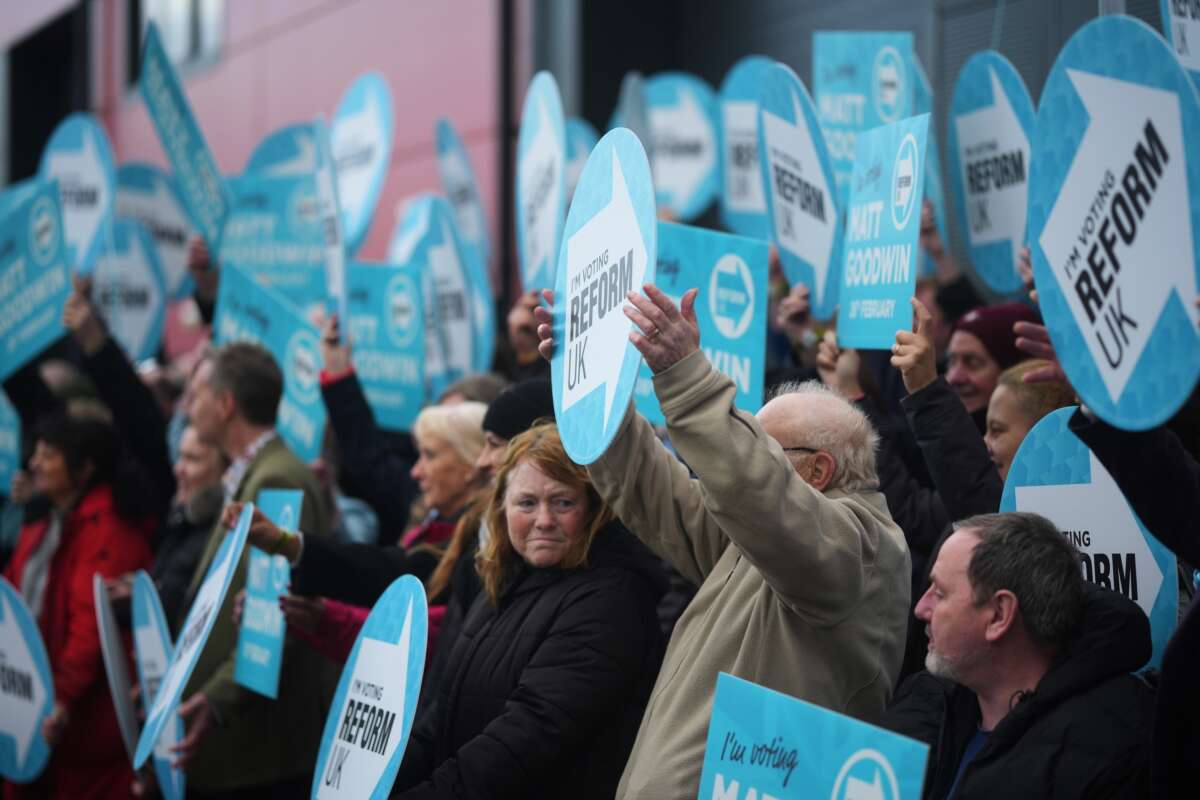
Reform U.K. supporters are seen as they open their campaign headquarters on February 5, 2026, in Denton, England.
Christopher Furlong / Getty Images

In recent months, as the anti-immigrant Reform U.K. Party surged to the top of the polls, the U.K.’s Labour government has sought to make it harder for immigrants to get “indefinite leave to remain” — essentially a British version of the U.S. green card — as well as restrict access to benefits for immigrants.

Currently, immigrants can seek “indefinite leave to remain” after five years in the country. Now, the Labour government’s plan is to double that wait time to 10 years. It has also proposed making refugees wait 20 years for citizenship; seizing the assets of asylum seekers; and curbing family reunification.

The Labour Party’s strategy, pushed by Home Secretary Shabana Mahmood, is to take the wind out of the Reform U.K. Party’s sails by co-opting some of its more toxic policies around immigration, even if the impact is to drive away needed workers, in health care and other industries, who can more easily get residency rights in other countries in Europe and beyond.

There is scant evidence that this anti-immigration strategy is actually working to Labour’s political advantage. True, polls show that Reform U.K. seems to have peaked in mid-2025, and that in recent months its support has begun to ebb — as outsider parties normally do in the U.K. system. Yet, it still is polling significantly ahead of Labour. And, come the general election, it will almost certainly receive a massive propaganda assist from the Trump administration in the U.S., which makes no secret of its loathing of European social democratic governments and which has explicitly allied with Reform U.K. in its aspirations to deport immigrants from the U.K. in much the same way that Donald Trump is currently removing them wholesale from the United States.


Op-Ed |
Why Is New UK Prime Minister Seeking Immigration Advice From Italy’s Far Right?
Keir Starmer of the Labour Party has looked to Giorgia Meloni, who has unleashed draconian measures against migrants. By Sasha Abramsky , Truthout September 24, 2024


In fact, if the general election were held tomorrow, the Reform U.K. Party could conceivably end up with the most members of parliament, putting it in pole-position to form a coalition government. Meanwhile, the Labour Party, which came to power a couple years ago with one of the largest parliamentary majorities in British history, faces something approaching an electoral wipeout. Modeling suggests the party could lose more than 80 percent of its seats.


If the general election were held tomorrow, the Reform U.K. Party could conceivably end up with the most members of parliament.

Astoundingly, Prime Minister Keir Starmer’s approval rating is, in some polls, at only 15 percent, making him far more unpopular than any other party leader in the U.K., including the notoriously polarizing Reform U.K. leader Nigel Farage. (You know you’re in trouble when your polling numbers make Joe Biden, after his June 2024 debate debacle, look like a paragon of popularity.)

Many voters in the U.K. are going to get a test run on May 7, when they will be electing local council members as well as members of the devolved Welsh and Scottish parliaments (polling suggests the Labour Party could fall to third place in Wales). Voters’ decisions this May could be a bellwether for the general election that is set to take place in three months. Despite elections for more than 600 council positions being delayed due to a reorganization of local government in many parts of England, more than 4,200 council members will be elected that day, including in London and many of the other large metropolitan areas in the southeast of the country, as well as in parts of the industrial Midlands and the north of England. In cities such as Newcastle, in the north, the city council of which is currently controlled by Labour but the population of which remains skeptical of Europe and hostile to large-scale immigration, voters are likely to express their discontent with the Labour Party by turning toward Reform U.K. Elsewhere, Liberal Democrats and Greens could pick up disillusioned Labour voters, as could Jeremy Corbyn’s new “Your Party,” which is wooing left-wing Labour stalwarts turned off by Starmer’s leadership.

Immigration will likely play an outsized roll in the local elections. Since the COVID pandemic, the number of asylum applications in the U.K. has grown rapidly, reaching 100,000 per year from a previous average of less than 40,000. About half of these applicants enter the country “irregularly,” oftentimes taking small boats across the English Channel. The government has put thousands of these asylum seekers up in hotels as their cases are processed — and hard-right political groups have, in recent years, held protests, many of them violent, outside of these shelters.


At the same time as asylum claims have increased, overall migration rates into the U.K. have actually been falling in recent years…. Among Reform U.K. Party voters, 80 percent erroneously believe that immigration is on the rise.

But at the same time as asylum claims have increased, overall migration rates into the U.K. have actually been falling in recent years. That is a reality that a majority of U.K. voters, absorbing huge amounts of misinformation via social media and other rumor mills, are unaware of. Fully two-thirds of U.K. voters tell pollsters they believe that immigration rates are increasing. Among Reform U.K. Party voters, 80 percent erroneously believe that immigration is on the rise. Because of this, the governing Labour Party has decided its best bet to remain in power is to mimic at least some of Reform U.K.’s policy positions. It’s a similar tack-to-the-right on immigration that the Biden administration attempted in its last year in office; it didn’t play out so well for Biden and there’s precious little evidence the strategy is working for Starmer.

As in the United States, the increase in asylum applications has fueled a more general surge of anti-immigrant sentiment, the beneficiaries of which are hard-right political movements, from Trump’s MAGA movement to the anti-immigrant Reform U.K. Party. Last September, the hard-right provocateur Tommy Robinson helped organize a massive anti-immigrant demonstration, titled “Unite the Kingdom,” in the center of London. More than 100,000 people attended.

“Tackling immigration” is now seen as the most important issue facing the country, with 23 percent of voters telling pollsters that that should be the government’s number one priority, far ahead of the 16 percent who say that cost of living should be the government’s main focus. By contrast, only 5 percent list the National Health Service and 3 percent opt for tackling climate change.

Starmer’s efforts to control the narrative through embracing ever-tougher anti-immigrant measures clearly haven’t worked. They have, instead, simply added fuel to the fire and further empowered Farage’s Reform U.K. Party. It is a peculiar combination of opportunism and political ineptness, and one that will likely hand the Labour Party a drubbing in the local elections this May. Should that happen, it will become a near-certainty that Starmer will face a challenge to his leadership from within his own party before the year is out.

This article is licensed under Creative Commons (CC BY-NC-ND 4.0), and you are free to share and republish under the terms of the license.


Sasha Abramsky  is a freelance journalist and a part-time lecturer at the University of California at Davis. Abramsky’s latest book, American Carnage: How Trump, Musk, and DOGE Butchered the US Government, is available for pre-order now and will be released in January. His work has appeared in numerous publications, including The Nation, The Atlantic Monthly, New York Magazine, The Village Voice and Rolling Stone. He also writes a weekly political column. Originally from England, with a bachelor’s in politics, philosophy and economics from Oxford University and a master’s degree from the Columbia University Graduate School of Journalism, he now lives in Sacramento, California.
Venture Capitalists Are Using Profits From Genocide to Fund AI-Powered Weapons

Arms makers are teaming up with venture capital firms in a push to bring AI to the battlefield.
PublishedFebruary 2, 2026

An artificial intelligence-piloted unmanned aircraft system is seen on the opening day of the Farnborough International Airshow 2024 in London, U.K., on July 22, 2024.JUSTIN TALLIS / AFP via Getty Images

What does it mean for humanity if cutting-edge AI weapons development for the Pentagon is being significantly funded by venture capitalists who are also profiting from the Israeli genocide against the Palestinian people?

Consider, for example, the X-BAT.

On October 21, 2025, in a theatrical unveiling involving a darkened auditorium, a smoke machine, and a black silken shroud that was whisked away, the war industry start-up Shield AI revealed a sleek, black, full-sized model of its proposed X-BAT drone jet fighter.

“When you see it,” teased Shield AI president Brandon Tseng, before the unveiling, “you’ll probably think to yourself: ‘Holy shit, that thing is fucking cool.’”

Shield AI says that the X-BAT will be vertically launched to enable it to operate without runways and from a variety of ships, not just aircraft carriers. The drone will have the AI power to select its own targets and launch weapons without human control, although there may be provision for some degree of human involvement.


Japanese BDS Activists Are Ramping Up Their Campaign Against a Robotics Company
Japan BDS is claiming a special responsibility to end Japanese robot makers’ complicity in Israel’s genocide in Gaza. By Frances Madeson , Truthout July 8, 2025


Pitching Shield AI’s achievements, Tseng said that its NOVA scout drone was used by Israel in Gaza “to help rescue hostages.” He said another one of its products, the V-BAT surveillance drone, is being used by Ukrainian troops and by the U.S. Coast Guard and Navy “to interdict and destroy billions of dollars’ worth of drugs that were headed for the United States of America.”

The real X-BAT has yet to be created, and whether it will perform as advertised may be known in the fall of 2026 when, the company says, flight tests will begin.

What is clear, however, is that the X-BAT is a poster child for a class of AI-guided weapons being built by military start-ups supported by highly speculative venture capital (VC) funds often built around Silicon Valley AI software. These funds amount to high-stakes gambling by extremely wealthy people, who know that they have perhaps a 10 percent chance of striking it rich should the start-up on which they are betting eventually tap into the nearly $1 trillion Pentagon budget and international military funding.

“We are in the midst of a military AI bonanza”, said Professor Elke Schwarz, a Queen Mary University of London ethicist and analyst, in an article published by Cambridge University Press on the impact of VC investments on U.S. and European militaries and the war industry.

“Between 2022 and 2023,” Professor Schwarz reported, U.S. federal contracts for military AI “nearly tripled, with a potential increase in the value of these contracts by 1,200 percent.”

According to J.P. Morgan, VC investment in military and aerospace companies amounted to $48 billion in 2024, and “Through the first half of 2025, venture investments into U.S.-based defense tech startups totaledroughly $38 billion and could very well exceed the 2021 peak ($55 billion) should the pace of investing remain constant through the end of the year.”

Profiting From Israel’s Genocide

Many of the largest VCs that are funding cutting edge AI weapons development for the Pentagon — such as Founders Fund, Andreessen Horowitz, Lux Capital, General Catalyst, Hercules Capital, Shield Capital, and Sequoia Capital — are also investing in Israeli high-tech firms, thus profiting from Israel’s genocide in Gaza.

These investments are being made in spite of pleas by Francesca Albanese, UN special rapporteur on the situation in the occupied Palestinian territories, that all governments and corporations “completely abstain from, or end, their relationship with this [Israeli] economy of the occupation, especially as it has transformed into an economy of genocide.”

The American Friends Service Committee (AFSC) lists Shield AI as a corporation profiting from genocide, noting that Israel has been using Shield AI’s Nova 2 drone for “close-quarters indoor combat” in Gaza.

Andreessen Horowitz, a primary backer of Shield AI, invests in Israeli high-tech firms. According to CTech, Andreessen Horowitz officials visited Israel in August 2025 for “a series of closed-door events aimed at recruiting top entrepreneurial talent from Israel’s elite military units” for firms in which Andreessen Horowitz invests.

In 2024, Andreessen Horowitz oversaw distribution of $89 million to PACs, parties, and individual politicians. By comparison, Lockheed Martin, the world’s largest military contractor, contributed $5.6 million.

L3Harris Technologies, the sixth largest U.S. weapons maker, is also an investor in Shield AI and is listed by AFSC as a genocide profiteer. Other VCs investing in Shield AI and Israeli tech include Hercules Capital and the South Korean firm Hanwha, which has partnerships with Israeli war corporations Elbit Systems and Israel Aerospace Industries.

Schwarz noted in an August 2025 interview for the Carnegie Council for Ethics in International Affairs that the entry of “really very financially strong venture capital companies” into the war industry has “amplified and accelerated” lobbying on Capitol Hill by VC weapons funders.

In 2024, according to OpenSecrets, Andreessen Horowitz oversaw distribution of $89 million to PACs, parties, and individual politicians. By comparison, Lockheed Martin, the world’s largest military contractor, contributed $5.6 million.

Schwarz also pointed out in the same interview that the introduction of AI into weapons has given VCs and AI tech firms a new level of dominance over politicians and Pentagon officials; many of them are not technically knowledgeable enough to make appraisals of the true value of the AI-powered weapons being sold to them.

The VC pressure for quick development and profitability of AI weapons, Schwarz writes in her Cambridge Press article, runs the risk of “making the Pentagon function like a start-up, and rapidly adopt technology innovation (which usually is software), and away from other initiatives that might have more oversight, utility, or effectiveness in the context of defense operations.”

“But perhaps most alarming,” Schwarz continues, “is the logical consequence of what has most utility to the VC sector and its mandate for hypergrowth: To get the military industrial sector to grow fast, perhaps the best catalyst is war, or at least the embrace of that possibility.”

So what are the war implications of VC funding of weapons development in Israel as well as the U.S.?

The U.S. is continuing to supply weapons to Israel to enable the genocide against the Palestinian people, and to support Israeli air attacks throughout the Middle East and possibly beyond. Silicon Valley billionaires, who largely support both the Republican and Democratic Parties, stand to gain mightily from continuing Israeli deployment of the weapons in which they are investing, and the use of Middle East killing grounds to test and improve those weapons.

The U.S. and Israel have adopted a strategy of endless assassination and bombing in the Middle East, seeking to achieve dominance by terrorizing target nations, destroying their key infrastructure, and killing their government officials. This strategy has been enabled by rapid advances in surveillance and targeting technology, in which weapons start-ups play an essential role.

The X-BAT, if built, and other mini-fighter jet drones, like the Kratos Valkyrie, could enable the U.S. and Israel to sustain and expand their massively destructive campaign at reduced cost, launching weapons similar to those launched by larger, more expensive, manned aircraft, like the F-35.

Shield AI announced that X-BAT would carry long range attack missiles, such as the Red Wolf missile produced by L3Harris Technologies. This missile would be a longer range, more destructive version of the Hellfire missile that has been responsible for countless civilian deaths and widespread trauma over the last 20-plus years of U.S. drone warfare.

The X-Bat will also carry the JSOW-C-1, a class of weapons that includes guided 500-pound bombs such as those that have killed tens of thousands of Palestinians and turned Gaza to rubble.

The use of these drones makes constant bombing less politically costly by enabling pilots controlling these strikes to stay far away from the zone of attack.

AI drone bombings will likely be touted for “precise” targeting ostensibly meant to spare civilians, but the speed of the X-BAT and similar “force multiplier” drones may severely limit the discernment of targeting gear.

Truthout reached out to Shield AI for comment on the X-BAT’s AI-targeting capability and human involvement in the aircraft’s launch decisions; there has been no response.
Destroying Sudan

Massive refugee populations and starvation will likely become even more common in the Middle East and Africa, and possibly elsewhere, as the U.S. and Israel use drones directly and indirectly in proxy resource wars.

In Sudan, the International Rescue Committee said on December 19, 2025, the two-year-old civil war has displaced more than 11 million people and 33.7 million need humanitarian aid. In spite of this, the United Arab Emirates (U.A.E.), an ally of the U.S. and Israel, has been supplying weapons to the breakaway Sudanese Rapid Support Forces (RSF), including Chinese-made drones that have been used to assassinate Sudanese people and destroy life-supporting Sudanese infrastructure. The Sudanese central government’s military (SAF) is using drones as well, provided, primarily by Iran and Turkey.

Drones empower relatively weak military forces to greatly harm opponents by launching attacks into areas beyond where they can send troops and prolonging attacks longer than could be endured by ground forces. As The Soufan Center reported in October 2025: “Drone technology … has reshaped the dynamic of the civil war as both the SAF and RSF are pivoting from static, ground-based engagements toward more sophisticated aerial operations … Drone technology has also intensified the RSF’s 18-month siege of El-Fasher, the capital of the North Darfur state, with multiple attacks on civilians in recent weeks.”

Israel appears to be becoming directly involved in supplying weapons, including drones, to the U.A.E. Forbesreported in August 2025 that the U.A.E. was making a deal with Israel’s Elbit Systems to buy Hermes 900 drones, and that the U.A.E. wanted the licensing and technology to build its own version of the Hermes. In November, Elbit disclosed it would be selling $2.3 billion in weapons to the U.A.E., but it did not reveal the full list of weapons being purchased. Meanwhile, the U.S. has its own stake in Sudan’s civil war because of its interest in Sudanese oil and gold, and its desire to block Chinese economic influence in Africa.

The foregoing, of course, should raise serious ethical questions for “defense” venture capitalists.

Shield AI’s CEO, Gary Steele, apparently wants to avoid such questions. Fortune reported in December 2025:


Shield AI’s new CEO talks in circles about whether he feels a heightened sense of responsibility running a defense tech business and seems uncomfortable to be asked about it at all. When asked about increasing disagreement regarding U.S. involvement in Ukraine or the controversy around the Coast Guard carrying out the Trump Administration’s agenda for Venezuela, he said: “We literally spend no time talking about the politics of particular missions.” While Steele acknowledged Shield AI has different protocols and processes because there is “human life involved,” he repeatedly stated that Shield AI isn’t much different from other tech companies. His focus is on the “mission,” he says, and how to “deliver the customer outcomes.”

There are about 3,000 billionaires in the world, with an accumulated wealth of $16 trillion, who are demonstrating their power over the world’s governments and businesses in preventing the sanctions against Israel called for by Palestinian civil society, Francesa Albanese, and hundreds of millions around the world who are outraged the U.S. and Israel’s continuing genocide.

These billionaires, as a group, are becoming increasingly dependent on AI-powered surveillance and killing machines to maintain their increasing, extraordinary wealth and political power by capturing and exploiting earth’s resources at gunpoint.

They, in turn, are dependent on the ingenuity of those who create AI-driven surveillance and killing machines.

In her 2018 book Death Machines: The Ethics of Violent Technologies, Schwarz asks these creators, and all of us, “What are we doing?”

Her question raises another question: What will each of us do to stop the X-BAT and its species from being used to further control and destroy our lives and the lives of others?


This article is licensed under Creative Commons (CC BY-NC-ND 4.0), and you are free to share and republish under the terms of the license.


Nick Mottern is co-coordinator of BanKillerDrones.org.
U.S. Measles Infection Count in January Topped Total Cases in 2023 and 2024 Combined

If infections continue at their current pace, the US could see triple the number of measles cases seen last year.
PublishedFebruary 5, 2026

Human skin covered with measles rash.Getty Images

The Centers for Disease Control and Prevention (CDC) has identified nearly 600 cases of measles in the U.S. in the first month of 2026 — a number that would have seemed unimaginable just a few years ago, as the virus has been considered eradicated in the U.S. for more than two decades.

As of January 29, the CDC counted 588 cases of measles across 17 states. The vast majority of cases identified (85 percent) occurred in people 19 years old and under.

Although the CDC updates its numbers weekly, a new report might not be issued until next week due to the limited government shutdown that occurred last weekend. Johns Hopkins University, which also tracks the spread of measles (by monitoring state and county health departments, county-level press releases, and news articles), has a more updated count through the first few days of February, pegging this year’s total as 712 cases as of Thursday morning.

The numbers from both the CDC and Johns Hopkins are incredibly high, molecular biologist and public health advocate Lucky Tran noted in a post on X.

“US measles cases this year already exceed the total for the whole of 2023 and 2024 combined, and it is only January,” Tran wrote. “Yikes.”


This year’s total will likely be much higher than the 2,267 measles cases that were counted in 2025. Indeed, although we’re almost one-tenth of the way through 2026, the numbers from the CDC already amount to more than a quarter of last year’s total. Johns Hopkins’s numbers amount to more than 31 percent of last year’s total.

If the CDC’s numbers continue at their current pace, the U.S. could see as many as 7,400 total cases by the end of the year — more than triple the number that was counted in 2025.

The spread of the highly contagious virus is happening mostly in unvaccinated communities, with the CDC recognizing that 94 percent of those infected were not vaccinated for measles or had “unknown” vaccination status. But it’s also hitting people who are being confined in tight quarters — for example, measles was recently detected at an immigration jail where families are being imprisoned in Dilley, Texas, forcing officials there to halt “all movement” within the facility.

Neha Desai, a lawyer for the National Center for Youth Law, which represents children in immigration custody, said there was a better option to ensure the infection wouldn’t spread.

“This is an untenable situation with a simple solution — families should never be detained,” Desai said.

Because of the thousands of cases counted last year, as well as the continued spread of the virus happening now, the United States risks losing its status as a country that has virtually eliminated measles. In April, health officials from the U.S. will meet with leaders of the Pan American Health Organization (PAHO) to reassess its status.

Complicating matters is the fact that Robert F. Kennedy Jr., head of the Department of Health and Human Services (HHS) and a noted anti-vaxxer, is downplaying the significance of the spread of measles. While Kennedy has said that an MMR vaccine is a good way to prevent the virus from spreading, he has also downplayed the vaccine’s efficacy, dangerously claiming that a person gets better immunity from being infected with measles directly.

A two-dose regimen of the MMR vaccine generally provides lifetime protection against the virus. When breakthrough cases do occur, the vaccine is still helpful, as it makes symptoms much milder compared to in cases where a person is unvaccinated.

Direct infection with measles, meanwhile, can lead to a host of lifetime complications, including respiratory and neurological issues. Up to 3 children out of every 1,000 who are infected with measles will die from the virus, the CDC estimates.

“Measles is a dangerous disease and the vaccine is very safe,” an explainer from Johns Hopkins states. “The risks of severe illness, death, or lifelong complications from measles infection far outweigh the generally mild side effects some people experience following vaccination.”
French Police Raid X’s Offices in Investigation of Grok’s Deepfake Porn Problem


A recent study estimated that Elon Musk’s platform created 23,000 pornographic images of children in 11 days last month.
February 4, 2026

In this photo illustration, the Grok Imagine website is seen on a computer screen on January 26, 2026, in Miami, Florida.Joe Raedle / Getty Images

Did you know that Truthout is a nonprofit and independently funded by readers like you? If you value what we do, please support our work with a donation.

French police have raided X’s offices in Paris and summoned its chairman, Elon Musk, to testify, in an escalation of a multifaceted investigation into the social media platform’s data use, deepfake porn generation, and other allegations of wrongdoing.

Cybercrime investigators in France have been probing the company for over a year, with authorities looking into the company for allegations of abuse of algorithms under Musk and fraudulent data extraction.

The investigation has expanded in recent months, Paris’s chief prosecutor Laure Beccuau said in a statement on Tuesday. Recently, the investigation has expanded to include allegations of the possession of child sexual abuse material, after X’s AI bot, Grok, generated an estimated 3 million sexualized images over the course of 11 days last month, including 23,000 that appeared to depict children.

French prosecutors have said that X is allowing users to be targeted for ads based on highly sensitive personal information, in violation of privacy concerns.

Also under investigation by French authorities is Grok’s alleged spreading of Holocaust denial, which is illegal under French laws.

Prosecutors have summoned Musk and former chief executive Linda Yaccarino to appear at hearings this spring in relation to the probe.

X’s Global Government Affairs department said in a statement that the allegations are “baseless” and said the investigation violates “X’s rights to defend itself.” Musk said it was a “political attack,” without evidence.

The U.K. also launched an investigation into the company on Tuesday, shortly after the Paris raid. The U.K. government is investigating whether X and xAI, which operates Grok, broke the EU’s General Data Protection Regulation, known as GDPR, in creating the sexualized deepfakes.

The investigations are the latest developments in fights between X and other Big Tech companies against Europe’s digital rights regulations.

“The reports about Grok raise deeply troubling questions about how people’s personal data has been used to generate intimate or sexualised images without their knowledge or consent, and whether the necessary safeguards were put in place to prevent this,” said William Malcolm, an official with the U.K. Information Commissioner’s Office. “Losing control of personal data in this way can cause immediate and significant harm. This is particularly the case where children are involved.”
Anti-ICE Organizing Is Creating Counter-Institutions Based on Care

Rapid-response networks and mutual aid are not charity. They’re shared infrastructure for collective care and survival.


February 4, 2026

People prepare food packages for immigrants at the Dios Habla Hoy church in Minneapolis, Minnesota, in January 2026.ROBERTO SCHMIDT / AFP via Getty Images

The U.S.’s political landscape — and our daily lives — are increasingly shaped by repression and violence, amplified by a media cycle designed to keep us fearful in the present, uncertain about the future, and depleted. Exhaustion is not a side effect of this system. It is one of its core tools.

Last year, I wrote that Donald Trump’s attacks were designed to exhaust us. Over the past year, I’ve watched communities build movements and adapt their organizing under this reality.

The Trump administration and the institutions aligned with it — including Project 2025’s policy influence — pushed that strategy to its limits. The chaos meant to break us instead revealed what it actually costs — mentally and physically — to live inside a system built on crisis and attrition.

Communities did not respond with better individual coping. They changed how resistance is carried — away from the myth of the solitary activist hero and toward shared capacity. As Grace Lee Boggs taught us, “Movements are born of critical connections rather than critical mass.”

Political exhaustion took on new meaning. It was no longer treated as a personal struggle, but as shared terrain — produced by oppressive systems and requiring collective response. The question shifted from How much more can we carry? to What needs to change so fewer people have to carry so much?

As adrienne maree brown reminds us, “What we practice at the small scale sets the pattern for the whole system.” Organizers and neighbors expanded strategies of care, political education, and collective action, rooted in lived experience and repeatedly rebuilt in response to escalating state violence and policy whiplash.

Learning circles emerged not as abstract study groups but as spaces of collective preparedness. Across communities, campuses, and movements — from Intro to Worldbuilding, an ongoing reflective learning space offered by the Resonance Network; to student-led teach-ins organized through Students for Justice in Palestine; to long-standing political education shaped by Critical Resistance and Interrupting Criminalization — these decentralized spaces became sites of local, and global political analysis. Participants examined U.S. complicity in international violence, tracked the repression of student dissent and protest movements, and situated present struggles within longer, transnational histories of resistance. More than information-sharing, they helped people think together and clarify what the coming years would demand. In moments designed to confuse and overwhelm, shared analysis and deliberate pace became forms of power — shaping collective responses to state violence.

In cities facing intensified immigration crackdowns, communities and their allies built rapid-response networks to protect neighbors targeted by Immigration and Customs Enforcement (ICE). Hotlines tracked enforcement in real time. Volunteers organized court accompaniment and legal support, while mutual aid networks circulated know-your-rights materials and provided food, clothing, and other essentials.

These were not merely acts of charity. They were counter-institutions — infrastructure designed to keep people connected, informed, cared for, and protected in a system built to fragment and isolate them.

That same ecosystem extended into health care. As ICE activity near clinics and hospitals drove many people to delay surgeries, avoid urgent care, or forgo prenatal support, organizers, community members, and health workers stepped in. They coordinated clinic escorts, arranged discreet transportation, and connected patients to safe care settings, filling the gaps left by fear, criminalization, and state abandonment.

This is what the slow and uneven arc of justice demands: collectivity, coordination, and commitment to keeping one another safe.

I keep returning to images of college campuses across the nation, particularly amid sustained organizing for Palestinian liberation. Students began building care and rest into the architecture of their movements — not as an afterthought, but as strategy. Medical teams rotated shifts. Wellness and child care volunteers made broader participation possible. Organizers treated sleep, food, and emotional regulation not as luxuries deferred to some imagined future, but as conditions for protecting the fullness of our humanity and our ability to stay in the struggle.


The task now is not to burn brighter or faster, but to build the collective capacity to withstand what’s coming.

That same logic is visible beyond campus gates. In Minnesota, amid intensified federal immigration attacks, Stand With Minnesota has become a volunteer-led hub that organizes mutual aid, legal resources, and collective response — offering a clear point of access for those facing enforcement and for those seeking to support them. In Chicago, The Love Fridge Chicago, founded during the COVID-19 pandemic, continues to address food access and inequity through a citywide network of free community refrigerators, redirecting edible food away from landfills and into neighborhoods most impacted by food apartheid. What began as emergency response has endured as everyday infrastructure, linking survival, environmental harm, and collective responsibility in material ways. Across these contexts, care is not framed as charity or personal wellness, but as strategy — designed to reduce harm, sustain participation, and make endurance possible under sustained pressure.

Our resistance must be shaped by what lies ahead: a system sliding toward open authoritarianism, the normalization of mass violence, and repression that is no longer episodic but continuous. The task now is not to burn brighter or faster, but to build the collective capacity to withstand what’s coming.

This past year has made one thing unmistakably clear: This system is designed to wear us — and our movements — down. The most subversive thing we can do is refuse to disappear. Refuse to surrender our ability to imagine liberation. The question now is not how much more we can push ourselves, or how long we can survive in isolation, but whether we can build the capacity to hold on — to care for and protect one another — because everything ahead of us depends on it.


This article is licensed under Creative Commons (CC BY-NC-ND 4.0), and you are free to share and republish under the terms of the license.


Rashida James-Saadiya is a cultural educator and Executive Director of the Muslim Power Building Project, a national leadership collective that supports emerging Muslim organizers in building sustainable movements rooted in collective care, social repair and advocacy.
With Desalination Plants Destroyed, Families in Gaza Are Drinking Salty Water


“The water is salty, and sometimes it smells strange, but we have no other choice,” 17-year-old Ruba Al-Amsha said.
February 2, 2026

A young girl fills up container with water from a public cistern in the Nuseirat camp for Palestinian refugees north of Deir al-Balah in the central Gaza Strip on January 29, 2026.EYAD BABA / AFP via Getty Images

Since the beginning of the Israeli genocide and the imposition of a total blockade on the Gaza Strip on October 7, 2023, water desalination plants have almost completely shut down due to severe fuel shortages.

According to Gaza’s Government Media Office, more than 90 percent of water and desalination facilities have gone out of service. As infrastructure systems collapse, thousands of displaced families are left with no option but to rely on contaminated, salty, and undrinkable water sources.

In the camps and tents, life is no longer measured by hours of sleep, but by the number of liters of water that arrive — or fail to arrive.

Six Children Contend With Water Unfit for Human Use

Rahma Fadi, a mother of six living in a tent near Al-Maghazi refugee camp, told me: “When my children cry from thirst, I give them salty water and pray for God’s mercy. What else can I do?”


Rubble. Sewage. Desperation for Clean Water. This Is Gaza After Ceasefire.
The ceasefire allowed many of us to taste a vegetable for the first time in months, but our fight for survival is acute.  By Shahad Ali , Truthout February 11, 2025


In an interview earlier this winter, Fadi was able to tell me about her family’s ordeal. Since the beginning of the genocide, she has been unable to access clean water. With desalination plants out of service for many months, her daily routine — and that of her children — has become a long wait for a rare water truck that may or may not arrive. Even when the truck does arrive, the water is often unsafe to drink, stored in plastic jerrycans surrounded by flies. But she has no other choice.

As I spoke with her, Fadi sat with her six children in a worn-out tent on the outskirts of Al-Maghazi refugee camp after being displaced from their home in northern Gaza, specifically the Al-Zaytoun neighborhood. She built the tent from pieces of fabric and plastic stretched tightly over flimsy wooden poles. Inside, the air is heavy with the smell of damp earth mixed with dust and drifting smoke.

The pale faces of Fadi and her children reflect the weight of harsh, unrelenting days: 10-year-old Salma, 8-year-old Mohammed, 5-year-old Ghada, 3-year-old twins Omar and Yaqeen, and baby Zeinab, who has not yet completed her first year. All of them wear tattered clothes that offer little protection from the heat of the day or the cold of night.

Rahma Fadi’s husband, 41-year-old Akram Fadi, used to work as a taxi driver. He sustained an injury to his right leg from an Israeli tank shell while fleeing toward the southern part of Gaza and, due to the severe shortage of medical equipment and treatment capacities, doctors were forced to amputate his leg. As a result, the burden of sustaining the family has fallen almost entirely on Rahma, who had never worked before the war. Today, she stands in his place in long water lines, waiting for hours just to fill a few containers that must last the entire day.


Kidney Patients Are Caught in the Crossfire of Israel’s War on Gaza’s Water

On December 24, 2025, I visited an area in Nuseirat where 17-year-old Ruba Al-Amsha lives with her family in a small tent they set up after being displaced from the Al-Shujaiya neighborhood in Gaza.

In the late afternoon, Al-Amsha sat at the entrance of the tent, surrounded by empty jerrycans and old plastic containers used to store water. Flies swarmed constantly around the tent and the containers, never leaving.


“I’ve been feeling pain for some time on the right side, around my kidney, especially when I drink water from the tank…. The water is salty, and sometimes it smells strange, but we have no other choice.”

Speaking in a low voice as she adjusted her position to ease the pain, she said: “I’ve been feeling pain for some time on the right side, around my kidney, especially when I drink water from the tank.”

She added, “The water is salty, and sometimes it smells strange, but we have no other choice.”

Al-Amsha has not yet been able to see a doctor due to transportation difficulties, but her kidney pain worsens day by day.

According to data released by Gaza’s Ministry of Health and government medical offices, between 40 percent and 42 percent of kidney failure patients have died due to the interruption of dialysis services caused by water and electricity shortages and the destruction of medical facilities.

In the absence of clean water, tents have turned into breeding grounds for disease. What Ruba Al-Amsha is experiencing is not an isolated case, but a reflection of a worsening health crisis unfolding in silence — paid for with pain by fragile bodies.

Providing Water to Families in Gaza Means Becoming a Target for Israel

This December I also met Mahmoud Abu Rayan, a water truck driver who bears the weighty responsibility of delivering this vital resource to families in the camps. He continues his work under extremely dangerous conditions, trying to ease the suffering of Gaza’s residents who rely on unsafe water sources.

The 42-year-old father of three continues his daily mission despite fuel shortages and the constant threat of drones, transporting water to camps that lack any safe source of it.

“Sometimes I come home exhausted and overwhelmed by everything I’ve seen, and my children ask me if I’m OK. I tell them, ‘I’m here for you,’ but honestly, I haven’t been able to sleep these days,” he says.


“I know I’m putting myself at risk, but if I don’t bring the water, what are the children supposed to drink?”

Abu Rayan used to work in a car repair shop before the war began, but he left his job to dedicate himself to water transport after realizing the severity of the escalating crisis.

Watching the tanker unload its water in front of a tent in central Deir al-Balah, he told me: “I know I’m putting myself at risk, but if I don’t bring the water, what are the children supposed to drink?”

In Gaza, before the ceasefire was announced, water truck drivers were frequently targets of the Israeli occupation.

Abu Rayan may now be considered a “threat” to Israel because he has frequently been a witness to the Israeli military’s killing of innocent people, including children and elderly people carrying empty jerrycans, waiting for water to arrive.

“Sometimes I run out of fuel before finishing the route, and I have to walk back or ask for help,” he says.

The shortage of water, in conjunction with the shortage of fuel, makes providing water almost impossible.

Abu Rayan also confirms that random pumping and transporting water in unsterilized tankers increases the risk of contamination, but he adds, “People are thirsty, and they have no other choice.”

Health Workers See Firsthand the Devastation Wrought by Gaza’s Water Crisis

Mahmoud Abu Rayan’s struggle to deliver water intersects with that of Sajid Ashraf, an employee at Gaza’s Ministry of Health and Al-Zahra Municipality. Ashraf, who is married and has two children, works daily on the front lines dealing with the consequences of the water crisis.

Ashraf explained in an interview with me that the shutdown of desalination plants due to fuel shortages has intensified the water crisis, leading to a rise in waterborne diseases in densely populated areas.


“We are witnessing an increase in cases of diarrhea and poisoning, especially among children and the elderly.”

“We are witnessing an increase in cases of diarrhea and poisoning, especially among children and the elderly,” he said.

“Working under these conditions is extremely difficult. The lack of resources and the immense pressure on the health system make our mission more challenging, but we do everything we can to provide medical and preventive support,” he added.

Ashraf also spoke about his efforts at Al-Zahra Municipality to help provide water and clean public spaces to reduce the spread of disease: “Despite all the difficulties, we try to be a support system for the community during this crisis.”


This Crisis Demands an Urgent Humanitarian Response


On my way back to Nuseirat, I passed one of the camps near Deir al-Balah, where families stood in long lines in front of temporary water tanks. Children carried old plastic jerrycans, while women struggled to fill them amid dirt and debris surrounding the tanks.

The air was thick with dust and the smell of dry earth, and the sounds of children crying and shouting filled the space.

Under the scorching sun, people anxiously waited for the arrival of a water truck, which could be delayed for hours due to fuel shortages and restrictions on movement.

The water crisis in Gaza is not merely a technical or logistical problem — it is a profound humanitarian catastrophe affecting the lives of 2 million people every single day. As the blockade continues and fuel remains scarce, countless lives hang in the balance between thirst and danger. An urgent international response is needed to ease this suffering and ensure access to clean water for all those in need


This article is licensed under Creative Commons (CC BY-NC-ND 4.0), and you are free to share and republish under the terms of the license.


Eman Abu Zayed is a writer and journalist from Gaza who believes in the power of words to change reality.


Remove all US military from Britain – Stop The War

“Trump is the biggest threat to world peace. His dangerous and erratic behaviour is taking the world to the brink of war.”

Stop the War has launched an open letter to the Prime Minister demanding the removal of the US military from the UK. You can read the open letter published below.

To: Prime Minister Keir Starmer

We the undersigned call you to remove all US military from Britain.

Trump is the biggest threat to world peace. His dangerous and erratic behaviour is taking the world to the brink of war. His threats to invade Greenland and other countries and his kidnapping of the Venezuelan President breach international law and threaten chaos.

There are 10,000 US service people in Britain and thirteen US bases. We call on the government to remove all US military personnel from Britain, close all US bases, oppose the descent into a world of might is right and to prioritise welfare over warfare.