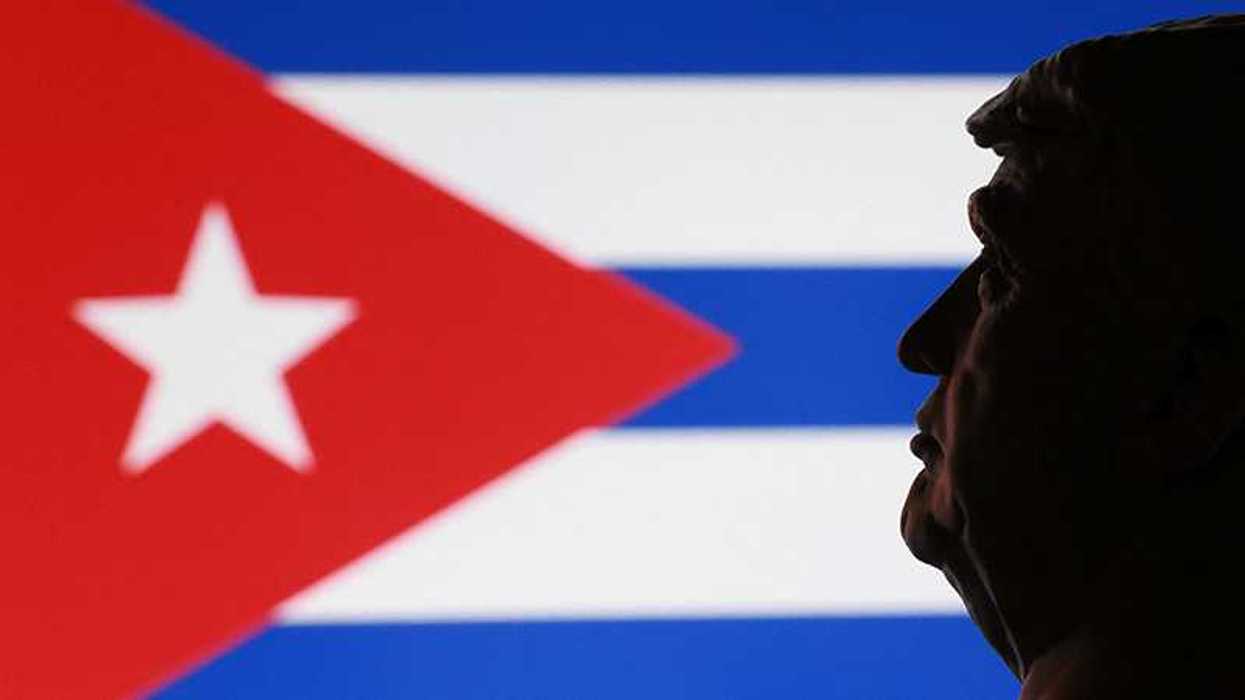
A 3D printed miniature of U.S. President Donald Trump and the Cuban flag are seen in this illustration taken January 9, 2026. REUTERS/Dado Ruvic/Illustration
Donald Trump's immigration crackdown has taken a "brutal" new turn, according to a report from The Guardian, with a once "privileged" group now facing threats of deportations.
As the outlet explained in its Friday report, Cuban immigrants "have traditionally enjoyed a privileged position" among the many different Latin American communities in the U.S., thanks in large part "to fast-track routes to residency and citizenship." Since the end of the Cuban Revolution in 1959 and the takeover of the island nation by Fidel Castro, roughly 2.9 million Cubans have immigrated to the U.S., with the largest wave coming in recent years due to a period of economic collapse.
"Nearly all" of the programs that fast-tracked the ability for Cubans to come to the U.S. have now closed under the second Trump administration. Even worse for some, a few Biden-era programs have been outright reversed, stripping legal status from some immigrants and making them targets for deportation.
The Guardian relayed the stories of a few Cubans caught up in Trump's crackdown. Heidy Sánchez, 43, was forcibly deported from her home in Florida in April and opted to leave behind her young daughter, 2, with her American husband, fearful of Cuba's failing healthcare system. Sánchez said that the child, her only one after years of struggling to conceive, was still breastfeeding. Another Cuban immigrant, Rosaly Estévez, 32, opted to self-deport in November, taking her son Dylan, an American citizen, with her.
“It’s been brutal,” Estévez told The Guardian. “Imagine Dylan hugging his phone every night when he sees his dad. I wouldn’t wish this on any mother.”
The Trump administration has recently begun to put pressure on Cuba, including by cutting off shipments of oil to the island. Some officials in the administration have suggested the Cuban government could be the next target for a military raid like the one that deposed Venezuela's Nicolás Maduro last month. Trump has claimed that these efforts are attempting to make the island safer for Cuban Americans to return to.
“A lot of people that live in our country are treated very badly by Cuba,” Trump said. “They all voted for me, and we want them to be treated well. We’d like to be able to have them go back to a home in their country, where they haven’t seen their family, their country for many, many decades.”
Experts, however, argued that many Cuban immigrants and their families are among the immigrants least likely to want to return home.
“Like many of the president’s statements on Cuba, it’s difficult to know exactly what he’s referring to,” Michael Bustamante, chair of Cuban and Cuban-American studies at the University of Miami, explained. “Cuban-Americans who left decades ago are perhaps among the least likely to want to return full-time to a future Cuba, though they could certainly play a role as investors in the future economy.
By AFP
February 6, 2026

Fuel sales will be restricted as part of the new measures announced on Friday - Copyright AFP YAMIL LAGE
The Cuban government on Friday announced emergency measures to address a crippling energy crisis worsened by US sanctions, including the adoption of a four-day work week for state-owned companies and fuel sale restrictions.
Deputy Prime Minister Oscar Perez-Oliva Fraga blamed Washington for the crisis, telling Cuban television the government would “implement a series of decisions, first and foremost to guarantee the vitality of our country and essential services, without giving up on development.”
“Fuel will be used to protect essential services for the population and indispensable economic activities,” he said.
Among the new measures are the reduction of the working week in state-owned companies to four days, from Monday to Thursday; restrictions on fuel sales; a reduction in bus and train services between provinces; and the closure of certain tourist establishments.
School days will also be made shorter and universities will reduce the requirement of in-person attendance.
These measures are intended to save fuel in order to promote “food and electricity production” and enable “the preservation of fundamental activities that generate foreign currency,” said Perez-Oliva Fraga.
The island of 9.6 million inhabitants, under US economic embargo since 1962, has been mired in a severe economic crisis for six years.
Washington has increased pressure on its communist government in recent weeks.
The United States cut off oil deliveries from Havana’s key ally Venezuela following its ouster of President Nicolas Maduro in early January.
US President Donald Trump also signed an executive order last week allowing his country to impose tariffs on countries selling oil to Havana.
Trump said that Mexico, which has been supplying Cuba with oil since 2023, would stop doing so — under threat of US tariffs.
The oil shortages have threatened to plunge Cuba into complete darkness, with power plants struggling to keep the lights on.
Washington has long sought to overthrow or weaken the communist-led Cuban government.
Havana accuses Trump of wanting to “strangle” the island’s economy, where power cuts and fuel shortages, already recurrent in recent years, have become even more acute.
This week, Cuban President Miguel Diaz-Canel said his country was willing to hold talks with the United States, but not under pressure.
He said any talks must take place “from a position of equals, with respect for our sovereignty, our independence and our self-determination” and without “interference in our internal affairs.”
By AFP
February 5, 2026

Cuban President Miguel Diaz-Canel addressed the nation on state TV
Cuba is prepared to hold dialogue with the United States but not under pressure, President Miguel Diaz-Canel insisted Thursday after months of threats from US President Donald Trump.
“Cuba is willing to engage in dialogue with the United States, a dialogue on any topic… but without pressure or preconditions,” Diaz-Canel said in an address to the nation on state TV and radio.
He said any talks must take place “from a position of equals, with respect for our sovereignty, our independence, and our self-determination” and without “interference in our internal affairs.”
Trump has made repeated threats against communist-run Cuba in recent months, vowing to cut off its access to oil and stating the island was “ready to fall.”
Cuba, in the grips of an economic crisis, had long relied on oil supplies from Venezuela, whose leader was ousted in a deadly US military operation last month.
Trump subsequently claimed to have taken control of Venezuelan oil, vowed to starve Cuba of the commodity, and threatened tariffs on any other nation stepping in to help US-sanctioned Havana.
The pressure tactics threaten to plunge Cuba into complete darkness as its power plants struggle to keep the lights on due to fuel shortages.
Earlier Thursday, hundreds of thousands of people in the country’s east were left without electricity for hours after an electricity grid failure.
Diaz-Canel insisted his country still had friends, which he did not name, as it confronts what he described as an “acute fuel shortage.”
“We cannot openly explain everything we are doing,” he said, but “Cuba is not alone.”
He said energy production from diesel- and oil-powered generators has been “zero” for weeks.
Mexico’s President Claudia Sheinbaum said this week that her country was using all available diplomatic channels to ensure a resumption of crude shipments to Cuba, but would not put itself at risk of punitive US tariffs.
Diaz-Canel said the pressure that Cuba found itself under highlighted the importance of its drive for greener energy and reducing reliance on others.
Cuban officials blame US sanctions for Cuba’s worst economic crisis in decades, marked by shortages of fuel, food and medicine.
But observers say poor economic management and a tourism collapse following the Covid-19 pandemic have contributed to the island’s woes.
Trump has repeatedly said Washington was in talks for “a deal” with Havana, which has denied any formal negotiations were under way.
Trump has not specified the nature of the agreement he has floated.
Stop Trump’s sanction suffocation of Cuba – Peace and Justice Project

By Cllr Claudia Turbet-Delof
The Cuban people know this means further suffocation of their nation, an assault to their fundamental human rights to food, health and education.
But Trump and Rubio -in their rotten colonial minds -cannot fathom that this affliction is quickly followed by the resilience and resistance of the Cuban people, the one they have learned and developed through decades of the punitive system the US has inflicted on them with impunity.
Yes, there are Cubans who are discontent with the state and how services like the collection of rubbish is being managed at the moment, for example. There are a great majority, however, who understand the reason for the current daily struggle and asphyxiation of their economy: the US embargo.
I have been speaking to many since arriving in Havana, my family, friends, organisations, people in the arts and culture, micro businesses and more.
The message is almost always overwhelmingly similar: ‘Seguimos en combate’.
This is the message of a revolutionary. The message of many women, mothers, fathers, workers, and young people who, despite struggling with imposed daily power outages (lasting from minutes to 6-10 hours long), have full conviction of their dignity and sovereignty and who unequivocally know it thanks to the US sanctions and refer to Trump as a Dictator.
Similar to us around the world, Cubans are up to date with information of all of the human rights abuses by Trump and Marco Rubio’s administration: Mass ICE deportations, support for Israel’s genocide of the Palestinian people, and, most recently, the invasion of Venezuela.
Cubans have told me they cannot comprehend how it is possible that so many human rights abuses can take place without the world being able to put a stop to it.
I have lost count of the number of people I’ve spoken to since arriving in Cuba, and I have found it humbling and moving to hear almost all of the people who’ve willingly chatted to me of how much they miss Fidel.
I’ve heard many tell me, almost in poetic form at times, how Fidel Castro never let the elderly without food, the sick without medicine, the young without milk.
The current daily struggle for Cubans is real; some say it’s nothing to do with the embargo, but a great majority understand it is a political choice by the United States to punish the Cuban people.
I have stayed on the island many times in the past two decades and have seen how the embargo has meant many products, stock and infrastructure have not made it to the island due to the barriers caused by these political sanctions.
Cubans, however, have learned to live and thrive despite the inhumane US embargo. As they say here, ‘el Cubano inventa’
This time, however, it is past an economic embargo. This is starvation en masse of an entire sovereign nation.
The current reduced oil, petrol and gas means most people wake up in homes without electricity, food rots with fridges without power, kitchen taps without running water, and a paralysed transport without fuel to transport workers, nurses, doctors and families to their places of work and study.
At present I see children who cannot have breakfast before going to school and elderly like our neighbour here in this Old Habana building who is a diabetic patient, who cannot eat on time, does not have timely access to medicine and is becoming ill by the levels of stress and uncertainty of when she will be able to prepare and cook her next meal.
I know this is a hard read, but it is the reality of what a fascist, colonial leadership like Trump’s and his government inflict on people. And we cannot stay silent.
Nor can we stay quiet to the threats Trump has made to those who show solidarity to the Cuban people.
Declaring Cuba as an ‘unusual and extraordinary threat’ is an insult to the Cuban people, their dignity and resilience.
Yes, Cuba poses a threat not the US or any other nation, but to the inhumane capitalist world that have witnessed that despite the US capitalist criminal decades long asphyxiation of their economy- Cuba has proven that it is possible to not need to submit to the US, live on your knees to the Yankee empire and still become world leaders for medicine, culture, arts, science, sports and many, many more.
I’ll soon be returning to the UK. I’m deeply concerned by what Trump can get away with in his pursuit of capitalist power, and how, shamelessly, fellow US Latinos Congress people, colonised in their minds, find their way to importance and relevance by supporting and becoming complicit to the barbarities committed against the Cuban people and our entire Latinoamérican region.
As an elected member for the London Borough of Hackney in the UK, I see every action we take from local to national and global issues as our best collective powers in the defence of the working class and peoples of the world. We must resist and reject imperialist forces, which are clearly becoming decadent in global value, given that the powerful few remain strong in impunity.
Join the Peace & Justice Project actions to support the Cuban people through official channels for donations, follow the Cuba Solidarity Campaign and remain alert to demand an end to the collective punishment of the Cuban people.
As Fidel said it himself: Muerte al invasor! Viva Cuba Libre!
- Claudia Turbet-Delof is a Hackney Independent Socialist Councillor in Hackney South and Shoreditch. You can follow her on Twitter/X here.
- You can follow Jeremy Corbyn’s Peace and Justice Project on Facebook, Instagram, Twitter/X, Bluesky and TikTok.
- This article was originally published by the Peace and Justice Project on 2 February 2026.
- If you support Labour Outlook’s work amplifying the voices of left movements and struggles here and internationally, please consider becoming a supporter on Patreon.


No comments:
Post a Comment