Friday, February 27, 2026

What's the real environmental and financial impact of artificial snow?
The Alps seen from the sky AP/Julia Demaree Nikhinson

By Alessio Dell'Anna 
Published on 

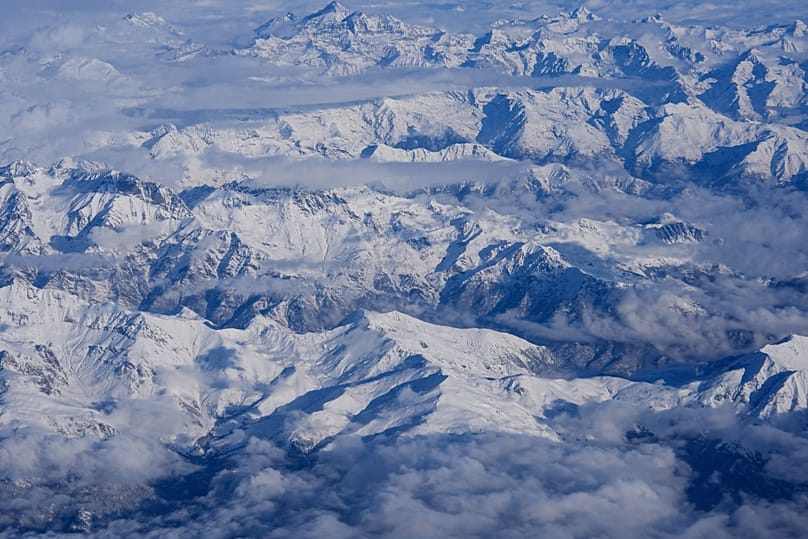
By the end of the century, all ski resorts across the Alps may be forced to use snow cannons, with dire consequences for local nature.

Could the 2026 Milano-Cortina Winter Olympics be the last held on natural snow?

The Games were widely hailed as a success, but also drew criticism for their heavy reliance on artificial snow: around 1.6 million cubic meters, according to the organisers.

That's roughly equivalent to around 640 Olympic-sized swimming pools.

Like it or not, rising winter temperatures could make artificial snow a non-negotiable necessity for future Winter Games — at least on the Alps.

Artificial snow keeps winter sports industry afloat

By the end of the century, snowfall across the mountain range, which spans eight countries, is predicted to decline by between 25% and 45%.

This is based on a joint study by King's College, the University of Oxford, and the University of Trento called "The snow must go on: Theorising the climate innovation conundrum in expiring industries".

Globally, the industry is projected to grow at an annual rate of 4.4% between 2025 and 2032. But researchers warn that by 2050, ski resorts below 1,200 metres may have to endure snow-free winters.

So far, the winter sports sector has seen off the threat and managed to stay in good health, also thanks to the use of artificial snow, much like the recent Winter Olympics.

According to the study, some 90% of Italy's ski resorts already rely on artificial snow, compared to 70% in Austria and 54% in Switzerland.

"Once seen as a temporary fix, technical snowmaking is now a structural necessity, enabling resorts to remain operational even in low-snow years," the study says. "The widespread adoption of snowmaking reflects the growing consensus that natural snowfall alone cannot sustain snow tourism."

One of the few exceptions in Italy is the ski resorts near the highest glaciers. For example, the Marmolada — at 3,343 metres — which is nonetheless projected to vanish by 2040.

What's the financial, energy and environmental cost of artificial snow?

The use of artificial snow may save winter holidays, but for the environment, it's a problem, scientists say.

Snow cannons need a massive amount of water to blanket the slopes with snow.

Covering just one hectare (or 0.01km²) with 30 centimetres of artificial snow requires around 1,000 cubic metres of water — roughly 20 backyard swimming pools.

The water is pumped from nearby rivers and lakes — draining local resources — or drawn from artificial basins, which is no less impactful, as it requires extensive land work.

By 2023, the industry created "142 such basins" in Italy alone, covering more than one million square metres.

On top of that, fake snow is also denser and harder. It melts more slowly, leading to soil compaction and delayed plant growth.
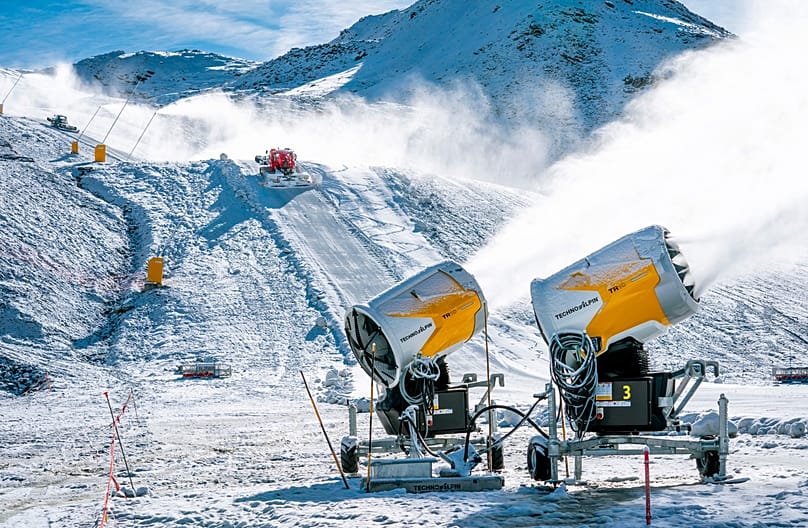
Snow cannons spray snow at the finish area of the new four-kilometre ski slope "Gran Becca", in Cervinia, Italy AP/Maxime Schmid

'Delaying a local problem while intensifying it globally'

Its carbon footprint is significant too: in Italy, for example, "electricity-related emissions from snow production alone amount to 24 kt CO₂ eq, projected to rise by 24% and 30% with +2°C and +4°C warming, respectively", according to the King's College, Oxford and Trento study.

Ultimately, the cost is not to be overlooked, ranging from €3.50 to €5 per cubic metre.

"Artificial snow making exemplifies the tension between short-term economic resilience and long-term environmental sustainability", tells Europe in Motion Juliane Reinecke, one of the study's authors.

"For resort managers, snowmaking is about survival. It is a rational and necessary adaptation to climate risk. But snowmaking raises long-term sustainability concerns: it is water- and energy-intensive and requires intensive snowmaking infrastructure".

"As temperatures rise, even more snow must be produced until even that may no longer be sufficient to guarantee season-long snow cover."

"Firms are incentivised to prioritise operational continuity and short-term resilience. Societies, by contrast, have to worry about long-term decarbonization and ecological limits. When adaptation technologies are energy- and resource-intensive, they may solve (or delay) one problem locally while intensifying it globally. That is the paradox we are trying to highlight".

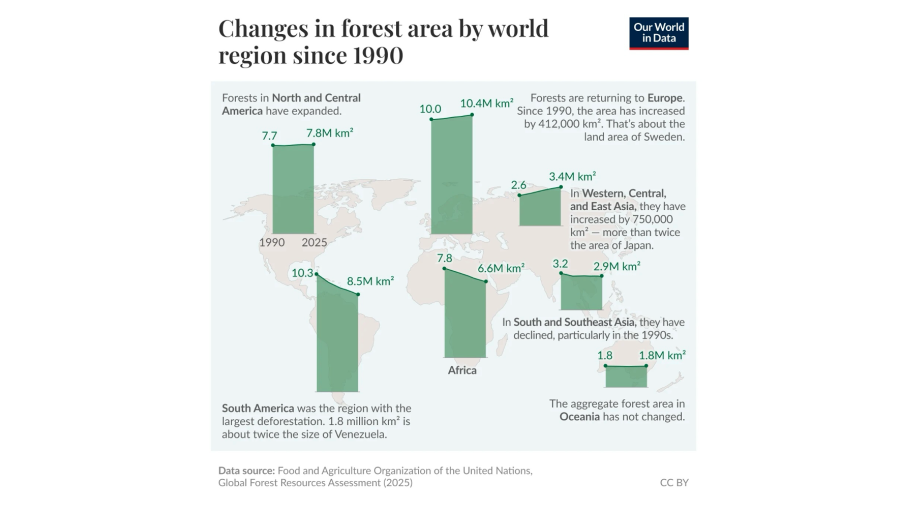
Global deforestation slows but losses persist in South America and Africa - OWID

Global deforestation slows but losses persist in South America and Africa - OWID
Since 1990, global forest trends have diverged, with continued losses in South America and Africa offset by expanding forest cover in Europe, North America and parts of Asia. / bne IntelliNews
By bne IntelliNews February 27, 2026

In the past, forests around the world were cut down on a massive scale. We lost some of the world’s richest ecosystems, Our World in Data  (OWID) reports.

In recent decades, the picture has become more complex. Deforestation has not ended, but it is no longer happening everywhere. Since 1990, some regions have continued to lose large areas of forest, while others have slowed this long-run trend — and even reversed it.

The map shows regional changes in forest area based on the latest data from the Food and Agriculture Organization of the United Nations.

Deforestation has been particularly large in South America and Africa. At the same time, the forested area has expanded in Europe, North and Central America, and large parts of Asia.

These gains show that deforestation is not inevitable. When pressure on land falls, forests can return.

I previously wrote about why deforestation is happening, and what we can do to bring the long history of deforestation to an end.


LATAM BLOG: Mexico's rise to the top of US trade exposes the stakes of Trump's USMCA gamble

LATAM BLOG: Mexico's rise to the top of US trade exposes the stakes of Trump's USMCA gamble
Integration between Mexico and the US runs much deeper than trade statistics capture. / unsplash
By bnl editorial staff February 26, 2026

For at least 34 years, Canada held an unbroken grip on the top spot in US trade. In 2025, Mexico ended it, and the timing could hardly be more consequential.

According to reports from Bloomberg and Forbes, Mexico finished 2025 as the leading destination for US merchandise exports, the largest source of US imports and, by extension, the dominant overall US trade partner  a clean sweep no country has achieved since Canada managed it in 2006. It accounted for 15.6% of total US two-way goods trade, more than double China's 7.4%, in a transformation that has unfolded remarkably quickly. Five years ago, as USMCA was being implemented, China led all US trading partners with nearly 15% of total trade. Today, the Asian superpower ranks third.

The numbers alone tell only part of the story. The top US exports to Mexico  refined petroleum, motor vehicle parts, computer components, computers and semiconductors  reflect an industrial relationship built around shared supply chains under the nearshoring model rather than simply consumer demand. On the import side, four of the five biggest categories are tied to the North American automotive industry. Mexico is not so much a trading partner as a production partner.

Yet the relationship faces its most fraught political test in years. US President Donald Trump has reportedly asked aides why he should not withdraw from USMCA, the trade agreement he championed in 2020, ahead of the treaty's mandatory six-year review deadline of July 1. He could technically do so with six months' notice. Bloomberg columnist Juan Pablo Spinetto argues this would amount to a self-inflicted wound: abandoning USMCA would disrupt supply chains, threaten American manufacturing jobs, push up import prices on everything from cars to avocados and trigger backlash from the US Chamber of Commerce and bipartisan Congressional supporters of the pact.

The peso barely moved after reports of Trump's deliberations emerged, suggesting investors assign low probability to a full withdrawal. But the uncertainty itself carries costs, potentially dampening investment flows into Mexico and prolonging the kind of instability that has already weighed on the country's 0.8% GDP growth in 2025.

Integration between the two countries runs much deeper than trade statistics capture. Mexicans living in the US send home more than $60bn per year in remittances. Mexico is the top foreign destination for American tourists. In New Mexico, California and Texas, Latinos are now the largest population group. In parallel, a growing wave of American expats relocating to Mexico is reshaping neighbourhoods from Baja California to Mexico City.

The strategic logic, Spinetto argues, is difficult to escape. If Washington is serious about decoupling from China, reindustrialising its economy and securing critical supply chains, Mexico is not the obstacle, but rather a central part of the solution. Mexico's share of US trade has more than doubled relative to China's in five years, driven not by political goodwill but by geography, manufacturing integration and demographic reality. Those are not conditions that dissolve overnight when a trade agreement is threatened.

Whether that case gets made clearly in the White House, or gets lost in the noise of erratic tariff threats and negotiating posture, may be the defining question of the USMCA review.

Panama seizes control of strategic ports from Hong Kong’s Hutchison

Panama seizes control of strategic ports from Hong Kong’s Hutchison
The dispute has acquired overt geopolitical dimensions. US President Donald Trump has repeatedly alleged Chinese influence over canal-adjacent infrastructure and threatened to “take back” the waterway upon returning to office. / xinhua
By Alek Buttermann February 25, 2026

Panama’s decision to assume control of the Balboa and Cristóbal container terminals marks a structural rupture in the governance of infrastructure that underpins roughly 5% of global maritime trade and about 40% of US container traffic.

The measure, executed following a Supreme Court ruling that declared unconstitutional the concession held by a subsidiary of Hong Kong-based CK Hutchison Holdings, has triggered legal threats, diplomatic protests and operational disruption, while opening a broader debate over legal certainty in one of the world’s most strategic logistics corridors.

The legal trigger was a January ruling by Panama’s Supreme Court annulling the concession contract under which Panama Ports Company had operated the Pacific terminal at Balboa and the Atlantic terminal at Cristóbal since 1997. Publication of the ruling in the official gazette on February 23 rendered the decision final. 

Within hours, the Panama Maritime Authority occupied the facilities under Executive Decree No. 23 of February 23 2026, invoking “urgent social interest” grounds to ensure continuity of service. The decree authorised temporary occupation of movable assets, including cranes, vehicles, software and information systems, while explicitly stating that no transfer of ownership was implied.

President José Raúl Mulino framed the measure as an administrative tool rather than expropriation. In a televised address cited by multiple outlets, he insisted that the state was merely using assets to guarantee uninterrupted operations until their value could be determined for subsequent actions. The distinction is constitutionally relevant: expropriation entails permanent transfer of title and compensation; temporary occupation maintains ownership while the state assumes operational control.

Despite official assurances, the transition exposed immediate operational fragilities. The Panama Maritime Authority disabled internet systems at both ports to allow incoming operators to install their own software platforms and to mitigate cyber risks. As a consequence, the terminals were unable to operate at full capacity on February 24. 

At Balboa, export and empty containers resumed reception between 07:00 and 22:00, but import containers were not being delivered. Refrigerated cargo remained connected to power supplies under monitoring to protect perishable goods. At Cristóbal, gates were temporarily closed, halting container ingress and egress.

Government officials, including Canal Affairs Minister José Ramón Icaza, argued that vessel movements had not been materially affected. He noted that two ships had departed Balboa prior to publication of the ruling and that Cristóbal faced an eleven-day window without scheduled container berthing. 

Nonetheless, exporters reported difficulty retrieving empty containers, and industry representatives warned that even short-term frictions could affect routes dedicated exclusively to Balboa, particularly for perishables.

To prevent paralysis, the Cabinet authorised transitional concessions worth $41.9mn. The Comptroller General endorsed Contract No. A-2002-26 with APMT Panamá, S.A. for $26.1mn to operate Balboa, and Contract No. A-2003-26 with TIL Panamá, S.A. for $15.8mn to manage Cristóbal, both for up to eighteen months. 

APMT Panamá is affiliated with A.P. Moller - Maersk, while TIL Panamá is linked to Mediterranean Shipping Company. Under the published terms, operators will pay a fixed annual canon of $7.5mn plus variable payments after deducting recoverable costs, alongside fees of 13.20 dollars per container movement and 6.60 dollars per vehicle discharged outside containers.

The Ministry of Economy and Finance projects that, over eighteen months, state revenues could reach up to $100mn, several times higher than returns generated under the annulled concession. Officials cite a Comptroller’s audit indicating that over 29 years the state received $483mn, allegedly resulting in foregone revenues of $853mn. 

Conversely, the company has initiated arbitration exceeding $1.5bn, a figure the minister characterised as detached from financial reality. Legal representation is being assembled, with notification deadlines in early March and proceedings potentially lasting years.

From the corporate perspective, the events constitute unlawful termination. Panama Ports Company stated that authorities entered the terminals and assumed administrative and operational control without coordination. CK Hutchison Holdings described the takeover as illegal and warned of risks to operational safety. 

Reuters reported that employees were threatened with criminal prosecution should they refuse to vacate facilities and were instructed not to contact the parent company. The conglomerate signalled possible recourse under investment protection treaties and before the International Chamber of Commerce, and it has not excluded action against third parties, including APM Terminals.

The dispute has acquired overt geopolitical dimensions. US President Donald Trump has repeatedly alleged Chinese influence over canal-adjacent infrastructure and threatened to “take back” the canal upon returning to office. Panama has consistently denied any Chinese control. Following the court ruling, Hong Kong authorities lodged a “stern protest”, while China’s Foreign Ministry spokesperson Mao Ning declared that Beijing would firmly defend the legitimate rights and interests of its enterprises. 

Bloomberg reported earlier this month that Chinese authorities had asked state-owned firms to suspend new project talks with Panama and consider alternative shipping routes, as well as intensifying customs inspections on certain Panamanian goods. 

Finance Minister Felipe Chapman stated on February 25 that Panama had received no official Chinese reaction and that Chinese participation in foreign direct investment and banking deposits remained relatively low compared with investors from the Americas and Europe.

Domestic political scrutiny has paralleled international reaction. Former president Martín Torrijos criticised what he termed an “unnecessary geopolitical dispute” and questioned the transparency of the transition, even while acknowledging that the outgoing concessionaire had not been an effective partner. He warned that terminating concessions without clear explanation could set precedents affecting institutional credibility. 

Labour considerations are similarly central: more than 1,200 workers are directly employed at the two terminals. Authorities reported over 526 employer substitutions at Balboa and more than 326 at Cristóbal within 24 hours, with agreements reached with two of four unions. Legislator Eduardo Gaitán argued that if transitional operators do not assume accrued benefits, the state must compel the former concessionaire to settle outstanding entitlements.

Sectoral analysts emphasise reputational risk. Jorge Barnett of Georgia Tech Panamá underlined that the country’s logistics brand rests on uninterrupted service, while business leaders stressed that a port operating below 100% capacity erodes confidence irrespective of legal justifications. Angel Sánchez Chiapeto of the National Logistics Business Council warned that “a ship at berth generates no freight”, highlighting the cost of even temporary inefficiencies.

In aggregate, the episode intertwines constitutional adjudication, emergency administrative action, commercial renegotiation and great-power rivalry. Panama seeks to demonstrate that judicial independence and executive enforcement can coexist with operational continuity. Whether the combination of temporary occupation, enhanced fiscal returns and international arbitration will consolidate or weaken legal certainty depends on the state’s ability to sustain uninterrupted service while defending its position in protracted legal forums.

India’s Modi addresses Israeli Parliament, deal negotiations ongoing


India’s Modi addresses Israeli Parliament, deal negotiations ongoing
PM Modi in Israel / Narendra Modi - PM of India - X
By bno Chennai Office February 26, 2026

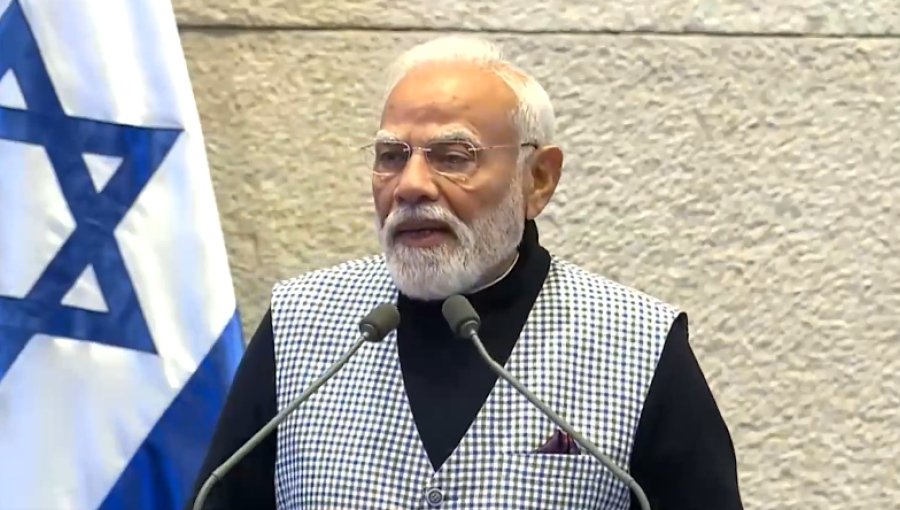
On the first day of his two day visit to Israel Indian Prime Minister Narendra Modi addressed the Israeli parliament, the Knesset in Jerusalem, according to a report by All India Radio.

During the address Modi condoled the loss of life and terrorism perpetrated by the terrorist group Hamas on October 7 2023 in Israel. He drew parallels to India’s own experience of being attacked by terrorists during the November 26 2008 attacks in Mumbai which led to the death of 160 people including civilians, law enforcement and security forces and armed forces personnel.

Some of the civilians killed during the Mumbai attack were also Jewish and Israeli nationals. India subsequently established that the Mumbai attacks were perpetrated by terrorist groups backed, funded and operationally overseen by Pakistan’s military and intelligence agencies.

Modi also revealed that his exact day of birth coincided with the day India officially recognised the state of Israel on September 17 1950.

According to a report by The Times of India, Modi was also honoured with the Speaker of the Knesset Medal and became its first awardee.

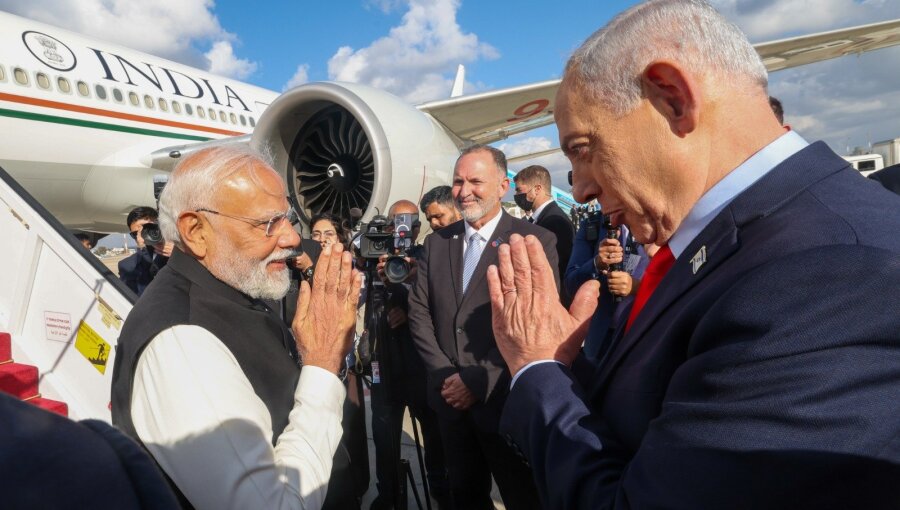
Preceding the address to the Israeli parliament the Indian leader was received at the airport by Israeli Prime Minister Benjamin Netanyahu and his spouse. Modi also had a meeting and conversation with Netanyahu and later visited a technology and innovation exhibition with him, with both Israeli and Indian products featured.

The visit to the exhibition included visuals of Modi and Netanyahu posing with a Royal Enfield Motorcycle - the product of a world recognised Indian motorcycle brand Eicher Motors (NSE: EICHERMOT).

While Modi has been in Israel, a delegation of Israeli officials is purportedly negotiating the specifics of a Free Trade Agreement with the Indian side in New Delhi, in parallel according to another report by All India Radio.

An agreement will be a headline maker when confirmed, and may sit beside a list of agreements and memoranda signed between Tel Aviv and New Delhi as Modi’s visit concludes. Defence is also a major pillar of the visit and diplomatic engagement that is underway between India and Israel.

While specific and confirmed cues are not forthcoming from either the Israeli defence establishment or its Indian counterpart. It is likely that India is seeking components for its future nationwide air defence shield dubbed the “Sudarshan Chakra” programme which is conceived to be a multi stage and multi layer system with several components of different origin, range and role.

Possible acquisitions could include jointly developed versions of air defence and precision strike weapons and platforms such as ballistic missile interception capable air defence systems IAI industries’s Arrow and Rafael Advanced Defense Systems’s David’s Sling and shorter ranged Elbit systems’s (TASE:ESLT, NASDAQ:ESLT) Iron Dome and Iron Beam.

Unmanned Aerial Vehicles(UAV)s may also be explored as Israel and IAI industries has been a traditional vendor to India’s military for UAVs which India has successfully used in combat operations. However none of these deals or likelihood of these systems being under discussion has been referred to by any official sources.

Be it coincidental or by design, India has also been negotiating an FTA with the Gulf Cooperation Council (GCC) which can be seen as a hedge strategy for the broader West Asia region in India’s complex foreign policy web.

India has always taken a neutral stance on the Arab-Israeli conflict and has advocated for a peaceful resolution of all conflicts in the region through dialogue and diplomacy as it has strategic ties to both Israel and Arab states that affect its own national interest directly across defence, food, mobility, diaspora and energy security.

India and Israel sign new pacts but FTA negotiations to continue

India and Israel sign new pacts but FTA negotiations to continue
/ Narendra Modi - PM of India - X
By bno Chennai Office February 26, 2026

Indian Prime Minister Narendra Modi ended the second and final of his state visit to Israel on February 26, 2026, according to a report by All India Radio.

During his visit a delegation of Israeli officials was in New Delhi negotiating a Free Trade Agreement (FTA) in parallel with their Indian counterparts headed by India’s Minister of Commerce and Industry Piyush Goyal.

The round of FTA negotiations were positive but didn’t conclude with the agreement as was widely expected, and instead a second round of negotiations has been scheduled for May 2026. It is unclear what issues or obstructions remain in concluding the agreement, or if the issues are regulatory or legislative that need to be resolved first before any preferential trade access to either side can be granted by the other.

According to the official website of the Indian prime minister, Modi delivered a joint statement to the press alongside Israeli Prime Minister Benjamin Netanyahu, continuing his comments on terrorism being unacceptable in any form, expressions and manifestations including cross border terrorism which was unequivocally supported by the Israeli side.

The summit’s official outcomes have been listed as 16 agreements across domains such as emerging technologies, cyber, agriculture, water management, health, entrepreneurship, mobility, defence and security. One of these agreements is an MoU between India’s NPCI International (NIPL) and Israel’s MASAV on implementation of India’s Unified Payments Interface (UPI) digital payments system in Israel.

Modi made a reference to being informed that the agreement will now lead the way in enabling UPI to be functional in Israel. The goal behind the agreement is to enable seamless remittances between Israeli and Indian nationals, companies and entities via an instant and well regulated digital mechanism.

UPI is a fully sovereign technology as part of India’s digital public infrastructure and doesn’t rely on any third party services like SWIFT. While SWIFT is the ubiquitous standard for cross border digital payments, the exclusion of Russian financial institutions from it after the 2022 invasion of Ukraine has established a precedent.

States with a high sense of sovereign fiscal patterns in international trade seek to develop or adopt alternatives which can’t be cut off depending on the political and alignment calculations of third parties at any time.

While defence agreements were also expected as the two countries have a burgeoning security relationship and shared cross border threats, nothing substantive on the procurement of new platforms or systems was announced during or in conjunction to the visit.


Cuba vows to defend sovereignty after deadly speedboat clash raises US tensions

Cuba vows to defend sovereignty after deadly speedboat clash raises US tensions
Deadly exchanges between Cuban security forces and vessels arriving from Florida are rare, though the Florida Straits have long been a corridor for people-smuggling and drug-running operations that have occasionally drawn gunfire.
By bnl editorial staff February 26, 2026

Cuba has vowed to counter any further armed incursions after its border guards shot dead four people and wounded six others aboard a Florida-registered speedboat whose occupants opened fire on a patrol vessel off the country's northern coastline, an episode that threatens to deepen the already strained relationship between Havana and Washington.

The confrontation took place on February 25 morning after a Cuban border guard patrol boat with five crew members on board moved to intercept the vessel, registered in Florida as FL7726SH, spotted approximately one nautical mile north-east of the El Pino channel near Villa Clara province. Cuba's interior ministry said the speedboat's occupants fired on the patrol boat as it approached, wounding its commander, and that Cuban forces responded in kind.

All ten people aboard were Cuban nationals resident in the United States, according to the ministry. The six survivors were wounded, detained and taken to Cuban medical facilities for treatment. Separately, a person dispatched from the US to participate in the operation was apprehended on Cuban territory, the ministry added.

Cuban President Miguel Díaz-Canel on February 26 said his country "does not attack or threaten" but declared that "Cuba will defend itself with determination and firmness against any terrorist or mercenary aggression that seeks to undermine its sovereignty and national stability." Foreign Minister Bruno Rodríguez said authorities were working to establish the full facts and described coastal defence as "an inescapable duty."

Following a search of the vessel, the ministry said authorities recovered an arsenal including automatic weapons, pistols, improvised explosive devices, body armour, optical scopes and military-style clothing. The government named seven of the ten passengers. Two of them, Amijail Sánchez González and Leordan Enrique Cruz Gómez, now face Cuban terrorism-related charges.

US Secretary of State Marco Rubio, himself a Cuban-American, said Washington played no part in the incident and called it "highly unusual, it's not something that happens every day." He said the administration was assembling its own account of events, including establishing whether those involved held US citizenship or permanent residency. Florida's attorney-general ordered a separate inquiry, while the US Attorney's Office for the Southern District of Florida said the facts remained "unclear and conflicting."

Moscow, a long-time ally of the communist regime, sided with Havana. Kremlin spokesman Dmitry Peskov said Cuban border guards "did what they had to do in that situation" and urged all parties to exercise restraint around the island. Russian foreign ministry spokeswoman Maria Zakharova went further, denouncing the incident as "an aggressive provocation by the United States" aimed at escalating tensions, a claim Washington has not addressed.

The clash lands at a moment of acute pressure on Cuba. Since January, Venezuelan oil deliveries, which had covered roughly half the island's energy needs, have been disrupted following the US military intervention that captured Nicolas Maduro. On January 29, the Trump administration issued a directive imposing duties on any nation supplying crude to the island, compounding a fuel crisis that has forced Havana to implement severe energy rationing.

The US Treasury Department moved on February 25 to permit limited Venezuelan oil sales to Cuba through private channels, though analysts said the measure fell well short of what the island, which relies on crude to generate over 80% of its electricity, required. According to AP, William LeoGrande, a Cuba specialist at American University in Washington, warned that the Trump administration might "use this incident as some kind of an excuse to come up with even more sanctions." He added, however, that if the Cuban government publicly displayed the seized weapons and allowed detainees to speak about their intentions, that "might put the issue to rest."

Deadly exchanges between Cuban security forces and vessels arriving from Florida are rare, though the Florida Straits have long been a corridor for people-smuggling and drug-running operations that have occasionally drawn gunfire. Cuba's foreign minister said the island had faced what he described as "numerous terrorist and aggressive infiltrations" from American territory since 1959, at great cost in lives and material damage, a lineage that stretches back to the CIA-backed Bay of Pigs invasion of 1961.