Friday, February 27, 2026


Podcast: How activism is helping Ukrainians endure four years of full-scale war


By Méabh Mc Mahon & Alice Carnevali
Published on  

A meeting in Kyiv marking the anniversary of Russia’s full-scale invasion of Ukraine, Hungary’s vetoes on financial aid to Ukraine, and the resilience of Ukrainians: after four years of conflict, the end of the war seems nowhere in sight.

There are moments in life that are hard to forget and remain etched in the collective memory of those who witnessed them: a natural disaster affecting our hometown, a terrorist attack in our country or the outbreak of a full-scale war.

“You can ask every Ukrainian — no matter where they were, in Ukraine or abroad — and they will remember moment by moment where they were and what they were doing the moment Russia started its full-scale invasion,” Euronews’ correspondent Sasha Vakulina told Brussels, My Love?.

Together with Marta Barandiy, founding president of Promote Ukraine and Katharina Emschermann, head of programme EU and international politics at Heinrich-Böll-Stiftung, Euronews' correspondent joined this week’s episode of the podcast to discuss the fourth anniversary of Russia’s war on Ukraine.

How are Ukrainians coping? Is the EU doing enough to support them?

Apple podcast Spotify podcast Castbox podcast

The morale in Ukraine

Marta Barandiy founded her non-profit organisation Promote Ukraine in 2014, the year Russia annexed Ukraine's peninsula of Crimea. “The war started in 2014, let’s not forget that, the full-scale invasion started in 2022,” Barandiy said.

Over the years of Barandiy’s activism in Brussels, she witnessed how slowly things were moving toward providing support and maintaining attention to Ukraine. “I sort of imagined that (the war) could last so long,” she said.

Barandiy explained that Ukrainians are resisting by creating communities of veterans, of families of abducted children and abducted prisoners of war: “The whole of Ukraine is living in activism in order to help each other to cope with the situation and to not lose.”

The EU's role

On Tuesday, European Commission chief Ursula von der Leyen, European Council President António Costa and some European leaders went to Kyiv to show their support for the country on the day of the anniversary of Russia’s full-scale invasion.

The meeting, however, came just one day after Hungary vetoed both a new package of sanctions against Russia and a €90 billion loan to Ukraine. “That undercut the message that European leaders wanted to send,” Emschermann said.

According to the expert, Hungary’s veto puts the EU before a broad question about how it makes decisions on security challenges, its efficiency, and its unity.

The loan had, in fact, been approved in December 2025 at the European Council after long negotiations among 27 heads of state and governments.

Also according to Vakulina, Hungary’s last-minute veto and the meeting in Kyiv are very representative of the EU challenges.

“The EU has done a lot,” she said, commenting on Brussels’ involvement in Ukraine.

“Even the EU itself wishes it could do more, but there are some hurdles, political issues, nuances, vetoes on some occasions, which is very frustrating not only for Ukraine but for the EU,” she said.

Listen to the podcast in the player above or wherever you get your podcasts.

Get in touch with us by writing to brusselsmylove@euronews.com.


‘It’s Not A War Crime If It Was Fun’: Three


Years Of Gory Messages By A Russian


General – Analysis


Major General Roman Demurchiev has served as commander of the 42nd Guards Motor Rifle Division, fighting in Ukraine. Photo Credit: RFE/RL


February 27, 2026
RFE RL
By Yelizaveta Surnacheva, Valeriya Yegoshyna, Kira Tolstyakova, Schemes and Systema


On October 18, 2022, roughly eight months after Russia launched its all-out war on Ukraine, a high-ranking Russian officer texted several messages to his wife, and several acquaintances, back home in Russia.

The officer, then-Colonel Roman Demurchiev, commander of the 42nd Guards Motor Rifle Division, bragged about how his soldiers had just stormed a “strongpoint” in Ukraine, and had captured four prisoners-of-war.

In a message to his wife, Aleksandra, he sent a photograph that appeared to be several human ears, blackened and hanging from a metal pipe.

“What do you do with them afterward?” Aleksandra wrote.

“I’ll make a garland and give it as a gift,” Demurchiev, who was promoted to major general the following year, responded.

“Like pig ears for beer,” she wrote.

“Yeah,” he replied.

The gory banter, and evidence of possible war crimes by a senior Russian military officer, are among the revelations contained in three years of communications — text and audio messages, photographs, videos — purportedly sent and received by Demurchiev.

The materials — dozens of messages and other related materials — were provided to reporters from Schemes, the investigative unit of RFE/RL’s Ukrainian Service , by a person serving in the Ukrainian military. RFE/RL agreed not to disclose the person’s identity or how they obtained the files.

Schemes verified the authenticity of the communications, working with forensics laboratories in the United States and data researchers in Germany.

RFE/RL reporters also corroborated many of the dates and events listed in the data using details provided by soldiers from Ukraine’s Third Army Corps, whose units fought, and continue to fight, against soldiers under Demurchiev’s command.

Contacted by RFE/RL by phone, Demurchiev, 49, hung up upon being asked about the treatment of prisoners of war.

The Russian Defense Ministry did not respond to RFE/RL’s emails regarding its policies on treatment of prisoners of war.
‘You Didn’t Touch The Ears?’

Throughout Russia’s war on Ukraine, which hits its fourth anniversary on February 24, there have been widespread allegations of, and ample evidence pointing to, war crimes being committed by Russian units.

Among the best-known examples was from Bucha, a town north of the Ukrainian capital, Kyiv, that was occupied by Russian forces for just over a month.

After the Russian troops withdrew, residents discovered dozens of dead bodies, overwhelmingly civilians that appeared to have been summarily executed, or tortured, with corpses lying on streets or piled in basements.

With the help of military records left behind in Bucha and cross-referenced with social media profiles, RFE/RL identified several members of the one particular unit — the 234th Pskov Regiment — that was directly involved in the killings of civilians.

In the correspondence obtained by RFE/RL, the conversation about the mutilated ears began when Demurchiev wrote to another army officer who was a longtime acquaintance: Major General Igor Timofeev, the first deputy commander of the 36th Army.


“You didn’t touch the ears? Like when we were kids?” Timofeev replied in response.

It’s unclear exactly what Timofeev was referring to.

However, both he and Demurchiev fought in Chechnya in the 2000s, during the conflict that ravaged the Russian region.

Demurchiev then started a separate chat on the same subject with his wife, Aleksandra. In one of her responses, she also appeared to refer to Chechnya when reacting to the ear photo:

“I thought those were tales from Chechnya times,” she wrote. “Turns out it’s true.”

Aleksandra could not be reached for comment.

Russian forces have been accused of amputating ears of prisoners in the past.

During the First Chechen War, in the 1990s, journalists and human rights activists documented multiple reports of reported mutilations by Russian troops. In 2000-2001, during the second conflict in the region, Human Rights Watch and the Russian rights group Memorial described bodies with severe mutilations, including scalping, broken limbs, and cut-off fingers and ears.

Russian media have described similar practices by Chechen fighters.

In 2022, Schemes obtained another series of recordings of calls from Russian soldiers, intercepted by Ukrainian intelligence. In one, a soldier could be heard saying of a prisoner: “He wouldn’t talk. They cut off his ear.”

Demurchiev mentioned amputating ears again in late 2024 in a voice message sent to a contact identified as Valery Nepop.

RFE/RL was able to determine that Nepop was likely an officer with the Federal Security Service, Russia’s main domestic intelligence agency.

“You’re the boss of a super organization, that’s my dream,” Demurchiev can be heard saying. “Damn, and you even cut off the ears. But at our age they don’t do that anymore; we just give out the orders.”
Of Mice And Generals

Some of the materials sent or received by Demurchiev showcased dark, juvenile, and often sadistic humor among his colleagues or acquaintances, many of whom are Russian officers.

In one received by Demurchiev in December 2023, a live mouse is shown tied up by its legs — spread-eagled, as if it were being crucified — as a Russian voice pretends to interrogate the mouse, offering it a cigarette.

Demurchiev replied with a smiley-face emoji to the video, sent by Lieutenant General Mikhail Kosobokov, commander of the 49th Combined Arms Army.


In a separate message sent to Kosobokov, Demurchiev sent a Russian language meme that said: “It’s not a war crime if it was fun.”

In another series of messages with a person who appeared to be a military intelligence officer attached to the FSB named Roman, Demurchiev asked Roman what to do about a Ukrainian prisoner in his custody.

“I’ve got one prisoner… I can gift him to you,” he wrote in the October 2023 messages. “He’s sitting in a pit… What should I do with him — dispose of him or give him to you?”

“We didn’t have time to torture him, so the info was friendly,” Demurchiev wrote. “But you’ve got plenty of time — you can use tools that make people tell the truth.”

RFE/RL identified the prisoner in question: a 42-year-old man from the southern city of Zaporizhzhya who spent nearly two years in Russian captivity, including a facility in Altai, a Russian region far from Ukraine.

In the summer 2025, the man was returned to Ukraine, as part of a prisoner exchange.

RFE/RL reporters contacted the soldier via relatives. The man declined to speak in detail, saying he was in poor physical and mental health. He only said that he had been severely beaten and subjected to electric shock.
‘Are They Dismembering Them?’

Other messages exchanged by Demurchiev point to his possible complicity not only in blatant war crimes — but also possibly outright murder.

In December 2024, Demurchiev received a video message that appears to have been taken by drone, using a thermal imaging camera. A voice speaking in Russian off-camera asks: “Are they dismembering them?”

Yeah, with a shovel,” another voice responds.

“Are they ours?” the first voice says, asking if the people wielding the shovels are Russian soldiers.

Yeah,” the second voice replies.

Holy shit!” the first exclaims.

Other messages sent by Demurchiev explain that the soldiers shown in the video were former prison inmate and that they had hacked three surrendering Ukrainians to death using sapper shovels.

“Well, I reported this to you. Two of the cons made it into the stronghold. There were three Ukrainians,” he wrote to his commanding officer, General Oleg Mityaev, using a derisive insult to describe them. “They took them prisoner and then chopped them up with shovels. Shit. Beasts. But look, shit, they executed them with sapper shovels. Shit.”


RFE/RL identified the Ukrainian military unit whose soldiers were taken prisoner and then killed by Russian troops. The unit said the incident occurred in eastern Ukraine. The unit also asked RFE/RL not to disclose its identity or the names of the deceased, saying that could traumatize relatives or survivors.

Intelligence data provided by the unit identified the former prison inmates who were mentioned by Demurchiev in the video: members of the “Black Mamba” unit of the 252nd Motorized Rifle Regiment, part of the Third Division of Russia’s 20th Combined Arms Army.

In later correspondence, Demurchiev reported the details of the incident to Mityaev, who commanded the Russia’s 20th Army. Mityaev responded with praise.

“The ‘cons’ who took that location and chopped them up with shovels, God willing they’ll survive,” he said. “They should definitely be nominated for an award. Keep pushing, little by little. Well done…Good job, keep pushing, keep pushing, crush the bastards,
 shit.”


Yelizaveta Surnacheva is journalist for Systema, RFE/RL’s Russian Investigative Unit. Focused on political and social issues, she previously worked as an editor for the Russian investigative outlet Proyekt and BBC News.

Valeriya Yegoshyna is a journalist for Schemes (Skhemy), an investigative news project run by RFE/RL’s Ukrainian Service. Yehoshyna is the 2024 winner of the ICFJ Knight International Journalism Award. She was recognized as one of the “Top 30 Under 30” by the Kyiv Post in 2019 and has won a number of other awards, including the top prizes at the V. Serhienko Investigative Journalism Competition in 2017 and the Mezhyhirya Festival in 2018. An investigation she co-authored in 2023 about Izyum and the Russian invasion of Ukraine received a Special Certificate of Excellence at the Global Shining Light Awards from the Global Investigative Journalism Network.

Kira Tolstyakova is an editor for Schemes, the investigative unit of RFE/RL’s Ukrainian Service.
Schemes (Skhemy) is the award-winning investigative project of RFE/RL’s Ukrainian Service. Launched in 2014, it has exposed high-level corruption and abuse of power for over a decade. Following Russia’s full-scale invasion in February 2022, the project expanded to uncovering Russian war crimes.

Systema is RFE/RL’s Russian-language investigative unit, launched in 2023. The team conducts in-depth investigative journalism, producing high-profile reports and videos in Russian.


An Archive of material relating to Nestor Makhno and the Makhnovshchina.

Makhno was a Ukrainian anarchist revolutionary and the commander of an independent anarchist army in Ukraine from 1917–21.

English: Organizational Platform of the General Union of Anarchists (Draft), Nestor Makhno and others of the Group of Russian Anarchists Abroad (the "Delo ...


Could glacier melt slow climate change? Scientists thought so – until now

Sampling rosette with gray sampling bottles at left, the ship’s rail at lower right, and the face of the ice shelf in the background.
Copyright Robert Sherrell

By Liam Gilliver
Published on 


Iron fertilisation has long been touted as a glimmer of hope amid rising emissions – but a new study has seemingly debunked the theory.

A “long-standing silver lining” to the wrath of climate change has been put under scrutiny, as scientists find a huge flaw in the theory.

As heat-trapping emissions continue to bake the planet, glaciers in Antarctica are witnessing unprecedented melt. Despite being geographically isolated from civilisation, the demise of these vast bodies of ice has a significant impact on the entire world.

Thwaits Glacier, aka the Doomsday Glacier, is already responsible for four per cent of global annual sea level rise. If it were to collapse completely, sea levels could increase by a staggering 65cm.

To put this into context, scientists predict that for every centimetre of sea level rise, around six million people are exposed to coastal flooding.

But down in the elusive Southern Ocean, the theory of iron fertilisation offered a glimmer of hope.

What is iron fertilisation?

As temperatures rise and glaciers melt, ice-trapped iron is released into the ocean.

Scientists theorised that this iron goes on to feed huge blooms of microscopic algae, which can suck carbon dioxide from the atmosphere through photosynthesis.

When the algae dies, it sinks to the sea floor – potentially sequestering carbon forever.

While some researchers have promoted dumping large amounts of iron into the ocean as part of geoengineering drives to tackle rising emissions, others warn it could potentially cause “dead zones”.

This is where oxygen levels are so low – in this case, consumed by decomposing algae – that little to no life can exist beneath the surface water. It has already occurred in places like the Baltic Sea due to nutrient pollution from human activity.

Can melting glaciers help reduce carbon emissions?

However, marine scientists from Rutgers University-New Brunswick in the US have discovered that meltwater from the Antarctic ice shelf supplies far less iron to surrounding waters than previously thought.

Working with several universities in the US and UK, Rob Sherrell, a professor in the Department of Marine and Coastal Sciences, and his team travelled to the Dotson Ice Shelf in the Amundsen Sea, West Antarctica, in 2022.

The Amundsen Sea accounts for most of the sea level rise driven by Antarctic melting. Here, glacial meltwater comes from beneath floating ice shelves, primarily driven by warm water flowing from the deep ocean into the cavities under the ice.

To measure how much iron this meltwater contributes to surrounding waters, researchers identified where seawater enters one such cavity and where it exits after meltwater is added. They collected water samples from both entry and exit points.

Back in the US, Sherrell’s colleague Venkatesh Chinni analysed the samples for iron content in both its dissolved state and in suspended particles to calculate how much more iron was coming out of the cavity than went in.

To their surprise, the scientists found that only around10 per cent of the outflowing dissolved iron came from the meltwater itself. The majority came from inflowing deep ocean water (62 per cent) and inputs from shelf sediments (28 per cent).

‘Meltwater carries very little iron’

“Roughly 90 per cent of the dissolved iron coming out of the ice shelf cavity comes from deep waters and sediments outside the cavity, not from meltwater,” Chinni says.

The study, published in the science journal Communications Earth and Environment, also found that beneath the glacier is a liquid meltwater layer that lacks dissolved oxygen. This could be a larger source of iron than ice shelf melting.

“Our claim in this paper is that the meltwater itself carries very little iron, and that most of the iron that it does carry comes from the grinding up and dissolving of bedrock into the liquid layer between the bedrock and the ice sheet, not from the ice that is driving sea level rise,” Sherrell says.

The team says that more research is now needed to understand Antarctica’s iron sources in a warming world. It means the “silver lining” many scientists hoped for may no longer hold water.

CLIMATE REVANCHISTS

Italy calls for suspension of EU carbon market

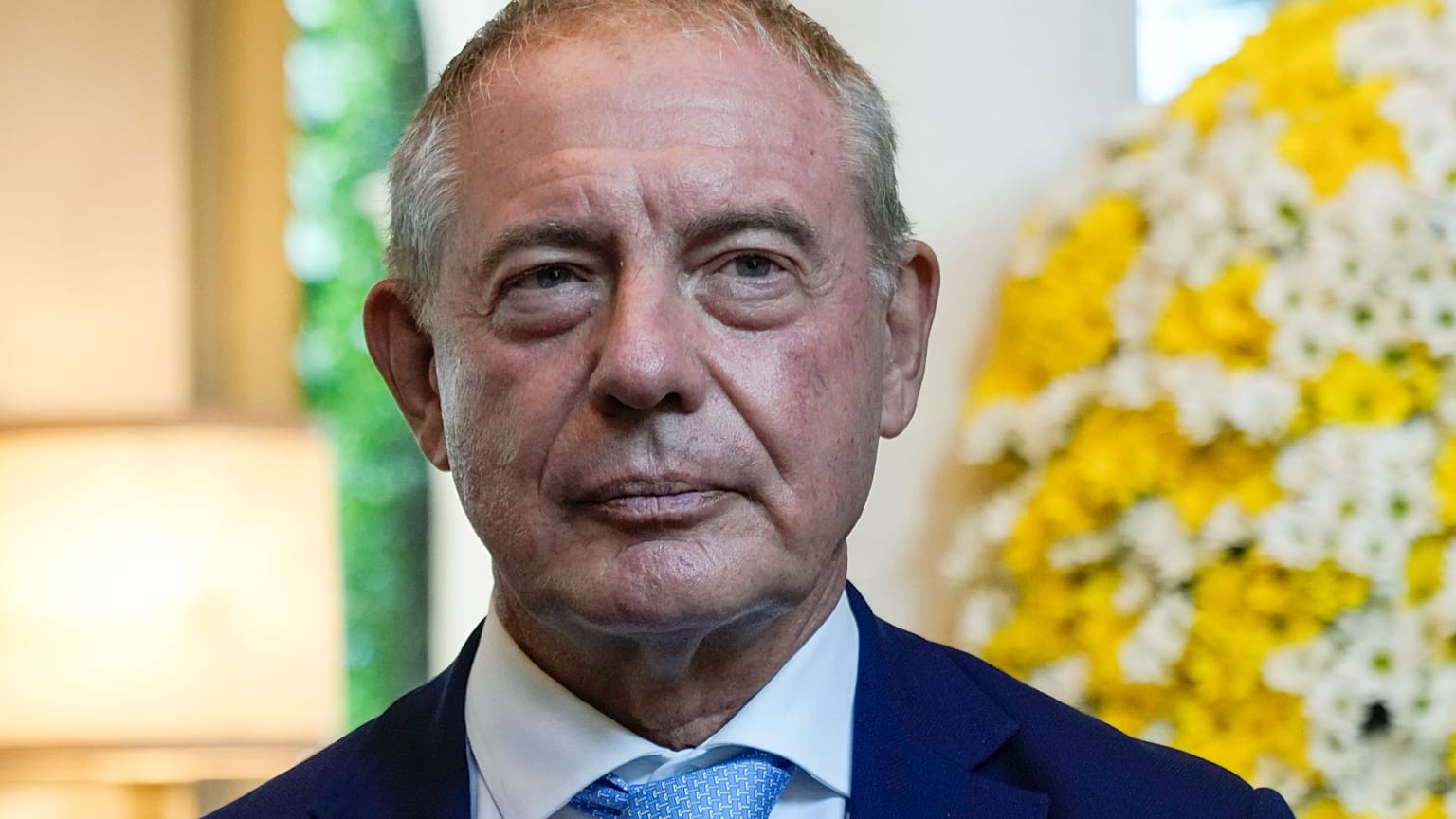
Minister of Business and Made in Italy Adolfo Urso attends the Teha (The European House Ambrosetti ) economic forum in Cernobbio, Como Lake, Italy, Saturday, Sept. 7, 2024.
Copyright AP Photo / Luca Bruno

By Marta Pacheco
Published on 


The Italian Minister said the Emissions Trading System (ETS) has a "perverse effect" and is condemning European companies from being competitive with other countries, urging other member states to back the suspension.

Italy's Industry minister Adolfo Urso urged the European Union to suspend its carbon market until the bloc presents a revised proposal due this summer, citing the hardship faced by European businesses because of high power and carbon costs.

The Emissions Trading System (ETS) is the bloc’s mechanism for making companies pay for their pollution, with the dual aim of reducing emissions and encouraging industry to invest in more sustainable alternatives.

In Europe, the ETS currently covers heavy industries, power plants as well as airlines and shipping. Additional sectors such as international aviation, landfills and incinerators will be included in the upcoming review by the European Commission.

But Urso said the ETS is to blame for Europe's competitiveness problems because the bloc's climate policy tool has a "perverse effect" and is preventing European companies from competing with China and the United States.

"We are all aware that the mechanism of the ETS, as it is currently drafted, is only a tax, a tariff on the energy-intensive companies that struggle to remain competitive," Urso told reporters on the sidelines of a gathering of industry ministers in Brussels on Thursday. “It is necessary - we are all aware - to review it in a substantive way."

"To do this properly, it is necessary to suspend the ETS mechanism while awaiting a reform that must necessarily be comprehensive," Urso added.

Urso added: "If we are in the face of the collapse of the European chemical industry and the crisis of European ideology, we cannot wait for the time of negotiations within the European Union to find a solution."

The Italian minister said that in the meantime, "we are looking for an effective organic solution," adding that he will ask the European Commission to suspend the ETS.

Italy's plea joins that of industry leaders who have recently asked the EU to urgently act to reduce energy and carbon costs. German Chancellor Friedrich Merz has recently touted the same idea, driving down carbon market prices, only to backtrack on it a few days later.

Nordic business leaders back ETS

In a letter sent to Commission President Ursula von der Leyen and EU Climate Commissioner Wopke Hoekstra, a group of Nordic industry associations representing Finland, Sweden, Denmark and Norway urged the EU to maintain the ETS, highlighting its role as a key European advantage and as a source of certainty for investments in clean technologies.

They backed the ETS as a "market-based and technology-neutral policy instrument" that helps reduce carbon dioxide emissions.

"Reforming the system must be done carefully, because it has such a significant impact on the economy and competitiveness, in addition to the climate," the Nordic leaders suggested.

The four industry associations argued that future prosperity in the EU is linked to the ETS since its revenues can bring about decisive investments in clean energy production, critical infrastructure, electrification, and ultimately the decarbonisation of industry.

"Efficient use of the EU's own resources is central to achieving almost all the Union's major strategic aims, and these efforts require reliable access to both public and private financing," reads the letter dated 23 February and seen by Euronews.

Since its inception in 2005, the ETS has slashed emissions by 39%, with revenues exceeding €260 billion, according to the EU data.

Hindering technological innovation

Carlo Carraro, President Emeritus and Professor of Economics at Ca' Foscari University of Venice, criticised the Italian government’s stance on the ETS, saying the attack risks weakening a policy that has proven effective in reducing emissions in regulated sectors.

"Innovation and competitiveness are now inextricably linked to decarbonisation," Carraro said. "Hindering the transition exposes businesses to increasing technological and financial risks and makes the country less competitive".

Similar thoughts were voiced by Chiara di Mambro, Director of Strategy Italy and Europe at the environmental think tank ECCO.

"Suspending the ETS as proposed today or subsidising gas, as envisaged in the Government’s recent decree, would move Italy in the opposite direction (higher energy prices): weakening the price signal, increasing market uncertainty, and ultimately delaying the transition away from expensive fossil fuels," di Mambro said.

Italy is already on track to overhaul its electricity market, which would strip carbon costs from power bills. Instead, Di Mambro suggests using fiscal revenues or dividends from energy companies to reduce the burden of levies on electricity bills.


‘This reform is a disaster’: Climate groups slam Germany for scrapping renewable heating law

An air-to-water heat pump system is installed at a suburb new housing estate in Marl, Germany.
Copyright Copyright 2023 The Associated Press. All rights reserved.

By Rebecca Ann Hughes
Published on 

A revision of an existing law will now allow homeowners to use oil and gas as heating fuel instead.

Germany’s government has drawn heavy criticism from environmental groups after it agreed to remove parts of a controversial law on heating homes.

The legislation previously stated that newly installed heating systems were required to use at least 65 per cent renewable energy - such as a heat pump.

The reform will now allow homeowners to use oil and gas instead.

One critic has called the move "an unconditional fulfilment of all the wishes of the fossil fuel lobby".

Germany scraps renewable heating mandate

The law on renewable heating sources was passed in 2023, and hailed by climate experts as one of the most ambitious goals of the centre-left-led government in power at the time.

But critics pointed to the challenges presented by rising inflation, with one newspaper calling the bill “Habeck’s heating hammer”, referring to the legislation’s author, Robert Habeck of the Green Party.

The right-wing, climate-denying Alternative für Deutschland slammed the law’s promotion of heat pumps, accusing the Green Party of “forcing” households to make costly interventions and removing their freedom of choice.

Germany’s government has now agreed to scrap the renewable heating mandate, as well as the requirement for expert consultation when installing a new system.

‘This reform is a disaster’

The centre-right Christian Democratic Union (CDU) maintains that the modifications to the legislation will still align with the target to cut CO2 emissions from buildings, among the major sources of planet-warming pollution, while giving households greater choice as to which technology to use.

Proponents say the legislation plans for a greater use of ‘green’ fossil fuels.

Economy Minister Katherina Reiche said homeowners would be able to choose sources including “hybrid models, biomass; yes, even gas and oil heating, but with an increasing proportion of biogas or bio-oil”.

The ‘green’ credentials of biomass and biogas are highly debated as their production and combustion can lead to significant carbon emissions and ecosystem damage.

Campaigners have accused the government of abandoning its climate goals - which include hitting net zero emissions by 2045.

"This reform is a disaster," Green Party parliamentary group co-leader Katharina Dröge told the German Press Agency (dpa).

"The CDU and SPD [Social Democratic Party] have today made it abundantly clear: climate protection is completely irrelevant to this coalition,” she added. “The federal government has abandoned the achievement of the climate targets."

The managing director of the German Environmental Aid Association (DUH), Barbara Metz, described the revised law as "an unconditional fulfilment of all the wishes of the fossil fuel lobby".

‘An enormously expensive gas cost trap’

Germany is the biggest greenhouse gas emitter in the EU, with the nation still relying on oil and gas for nearly 80 per cent of its heating.

Despite the promise to switch to ‘climate-friendly’ fossil fuels, critics have pointed to the scarcity and rising cost of sources like biomethane on global markets.

Dröge criticised the government of “driving people into an enormously expensive gas cost trap" with the legislation reform.

Heat pumps cost more than gas boilers to buy and install, but they are more economical to run.

Germany subsidises 30-70 per cent of the cost of a new heat pump, funding that will continue to be offered until at least 2029 under the revised law.

“Especially in light of Trump, global crises and fossil fuel dependencies, this [legislation change] is short-sighted and dangerous," Julian Joswig, a Green Party politician, wrote on X.


‘It’s a real New Zealand duty to save these birds’: Berry harvest brings hope for beloved kakapo

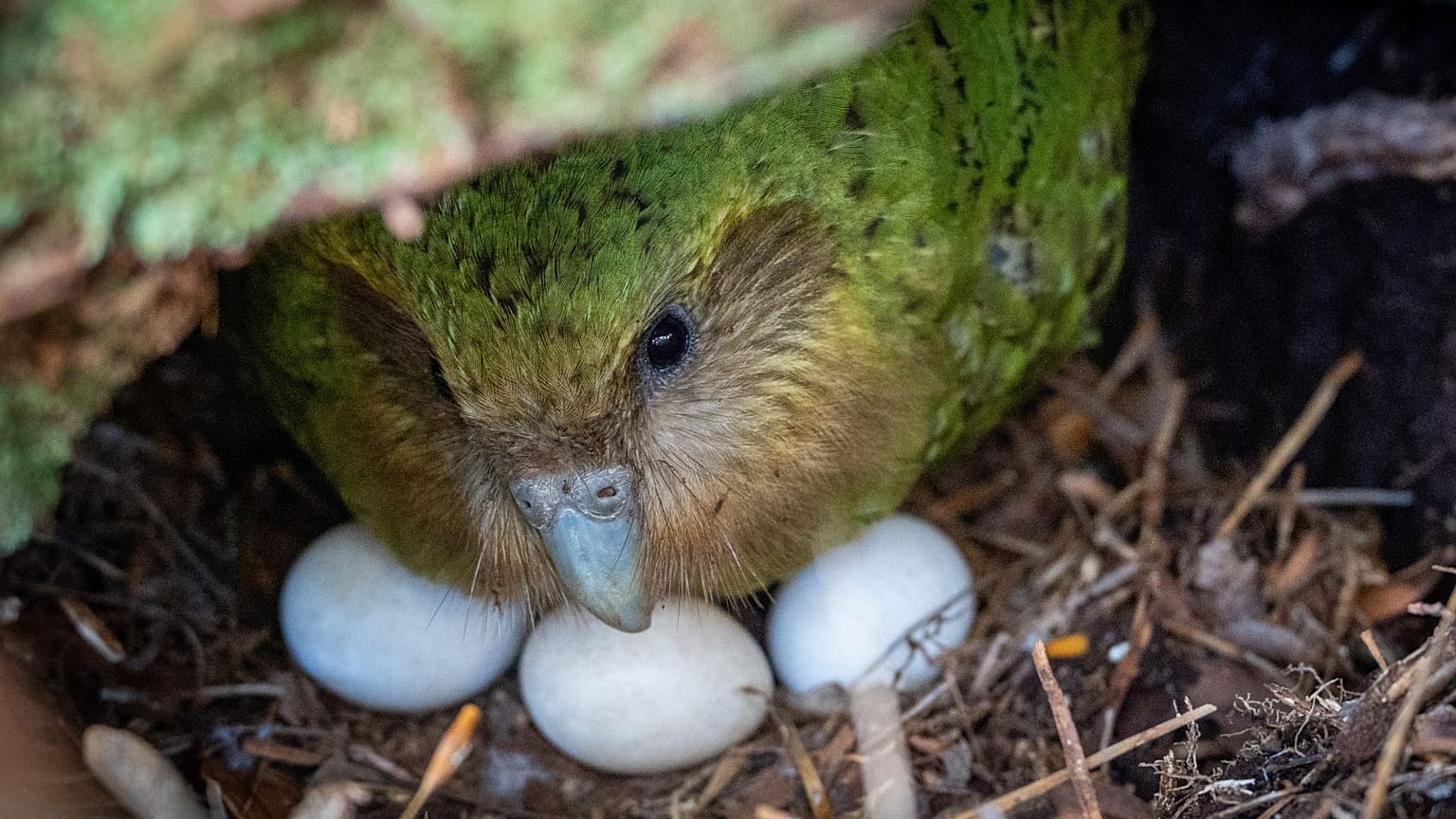
Kohengi sits with her three eggs, on Anchor Island, Pukenui, New Zealand, Feb. 3, 2026.
Copyright Andrew Digby/Dept. of Conservation, New Zealand via AP


By Charlotte Graham-McLay with AP
Published on 

'We don’t have the Eiffel Tower or the pyramids, but we do have kakapo," says New Zealand Department of Conservation’s Deidre Vercoe.

The world’s only flightless parrot species was once thought to be doomed by design. The kakapo is too heavy, too slow and, frankly, too delicious to survive around predators, and takes a shamelessly relaxed approach to reproduction.

But the nocturnal and reclusive native New Zealand bird's fate is teetering toward survival after an unlikely conservation effort that has coaxed the population from 50 to more than 200 over three decades.

This year, with a bumper crop of the strange parrot’s favourite berries prompting a rare enthusiasm for mating, those working to save the birds hope for a record number of chicks in February, which would move the kakapo closer to defying what was not long ago believed to be certain extinction.

Kakapo live on three tiny, remote islands off New Zealand’s southern coast and chances to see them in the wild are scarce. This breeding season has launched one of the birds to internet fame through a livestreamed video of her underground nest, where her chick hatched on Tuesday.

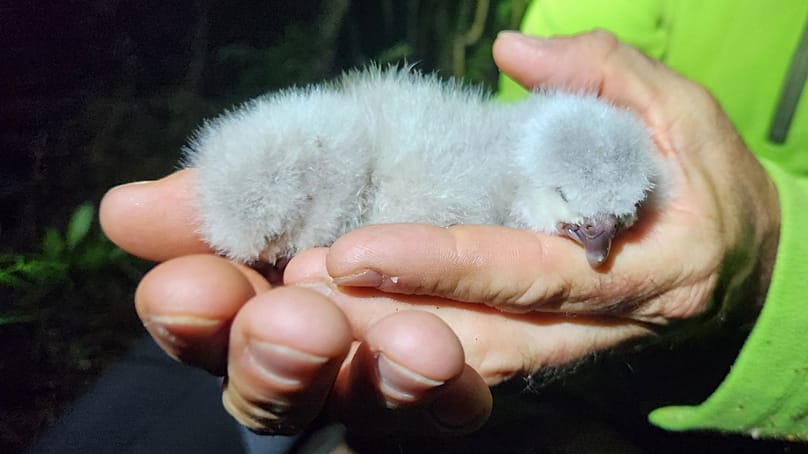
A Dept. of Conservation staff member holds Kakapa chicks Tiwhiri A1 and Tiwhiri A2 on Anchor Island Pukenui, New Zealand, Feb. 2026. Dept. of Conservation, New Zealand via AP

Smelly parrots the size of small cats

The kakapo is a majestic creature that can live for 60 to 80 years. But they’re undoubtedly weird to look at.

The birds can weigh over 3 kilograms. They have owllike faces, whiskers, and mottled green, yellow and black plumage that mimics dappled light on the forest floor.

That’s where the flightless parrot lives, which has made its survival complicated.

“Kakapo also have a really strong scent,” says Deidre Vercoe, the operations manager for the Department of Conservation’s kakapo program. “They smell really musky and fruity – gorgeous smell.”

The pungent aroma was bad news for the parrots when humans arrived in New Zealand hundreds of years ago. The introduction of rats, dogs, cats and stoats, as well as hunting by people and destruction of native forest habitats, drove species of the country’s flourishing flightless birds – the kakapo among them – to near or complete extinction.

By 1974, no kakapo were known to exist. Conservationists kept looking, however, and in the late 1970s, a new population of the birds was discovered.

Reversing their fortunes hasn’t been simple.

A Dept. of Conservation staff member checks the size of a Kakapo egg on Whenua Hou Island, New Zealand, Feb. 2026. Dept. of Conservation, New Zealand via AP

Birds wait years or decades to breed

One reason the kakapo population has grown slowly is that its breeding is, like everything about the birds, peculiar. Years or even decades can pass between successful clutches of eggs.

A breeding season only happens every two to four years, in response to bumper crops of fruit from the native rimu trees the parrots favour, which last happened in 2022. A huge food source is needed for chicks to survive but it’s not known exactly how adult birds become aware of an abundant harvest.

“They’re probably up there in the canopy assessing the fruiting,” said Vercoe. “When there’s a large crop developing, they somehow tune into that.”

That’s when things get really strange. Male kakapo position themselves in dug-out bowls in the ground and emit sonorous booming sounds followed by noises known as 'chings', which sound like the movement of rusty bedsprings.

A Dept. of Conservation staff member holds an egg for candling of a Kakapo egg on Whenua Hou Island, New Zealand, Feb. 2026. Dept. of Conservation, New Zealand via AP

The deep booms, which on clear nights can be heard across the forest, attract female kakapo to the bowls. Females can lay up to four eggs before raising their chicks alone.

Since January, admirers of the birds have had a rare glimpse into the process through a livestream showing the underground nest of 23-year-old kakapo Rakiura on the island of Whenua Hou, where she has laid three eggs, two of them fertile. So precarious is the species’ survival that the eggs were exchanged for fake replacements while the real ones were incubated indoors.

A technician on 24 February replaced the fake eggs with the first near-hatching egg. The kakapo kept her distance while the switch was made but quickly returned to the nest, seemingly unperturbed. The chick hatched just over an hour later. The second real egg was expected to be added within days.

Native birds are beloved in New Zealand

Perhaps the only thing stranger than the kakapo is the lengths to which New Zealanders have gone to save it. Quadrupling the population over the past three decades has required their relocation to three remote, predator-free offshore islands and the micromanaging of the parrots’ every romantic entanglement.

“We do what we can to make sure we don’t lose any further genetic diversity,” Vercoe says. “We manage that carefully through having the best matches possible on each island.”

Each bird has a name and is monitored by a small backpack tracker; if a bird vanishes, they’re nearly impossible to find. With the kakapo still critically endangered, there’s little prospect of conservation efforts ending anytime soon, although those working with the birds are easing their hands-on management each breeding season.

The painstaking work to preserve the species might seem odd to outsiders, but the parrot is just one of many spirited and strange avians in a country where birds reign supreme. The only native land mammals are two types of bat, so New Zealand’s birds, which evolved eccentrically before human and predator arrival, have become beloved national symbols.

“We don’t have the Eiffel Tower or the pyramids, but we do have kakapo and kiwi,” Vercoe says. “It’s a real New Zealand duty to save these birds.”