Friday, February 27, 2026

 Green Party Scores Upset Win in UK Election in Blow to Labour, Far-Right Reform


“Instead of working for a nice life, we’re working to line the pockets of billionaires,” victorious Green Party candidate Hannah Spencer said during her victory speech. “We’re being bled dry.”
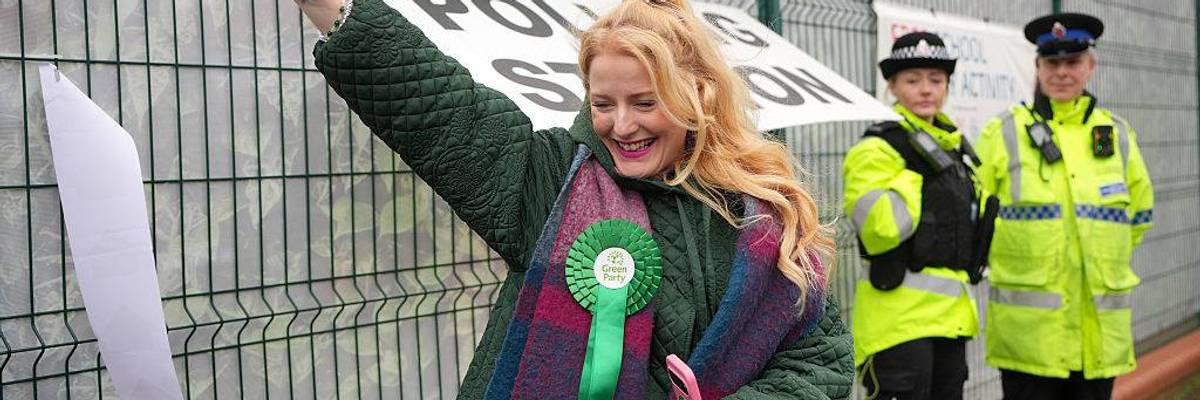

Green Party candidate Hannah Spencer visits Green Party volunteers at St Agnes Primary School polling station on February 26, 2026 in Manchester, England.
(Photo by Christopher Furlong/Getty Images)

Brad Reed
Feb 27, 2026
COMMON DREAMS


Green Party candidate Hannah Spencer on Thursday won an upset victory in a byelection in the Gorton and Denton constituency, delivering a blow to both Labour Prime Minister Keir Starmer and the far-right Reform Party led by Nigel Farage.

As reported by the Guardian, Spencer, a local plumber, won by overturning a 13,000-vote majority that the Labour Party achieved in the 2024 general election.

In fact, Labour fell to third place in the Thursday election, winning 9,364 votes, compared to 14,980 votes for the Greens and 10,578 votes for Reform.

In her victory speech, Spencer emphasized major class divides in the UK, where she said people are working increasingly harder for fewer benefits.

“Working hard used to get you something,” she said. “It got you a house. A nice life. Holidays. It got you somewhere. But now—working hard? What does that get you?... Instead of working for a nice life, we’re working to line the pockets of billionaires. We’re being bled dry.”

The Green Party said Spencer’s victory showed it was now a viable force in national elections, projecting that it is “on track to win over a hundred seats at the next general election, if the historic swing achieved to win Gorton and Denton is replicated nationwide.”

Green Party leader Zack Polanski hailed the election result and predicted “a tidal wave of new Green MPs” in future elections should current trends continue.

“When I was elected Leader of the Greens I said we were here to replace Labour and I meant it,” Polanski said. “Hannah was a fantastic candidate and I know she’ll make a brilliant MP.”

Starmer, who has pushed the Labour Party to the right on issues such as immigration and transgender rights during his tenure, reacted bitterly to the defeat in a letter he sent to other Labour MPs.

“The result in Gorton and Denton is deeply disappointing,” Starmer wrote. “Instead of a Labour MP who can be a local champion delivering for Gorton and Denton alongside a Labour Government and a Labour mayor, the people of Gorton and Denton now have a representative who is more interested in dividing people than uniting them.”

Starmer, whose job approval rating in polls is consistently under 20%, also predicted that “over the coming months, people will feel the benefit of the long-term decisions this government is taking.”

Socialist commentator Owen Jones, a longtime Starmer critic, gloated over the result in a social media post in which he reminded followers of Starmer’s past statement that left-wing voters could “leave” if they didn’t like the changes he was making to Labour.

“OK, Keir Starmer, we did as you asked us!” he wrote. “Happy now?”

UK Labour party loses parliamentary seat to left-wing Greens


By AFP
February 27, 2026


Left-wing Greens beat the Britain's ruling Labour party in crunch local polls - Copyright AFP Paul ELLIS


Peter HUTCHISON

Britain’s ruling Labour party on Friday lost a crunch local poll in one of its traditional northern English heartlands to the left-wing Greens, adding to the woes of unpopular Prime Minister Keir Starmer.

Labour also finished behind the hard-right Reform UK party in the by-election for the parliamentary seat of Gorton and Denton in Manchester, as the country’s traditional two-party system fractures.

The third-place finish in a seat that Labour has dominated for decades is likely to increase chatter about how much longer the 63-year-old Starmer can stay in office.

It also suggests that Britons appear more willing to look towards insurgent parties for answers on long-standing, hot-button issues like the high cost of living and irregular immigration.

Labour won the constituency with almost 51 percent of the vote at the July 2024 general election that swept Starmer to power and ousted the Conservatives from 14 consecutive years in office.

But the government has since been beset by numerous policy reversals and several rows, including over the appointment of Peter Mandelson, an associate of sex offender Jeffrey Epstein, as Britain’s ambassador to Washington.

Polls suggest Starmer is the most unpopular British prime minister since surveys began and earlier this month he faced down calls from within his own party to resign.

Hannah Spencer, a 34-year-old plumber and plasterer won with almost 15,000 votes and becomes the Green’s fifth MP in the 650-seat British parliament.

Reform candidate Matt Goodwin, a 44-year-old political scientist registered some 10,500 votes, while Labour won just over 9,300.

The vote was triggered by the resignation of former Labour MP Andrew Gwynne on health grounds.

Starmer has spent much of his time in office targeting Reform, which leads national polls, by toughening Labour’s immigration policies.

But the stance has alienated elements of the party’s left-wing base and young people, who appear to be turning towards the Greens, whose leader Zack Polanski is also appealing to pro-Palestinian supporters.

“The Green Party is offering hope to the wider society, marginalised people, and I think they’re the choice for working people,” writer Matt Alton, 31, told AFP on Thursday after casting his ballot.

Anti-immigration Reform UK, led by Nigel Farage, have led national surveys for over a year. The next general election is not expected until 2029.

Labour’s candidate, Angeliki Stogia, was selected to run after the party’s ruling body blocked the candidacy of popular Manchester mayor Andy Burnham.

Burnham’s bid to become an MP was widely seen as a precursor for a potential leadership challenge from the party’s left against Starmer, who hails from the party’s centre right.

Starmer faces another critical period in May with elections in Scotland, Wales and London that pollsters predict will be painful for Labour.

UK Greens trounce far right in key election as Labour fall to disastrous third place
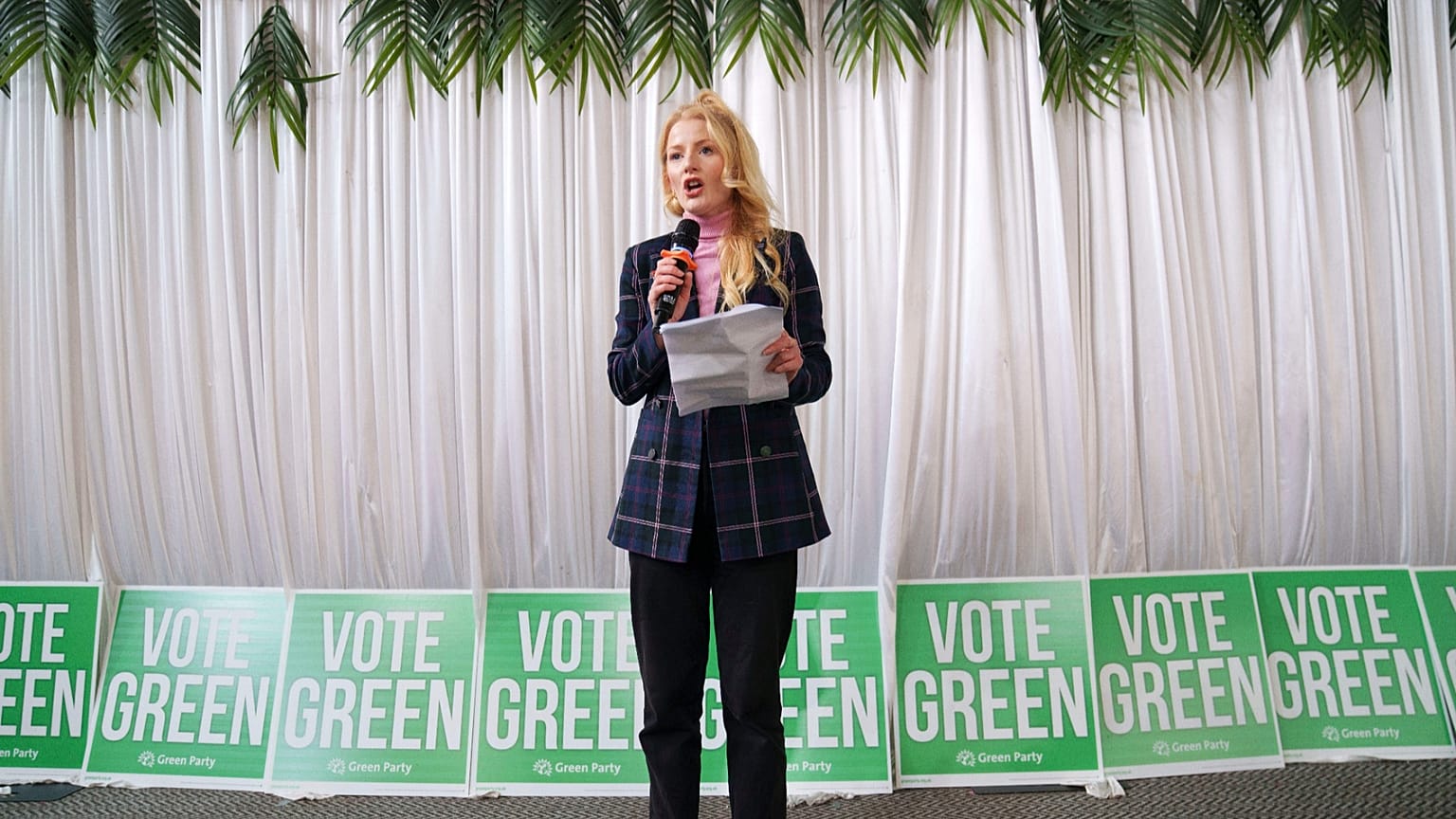
Green Party candidate for the Gorton and Denton by-election Hannah Spencer speaks in Manchester, England.
Copyright AP Photo

By Andrew Naughtie
Published on 

Two insurgent parties with a tiny number of MPs between them have shunted Britain's governing party into a humiliating defeat.

The Green Party of England and Wales has won a stunning victory in the most pivotal UK by-election in years, establishing itself as a major political force and beating Nigel Farage's far-right Reform UK into second place while the governing Labour Party suffered a humiliating defeat.

Held to fill the greater Manchester seat of Gorton and Denton, which was vacated by a Labour MP who resigned over racist and sexist WhatsApp messages about his party colleagues, the by-election pitted the UK’s strongest far-right and left-wing parties directly against each other.

In the final result, the Greens' Hannah Spencer won with 14,980 votes, beating Reform UK's Matt Goodwin on 10,578 and Labour's Angeliki Stogia on 9,364.

While they only have a combined 13 seats in the House of Commons, Reform and the Greens are increasingly dominating Britain’s political discourse, and Thursday’s result – coming off the back of the highest turnout in any by-election since 1983 – will fuel their overlapping claims that the traditionally dominant parties are in irreversible decline.

A new left rises

In her victory speech, Spencer stressed the economic difficulties faced by everyday people "working to fill the pockets of billionaires" and stressed the Greens' strong left-wing message of fairness for working-class people who have seen their neighbourhoods and life chances alike go into decline while working ever harder to maintain their standard of living.

"Everybody should get a nice life," she said. "And clearly I'm not the only person who thinks that."

Spencer also called out "politicians and divisive figures" who she said had scapegoated the area's large Muslim population and tried to turn white working-class locals against them.

"My Muslim neighbours are just like me: human," she said.

Having won four seats at the last general election, its best ever result, the Green Party has surged in the polls since choosing a new leader, Zack Polanski, last September.

Polanski was originally a member of the more centrist Liberal Democrats, but stormed out of the party in 2016 when he failed to make the shortlist of candidates to fight a pivotal by-election. Now an elected member of the London Assembly, he is highly popular on social media, where he projects himself as a cheerful and charismatic left-populist.
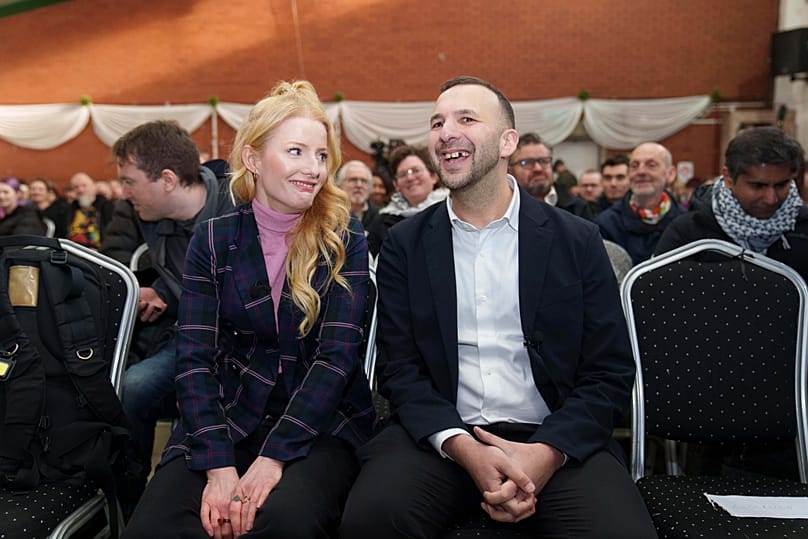
Green Party leader Zack Polanski, right, sits with the party candidate is the Gorton and Denton by-election Hannah Spencer AP Photo

While not departing from the Greens' baseline environmentalism, his most attention-grabbing proposals include withdrawing the UK from NATO, imposing higher taxes on the wealthy, and nationalising various utilities and services. He has also been a vociferous critic of Israel's war in Gaza.

The Greens’ meteoric polling surge under his leadership has eclipsed an attempted comeback by former Labour leader Jeremy Corbyn, whose attempt to form a new left-wing political force named Your Party has been dogged by financial and organisational chaos as well as a rift between him and co-founder Zarah Sultana – who, like Polanski, is highly popular with the online left.

Having quit the Labour Party in 2025 over the government's political direction and its stance on the war in Gaza, she now argues that the British government should "nationalise the entire economy". It is unclear when Your Party will begin contesting elections.

Extremists on the march

Despite only returning a handful of MPs at the last general election, Reform UK has consistently led nationwide opinion polls for some time, and achieved a wave of victories in local elections across England in May 2025. Pollsters estimate that the UK's first-past-the-post electoral system would have a high chance of forming a majority government were an election held tomorrow.

However, it has suffered from a number of disastrous candidate vetting failures and a steady flow of defections and resignations by both MPs and local councillors, many of whom have left the party after making outlandish or racist public statements.

The party’s ongoing effort to refute allegations of extremism meant it was something of a surprise when it decided to fight the Gorton and Denton contest with Goodwin, who has built a substantial personal following while espousing some of the most extreme views of any major party candidate in recent British political history.

Goodwin first came to public prominence in the 2010s as an academic studying the rise of right-wing populism, in particular Islamophobia. However, in the years following the UK's departure from the EU, he has morphed from a critic of right-wing movements and parties into an out-and-out advocate of far-right ideas.
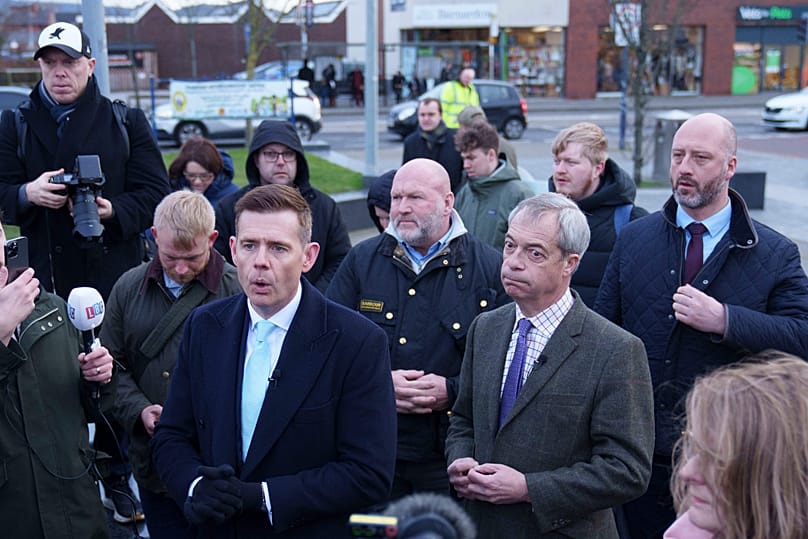
Reform UK's Matt Goodwin (centre) campaigns with party leader Nigel Farage. AP Photo

With tens of thousands of followers on social media and Substack as well as a show on right-wing TV channel GB News, Goodwin argues that immigration from non-European countries and cultures poses an existential threat to British and Western civilisation.

A leading proponent of the widely circulated right-wing claim that "London is over" thanks to rampant violent crime and the "displacement" of white British residents – claims easily proven untrue by abundant publicly available evidence – Goodwin has repeatedly advanced explicitly ethnonationalist conceptions of national identity.

In one particularly infamous interview last year, he opined that “Englishness is an ethnicity that is deeply rooted in a people that can trace their roots back over generations” and argued that British citizens with recent foreign heritage – among them former Conservative prime minister Rishi Sunak, who was born in Hampshire – cannot reasonably call themselves "English" in a true sense.

However, Goodwin himself and Reform are increasingly under pressure from even more extreme figures on the right, notably expelled Reform MP Rupert Lowe, whose recently founded party Restore claims to have 100,000 members and has attracted the backing of Elon Musk.

Lowe, who has promised to "remove millions of foreigners who shouldn’t be in our country, and chainsaw back the size of the state, vastly empowering the individual", has lately attacked Reform UK for his supposed moderation on “mass deportation” and racial difference in general.

In response, Goodwin – who among other things has promised to “slash welfare for non-Brits” – has responded to Restore supporters’ mockery by accusing them of providing a haven for “white supremacists, antisemites, racists and conspiracy theorists”.

Labour on life support

Meanwhile, the result in Gorton and Denton deals a heavy blow to the Labour government, in particular Prime Minister Keir Starmer, whom some pollsters judge to be the most unpopular prime minister in the history of modern British politics depending on what measure is used.

Having fallen well behind Reform in the polls – sinking to as low as fourth place in some surveys – the Starmer government has lately been rocked by the release of the so-called Epstein Files, which revealed that its chosen ambassador to Washington, Peter Mandelson, had not only continued a close friendship with convicted paedophile Jeffrey Epstein well after his first conviction but also passed him confidential information while serving as Business Secretary at the height of the 2009 global financial crisis.

The ensuing row forced the resignation of Starmer's chief of staff, and the prime minister was briefly expected to face an immediate leadership challenge. But the Gorton and Denton vote will be followed in May by simultaneous elections for the Scottish Parliament, Welsh Senedd and many English local governments, all of which are expected to be disastrous for the Labour Party.

With the exception of Manchester Mayor Andy Burnham, whose attempt to stand in Gorton and Denton was blocked by the Labour Party’s National Executive Committee, no candidate has so far emerged to directly challenge Starmer before the government has those elections behind it.

Cambodia welcomes back dozens of artefacts looted by UK trafficker


By AFP
February 27, 2026


Cambodia's Deputy Prime Minister Hun Many attends a ceremony to welcome back the looted cultural artefacts - Copyright AFP STR

Cambodian monks chanted blessings and scattered flowers Friday over 74 cultural artefacts returned to the country after being plundered by a notorious British antiques smuggler.

Scholar Douglas Latchford — once regarded as a key authority on Cambodian antiquities — was charged by prosecutors in New York in 2019 with smuggling looted Cambodian relics to sell on the international black market.

Cambodia’s culture ministry said the repatriation from Britain of the relics, some dating back more than around 1,000 years, was sealed in a deal with the estate of Latchford — who died in Bangkok in 2020.

Before the scandal came to light, Latchford earned acclaim for books detailing the art of the ancient Khmer Empire, which spanned modern-day Cambodia and much else of Southeast Asia.

Deputy Prime Minister Hun Many told reporters the return of the artefacts was a matter of “national pride” because the pieces “connect the national soul from our ancestors’ era to the current time”.

The objects, to form part of the collection at the National Museum of Cambodia in Phnom Penh, include “monumental sandstone sculptures, refined bronze works, and significant ritual objects”, said a culture ministry statement.

“These 74 sacred objects are not merely works of art; they are living witnesses to the genius of the Khmer ancestors and the spiritual heart of Khmer civilization,” it added.

In 2024, New York’s Metropolitan Museum of Art returned 14 artefacts looted by Latchford, including a 10th century sandstone goddess statue and a large 7th century Buddha head.

Thousands of relics are believed to have been trafficked out of Cambodia over the years.

Experts say the trade thrived from the mid-1960s to the 1990s — a period of instability that saw the anti-intellectual Khmer Rouge regime rise to power and left precious heritage unprotected.

Since 1996 Cambodian law has forbidden the unauthorised removal of antiquities, with a prison punishment of up to eight years.

Growing numbers of museums and private collections worldwide are facing pressure to repatriate artworks removed from their native countries, particularly those looted during periods of colonial rule.


‘Without ports, Ukraine will be destroyed’:


 Odesa buckles under Russian bombs


By AFP
February 27, 2026


Odesa is a key logistics hub for Ukraine, one of the world's top agricultural exporters - Copyright AFP Oleksandr GIMANOV


Cecile FEUILLATRE

Looking out at the blue and yellow cranes towering over the Black Sea horizon, Viktor Berestenko worries about the relentless Russian bombardment of Odesa, Ukraine’s southern port city.

“It’s war, every night,” the head of the Inter Trans logistics company told AFP.

The main gateway to the Black Sea and beyond, Odesa is a key logistics hub for Ukraine, one of the world’s top agricultural exporters.

Russia has intensified its attacks on the region — tripling the number of missile and drone strikes over the last year in what officials call an attempt to cut Ukraine off from the sea.

“Without ports, Ukraine will be destroyed,” said Berestenko.

The escalation comes four years into Russia’s invasion, in which Ukraine’s maritime infrastructure has been a target for Moscow.

The attacks are accepted as part of daily life for the city of around one million people, dotted with ornate 19th-century architecture and where luxury cars pass mobile air defence units along the bustling seaside.

Russia’s army occupies much of Ukraine’s southern coast, including key port cities of Mariupol and Berdiansk further to the east.

And in 2023 Moscow walked away from a deal, brokered by the UN and Turkey, that facilitated the safe passage of Ukrainian agricultural exports across the Black Sea.

In response, Kyiv set up an alternative route with vessels hugging the sea’s western coastline from Odesa, along Romania, Bulgaria and through the Bosphorus into the Mediterranean.

Ukraine touts it as a success, with more than 170 million tonnes of cargo transported through the route, including grain to some 55 countries, mostly in Africa.

The sales provide a vital source of income for the economy, decimated by the Russian invasion.

But the surge in strikes is taking a toll.

Volumes were down 15 percent last year, when some 57 ships and 336 pieces of port equipment were damaged, according to Mykola Kravchuk, head of the state-run Ukrainian Sea Ports Authority in the city.

There were more than 800 air raid alerts in Odesa in 2025 — “this amounts to more than a month of operational time lost over the course of the year,” Kravchuk told AFP.

The vast majority of Ukraine’s grain exports go through Odesa.


– Two-minute warning –


Incoming ballistic missiles can hit Odesa within two minutes of being launched from Crimea, which Russia annexed in 2014.

It takes some 45 seconds for a crane operator to climb down, let alone reach a shelter, Berestenko said.

He scrolled through photos on his phone of burned-out trucks and warehouses damaged by strikes.

“It’s scary, to put it briefly,” said Iryna, who works at the port’s container terminal.

“When the alarm sounds, we go down… we put our trust in God,” the 41-year-old said.

“Sometimes alerts can last for three hours, and we sit there.”

Several strikes have killed port employees or ship crew members.

In December, a ballistic missile attack killed eight people.

The strikes also have an environmental toll. Last year an attack on the nearby port of Pivdennyi hit a sunflower oil storage tank, polluting the Black Sea coast.

Thousands of birds and seahorses were killed as a result, ecologist Vladyslav Belinsky said.

Ukraine classifies its ports as strategically important infrastructure, limiting access to them.

Kravchuk said the port industry’s top two priorities are protecting people, “specifically our employees” and making sure the ports stay open.

After an overnight attack on Friday Deputy Prime Minister Oleksiy Kuleba repeated that the maritime corridor was still operational despite another massive attack on Ukraine’s port facilities.

But the surge in the attacks has many in the industry and the city on edge.

“What will be the next steps?” asked logistics chief Berestenko.

“To occupy Odesa? To cut Ukraine from the sea?”


Podcast: How activism is helping Ukrainians endure four years of full-scale war


By Méabh Mc Mahon & Alice Carnevali
Published on  

A meeting in Kyiv marking the anniversary of Russia’s full-scale invasion of Ukraine, Hungary’s vetoes on financial aid to Ukraine, and the resilience of Ukrainians: after four years of conflict, the end of the war seems nowhere in sight.

There are moments in life that are hard to forget and remain etched in the collective memory of those who witnessed them: a natural disaster affecting our hometown, a terrorist attack in our country or the outbreak of a full-scale war.

“You can ask every Ukrainian — no matter where they were, in Ukraine or abroad — and they will remember moment by moment where they were and what they were doing the moment Russia started its full-scale invasion,” Euronews’ correspondent Sasha Vakulina told Brussels, My Love?.

Together with Marta Barandiy, founding president of Promote Ukraine and Katharina Emschermann, head of programme EU and international politics at Heinrich-Böll-Stiftung, Euronews' correspondent joined this week’s episode of the podcast to discuss the fourth anniversary of Russia’s war on Ukraine.

How are Ukrainians coping? Is the EU doing enough to support them?

Apple podcast Spotify podcast Castbox podcast

The morale in Ukraine

Marta Barandiy founded her non-profit organisation Promote Ukraine in 2014, the year Russia annexed Ukraine's peninsula of Crimea. “The war started in 2014, let’s not forget that, the full-scale invasion started in 2022,” Barandiy said.

Over the years of Barandiy’s activism in Brussels, she witnessed how slowly things were moving toward providing support and maintaining attention to Ukraine. “I sort of imagined that (the war) could last so long,” she said.

Barandiy explained that Ukrainians are resisting by creating communities of veterans, of families of abducted children and abducted prisoners of war: “The whole of Ukraine is living in activism in order to help each other to cope with the situation and to not lose.”

The EU's role

On Tuesday, European Commission chief Ursula von der Leyen, European Council President António Costa and some European leaders went to Kyiv to show their support for the country on the day of the anniversary of Russia’s full-scale invasion.

The meeting, however, came just one day after Hungary vetoed both a new package of sanctions against Russia and a €90 billion loan to Ukraine. “That undercut the message that European leaders wanted to send,” Emschermann said.

According to the expert, Hungary’s veto puts the EU before a broad question about how it makes decisions on security challenges, its efficiency, and its unity.

The loan had, in fact, been approved in December 2025 at the European Council after long negotiations among 27 heads of state and governments.

Also according to Vakulina, Hungary’s last-minute veto and the meeting in Kyiv are very representative of the EU challenges.

“The EU has done a lot,” she said, commenting on Brussels’ involvement in Ukraine.

“Even the EU itself wishes it could do more, but there are some hurdles, political issues, nuances, vetoes on some occasions, which is very frustrating not only for Ukraine but for the EU,” she said.

Listen to the podcast in the player above or wherever you get your podcasts.

Get in touch with us by writing to brusselsmylove@euronews.com.


‘It’s Not A War Crime If It Was Fun’: Three


Years Of Gory Messages By A Russian


General – Analysis


Major General Roman Demurchiev has served as commander of the 42nd Guards Motor Rifle Division, fighting in Ukraine. Photo Credit: RFE/RL


February 27, 2026
RFE RL
By Yelizaveta Surnacheva, Valeriya Yegoshyna, Kira Tolstyakova, Schemes and Systema


On October 18, 2022, roughly eight months after Russia launched its all-out war on Ukraine, a high-ranking Russian officer texted several messages to his wife, and several acquaintances, back home in Russia.

The officer, then-Colonel Roman Demurchiev, commander of the 42nd Guards Motor Rifle Division, bragged about how his soldiers had just stormed a “strongpoint” in Ukraine, and had captured four prisoners-of-war.

In a message to his wife, Aleksandra, he sent a photograph that appeared to be several human ears, blackened and hanging from a metal pipe.

“What do you do with them afterward?” Aleksandra wrote.

“I’ll make a garland and give it as a gift,” Demurchiev, who was promoted to major general the following year, responded.

“Like pig ears for beer,” she wrote.

“Yeah,” he replied.

The gory banter, and evidence of possible war crimes by a senior Russian military officer, are among the revelations contained in three years of communications — text and audio messages, photographs, videos — purportedly sent and received by Demurchiev.

The materials — dozens of messages and other related materials — were provided to reporters from Schemes, the investigative unit of RFE/RL’s Ukrainian Service , by a person serving in the Ukrainian military. RFE/RL agreed not to disclose the person’s identity or how they obtained the files.

Schemes verified the authenticity of the communications, working with forensics laboratories in the United States and data researchers in Germany.

RFE/RL reporters also corroborated many of the dates and events listed in the data using details provided by soldiers from Ukraine’s Third Army Corps, whose units fought, and continue to fight, against soldiers under Demurchiev’s command.

Contacted by RFE/RL by phone, Demurchiev, 49, hung up upon being asked about the treatment of prisoners of war.

The Russian Defense Ministry did not respond to RFE/RL’s emails regarding its policies on treatment of prisoners of war.
‘You Didn’t Touch The Ears?’

Throughout Russia’s war on Ukraine, which hits its fourth anniversary on February 24, there have been widespread allegations of, and ample evidence pointing to, war crimes being committed by Russian units.

Among the best-known examples was from Bucha, a town north of the Ukrainian capital, Kyiv, that was occupied by Russian forces for just over a month.

After the Russian troops withdrew, residents discovered dozens of dead bodies, overwhelmingly civilians that appeared to have been summarily executed, or tortured, with corpses lying on streets or piled in basements.

With the help of military records left behind in Bucha and cross-referenced with social media profiles, RFE/RL identified several members of the one particular unit — the 234th Pskov Regiment — that was directly involved in the killings of civilians.

In the correspondence obtained by RFE/RL, the conversation about the mutilated ears began when Demurchiev wrote to another army officer who was a longtime acquaintance: Major General Igor Timofeev, the first deputy commander of the 36th Army.


“You didn’t touch the ears? Like when we were kids?” Timofeev replied in response.

It’s unclear exactly what Timofeev was referring to.

However, both he and Demurchiev fought in Chechnya in the 2000s, during the conflict that ravaged the Russian region.

Demurchiev then started a separate chat on the same subject with his wife, Aleksandra. In one of her responses, she also appeared to refer to Chechnya when reacting to the ear photo:

“I thought those were tales from Chechnya times,” she wrote. “Turns out it’s true.”

Aleksandra could not be reached for comment.

Russian forces have been accused of amputating ears of prisoners in the past.

During the First Chechen War, in the 1990s, journalists and human rights activists documented multiple reports of reported mutilations by Russian troops. In 2000-2001, during the second conflict in the region, Human Rights Watch and the Russian rights group Memorial described bodies with severe mutilations, including scalping, broken limbs, and cut-off fingers and ears.

Russian media have described similar practices by Chechen fighters.

In 2022, Schemes obtained another series of recordings of calls from Russian soldiers, intercepted by Ukrainian intelligence. In one, a soldier could be heard saying of a prisoner: “He wouldn’t talk. They cut off his ear.”

Demurchiev mentioned amputating ears again in late 2024 in a voice message sent to a contact identified as Valery Nepop.

RFE/RL was able to determine that Nepop was likely an officer with the Federal Security Service, Russia’s main domestic intelligence agency.

“You’re the boss of a super organization, that’s my dream,” Demurchiev can be heard saying. “Damn, and you even cut off the ears. But at our age they don’t do that anymore; we just give out the orders.”
Of Mice And Generals

Some of the materials sent or received by Demurchiev showcased dark, juvenile, and often sadistic humor among his colleagues or acquaintances, many of whom are Russian officers.

In one received by Demurchiev in December 2023, a live mouse is shown tied up by its legs — spread-eagled, as if it were being crucified — as a Russian voice pretends to interrogate the mouse, offering it a cigarette.

Demurchiev replied with a smiley-face emoji to the video, sent by Lieutenant General Mikhail Kosobokov, commander of the 49th Combined Arms Army.


In a separate message sent to Kosobokov, Demurchiev sent a Russian language meme that said: “It’s not a war crime if it was fun.”

In another series of messages with a person who appeared to be a military intelligence officer attached to the FSB named Roman, Demurchiev asked Roman what to do about a Ukrainian prisoner in his custody.

“I’ve got one prisoner… I can gift him to you,” he wrote in the October 2023 messages. “He’s sitting in a pit… What should I do with him — dispose of him or give him to you?”

“We didn’t have time to torture him, so the info was friendly,” Demurchiev wrote. “But you’ve got plenty of time — you can use tools that make people tell the truth.”

RFE/RL identified the prisoner in question: a 42-year-old man from the southern city of Zaporizhzhya who spent nearly two years in Russian captivity, including a facility in Altai, a Russian region far from Ukraine.

In the summer 2025, the man was returned to Ukraine, as part of a prisoner exchange.

RFE/RL reporters contacted the soldier via relatives. The man declined to speak in detail, saying he was in poor physical and mental health. He only said that he had been severely beaten and subjected to electric shock.
‘Are They Dismembering Them?’

Other messages exchanged by Demurchiev point to his possible complicity not only in blatant war crimes — but also possibly outright murder.

In December 2024, Demurchiev received a video message that appears to have been taken by drone, using a thermal imaging camera. A voice speaking in Russian off-camera asks: “Are they dismembering them?”

Yeah, with a shovel,” another voice responds.

“Are they ours?” the first voice says, asking if the people wielding the shovels are Russian soldiers.

Yeah,” the second voice replies.

Holy shit!” the first exclaims.

Other messages sent by Demurchiev explain that the soldiers shown in the video were former prison inmate and that they had hacked three surrendering Ukrainians to death using sapper shovels.

“Well, I reported this to you. Two of the cons made it into the stronghold. There were three Ukrainians,” he wrote to his commanding officer, General Oleg Mityaev, using a derisive insult to describe them. “They took them prisoner and then chopped them up with shovels. Shit. Beasts. But look, shit, they executed them with sapper shovels. Shit.”


RFE/RL identified the Ukrainian military unit whose soldiers were taken prisoner and then killed by Russian troops. The unit said the incident occurred in eastern Ukraine. The unit also asked RFE/RL not to disclose its identity or the names of the deceased, saying that could traumatize relatives or survivors.

Intelligence data provided by the unit identified the former prison inmates who were mentioned by Demurchiev in the video: members of the “Black Mamba” unit of the 252nd Motorized Rifle Regiment, part of the Third Division of Russia’s 20th Combined Arms Army.

In later correspondence, Demurchiev reported the details of the incident to Mityaev, who commanded the Russia’s 20th Army. Mityaev responded with praise.

“The ‘cons’ who took that location and chopped them up with shovels, God willing they’ll survive,” he said. “They should definitely be nominated for an award. Keep pushing, little by little. Well done…Good job, keep pushing, keep pushing, crush the bastards,
 shit.”


Yelizaveta Surnacheva is journalist for Systema, RFE/RL’s Russian Investigative Unit. Focused on political and social issues, she previously worked as an editor for the Russian investigative outlet Proyekt and BBC News.

Valeriya Yegoshyna is a journalist for Schemes (Skhemy), an investigative news project run by RFE/RL’s Ukrainian Service. Yehoshyna is the 2024 winner of the ICFJ Knight International Journalism Award. She was recognized as one of the “Top 30 Under 30” by the Kyiv Post in 2019 and has won a number of other awards, including the top prizes at the V. Serhienko Investigative Journalism Competition in 2017 and the Mezhyhirya Festival in 2018. An investigation she co-authored in 2023 about Izyum and the Russian invasion of Ukraine received a Special Certificate of Excellence at the Global Shining Light Awards from the Global Investigative Journalism Network.

Kira Tolstyakova is an editor for Schemes, the investigative unit of RFE/RL’s Ukrainian Service.
Schemes (Skhemy) is the award-winning investigative project of RFE/RL’s Ukrainian Service. Launched in 2014, it has exposed high-level corruption and abuse of power for over a decade. Following Russia’s full-scale invasion in February 2022, the project expanded to uncovering Russian war crimes.

Systema is RFE/RL’s Russian-language investigative unit, launched in 2023. The team conducts in-depth investigative journalism, producing high-profile reports and videos in Russian.


An Archive of material relating to Nestor Makhno and the Makhnovshchina.

Makhno was a Ukrainian anarchist revolutionary and the commander of an independent anarchist army in Ukraine from 1917–21.

English: Organizational Platform of the General Union of Anarchists (Draft), Nestor Makhno and others of the Group of Russian Anarchists Abroad (the "Delo ...


‘Antitrust Disaster’: Son of Billionaire Trump Donor Poised to Take Over Warner Bros.

“A handful of Trump-aligned billionaires are trying to seize control of what you watch and charge you whatever price they want.”


David Ellison, the chairman and CEO of Paramount Skydance, walks through Statuary Hall to the State of the Union address on February 24, 2026 in Washington, DC.
(Photo by Anna Moneymaker/Getty Images)

Jake Johnson
Feb 27, 2026
COMMON DREAMS

Netflix announced Thursday that it would not continue its effort to acquire Warner Bros. Discovery, paving the way for Paramount Skydance—a company controlled by the son of billionaire Trump donor Larry Ellison—to take over the media giant after a lengthy bidding war.

The news came after Netflix CEO Ted Sarandos visited the White House and met with members of President Donald Trump’s staff, raising suspicions about the role the administration may have played in pushing the streaming giant to drop its bid for Warner Bros. and cede the fight to David Ellison’s Paramount. Along with other major media properties, Warner Bros. owns CNN, a frequent target of Trump’s ire.

“What did Trump officials tell the Netflix CEO today at the White House?” asked Sen. Elizabeth Warren (D-Mass.), calling the potential Paramount-Warner Bros. merger “an antitrust disaster threatening higher prices and fewer choices for American families.”

“A handful of Trump-aligned billionaires are trying to seize control of what you watch and charge you whatever price they want,” Warren added. “With the cloud of corruption looming over Trump’s Department of Justice, it’ll be up to the American people to speak up and state attorneys general to enforce the law.”

In a statement that appears to have stunned Hollywood, Netflix announced Thursday that it would not raise its offer for Warner Bros. after that company’s board deemed Paramount’s latest offer of $111 billion “superior.” Netflix said it determined the pursuit of Warner Bros. was “no longer financially attractive.”

“Ellison will readily throw the First Amendment, CNN’s reporters, and HBO’s filmmakers under the bus if they stand in the way of expanding his corporate empire and fattening his pockets.”

Ellison, for his part, said he was “pleased” that the Warner Bros. board “affirmed the superior value of our offer, which delivers to WBD shareholders superior value, certainty, and speed to closing.”

The proposed Paramount-Warner Bros. merger still must receive regulatory approval in the US and Europe. Critics have voiced concerns about the legitimacy of a US Justice Department review given the recent ouster of antitrust chief Gail Slater.

State attorneys general could also intervene. Rob Bonta, the attorney general of California, emphasized in a statement that “Paramount/Warner Bros is not a done deal.”

“These two Hollywood titans have not cleared regulatory scrutiny—the California Department of Justice has an open investigation, and we intend to be vigorous in our review,” said Bonta.

On top of antitrust concerns, critics of the potential Paramount-Warner Bros. merger warned it would be a disaster for journalism and free expression. David Ellison acquired CBS News last year through the Paramount-Skydance merger approved by the Trump administration, and he is now poised to take over CNN, HBO, and other major platforms.

“Ellison has already shown his cards,” said Seth Stern, chief of advocacy at the Freedom of the Press Foundation. “When the Trump administration unconstitutionally demanded editorial concessions from Ellison’s Skydance in exchange for government approval of its takeover of Paramount and CBS News, he obliged, even appointing a Trump loyalist as a so-called ‘bias ombudsman.’ CBS has since repeatedly censored journalists or altered its coverage to please Trump and his allies.”

“There is no reason to believe that this proven capitulator will behave any differently this time around—in fact, he’s already reportedly promised Trump ‘sweeping changes’ at CNN, including firing people Trump dislikes,” Stern said. “Ellison will readily throw the First Amendment, CNN‘s reporters, and HBO’s filmmakers under the bus if they stand in the way of expanding his corporate empire and fattening his pockets.”

“Lawmakers, state attorneys general, and anyone else in a position to intervene should make clear that they will not stand by as the Trump administration abuses its power to unconstitutionally extract content-based concessions from news companies,” he added.

Netflix walks away from Warner Bros. bid, clearing path for Paramount


By AFP
February 26, 2026


Image: - © AFP Patrick T. Fallon

Netflix said Thursday it would not raise its takeover offer for Warner Bros. Discovery, effectively ceding the media giant to a rival bid from Paramount Skydance after deciding the deal was no longer financially attractive.

The streaming giant’s co-CEOs Ted Sarandos and Greg Peters said they were “declining to match” Paramount Skydance’s latest offer after Warner Bros. Discovery’s board declared it a “Superior Proposal” under the terms of its existing merger agreement with Netflix.

The development will likely see the storied Hollywood studio and a group of TV properties that includes CNN fall into the hands of Paramount, reshaping US media.

Without a Netflix counteroffer, the Warner Bros. Discovery board is now free to terminate its agreement with the streaming giant and proceed with Paramount.

The sweetened offer, made Monday, was the latest installment of a bidding war that has drawn White House attention, with President Donald Trump insisting he had a say in the outcome.

The revised Paramount offer included a purchase price of $31.00 per share in cash, a one-dollar increase from its earlier bid, which valued the company at around $108 billion.

Paramount has also offered a $7 billion regulatory termination fee should the deal fail to close on regulatory grounds, and agreed to cover the $2.8 billion breakup fee Warner Bros. Discovery would owe Netflix if it walked away from their agreement.

Crucially, the proposal also includes a commitment from Oracle founder Larry Ellison to contribute additional funding if needed to support solvency requirements from Paramount’s lending banks.

Ellison is the father of Paramount Skydance CEO David Ellison, a Hollywood producer, and largely financed his son’s takeover of Paramount and his subsequent bid for Warner Bros. Discovery.

Larry Ellison is also a longtime ally of President Trump, and both Paramount and Netflix have sought to curry favor with the White House.

Creating headwinds for Netflix, Republican lawmakers came out against the company during the deal process, accusing it of promoting pro-trans content on its platform, something co-CEO Ted Sarandos strenuously denied.

Just hours before withdrawing from the bidding war, Sarandos was filmed entering the White House on Thursday for talks with officials — though not the president, according to CNBC.

A victory by Paramount would see CNN — often the target of Trump’s threats and criticism — pass to Ellison family control, amid criticism that their takeover of Paramount-owned CBS brought personnel changes more to the White House’s liking.
Democrats bet on centrism in rebuttal to Trump speech


By AFP
February 25, 2026


Spanberger, a former CIA officer and three-term Congresswoman, successfully won back the Virginia governor's mansion from Republicans last year - Copyright GETTY IMAGES NORTH AMERICA/AFP Mike Kropf

The rebuttal to Donald Trump’s State of the Union was delivered Tuesday by a stalwart of the Democrats’ moderate wing — seen as a model for the centrism some bet is key to winning November’s midterm elections.

Virginia Governor Abigail Spanberger criticized the US president for his handling of the Jeffrey Epstein affair as well as alleged corruption, but mostly focused on cost-of-living issues centrists believe will have cross-party appeal.

“Costs are too high in housing, health care, energy and child care,” Spanberger said in a staid, measured speech.

“Americans deserve to know that their leaders are focused on addressing the problems that keep them up at night.”

Spanberger, a former CIA officer and three-term Congresswoman, successfully won back the Virginia governor’s mansion from Republicans last year with an affordability-focused platform.

Her selection to deliver the party’s formal rebuttal to Trump’s address to Congress was clearly aimed at putting forward an example for the rest of the party to follow.

The Democratic Party remains split over turning out centrist and even moderate Republican voters or firing up the base on progressive promises of sweeping reform.

While left-wing stalwarts like New York Mayor Zohran Mamdani have also run campaigns on affordability, Spanberger also emphasized more traditional centrist ideals like bipartisanship, patriotism and her law enforcement bonafides.

Spanberger also hit Trump on issues like the immigration crackdown, saying federal agents have “ripped nursing mothers away from their babies,” while saying the immigration system was “broken.”

The primaries ahead of the midterms are likely to see some combative races between moderate and Democratic progressives.

With Spanberger, the Democratic leadership was signaling a preference for persuasion and disciplined messaging over ideological confrontation.

Party leaders view her as a communicator capable of reaching beyond the Democratic base at a time when cost‑of‑living pressures dominate public debate.

“Those who are stepping up now to run will win in November, because Americans — you at home — know you can demand more,” she said.

Spanberger first gained national prominence in 2018 when she captured a Republican-held suburban district in Virginia, part of a Democratic wave driven by moderate candidates and disaffected swing voters.

She later secured reelection in the competitive seat before securing the governorship last year, solidifying her reputation as an election winner focused on economic and national security concerns.

Her campaigns have consistently emphasized healthcare, economic stability and bipartisan problem‑solving — priorities Democrats hope will resonate with suburban and independent voters this November.
Microplastics found in 90% of prostate cancer tumours


By Dr. Tim Sandle
SCIENCE EDITOR
DIGITAL JOURNAL
February 25, 2026


Plastics contributed 3.4 percent of global greenhouse emissions in 2019, the report said - Copyright AFP/File Peter PARKS

Medical researchers from NYU Langone Health have detected microplastics in nearly all prostate cancer tumours examined in a new study. Tumour tissue contained about 2.5 times more plastic than nearby healthy prostate tissue. Scientists say this is the first Western study to directly measure plastic particles in prostate tumours.

Although more research is needed, the findings suggest microplastic exposure could play a role in cancer development.


The scientists set out to explore whether exposure to microplastics could contribute to the development of prostate cancer, which the American Cancer Society identifies as the most common cancer among men in the U.S.

The scientists further discovered that these microplastics were present at higher concentrations in cancerous tumours than in nearby noncancerous prostate tissue.
How Microplastics Enter the Human Body

Plastic materials used in food packaging, cosmetics, and many everyday products can break down into microscopic fragments when heated, worn down, or chemically processed. These particles can enter the body through food, breathing contaminated air, or contact with the skin.

Previous research has detected microplastics in nearly every organ, as well as in bodily fluids and even the placenta. Despite their widespread presence, scientists still do not fully understand how these particles may affect human health and the human microbiome.
Research Basis

To conduct the analysis, scientists first reviewed tumour and benign tissue samples under visual inspection. They then used specialised instruments to measure the quantity, chemical composition, and structure of microplastic particles. The team focused on 12 of the most common plastic molecules.

Because plastic is widely used in medical and laboratory equipment, researchers took extra precautions to prevent contamination. They replaced plastic tools with alternatives made from aluminium, cotton, and other non-plastic materials. All testing was performed in controlled clean rooms designed specifically for microplastic analysis.
Higher Plastic Levels in Cancerous Tissue

The researchers examined prostate tissue collected from 10 patients undergoing surgery to remove the gland. Plastic particles were identified in 90% of tumour samples and in 70% of benign prostate tissue samples.

The difference in concentration was notable. On average, tumour samples contained about 2.5 times more plastic than healthy tissue (about 40 micrograms of plastic per gram of tissue compared with 16 micrograms per gram).

Hence, the study provides important evidence that microplastic exposure may be a risk factor for prostate cancer.

The researchers noted that earlier research had suggested possible links between microplastics and conditions such as heart disease and dementia, but there had been little direct evidence tying them specifically to prostate cancer.

The findings were presented at the American Society of Clinical Oncology’s Genitourinary Cancers Symposium. According to Loeb, this is the first Western study to measure microplastic levels in prostate tumours and compare them directly with levels in noncancerous prostate tissue.
US plaintiff decries harmful social media addiction


By AFP
February 26, 2026


Starting December 10, some of the world's largest social media platforms will be forced to remove all users under the age of 16 in Australia. © AFP/File David GRAY


Romain FONSEGRIVES

The plaintiff in a blockbuster social media trial in Los Angeles took the stand Thursday, telling the jury that she could not control her use of YouTube and Instagram as a child.

Kaley G.M., a 20-year-old California resident, painted a dire picture of a social media addiction that began when she was six years old and that she says exacerbated her mental health issues, including depression, body image problems and acts of self-harm.

“I was at a young age and I would spend all my time on it,” Kaley testified when asked to explain why she thought she was addicted to YouTube. “Anytime I tried to separate myself from it, it just didn’t work.”

Even when she was bullied on Instagram, she still stayed on the app. “If I was off, I would just feel like I was missing out.”

The landmark trial is expected to last until late March, when the jury will decide whether Meta, which owns Instagram, and Google-owned YouTube knowingly designed addictive apps that harmed her mental health.

Meta CEO Mark Zuckerberg took the stand last week and pushed back against accusations that his social media company had done too little to keep underage users off his platform and had profited from their presence.

In the highly anticipated testimony, Kaley took questions from her lawyer, who sought to portray her as an emotionally fragile user who was ensnared as a child by YouTube and Instagram and whose use of those apps caused her lasting harm.

“I’m very nervous,” Kaley, wearing a pale pink cardigan, said as she began her testimony, which will include cross-examination by lawyers from Meta and Google.


Attorney Mark Lanier is representing the plaintiff Kaley G.M. in a landmark case accusing Meta and YouTube of building addictive social media platforms – Copyright GETTY IMAGES NORTH AMERICA/AFP MARIO TAMA

Kaley described scenes from her childhood in which her mother would have her leave her phone in the living room at night, only for her to retrieve it once her mom went to bed and return it before morning.

“I would be really upset,” she said, when denied access to the apps.

Her lawyer Mark Lanier said court records indicate that on one day she was on Instagram for 16 hours.

She said her mother pushed her into therapy at around age 12, and that during the first session she said she could not engage with her family at home because of “excessive worrying because of social media.”

“I stopped engaging with them as much because I was spending all my time on social media,” she recalled.

She also described her heavy use of filters on Instagram from a young age to make her eyes bigger and her ears smaller. The jury was shown a video in which she complained about being fat.

Shown a banner featuring dozens of her Instagram pictures, Kaley said “almost all of them have a filter on.”

When asked if her life, health, sleep and grades would have been better without social media, Kaley answered: “Yes.”

– Seeking job in social media –

In a surprising twist, Kaley said she would like to become a social media manager and capitalize on the skills she has built since a young age.

Kaley G.M.’s case is the first of three trials expected in the same court that will help determine whether Google and Meta deliberately designed their platforms to encourage compulsive use among young people, damaging their mental health in the process.

The outcome of the Los Angeles trials is expected to establish a standard for resolving thousands of lawsuits that blame social media for fueling an epidemic of depression, anxiety, eating disorders and suicide among young people.

Similar lawsuits, including some brought by school districts, are making their way through federal court in Northern California and state courts across the country.
‘Sacrificed futures’: German BASF chemical workers protest looming job cuts

By AFP
February 27, 2026


BASF employees protested at plans to cut jobs in Berlin - Copyright AFP John MACDOUGALL


Clement Kasser with Sam Reeves in Frankfurt

Waving placards reading “Broken Agreements, Sacrificed Futures”, hundreds of workers from chemical titan BASF protested in Berlin Friday over plans to axe jobs in Germany and shift them to Asia.

The looming cuts at a major office employing some 3,000 administrative staff in the capital are the latest sign of the huge pressures facing Germany’s traditional industries.

They are part of a cost-cutting drive by the world’s biggest chemical company, which has been battered by high energy costs in Germany, weak demand and massive overcapacity on global markets.

“What BASF is doing is not right,” Jesus Pinate, who works in BASF’s HR division, told AFP at the protest.

“They are taking away important jobs, a bunch of people are going to be unemployed,” added the 33-year-old, as some 300 protesters waved the red and white flags of the IGBCE chemical workers union.

They also brandished placards emblazoned with various messages playing on the company’s name, such as “Berliners Axed, Shareholders Flourishing” and “Budget Above Staff Futures?”

Berlin mayor Kai Wegner addressed the protesters outside the BASF offices in Berlin, telling them that we “are fighting together for this site”

“We are fighting together for your jobs with the works council, with the union, and with the Berlin legislature — I am sure that we will achieve something here”.

Outlining the plans Friday as it unveiled downbeat financial results, BASF said that back-office jobs would be reduced including at the Berlin office — the European hub of the global business services division — although it did not give a figure.

A whole range of administrative tasks will in future be carried out at a new site to be established in India, as well as at an existing centre in Malaysia, the group said.


– ‘Uncertain future’ –


“We will adapt our existing location structures and achieve significant cost savings as a result,” BASF chief financial officer Dirk Elvermann told reporters.

He offered assurances that the Berlin hub would not be closed completely but conceded that it “will be smaller in terms of staffing than it is today”.

Union representatives however slammed the plans to “relocate large parts” of the Berlin operation to India, and accused management of breaching existing agreements.

Europe’s biggest economy has faced a storm of problems in recent years, from a manufacturing slump and fierce competition from China to weak demand in key export markets and high energy prices.

Firms large and small are shedding jobs, and there is a steady drumbeat of redundancy announcements in sectors ranging from automotive to factory equipment makers.

BASF’s latest results highlighted their problems — adjusted operating profit, a key metric for investors and analysts, slipped to 6.6 billion euros ($7.8 billion) in 2025 from 7.2 billion the year before.

Sales meanwhile fell to 59.7 billion euros, from 61.4 billion in 2024. The company’s shares fell by two percent after the results were announced.

The group, with around 110,000 staff worldwide, is hoping for a turnaround through its cost savings, targeting in particular its historic site in Ludwigshafen, the largest chemical complex in the world.

BASF CEO Markus Kamieth said Friday his message was that “cost pressure will naturally remain”.

“We will continue to seek constant productivity improvements and cost reductions in the coming years, especially in Europe, but also worldwide.”

But such comments will likely offer little solace to the BASF workers in Berlin whose jobs are facing the axe.

“I think we’re all disappointed,” Iris Esteves, a 40-year-old taking part in the demonstration, told AFP.

“I feel uncertain about the future. Nobody knows if our job is going to be transferred.”


Chemical giant BASF to shift jobs from Germany to Asia


By AFP
February 27, 2026


BASF reported falling sales in 2025 - Copyright AFP Punit PARANJPE

BASF signalled on Friday it would shift jobs from its home market of Germany to Asia, as the struggling chemical giant seeks to aggressively cut costs.

The vast German chemical sector has been mired in crisis in recent years due to overcapacity, weak demand and high energy costs.

BASF, the world’s biggest chemical group and a key supplier to industries ranging from automotive to agriculture, has launched a major savings drive, in particular directed at its operations in Germany.

In its latest move, the group said it intended to cut administrative jobs, including at a major hub in Berlin, without giving a precise figure.

It outlined plans to build up hubs for a range of back-office roles in Asia — a new one to be opened in India, and an existing centre in Malaysia.

“We will adapt our existing location structures and achieve significant cost savings as a result,” BASF chief financial officer Dirk Elvermann told reporters, as the group reported falling operating profits and sales for 2025.

“We want to achieve efficiency gains through competitive service levels and targeted digitalisation, and we will also significantly reduce our overall workforce in the digital sector.”

The business services division has about 8,500 employees in total.

He insisted that “we do not plan to close Berlin” but added that the “hub will be smaller in terms of staffing than it is today”.

There was no “concrete figure” for future staffing levels in the German capital, he said.

On Friday a union representing BASF workers was organising a protest at the group’s business services hub in Berlin, which has some 3,000 staff, against what it said were plans to “relocate large parts” of the business to India.

BASF reported Friday that its adjusted operating profit, a key metric for investors and analysts, slipped to 6.6 billion euros ($7.8 billion) in 2025 from 7.2 billion the year before.

Sales fell to 59.7 billion euros, from 61.4 billion in 2024.

BASF said it had cut around 4,800 jobs in recent times, and had achieved cost savings of 1.7 billion euros in 2025, ahead of its goals.

Its savings drive is targeted in particular at its historic site in Ludwigshafen, western Germany, the largest chemical complex in the world.