“The US is intensifying the drumbeat of war against Iran, with zero explanation of the nonexistent legal authority to use force and zero evidence of an ‘imminent threat,’” said Mohamed ElBaradei.
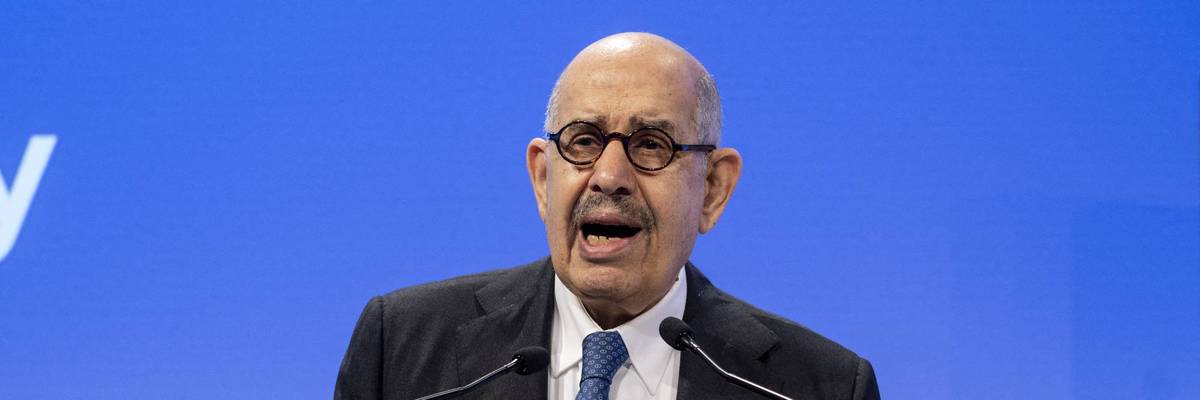
Mohamed ElBaradei, former director-general of the International Atomic Energy Agency, speaks during the 2022 Vienna Conference on the Humanitarian Impact of Nuclear Weapons at the Austrian Center in Vienna, Austria on June 20, 2022.
(Photo by Joe Klamar/AFP via Getty Images)
Jake Johnson
Feb 26, 2026
COMMON DREAMS
The former head of the International Atomic Energy Agency said Wednesday that a US war on Iran would have “horrific costs,” a warning that came before American and Iranian officials gathered in Geneva for the latest round of closely watched negotiations.
“The US is intensifying the drumbeat of war against Iran, with zero explanation of the nonexistent legal authority to use force and zero evidence of an ‘imminent threat’ other than hypothetical scenarios based on possible future intentions,” Mohamed ElBaradei, a Nobel Peace Prize laureate who served as IAEA director-general from 1997 to 2009, wrote in a social media post.
“All wars, including ‘wars of choice,’ have horrific costs,” he added. “That is the reason for the restraints and limitations established by international norms. This is Iraq redux... It seems we never learn.”
US President Donald Trump and members of his administration have repeatedly claimed, without evidence, that Iran desires and is on the brink of making a nuclear weapon, even after Trump claimed to have “obliterated” the country’s nuclear program with airstrikes last year.
Iran has said its nuclear program is entirely for peaceful purposes; the nation’s foreign minister, Abbas Araghchi, said earlier this week that Iran would “under no circumstances ever develop a nuclear weapon.”
“A deal is within reach, but only if diplomacy is given priority,” said Araghchi.
In recent weeks, the Trump administration has assembled a massive fleet of warplanes and aircraft in the Middle East as the US president has threatened to attack Iran, accusing the country of harboring “sinister nuclear ambitions.”
But Rafael Grossi, the current head of the IAEA, said last week that the nuclear agency had not seen any evidence that Iran is currently working to develop nuclear weapons capacity.
“On the contrary, I see, today, a willingness on both sides to reach an agreement,” said Grossi.
By AFP
February 27, 2026

Iran has asked the US to lower its demands during a last-ditch bid to avert fresh war - Copyright AFP Adam BERRY
Iran said Friday that in order to reach a deal, the United States will have to drop its “excessive demands”, tempering the optimism expressed after talks seen as a last-ditch bid to avert war.
The Oman-mediated talks follow repeated threats from President Donald Trump to strike Iran, and with the United States conducting its biggest military build-up in the region in decades.
Trump on February 19 gave Iran 15 days to reach a deal, and while Iran has insisted the discussions focus solely on its nuclear programme, the US wants Tehran’s missile programme and its support for militant groups curtailed.
The Wall Street Journal reported on Thursday that Trump’s negotiating team would demand that Iran dismantle its three main nuclear sites and hand over all its remaining enriched uranium to the United States.
Without specifying what demands he was referring to, Iran’s Foreign Minister Abbas Araghchi on Friday told his Egyptian counterpart that “success in this path requires seriousness and realism from the other side and avoidance of any miscalculation and excessive demands”.
Following the talks in Geneva on Thursday, Araghchi told state TV that the negotiations “made very good progress and entered into the elements of an agreement very seriously, both in the nuclear field and in the sanctions field”.
He said the next round would take place in “perhaps less than a week”, with technical talks at the UN’s nuclear agency to begin in Vienna on Monday.
Omani Foreign Minister Badr Albusaidi also announced technical discussions were to be held next week in Vienna.
“We have finished the day after significant progress in the negotiation between the United States and Iran,” he said in a post on X.
Araghchi, in a post on X, called the latest round of talks “the most intense so far”.
“It concluded with the mutual understanding that we will continue to engage in a more detailed manner on matters that are essential to any deal — including sanctions termination and nuclear-related steps,” he wrote.
UN nuclear chief Rafael Grossi joined the negotiations, a source close to the talks told AFP.
– ‘Big lies’ –
US President Donald Trump said in his State of the Union address that Iran had “already developed missiles that can threaten Europe and our bases overseas, and they’re working to build missiles that will soon reach the United States of America”.
He also accused Iran of “pursuing sinister nuclear ambitions”, though Tehran has always insisted its programme is for civilian purposes.
The accusations were delivered in the same forum in which then-president George W. Bush laid out the case for the invasion of Iraq in 2003.
The Iranian foreign ministry called these claims “big lies”.
On Wednesday, US Secretary of State Marco Rubio said on Wednesday that Iran is “not enriching right now, but they’re trying to get to the point where they ultimately can”, adding that Tehran “refuses” to discuss its ballistic missile programme and “that’s a big problem”.
Iran’s President Masoud Pezeshkian insisted ahead of the talks that the Islamic republic was not “at all” seeking a nuclear weapon.
US Vice President JD Vance told the Washington Post on Thursday there was “no chance” that a long-threatened strike on Iran would result “in a Middle Eastern war for years with no end in sight”.
Parallel to the talks is a dramatic US military buildup in the region, with the USS Gerald R. Ford, the world’s largest aircraft carrier, sent to the Mediterranean this week.
Washington currently has more than a dozen warships in the Middle East: one aircraft carrier — the USS Abraham Lincoln — nine destroyers and three other combat ships.
It is rare for there to be two US aircraft carriers in the region.
The maximum range of Iran’s missiles is 2,000 kilometres (1,200 miles), according to what Tehran has publicly disclosed.
However, the US Congressional Research Service estimates they top out at about 3,000 kilometres — less than a third of the distance to the continental United States.
A previous attempt at negotiations collapsed when Israel launched strikes on Iran last June, beginning a 12-day war that the US briefly joined to bomb Iranian nuclear sites.
In January, Tehran launched a mass crackdown on nationwide protests, killing thousands of people according to rights groups.
Protests have since resumed around Iranian universities.
How America lit the fuse on Iran's nuclear programme
Iran and the United States made "significant progress" during talks in Switzerland on Thursday, according to mediators, with both sides agreeing to resume negotiations in Austria next week.
Issued on: 27/02/2026 - RFI
 In this photo released by the Iranian Presidency Office, President Masoud Pezeshkian, second right, listens to the head of Atomic Energy Organization of Iran Mohammad Eslami as he visits an exhibition of Iran's nuclear achievements, in Tehran, Iran, on April 9, 2025. AP
By: Jan van der Made
Washington is demanding curbs on Iran's missile programme, its network of regional proxies, and above all its nuclear capabilities - a demand that carries a particular historical irony, given that it was the United States itself that launched Iran's nuclear ambitions in 1953 under Eisenhower's Atoms for Peace initiative.
The talks, brokered by Oman, follow repeated threats from Donald Trump to strike Iran militarily. The US president gave Tehran a 15-day deadline to reach a deal last Thursday.
The two sides, however, remain some distance apart on scope. Iran has insisted the discussions be confined to its nuclear programme, while Washington wants Tehran's missile arsenal and its financial and operational support for militant groups across the region brought to the table as well.
'Atoms for peace'
Iran's nuclear programme was launched with American help in 1953 under President Dwight Eisenhower's Atoms for Peace initiative, a Cold War effort to balance the threat of nuclear conflict with the promise of uranium's peaceful applications.
 1970s advertisement of Boston Edison, a company that made nuclear plants Boston Edison
In 1967, the Tehran Nuclear Research Center, equipped with a US-made five megawatt nuclear research reactor fueled by highly-enriched uranium, started operating. One year later, Tehran signed the Non Proliferation Treaty allowing the International Atomic Energy Agency (IAEA) to inspect its nuclear sites.
In March 1974, the Shah unfolded plans to build 23 nuclear plants by the year 2000, claiming the energy would be used as a substitute for oil. Loans worth billions and nuclear cooperation agreements were signed with the US, France, Germany, South Africa and others.
1979 Revolution
When Ayatollah Khomeini's revolution installed an anti-western theocracy most western nuclear companies withdrew from Iran — but the programme continued with Russian and Chinese assistance.
The first allegations that Iran was pursuing an atomic bomb emerged in 1984, based on reports from West German intelligence, though the IAEA found nothing to substantiate them at the time. Iran meanwhile acquired nuclear expertise from both Russia and China, including a 915MW water reactor built with Russian assistance at the existing Bushehr complex.
Conspiracy theories have since added further layers of mystery to Iran's suspected pursuit of a nuclear weapon.
Merlin program
In his 2006 book State of War New York Times investigative journalist James Risen alleged that the CIA may inadvertently have helped Iran develop a nuclear weapon.
Under an operation codenamed Merlin, a Russian defector working for the CIA was tasked with posing as a disgruntled nuclear scientist willing to sell classified bomb designs to Tehran.
The CIA had doctored the blueprints beforehand, inserting deliberate flaws in the hope that Iran would build a faulty device and set its nuclear programme back by years.
Risen's conclusion was the opposite: the Iranians identified the flaw, and the blueprints may in fact have advanced rather than hindered their weapons development. The operation has since passed into popular culture, providing the basis for the Israeli television series Tehran, created by Moshe Zonder.
The CIA source who disclosed the Merlin programme to Risen, Jeffrey Sterling, was subsequently prosecuted under the Espionage Act, sentenced to three and a half years in prison, and released in 2018.
People's Mujaheddin
It was not until 2002 that the question of Iran's nuclear ambitions entered the public domain in earnest. At a press conference in Washington on 14 August of that year, the Paris-based opposition group Mujaheddin-e-Khalq (MEK), which had fought first against the Shah and later against the Khomeini regime, claimed to have satellite evidence that Iran was running two top-secret nuclear facilities, at Natanz and Arak.
A year later, the IAEA reported that Iran had failed to declare certain uranium enrichment activities. Iran has maintained ever since that its nuclear programme is entirely peaceful, insisting it has enriched uranium to less than five per cent, consistent with the requirements of a civilian power plant.
Iran went to considerable lengths to deny any ambition to develop a nuclear weapon. Its supreme leader stated repeatedly on his official website that the use of nuclear weapons was a "great sin," that Iran did "not accept nuclear weapons because of our beliefs," and that "according to Islamic thought, a weapon that destroys civilians is prohibited."
None of it persuaded Washington or its regional ally Israel, which feared it would be the primary target should Iran ever acquire the bomb.
 Israeli Prime MinisterBenyamin Netanyahu speaking at the UN in 2012 about a possible Iranian nuclear deal. Reuters/Lucas Jackson
Ali Khamenei believes that his survival, and that of his regime, depends on possessing a nuclear weapon," according to Adrian Calamel, co-author of a report on Iran's foreign influence operations.
The allegations surrounding Iran's nuclear activities eventually led to sweeping sanctions and a prolonged diplomatic process, culminating in the signing of the Joint Comprehensive Plan of Action (JCPOA) in 2015. The agreement was struck between Iran and the so-called G5+1: the five
permanent members of the UN Security Council (the United States, China, Russia, France and the United Kingdom) plus Germany. Its aim was to curtail Tehran's nuclear programme in exchange for a gradual lifting of sanctions.
The deal did not hold. Mounting criticism, led most vocally by Israeli prime minister Benjamin Netanyahu, culminated in the United States unilaterally withdrawing from the agreement on 8 May 2018, during Donald Trump's first term in office. Washington promptly reimposed sweeping sanctions on Iran's oil, banking and shipping sectors, triggering a severe economic contraction.
The remaining signatories attempted to salvage the agreement, establishing the Instex mechanism to facilitate limited trade with Iran. It was never adequate compensation for the loss of access to the US-linked global financial system.
From mid-2019, Iran responded with a series of calculated breaches of its JCPOA commitments, gradually raising enrichment levels, expanding its stockpiles and increasing the number of advanced centrifuges in operation, while continuing to permit IAEA monitoring.
Diplomacy shifted into crisis management mode. European governments pressed both sides to step back from the brink, while indirect contacts between Washington and Tehran continued through European, Omani, Swiss and Qatari intermediaries, focusing on prisoner exchanges, de-escalation in the Gulf and limited sanctions relief.
Formal negotiations to restore or extend the JCPOA proceeded fitfully under successive American administrations, but were repeatedly derailed by regional instability, domestic political pressures in both Tehran and Washington, and a fundamental mistrust over which side should move first: sanctions relief or nuclear rollback.
(With newswires)
IBy: Jan van der Made
Washington is demanding curbs on Iran's missile programme, its network of regional proxies, and above all its nuclear capabilities - a demand that carries a particular historical irony, given that it was the United States itself that launched Iran's nuclear ambitions in 1953 under Eisenhower's Atoms for Peace initiative.
The talks, brokered by Oman, follow repeated threats from Donald Trump to strike Iran militarily. The US president gave Tehran a 15-day deadline to reach a deal last Thursday.
The two sides, however, remain some distance apart on scope. Iran has insisted the discussions be confined to its nuclear programme, while Washington wants Tehran's missile arsenal and its financial and operational support for militant groups across the region brought to the table as well.
'Atoms for peace'
Iran's nuclear programme was launched with American help in 1953 under President Dwight Eisenhower's Atoms for Peace initiative, a Cold War effort to balance the threat of nuclear conflict with the promise of uranium's peaceful applications.
In 1967, the Tehran Nuclear Research Center, equipped with a US-made five megawatt nuclear research reactor fueled by highly-enriched uranium, started operating. One year later, Tehran signed the Non Proliferation Treaty allowing the International Atomic Energy Agency (IAEA) to inspect its nuclear sites.
In March 1974, the Shah unfolded plans to build 23 nuclear plants by the year 2000, claiming the energy would be used as a substitute for oil. Loans worth billions and nuclear cooperation agreements were signed with the US, France, Germany, South Africa and others.
1979 Revolution
When Ayatollah Khomeini's revolution installed an anti-western theocracy most western nuclear companies withdrew from Iran — but the programme continued with Russian and Chinese assistance.
The first allegations that Iran was pursuing an atomic bomb emerged in 1984, based on reports from West German intelligence, though the IAEA found nothing to substantiate them at the time. Iran meanwhile acquired nuclear expertise from both Russia and China, including a 915MW water reactor built with Russian assistance at the existing Bushehr complex.
Conspiracy theories have since added further layers of mystery to Iran's suspected pursuit of a nuclear weapon.
Merlin program
In his 2006 book State of War New York Times investigative journalist James Risen alleged that the CIA may inadvertently have helped Iran develop a nuclear weapon.
Under an operation codenamed Merlin, a Russian defector working for the CIA was tasked with posing as a disgruntled nuclear scientist willing to sell classified bomb designs to Tehran.
The CIA had doctored the blueprints beforehand, inserting deliberate flaws in the hope that Iran would build a faulty device and set its nuclear programme back by years.
Risen's conclusion was the opposite: the Iranians identified the flaw, and the blueprints may in fact have advanced rather than hindered their weapons development. The operation has since passed into popular culture, providing the basis for the Israeli television series Tehran, created by Moshe Zonder.
The CIA source who disclosed the Merlin programme to Risen, Jeffrey Sterling, was subsequently prosecuted under the Espionage Act, sentenced to three and a half years in prison, and released in 2018.
People's Mujaheddin
It was not until 2002 that the question of Iran's nuclear ambitions entered the public domain in earnest. At a press conference in Washington on 14 August of that year, the Paris-based opposition group Mujaheddin-e-Khalq (MEK), which had fought first against the Shah and later against the Khomeini regime, claimed to have satellite evidence that Iran was running two top-secret nuclear facilities, at Natanz and Arak.
A year later, the IAEA reported that Iran had failed to declare certain uranium enrichment activities. Iran has maintained ever since that its nuclear programme is entirely peaceful, insisting it has enriched uranium to less than five per cent, consistent with the requirements of a civilian power plant.
Iran went to considerable lengths to deny any ambition to develop a nuclear weapon. Its supreme leader stated repeatedly on his official website that the use of nuclear weapons was a "great sin," that Iran did "not accept nuclear weapons because of our beliefs," and that "according to Islamic thought, a weapon that destroys civilians is prohibited."
None of it persuaded Washington or its regional ally Israel, which feared it would be the primary target should Iran ever acquire the bomb.
Ali Khamenei believes that his survival, and that of his regime, depends on possessing a nuclear weapon," according to Adrian Calamel, co-author of a report on Iran's foreign influence operations.
The allegations surrounding Iran's nuclear activities eventually led to sweeping sanctions and a prolonged diplomatic process, culminating in the signing of the Joint Comprehensive Plan of Action (JCPOA) in 2015. The agreement was struck between Iran and the so-called G5+1: the five
permanent members of the UN Security Council (the United States, China, Russia, France and the United Kingdom) plus Germany. Its aim was to curtail Tehran's nuclear programme in exchange for a gradual lifting of sanctions.
The deal did not hold. Mounting criticism, led most vocally by Israeli prime minister Benjamin Netanyahu, culminated in the United States unilaterally withdrawing from the agreement on 8 May 2018, during Donald Trump's first term in office. Washington promptly reimposed sweeping sanctions on Iran's oil, banking and shipping sectors, triggering a severe economic contraction.
The remaining signatories attempted to salvage the agreement, establishing the Instex mechanism to facilitate limited trade with Iran. It was never adequate compensation for the loss of access to the US-linked global financial system.
From mid-2019, Iran responded with a series of calculated breaches of its JCPOA commitments, gradually raising enrichment levels, expanding its stockpiles and increasing the number of advanced centrifuges in operation, while continuing to permit IAEA monitoring.
Diplomacy shifted into crisis management mode. European governments pressed both sides to step back from the brink, while indirect contacts between Washington and Tehran continued through European, Omani, Swiss and Qatari intermediaries, focusing on prisoner exchanges, de-escalation in the Gulf and limited sanctions relief.
Formal negotiations to restore or extend the JCPOA proceeded fitfully under successive American administrations, but were repeatedly derailed by regional instability, domestic political pressures in both Tehran and Washington, and a fundamental mistrust over which side should move first: sanctions relief or nuclear rollback.
(With newswires)
Israeli leaders and citizens begin emergency preparations amid US-Iran war concerns
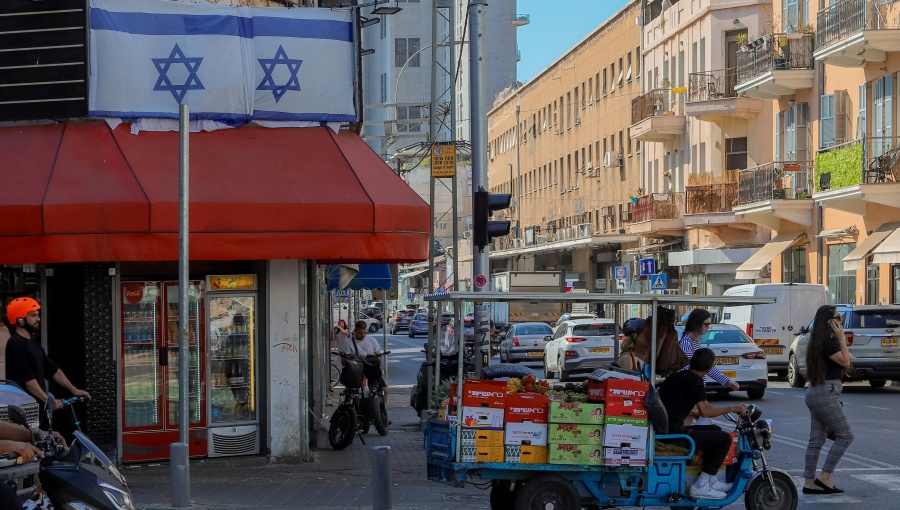
Amid rising concerns over a potential US-Iran war, Israeli citizens are on high alert in preparation for any potential attacks against the country by Tehran.
Diplomatic efforts in Geneva stalled on February 26 between the Iranians and Americans, as reports indicate the two sides could not reach an agreement. Iranian and American negotiators briefly suspended their third round of talks on February 26, then resumed the same day.
Meanwhile, Israel's Home Front Command has remained silent on whether to raise threat levels as a potential conflagration.
Still, the possibility of a US strike on Iran remains on the table. Speaking at his first State of the Union from Washington since being re-elected, Trump said "our enemies are scared...and America is respected like never before" prior to adding that "for decades it had been the policy of the United States never to allow Iran to obtain nuclear weapons."
“I will never allow the world's number one sponsor of terror, which they are by far, to have a nuclear weapon,” Trump concluded.
The silence from Israeli defence authorities has not prevented local officials from activating contingency plans.
Municipal preparations are already underway, suggesting that local authorities are hedging against sudden escalation whilst avoiding public alarm.
"Last week we were at a meeting with the head of the National Emergency Authority, in order to also clarify things and prepare," Haim Bibas, Mayor of Modi'in-Maccabim-Re'ut, told N12. Zvika Brut, Mayor of Bat Yam, added: "We are prepared to go from zero to one hundred, meaning to a full state of emergency within 20 minutes, in all aspects, but on the other hand, we are also busy maintaining calm at the moment, explaining to the public that right now it is a complete routine."
Ramat Gan Mayor Carmel Shama HaCohen added that the city has equipped itself with Starlink satellite systems to maintain communications if electricity and internet networks are damaged. HaCohen confirmed the city is "in an emergency state of distributing informational materials, updating the lessons we have learned and the improvements we have made to the emergency system."
The Assuta hospital network has converted its Ramat HaHayal parking lot into a 200-bed emergency facility. "When necessary, the Assuta Ramat HaHayal parking lot becomes a hospital complex for 200 inpatient beds," CEO Gidi Leshetz confirmed in a press statement.
Tel Aviv residents also expressed mounting anxiety. "I'm a little stressed just because of the children and grandchildren. I have a bag by the door at home with a few things that I need," Dafna Gordon explained, whilst Yaarit Atal noted: "The uncertainty is what's stressful, that we don't know what the future holds."