Friday, January 24, 2025


COMMENT: 

Europe needs to start the fightback against Trump now

COMMENT: Europe needs to start the fightback against Trump now
Hungarian Prime Minister Viktor Orban has become a totemic figure for the US far right.


Robert Anderson in Prague January 21, 2025

Even before Donald Trump re-entered the White House in triumph this week, Europe’s rightwing was already adjusting their sails to the new prevailing wind.

Europe’s resurgent far right has long hailed the coming of the king across the water. Some, such as Hungary’s Viktor Orban, have been longing for this moment for years. The Hungarian premier crowed this week, “So the great attack can start. Hereby I launch the second phase of the offensive that aims to occupy Brussels.”

But now the centre-right (and some liberals and social democrats) are also making their obeisances to the American populist strongman. European politicians are rushing to assure the new president that they will jump at his command – their only question is how high — in a clear sign of the rottenness of the European centre at a time when it should be steeling itself to protect liberal democracy against its modern day enemies.

Trump’s outriders such as Elon Musk have been threatening Europe even before his motorcade arrived, and have met little if no resistance. Even when Trump himself made extraordinary and outrageous territorial claims on Greenland, Danish and EU leaders hardly made a peep.

“There is the danger of bilateral responses, what we have to offer to the new king of America. Everyone is looking how we can please this guy,” Ursula Plassnik, former Austrian foreign minister, warned a seminar at the Czech Institute for International Relations in November.

A weakened Europe – with traditional motors France and Germany consumed by domestic political woes – appears ready to give way to Trump on key parts of the bloc’s policy framework. Already political leaders are rushing to promise to buy more American LNG and hike defence spending (typically by buying more from US arms companies). 

On Ukraine, doomsayers and Kremlin apologists are sensing growing support for their false counsel that Europe should cut and run. The EU has even postponed discussion on Russian sanctions until after his inauguration.

On the Green Deal, there also appears to be mounting pressure to ratchet back. On social media regulation that infuriates US tech giants, the EU has signalled that it will have a rethink. Only significantly on Trump’s threat to impose tariffs are there signs that Europe is prepared to push back.

Trump’s election has also helped to normalise illiberal politicians, Ruth Deyermond, a senior lecturer at King’s College London, told a UCL webinar in November. 

“‘We’re not marginal, we’re really moving with the tide of history’,” she said the far right were now saying, predicting that “they will walk taller, play a bigger role, be more difficult and play hardball … The awkward squad will get more awkward”.

But she argued the mainstream right are really the ones to watch. “We can see figures in these conservative parties who say ‘we need to reassess, to take Trump seriously’,” she said. “They want to do a double take, to get behind a winner.”

The truth is that the rise of Europe’s far-right has long been facilitated by the weakness and lack of scruples of the continent’s traditional centre-right. Time and time again the centre-right has both formed governments with the far right and adopted its illiberal ideas in an attempt to stay relevant, thereby normalising politicians and ideas that are opposed to everything a liberal and democratic Europe stands for.

Currently the radical or far right is in government or has a share of power in nine governments out of 27 in the European Union, with a commanding position in Hungary and Italy. Slovakia’s Prime Minister Robert Fico also arguably should be added to that number, though his party is ostensibly leftwing.

The far right is also likely to add to its tally this year following the elections in Austria, while Calin Georgescu looks likely to become Romanian president at the second attempt in May, after the 2024 election was cancelled because of suspected Russian interference. 

Also in May, Poland’s radical rightwing Law and Justice party will hope Trump’s victory helps it retain the presidency, while Czech populist leader Andrej Babis will be even more confident of returning to power this autumn.

The number of European Council members with a strong radical or far right presence is already close to a blocking minority and that point looks almost certain to be reached in the near future.

This trend was confirmed this month when the centre-right Austrian People’s Party (OVP) agreed to open negotiations on taking part in a government led by the far-right Austrian Freedom Party (FPO). The scandal-ridden FPO, which was formed by Austrian Nazis after the war, plays with Nazi dog whistle slogans, promotes hostility towards immigrants, campaigns against the EU, and has had longstanding links with Russian dictator Vladimir Putin.

In a first for the party, the FPO came top in Austria’s general election last September with 29%, ahead of the country’s two traditional main parties, the OVP with 26% and the Austrian Social Democrats (SPO) with 21%. 

Three month-long negotiations between the OVP and the SPO to keep the FPO out collapsed earlier this month, prompting the resignation of OVP Chancellor Karl Nehammer. Liberal President Alexander Van der Bellen felt he had no alternative than to nominate FPO leader Hubert Kickl as premier. Under its new leader Christian Stocker, the OVP has indicated that it is now willing to serve under Kickl.

The FPO has taken part in Austrian coalitions before but if such a government is formed, this would be the first time it will be calling the shots. The days when the OVP and the SPO were able to divide up power are well and truly over.

An FPO-led government would have serious implications for EU policymaking, notably on Ukraine and Russia, where already Hungary and Slovakia criticise the bloc’s approach. The FPO is so suspect on Russia that when Kickl was interior minister between 2017-19 in an OVP-led government, Nato allies were forced to cut intelligence ties with Austria because of the risks of leaks to the Kremlin.

“Kickl has kept his powder dry on Russia but his policy positions are very Russia-friendly,” says Marcus How of VE Insight, a Vienna-based investment risk advisory. “Kickl is opposed to sanctions, and especially opposed to aid to Ukraine within the European Peace Facility. He is even sceptical of non-lethal aid to Ukraine, and opposed to [hosting] Ukrainian refugees.”

Kickl could be a stalwart ally for Orban, How argues, because Austria is not reliant on EU aid. “Kikl is not like Fico, as he can’t easily be held over a barrel. He is much more ideological, he will be a much more reliable figure for Orban.”

If the FPO is able to form a government, it will give a boost to the EU’s far right and radical right parties, whose rise was highlighted by last summer’s European Parliamentary elections. Kickl would join Orban and Italy’s Georgia Meloni as far-right premiers in the EU, and he could be joined by Babis after the Czech elections this autumn. 

If that were to happen, all the core parts of the old Habsburg Empire – Austria, Czechia and Hungary, together with Slovakia – would be controlled by populist Eurosceptic parties.

An FPO-led Austria could also have a knock-on effect on Germany, where the far-right Alternative for Germany (AfD) is in second place in opinion polls ahead of the general election on February 23. “Will the Austrian government become some kind of template for the far right in Germany?” How ponders.

The rise of the FPO in Austria is mirrored by the rise of the far right in the European Parliament. After last June’s European Parliament elections, Kickl was one of the founders of the Patriots for Europe grouping, together with Orban and Babis. They have subsequently been joined by France’s National Rally, Italy’s Lega, Spain’s Vox, Netherland’s PVV, Belgium’s Vlaams Belang and the Danish People’s Party, becoming the third largest grouping in the parliament.

Several of these parties are already in government, notably Hungary’s Fidesz (leading the government since 2010), and Italy’s Lega and the Dutch PVV, both as part of coalitions. 

Italian premier Meloni’s Brothers of Italy has yet to join the grouping but is close to Orban. More worryingly, France’s National Rally is widely expected to win the next presidential election in 2027, if it is not held earlier.

Alongside the Patriots for Europe is the even more extreme Europe of Sovereign Nations group, which includes the AfD, which is expected to come second in the German federal election next month, ahead of the ruling Social Democrats. 

Both party groups are  likely to become noisier and more obstructive following Trump’s victory.

This populist surge comes as the EU’s traditional leading political families – the Social Democrats and the centre-right European People’s Party (EPP) – are suffering a prolonged crisis of confidence. 

The EPP, to which the OVP belongs, is if anything undergoing the more profound crisis. It has often indulged the far right. Only in 2021 did Orban jump before he was pushed out of the EPP, while Bulgaria’s populist Gerb – which formed the new government there earlier this month – remains a member.

Leading EPP figures have indicated that the group should be open minded about working with the far right in the European Parliament, particularly on migration and on reversing the last Commission’s Green Deal.

European Commission President Ursula von der Leyen (nominated by the EPP) has already shown a willingness to be more accommodating to the views of the far right on migration and the Green Deal, as part of a bargain to use their votes if needed to get the rest of her programme through.

A further risk now is that, following Trump’s victory, the EU could back down on trying to discipline Orban – who has become a totemic figure for the US far right – ignoring his hollowing out of democracy, corruption and abuse of human rights, and his more and more overt sabotage of the bloc’s efforts to counter Russia.

“A new Trump administration might be willing to back [populist forces] in their intra-EU struggles or help out in their individual challenges,” Jeremy Schapiro and Zsuzsanna VĂ©gh wrote in a recent policy brief for the European Council on Foreign Relations. “In exchange, these forces could use their influence in the Council to, say, reduce retaliation from the EU against his trade policies or for increasing fossil fuel and weapons purchases from the US.”

Europe is therefore in danger of giving in to the far right without putting up a fight, something that would be dangerous at any time, but which is disastrous when the continent is threatened by Russian aggression, both on its borders and in hybrid attacks within.

Yet the victory of the far right, abetted by Trump and his minions, is still far from certain. Even in Central Europe, populism’s stronghold, Fico’s government in Slovakia is wobbling, and Orban faces a serious challenge from Peter Magyar’s Tisza party at the 2026 Hungarian election. 

But only by standing firm against Trump and the far right, and by meeting the real – primarily economic – concerns of their discontented voters, will Europe’s centre be able to do this.

FASCIST PRAISE FOR TRUMPVILLE

Immigration: the American state comes first, no more ‘pathololgical altruism’


Ralph Schoellhammer
Comment
BRUSSELS SIGNAL
24 January 2025


While I agree with the premise that Donald Trump’s return to the presidency will be a good thing for the United States, I am a little less sanguine about what is going to happen in Europe. The European leadership in Brussels, but also in the dominant capitals, Berlin and Paris, has a tendency towards severe cases of cognitive dissonance: No matter how strongly the people reject their policies, the decision is always to double down on them.

Take, for example, the issue of migration. Almost nothing bothers Europeans (and Americans) more than the loss of cultural and social cohesion they are experiencing in their daily lives, with economic issues being mostly a secondary concern. Trump, when he came down the escalator in 2015 to announce his run for the presidency, realised this and built his entire movement around the question of migration. In the fall of 2024, it finally paid off: He was re-elected and just a few days ago returned triumphantly to the White House.

And he did not lose any time fulfilling his promises. For example, executive orders say refugees admitted to the US must have a significant probability of integrating into American society. This approach, prioritising national cohesion over unchecked altruism, presents a contentious yet pragmatic stance on immigration policy. Clearly, Trump wants to put the interests of the American state and people first and is giving up “pathological altruism” that has afflicted much of the West. Similarly, illegal border crossings at the Southern border will be stopped, and being born in America to parents who are non-citizens and are in the country on a visa or vacation will not automatically grant US citizenship.

Now compare this to the European Union: “On 04/10/2024, in a landmark decision, the Court of Justice of the European Union, Third Chamber, ruled that cumulative discriminatory measures against Afghan women under the Taliban, such as restrictions on education, employment, healthcare, and freedom of movement, qualify as acts of persecution under Directive 2011/95/EU. The decision underscores that Afghan women, as a group, face inherent risks, making them eligible for refugee status without needing an individual assessment based on personal circumstances.”

In other words, if you happen to be a woman from Afghanistan, you are immediately granted refugee status under EU law. With the stroke of a pen, the “Court of Justice” has decided that 19 million Afghan women would have the right to claim asylum in Europe. While the US is reducing the number of people that can claim asylum, the European Union is expanding it. The hubris of a court that thinks it can decide the constitutive parts of a sovereign nation’s population based on some form of universal human right is – as far as I know – without historic precedent. There are many places in the world where minorities and especially women face inherent risks, including Sudan, Somalia, and almost all of Sub-Saharan Africa. The “Court of Justice” more or less issued an invitation to half the population of the developing world, detaching the question of asylum from the matter of national sovereignty and reducing it to a matter of logistics: If you make it to Europe, you can stay. Not because the elected government in the state you arrive in says so, but because an unelected court in the Grand Duchy of Luxembourg did.

So no matter for whom the people of Europe cast their vote, an entrenched bureaucracy can simply ignore it. You want to limit migration? Tough luck; a collection of judges in a foreign country has decided that you, Hans German or Pierre France, no longer have a say in the matter. Say whatever you want about Donald Trump, at least he was elected and he can be held accountable by the people. In Europe, who can hold the “Court of Justice” accountable?

The problem with the EU is not just the politicians in charge, but also the institutional culture that permeates the entire European project. The supranational vision the EU has been built on has reached its limits, and transferring more and more power from national capitals to Brussels will not change this fact. Neither will the increasingly imperial attitude of the Brussels bureaucracy that thinks it can replace the voluntary surrendering of power to the EU with a forced one. When former EU Commissioner Thierry Breton insinuates that elections in Germany could be annulled if the Alternative for Germany (AfD) should get too many votes, he is not speaking as the representative of a union, but as a wannabe colonial enforcer, for whom the will of the German people is just a nuisance at the periphery of his empire.

Yet Breton is not a cause, but a symptom of the problem. He expresses what the most ardent supporters of the European Union have always believed: That it is a vast bureaucratic straitjacket meant to protect the peoples of Europe from themselves, ideally by gradually and benevolently disenfranchising them. A thick web of laws, regulations, recommendations, and legal rulings is designed to accomplish the kind of democratic tyranny that de Tocqueville described as follows: “Society will develop a new kind of servitude which covers the surface of society with a network of complicated rules, through which the most original minds and the most energetic characters cannot penetrate. It does not tyrannize but compresses, enervates, extinguishes, and stupefies a people, till each nation is reduced to nothing better than a flock of timid and industrious animals, of which the government is the shepherd.”

This is the nutshell version of what the current cadre of European politicians is dreaming of: a world devoid of original minds and energetic characters where everyone is a sheep and they are the shepherds. They do not hate Elon Musk because he is a Nazi or a “threat to democracy”. They hate him because he is an energetic and original mind.

And, by the way, so is Trump – and quite a handful of Europe’s so-called “far right.” For all their flaws, they want to do things differently, while the status-quo elite still sticks to former Chancellor Merkel’s idea of Alternativlosigkeit (there are no alternatives). As the US election has shown, however, there are alternatives, and that is something we should all embrace. Only a system that can change and adapt can survive, while those who fail to do so will wither away.

I usually find comparisons between the EU and the USSR a bit overwrought, but in this respect, they are appropriate: Like Moscow before, Brussels lacks the ability to correct course in a changing environment, doubling down on failing policies instead. The United States has demonstrated that a course correction is possible. 
'Egregious' ICE raid targeted US citizen and military vet: Newark mayor


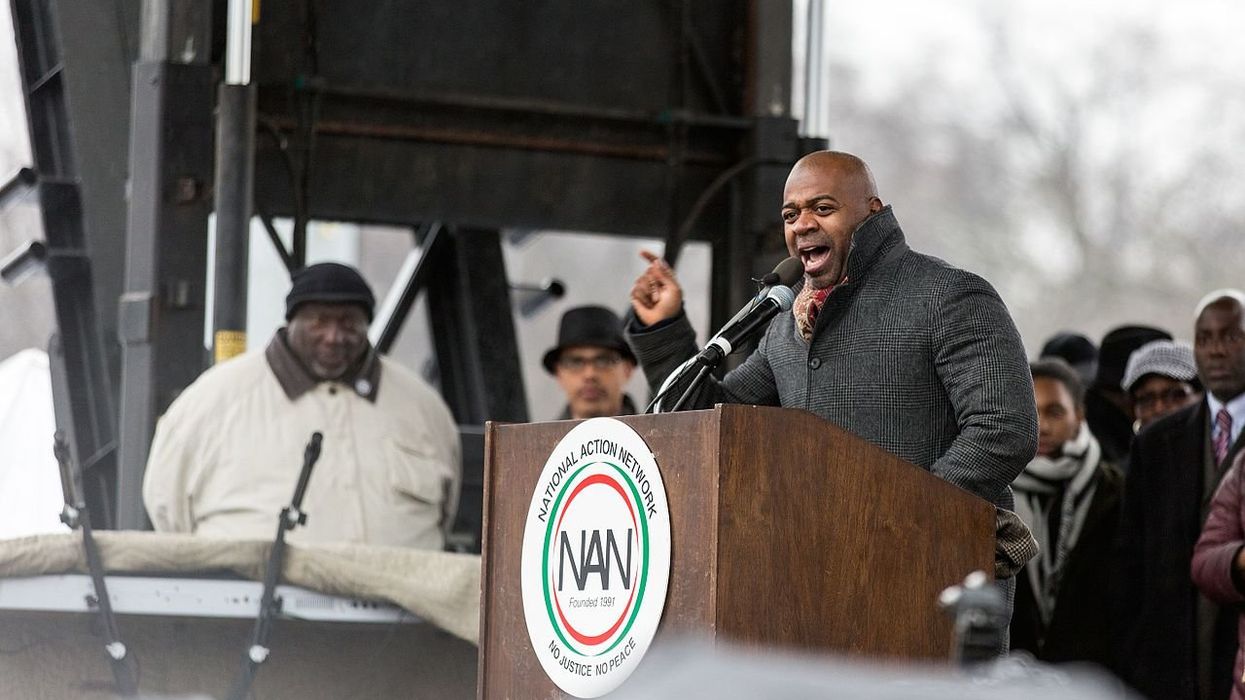
Newark, New Jersey Mayor Ras J. Baraka in 2017 (Wikimedia Commons)

January 24, 2025
ALTERNET

When Donald Trump promised mass deportations on the campaign trail in 2024, some of his critics feared that people who are living in the United States legally could be wrongly deported — including U.S. citizens. Now, during the first week of Trump's second presidency, Newark, New Jersey Mayor Ras J. Baraka is alleging that U.S. Immigration and Customs Enforcement (ICE) officers wrongly arrested a U.S. citizen who served in the military.

The Daily Beast's Janna Brancolini reports that on Thursday, January 23, "about 10 or 12 ICE agents raided a seafood wholesaler and restaurant" in Newark. Baraka alleges that the agents didn't have a warrant and were in violation of the U.S. Constitution's 4th Amendment, which protects against unlawful search and seizure.

Ocean Food Depot owner Luis Janota told New York City's PIX11 News, "I asked (the agents) what documentation they were looking for, and they said it was a license or a passport. I thought, who walks around with a passport…. One of the guys was a military veteran…. He is Puerto Rican and the manager of our warehouse."


READ MORE: GOP rep proposes 'third term' constitutional amendment for Trump: report

Janota added, "It looked to me like they were specifically going after certain kinds of people — not every kind, because they did not ask me for documentation or my American workers, Portuguese workers, or white workers."

Although Puerto Rico does not have statehood, it is a U.S. territory — and Puerto Ricans are U.S. citizens.

Baraka, in an official statement, attacked the January 23 ICE raid as "egregious" and said, "One of the detainees is a U.S. military veteran who suffered the indignity of having the legitimacy of his military documentation questioned. Newark will not stand by idly while people are being unlawfully terrorized."

Brancolini notes that Trump declared a state of emergency after returning to the White House on January 20.

"On Thursday night," according to Brancolini, "the acting head of the Department of Homeland Security signed a memo giving ICE officials the power to deport about 1.4 million people who were allowed to enter the country temporarily and thought they were in the U.S. legally, the New York Times reported. The move shows Trump isn’t just targeting people who snuck across the border, but who came to the U.S. via official, authorized pathways, according to the Times. "

Newark mayor decries 'egregious' warrantless ICE raid

David McBrayer
January 24, 2025 
RAW STORY

An ICE agent (Screenshot)

Federal agents with U.S. Immigration and Customs Enforcement carried out a warrantless raid on Thursday targeting a local establishment in Newark, New Jersey, according to Newark Mayor Ras Baraka—who decried the move as an "an egregious act" in violation of the of the U.S. constitution

Federal agents detained both undocumented residents and citizens, including a U.S. military veteran, Baraka said in a statement Thursday.

The local outlet PIX11 reported that ICE agents targeted the Ocean Seafood Depot, a wholesale seafood distributor. Store owner Luis Janota told the outlet that three people were taken into custody, including a Puerto Rican employee who is a military veteran. People from Puerto Rico have U.S. citizenship.


"We don't fret, we fight," wrote the New Jersey Alliance for Immigrant Justice, which is distributing materials to inform community members about their rights.

Immigration raids on so-called "sanctuary cities"—a list that includes Newark—were expected. On Monday, Trump issued executive orders ramping up immigration enforcement via executive orders, including attempting to end birthright citizenship, reinstating his "Remain in Mexico" policy, suspending refugee resettlement, and moving to restrict federal funds for sanctuary cities.

Trump's deputy acting attorney general sent a memo to Justice Department staff this week indicating that state and local officials could potentially be criminally prosecuted for failing to cooperate with Trump's ramped up immigration enforcement, and the Trump administration has also revoked a directive barring arrests in "sensitive" locations, such as schools.

The changes to immigration enforcement have already been met with hurdles. On Thursday a federal judge temporarily blocked his challenge to birthright citizenship, calling it "blatantly unconstitutional."

"Newark will not stand by idly while people are being unlawfully terrorized. I will be holding a press conference in alliance with partners ready and willing to defend and protect civil and human rights," Baraka said Thursday.

U.S. Sens. Andy Kim and Cory Booker, both New Jersey Democrats, said they were concerned about the news and that their offices had reached out to the Department of Homeland Security "to demand answers."

Following the incident, ICE issued the following statement to multiple news outlets: "U.S. Immigration and Customs Enforcement may encounter U.S. citizens while conducting field work and may request identification to establish an individual's identity as was the case during a targeted enforcement operation at a worksite today in Newark, New Jersey."

On X, ICE posted on Thursday that it had arrested 538 people and detained 373 others, though it's not clear from the post where those arrests and detentions took place.

"A reminder these raids and attacks on the Constitution are an attack on all of us—not just immigrants, not just their families, everyone. You, your neighbors, your colleagues—you're not safe just because you're a citizen, a legal resident, a veteran," wrote Peter Chen, an analyst at the think tank New Jersey Policy Perspective.

ICE officers whine that everyone hates them now: 'Even the cops don’t like us anymore'

Migrants held in US sanctuary city as Trump moves army to border


By AFP
January 24, 2025


Newark Mayor Ras Baraka said a US Army veteran was among those detained in an overnight raid by immigration officers on Ocean Seafood Depot - Copyright AFP Kena Betancur

The mayor of a major US city said Friday immigration officers raided a seafood business, detaining undocumented migrants alongside an American citizen as President Donald Trump pressed actions against undocumented people and deployed troops to the Mexican border.

Trump has pledged a crackdown on migrants with the White House reporting that agents arrested 538 undocumented people on Thursday, with hundreds removed from the country on military aircraft.

Newark Mayor Ras Baraka said that a US Army veteran was among those detained in an overnight raid on Ocean Seafood Depot that marked a resumption of workplace raids, suspended under former president Joe Biden.

“Some ICE (Immigration and Customs Enforcement) agents raided a business in our city without a warrant,” Baraka told a briefing, adding that a military veteran who held US citizenship was questioned during the operation.

“The problem with this is that none of these people were rapists or murderers or criminals — the problem is that ICE went in without a warrant.”

Newark, New Jersey, like other major cities including New York, is a sanctuary city meaning local officials and law enforcement do not typically cooperate with federal immigration agents as a matter of policy.

Trump has threatened to curb federal funding for cities that uphold sanctuary policies.

Immigration enforcement agents used raids on businesses and workplaces during Trump’s first term, with the newly-inaugurated president vowing to resume them, and to conduct operations at schools, churches and hospitals — also off-limits under Biden.

“They caught three guys… everybody is afraid, I don’t know if this is normal. They were from Ecuador I think,” a witness to the Newark raid who declined to be named told NBC News.

Last year under Biden there were 270,000 deportations in total, which was a 10-year high alongside 113,400 arrests.

On his first day in office, Trump signed orders declaring a “national emergency” at the southern border and announced the deployment of more troops to the area, vowing to deport “criminal aliens.”

Active service troops began arriving on the US-Mexico border Friday, images showed, with soldiers working to build structures and barracks.

There are an estimated 11 million undocumented migrants in the United States, according to the Office of Homeland Security Statistics.

Amy Torres, executive director of the New Jersey Alliance for Immigrant Justice, said “people are scared.”

“We knew this was going to happen, and what we learned from folks that stayed behind was that ICE walked in like it was their empire’s own conquered land,” she said.

“They were heavily armed, there was no prior announcement. They were blocking off entrances and exits.”

Donald Trump begins crackdown on ‘illegal immigrant criminals’; 538 arrested, hundreds deported

By HT News Desk
Jan 24, 2025


US authorities arrested 538 illegal migrants and deported hundreds in a large operation following Trump’s second inauguration.

US authorities have arrested 538 illegal migrants and deported hundreds in a mass operation after President Donald Trump took office for the second time this week, according to his press secretary.

Immigrants prepare to be transported by the US Border Patrol after crossing the US-Mexico border on January 20, 2025 near Sasabe, Arizona. (Getty Images via AFP)

In a post on social media platform X, Karoline Leavitt, Trump's press secretary said, “The Trump Administration arrested 538 illegal immigrant criminals including a suspected terrorist, four members of the Tren de Aragua gang, and several illegals convicted of sex crimes against minors.”

Also Read: US House passes Laken Riley Act as Donald Trump begins crackdown on immigrants

She added that hundreds of “illegal immigrant criminals” had been deported via military aircraft.

“The largest massive deportation operation in history is well underway. Promises made. Promises kept,” she said in another post.

The Immigration and Customs Enforcement agency (ICE) also confirmed the arrests and said that 373 detainers (criminal non-citizens) had been lodged in jail.

Also Read: Indian parents denied entry at US airport as Donald Trump's immigration rules tighten

The move comes after Donald Trump signed a slew of executive orders on his first day of office that were aimed to tightening border security and facilitating the deportation of undocumented immigrants in the country

Also Read: Birthright citizenship panic: Indian expectant mothers in US rush to beat Trump's deadline

Raids were also conducted in Newark, New Jersey, which is designated as a ‘sanctuary city’, where not only undocumented immigrants but legal residents were also detained.

The city's mayor Ras Baraka condemned the action and said, “Newark will not stand by idly while people are being unlawfully terrorized.”
Trump's anti-immigration orders

President Trump brought an end to a policy that restricts ICE agents from arresting undocumented people in houses of worship, schools and hospitals, among many others orders passed on his first day in office.

Trump said that his cabinet “shall take appropriate action to repel, repatriate or remove any alien engaged in the invasion," referring to migrants crossing borders illegally.

Framing illegal immigration as a national security crisis, Trump has also allowed for military service members to act as immigration and border enforcement officers as part of his mass deportation program.


Trump toughens crackdown on immigration and diversity


By AFP
January 22, 2025


US President Donald Trump has launched a crackdown on diversity programs - Copyright AFP Jim WATSON

Danny KEMP

President Donald Trump announced Wednesday deployment of an extra 1,500 US troops to the Mexican border, as he stepped up a crackdown against illegal immigration and diversity programs in a whirlwind start to his second term.

The 78-year-old Republican — who has pledged a “golden age” for America — halted refugee arrivals and threatened to prosecute local authorities that fail to deport migrants.

As part of his blitz of right-wing measures on returning to office, the billionaire also ordered that US government employees in diversity programs — conceived as ways to combat racism and sexism — be put on paid leave immediately.

Trump held what was reportedly his first phone call with a foreign leader since taking office Monday, talking with Saudi Crown Prince Mohammed bin Salman, who promised increased trade to the United States, according to the kingdom’s foreign ministry.

And in the latest round of appointments, Trump announced that fast food executive Andrew Puzder — who has previously faced questions over his business and private conduct — will be the new US ambassador to the European Union.

He named his longtime Secret Service bodyguard Sean Curran — who was at his side when an assassin opened fire and grazed his ear during a presidential campaign rally last July — as director of the security agency, which protects the president and other top officials.

But while Trump is steamrolling through Washington, there have been surprise speedbumps.

Close advisor and world’s richest man Elon Musk revealed budding tensions when he bashed an AI investment mega project that Trump himself publicly touted at a televised White House event, flanked by top Silicon Valley tycoons.

And Trump prompted questions when he threatened Russia with sanctions if it doesn’t accept an unspecified Ukraine peace deal — something he previously had claimed he would broker within 24 hours.

His predecessor Joe Biden had left him a “lot of work,” Trump told Fox News’s Sean Hannity in his first television interview since taking office.

As Los Angeles continues to be scorched by wildfires, he also floated the idea of ending federal disaster aid and disbanding FEMA, the government agency that manages disasters.

“I’d rather see the states take care of their own problems,” he told Hannity.


– Migrants and diversity fight –


Trump, who has more than a dozen ex-Fox News employees in his adminstration, discussed his barrage of executive orders and his plans for the first 100 days.

But it was a typically divisive conversation, with Trump — investigated for leading unprecedented efforts to overturn his 2020 election loss — calling Democrats “stupid” and claiming that “the only thing they’re good at, really, is cheating.”

Since reentering the White House, Trump has focused heavily on harsh migration measures.

White House Press Secretary Karoline Leavitt confirmed that Trump was dispatching 1,500 troops to add to the 2,000-plus contingent already at the Mexican border.

He likewise halted arrivals of refugees already cleared to enter the United States as part of the crackdown, according to a State Department memo.

Trump’s other main target has been on anything related to diversity, equity and inclusion (DEI) programs.

He ordered related government websites and social media accounts to go offline and federal workers involved to put on paid leave.

Trump also ended what he called “radical” affirmative action in awarding federal contracts, revoking an order crafted to combat racism that dates back to the civil rights era of the 1960s.

One of Trump’s first acts as president on Monday was to pardon more than 1,000 supporters who stormed the US Capitol, attacking police and vandalizing the seat of US democracy, after he lost in 2020.

A row between Trump and the bishop at the National Cathedral, who asked him during her sermon at a service he attended Tuesday to show “mercy” to “scared” migrants and LGBTQ people, simmered on.

Trump called Bishop Mariann Edgar Budde “nasty” and she later told The New York Times that she felt compelled to speak up.

“Was anyone going to say anything about the turn the country’s taking?”

He has also ordered the suspension of the US Refugee Admission Program from January 27, 2025.


‘Hunting grounds’: Trump cancels ban on ICE arrests at schools, churches, hospitals

David Badash, The New Civil Rights Movement
January 21, 2025 

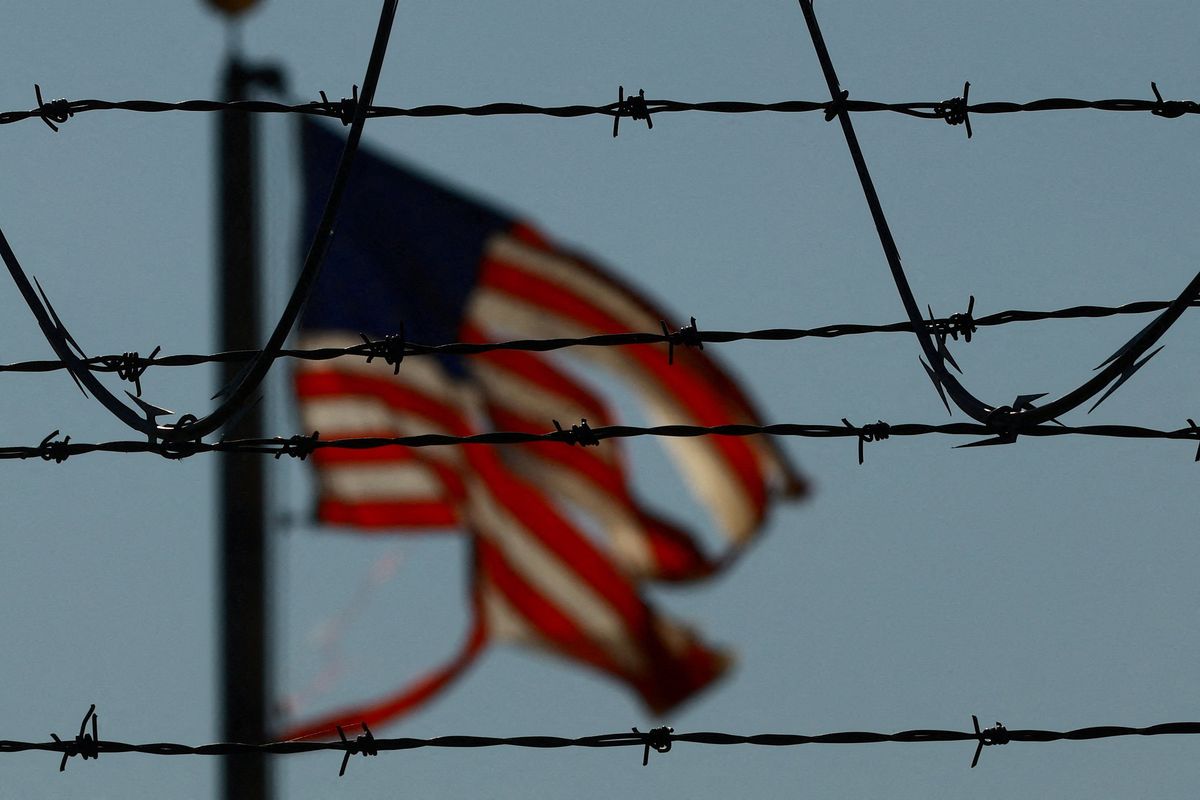
FILE PHOTO: A United States flag is seen near the El Paso airport as Guatemalan migrants, mostly shackled, are being transported to a plane to be expelled from the United States to their country of origin by agents of the U.S. Immigration and Customs Enforcement (ICE) and Border Patrol agents, at the El Paso airport, Texas, U.S., June 13, 2024. REUTERS/Jose Luis Gonzalez/File Photo

The Trump administration has canceled President Joe Biden’s ban on federal immigration agents arresting suspects inside schools, churches, houses of worship, hospitals, shelters, and at events such as weddings, funerals, and public demonstrations and protests.

“This action empowers the brave men and women in CBP and ICE to enforce our immigration laws and catch criminal aliens— including murders [sic] and rapists—who have illegally come into our country. Criminals will no longer be able to hide in America’s schools and churches to avoid arrest,” an unnamed DHS spokesperson said in a statement Tuesday, posted by CBS News’s Camilo Montoya-Galvez. “The Trump Administration will not tie the hands of our brave law enforcement, and instead trusts them to use common sense.”

“The Biden-Harris Administration abused the humanitarian parole program to indiscriminately allow 1.5 million migrants to enter our country. This was all stopped on day one of the Trump Administration,” the spokesperson alleged. “This action will return the humanitarian parole program to its original purpose of looking at migrants on a case-by-case basis.”

CBS’s Montoya-Galvez also reports that the “new DHS team has also instructed officials to begin the process of phasing out programs that allowed certain immigrants to stay in the U.S. under the immigration parole authority.”

“Pro-immigrant advocates had feared the rescission of the Biden-era rules, warning that it would allow the Trump administration to bring its mass deportations plans to churches and schools,” Montoya-Galvez wrote at CBS News.

CNN calls the move “a departure from long-standing policy to avoid so-called sensitive areas.”

Attorney Krish O’Mara Vignarajah, formerly the Policy Director for First Lady Michelle Obama, responded to the news: “Churches, hospitals, and schools all appear to now be hunting grounds for ICE enforcement operations.”

Immigration law attorney Allen Orr Jr. remarked, “It’s never been about safety or national security. It’s about fear—weaponized to isolate and divide.”

In an interview with Fox Business (video below), Trump’s “border czar” Tom Homan was asked on Tuesday, “If and when ICE went into a school to arrest someone, that would be highly contentious, wouldn’t it?”

Homan quickly turned the hypothetical example from a “school,” which could be an elementary school, to a “college campus.”

“Absolutely. But then again, you know, what’s our national security worth?” he replied. “If we have a national security vulnerability that we know is a national security risk, and we have to walk on a college campus to get him, that’s something we have to do.”

Indeed, various Homeland Security officials prior to Trump’s administration have issued similar bans on arrests in sensitive areas. Among them, John Morton, the Assistant Secretary for U.S. Immigration and Customs Enforcement (ICE) from 2009 to 2013, under President Barack Obama.

In 2021, DHS Secretary Alejandro Mayorkas issued a new memo, focused on how “we impact people’s lives and advance our country’s well-being.”

Mayorkas wrote, “When we conduct an enforcement action – whether it is an arrest, search, service of a subpoena, or other action – we need to consider many factors, including the location in which we are conducting the action and its impact on other people and broader societal interests. For example, if we take an action at an emergency shelter, it is possible that noncitizens, including children, will be hesitant to visit the shelter and receive needed food and water, urgent medical attention, or other humanitarian care.”

“To the fullest extent possible, we should not take an enforcement action in or near a location that would restrain people’s access to essential services or engagement in essential activities. Such a location is referred to as a ‘protected area.’ This principle is fundamental. We can accomplish our enforcement mission without denying or limiting individuals’ access to needed medical care, children access to their schools, the displaced access to food and shelter, people of faith access to their places of worship, and more. Adherence to this principle is one bedrock of our stature as public servants.”

Mayorkas had expanded the list of “protected” or “sensitive” areas to include doctor’s offices, vaccination or testing sites, playgrounds, recreation centers, foster care facilities, and school bus stops, to name a few.

Watch the video below or at this link.


Duration in immigration detention and health harms


JAMA Network


About The Study:

 In this cross-sectional study, detained immigrants experienced a high prevalence of poor health, mental illness, and posttraumatic stress disorder (PTSD), with detention periods of 6 months or more associated with higher rates compared with those detained less than 6 months. Duration of custody is one mechanism by which immigration detention might be a catalyst for worsening health. 

Corresponding Author: To contact the corresponding author, Altaf Saadi, MD, MSc, email asaadi@mgh.harvard.edu.

To access the embargoed study: Visit our For The Media website at this link https://media.jamanetwork.com/

(doi:10.1001/jamanetworkopen.2024.56164)

Editor’s Note: Please see the article for additional information, including other authors, author contributions and affiliations, conflict of interest and financial disclosures, and funding and support.

#  #  #

Embed this link to provide your readers free access to the full-text article This link will be live at the embargo time http://jamanetwork.com/journals/jamanetworkopen/fullarticle/10.1001/jamanetworkopen.2024.56164?utm_source=For_The_Media&utm_medium=referral&utm_campaign=ftm_links&utm_term=012425

About JAMA Network Open: JAMA Network Open is an online-only open access general medical journal from the JAMA Network. On weekdays, the journal publishes peer-reviewed clinical research and commentary in more than 40 medical and health subject areas. Every article is free online from the day of publication. 


Trump pardons ‘peaceful’ anti-abortion protestors who barricaded door and injured nurse

Among those pardoned by Trump is Lauren Handy, who was discovered to have stolen fetal remains in her home

Alex Woodward
in New York
Friday 24 January 2025 
Independent UK

Trump pardons anti-abortion activists who blocked access to clinics


Donald Trump signed pardons for 23 anti-abortion activists who were convicted for violating a federal law that makes it a crime to block entrances to reproductive health clinics.

The pardon list includes Lauren Handy, who is serving a nearly five-year prison sentence after forcing her way inside a Washington, D.C., clinic in 2020 and using ropes, bike blocks and chains to stop patients from entering — actions that anti-abortion groups and Republican officials have characterized as peaceful protests unjustly prosecuted by a politically motivated administration.

Their convictions under the Freedom of Access to Clinic Entrances Act during Joe Biden’s presidency were fiercely condemned by anti-abortion organizations and right-wing legal groups, which pressed Trump for Thursday’s pardon.

Trump pardons anti-abortion activists who blocked access to clinics

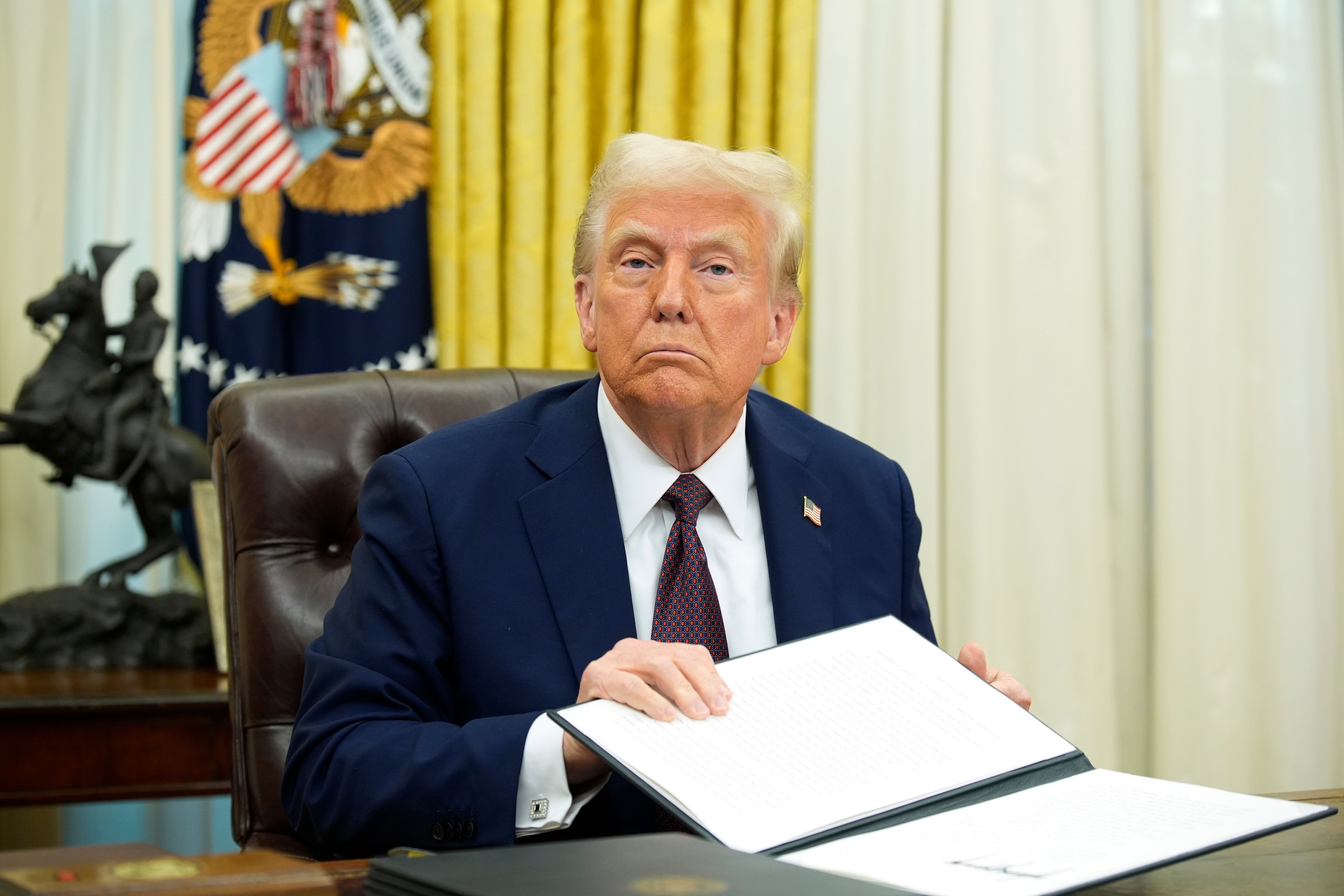
open image in galleryDonald Trump signed pardons for 23 anti-abortion activists on his fourth day in office (EPA)

Handy, in an unrelated case, made headlines after federal authorities discovered fetal remains in her apartment in March 2022. She reportedly stole the remains from a medical waste truck parked outside a clinic. No charges were ever filed in that case and the incident was not part of the investigation leading to her conviction under the FACE Act.

“This is a great honor to sign this,” Trump said from the Oval Office on Thursday. “They should not have been prosecuted … Ridiculous.”

Steve Crampton, senior counsel with the anti-abortion advocacy group Thomas More Society, called the pardons a “huge step towards restoring justice.”

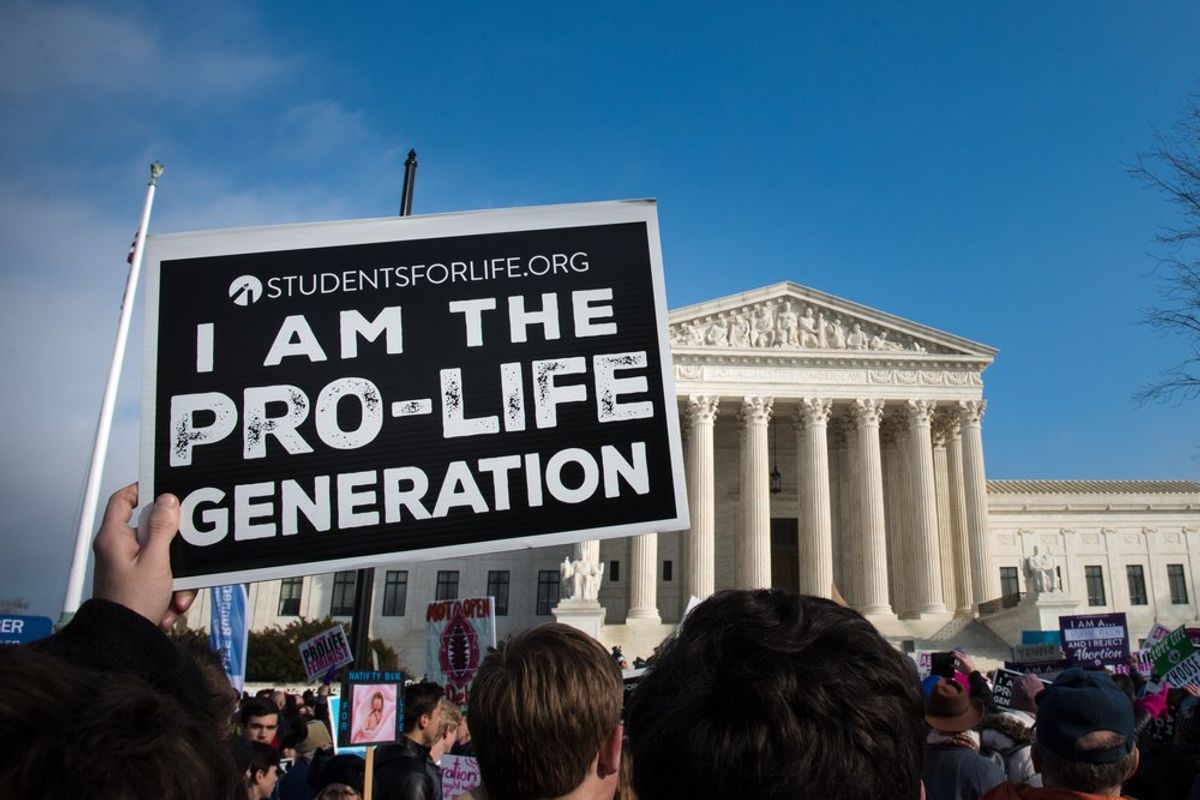
The pardons were issued one day before thousands of anti-abortion activists gather in Washington for the annual March for Life event, which marks the anniversary of the Supreme Court’s landmark 1973 decision in Roe v Wade, which affirmed a constitutional right to abortion care. The Supreme Court’s conservative majority overturned that decision in 2022, upending access to care for tens of millions of women across the country.

Trump and Vice President JD Vance are expected to deliver remarks at Friday’s event.

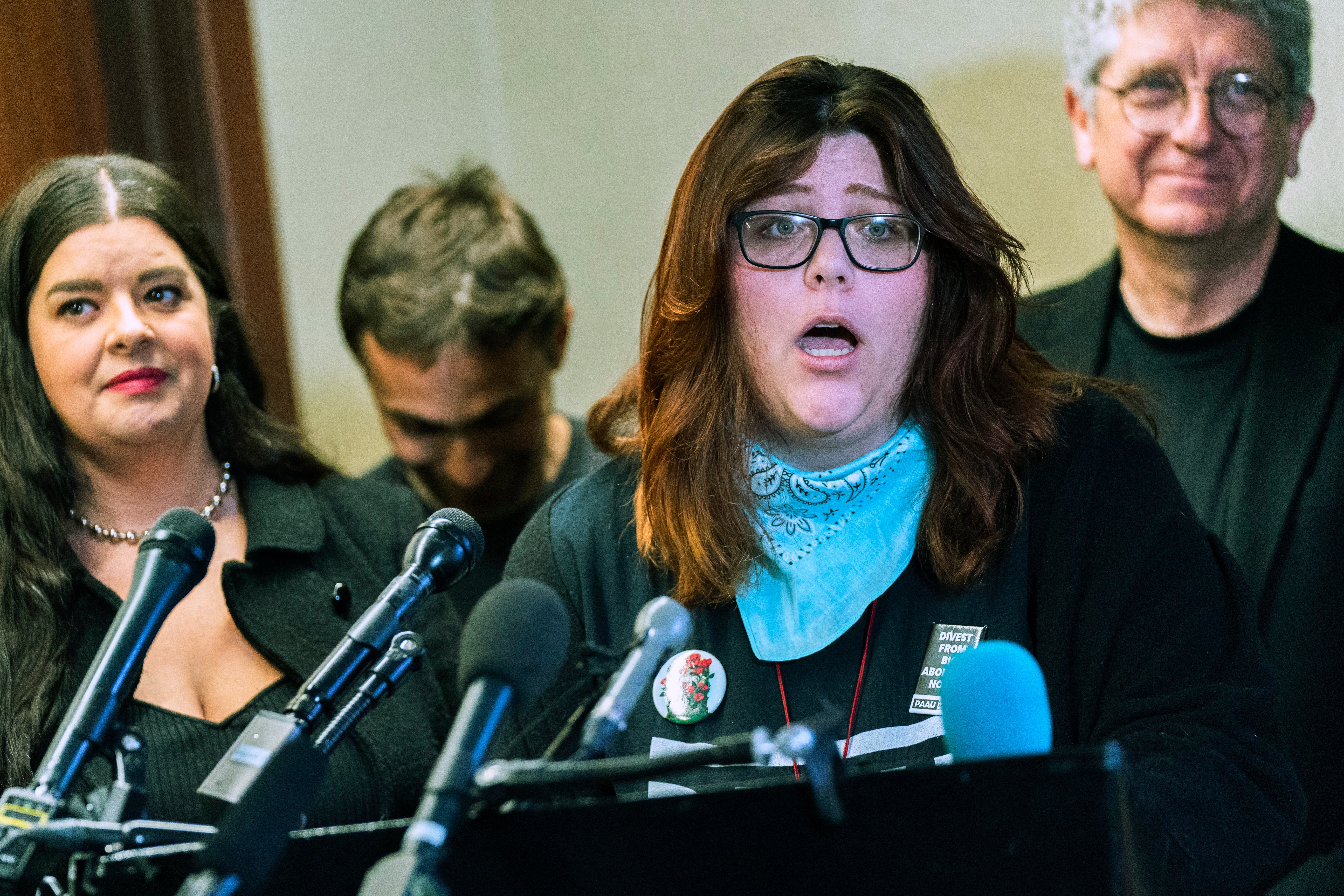
open image in galleryLauren Handy is among 23 anti-abortion activists who received presidential pardons on January 23 after they were convicted for violating federal law that makes it a crime to block access to reproductive health clinics (AP)

Prosecutions in the Washington case marked the first time that the Department of Justice charged anti-abortion activists under the FACE Act, which was enacted in the early 1990s in response to a wave of violent threats towards reproductive healthcare providers and patients.

The violence reached a peak in 1993, when fundamentalist Christian activist Michael Griffin fatally shot physician David Gunn outside a Florida clinic. That same year, anti-abortion activist Shelley Shannon was convicted for the attempted murder of George Tiller, who operated a clinic in Kansas. In 2009, Tiller was murdered by anti-abortion activist Scott Roeder during a Sunday service at Tiller’s church.

The FACE Act makes it a crime to damage or destroy facilities or to intimidate or interfere with anyone obtaining or providing reproductive healthcare.

This week, House Republican Chip Roy filed legislation to revoke the law, which he claims has been “weaponized against pro-life Americans” for “for speaking out and standing up for life.” But the FACE Act has also been used to prosecute abortion rights demonstrators — as recently as last year — who have targeted so-called crisis pregnancy centers.

Senator Josh Hawley grilled Trump’s attorney general nominee Pam Bondi on whether her Department of Justice would ever pursue similar charges.


“Will you protect churches and pregnancy care centers when they are targeted for violence, when they are targeted for intimidation?” Hawley asked during her Senate confirmation hearing last week. He also asked if she would “stop the disparate treatment of Americans on the basis of religious faith” and “stop the deliberate persecution of pro-life Americans for nothing more than their pro-life beliefs.”

She said “yes” to both.

Trump issued the pardons as House lawmakers voted 217-to-204 on a bill that would criminalize healthcare providers’ failure to care for an infant that is “born alive” after an abortion — which would be infanticide, and is already plainly illegal. Democrats have blasted the legislation as a publicity stunt; less than 1 percent of abortions occur within the final weeks of a pregnancy, and virtually all are the result of dire medical conditions, according to the Centers for Disease Control and Prevention.

It was the second time in two years that the bill was introduced in the Republican-led House. It has no chance of passage in the Senate, where Democrats blocked the bill from coming up for a vote on Wednesday.


GOP senators warn Smithsonian museums not to eject anti-abortion activists

Matthew Chapman
January 21, 2025 
RAW STORY


Washington, DC / USA – January 18, 2019: Pro-life supporters participate in the 46th annual March for Life in Washington, DC. (Jeffrey Bruno / Shutterstock)

Republican senators sent a stern warning to the Smithsonian museums: leave anti-abortion activists to do what they want.

According to Fox News, Sens. Ted Cruz (R-TX) and Todd Young (R-IN) told the institutions in a letter, "This peaceful exercise of First Amendment rights has historically provided participants with a positive, welcoming experience in our nation’s capital," and that attendees of the National March for Life should not be harassed or excluded if they visit the museums.

"Two years ago, the Smithsonian National Air and Space Museum booted several Catholic students and their chaperones for wearing pro-life attire," reported Jamie Joseph. "Students and chaperones from Our Lady of the Rosary School in Greenville, South Carolina, traveled to Washington, D.C., to participate in the annual National March for Life. The group stood out in matching blue beanies emblazoned with the words 'Rosary PRO-LIFE.'"

Ultimately, the Smithsonian had to settle a lawsuit brought on the students' behalf by the right-wing public interest law firm, the American Center for Law and Justice. While the Air & Space Museum disputes certain accounts of the students, spokesperson Alison Wood told the conservative Washington Examiner that their removal was not appropriate.

“Asking visitors to remove hats and clothing is not in keeping with our policy or protocols,” said Wood. “We provided immediate training to prevent a reoccurrence of this kind of incident and have determined steps to ensure this does not happen again.”

In recent years, the March for Life has been plagued with troubles even as the group saw one of its major policy goals accomplished with the Supreme Court allowing states to enact total abortion bans. In 2022, the white supremacist group Patriot Front infiltrated the organization. More recently, anti-abortion groups have been divided over what the strategy should be and whether President Donald Trump is moving them in the right direction.
Trump revokes security protection for COVID advisor Fauci

Agence France-Presse
January 24, 2025


President Donald Trump has revoked security protection for his former Covid advisor Anthony Fauci (POOL/AFP)


U.S. President Donald Trump said Friday that he has revoked security protection for Anthony Fauci, his former COVID advisor who has received death threats over his handling of the pandemic.


"You can't have a security detail for the rest of your life because you worked for government," Trump told reporters in North Carolina, where he was on a visit to inspect flood damage.

Trump withdrew Secret Service protection earlier this week from his former national security advisor John Bolton.

The New York Times said the president had also revoked government security provided to his former secretary of state, Mike Pompeo, and a top Pompeo aide, Brian Hook.

Asked by a reporter whether he would feel partially responsible if anything happened to Fauci or Bolton, Trump said: "No."

"Certainly I would not take responsibility," he said.

"They all made a lot of money," Trump said. "They can hire their own security."

"I can give them some good numbers of very good security people," the president said. "Fauci made a lot of money."


According to the Times, Fauci's security protection was canceled on Thursday and he has hired his own security detail.

Fauci, who led the country's fight against the Covid pandemic during Trump's first term, has become a hated figure for many on the right and has received numerous death threats.

Former president Joe Biden issued a preemptive pardon to Fauci on Monday before leaving office.

Bolton, who has been the target of an alleged Iranian assassination plot, has become one of Trump's most outspoken critics since leaving the White House.


The State Department has announced a $20 million reward for information leading to the arrest of the alleged Iranian mastermind behind the plot to assassinate Bolton.

U.S. officials have also accused Iran of seeking to assassinate Trump to avenge the death of Iranian general Qassem Soleimani, who was killed in 2020 in a US drone strike.

© Agence France-Presse
Major leak exposes billions of Weibo and DiDi records


By Dr. Tim Sandle
January 22, 2025
DIGITAL JOURNAL


Photo: © AFP

Cybernews research has discovered one of the largest data leaks mainly involving Chinese nationals. One unknown server exposed 1.5 billion records of users’ sensitive data, such as full names, government ID numbers, and more.

The unprotected server, which contains hundreds of millions of records, houses data from several major brands, such as JD.com (142 million exposed records), Weibo, DiDi, various Chinese banks, and many others.

Cybernews researchers believe the dataset is likely a mix of known and completely new data leaks collated on a single now-closed Elasticsearch server. While not all 1.5 billion records were exposed for the first time, some undoubtedly were, as the analysts found no indication of previous data leaks from companies included in the list.

The largest number of identifiable records were grouped in a collection credited to QQ messenger, Tencent’s instant messaging software. The second largest collection of leaked records, 504 million, was credited to Weibo, sometimes called China’s Twitter.

It is worth noting that while 1.5 billion records were exposed, this does not mean the same number of individuals had their details leaked online. Since details come from different platforms, organizations, and economic sectors, some users may have had their data leaked several times.

“Saying the magnitude of this leak is alarming is an understatement. The leaks’ volume alone is mind-boggling. Worse so, the exposed server had data from essential sectors like healthcare and finance, amplifying the potential harm,” Cybernews researchers said in a statement.

What data was exposed?

• Full names
• Email addresses
• Platform ID numbers
• Usernames
• Phone numbers
• Healthcare data
• Financial records
• Transportation-related details
• Education-related records

As the database’s owner remains unknown, it raises serious concerns about data privacy and security.

Spotlight: China

The third largest exposed dataset, with over 25 million records, was credited to China’s largest courier service, SF Express. The researchers discovered tens of thousands of leaked records titled Sichuan Nurse, another million titled Doctor and Patient, and 400,000 more credited to pharmacies.

Collections like Securities (243k), China Provident Fund (531k), China Union Pay Users (1.1 million), China Merchants Bank (1 million), Bank of China (985k), as well as a collection named Cryptocurrency (100k), strongly suggest a massive financial data exposure.

In addition, the collection of Zhejiang Student Records (9 million) and Graduate data (366k) points to the exposure of educational data likely involving millions of Chinese students. There’s also the addition of the Zhilian collection (1.1 million), which likely refers to Zhillian Technology, an automotive R&D company.

With specific records, 2.6 million records were credited to vehicle owners, and another 3.5 million were credited to an unnamed driving school, pointing to the server owners’ interest in Chinese motorists. Another 65k records were attributed to customers of an unknown mobile carrier, residents of Beijing (196k), KFC China (5 million), and Household registration data (5.4 million).


Study shows drop in life expectancy in the Gaza Strip


A collaborative team of international researchers estimate that between Oct. 2023 and Sep. 2024 compared to pre-war levels, life expectancy in the Gaza Strip almost halved.


University of Pennsylvania


Life expectancy in the Gaza Strip has been nearly cut in half (-46.3%) since the current war began in October 2023, according to new estimates published in The Lancet. The study led by Michel Guillot, professor of sociology in the School of Arts & Sciences, and a team of international collaborators found that life expectancy dropped from a pre-war average of 75.5 years to 40.5 years for the period of time between October 2023 and September 2024. The decrease in life expectancy was higher for men (-51.6%; 73.6 years pre-war to 35.6 years) than for women (-38.6%; 77.4 years pre-war to 47.5 years).

The authors calculated three life expectancy scenarios: 

  • The central scenario—based on the official count of fatalities from the Gaza Ministry of Health, excluding the estimated count of individuals reported missing or under the rubble, estimates life expectancy between Oct. 2023 and Sep. 2024 to be 40.5 years  

  • The low scenario—based on deaths for which complete identifying information was available—estimates life expectancy between Oct. 2023 and Sep. 2024 to be 44.4 years

  • The high scenario—based on the official count of fatalities from the Gaza Ministry of Health, including the lower bound of the estimated count of individuals reported missing or under the rubble—estimates life expectancy between Oct. 2023 and Sep. 2024 to be 36.1 years

The authors caution that the central scenario estimate of 40.5 years life expectancy includes deaths for people whose identification information was not complete and whose existence could not be cross-checked against the United Nations Relief and Works Agency for Palestine Refugees in the Near East (UNRWA) register. As the estimate doesn’t include individuals reported missing or under the rubble it may still be an underestimation. Additionally, the authors highlight that none of the scenarios include the indirect effects of the war—such as lack of access to health care and malnutrition—on mortality.  

Michel Guillot is a professor in the Department of Sociology and a research associate in the Population Study Center in the School of Arts & Sciences at the University of Pennsylvania.

Other authors on the study include Penn Ph.D. candidate José H C Monteiro Da Silva; Mohammed Draidi of the Palestinian Central Bureau of Statistics, Ramallah, Palestine; Valeria Cetorelli of the UN Relief and Works Agency for Palestine Refugees in the Near East, Amman, Jordan; and Ismail Lubbad UN Economic and Social Commission for Western Asia, Beirut, Lebanon.