Tuesday, January 28, 2025

NAKBA 2.0

France slams Trump's plan to forcibly displace Gazans to Jordan and Egypt


France has called a proposal by US President Donald Trump to forcibly move Gazan Palestinians to Egypt and Jordan “unacceptable”, adding it would be a serious breach of international law and could derail future efforts towards a two-state solution.

28/01/2025 - 
FRANCE24
By: NEWS WIRES
Columns of Gazans, many carrying whatever belongings they could, were moving toward northern Gaza for the second consecutive day on January 28 after Israel permitted their passage as part of an ongoing ceasefire. © Eyad Baba, AFP

France on Tuesday said any forced displacement of Gazans would be "unacceptable" after US President Donald Trump proposed moving Gaza Palestinians to Egypt and Jordan.

"Any forced displacement of the population in Gaza would be unacceptable," a French foreign ministry spokesman said when asked about Trump's comments.

"It would not only be a serious violation of international law, but also a major hindrance to the two-state solution," the spokesman said, referring to calls for Israeli and Palestinian states living side-by-side.

It would also be a "destabilisation factor (for) our close allies Egypt and Jordan".


Almost all of the Gaza Strip's 2.4 million inhabitants have been displaced by the war that began with Palestinian militant group Hamas's attack on Israel on October 7, 2023.

But a fragile ceasefire that came into force this month could boost permanent peace efforts.

Trump on Monday expressed his desire to move Palestinians from Gaza to "safer" locations such as Egypt or Jordan.

Trump had on Saturday floated the idea to "clean out" Gaza after the conflict, which he said had reduced the Palestinian territory to a "demolition site."

After jointly mediating the ceasefire with the United States and Egypt, Qatar on Tuesday said the two-state solution was "the only path forward".


07:13People walk northwards along a coastal in Gaza after Israel opened the way following a deal on future hostage exchanges © Omar AL-QATTAA / AFP

Egypt and Palestinian Authority president Mahmoud Abbas have also strongly opposed Trump's proposal.

(AFP)


FASCISTS OF A FEATHER...
Italy PM Meloni under investigation for releasing Libyan warlord wanted by ICC
Europe

Italian Prime Minister Giorgia Meloni and two of her government ministers were placed under investigation Tuesday for allegedly releasing and repatriating a Libyan official wanted by the International Criminal Court for war crimes.


Issued on: 28/01/2025 -
FRANCE24
By: NEWS WIRES
Italy's Prime Minister Giorgia Meloni at a joint press conference at Palazzo Chigi in Rome on November 5, 2024. © Tiziana Fabi, AFP

Italian Prime Minister Giorgia Meloni on Tuesday said she and two of her ministers were under investigation after a Libyan official wanted by the ICC for war crimes was released and repatriated.

She made the announcement in a video on Facebook and said the probe was politically motivated.

Osama Najim, head of the Libyan judicial police, was detained 10 days ago in a Turin hotel on an arrest warrant from the International Criminal Court (ICC).

He was released a few days later on procedural grounds by a Rome appeals court, and flown to Libya on an Italian government plane.

Investigative magistrates suspect Meloni and Justice Minister Carlo Nordio and Interior Minister Matteo Piantedosi facilitated Najim's release.


Meloni has frequently accused magistrates, particularly Rome prosecutor Francesco Lo Voi, of being biased against her government.

She noted that he was the prosecutor in the trial of deputy head of government Matteo Salvini for stranding migrants at sea while he was interior minister in 2019. He was found not guilty.

Italian judges are obliged to open an investigation following the filing of a complaint, allowing the persons targeted by the probe to hire a lawyer.

Najim is accused by the ICC of having committed crimes in Libya against detainees.

On Saturday and again in her video, Meloni defended the expulsion of the Libyan police chief, asking why the ICC only issued the warrant as he entered Italy after "spending a dozen calm days in three other European countries".

(AFP)

Danish PM marshals European support against Trump's threats to Greenland
Europe


Danish Prime Minister Mette Frederiksen received pledges of support on Tuesday from European leaders in the face of US President Donald Trump's threats to Greenland on a whirlwind tour that included talks with German Chancellor Olaf Scholz, French President Emmanuel Macron and NATO Secretary General Mark Rutte.


Issued28/01/2025 -
By: FRANCE 24
Denmark's Prime Minister Mette Frederiksen meets with NATO Secretary General Mark Rutte in Brussels on January 28, 2025. © Mads Claus Rasmussen, Ritzau Scanpix, AFP

Danish Prime Minister Mette Frederiksen on Tuesday said she had received support from European leaders as she sought backing to counter US President Donald Trump's threats to take over Greenland.

Frederiksen and NATO chief Rutte agreed that allies need to focus on strengthening defences in the Arctic, a source familiar with the talks told Reuters.

"They agreed that in this effort all allies have a role to play," the source said after the meeting.

After an initial stopover in Berlin, Frederiksen was in Paris by midday for a meeting with French President Emmanuel Macron, after which she told reporters she had received "a great deal of support".


"This is a very, very clear message ... that of course there must be respect for territory and the sovereignty of states," Frederiksen said.

"This is a crucial part of the international community, the international community that we have built together since World War II," she added.

Trump has signalled that he wants the Arctic island – which is believed to hold large untapped mineral and oil reserves – to become part of the United States.

He has talked for years about a possible deal to take control of the Danish autonomous territory.

On Saturday, he told reporters he believed that the United States would "get Greenland", which is located between the United States and Europe in a region of increasing strategic value as the melting of Arctic sea ice opens up new shipping routes.

Trump argues his country needs Greenland for "international security".

Read moreTrump's expansionist designs, from Greenland to the Panama Canal

But Denmark's Foreign Minister Lars Lokke Rasmussen on Tuesday retorted that "Trump will not have Greenland."

"Greenland is Greenland. And the Greenlandic people are a people, also in the sense of international law," Lokke told reporters.

Frederiksen met early on Tuesday with German Chancellor Olaf Scholz in Berlin. After speaking about Russia's war in Ukraine, Scholz stressed that "borders must not be moved by force" and added the English-language phrase: "To whom it may concern."

The chancellor said "the times we live in are challenging" and require a strong Europe and NATO. He stressed that "Denmark and Germany are strong partners and close friends."
'Gravity of the situation'

Tuesday's visits followed a weekend Nordic summit where leaders all "shared the gravity of the situation", Frederiksen said.

Denmark on Monday announced that it would spend 14.6 billion kroner ($2 billion) to bolster security in the Arctic.

It said it would send three new frigates to the region, as well as long-distance drones equipped with advanced imaging capabilities. It would also reinforce its satellite capabilities.

Officials in Greenland, which depends heavily on Denmark for subsidies, have long been pushing for independence but have said they are open to doing business with the US.

A day after Trump was sworn in as president, Greenland Prime Minister Mute Egede insisted that Greenlanders "don't want to be American".

In mid-January, Frederiksen reportedly spoke to Trump by telephone, stressing that it was up to Greenland to determine its future.

According to European sources cited by the Financial Times, Danish officials described the conversation as "horrendous" and said that Trump's interest in Greenland was "serious, and potentially very dangerous".

The US president, who has not excluded a possible military intervention to annex the island, reportedly threatened Denmark with tariffs over the issue.

The United States is the small Scandinavian country's main export market.
'Worrying time'

Greenland's trade and justice minister Naaja Nathanielsen on Monday told AFP that the Greenlandic people were living through a "worrying time" and were "concerned" about Trump's statements.

"As a government, our job is not to panic and to figure out what the actual demands are," Nathanielsen said.

"If it is about military presence, the US has been here for 80 years, we are not opposed to that. If it is about the minerals, it is an open market," she said.

But, she warned, "if it is about expansionism, we are a democracy, we are allies and we ask our allies to respect our institutions."

The European Union's top military official on Saturday said that troops from EU countries could be based in Greenland.

"In my view, it would make perfect sense not only to station US forces in Greenland, as is currently the case, but also to consider stationing EU soldiers there," Robert Brieger, chairman of the European Union Military Committee told German newspaper Welt am Sonntag.

France's Foreign Minister Jean-Noël Barrot did not rule out the possibility of European troops in Greenland.

"Why not, since it is a matter of security," Barrot told Sud Radio on Tuesday.

He stressed, however, that "that is not the wish expressed by Denmark, but it is a possibility".

(FRANCE 24 with AFP and Reuters)
Fareed Zakaria's Message After Working Class Voters Ditch the Democrats: Good Riddance!

It's a mistake to dismiss the workers of this nation. And yet the elites within the Democratic Party have shown their disdain over and over and over again.


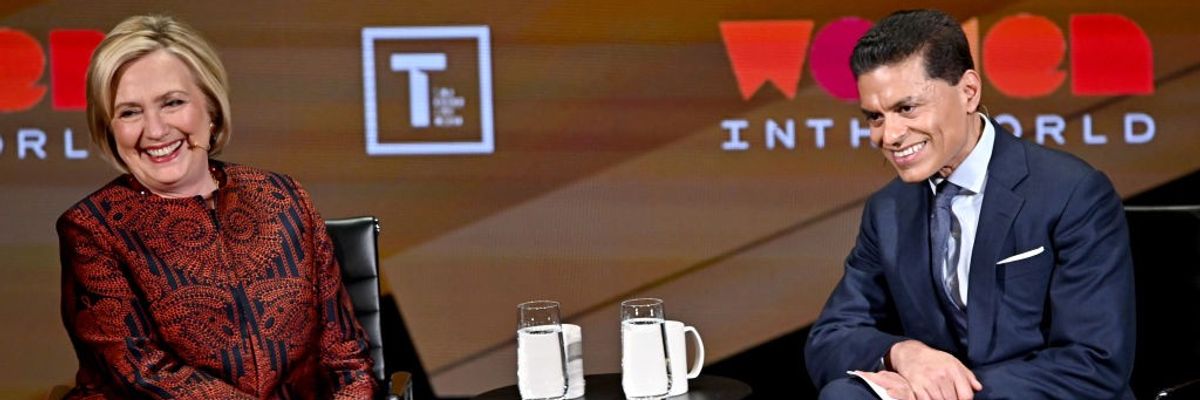
Hillary Clinton and Fareed Zakaria speak during the 10th Anniversary Women In The World Summit at David H. Koch Theater at Lincoln Center on April 12, 2019 in New York City.

Photo by Mike Coppola/Getty Images


OPINION
Les Leopold
Jan 28, 2025
Common Dreams


While some prominent Democrats are calling on party to reconnect with the working class by embracing economic populism, Fareed Zakaria, the host of a CNN news show and a Washington Post columnist, argues in a recent op-ed that it’s lost cause:
“[The Democrats] have a solid base of college-educated professionals, women and minorities. Many of the swing voters who have helped them win the popular vote in seven of the past nine presidential elections are registered independents and suburbanites. Perhaps they should lean into their new base and shape a policy agenda around them, rather than pining for the working-class Whites whom they lost decades ago.”

It's eerily reminiscent of what Senator Chuck Schumer infamously said eight years ago just before Hillary Clinton lost to Trump:
“For every blue-collar Democrat we lose in western Pennsylvania, we will pick up two moderate Republicans in the suburbs in Philadelphia, and you can repeat that in Ohio and Illinois and Wisconsin.”

Zakaria, however, claims that Biden didn’t follow Schumer’s advice and instead enacted massive infrastructure investments that were intended to please the entire working class. Biden, he writes, “presided over the creation of almost 17 million jobs with inflation nearing the Fed’s 2 percent target….wage inequality is down…and wage growth is outpacing inflation.”

To counter the blooming oligarchy which appears to have planted itself firmly in both parties, working people need a new political home, one of their own making.

But despite all this economic assistance, the working class increased its vote for Trump. For Zakaria, the Democrats’ electoral failure illustrates the futility of pandering to the working class.

We might better understand working-class alienation if we look at how Zakaria cherry picked his facts and ignored those that didn’t fit his story.He didn’t mention that most of those new jobs were a bounce-back after Covid -- the December 2024 employment level is 7.2 million higher, not 17 million higher, than the pre-pandemic peak in February 2020.
Yes, inflation is down, thank goodness, but it soared to a 40-year high during the Biden years, soaring by 20 percent, and causing enormous financial stress for working-class families.
He didn’t mention that the subhead for the link he cites on wage inequality reads, “But top 1% wages have skyrocketed 182% since 1979 while bottom 90% wages have seen just 44% growth.”
It’s not at all clear that wage growth for the average worker is outpacing inflation. (See “Are Workers Just Too Stupid to Understand Inflation.”)
And finally, Zakaria fails to mention the involuntary layoffs that hit millions of workers during the Biden administration. It’s hard to feel good about a party that fails to protect your job.

Zakaria loads the dice because he is sure that the White working-class cares more about race, immigration, gender, and sexual preference than it does about its own economic well-being. Hillary Clinton in 2016 ungracefully called half of the Trump voters “deplorables.” Zakaria means much the same when he writes that the Democratic Party “has been slowly losing the votes of the White working class, largely on issues related to race, identity and culture.”

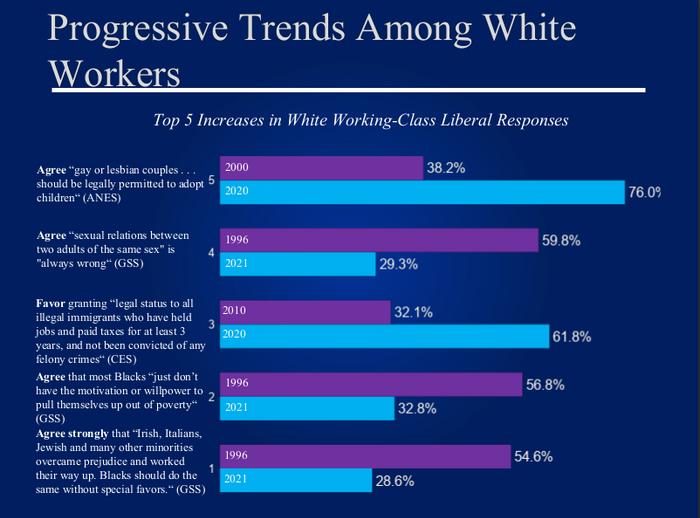
The data from long-term voter surveys tell a different story. The White working-class has become more liberal, not more deplorable, on these issues. While researching my book, Wall Street’s War on Workers, I identified 23 controversial questions put to tens of thousands of White working-class voters over the last several decades. In no case did the White working-class become more illiberal. On thirteen of those controversial questions workers became more liberal. Here are five examples:


Zakaria’s laments the Democrats leftward shift, but the Democrats have not in recent years put forth a strong populist agenda. (See “Are You Still Wondering Why Workers Voted for Trump?”)Democrats have not eliminated Wall Street stock buybacks, which kill millions of jobs each year while enriching the richest.

They have not limited the price gouging by food and drug cartels.

They have not stopped the healthcare industry from profiting wildly at our expense.
And their major infrastructure bills continue to pour money into corporate coffers without requiring job-creation guarantees.

Zakaria, nevertheless, has no trouble pushing these alienated workers into the MAGA movement. No big loss. But such abandonment is a loss for members of the working class. The MAGA oligarchs did not become billionaires by protecting the economic needs and interests of working people.

To counter the blooming oligarchy which appears to have planted itself firmly in both parties, working people need a new political home, one of their own making. Although the process is extremely difficult in our two-party system, working people and labor unions may have no choice but to build a new political formation of and by working people, just like the Populists did at the end of the 19th century to battle the robber barons of that era.

Their party’s name is as appropriate today as it was then: The People’s Party.

Our work is licensed under Creative Commons (CC BY-NC-ND 3.0). Feel free to republish and share widely.


Les Leopold is the executive director of the Labor Institute and author of the new book, “Wall Street’s War on Workers: How Mass Layoffs and Greed Are Destroying the Working Class and What to Do About It." (2024). Read more of his work on his substack here.
Full Bio >

Organizers Report Longtime 'Loyal' Dem Voters Fed Up With Party's Inaction as Trump 2.0 Takes Hold


Leaders of the grassroots group Indivisible said voters are eager to beat the Trump agenda, and called on Democratic leaders to act as a true opposition party.


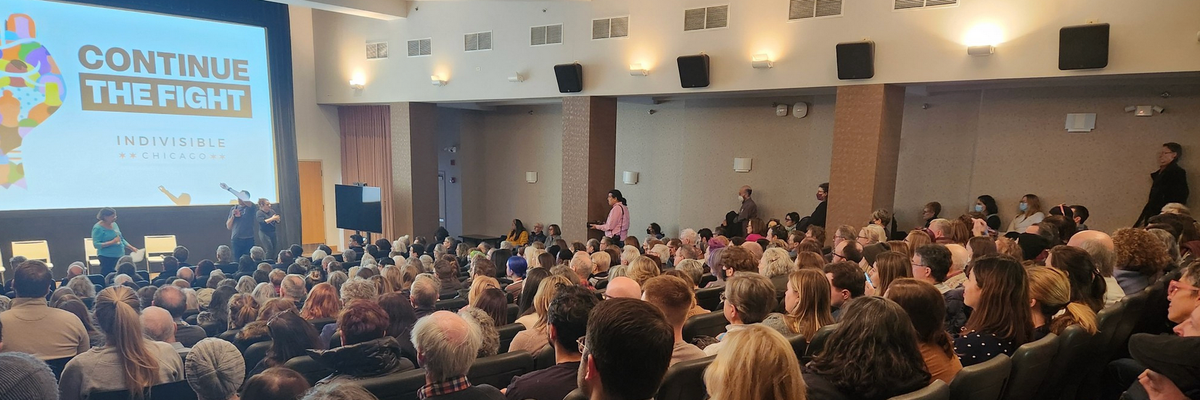
An Indivisible chapter in Chicago held a strategy session with more than 600 attendees on January 25, 2025.
(Photo: Michelle Singleton/Bluesky)


Julia Conley
Jan 27, 2025
COMMON DREAMS


A week into Republican U.S. President Donald Trump's second term in the White House, high-profile advocates with close ties to the Democratic Party expressed frustration at congressional Democrats' response to the slew of unconstitutional, xenophobic, and bigoted executive actions already unleashed by Trump.

"Democrats in Congress: WHAT IS THE PLAN?" Shannon Watts, founder of Moms Demand Action, demanded to know on Monday.

Watts cited Trump's purge of at least 12 inspectors general at federal agencies on Friday—an action that was met with outrage from Democratic lawmakers including Sen. Elizabeth Warren (D-Mass.), but little in the way of specific action from party leaders.

"There's no sit-in? No filibuster? No direction to voters? And in fact, some of you are actually voting for Trump's agenda?" asked Watts, an apparent reference to Democrats such as Sens. John Fetterman (D-Pa.), Tim Kaine (D-Va.), and Elissa Slotkin (D-Mich.), who voted in favor of some of the president's Cabinet nominees and the anti-immigration Laken Riley Act, the first bill to be sent to Trump's desk, last week.

Watts suggested in a series of posts on the social media platform X that she has typically been aligned with the Democratic establishment, calling herself a "loyal 'normie Dem.'"


Leah Greenberg, a former Democratic congressional staffer who co-founded the grassroots advocacy group Indivisible, said the group's members across the country are sharing the same "exact sentiment" as Watts.


In addition to Trump's mass firing of officials tasked with overseeing federal agencies, the president in the week pardoned more than 1,500 people who were convicted or charged in the attack on the U.S. Capitol on January 6, 2021; launched an immigration enforcement crackdown in Chicago; and issued an executive order revoking birthright citizenship—an action that was swiftly blocked by a federal judge who said the order with "blatantly unconstitutional."

As Common Dreamsreported last week, Democrats' refusal to aggressively stand against the GOP, which now controls both chambers of Congress as well as the White House, has frustrated progressive lawmakers including Rep. Alexandria Ocasio-Cortez (D-N.Y.).

Last week she told Jon Stewart on his podcast, "The Weekly Show," that the entire Democratic Party must differentiate itself from the GOP by becoming unapologetic "brawlers for the working class"—but suggested that with many Democrats taking donations from corporate lobbyists and the ultrarich and trading stocks in numerous industries, it's the party must make major changes to remake itself as one that fights for working people, many of whom swung to the right in the November elections.

Watts highlighted Ocasio-Cortez's speech on the House floor last week when she opposed the Laken Riley Act—a bill that would require immigration officers to detain undocumented immigrants who are accused of theft, including shoplifting, and allow state attorneys general to file legal challenges to detain specific immigrants—as "the energy we need."

In her speech, the congresswoman pointed to members of Congress who take donations from the private prison companies that will inevitably be "flooded with money" as the federal government looks to detain undocumented immigrants swept up in raids.

The Laken Riley Act passed in the House with the support of 46 Democrats who joined the GOP, and in the Senate with 12 Democrats joining the Republicans.

As the bill headed to Trump's desk, House Minority Leader Hakeem Jeffries (D-N.Y.) on Sunday garnered scorn by wrapping up the president's first week in office with a message one critic likened to "thoughts and prayers."


"This is what the Democrats have after a week of historic racism, homophobia, illegality, and fascism by the Trump regime," said civil rights attorney Scott Hechinger. "Here's the leader of the opposition party just leaving it to God."


Watts, Greenberg, and Ezra Levin, who also co-founded Indivisible, called on voters to put pressure on their representatives to act as a true opposition party and, as Josh Marshall of Talking Points Memowrote last week, "focus in on making [Republicans'] unpopular actions as painful as possible" for the GOP.

As an example, Marshall warned that Democrats are attempting to "court" Republicans who could vote against Trump's nominees by tempering their criticism of the potential Cabinet members.

"Far from courting potential defectors, they should be attacking them," Marshall wrote. "The criticisms of the bad nominees should be as intense as possible and all focused on the support of these senators. No one does you a favor in these settings for being nice: Senators defect when they think they may pay a price at the ballot box. That is the only way to have messaging that takes the initiative and stays on the attack. If things get too hot and the senator pulls their support, great. If not, that just lays the groundwork for beating that senator in the next election."

"The job of the opposition is quite literally to oppose," he added. "Get to it."

Greenberg emphasized Monday that calling Democratic lawmakers and demanding that they stop "cowering in terror from Trump" will make a difference.


"It would be really cool if we had a party of principled and authentic leaders capable of acting like an opposition party without us constantly yelling at them," said Greenberg. "We do not have that right now! So we need to keep yelling at them!"

Levin reported that, contrary to claims by the corporate media, voters across the country are eager to fight the Trump agenda, and to demand that Democratic lawmakers join them.


"At the Chicago Indivisible meeting I joined yesterday, they filled the theater and an overflow room," said Levin. "In North Carolina where Leah Greenberg was yesterday, it was standing room only. We've had ~250 *new* Indivisible groups form since the election, and leaders report surging membership."
California Bill, Ad Campaign Aim to Hold Big Oil Accountable for LA Wildfires

"Major fossil fuel companies intentionally misled the public for decades about the impacts of their products, and now Californians are paying the price," according to the office of California state Sen. Scott Wiener.


A person uses a garden hose in an effort to save a neighboring home from catching fire during the Eaton Fire on January 8, 2025 in Altadena, California.
(Photo: Mario Tama/Getty Images)

Eloise Goldsmith
Jan 28, 2025
COMMON DREAMS


In California, recently introduced legislation and a new six-figure ad campaign called "Make Polluters Pay" indicate that the drum beat to hold oil and gas companies directly accountable for their role in fueling climate disasters, like the Los Angeles wildfires, is growing.

State Sen. Scott Wiener (D-11) on Monday introduced legislation that would allow homeowners, businesses, and insurance companies to recoup losses incurred by a climate disaster by seeking damages from fossil fuel companies.

The bill would also permit California's FAIR Plan, the state-created insurer of last resort for fire coverage, to do the same so it doesn’t become insolvent.

"Major fossil fuel companies intentionally misled the public for decades about the impacts of their products, and now Californians are paying the price with devastating wildfires, mudslides, sea level rise, and skyrocketing insurance costs," according to a statement from Wiener's office.

Wiener himself said that "containing these costs is critical to our recovery and to the future of our state. By forcing the fossil fuel companies driving the climate crisis to pay their fair share, we can help stabilize our insurance market and make the victims of climate disasters whole."

Wildfires engulfed the Los Angeles region earlier this month, burning tens of thousands of acres of land and destroying more then 16,000 structures, according to the California Department of Forestry and Fire Protection. Damage estimates indicate the wildfires could be the costliest wildfire disaster in U.S. history.

The fires have also strained insurers, and led to increased rents in the area. Washington Postreporting found that rents in Los Angeles County rose above the legally permitted 10% after the wildfires.

Meanwhile, the communications firm Fossil Free Media launched a six-figure campaign, Make Polluters Pay, on Friday. The campaign is aimed at supporting "the growing demand that Big Oil companies pay their fair share for the Los Angeles wildfires and other climate disasters that are costing taxpayers billions of dollars every year."

The campaign includes ads on Facebook and Instagram, as well as other digital platforms, which will highlight the plight of people like the Howes family, who lost their home to a California wildfire.

According to a statement from Fossil Free Media, over 4,000 people have signed on to a petition sponsored by the organization urging California lawmakers to pass a "climate superfund bill," which would compel polluters to pay into a fund that would help prevent disasters and aid cleanup efforts.

California lawmakers introduced, but did not pass, a bill like this—the Polluters Pay Climate Cost Recovery Act—in the last legislative session. New York and Vermont recently passed similar legislation.


40K+ People Urge Trump-Led GOP to Stop Attacking Disaster Relief

"Politicizing disaster response efforts for political points at the expense of real people who are suffering after natural disasters is unacceptable."


A member of FEMA's Urban Search and Rescue Task Force searches a flood-damaged property with a search canine following Hurricane Helene in Asheville, North Carolina on October 4, 2024.
(Photo: Mario Tama/Getty Images)

Brett Wilkins
Jan 27, 2025
COMMON DREAMS

Tens of thousands of people have signed a petition calling on U.S. President Donald Trump and congressional Republicans to stop attacking disaster relief, including by trying to attach politicized conditions to California wildfire aid, spreading lies about the Federal Emergency Management Agency, and threatening to shut down the vital government body.

As of Monday afternoon, more than 41,300 people had signed the petition, which was launched by the progressive political action committee MoveOn earlier this month in the wake of Trump's mounting attacks on FEMA.

"Instead of working to support those trying to survive and rebuild, Donald Trump and Republicans in Congress are exploiting this climate disaster to spread disinformation and sow chaos for political points."

"The tragic wildfires raging across Southern California have killed dozens of people and displaced tens of thousands from their homes," the petition states. "But instead of working to support those trying to survive and rebuild, Donald Trump and Republicans in Congress are exploiting this climate disaster to spread disinformation and sow chaos for political points."

Trump has threatened to withhold wildfire aid if California does not enact voter identification legislation and reform its forest and water management policies. He also said last week that "FEMA's turned out to be a disaster," and that "we're gonna recommend that FEMA go away."

"And this isn't the first time," the MoveOn petition notes. "Right-wing disinformation and attacks against disaster workers prevented people from getting the urgent help they needed in the wake of devastating natural disasters like Hurricanes Helene and Milton. Conservative-fueled conspiracies have even resulted in meteorologists receiving death threats for reporting on the weather and explaining climate science."

"Accessible and accurate information, including weather forecasts and disaster relief, can be lifesaving for those impacted," the petition stresses. "Instead of focusing on helping our communities recover from these latest natural disasters, Republicans disseminated harmful disinformation about FEMA's response and relief efforts, discouraging people from getting the help they urgently need. And they're doing it again."

MoveOn cited recent examples including Trump falsely accusing FEMA of stealing donations and diverting disaster aid to migrants, and Congresswoman Marjorie Taylor Greene's (R-Ga.) unfounded allegation that Democrats are controlling the weather. Critics say such baseless claims endanger FEMA personnel and make their work harder, if not impossible.

"Threats of truckloads of militia members 'hunting FEMA' forced FEMA and U.S. Forest Service workers to pause their lifesaving recovery efforts to relocate workers out of fear for their safety," MoveOn said of agency work in North Carolina. "Survivors of natural disasters who urgently need assistance are refusing FEMA's help because of this disinformation."

"Conservative-led disinformation campaigns against our disaster relief workers and meteorologists are threatening public safety and undermining public trust in our lifesaving institutions," the petition argues. "In times of crisis, our elected officials should be working to deliver aid and recovery—not spreading conspiracy theories on social media. Politicizing disaster response efforts for political points at the expense of real people who are suffering after natural disasters is unacceptable."

Six-Figure Ad Campaign Calls on Big Oil to Pay for California Fires


After Trump visits California, new ad campaign from Fossil Free Media supports the growing call to “Make Polluters Pay” for the damage they’ve caused


Tuesday January, 28 2025
Fossil Free Media

WASHINGTON - Fossil Free Media launched a six-figure advertising campaign in California this Friday to support the growing demand that Big Oil companies pay their fair share for the Los Angeles wildfires and other climate disasters that are costing taxpayers billions of dollars every year.

The California ad campaign, Make Polluters Pay, is highlighting stories of real people who have faced irrevocable harm from the effects of extreme weather while major oil companies rake in billions and fuel climate disasters.

"These companies spent decades burying climate science, poured $30 million into killing accountability legislation last year in California, and now want taxpayers to foot the bill for $250 billion in fire damage,” said Cassidy DiPaola, the communications director for the Make Polluters Pay campaign. “That's not just unfair – it's unconscionable. California needs a climate superfund law to ensure polluters, not working families, pay for the crisis they created."

The ad campaign supports a growing call to “make polluters pay” for the Los Angeles wildfires and other climate disasters. In the last week, more than 40,000 people have signed a petition calling on California public officials to pass a “climate superfund bill” that would raise billions of dollars from Big Oil to pay for recovery and resiliency efforts in the state. A superfund bill was introduced last legislative session in California, since then similar policies have passed in New York and Vermont.

Some of the stories told in ad campaign include:The Howes, a family who lost their home to a wildfire in California
Zion, a 7-year-old boy in Los Angeles who has suffered from the effects of pollution

Wildfire smoke is 10 times more harmful to children’s respiratory health than other types of air pollution, so children living through these increasingly frequent wildfires, like Zion, can develop lifelong health problems.

While these Californians suffered, the fossil fuel industry mounted one of the largest lobbying campaigns in state history to defeat previous climate accountability legislation, with the bill appearing in 76% of Chevron and Western States Petroleum Association's lobby filings. At least 34 major oil producers joined the effort to block the measure. Now, even before any new bill has been introduced this session, these same companies have launched aggressive social media campaigns opposing climate accountability – all while Los Angeles burns.

Climate change has made California hotter and drier, making it easier for fires to start and spread. This is causing a larger area to be burned every year. The area burned by wildfires in California annually is now five times bigger than in the 1970s - nearly all of this increase is due to climate change.

California fires are growing in severity and in devastation as a result of fossil fuel pollution. People have suffered unspeakable losses. The ads call for holding these polluters accountable and making them pay for the damage they’ve caused.

The six-figure ad buy will run on streaming television, YouTube, social media platforms like Facebook and Instagram, as well as digital platforms.


Fossil Free Media is a nonprofit media lab that supports the movement to end fossil fuels and address the climate emergency.

'Dollar signs in their eyes': Los Angeles landlords illegally jack up rent after fires


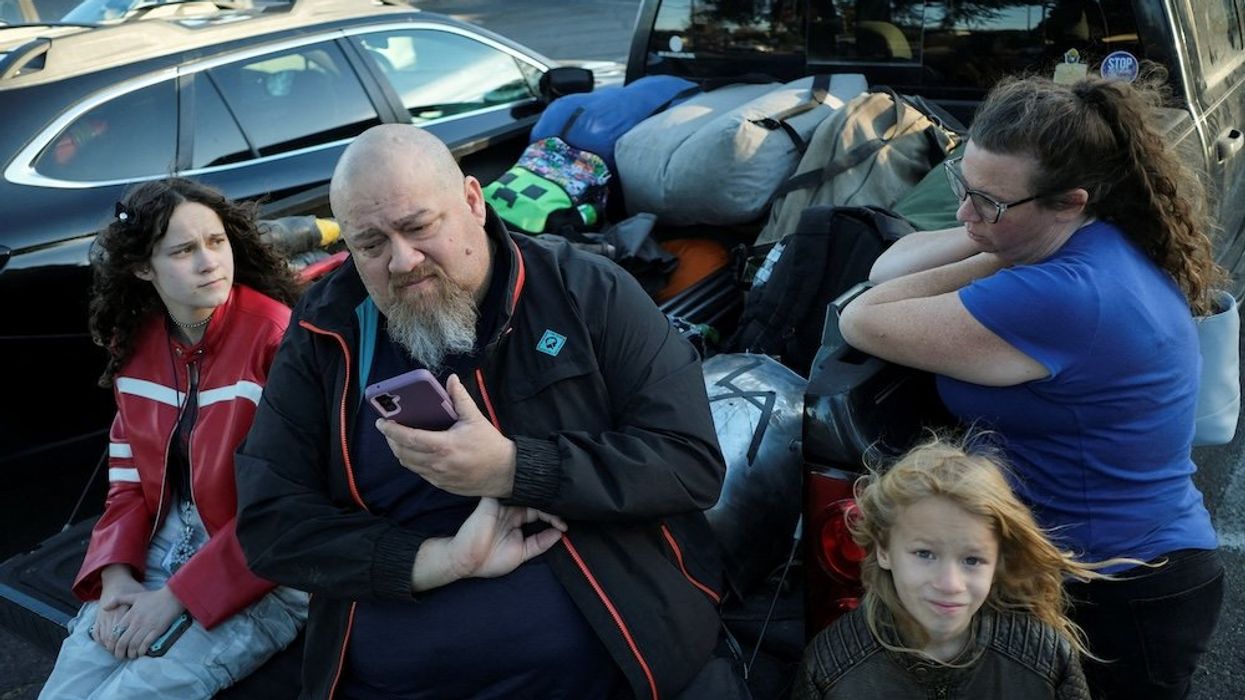
Kalliope Sidnam, 14, her father, Chief Sidnam, brother, Flynn Sidnam, 8, and mother Melissa Sidnam, wait in a parking lot, at a Red Cross evacuation center at Hart High School as firefighters and aircraft battle the Hughes Fire near Castaic Lake, north of Santa Clarita, California, U.S. January 22, 2025. REUTERS/Joel Angel Juarez

January 25, 2025
ALTERNET

The recent wave of January wildfires in Los Angeles County that have displaced 150,000 people and counting has some landlords in the area looking to cash in on the surge in demand.

That's according to a Saturday article in the Washington Post, which reported that some landlords have been imposing double-digit rent hikes on their properties in the wake of the unprecedented fires. The Post found that rents across Los Angeles County have gone up by roughly 20%, well beyond the state-approved limit of 10% that California Governor Gavin Newsom (D) put in place for hotels, housing, gasoline and other essentials with an executive order earlier this month.

In rental properties listed in Beverly Hills, Encino, Glendora and Tarzana, the Post found that rents increased by triple-digit percentages when comparing prices before and after the wildfire outbreak. A single-family home in Sherman Oaks that rented for $5,473/month before the fire now rents for $10,890 — a 99% increase.

READ MORE: 'Lack of empathy': Laura Ingraham's brother slams her 'twisted propaganda' during LA wildfires

The state is already pursuing some property owners for alleged price gouging. California Attorney General Rob Bonta (D) said earlier this week that one couple trying to rent a home after they were displaced by the Eaton Fire was informed by a real estate agent that the price had gone up by 38%. Bonta's office is now prosecuting that agent, who could face up to a year in prison and a fine of up to $10,000 if convicted.

"These predators are looking at the disaster with dollar signs in their eyes," Bonta said.

Los Angeles County has since established a task force focused on price gouging. The Post reported that Rafael Carbajal, who heads the county's Department of Consumer and Business Affairs, has already received more than 600 complaints alleging price gouging since the fires broke out earlier this month. That's roughly 200 more complaints received than in the entire first year of the Covid-19 pandemic.

“I’m being confronted with this feeling of panic, from, I would find a place no problem, to ‘Oh my God, the margins are getting thinner,’” 28-year old LA County resident Sam Delfavero told the Post.

READ MORE: 'Lies and disinformation': Critics say Trump got 'nothing right' about LA wildfires

Josh Lederer, who was displaced from his Pacific Palisades home, has moved his family four times since the fires broke out, and has had difficulty finding an affordable place to stay. Lederer told the Post that his problem is compounded by the fact that he needs to remain close to his still-standing home in order to accommodate insurance adjusters and remediation companies.

“Places that were renting out for $4 a square foot went to $8 a square foot,” Lederer said. “I saw the same listing on different websites for twice the price that it was listed for on another website last week.”

The paper discovered that one rental listed on Zillow before the fires was abruptly taken down after its rent was revised upwards of 40%. It was later re-listed by real estate firm Nest Seekers International. Post reporters got a cold response when asking the company if the property had been leased and if the new, higher price on Zillow was correct.

"Do yourself a favor and jump in the lake,” Nest Seekers International told the Post — followed by an "expletive" — before hanging up.
OPINION
Trump’s Refusal to Invest in EVs Could Hand the World’s Economic Future to China

If we take President Donald Trump at his word, his policies will slam the brakes on innovation or the next four years—just long enough to potentially send the Detroit auto industry into a death spiral.


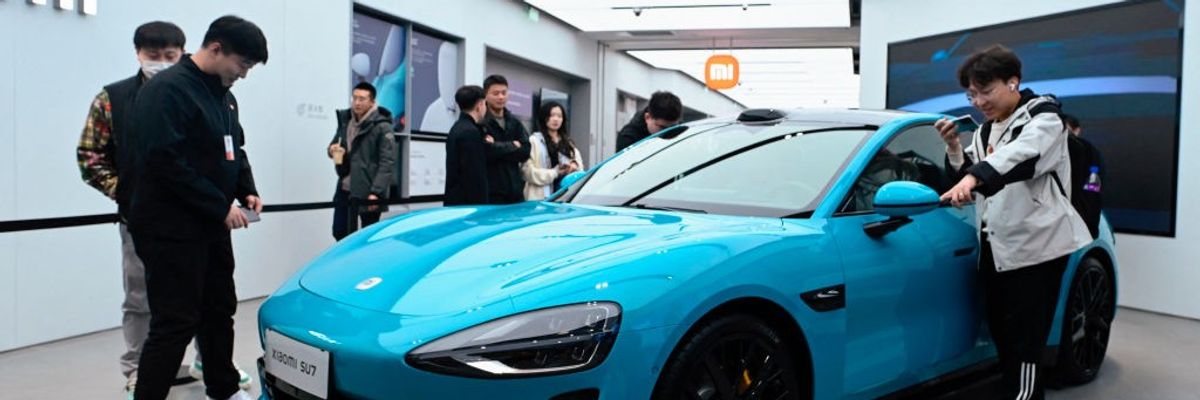
People look at a Xiaomi SU7 electric car displayed at a Xiaomi store in Beijing, China on March 26, 2024.
(Photo: Wang Zhao/AFP via Getty Images)


Alfred W. Mccoy
Jan 28, 2025
TomDispatch


It came upon a midnight clear, a vision both complete and quite specific—not from any of those “angels bending near the Earth to touch their harps of gold,” as in the Christmas carol, but from a long line of trucks on the Indiana Toll Road.

On that cold winter’s night about five years ago, the 18-wheelers were playing their usual game to stay awake, passing each other endlessly and slowing me down to 60 miles an hour when I wanted to do 70 or, I’ll admit it, 75. When I pulled into a rest stop to gas up, about 50 of those big rigs were parked there. Their drivers were taking the federal government’s mandatory 11- or 12-hour rest breaks.

A quick bit of mental arithmetic told me that 50 big rigs, each costing $200,000 new, meant that $10 million in working capital was snoozing profitlessly by the side of that road. Back on the highway in a radio-dead zone, my mind wandered as I wondered just how many trillions of dollars in capital were tied up when America’s three million big rigs spent half their working days functionally asleep. Surely, I thought, there must be a better way to run the world’s biggest consumer economy.

As I hit the Chicago Skyway with its rough pavement and rusting guard rails, a vision of America’s automotive future came to me in a flash, complete in every detail. One day in the not-too-distant future, the left lane of every Interstate highway across America would be filled with platoons of a dozen or so 18-wheelers, all electric, all driverless, going 70 miles per hour only 10 feet apart to draft in the slipstream and cut their energy consumption by 30%. In the right lanes, electric passenger vehicles would be driving, hands-free, until they reached their exit ramps. To keep the navigation signal constant, the highway reflectors would have become wireless transmitters, linked by fiber-optic cables to ensure safety.

Then, as I merged into that crazy-fast nighttime traffic on Chicago’s Kennedy Expressway, I came up with what I thought was my really big idea. Outside every major city, those all-electric big rigs would pull into an automated depot to exchange their standard-sized batteries, allowing a full charge in five minutes. There, human truckers, probably more of them than ever before, would take over, navigating crowded city streets and tight loading docks with hard-won skills that no robot could ever replicate.

When I got home to Madison, Wisconsin late that night, I went online to test my vision with some quick numbers. In 2020, the costs for a big rig’s driver, fuel, and engine maintenance were as much as $2.20 a mile, so a typical thousand-mile run from Port Newark on the East Coast to Chicago could cost $2,200. By contrast, a driverless electric semi-slipstreaming in a peloton would make the same trip for just $70—with the cost of drivers at near-zero, energy outlays down to five cents per mile, and maintenance reduced to tire replacement—not to mention the incalculable gains from doubling each rig’s driving time to 24/7.
Vision Becomes Reality

Until recently, I kept that midnight vision to myself, except for an occasional dinner-table chat after a second glass of wine. Frankly, it all seemed a bit much for prime time. Even electric passenger vehicles, much less semi-trucks, faced two key barriers to widespread acceptance in America—range and cost. In the upper Midwest where I live, a cold winter’s day can cut the 300-mile range of an electric car like a Tesla to just 150 miles. Although I could make the 250-mile drive in an electric vehicle from the state capital of Madison to hike or ski in Northwoods Wisconsin, there’s no public charger anywhere nearby. So there’s no way to get back. And cost? While you can get a reliable gas-powered Honda Civic for $24,000, a comparable electric vehicle like the Hyundai Ioniq now costs $39,000.

But just last week, I was surfing the EV (electric vehicle) test drives in Edmunds and Kelly Blue Book when a web page popped up with the title “Seven Long-Range Electric Cars from China.” I was stunned to read that a car I’d never heard of, the NIO ET7, comes with a standard 649-mile range and complimentary access to “3,000 battery swap stations across China.”

Following Ford’s time-tested lead, China’s largest automaker, BYD, is selling its Dolphin hatchback EV for a low-low $15,000, complete with a 13-inch rotating screen, ventilated front seats, and a 260-mile range.

Was my midnight vision becoming clearer? Yes, the article said, “the battery swap stations allow you to exchange your depleted battery for a fully charged one in just a few minutes, minimizing downtime.” Another cutting-edge Chinese car few in America have ever heard of, the ZEEKR 001, can load a 300-mile charge in 11 minutes flat, less time than it takes to pump an equivalent-mileage of gas. And a Chinese car unknown here, the XPENG P7, has an innovative battery that “operates optimally” in temperatures ranging down to –22°F, ending the cold weather battery loss that makes EV driving so frustrating in Midwest winters.

And what about their price? While Detroit is maxing profits by pricing the tricked-out Ford F-150 Lightning EV truck for $87,000 and GM’s similar Silverado EV costs $96,000, China has gone back to basics with a latter-day Model T Ford—reliable, affordable cars for the average worker.

European companies were hand-crafting cars for the rich as early as 1890. The Detroit auto industry didn’t get a jump-start until 1908 when Henry Ford mass-produced the Model T for what began as a reasonably affordable $850 and soon had dropped to $345—unprecedented pricing that ramped that car’s production relentlessly up to an impressive 2 million units a year. In just 10 years, half of all the cars in America were Model Ts.

Following Ford’s time-tested lead, China’s largest automaker, BYD, is selling its Dolphin hatchback EV for a low-low $15,000, complete with a 13-inch rotating screen, ventilated front seats, and a 260-mile range. Here in the U.S., you have to pay more than twice that price for the Tesla Model 3 EV ($39,000) with lower tech and only 10 more miles of driving range. In case $15K beats your budget, the Dolphin has a plug-in hybrid version with an industry-leading 74-mile range on a single charge for only $11,000 and an upgrade with an unbeatable combined gas-electric range of 1,300 miles. Not surprisingly, EVs surged to 52% of all auto sales in China last year. And with such a strong domestic springboard into the world market, Chinese companies accounted for more than 70% of global EV sales.

It’s time to face reality in the world of cars and light trucks. Let’s admit it, China’s visionary industrial policy is the source of its growing dominance over global EV production. Back in 2009-2010, three years beforeElon Musk sold his first mass-production Tesla, Beijing decided to accelerate the growth of its domestic auto industry, including cheap, all-electric vehicles with short ranges for its city drivers. Realizing that an EV is just a steel box with a battery, and battery quality determines car quality, Beijing set about systematically creating a vertical monopoly for those batteries—from raw materials like lithium and cobalt from the Congo all the way to cutting-edge factories for the final product. With its chokehold on refining all the essential raw materials for EV batteries (cobalt, graphite, lithium, and nickel), by 2023-2024 China accounted for well over 80% of global sales of battery components and nearly two-thirds of all finished EV batteries.

Clearly, new technology is driving our automotive future, and it’s increasingly clear that China is in the driver’s seat, ready to run over the auto industries of the U.S. and the European Union like so much roadkill. Indeed, Beijing switched to the export of autos, particularly EVs, to kick-start its slumbering economy in the aftermath of the Covid-19 lockdown.

Given that it was already the world’s industrial powerhouse, China’s auto industry was more than ready for the challenge. After robotic factories there assemble complete cars, hands-free, from metal stamping to spray painting for less than the cost of a top-end refrigerator in the U.S., Chinese companies pop in their low-cost batteries and head to one of the country’s fully automated shipping ports. There, instead of relying on commercial carriers, leading automaker BYD cut costs to the bone by launching its own fleet of eight enormous ocean-going freighters. It started in January 2024 with the BYD Explorer No. 1, capable of carrying 7,000 vehicles anywhere in the world, custom-designed for speedy drive-on, drive-off delivery. That same month, another major Chinese company you’ve undoubtedly never heard of, SAIC Motor, launched an even larger freighter, which regularly transports 7,600 cars to global markets.

Those cars are already heading for Europe, where BYD’s Dolphin has won a “5-Star Euro Safety Rating” and its dealerships are popping up like mushrooms in a mine shaft. In a matter of months, Chinese cars had captured 11% of the European market. Last year, BYD began planning its first factory in Mexico as an “export hub” for the American market and is already building billion-dollar factories in Turkey, Thailand, and Indonesia. Realizing that “20% to 30%” of his company’s revenue is at risk, Ford CEO Jim Farley says his plants are switching to low-cost EVs to keep up. After the looming competition led GM to bring back its low-cost Chevy Bolt EV, company vice president Kurt Kelty said that GM will “drive the cost of E.V.s to lower than internal combustion engine vehicles.”
Will Tesla Be Toast?

What about Tesla, America’s pioneering EV maker? With its CEO Elon Musk off playing pretend president, its worldwide vehicle deliveries fell last quarter for the first time in a decade, even as BYD’s global sales shot up 12% to 1.76 million, beating Tesla by a 20% margin to become the world’s biggest EV car-maker. Even though Tesla still accounts for almost half of this country’s EV sales and has a current market capitalization of $1.3 trillion, Musk’s model line-up now seems increasingly outmoded, over-priced, and unappealing, exemplified by his latest launch, the “weird” Cybertruck with a “nonsensical exterior,” which starts at $82,000 for a minimal 330-mile driving range. Even though Tesla is still the world’s “most valuable automotive brand,” stock pickers and short-sellers take note: Its car sales could be toast within five years, though its still-small division making electrical semi-trucks has real growth potential. (And take note as well that I’m not giving stock advice, just making a point on where I think our world’s heading.)

Realizing that their auto industries are facing a carmageddon of Chinese competition, the U.S. and Europe are already slapping heavy tariffs on imports from China. With its robotic factories cranking out one complete car every 76 seconds, China is ready to crush rival car companies and build 80% of all the world’s autos, as it already does with solar panels. Last June, the European Union imposed additional duties of 17% on China’s BYD and 38% on SAIC, but the Biden administration had already beaten that with a flat 100% duty on all Chinese EVs. And count on one thing: That’s just the start. In his second term in office, Donald Trump has already promised an additional 10% tariff on all Chinese imports, cars included—protecting the U.S. auto industry just long enough for it to decline into technological obsolescence.

In our integrated global economy, cars are a commodity like copper, oil, food, or textiles. In capitalist societies, commodities are not just products but the sinews that bind together nations on an otherwise disparate planet and a force like water that always finds its own level. Even if those tariffs manage to keep American workers buying overpriced, outmoded vehicles, the big four of the U.S. auto industry—Ford, GM, Stellantis, and Tesla—can hardly afford to lose their overseas markets. Last quarter, China’s motorists accounted for a hefty 40% of Tesla’s total worldwide sales, so Elon Musk faces an impossible contradiction: how to get President Trump to protect his U.S. market with high tariffs on Chinese cars while somehow avoiding Beijing’s wrath. Finding a way through that conundrum will likely prove challenging for Tesla.
Autos and America’s Future

So, what does all this mean for America? In the past four years, the Biden administration made real strides in protecting the future of the country’s auto industry, which is headed toward ensuring that American motorists will be driving $10,000 EVs with a 1,000-mile range, a 10-year warranty, a running cost of 10 cents a mile, and 0 (yes zero!) climate-killing carbon emissions.

Not only did former President Joe Biden extend the critical $7,500 tax credit for the purchase of an American-made EV, but his 2021 Infrastructure Act helped raise the number of public-charging ports to a reasonable 192,000, with 1,000 more still being added weekly, reducing the range anxiety that troubles half of all American car owners. To cut the cost of the electricity needed to drive those car chargers, his 2022 Inflation Reduction Act allocated $370 billion to accelerate the transition to low-cost green energy. With such support, U.S. EV sales jumped 7% to a record 1.3 million units in 2024.

Most important of all, that funding stimulated research for a next-generation solid-state battery that could break China’s present stranglehold over most of the components needed to produce the current lithium-ion EV batteries. The solution: a blindingly simple bit of all-American innovation—don’t use any of those made-in-China components. With investment help from Volkswagen, the U.S. firm QuantumScape has recently developed a prototype for a solid-state battery that can reach “80% state of charge in less than 15 minutes,” while ensuring “improved safety,” extended battery life, and a driving range of 500 miles. Already, investment advisors are touting the company as the next Nvidia.

The loss or even weakening of the U.S. auto industry would have a devastating effect on this country’s economy and its quality of life.

But wait a grim moment! If we take President Donald Trump at his word, his policies will slam the brakes on any such gains for the next four years—just long enough to potentially send the Detroit auto industry into a death spiral. On the campaign trail last year, Trump asked oil industry executives for a billion dollars in “campaign cash,” and told the Republican convention that he would “end the electrical vehicle mandate on day one” and thereby save “the U.S. auto industry from complete obliteration.” And in his victory speech last November, he celebrated the country’s oil reserves, saying, “We have more liquid gold than anyone else in the world.”

Then, just last month, president-elect Trump “vowed” to repeal Biden’s Inflation Reduction Act and its $400 billion in unspent funds for green energy, while his transition team began to plan a “sweeping rollback” of federal support for the adoption of EVs—including shifting charging-station appropriations to defense, blocking California’s strict emission standards, and ending the $7,500 tax credit that has made EVs affordable for many Americans. More broadly, he’s promised to reverse Biden’s ban on oil leases in federal waters, saying just this month: “It’s ridiculous. I’ll unban it immediately. It’ll be changed on Day One.”

But, you might protest, it’s only four years, right? How much damage can be done in just one itty-bitty presidential term? The answer is all too grim: With technology passing us at 100 miles an hour, four years isn’t a term; it’s an era, a veritable epoch. Think back to 2020. Worldwide EV sales were just 1.6 million then; now they’re up 10-fold to 16.6 million and rising fast. Chinese motorists bought just 1 million EVs in 2020; now they’re buying 10 million a year. Then, the reasonably affordable 2020 Hyundai Ionic EV had a relatively useless driving range of 133 miles; now, it has a very usable 342 miles. Back in that day, QuantumScape’s extended-range solid-state EV battery seemed so improbable it was damned by stock-pickers as “a pump and dump… scam”; now Volkswagen is taking that company’s prototype into mass production.

So here’s the reality of it all: The loss or even weakening of the U.S. auto industry would have a devastating effect on this country’s economy and its quality of life. At the moment, the industry employs 13 million workers, including 1 million in manufacturing. We’re talking about a solid 10% of the country’s full-time workforce of 133 million.

Under their 2023 union contract, striking unionized UAW auto assembly workers won an hourly wage of $35 and skilled trades got $50, which is a gate pass into the American middle class. Not only did President Biden join a UAW picket line with striking auto workers, but he engineered a full-spectrum transition to EVs, understanding that they represent the future of the auto industry. Indeed, as Biden explained while signing a 2021 executive order requiring that 50% of all cars sold in America by 2030 be EVs: “We need to grow good-paying, union jobs at home, lead on electric vehicles around the world, and save American consumers money.” As Biden all too accurately reminded that UAW picket line at the Willow Run GM plant: “The middle class built the country, and unions built the middle class.”

During his upcoming four-year term, despite the present support of Elon Musk—and who knows how long he’ll last in Trump world—President Trump has made it clear that he will undo all of that, promote fossil fuels in a massive fashion, ignore climate change, and potentially hand the economic future to China (which already makes 80% of the world’s solar panels and 60% of its wind turbines), while creating a carmageddon for this country’s auto industry.

And what about my midnight vision of that peloton of all-electric, driverless semi-trucks slipstreaming down the Interstate at 70 mph? Yes, it’s coming. But with Trump as our driver for the next four years, we can only pray to those angels with the golden harps that electric semi-trucks and their batteries will somehow, someday, be made in America.


On January 20th, it begins...


Political revenge. Mass deportations. Project 2025. Unfathomable corruption. Attacks on Social Security, Medicare, and Medicaid. Pardons for insurrectionists. An all-out assault on democracy.

Republicans in Congress are scrambling to give Trump broad new powers to strip the tax-exempt status of any nonprofit he doesn’t like by declaring it a “terrorist-supporting organization.” Trump has already begun filing lawsuits against news outlets that criticize him. At Common Dreams, we won’t back down, but we must get ready for whatever Trump and his thugs throw at us.

As a people-powered nonprofit news outlet, we cover issues the corporate media never will, but we can only continue with our readers’ support. By donating today, please help us fight the dangers of a second Trump presidency.


© 2023 TomDispatch.com


Alfred W. Mccoy
Alfred W. McCoy is professor of history at the University of Wisconsin-Madison is the author of "In the Shadows of the American Century: The Rise and Decline of U.S. Global Power". Previous books include: "Torture and Impunity: The U.S. Doctrine of Coercive Interrogation" (University of Wisconsin, 2012), "A Question of Torture: CIA Interrogation, from the Cold War to the War on Terror (American Empire Project)", "Policing America's Empire: The United States, the Philippines, and the Rise of the Surveillance State", and "The Politics of Heroin: CIA Complicity in the Global Drug Trade".
Full Bio >
US Silent as Press Freedom Advocates Condemn Swiss Arrest of Electronic Intifada Journalist


"The climate surrounding freedom of speech in Europe is becoming increasingly toxic, and we should all be concerned," said one U.N. expert on Palestinian rights.


Ali Abunimah, executive director of Electronic Intifada, was arrested in Switzerland on January 25, 2025.
(Photo: Electronic Intifada)

Julia Conley
Jan 27, 2025
COMMON DREAMS

Two days after Swiss authorities detained Ali Abunimah, the executive director of the independent Palestine-focused news outlet Electronic Intifada, press freedom advocates in the United States demanded to know why the Trump administration had not spoken out about the U.S. citizen's arrest.

"If the U.S. State Department values free speech, it must publicly condemn the arrest of American journalist Ali Abunimah by Swiss authorities and do everything possible to secure his immediate release," said Freedom of the Press Foundation on the social media platform X.

Abunimah was arrested Saturday in Zurich, where he had been scheduled to give a speech on Palestinian history and the Israeli occupation. Electronic Intifada (EI) said in a statement that the journalist "was questioned by police for an hour before being allowed to enter the country."

The arrest "appears to be part of a growing backlash from Western governments against expressions of solidarity with the Palestinian people," said the group.

EI cited the cases of several activists and journalists who were arrested, subjected to raids, or charged last year under "counter-terror" powers of the British government. Asa Winstanley, an associate editor with EI, was among those whose homes were raided; Winstanley was accused of "encouragement of terrorism."


Swiss police said Abunimah was subject to an "entry ban."


While the White House has been silent thus far about Abunimah's arrest, Francesca Albanese, the United Nations special rapporteur on the situation of human rights in the Palestinian Territory occupied since 1967, was among those who urged a "prompt investigation" into the matter


Irene Khan, U.N. special rapporteur on freedom of expression and opinion, also called Abunimah's detention "shocking" and called on the Swiss government to investigate.

EI said Abunimah has had access to legal counsel since Saturday. The website, which was founded in 2001, has reported extensively on Israel's apartheid policies in the occupied Palestinian territories, including its recent violent escalations against Gaza and the West Bank.

"Speaking out against injustice in Palestine is not a crime," said EI on Saturday. "Journalism is not a crime."


A spokesperson for the U.S. Embassy in Bern, Switzerland toldAl Jazeera it was providing standard consular assistance after learning of Abunimah's arrest, but did not comment further.


Journalist Rania Khalek of BreakThrough News condemned the silence of corporate media outlets in the United States.

"Not a single mainstream western media outlet has covered" Abunimah's detention, said Khalek.


Human rights lawyer Craig Mokhiber—who resigned from his position in the U.N. Office of the High Commissioner for Human Rights in October 2023, saying the U.N. was failing to prevent genocide in Gaza—said Sunday that the social media platform X was blocking him from sharing a petition in support of Abunimah.

"This is not only an attempt to silence Ali Abunimah as an individual, but the manifestation of a wider campaign of repressing and intimidating those who dare speak up for for Palestinian human rights and against their genocide, fitting into a pattern of racism and Islamophobia," reads the petition, started by Swiss Action for Human Rights.

The group said the arrest is part of a broader effort "to silence the truth and deny the oppression of the Palestinian people, attacking free speech and waging a war on journalism."

Euro-Med Human Rights Monitor said Abunimah's "arbitrary arrest gives the false impression that showing solidarity with the victims of the Israeli occupation peacefully is now illegal."

"The action taken by Swiss authorities is extremely concerning, as it marks an unprecedented low level of respect for human rights, particularly in a nation that has long been known for upholding democratic principles and protecting fundamental liberties. Targeting journalists and human rights advocates is indicative of a significant decline in European governments' dedication to upholding human rights and freedom of expression," said the group.

"The Swiss authorities must immediately and unconditionally release Ali Abunimah," Euro-Med Monitor added, "and ensure respect for his legal and human rights."