Saturday, February 01, 2025

UK

THE STATE IS AUSTERITY

Long-term sick could face cuts of £5k a year in benefits crackdown

Timothy Sigsworth
Fri 31 January 2025 
THE TELEGRAPH

The plans are reportedly under consideration by Liz Kendall, the Work and Pensions Secretary - Leon Neal/Getty


Recipients of long-term sickness benefits could lose up to £5,000 a year and be forced to look for work under plans by ministers to overhaul the welfare system, it has been reported.

Hundreds of thousands of benefit claimants may see their payments reduced to encourage them to return to employment under plans being considered by ministers.

A near-record 2.8 million people are currently out of work claiming long-term sickness, with the most common reasons being mental health and back problems. The incapacity and disability benefits bill has skyrocketed since the pandemic.

Under plans reportedly under consideration by Liz Kendall, the Work and Pensions Secretary, those on long-term sickness benefits would face tougher conditions. Most claimants currently are not required to seek work.
ADVERTISEMENT


“The Tories failed on welfare because they failed on work,” a government source told The Times. “This Labour Government recognises that many sick and disabled people want to work, given the right support, but are unfairly shut out.

“We will bring forward big reforms that help more people into work, protect the most vulnerable, and boost growth – while putting the benefits bill on a more sustainable footing.”
Opposition from the Left

The newspaper reported that those with conditions such as depression and anxiety are likely to find it harder to claim.

Any reforms are likely to face major opposition from MPs on the Left of the Labour party.

It emerged earlier this month that Downing Street is preparing billions of pounds worth of cuts to disability benefits in an attempt to calm markets over its economic plan.
ADVERTISEMENT


No 10 and Treasury figures think significant reductions are needed in the welfare budget, including to personal independence payments (PIP).

The annual cost of support payments for people with disabilities and health conditions is forecast to soar from £22 billion to £35 billion by 2029 – a 60 per cent increase.

Benefit cheats also face being banned from driving for two years under a proposed new anti-fraud law.

People who owe more than £1,000 in wrongly claimed welfare payments and who have ignored repeated requests to return the money could be punished under the proposed changes.

An analysis in December found that sickness benefits are worth £3,000 a year more than a minimum wage job.

A spokesman for the Department of Work and Pensions said: “We’ve inherited a broken welfare system in desperate need of reform.”

He added: “But the proposals we’ll bring forward will ensure the health and disability benefit system is fit for purpose, fair on the taxpayer and delivers the right support to the right people. We will work closely with disabled people and their organisations and ensure their voices shape any proposals.”

Benefits claimants could lose £5000 a year in major Labour welfare overhaul

Lucy Jackson
Sat 1 February 2025 
THE NATIONAL

Liz Kendall is preparing to announce an overhaul of the welfare system


HUNDREDS of thousands of people could see reductions in sickness benefits payments of £5000 a year under a major welfare system overhaul being drawn up by Labour ministers.

Liz Kendall, the UK Government’s Work and Pensions Secretary, is preparing changes which have been dubbed the biggest overhaul of the welfare system for more than a decade, The Times reports.

The changes would remove the ability of the long-term sick to receive benefits without any requirements, and Kendall is also likely to reduce financial incentives that can see them paid twice as much as jobseekers.

People with mental health conditions will also find it harder to claim separate disability benefits in what has been dubbed the biggest package of changes to the welfare system for more than a decade.

A range of options is understood to be under consideration, although none have yet been agreed.

Under one option being considered, the universal credit “limited capability for work or work-related activity” category would be abolished, which would require claimants to make preparations for work and see them lose about £5000 a year.

Ministers also want to scrap the work capability assessment used to approve incapacity benefits and align the system more closely with assessments for personal independence payments (PIP), separate disability benefits that are paid regardless of whether or not someone can work.

PIP payments are also expected to be overhauled and it remains unclear whether the most severely disabled would be given higher awards to compensate for the loss of disability benefits.

Those with mental health conditions such as depression and anxiety are likely to find it harder to claim.

Ministers have reportedly told business leaders that changes to PIP thresholds and eligibility will be the first priority in spending cuts in March.

Options being looked at include one-off payments for some instead of a regular income and means testing. However, vouchers for specific equipment or aids instead of cash payments have been ruled out.

Kendall (above) has insisted that the present system is “broken” and that change is needed to help get people back to work and grow the economy.

However, she is under pressure from the Treasury to find billions of pounds in savings in the coming weeks as Chancellor Rachel Reeves hopes to avoid further tax rises.

A government source told The Times: “The Tories failed on welfare because they failed on work. This Labour government recognises that many sick and disabled people want to work, given the right support, but are unfairly shut out.

“We will bring forward big reforms that help more people into work, protect the most vulnerable, and boost growth – while putting the benefits bill on a more sustainable footing.”
President Trump signs tariffs on Canada, Mexico, China

Yahoo Finance
Sat, February 1, 2025

US President Donald Trump is aiming to reshape the country's trade policy using one of his preferred economic tools: tariffs.

Leading up to and upon his return to office, Trump has floated numerous threats on tariffs.

As Yahoo Finance's Ben Werschkul has chronicled, those threats have at times changed in scope and scale, depending on whether we hear from Trump or one of his advisers. This dynamic has left US business and the country's global trading partners — including neighbors Canada and Mexico, the European Union, and China — largely guessing about what comes next.

Tariffs could also have ramifications for inflation, as they have the potential to push prices higher. That, in turn, could have ramifications for where the Federal Reserve takes interest rates in the coming months — and years.

Read more: What are tariffs, and how do they affect you?

Yahoo Finance will chronicle the latest news and updates from the threats to the eventual policy.


New Trump tariffs on Mexico, Canada and China are signed


Yahoo Finance's Ben Werschkul reports:

President Donald Trump moved forward Saturday with his plans for tariffs on Canada, Mexico and China, ending a guessing game about how aggressively he would move to penalize America's three largest trading partners.

"Tariffs on imports from Canada, Mexico, and China are SIGNED!," a Trump official posted to social media.

The tariffs — as Trump has promised since after his election win — will be 25% duties on Canada and Mexico and 10% on China over issues of fentanyl and illegal migration, according to a White House summary of the actions.

Read more here.


Today at 12:11 p.m. MST


Canada ready to impose retaliatory tariffs and rethink its relationship with the US

Canada is bracing for President Trump's promised tariffs. As of mid-afternoon on Feb. 1, the White House had still not announced any official details, but as Bloomberg reports, Canadian officials aren't waiting around:

Canada is the biggest foreign energy supplier to the US, and the two countries have developed a tightly integrated network of pipelines and processing facilities in recent decades. Oil refineries in the US Midwest are especially dependent, having been built to process the heavy crude that’s most readily available from Alberta, with little ability to access alternative supplies.

The spat is prompting Canadian officials to talk with greater urgency about diversifying away from the US, and [Natural Resources Minister Jonathan] Wilkinson has an eye on a future in which Canada has ready export alternatives to its wealthy neighbor.

“People say ‘Well, this could be just a short-term thing,’ and maybe it is, but it also could be a long-term, structural thing,” he said.

Read more here

For charts that tell the story of Trump, tariffs, and markets, download YF Chartbook Vol. 4.


U.S. tariffs on Canada, Mexico expected to start March 1: sources

CBC
Fri, January 31, 2025 

U.S. President Donald Trump is expected to announce new tariffs against Canada and Mexico that will begin on March 1, but will include a process for the countries to seek specific exemptions for certain imports, three people familiar with the planning told Reuters.

The tariff situation remained fluid on Friday and no decision is final until Trump makes a public announcement.

The sources, who asked not to be named because they are not authorized to speak publicly on the matter, said they did not have details on a final tariff rate, but noted Trump has consistently said that he plans to impose a 25 per cent tariff on imports from the two countries on Saturday.

Separately, an administration official said Trump on Friday was reviewing tariff plans, which may allow for some exemptions. Still, any exemptions would be "few and far between," the official said.

The decision to impose tariffs stands to seriously harm both the diplomatic and economic relationships between two countries which are typically close allies, with significant implications for major industries — like energy and automotive — that have long thrived under a variety of free trade agreements. If Ottawa retaliates with its own tariffs as promised, it would amount to a trade war, which could mean higher prices and job losses nationwide.


Prime Minister Justin Trudeau speaks during a first ministers meeting in Ottawa, on Wednesday, Jan. 15, 2025.

Prime Minister Justin Trudeau speaks during a first ministers meeting in Ottawa on Jan. 15. (Justin Tang/The Canadian Press)

The trading relationship between Canada and the U.S. is enormous, to put it mildly. Roughly $3.6 billion worth of goods went back and forth over the border every day in 2023, according to Ottawa, making the relationship worth a trillion dollars a year.

Out of all the goods Canada exports to other countries, more than three-quarters goes to its southern neighbour. The automotive and agriculture sectors are key, but oil and gas lead the pack: Roughly 80 per cent of Canada's oil and 60 per cent of its natural gas go to the United States.

The move also means Canadian companies will have a harder time selling to American importers, since those importers will have to pay the tariffs. Canadian exporters will need to cut prices, and sacrifice profit, to offset the tax or try to find a patchwork of new buyers to make up for losing American business.

Ontario Premier Doug Ford has warned tariffs could cost up to half a million jobs in his province, where the sprawling auto-assembly industry is closely linked to the U.S. Newfoundland and Labrador Premier Andrew Furey said Trump's move could cost thousands more jobs there, while B.C. Premier David Eby said a long-lasting trade war could cost nearly $70 billion in economic activity out west by 2028.

Trump sees tariffs — taxes one country places on another's foreign goods — as a way to protect American manufacturing and strengthen the wider economy. He has repeatedly said foreign countries pay tariffs when, in fact, they are paid by American importers.

Those companies then typically pass those costs onto their customers in the form of higher prices — which is why economists have warned it could ultimately be the public that pays the price in a tariff war.

When Trump initially threatened to impose the tariffs, he said they would be a response to what he called inaction by Canada and Mexico on illegal drugs and migrants entering the U.S., though officials have said less than one per cent of fentanyl or migrants entering the U.S. come from Canada.

Still, the Canadian government pulled together a $1.3-billion plan to boost security at the border in December to try to appease the incoming president. Prime Minister Justin Trudeau, who is in his final months of power, had promised "robust, rapid" and "very strong" retaliatory measures if Trump made good on his threats.

Trump also has said the tariffs are a way to put pressure over the United States' trade deficit with Canada, which he has incorrectly described as a subsidy. He has also said he would use economic force to turn Canada into the 51st state.

For decades, most goods have flowed tariff-free between Canada, Mexico and the United States because of free-trade agreements, the most recent of which were the Canada-U.S.-Mexico Agreement and, its predecessor, the North American Free Trade Agreement. Even when American tariffs are in place for other countries, they're often far from 25 per cent — 2.5 per cent on passenger cars or six per cent on golf shoes, for example.

On Sunday, Colombia agreed to accept flights carrying deported migrants from the U.S. after Trump threatened to hit that country with its own set of tariffs for initially turning those flights away. The showdown served as a warning about the U.S. president's willingness to punish nations that interfere with his plans.


First major chunk breaks off world's biggest iceberg

AFP
Fri 31 January 2025 


The world's largest iceberg has stayed largely intact as it has drifted through the ocean but scientists say a piece 19 kilometres (12 miles) long has now cleaved off (Handout) (Handout/NASA/AFP)


An enormous chunk has broken off the world's largest iceberg, in a possible first sign the behemoth from Antarctica could be crumbling, scientists told AFP on Friday.

The colossal iceberg -- which is more than twice the size of Greater London and weighs nearly one trillion tonnes -- had largely stayed intact since it started slowly moving north in 2020.

It has been drifting toward the remote island of South Georgia in the South Atlantic, raising the prospect it could run aground in shallower water and disrupt feeding for baby penguins and seals.

But a chunk about 19 kilometres (12 miles) long has cleaved off, said Andrew Meijers from the British Antarctic Survey, who encountered the iceberg in late 2023 and has tracked its fate via satellite ever since.

"This is definitely the first significant clear slice of the iceberg that's appeared," the physical oceanographer told AFP.

Soledad Tiranti, a glaciologist currently on an Argentinian exploration voyage in the Antarctic, also told AFP that a section had "broken" away.

The jagged piece has an area of roughly 80 square kilometres (31 square miles) -- huge in its own right, but just a fraction of the approximately 3360 square kilometres that remained.

Meijers said icebergs were full of deep fractures, and although this monumental specimen had shrunk over time and lost a much smaller piece, it had "held together pretty nicely".

"This is a sign that those rifts in it are starting to break up," he said.

In the past, other mega-icebergs had fallen apart "relatively quickly over the course of several weeks" once they started losing big pieces, he said.

It was hard to say if this was "a loose tooth just waiting to come out" or evidence of a much bigger change underway.

"I'm sorry to say but it's not really an exact science how these things fall apart... it's really hard to say if this is going to blow apart now, or it's going to hang together for longer," Meijers said.

Known as A23a, the world's biggest and oldest iceberg calved from the Antarctic shelf in 1986.

It remained stuck for over 30 years before finally breaking free in 2020, its lumbering journey north sometimes delayed by ocean forces that kept it spinning in place.

This monster block of freshwater was being whisked along by the world's most powerful ocean "jet stream" -- the Antarctic Circumpolar Current.

Meijers said its trajectory toward South Georgia, a crucial feeding ground for seals and penguins, would unlikely change because it had lost this chunk.

But should it collapse further it would pose "much less of a threat for wildlife" because foraging animals could manoeuvre unimpeded between the smaller chunks to find food, he added.

Icebergs had grounded there in the past and caused significant mortality to penguin chicks and seal pups.

Tiranti said the iceberg was expected to keep plodding its way north but its exact course depended greatly on how local currents influenced its movements.

burs-np/yad


What we know about iceberg A23a and its collision course with a remote British island


Iceberg A23a is on a collision course with the remote British island of South Georgia, which provides an Antarctic haven for penguins and seals.


Rob Waugh
·Contributor
Updated 24 January 2025·

The iceberg is around three times the size of the Peak District. (Getty)


The world’s largest iceberg is heading towards a remote British island of South Georgia in the South Atlantic Ocean and could threaten millions of penguins and seals that live there.

The huge iceberg A23a measures almost 1,500 square miles, roughly twice the size of Greater London, and is as tall as the Shard in London.

Dr Andrew Meijers, physical oceanographer at British Antarctic Survey told Yahoo News that the collision may have a deadly impact on baby seals and penguins.

After the iceberg broke off from one of the ice shelves four decades ago, it immediately grounded on the shallow ocean bottom. It has since spent three years slowly meandering northwards.

Millions of penguins and seals live on South Georgia. (Getty)

"It wasn’t until the end of 2023, that it came out, and that was when I encountered it on a research vessel," Dr Meijers said.
ADVERTISEMENT


Millions of seals, penguins, and seabirds breed on South Georgia and forage in the surrounding waters.

Dr Meijers said: "People might be worried that it's likely to come into contact with South Georgia in the next two or four weeks. South Georgia is home to fur seals and penguins, and currently, they're in the middle of their breeding.

"So if it grounds, it will disrupt their access to food supplies, which means a lot of the chicks and pups are likely to die. That’s on top of a bad season already, because bird flu is affecting seals and penguins in the region.

When did iceberg A23a break off?


(Getty)

The iceberg calved off West Antarctica's Filchner-Ronne Ice Shelf in 1986 and previously hosted a Soviet research station.

For many years, it was stranded after its base became stuck on the floor of the Weddell Sea but in 2023 it broke off and started moving until it eventually passed the northern tip of the Antarctic Peninsula.

"It is presently in a meander of the current and not moving directly towards the island," Dr Meijers said. "But our understanding of the currents suggest that it is likely to again move towards the island soon.


Experts now fear the iceberg could stop seals and penguins feeding in South Georgia. (Getty)

"The current follows the shallow continental shelf around the island to the southeast, but the question is whether the berg will follow this out into the open South Atlantic, or run up onto the shelf and become stuck for some time."
Why does it pose a threat to South Georgia?

The iceberg could ground against the island, meaning that the many seals and penguins which live there could be unable to access food.

The iceberg is currently 173 miles away from the island, according to the BBC.


Cruise ship passengers look at A23a in December 2023. (Getty)

Large slabs of ice are already breaking off A23a, and experts fear it could break into segments which could hang around South Georgia for years.

"If this happens it could seriously impede access to feeding grounds for the wildlife - seals and penguins mostly - that breed on the island," Dr Meijers explained.

In 2020, another gigantic iceberg, A68, stirred fears that it would collide with South Georgia.

Researchers feared that the iceberg would end up crushing marine life on the sea floor and cutting off food access, but the iceberg eventually broke into smaller chunks.
What is causing this?

The root cause of the melting of such huge icebergs is climate change, Dr Meijers said. "This iceberg is a natural phenomenon, but it really does represent an increase in the ice loss of Antarctic ice shelves.

"Since 2020, the ice shelves have lost six trillion tons of ice. They've gotten smaller by then amounts, and that's due to climate change."
EVERYTHING, EVERYWHERE, ALL AT ONCE

From showers to tiny fish to windmills, Trump’s climate policies are driven by fixations

Oliver Milman
THE GUARDIAN
Sun 26 January 2025 


Donald Trump’s personal fixations have helped shape his first environmental priorities as US president.Photograph: Getty Images


From crusading against showers he feels don’t sufficiently wash his hair to reversing protections for a small fish he calls “worthless”, Donald Trump’s personal fixations have helped shape his first environmental priorities as US president.

While withdrawing the US from the Paris climate accords and declaring an “energy emergency” were among Trump’s most noteworthy executive orders on his first day in office, both were further down a list of priorities put out by the White House than measures to improve “consumer choice in vehicles, shower heads, toilets, washing machines, lightbulbs and dishwashers”.

Meanwhile, a separate Trump executive order titled Putting People Over Fish instructs federal agencies to divert more water from northern California to the southern part of the state, which has been ravaged by drought and wildfire. The order blames the “catastrophic halt” of water due to protections for the delta smelt, a small endangered creature that Trump recently called an “essentially worthless fish”.

While Trump has long complained about poor water pressure in home appliances and has repeatedly attacked California for its water policies, experts said that trying to further these grievances through the presidency will hit inconvenient roadblocks.

“It was very striking that the White House memo included toilets and shower heads as a presidential priority. It really was something,” said Andrew deLaski, executive director at the Appliance Standards Awareness Project. “But I think Donald Trump’s concerns are somewhat out of date, to tell you the truth, and backsliding on federal standards for appliances would be illegal.”

When he last was president, Trump scrapped stricter energy efficiency standards for lightbulbs and created loopholes for less efficient appliances such as dishwashers and showers. These moves, which were later reversed by Joe Biden, followed years of complaints by Trump over water pressure.

“You know, I have this gorgeous head of hair. When I take a shower, I want water to pour down on me,” the president said in 2023. “When you go into these new homes with showers, the water drips down slowly, slowly.” Trump separately claimed in 2019 that “people are flushing toilets 10 times, 15 times, as opposed to once” because of a lack of water pressure.

Under federal law, the Department of Energy has to review appliance standards every six years to improve or maintain – but not degrade – efficiency benchmarks. Proponents of the rules say they have helped save Americans money through less wasted energy and water, as well as help lower planet-heating pollution. Polling shows the standards are broadly popular with the public.

But Trump, some Republicans, and gas and homebuilding lobbyists have cast the rules as overreach, and unified Republican control of Congress and the White House could see rollback of the standards, or at least eliminate the tougher rules put in place by Biden.

“No doubt some people don’t like their shower heads and there is a nostalgia for old things, but testing shows there is a broad array of product choices that work very well while saving energy and water,” said deLaski.

“There were some performance problems with some products but that was back in the 1990s. Consumers generally like their efficient products now. The president may be operating on some out-of-date information and I’m sure there are very good showers in the White House.”

The disastrous wildfires in Los Angeles, meanwhile, have resurfaced Trump’s animus towards the delta smelt, which he said is being lavished with water that should be rerouted to southern California to fight the blazes. “Los Angeles has massive amounts of water available to it,” Trump said on Tuesday. “All they have to do is turn the valve.”

Experts say this rhetoric misstates a more complex situation in California, where water resources, under pressure from rising global heating, are being closely managed for big users such as agriculture and, to a lesser extent, cities. Water reservoirs in California were full of water when the wildfires erupted and there is no “valve” that could have released more water from the north.

“Very little additional water is released to support the delta smelt,” said John Durand, a scientist at the University of California, Davis, who has researched the Sacramento-San Joaquin river delta ecosystem, where the smelt – a translucent, silvery fish only a couple of inches long – has been pushed to extinction by water diversions, pollution and development.

“The smelt isn’t as charismatic to many people as salmon,” Durand added. “It’s more of an indicator species that points to more species extinctions to come if we don’t moderate water use …

“It may be amusing to leverage this fish but it doesn’t surprise me as there has been 150 years of leveraging everything in Californian water wars to help support power and money.”

Environmental groups said Trump is maneuvering to weaken endangered-species protections in order to bolster fossil fuel interests and developers. The energy emergency order signed by Trump demands that these protections be set aside for projects considered to be imperative.

“It’s sickening that President Trump is viciously exploiting the deadly Los Angeles wildfires to condemn endangered fish that had nothing to do with the fires to extinction,” said Kierán Suckling, executive director at the Center for Biological Diversity. “Those fish do stand in the way of big agribusiness and developers cashing in on destroying our environment.”
INDIA

WATER WARS
Opinion by JAYDEV JANA
 • 1w •

Mark Twain once remarked that “Whisky is for drinking; water is for fighting over.” Fresh water is a very precious and limited natural resource even though water covers about 71 per cent of the earth’s surface. Fresh water makes up a very small fraction of water available on Earth ~ between 2.5 and 3 per cent. The remaining 97.5 per cent is saline and in the oceans and seas. Of the fresh water on earth, 68.7 per cent is locked in ice caps, glaciers and frozen; 29.9 per cent is stored underground; 1.2 per cent is found in rivers, lakes, dam, streams and wetlands; and 0.04 per cent is in the form of water vapour in the atmosphere.

The scarcity of fresh water has been aggravated by a number of factors such as climate change, demographic growth, urbanisation, pollution, poor management of water resources, collapsed infrastructure and outbreak of conflicts over water. Indeed, sources of precious freshwater re sources remain unevenly distributed across Earth. While nations like Brazil, the former Soviet States and Canada have an abundant natural supply of fresh water, Nature seems to be less generous to the arid zones of the Middle East and numerous African nations. As per United Nations Watercourses Convention “260+ River Basins are shared by two or more countries and can become sources of tension or cooperation.”

Water resources and water infrastructure are not only triggers of conflict ~ they can be used as weapons as well. Key facts relating to the global availability of fresh water as identified by UNICEF are: one, nearly four billion people ~ almost two thirds of the world’s population ~ experience severe water scarcity for at least one month each year; two, over two million people live in countries where water supply is inadequate; three, around half the world’s population could be living in areas facing water scarcity by as early as 2025; four, some 700 million people could be displaced by intense water scarcity by 2030; and finally, by 2040, roughly one in four children worldwide would live in areas with very limited water, increasing the risk of illness, water poverty, and conflicts. Territorial disputes, competitions for this precious natural resource, and strategic advantages gave birth to water wars.

Indeed, a wide range of water wars have occurred through history. The former VicePresident of World Bank aptly warned three decades ago that “If the wars of this century (20th century) were fought over oil, the wars of the next century (21st century) will be fought over water.” The term water war is used for describing any conflict between countries, states, or groups over the right to access water resources, though they are rarely traditional wars waged over water alone. Conflicts occur on the interstate and intrastate levels. Interstate conflicts occur between two or more countries that share trans-boundary water sources, such as river, sea, or groundwater basins.

For example, the Middle East has only one per cent of the world’s fresh water shared among 5 per cent of the world’s population and most of the rivers cross international borders. Intrastate conflicts take place between two or more parties in the same country, such as conflicts between famers and urban water users. The Pacific Institute, a California-based think tank, has maintained the most comprehensive available database by gathering, analysing and analysing the litany of water related conflicts from around the world for more than three decades. Its Water Conflict Chronology stands as a significant contribution to efforts aimed at addressing inequalities in water resources management, keeping peace and protecting critical infrastructure and resources during violent conflicts. As many as 1,473 incidents of violence, conflicts and water-related issues were reported worldwide between 1990 and 2023.


Water wars

The database released by Pacific Institute in December 2023 reveals that over 72 per cent of these incidents occurred in 2014–23, with 671 between 2019 and 2023 and 392 in the preceding five years. This indicates a near 70 per cent rise in water related conflicts over the two periods. Asia and Africa are the main hotpots of water-related conflicts. Almost 80 per cent of conflicts worldwide are concentrated in these regions. Among these are conflicts in which water or water systems have been used as weapons or triggers. Asia is the leading region for water conflicts, where around 57 per cent have been recorded. Africa is the second, with close to 24 per cent of the conflicts, followed by Latin America and Caribbean region (taken as a group, accounting for 10 per cent).

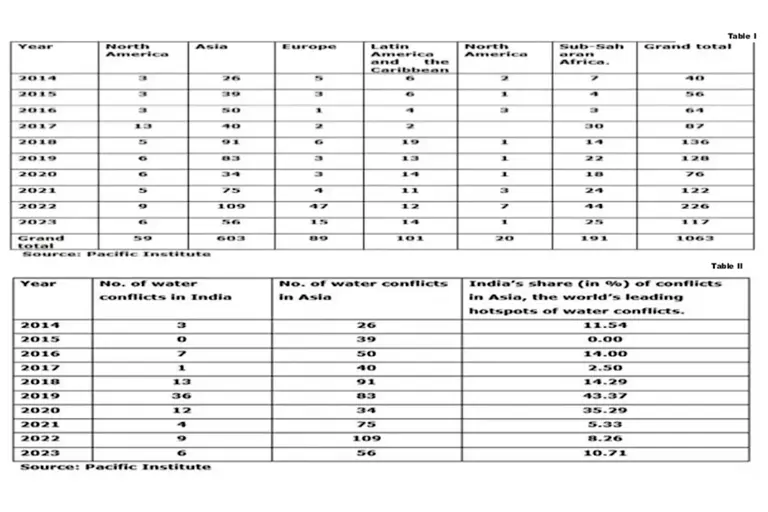
Keeping all these in view, region wise water dispute hotpots may be shown in the accompanying Table -I. Drought and water stress linked to climate change has been a trigger behind rising conflicts in Africa. Sub-Saharan Africa which includes countries such as Burkina Faso, Mali, Ethiopia, Nigeria, Somalia, and Kenya has the largest numbers of water stressed countries of any other place on the planet and of an estimated 800 million people who live in Africa. In Burkina Faso, at least 32 water facilities were destroyed between January and May 2022, impacting as many as three lakh people. Targeted attacks ranged from direct hits on water points and water trucks, purposeful contamination of water resources to sabotaging the public water network’s generators. Thus civilians’ access to fresh water was massively disrupted. South Africa has a history of denying access to fresh water, making water privatization a contentious issue. Even though SA’s Constitution guarantees the right to sufficient water, it remains unmet.

Hydrological poverty tends to trap people who cannot afford to purchase the food and water they need. Consequently, the unrest over the failure to provide safe water and sanitation is growing. Vandalism of water infrastructure that continues to cripple the Eastern Cape municipality may be cited as an example of water conflict. Undoubtedly, climate change is intimately linked to the occurrence of water conflicts. So, with temperatures on the rise and rainfall becoming more erratic, climate change may trigger water conflicts across SA and Asia, not to mention other regions of the planet Earth. India accounts for 43 per cent of reported water conflicts in Asia in 2019 – a year when more than 40 per cent of the country faced drought and about 17 per cent was under severe drought, according to the Water and Climate Laboratory, IIT Gandhinagar. Close to 500 million people were severely affected during the summer of 2019. That year, disputes over irrigation water and drinking water intensified.


The incidents were reported from several states including Andhra Pradesh, Uttar Pradesh, Madhya Pradesh and Punjab. In 2023, the country recorded only six cases, which was the second highest numbers in Asia for the year. India was indeed responsible for almost 11 per cent of water related hostilities in Asia. India’s share of Asia’s water conflicts, as recorded by Pacific Institute can be ascertained from accompanying Table -II. India has the following interstate and trans-boundary water related disputes. Interstate disputes include: (1) Ravi and Beas (the dispute involves Punjab, Haryana and Rajasthan); (2) Krishna (the dispute involves Maharashtra, Telangana, Andhra Pradesh and Karnataka); (3) Vamsadhara (the dispute involves Odisha and Andhra Pradesh), and (4) Mahadayi/Mandovi (the dispute involves Maharashtra, Goa and Karnataka). Transboundary water disputes exist between India and Pakistan over the Indus and the Sutlej River; and between India and China over the Brahmaputra River.


The Pacific Institute has shown that while interstate water conflicts are increasingly less likely, there appears to be a growing risk of subnational conflicts among water users, regions, ethnic groups and competing economic interests. Data from the Water Conflict Chronology shows these intrastate conflicts to be a larger component of all water disputes, and that the traditional international mechanisms for addressing them, such as bilateral or multilateral treaties, are not as effective. It is also estimated that due to an increase in human consumption of fresh water resources, water conflicts will become increasingly common in the near future.

In 2007, Naho Mirumachi, professor of environmental politics, and John Anthony Allan, a geographer, proposed their two dimensional method ~ Transboundary Water Interaction Nexus (TWIN) ~ to approaching water conflict and cooperation. The model is uniquely split into two parts ~ the horizontal scale (measures cooperation intensity) and the vertical scale (measures conflict intensity). In this approach parties often turn to each other to help decisions and can get hyper-focused on who is right and who is wrong. Water cannot be produced or added electronically or by any process of hydrology. Water crisis vis-à-vis water conflict is inevitably a critical issue for our civilisation. John F. Kennedy, the former US President rightly said:” Anyone who can solve the problems of water will be worthy of two Nobel prizes ~ one for peace and one for science.’

(The writer is a retired IAS officer)
WORKERS CAPITAL

UK

Reeves to seek billions for growth from corporate pension surpluses

Sky News
Sun 26 January 2025 at 3:59 am GMT-7·4-min read


Rachel Reeves will this week announce plans to unlock tens of billions of pounds from corporate pension schemes as part of government plans to kickstart economic growth.

Sky News has learnt that the chancellor will use a crucial speech on Wednesday to disclose that she wants to use so-called surplus release to boost investment in the economy.

Government sources said it could unlock more than £60bn of pension surpluses held in defined benefit (DB) schemes, while other estimates suggested the figure could be in the region of £100bn.

The surplus release plan could be included in a pension schemes bill expected to be published in the coming months.

City sources said that a meeting had taken place earlier this month which was attended by Treasury officials, members of the Number 10 Policy Unit and representatives of the 100 Group of FTSE-100 company finance chiefs.

The meeting, which was hosted by Varun Chandra, Sir Keir Starmer's top business adviser, discussed the surplus release plan in detail, according to one finance director briefed on the talks.

Ms Reeves's move will form part of a wider set of pensions reforms initiated under the last government and now being accelerated by Labour.

These include forcing the merger of local government pension schemes, which collectively hold about £400bn of assets.

In her maiden Mansion House speech in November, the chancellor said she would preside over "the biggest set of reforms to the pensions market in decades to unlock tens of billions of pounds of investment in business and infrastructure, boost people's savings in retirement and drive economic growth so we can make every part of Britain better off".

An overhaul of defined contribution (DC) schemes, which in aggregate manage £500bn in assets, is also on the cards, with consolidation there also anticipated in the coming years.

The Treasury has cited Australia and Canada as examples of the model Britain's pensions system should seek to emulate, with both countries utilising pension scheme capital to invest more heavily in domestic infrastructure.

The surplus release plan has the potential to be a major catalyst for economic investment, although it was unclear this weekend how the deployment of this capital into UK growth initiatives would be guaranteed.

It was also unclear the extent to which pension trustees would play a role in any surplus release plans.

The pensions industry has been pushing for surplus release to be adopted in Britain for years, with the Pensions and Lifetime Savings Association having endorsed such a move before last year's election.

Edi Truell, the prominent financier and pensions entrepreneur, said on Sunday: "It is time to split DB pension funds from their employers.

"The employers should be focussing on their core business; and the pension funds be backed by capital from specialist pension superfund managers."

"The Pensions Regulator needs to replace its misguided views of "risk" and recognise that investment in productive assets in the long term provides better pension outcomes."

Ms Reeves's speech on Wednesday will come at a critical time for her, with doubts having been raised about her grip on her job for the first time in recent weeks amid financial market volatility in the aftermath of her October Budget.

Speaking at the World Economic Forum in Davos last week, Ms Reeves indicated that she would row back from a number of Budget measures, including relating to the treatment of non-doms.

Having been repeatedly accused of talking down the economy in the wake of Labour's landslide general election victory, she said this weekend that she wanted Britain to be less "polite" about championing its economic virtues.

The chancellor has also formed a pivotal part of the government's move to shake up economic regulation, with the removal last week of the chairman of the Competition and Markets Authority.

Sky News revealed several weeks ago that Sir Keir had written to watchdogs to urge them to remove barriers to growth, with meetings between the chancellor and regulators set to continue in the coming weeks.

The chancellor's speech this week is expected to confirm government support for major infrastructure projects, including - controversially - a third runway at London Heathrow Airport.

The Treasury declined to comment on Sunday on the contents of the chancellor's growth speech.
China’s shoestring AI humiliates US and could undermine Trump

Samuel Montgomery
Mon 27 January 2025 
THE TELEGRAPH


DeepSeek was launched on the same day that Donald Trump was inaugurated and announced an AI push - Future via Getty

A Chinese AI model built on a shoestring budget has shocked Silicon Valley and presented a major challenge to Donald Trump.

DeepSeek, a language model that can generate human-like conversation, was released on the same day as Mr Trump’s inauguration.

It has since been tested against some of America’s most powerful AI (artificial intelligence) models, such as chatGPT, and in some cases has come out on top.

Experts warned that the breakthrough was a “wake-up call to America”, which has been battling to prevent China competing at the top level of an AI arms race.

Concerns have also been raised that DeepSeek has built-in censorship and refuses to answer sensitive political questions about China and Xi Jinping, the country’s leader.
ADVERTISEMENT


Shortly after his inauguration, Mr Trump announced a $500 billion (£400 billion) AI investment project, dubbed “Stargate”, in co-operation with US firms including OpenAI, which created ChatGPT.

DeepSeek’s new model comes despite a plan by Joe Biden’s administration to hamper China’s AI capabilities, in hopes of denying it the political influence and military supremacy which could come from being the first to achieve what is known as superintelligence.

Marc Andreessen, the Silicon Valley venture capitalist, has been advising Donald Trump on AI - Kimberly White/Getty for Fortune

DeepSeek said it had taken just two months and less than $6 million (£4.8 million) to build a model more advanced than many of its Western competitors.

It was developed as a side project by a maverick hedge fund manager who invested heavily in Nvidia, one America’s most sophisticated makers of the computer chips that are crucial for AI models.

Liang Wenfeng reportedly has close links to the Chinese Communist Party.

Mr Trump placed America’s ambition to become the “world capital of artificial intelligence” at the centre of his inauguration last week, reserving the front row at the Capitol Rotunda for tech billionaires developing AI.

On the same day, DeepSeek released its breakthrough R1 open source language model to little fanfare. Wenfeng’s start-up appeared to have immediately and unexpectedly closed the gap with the US and publicly thwarted the US government’s attempts to stifle Chinese innovation.

“Deepseek R1 is one of the most amazing and impressive breakthroughs I’ve ever seen,” warned Marc Andreessen, the Silicon Valley venture capitalist who has been advising Mr Trump.


Li Qiang, second from left, is the speaks to Liang Wenfeng (back to camera) as he solicits opinions on AI and tech - Xinhua

DeepSeek claimed to have used 2,048 second-rate Nvidia H800 chips and $5.6 million (£4.5 million) to build what is known as a reasoning-focused model.

For comparison, Mark Zuckerberg’s Meta used 16,000 first-class Nvidia H100 chips to build its Llama 3.1 model.

In an interview with Time magazine earlier this year, Dario Amodei, chief executive of the Amazon-backed AI developer Anthropic, estimated the cost of building a frontier model in 2024 as $1 billion (£800 million), with the next generation costing closer to $10 billion (£8 billion).

Yet DeepSeek outperformed Meta and Anthropic’s model, as well as OpenAI’s ChatGPT-4o, in some benchmarks such as accuracy, coding and complex problem-solving.

“DeepSeek is a wake-up call for America,” Alexandr Wang, chief executive of San Francisco-based Scale AI, said, calling for the US to innovate faster and tighten export controls on chips.

Mr Wang, who attended Mr Trump’s inauguration and previously secured a $250 million (£200 million) defence contract, took out a whole page advertisement in The Washington Post last week imploring the president to “win the AI war”.

“DeepSeek ... is the top-performing, or roughly on a par with the best American models,” he warned in an interview with CNBC, adding his belief that China had obtained thousands of first-class chips despite export bans.

Mr Biden curtailed exports of the best chips for training AI models to block China from competing with the US. Yet Mr Wang believes thousands of first-class chips still found their way to China.

Gina Raimondo, the former US secretary of commerce, initially championed the ban and sanctions but later conceded that “trying to hold China back is a fool’s errand”, instead advocating for rampant innovation to stay ahead.
‘High-quality people’

Announcing his $500 billion (£400 billion) “Stargate” AI investment last week, Mr Trump said the four-year project was “big money and high-quality people”.

Mr Zuckerberg followed suit by announcing plans to spend up to $65 billion (£52 billion) on AI infrastructure in 2025, while Elon Musk’s xAI set out intentions to expand its Colossus supercomputer to use more than one million computer chips to train his own Grok AI language model.

The Chinese government has announced a comparatively modest $8.2 billion (£6.6 billion) investment fund for AI projects, according to the South China Morning Post.

Yet DeepSeek’s intent has been matched by Alibaba, which launched its QwQ model in November and is said to be hot on the heels of its US counterparts, while Chinese homegrown chips including those designed by Huawei are also improving rapidly.

“The only strike against it is some half-baked PRC censorship,” Barrett Woodside, co-founder of AI hardware company Positron, told the Wall Street Journal, referring to the People’s Republic of China.

The model has drawn criticism online by appearing to refuse to answer sensitive questions about China or mention Xi Jinping.

Mr Woodside explained that such responses could actually be removed as other developers can freely modify the code.
Close links to Chinese government

Nevertheless, Mr Wenfeng enjoys a close relationship with the CCP, having been invited on Jan 20 by Li Qiang, China’s second-most powerful leader, to discuss how homegrown companies could close the gap with the US.

“We have to develop the top talent ourselves”, Mr Wenfeng said in an interview last year.

Mr Wenfeng made a fortune by harnessing AI to identify patterns which affect stock prices.

“When humans make investment decisions, it’s an art, and they just do it by the seat of their pants. When computer programs make such decisions, it’s a science, and it has the optimal solution,” the eccentric billionaire said in a 2019 speech.

In 2021, he started bulk-buying Nvidia graphics processing units on the side, while running his High-Flyer trading fund.

“When we first met him, he was this very nerdy guy with a terrible hairstyle talking about building a 10,000-chip cluster to train his own models. We didn’t take him seriously,” one of Mr Wenfeng’s business partners told The Financial Times.

His DeepSeek model was published not for commercial success but rather research propagation – as he reveals the secrets and explains the breakthroughs in an accompanying paper, instead of protecting them as intellectual property.

By doing so, DeepSeek has reinvigorated AI developers – sending excitement and anxiety to Silicon Valley in equal measure.

Jim Fan, a senior research scientist at Nvidia, hailed the breakthrough, saying a “non-US company is keeping the original mission of OpenAI alive – truly open, frontier research that empowers all”.