It’s possible that I shall make an ass of myself. But in that case one can always get out of it with a little dialectic. I have, of course, so worded my proposition as to be right either way (K.Marx, Letter to F.Engels on the Indian Mutiny)
Tuesday, February 04, 2025
Japanese Captain Faces Prosecution for Ferry Grounding
The captain of a K Line-operated ferry has been referred for prosecution in connection with a grounding on the island of Hokkaido last year.
In the early hours of July 2, 2024, the ferry Silver Breeze was arriving at Tomakomai, Hokkaido when it struck a breakwater. No injuries were reported among the 140 passengers and crewmembers, but the vessel sustained significant damage at the bow.
The Japan Coast Guard investigated the accident and determined that it was caused by human error - an "insufficient confirmation of the ship's position and course." The captain was aware of the breakwater, but allegedly did not confirm the ship's position on the radar or the electronic chart.
During questioning, the master admitted to causing the accident "due to my own steering error," according to NHK. The Japan Coast Guard has referred the case to a prosecutor, and the master stands accused of professional negligence resulting in danger to traffic.
Silver Breeze is a 2022-built ro/pax ferry, the last in a series of five. She was built by Naikai Zosen for shipowner Tsugaru Kaikyo Ferry, and is operated under charter by K Line's Silver Ferry division. In regular rotation, she connects Honshu's northeasternmost province with the island of Hokkaido.
Gibraltar Calls for Use of Pilots Saying OS 35 Master Misjudged Departure
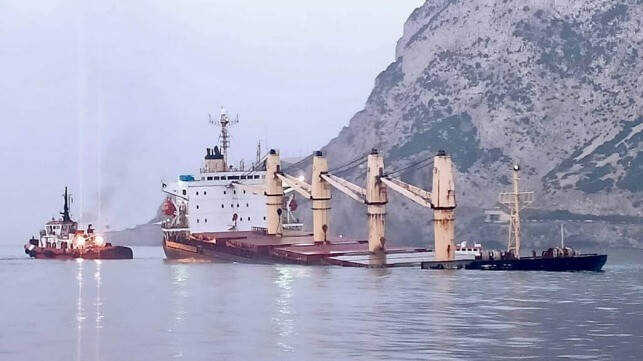
Bulker OS 35 was a total loss due to a misjudgment and a lack of pilot to oversee the departure (GPA)
Two and a half years after the accident which caused the loss of the bulker OS 35, Gibraltar’s maritime authority issued its report finding poor planning and that the captain misjudged the maneuver resulting in the casualty. The report calls for considering the compulsory use of pilots for vessels in the anchorage concluding a pilot very likely would have prevented the incident.
The bulker OS 35 was in the Western Anchorage at Gibraltar on August 29, 2022, taking on bunkers as is the common practice at the port. About two hours after the OS 35 arrived, the gas carrier Adam LNG also arrived in the Western Anchorage for a layover. She was traveling in ballast without a cargo aboard. The OS 35 completed her bunkering around 20:30 and made ready to get back underway bound for the Netherlands with a load of steel rebar.
Based on the analysis, the investigators concluded that environmental conditions were not a major factor. The OS 35 recorded the winds as light and that there was good visibility and clear skies in her log. Based on videos and other data the report concludes the current was at 0.2 knots from the west and wind speeds 12 knots from the east-north east.
Gibraltar’s regulations only require pilots for berthing and unberthing and not for departing the anchorage. The report notes incidents are rare but concludes planning for the departure was weak and not well monitored by the crew and harbor controllers. The controllers did inquire about how the OS35 planned to pass the anchored gas carrier and got a vague answer of going around. The report notes the departure was not plotted, the passage plan was not amended for the actual anchor position, and not discussed on the bridge.
After OS 35 raised her anchor, the master had ordered dead slow astern increasing the speed to 2.6 knots, but became concerned they were closing on Adam LNG due to the effects of the maneuver, tidal flow, and wind. The main engine was stopped. The master then ordered dead slow and then slow ahead and the rudder was placed hard to port. The master later telephoned the chief engineer asking for increased ahead power to maximum but the report notes it was limited by the rudder being hard over.
With OS 35 closing on Adam LNG, the speed was up to 1.3 knots when it clipped the bulbous bow of the LNG carrier holing two cargo holds. That set off the series of events with the port ordering the bulker to ground and becoming a total loss. There were additional communications problems during these subsequent maneuvers.
“The master of OS 35 made an error of judgment, which was not detected by the bridge team,” concludes the report. “Had a pilot been embarked, it is considered very likely that an alternative maneuver would have been used to depart the anchorage, which would not have included the prolonged astern maneuver. Had a pilot been aboard, it is considered very likely that the collision would have been prevented.”
Exploring the incident in further detail, the investigators also highlight that the OS 35’s procedures did not require a discussion with the bridge team, and they concluded that had the master or second officer effectively monitored the track of OS 35 they might have observed the vessel’s continued swing and taken action. The master’s revised plan for full ahead propulsion and the rudder hard over was not effectively challenged by the second officer who had not been consulted for the maneuver and change in plans.
Some of the analysis of the incident was hampered by the fact that OS 35’s VDR was not fully functioning. It is unclear if it was switched off, but later testing showed it was functional. There was no data retrieved first when they attempted in Gibraltar or when it was sent to the UK’s Marine Accident Investigation Branch for forensic analysis.
Without the requirement for a pilot, they report the master never considered using a pilot. Further, there were no requirements for the master to advise Gibraltar’s VTS of the intended plan so the VTS could not realize the vessel was off-plan. The VTS only called the vessel when it became concerned.
The report highlights that the Gibraltar Port Authority should consider introducing compulsory pilotage for vessels departing the Western Anchorage. Short of that, they also recommend the VTS provide clear advice to vessels prior to giving departure permissions. The pilots should also make clear their availability and the procedures for requesting a departure pilot. The report also recommends that the operator of OS 35 review bridge team training and procedures for arrival and departure from ports without pilots.
What should have been a simple maneuver became one of the most significant accidents Gibraltar has experienced. It took over a year to clear the wreck of the OS 35 and there was oil pollution impacting the shores of Gibraltar and Spain.
ALT. FUELS
Hanwha and Baker Hughes Partner for New Carbon-Free Ammonia Gas Turbines
Project plans to develop ammonia gas turbines for zero carbon emissions in shipping and other applications (Baker Hughes)
Hanwha Group through its shipbuilding and power systems divisions is partnering with energy technology company Baker Hughes to develop a new generation of small-size ammonia gas turbine engines. By using the proven design of gas turbines, the companies believe it will be possible to develop a new engine that can unlock the benefits of ammonia to provide carbon-free emissions in new applications including shipping.
Baker Hughes offers a broad line of gas turbines ranging from 5.7MW to 130MW which it highlights cover virtually every application across the oil and gas value chain, and in other industries. Power plants, LNG, and pipeline transmission, the company reports have widely adopted its gas turbine products and now it looks to develop the new small-size ammonia turbine which will be suitable for marine applications as well as for onshore and offshore applications and electric generation and mechanical drive. Gas turbines were explored for several ships including cruise ships starting about 20 years ago, but many cruise lines moved away from them saying they are costly to operate.
Under the new partnership, Baker Hughes will work with the shipbuilding group Hanwha Ocean and Hanwha Power Systems. They look to combine expertise for a new small-size turbine for ammonia applications that will leverage Baker Hughes’ small-size gas turbine technology and Hanwha’s ammonia combustion system.
Hanwha reports it has already tested successfully a proof-of-concept of the combustor, with 100 percent ammonia as the fuel gas, and Baker Hughes completed its initial turbine feasibility studies in 2024. The two companies target to complete the full engine test with ammonia by the end of 2027, after which the turbine (~16MW power range) will be commercially available for orders.
"This collaborative development of a low-carbon ammonia gas turbine will be a significant turning point in the global shipbuilding and shipping industry, accelerating the transition to eco-friendly fuel propulsion for ships," said Son Young-chang, vice president and head of Hanwha Ocean's Product Strategy Technology Institute.
The ammonia gas turbine to be developed through this collaboration will be based upon the proven, small-size turbine technology of Baker Hughes, and a newly-developed ammonia combustion system created by PSM, a US-based Hanwha subsidiary. The gas turbine will be capable of 100 percent ammonia combustion, and dual fuel operation with a natural gas and ammonia blend.
“It is expected to be a game-changing technology for large ship owners, enabling a completely carbon-free mode of propulsion,” predicts Hanwha. The shipbuilding group looks to incorporate the ammonia gas turbine into its designs for LNG gas carriers and containerships which it expects to have available by 2028. Hanwha Power Systems and Hanwha Ocean obtained in September 2023 approval in principle from the American Bureau of Shipping (ABS) to apply ammonia gas turbines to LNG carriers.
Baker Hughes reports that it is currently exploring how its small-size gas turbines can accelerate the transition from diesel motors to turbines powered by ammonia and hydrogen. In January 2024, the company announced the completion of the successful testing of the world’s first 100 percent hydrogen turbine, which is now commercially available and with orders under execution
Project to Develop High-Power Methanol Fuel Cells Targeting Cruise Ships
The research project seeks to use methanol to develop high-power fuel cells to support cruise ship operations (Meyer Werft)
A new project uniting leaders in German industry and funded by the German government looks to develop a new generation of fuel cells using methanol to provide power for cruise ships. In the zero4cruise project, the German Aerospace Centre (DLR), will be working with Meyer Werft and the Freudenberg Fuel Cell e-Power Systems, to further develop PEM fuel cell technology for large-scale maritime systems.
The partners highlight that the project is designed to tackle one of the maritime industry’s most pressing challenges, the development of sustainable and low-emission energy solutions for cruise ships. Several smaller-scale projects are working on fuel cells for cruise ships and demonstration projects, but the challenge is the amount of power required to sustain the operations of a large cruise ship. The project looks to build on existing technology to create large-scale fuel cell stacks.
Meyer, which is well-known for its large cruise ship constructions including the first LNG dual-fuel ships, notes the focus of this project is on retrofitting existing ships. In addition to extending the lifespan of current ships, they note it can accelerate the decarbonization process in the cruise sector. They are particularly focusing on sustainable operations in ports and coastal areas.
A key focus of the project is the further development of PEM (Proton Exchange Membrane) fuel cell systems for large-scale maritime applications. They note by combining with methanol as an energy carrier, this technology offers great potential for supplying ships with electricity, heat, and cooling - efficiently and with low emissions.
The DLR Institute of Engineering Thermodynamics is responsible for the pre-development of fuel cell stacks on a scale relevant to the maritime market. This includes the consistent implementation of innovative technology approaches in the field of both LT-PEM and HT-PEM. The aim is to build prototype fuel cell stacks with 250 kW (LT-PEM) and 120 kW (HT-PEM), including performance verification in the laboratory.
The DLR Institute of Maritime Energy Systems is carrying out long-term tests on a 500 kW maritime fuel cell system. The aim is to simulate the real load cycles of a cruise ship to prove the long-term suitability of the system. In addition, newly developed LT and HT PEM fuel cell stacks will be tested in the Maritime Energy Laboratory to ensure development to the system level.
The German Federal Ministry of Economics and Technology funded the project with a total of €18.7 million ($193 million). The research project kicked off in January with a team meeting in Munich.
Growing adoption of Wind-Assisted Ship Propulsion for sustainable shipping
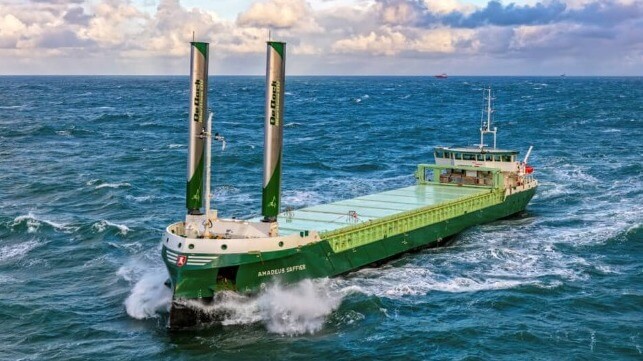
Econowind has surpassed 100 VentoFoil units sold, marking a major milestone in the shipping industry’s shift towards Wind-Assisted Ship Propulsion. The increasing adoption of the VentoFoil system reflects shipowners’ drive to cut fuel consumption, reduce CO? emissions, and comply with tightening global regulations.
Since the first two units were installed on MV Ankie in 2018, Econowind has steadily expanded its reach. Today, 32 VentoFoil units are in operation, 33 are currently in production or ready for installation, and another 37 are set for delivery in 2025. The VentoFoil technology has been successfully deployed on bulk carriers, tankers, RoRo, and container vessels.
“Surpassing 100 VentoFoil units sold is a clear sign that Wind-Assisted Ship Propulsion is gaining real momentum,” said Chiel de Leeuw, CCO of Econowind. “With rising fuel costs and increasingly strict environmental regulations, shipowners are embracing wind power as a proven solution. As we scale up production, we’re eager to help even more vessels transition to greener shipping. The low weight and tiltable VentoFoils are ideal for ship owners who value flexibility.”
Ramping up production in Zeewolde
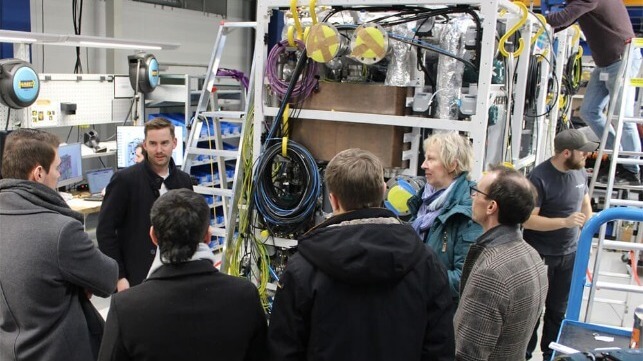
To meet growing demand, Econowind is scaling up production at its facility in Zeewolde. The expanded space and optimized processes allow for higher output and shorter lead times, ensuring more shipowners can benefit from VentoFoil technology. This strategic move positions Econowind to ramp up manufacturing as the industry accelerates its shift toward low-carbon shipping solutions.
The VentoFoil Family
The VentoFoil range offers flexible solutions with 10m, 16m, 24m, and 30m versions, catering to various vessel sizes and operational needs. Next to the fixed mounts Econowind offers containerized and Flatrack VentoFoil units. These can be easily transferred between vessels, making it a practical, scalable solution for shipowners looking to enhance efficiency and reduce carbon emissions while maintaining operational flexibility.
A solution for compliance: The Wind Reward Factor
From 2025, FuelEU Maritime will tighten CO? reduction targets, rising from 2% to 80% by 2050. Shipowners using VentoFoil technology benefit from the Wind Reward Factor (WRF), which lowers their vessel’s reported emissions, making compliance with FuelEU Maritime, CII, and ETS regulations easier and more cost-effective. By integrating VentoFoils, they reduce fuel costs, cut carbon allowance expenses, and improve
The products and services herein described in this press release are not endorsed by The Maritime Executive.
WinGD On-Engine NOx Abatement Solution to Make Commercial Debut
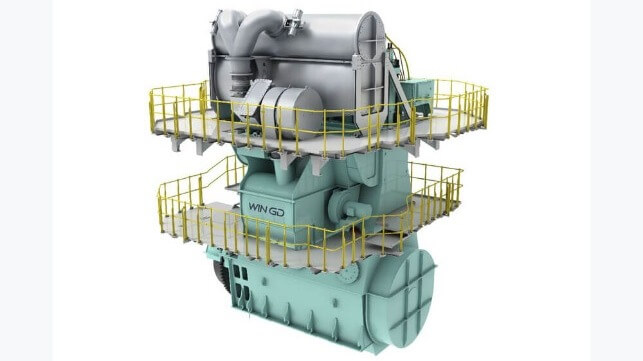
The only on-engine NOx reduction solution for marine two-stroke engines, designed by Swiss marine power company WinGD, will be deployed for the first time on commercial engines after securing type approval. The integrated Selective Catalytic Reduction (iSCR) solution was tested at Mitsui E&S DU (MESDU) Co’s factory in Aioi, Japan, where three WinGD 5X52-S2.0 engines are being built for bulk carriers under construction at a Japanese shipyard.
The type approval follows more than two years of service experience with a prototype version. The latest iteration features reduced material and production costs, a heating unit to enable operation with heavy fuel oil and design changes to deliver further reductions in ammonia slip.
WinGD Vice President Product Centre, Peter Krähenbühl, said: “WinGD’s unique on-engine NOx abatement solution secures IMO Tier III compliance while giving operators greater flexibility in engine room configuration and ship design. This new iteration further reduces the cost impact of NOx abatement and improves the efficiency of treatment with both existing and emerging fuels.”
As well as reducing the footprint of off-engine equipment, iSCR also simplifies piping requirements compared to either low- or high-pressure SCR off-engine units. Testing and commissioning are simplified as the engine and NOx abatement system can be tested together prior to installation. Optimised exhaust flow management and waste heat from the engine contribute to favourable conditions for treatment.
The test was held on January 16th and was witnessed by representatives from eight leading classification societies: ABS, BV, CCS, DNV, KR, LR, ClassNK and RINA.
The iSCR technology is available as an option for WinGD’s 52- and 62-bore engines, including short-stroke variants, using fuel oil, ammonia or methanol. Extension to further engines will be evaluated based on market demand.
The products and services herein described in this press release are not endorsed by The Maritime Executive.
Corvus ESS Will Power the World’s First Fully Electric Offshore Vessel
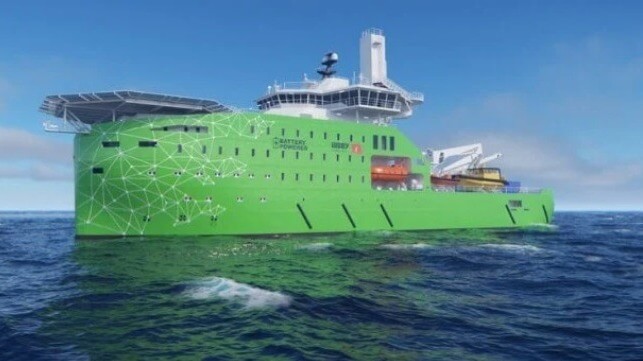
Corvus Energy, the leading supplier of zero emission solutions for the offshore and marine industry, is proud to announce that it will deliver a mega-size battery system for the first fully electric offshore vessel ever to be built.
The vessel is an electric Commissioning Service Operation Vessel (eCSOV) that will be constructed by Armon shipyard in Spain for the UK-based shipowner Bibby Marine Ltd.
World`s first of its kind
Corvus Energy will supply its Blue Whale Battery Energy Storage System (BESS) delivering close to 25MWh of power for the vessel. It will be the largest LFP (Lithium Iron Phosphate) battery system ever delivered to a maritime project.
“A fully electric offshore vessel is something the industry has been working towards for a long time and marks a major milestone in offshore vessel operations," said Pål Ove Husoy, VP Sales at Corvus Energy.
“This eCSOV will be the first offshore vessel that can operate fully electric for a full day and will set a new standard for future offshore vessels. The unique system design incorporating both battery power and dual-fuel methanol engines will significantly reduce carbon emissions and increase energy efficiency while providing the reliability and performance needed for demanding offshore wind and renewable operations.”
Unique and optimized power distribution system
Corvus Energy has been cooperating closely with the shipowner, designer and integrator to dimension and optimize the system design. Unlike conventional hybrid systems, the vessel will utilize its large battery pack as the primary power source, with engines running solely for charging at a constant, optimized load that maximizes efficiency, extends battery lifespan and significantly reduces emissions. The innovative DC grid architecture further enhances overall system performance by minimizing energy losses and ensuring seamless power distribution. Additionally, offshore charging capabilities will enable simultaneous battery charging while maintaining DP for station-keeping, representing an industry first in the SOV market.
Accelerating the path to net zero
Gavin Forward, New Build Director at Bibby Marine, commented: “We are excited to collaborate with Corvus on this pioneering eCSOV project, setting a new benchmark for sustainable offshore operations and driving the future of zero-emission vessel technology."
He added that Bibby Marine selected Corvus Energy "for its proven track record in delivering complex vessel projects, while the LFP battery chemistry was chosen for its alignment with our eCSOV’s operational profile, offering enhanced safety, longevity and reliability for a project that promises to accelerate the path to net-zero for the maritime sector."
Equipment from Corvus Energy will be delivered to the shipyard in 2026, and the vessel is scheduled for operation in 2027 supporting the commissioning and operation of windfarms.
The products and services herein described in this press release are not endorsed by The Maritime Executive.
Tech Enhancements Bring Smoother Sailing to International Commerce
The difficulties facing global trade and the global supply chains have been widely documented over the past few years. The outlook for global trade remains murky in 2025 with the threat of tariffs and ongoing shifts in geopolitics. Despite headwinds, the World Trade Organization is projecting world merchandise trade growth to increase three percent this year.
With growth in the market, however, comes an even greater influx of information. This is especially true for businesses engaged in maritime transport, as a projected oversupply of available shipping space will likely lead to more options for businesses to parse through. This increase in options comes at a time of increasingly complex supply chains, which only adds to the information that businesses must evaluate and can decrease the visibility businesses have into the process from start to finish. How businesses handle the influx of information that comes with more options can make all the difference between profit and loss, and visibility into the process is key to making informed decisions.
Digital Transformation of Maritime Finance
As globalization and international trade have expanded in recent decades, innovation has been a critical part of the process nearly every step of the way. Maritime trade in particular has evolved tremendously, from large wooden ships to steamer ships to the massive container ships we see on the waters today. Other innovations, such as the magnetic compass and the Panama Canal, have helped to simplify navigation and shipping routes along the way.
Today, maritime trade is experiencing a technological renaissance as businesses look for increased transparency and flexibility along with decreased costs. According to a report from PwC, the maritime software market is expected to reach $2.9 billion by 2028. While some innovations, such as autonomous ships, are still in the final stages of testing and early stages of use, other technologies are already changing the game. For example, e-documents are currently being used to save as much as $5.5 billion. Like many industries, artificial intelligence is also revolutionizing maritime trade through cost negotiations, negotiating purchasing terms, compliance checks, freight audits, and route optimization.
Similar to the physical processes of maritime trade, the financing aspect is always evolving. On the one hand tariffs and other fees associated with cross-border trade are always in flux. A recent development worth noting is the number of parties that can be involved in trade financing has increased. Initially, banks, importers, and exporters dominated maritime trade finance. Today, however, trade financing companies, insurers, and export credit agencies have entered the fold to increase options for businesses. The drawback to this development is that maritime trade financing has become somewhat fragmented, and many businesses do not have end-to-end transparency into the process.
For all the investment in navigational and tracking technology across the maritime trade landscape, there is also tremendous opportunity to deliver digital payments innovations to streamline the financial side of maritime trade and increase transparency—and banks are the perfect candidate to lead this charge.
Accelerate Trade: A New Way to Bank
One example of banking technology designed to help revolutionize maritime trade financing is AccelerateTM Trade, an advanced, automated, digital trade finance portal from Synovus Bank.
As global trade—and maritime trade in particular—became increasingly digitalized, Synovus recognized the need to digitalize the payments process to help bring the entire trade operation online. Accelerate Trade does just that by allowing banks to initiate and monitor transactions 24/7 without having to call the bank or submit paperwork. Through this product, businesses can maximize efficiency, optimize processing and reduce risk for commercial letters of credit (import and export), standby letters of credit, guarantees, bankers’ acceptances, documentary collections, financing, and more. Accelerate Trade users can also leverage features such as user-driven reporting, alerts and calendaring to track their trade financing process.
For maritime trade specifically, Accelerate Trade can be combined with another Synovus offering, AccelerateTM FX, to conduct foreign exchange and trade activities securely.
By bundling all of these services into one solution, Synovus offers businesses a high degree of visibility into their trade financing activities from start to finish. Accelerate Trade also helps businesses see the entire picture of their trade financing operation by consolidating key information for multiple transactions into one view. Access to all of this information gives business decision-makers the insights they need to improve operational efficiency and enter the new era of maritime trade.
In spite of economic and geopolitical headwinds, global trade, driven by maritime trade, appears poised to continue its steady growth. Automation and emerging technology have begun to revolutionize maritime trade operations throughout the process. Through products like Accelerate Trade, banks are making sure that the financing for these operations evolves to meet the needs of the modern market, too.
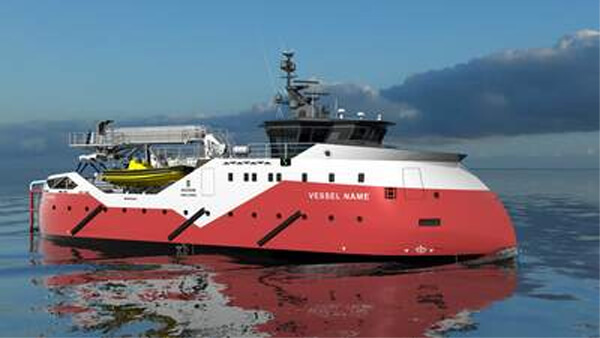
As the offshore wind energy sector continues to evolve, operators especially in the maintenance and operations phase are faced with the challenges of lowering costs and increasing efficiency. Norway’s Ulstein has developed a new hybrid design for a smaller service vessel that they believe fills a critical gap in the market and reduces costs for the operations of the wind farms.
While the world needs more renewable energy sources, costs continue to be a significant challenge for offshore wind. To achieve financial viability, developers have been looking to larger projects, but Ulstein focused on an approach with could lower CAPEX by 50 percent, operating costs, and contribute to making smaller, closer-to-shore wind farms more economical for the developers.
Currently, they point out the walk-to-work sector relies mostly on the larger Service Operation Vessels (SOV) which can stay onsite for an extended period and typically accommodate up to 100 people. Day projects are supported by the crew transfer vessels.
Smaller SOV fills a gap in the market and offers 50 percent lower CAPEX and OPEX (Ulstein)
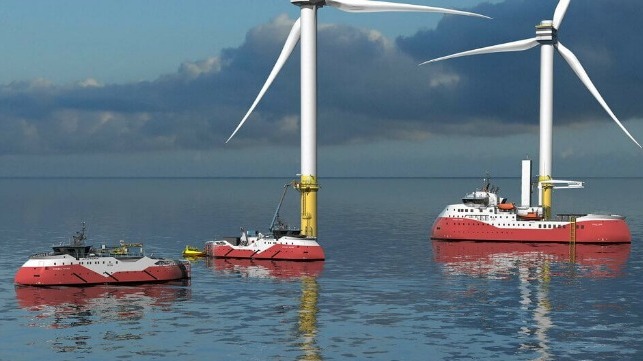
Ulstein’s proposal for the SX250 is a vessel that can bridge the gap between CTVs and the current large SOVs. Its smaller vessel would measure approximately 47 meters (154 feet) and provide accommodations for 32 to 40 individuals. It would have a top operating speed of 10 knots and use the designer’s Twin X-Stern to enhance seakeeping capabilities.
According to the company, the vessel would be suited for sea conditions up to 2 meters (6.5 feet) and best for small to mid-sized wind farms located in areas with calm or moderate sea states. These could be closer or shore or in shallow waters.
Another concept is for the smaller SOVs to work in unison with the larger vessels. According to Ulstein, two of three of the SX250 could be managing smaller jobs at the wind farm while the traditional, larger SOV focuses on the larger tasks.
The new vessel concept Ulstein says relies on existing off-the-shelf hardware and technology to ensure effective walk-to-work operations while reducing CAPEX and OPEX. The vessel can be customized with different arrangements and topside equipment and depending on the operational needs, various setups such as a gangway system, a daughter craft, deck storage, or a work or observation ROV.
Filling the perceived gap in the market Ulstein says provides a unique opportunity to lower CAPEX and OPEX by up to 50 percent versus the current vessels. As a smaller vessel, it also contributed toward the push toward sustainable operations and presents a unique new solution to support the broader building out of the offshore wind sector.
Dominion’s Offshore Wind Farm Reaches 50% Mark as Costs Soar Past $10B
Dominion Energy highlights continued progress on the installation of its offshore wind farm (Dominion Energy)
Dominion Energy reports its offshore wind farm project remains on schedule and is making good progress. Known as Coastal Virginia Offshore Wind, the 2.6 GW project will be the largest in the United States when it is completed at the end of 2026.
Offshore work for the wind farm began in 2024 and the company says it has now approached the 50 percent mark with milestones in the installation. After completing the installation of 78 monopole foundations and four offshore substation foundations during the first season which ended in November 2024, Dominion highlights that the first 16 transition pieces are now in place. The completed project will have 176 wind turbines. The company continues to stage materials at the Portsmouth Marine Terminal with the next phase of monopole installations due to start in the spring.
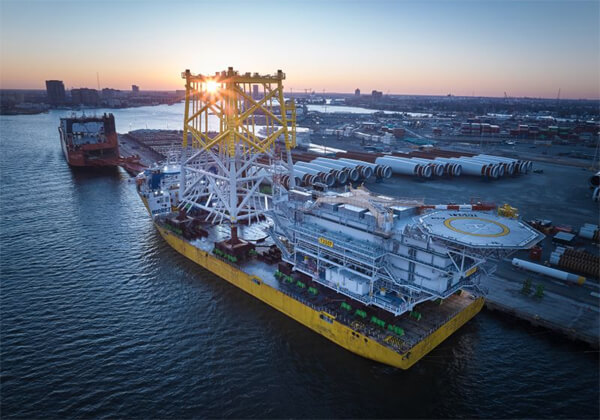
The first three of the 4,300-ton offshore substations arrived in late January in Virginia. Among the next steps, Dominion reports that wind turbine tower and blade fabrication is now underway and nacelle fabrication is scheduled to begin later this quarter.
Substations arrived as materials are staged onshore in Virginia (Port of Virginia)
While the project is making good progress on the installation, Dominion also revealed costs are up approximately nine percent from the November 2021 budget submitted to the Virginia State Corporation Commission. They noted that the increase, which is due to higher onshore network upgrade costs assigned by grid operator PJM, has driven the total budget to $10.7 billion up from the original estimate of $9.8 billion.
The company emphasized that the costs are controlled with robust cost-sharing mechanisms and an unused contingency that stands at $222 million. Dominion Energy last year sold a 50 percent stake in the project to investors Stonepeak which will cover half the costs up to $11.3 billion. Above that there is a cost-sharing mechanism. While costs are up, they also said it is only for the grid portion with other project costs including offshore having remained in line with the original budget. The company reports the project will cost the average customer 43 cents per month over the life of the project.
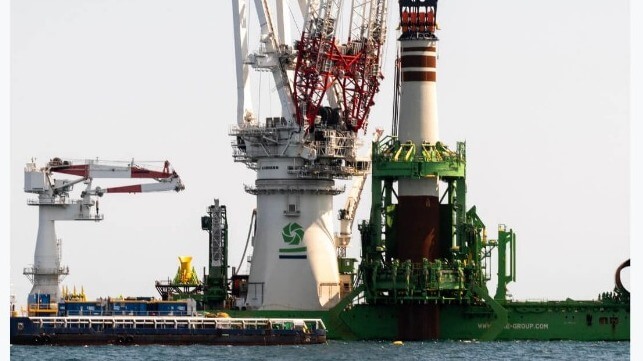
As part of the project, Dominion Energy is building the first U.S. wind turbine installation vessel at Seatrium’s shipyard in Texas. Named Charybis, they report the vessel is now 96 percent complete. It has commenced sea trials. Its first project will be the installations for Coastal Virginia Offshore Wind.
The company has been successful in managing the project to keep it on track and avoid some of the challenges that other projects are experiencing. It retrained DEME for the first phase of the installation using DEME’s large install vessel Orion.
Dominion’s long-term plan calls for expanding its offshore wind energy presence. In 2024, Dominion acquired an adjoining property from Avangrid which is said could provide an additional 800 MW of power. In August 2024, Dominion also won a lease from the Bureau of Ocean Energy Management for a site 35 nautical miles from the mouth of the Chesapeake Bay. The company has said the lease area could support between 2.1 gigawatts and 4.0 gigawatts of offshore wind energy generation according to BOEM’s preliminary estimates. These additional projects require planning and eventually permitting which would likely be delayed under the Trump administration’s energy policy.
New Jersey’s Fourth Offshore Wind Solicitation Ends Without Award
Opponents want to protect the New Jersey shore line from the installation of offshore wind turbines (file photo)
Regulators for New Jersey’s offshore wind energy sector announced today that they will not be proceeding with an award for the fourth round wind solicitation due to “uncertainty driven by federal actions and permitting.” It makes the latest setback for the state which has seen multiple projects delayed and withdrawn despite a strong commitment by the state’s governor to renewable energy.
The New Jersey Board of Public Utilities reported it will not be proceeding with an award but that it is committed to working with Governor Phil Murphy to “build a successful offshore wind industry in New Jersey.” It reported that two of the three bidders in this round withdrew and that only the Atlantic Shores project proceeded to submit a best and final offer.
Last week, Shell reported it would be pausing its involvement in the Atlantic Shores project saying it did not meet the company’s financial criteria. Previously in 2024 Shell also sold its portion of a New England wind farm project as it says it is reevaluating its participation in the sector.
Shell is a 50-50 joint venture partner with EDF Renewables in Atlantic Shores. The project calls for a two-stage project that would provide 2.8 MW of energy to New Jersey with up to nearly 200 turbines. It would be about 9 miles off the New Jersey shore near Atlantic City and Sea Girt. The project gained approval from the Bureau of Ocean Energy Management (BOEM) in October 2024 for its construction and operations plan,
“A number of reasons led to this decision, notably Shell backing out as an equity partner in the Atlantic Shores project and backing away from the American clean energy market, as well as uncertainty driven by federal actions and permitting. The Board concluded that an award in New Jersey's fourth offshore wind solicitation, despite the manifold benefits the industry offers to the state, would not be a responsible decision at this time,” said Christine Guhl-Sadovy, President, New Jersey Board of Public Utilities.
The state’s fourth solicitation called for 1.2 to 4 gigawatts of offshore wind generation capacity. The application window closed on July 10, 2024. Reports indicate the Corio-Total-Rise joint venture Attentive Energy and RWE-National Grid venture Community Offshore Wind also submitted initially but later withdrew from the process.
Governor Murphy had also announced in May 2024 that the state would be accelerating its schedule for future offshore wind solicitations. The fifth round he reported would be brought forward to the second quarter of 2025. It was previously scheduled for the third quarter of 2026.
New Jersey has struggled to get its offshore wind industry going. Ørsted had the two most advanced projects, Ocean Wind, but canceled them in 2023. The state awarded additional projects in January 2024 with 1,342 MW to Attentive Wind Two and 2,400 MW to Leading Light Wind. Problems with securing a turbine supplier however prompted Leading Light Wind to twice delay its application with the NJBPU. In December 2024, it asked for a delay till May 2025.
The New Jersey projects have faced strong local opposition. Donald Trump supported the efforts using New Jersey to highlight his opposition to offshore wind energy. Last week he posted on social media that he hoped the Atlantic Shores project would be “dead and gone.” The new Trump administration has imposed a moratorium on new leases in federal waters and is expected to delay the review of pending permit applications.
Atlantic Shores issued a brief statement last week on January 30 saying it was still committed to New Jersey and delivering the state’s first offshore wind project.
Based on these developments, the New Jersey Economic Development Authority reported today it is accelerating strategic review of options and alternatives for the New Jersey Wind Port. The state was planning the development of a large port facility to support the construction operations for offshore wind. The port facility was to be located in Salem, New Jersey.
NTSB: Wake From Passing Ships Pushed Barge Tow Into Algiers Lock Gate
The National Transportation Safety Board has released its final report on the allision of the towing vessel Kitty (and its tow) with the Algiers Lock in New Orleans. A deluge of water coming into the lock from the wake of passing vessels likely caused the tow to surge forward and strike the lock gate, NTSB concluded.
On the evening of July 4, 2023, the 68-foot towboat Kitty was pushing two tank barges into the Algiers Lock during low water conditions, from the Mississippi River side. The river stage at that point in the summer was 1.7 feet at Algiers Lock, an "extremely low" water level. A severe-wake warning was in effect because of the amplified risk of wave action in the shallows on either side of the shipping channel, but there were no specific speed restrictions in place. River pilots maintained standard transit speeds (full ahead) through the area.
At 1752-1802, just before the Kitty entered the lock, three deep draft ships passed by on the river at ordinary transit speeds of 10-14 knots. At 1804, the tow suddenly accelerated ahead in the lock chamber. Despite the master putting all engines full astern, Kitty and her barge tow were pushed forward. The momentum parted two mooring lines, and the lead barge struck one of the lock gates. No injuries or pollution occurred, but the lock gate sustained about $2 million in damage.
After the casualty, the crew of the Kitty reported that the water level had risen by three feet or more while transiting the lock. NTSB examined video footage from the accident and concluded that the wakes of the passing vessels caused the surge of water into the lock, and raised the water level by at least 3.4 feet.
Lock operators told NTSB that they had never seen anything like this before, though smaller surges of up to a foot had occurred previously. It was the lowest water level that they could recall as well; NTSB suggested that the extremely low water in the lock forebay could have amplified the effect of the wake, creating the unusual surge that pushed the towboat forward.
ReCAAP Sounds Alarm About Tripling of Robberies in Singapore Strait in 2025
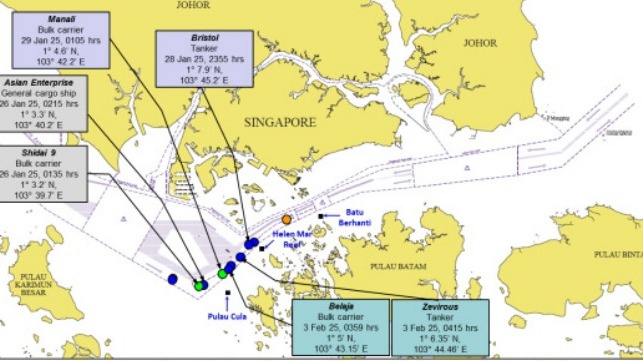
Incidents have tripled so far in 2025 versus 2024 (ReCAAP)
The monitoring and coordination operation for piracy and criminal activity against shipping in Asia, ReCAAP ISC, issued a new alert on February 3 highlighting that the number of robberies has nearly tripled in the Singapore Strait this year. They report that just over a month into 2025, there have now been 11 incidents all in a specific area near the western terminus and often grouped in a short interval of time.
“ReCaap ISC alerts the maritime community on the continued occurrence of incidents of sea robbery onboard ships while underway in the Singapore Strait, and warns of a possibility of further incidents,” is emboldened at the top of the new alert.
This comes after reports that two more vessels were boarded overnight on February 3. Ambrey Analytics says a tanker and bulker were each boarded approximately 15 minutes apart from each other. Four individuals were seen on a bulker with what appeared to be knives and guns. Shortly thereafter, there was a second report of six individuals on a product tanker armed with knives.
ReCaap notes that the incidents have occurred within short intervals, with two reports each in the early morning hours on January 26 and February 3 and two other reports overnight between January 28 to 29. All of them took place in the eastbound lane and were near the western end of the Singapore Strait near Indonesia.
Of note is that the perpetrators now appear to be armed with knives or possibly guns whereas in the past they were often unarmed. ReCAAP highlights of the 11 reports this year, four times there were indications of guns or gun-like objects, five reports of perpetrators with knives, and two reports did not specify if there were weapons involved.
In one case a chief engineer’s hands were tied by the perpetrators but no one was injured. In the past, the boarders most often fled when they were spotted and rarely came in direct contact with a vessel’s crew.
Most of the crimes continue to be robberies. Engine spare parts were reported stolen in seven of the current incidents.
ReCAAP notes that in 2024 there were only four incidents reported between January 1 and February 3. Based on the persistence and common nature of the incidents they warn that there may be further incidents in the future.
They are urging littoral states to increase patrols and surveillance in the respective waters and to respond promptly to reports coming from the ships. They also recommend coordination and information sharing to aid in the arrest of the criminal groups conducting these robberies. For ships, they note there is particular concern during the hours of darkness. They recommend adopting preventive measures and intensifying vigilance and look-outs while transiting the areas of concern.
Security consultants and ReCAAP warned in 2024 that robberies were increasing in the Singapore Strait. The current wave however is of particular concern due to the number of incidents and the more aggressive nature of the perpetrators.



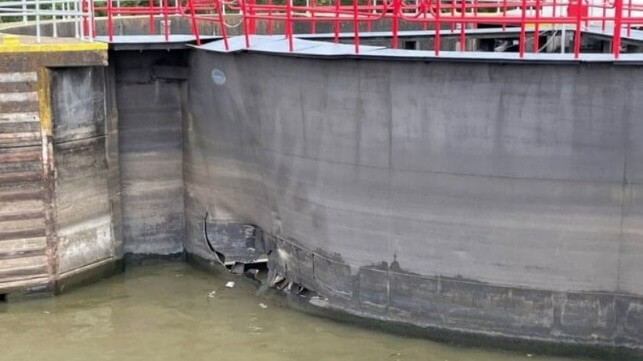 Damage to the lock after the allision (NTSB)