Friday, February 21, 2025

In First Major Climate Challenge to Trump 2.0, Groups Work to Block Offshore Drilling Once Again


Climate campaigners defeated the president's offshore drilling push during his first term, and they are pledging to do so again.


An offshore oil platform is seen in the Santa Barbara Channel in California on January 1, 2024.
(Photo: Marli Miller/UCG/Universal Images Group via Getty Images)


Julia Conley
Feb 21, 2025
COMMON DREAMS

Climate advocates are expressing confidence as they file the first major environmental legal challenges to U.S. President Donald Trump's administration, with the legal group Earthjustice noting that campaigners were victorious during Trump's first term when they sued to stop him from gutting protections from offshore oil drilling.

"We defeated Trump the first time he tried to roll back protections and sacrifice more of our waters to the oil industry," said Earthjustice managing attorney Steve Mashuda on Wednesday as the organization filed a challenge against an executive order Trump signed on his first day of his new White House term. "We're bringing this abuse of the law to the courts again."

Trump urged oil and gas companies—which poured nearly $450 million into efforts to get him and other anti-climate Republicans elected last year—to "drill, baby, drill" as he signed the order hours into his second term.

The order rolled back former Democratic President Joe Biden's ban on offshore drilling over more than 625 million acres of coastal territory, including parts of the Gulf of Mexico that were impacted by BP's Deepwater Horizon oil spill in 2010, which killed 11 people and devastated local ecosystems and businesses.

"Trump tried this illegal move to undo protections during his first administration, and he failed. We will keep working to ensure he won't be any more successful this time around."

As Common Dreamsreported in January, Biden invoked the Outer Continental Shelf Lands Act to protect areas of the U.S. coasts from future oil and gas leasing, and a federal judge ruled in 2019 that withdrawals under the law cannot be revoked without an act of Congress.

"When nearly 40% of Americans live in coastal counties that rely on a healthy ocean to thrive, removing critical protections shows how little care Trump has for these communities," said Devorah Ancel, senior attorney at Sierra Club, which joined the lawsuit along with climate groups Oceana, Greenpeace, the Northern Alaska Environmental Center, and other organizations. "Trump tried this illegal move to undo protections during his first administration, and he failed. We will keep working to ensure he won't be any more successful this time around."

Earthjustice noted that a poll conducted by Ipsos last year on behalf of Oceana found that 64% of Americans want elected officials to keep offshore areas off-limits for new oil and gas leasing. Climate scientists have consistently warned that new fossil fuel projects have no place on a pathway to limiting planetary heating to 1.5°C or as close to it as possible.


The possibility of fossil fuel drilling near coastal communities threatens "the health and economic resilience of millions of people who rely on clean and healthy oceans for everything from tourism to commercial fishing," said Earthjustice.

Trump is pushing to open up new areas for offshore drilling even as fossil fuel production in the U.S. has surged to record highs in recent years. He has claimed the country faces an "energy emergency" even as the oil industry has not yet begun drilling in 80% of the millions of public acres of water where it already holds leases.

"Trump's putting our oceans, marine wildlife, and coastal communities at risk of devastating oil spills and we need the courts to rein in his utter contempt for the law," said Kristen Monsell, oceans legal director at the Center for Biological Diversity, which is also involved in the legal action. "Offshore oil drilling is destructive from start to finish. Opening up more public waters to the oil industry for short-term gain and political points is a reprehensible and irresponsible way to manage our precious ocean ecosystems."

In a separate legal challenge, several climate action groups are asking the U.S. District Court for the District of Alaska to reinstate a 2021 federal ruling that blocked Trump from rolling back offshore protections that had been introduced by the Obama administration in the Atlantic and Arctic Oceans.

"The Arctic Ocean has been protected from U.S. drilling for nearly a decade, and those protections have been affirmed by the federal courts," said Sierra Weaver, senior attorney at Defenders of Wildlife. "Though these coastlines have been protected, the administration is showing no restraint in seeking to hand off some of our most fragile and pristine landscapes for the oil industry's profit."
Bird Flu Looms as Trump’s Mass Firings Unleash Chaos at Public Health Agencies

Trump and RFK Jr. have moved to fire thousands of highly trained employees at the CDC and other agencies since Friday.
February 20, 2025
A Centers for Disease Control (CDC) scientist uses a pipette to transfer H7N9 virus into vials for sharing with partner laboratories for public health research purposes.BSIP / Universal Images Group via Getty Images

The United States is experiencing the peak of one of the worst flu seasons in years. COVID-19 infection rates are also elevated in many parts of the country, and officials in Canada and the U.S. are stockpiling a new vaccine to protect farmworkers from bird flu as the outbreak, which caused the price of eggs to skyrocket, intensifies in the dairy and poultry industries.

We have a snapshot of such health threats thanks to the Centers for Disease Control (CDC). But the CDC is one of the federal health agencies thrown into chaos by a flurry of mass firings this week as President Donald Trump and his allies attempt to stretch the limits of executive power by gutting the civil service, leaving the future of those reports on health threats uncertain.

Despite troubling headlines about disease outbreaks and pushback from the medical community, Trump and his newly confirmed health secretary, Robert F. Kennedy Jr., have moved quickly since Friday to terminate thousands of highly trained employees at the CDC and other Health and Human Services (HHS) agencies tasked with protecting public health.

Most job losses are among probationary employees — which can include employees who are newer hires or were recently promoted to different positions, as well as those on two-year assignments — who have fewer protections than tenured federal employees. But the CDC recruits long-term talent through programs whose members fall under those categories, and critics say Trump is essentially wiping out the next generation of leadership in disease control and prevention.

“They are absolutely gambling with the public’s health,” Elizabeth Jacobs, an epidemiologist at the University of Arizona and founder of the grassroots group Defend Public Health, told Truthout. “We’re at the roulette table and hoping that nothing blows up before we can get the infrastructure back in place.”

Related Story

RFK Jr. Nomination Advances on Same Day Trump Pushes Anti-Vax Talking Points
The Senate Finance Committee narrowly advanced Kennedy's nomination to the full Senate by a 14-13 vote on Tuesday. By Chris Walker , Truthout February 5, 2025


The threat of mass firing of roughly 5,000 employees across HHS agencies this week appeared sloppy and haphazard, with Kennedy and other Trump officials backpedaling on multiple occasions after it became clear that firing thousands of workers would imperil critical programs such as the Indian Health Service, which provides health care to Native communities across the country.

“We’re at the roulette table and hoping that nothing blows up before we can get the infrastructure back in place.”

At the U.S. Department of Agriculture, hundreds of federal workers on the front lines of the bird flu outbreak received termination letters over the weekend that were rescinded a few days later. It was only the latest embarrassing incident resulting from the purge directed by Trump and unelected billionaire Elon Musk, who has been boasting on social media about using his so-called “Department of Government Efficiency” or “DOGE” as a political weapon against the federal bureaucracy.

A similar scenario played out at the CDC, with Musk and Kennedy appearing to reverse course and sparing an elite group of “disease-detectives” known as the Epidemic Intelligence Service (EIS) from being cut in half after public outcry. According to Denis Nash, a former EIS officer and now professor of epidemiology at the City University of New York’s Graduate School of Public Health, the CDC nearly lost a “cornerstone” of its ability to investigate and control disease outbreaks.

“I believe the mere proposition of dismantling such a pivotal program underscores a troubling reality: Our nation’s already tenuous public health infrastructure and response capacity are alarmingly susceptible to political whims and are at risk of being indiscriminately cut,” Nash wrote in StatNews.

However, 16 of 24 fellows were terminated from a similar CDC program that employs scientists to help labs across the country meet safety standards and monitor outbreaks of infectious disease, according to the Associated Press.

Officials originally announced 1,300 job cuts at the CDC on Friday — about 10 percent of the agency’s workforce — but by Wednesday that number had reportedly dropped to about 750, according to CDC employees who spoke to NPR on condition of anonymity. That number could easily change before the smoke around Musk and DOGE finally clears.

Employees described a climate of fear and chaos at the CDC this week, and protest erupted outside CDC offices in Atlanta after job cuts were announced on Tuesday. Jacobs said experts are still trying to wrap their heads around the long-term impacts to the nation’s health and science infrastructure, including state and local public health agencies that depend on funding, data, staffing and guidance coordinated by the CDC and HHS.

“The damage that’s being done to the U.S. science infrastructure is almost too big to fully capture; it’s happening everywhere,” Jacobs told Truthout. “It’s like trying to grab all the fallout from a bomb that’s been dropped on our public health infrastructure, and it’s being done willy-nilly, so we can’t even predict what the outcome would be yet.”

Doctors and public health experts complain that crucial CDC health information went missing online or was delayed for weeks after Trump put a stranglehold on federal agency communications and ordered that government websites be scrubbed of diversity language. On February 11, a federal judge intervened and ordered the CDC and other health agencies to restore data sets and webpages that were censored under Trump’s executive orders, but the disruption delayed the release of key data and research on the seasonal flu and bird flu outbreaks until late last week, according to KFF Health News.

Trump also severed ties with the World Health Organization, leaving international disease tracking programs without data on the bird flu and other diseases.

“It’s like trying to grab all the fallout from a bomb that’s been dropped on our public health infrastructure.”

Jacobs pointed to a CDC study on bird flu infections in dairy and poultry workers that was delayed under Trump’s executive orders. Testing in September of 150 veterinarians who work with cows found that three had previous asymptomatic infections, suggesting that animal-to-human transmission is going undetected to a greater extent than previously known.

Officials close to Trump changed the language of weekly CDC mortality reports during the height of the COVID-19 outbreak in 2020 in order to bolster the president’s rosy propaganda about the pandemic. The study on the bovine veterinarians and CDC’s weekly update on the seasonal flu are both included in these weekly reports.

“The way that public health infrastructure works in this country is that local and county health departments report to state departments, and states report to CDC, and the CDC reports to the American people, and each step in that link is critical,” Jacobs told Truthout.

Jacobs noted that local health departments do communicate with the communities they serve but said doctors across the country rely on guidance and data that was constantly updated on the CDC website until Trump took office and launched a massive campaign of censorship. Despite ongoing legal challenges, Trump’s executive orders left physicians and journalists scrambling to archive important government health data and set up alternative webpages.

“There’s a real fear right now among public health practitioners about what they’re permitted to say and what they are not, and keeping the bird flu data down and delaying it for weeks when you are looking at an outbreak of this magnitude is extremely dangerous,” Jacobs said.

As of February 8, the seasonal flu has caused 29 million illnesses and 16,000 deaths, according to the CDC’s weekly report. The rate of confirmed hospitalizations for the seasonal flu is higher than every peak week going back to 2011. The report for the week ending on February 15 is expected to be released on Friday.

While human-to-human transmission has not been confirmed, and the risk posed by the bird flu infection remains low outside of the poultry and dairy industries, Jacobs said Trump’s blitzkrieg to remake the federal agencies with mass firings and legally dubious power grabs is causing untold damage to the nation’s system for detecting and responding to public health threats.

“It’s not just the actual suppression of data like we saw earlier, but also the generation of fear, which is a very powerful tool if you are trying to control people,” Jacobs said.

Trump’s health secretary spent years promoting baseless conspiracy theories about vaccines, most notably the debunked idea that childhood vaccinations are linked to autism. In order to garner support from skeptical Republicans — notably Sen. Bill Cassidy (R-Louisiana), who is a physician — Kennedy claimed during recent Senate confirmation hearings that he supports the childhood vaccination schedule.

However, in a private address to HHS employees that leaked to the media this week, Kennedy said “nothing is going to be off limits” in his quest to uncover the roots of chronic disease in the U.S., including “formally taboo” factors such as the childhood vaccination schedule.

“Those who are unwilling to embrace those kinds of ideas can retire,” Kennedy said.

Jacobs said Kennedy wants to oversimplify extremely complex relationships between health exposure and chronic disease with blockbuster claims tying vaccines or food additives to illnesses, but that’s not how research works. Many factors combine to cause chronic disease, including problems Republicans in Congress do not want to fix, such as underfunded public health departments and persistent air and water pollution.

“I want to say clearly that requirements for vaccines for school entry are the most important public health strategy right now for preventing infectious disease, and he announced he’s going ‘look into it’ after all, and that’s alarming, because he cannot be trusted to oversee or interpret legit scientific research,” Jacobs told Truthout.


REVERSE ZOONOSIS
People can spread bird flu to their cats, U.S. study suggests

Agence France-Presse
February 21, 2025 

Cats may be at heightened risk of bird flu if their owners work with affected dairy herds, a new study suggests (Mandel NGAN/AFP)

by Issam AHMED

A study published Thursday by the U.S. Centers for Disease Control and Prevention (CDC) suggests that people can transmit bird flu to their domestic cats, with fatal consequences.

Two household case studies from Michigan in May 2024 were published in the agency's Morbidity and Mortality Weekly Report, as fears grow that the virus could mutate and cause a human pandemic.

Since then, it has also emerged that cats can be infected by pet food contaminated with the virus -- and it can spread between "big cat" species in shelters.

Both case studies involved pet owners who worked at or near dairy cattle farms affected by bird flu, and both resulted in deaths of infected felines.

In the first case, a five-year-old indoor female cat rapidly developed a loss of appetite, poor grooming habits, disorientation, lethargy, and neurological deterioration.


Her condition worsened quickly, requiring emergency care at the Michigan State University (MSU) Veterinary Medical Center.

Despite intervention, her symptoms progressed, and she was euthanized within four days. Postmortem testing confirmed she had contracted bird flu.

Two other cats lived in the same household. One exhibited mild symptoms, which the owners attributed to allergies, and they ceased communication with public health officials.

Among the household members, the farm worker declined testing, while an adult and two adolescents tested negative for bird flu.
- Unpasteurized milk connection -

Days later, a second case involving a six-month-old male Maine Coon was brought to the university. The cat exhibited symptoms including anorexia, lethargy, facial swelling, and limited movement, and died within 24 hours.

This cat lived with another feline that remained unaffected.

The Maine Coon's owner regularly transported unpasteurized milk from various Michigan farms, including those confirmed to have infected dairy cattle.

The owner reported handling raw milk without protective gear, frequently getting splashed in the face, eyes, and clothing, and failing to change work clothes before entering the home.

Notably, the sick cat frequently rolled in the owner's contaminated work clothes, whereas the unaffected cat did not.

The owner also experienced eye irritation before the cat fell ill but declined testing for bird flu.

"Farmworkers are encouraged to consider removing clothing and footwear and to rinse off any animal byproduct residue (including milk and feces) before entering households," the CDC researchers advised.

Since the US outbreak began in 2024, 69 human cases of bird flu have been officially reported in the US, though the true number may be significantly higher due to limited testing among farm workers. One person has died.

Experts warn that as the virus continues to circulate widely among mammals and birds, it could eventually mix with seasonal influenza, potentially mutating into a strain capable of efficient human-to-human transmission.

Newly confirmed US Health Secretary Robert F. Kennedy Jr. has said he wants the government to pivot away from infectious disease research and cast doubt on whether germs actually cause illness.

He has also for decades questioned the use of vaccines -- seen as key to containing bird flu if it does become a pandemic -- and has promoted the consumption of raw milk, a known vector for bird flu.

© Agence France-Presse


Trump’s Executive Orders Build Toward Dictatorial “Unitary Executive” Power


The president’s power grab over federal agencies is the latest example of his use of the controversial legal theory.


By C.J. Polychroniou
Truthout
February 21, 2025

President Donald Trump holds a joint press conference with Indian Prime Minister Narendra Modi in the East Room at the White House on February 13, 2025, in Washington, D.C.Andrew Harnik / Getty Images

During his first month in office, President Donald Trump has signed a plethora of executive orders that have proclaimed a dramatic expansion of the powers of the executive branch. In his latest, issued on February 18 and entitled Ensuring Accountability for all Agencies, Trump aims to bring all independent federal regulatory agencies under the direct control of the chief executive. Unsurprisingly, the 47th president of the United States has already referred to himself as the “king” and may even envision himself as emperor, making the Napoleonic statement “He who saves his Country does not violate any Law” after several judges blocked a slew of his executive actions.

David M. Driesen, university professor at Syracuse University College of Law, says that Trump’s executive order to curb the authority of independent agencies is illegal and that the president is using unitary executive theory to establish a dictatorship. In the interview that follows, Driesen addresses Trump’s recent actions as well as the debate over unitary executive theory — a legal theory which says that the U.S. president can rule over the executive branch with absolute power. In two recent cases the far right Supreme Court has signaled increasing openness to this theory, once considered a fringe interpretation of the Constitution. Legal scholars and advocates, including Driesen, are now sounding the alarm that Trump’s seizure of dictatorial executive power may succeed with the court’s approval.

Driesen is the author of many academic articles and books, including The Specter of Dictatorship: Judicial Enabling of Presidential Power.

Uncompromised, uncompromising news

Get reliable, independent news and commentary delivered to your inbox every day.

Email*


C. J. Polychroniou: On February 15, Donald Trump proclaimed on his Truth Social network that “He who saves his Country does not violate any Law.” The post raised a lot of eyebrows, as this quote is often attributed to Napoleon, who crowned himself emperor. Trump then went on to sign an executive order that allows him to claim power over independent agencies, which would turn the presidency into an office of almost unlimited powers. Many constitutional experts say that he cannot do that — so what are the constitutional powers and limits on the U.S. presidency?

David M. Driesen: Demagogues and tyrants frequently claim that they are saving the country and denigrate the need to follow law. But the Constitution requires the president to “take care that the law be faithfully executed,” and Trump is doing the opposite, attacking law at every turn.

The order asserting control over independent agencies usurps congressional authority to structure the government under the Necessary and Proper Clause. It also asserts a power to “adjust” statutes (referred to as “obligations” of independent agencies) to fit the president’s political preferences. This amounts to usurping congressional authority to amend statutes. It also calls for defunding activities that the president does not support, thereby usurping the power of the purse. The fundamental limit on executive power is that it must be used to faithfully implement, not violate or impede, statutes and further their purposes.

Does this mean then that Trump’s executive order to curb the authority of independent agencies lacks legality?

Yes, the order is illegal. But the courts will probably not adjudicate it. Instead, it will likely play out in a number of illegal decisions by agencies, many of which the courts will likely overrule. In the first term, the Trump administration lost about 77 percent of its regulatory cases. That is a lawbreaking record. Normally, the executive branch loses only about 30 percent of these cases.

There is a debate over the unitary executive theory, which argues that the president possesses sole authority over the executive branch of government. What gave rise to the idea of a presidency with virtually unlimited powers, and what are the arguments in favor of it?

The Constitution says that the president has “executive power.” The Supreme Court infers from this statement an intention to give “all” executive power to the president and not allow anybody else to exercise any part of that power, something the court emphasized in its decision granting presidents immunity from criminal prosecution. But the court, in Seila Law LLC v. Consumer Financial Protection Bureau, does admit that there are some exceptions to this reading of the Constitution, for “inferior officers” and members of multimember commissions exercising only quasi-legislative or judicial power. I would say the exceptions, including some that the court does not mention, are so striking as to undermine the rule the court has constructed. After all, the Appointments Clause authorizes Congress to deny the President any say in who becomes inferior officers by authorizing the judiciary to make those appointments. Similarly, the requirement of Senate confirmation for “Officers of the United States” and the Constitution’s only removal provision, which authorizes removal by the Senate after impeachment, show that the Constitution’s framers provided for checks and balances rather than sole presidential control over the executive branch.

Many scholars, including yourself, contend that unitary executive theory is a dangerous idea. What makes it so dangerous? How is it used? And is Trump the first president seeking to implement the unitary executive theory?

The court has inferred from the president’s power to execute law an authority to remove at least the single heads of administrative agencies without any reason at all. Arbitrary removal authority is dangerous because, as the court said in Seila Law, this power will make government officials “fear and obey” the president. That means that they will likely carry out illegal orders and can be fired for faithfully implementing law, as their oath of office demands. That paves the way for statutes a president does not like to become a dead letter and for all sorts of heinous things that the law does not authorize. And that is exactly what the Trump administration is doing.

All working democracies that I know of have independent agencies. They have found them necessary for functions where apolitical fairness is especially important. For that reason, agencies regulating the media, elections and carrying out prosecutions usually have some form of independence, whether provided by law or custom. This is true of the U.S. as well (with the Department of Justice independent by custom and the Federal Election Commission and Federal Communications Commission by law). Elected autocrats who have attacked and often destroyed democracies do away with independent agencies and purge the government of neutral civil servants in favor of loyalists. That is what Trump is doing.

Many recent presidents seem to believe in the unitary executive theory to some degree. But the presidents before Trump were not trying to establish a dictatorship and therefore limited their attacks or left alone agencies that protect democracy, regulate finance (the Securities and Exchange Commission, Consumer Financial Protection Bureau and Federal Reserve), or protect labor (the National Labor Relations Board).

Some of Trump’s more contentious actions may reach the Supreme Court. But isn’t it the case that the current Supreme Court has already embraced the unitary executive theory?

The court has indeed embraced the unitary executive theory, claiming (wrongly in my view) that original intent supports it in Seila Law and hyperbolically declaring that the president constitutes a branch of government by himself in the presidential immunity is carried to its logical extreme, the civil service might be unconstitutional, but the court rejected that idea long ago in Myers v. United States, the 1926 case that first sugge
 case. But an older line of cases upholds arrangements in tension with the theory, accepting the constitutionality of independent agencies in Humphrey’s Executor and the independent counsel established after Watergate in Morrison v. Olson. If the theorysted a unitary executive theory. So, we may find out soon whether the court will use amateur history to overturn or undermine more than 100 years of practice and precedent, thereby helping end constitutional governance in the United States. I expect that challenge to arise in cases contesting Trump’s decisions to fire members of the National Labor Relations Board and Merit Systems Protection Board.

Is it an exaggeration to say that the specter of dictatorship looms large in today’s United States?

It is not an exaggeration. It is a consensus view of many well-informed lawyers and law professors. Even the relatively conservative American Bar Association (ABA) has suggested that Trump has attacked the rule of law and felt obliged to issue a statement about its importance:


The administration cannot choose which law it will follow or ignore. These are not partisan or political issues. These are rule of law and process issues. We cannot afford to remain silent. We must stand up for the values we hold dear. The ABA will do its part and act to protect the rule of law. We urge every attorney to join us and insist that our government, a government of the people, follow the law.

The world is also scared of Trump. And it’s obvious that Congress isn’t stopping him. Can the courts block his efforts to be a dictator?

Elon Musk and the “Department of Government Efficiency” cutting off funding is very egregious and is producing pressures on Republicans to constrain Trump’s destruction of the government. So, Congress’s current abdication may change.

The courts could at least slow Trump down, and the lower courts will. But the Supreme Court may amend the Constitution to facilitate dictatorship by further extending the unitary executive theory.


Trump and Musk Are Returning Us to the Age of the Robber Barons

For generations, the ultra-rich have been pushing to overthrow the Progressive Era’s and the New Deal’s utilitarian reforms. They have now found their moment.


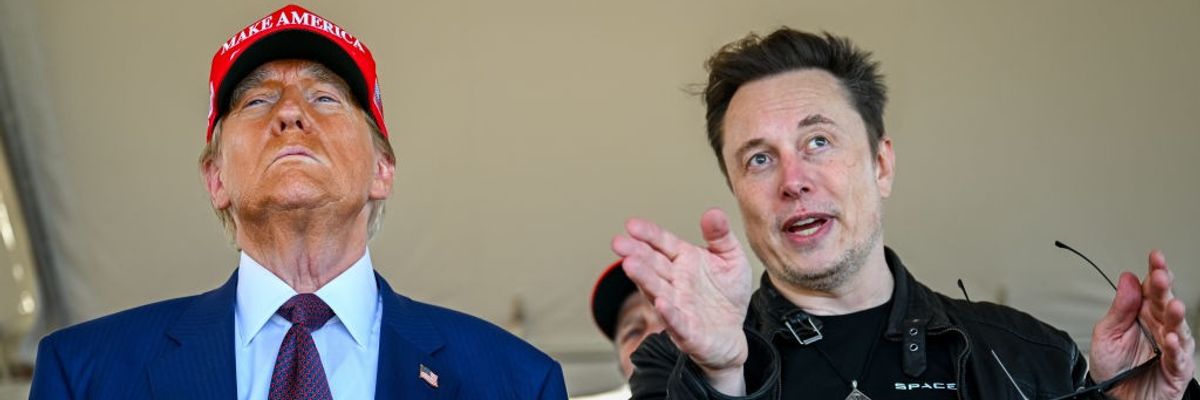
Elon Musk speaks with then-U.S. President-elect Donald Trump as they watch the launch of the sixth test flight of the SpaceX Starship rocket on November 19, 2024 in Brownsville, Texas.
(Photo: Brandon Bell/Getty Images)


Peter F. Crowley
Feb 20, 2025
Common Dreams

U.S. President Donald TrumpElon Musk, and their ilk are returning the U.S. to the Gilded Age of robber barons, replete with railroad monopolies and no union protections. They are bringing us back to a time before the Progressive movement had instituted the first real wave of social reforms, which were later widely expanded by New Deal programs. These initial reforms offered workers’ compensation, free school meals for poor children, regulated working hours, and put antitrust laws on the books. They protected the everyday person, white- and blue-collar alike, and were a setback for the ultra-rich. For generations afterward, the ultra-rich have been pushing to overthrow the Progressive Era’s and the New Deal’s utilitarian reforms.

It started with deregulation in the 1970s and was then magnified during Ronald Reagan’s neoliberal presidency. The talking points behind deregulation duped people through bastardizing the concept of “freedom.” The U.S. is a free country, the argument goes, so there shouldn’t be regulation. Yet deregulation, in this sense, is focused on giving businesses and corporations free rein, screwing the rest.

Inevitably, the neoliberals’ free trade policies, the gutting of unions, the reducing of social programs, and the lowering of taxes for the very wealthy led to wide-scale disillusionment. It birthed the Occupy Wall Street and Tea Party movements.

That brings us to today, where there is one option: resistance everywhere.

The Tea Partiers, mostly unwittingly, pushed for the policies of the late 19th-century robber barons, free of any regulation on business and extremely low (if any) taxes, as if these policies would help the average person. The Occupy movement failed in that, while offering an accurate critique of vast wealth inequality, it did not propose any concrete goals. There was the fear that its message would be branded, hijacked, or warped by the mainstream media. Fair point, I suppose. But a protest movement without policy objectives is like a tree falling in an empty forest. Luckily, the forest was not empty.

Sen. Bernie Sanders (I-Vt.) had been voicing the same message for decades. He rose to national prominence shortly after the movement’s demise, and his popularity was, in part, due to the Occupy movement raising the issue of wealth inequality to public consciousness. Unlike Occupy, Bernie had specific utilitarian policy goals.

On the other side, Trump voiced the radical Tea Partiers’ message of the robber barons, with more overt xenophobia and racism.

In 2016, both establishment parties tried to crush their mass movement candidates. The Democratic Party succeeded and had Hillary Clinton run as its presidential candidate. On the other hand, the GOP failed to stop Trump and held their nose, presuming Hillary Clinton would trounce him in the general.

When Trump won, most were surprised. Trump himself was unprepared, and the majority of institutions were unprepared to back him. His policy efforts, such as the Muslim ban and immigrant parent-child separation, were short-lived due to popular and legal pushback and sloppy execution.

During his first term, Trump’s core supporters remained steadfast behind him, but most mainstream institutions did not overtly support or cave to him.

For an unprepared presidency, dawdling along much like a toddler with a flippant mouth, the Covid-19 pandemic was icing on the cake for executive leadership failure. Because of Trump’s anti-vax rhetoric, inept health policies, and spewing of misinformation, the deaths of nearly half-a-million Americans can be attributed to him.

Unsurprisingly, Trump was booted out of office in 2020 and Joe Biden stepped in. Once again, the Democrat establishment coalesced against Bernie’s candidacy.

During Biden’s first three years in office, he was a good president, passing the most important climate change legislation in U.S. history, the Inflation Reduction Act, and the bipartisan infrastructure bill. He supported unionization efforts and tried to eliminate student loan debts. He restored a sense of decency and aid for UNWRA.

As the 2024 election came closer, the Gaza genocide commenced, which Biden wholeheartedly backed. In Biden’s last year in office, when Trump became the clear GOP presidential candidate, he tried to outflank the GOP on the right on immigration, restricting asylum seeker border crossings and attempting to push an anti-immigrant bill that Sen. Mitch McConnell (R-Ky.) crafted. (Of course, Trump killed it to prevent Biden from getting “credit.”)

Throughout the Biden years, inflation increased dramatically, similarly to most of the world. Yet Biden could never adequately explain this phenomenon to the American people and was horrible at communicating his domestic accomplishments.

He and his staff ignored his mental decline, leaving former Vice President Kamala Harris little time to campaign. Simultaneous to Biden’s growing unpopularity, far-right institutions began crafting Project 2025 (now being instituted) for a new Trump administration. When the Dems lost this time, the far-right was prepared with institutional backing. For the most part, the establishment (media, corporations, etc.) caved to Trump and his anti-constitutional, authoritarian executive actions.

That brings us to today, where there is one option: resistance everywhere.

Resist on the streets, in Congress (wake up Jeffries and Schumer!), and the courts, to save a very flawed republic before it’s too late. Before fascistic robber barons steal it away, leaving the American people whistling in the desert wind watching a whiny rich snowflake asshole pretend that the United States is a reality TV gameshow.


Peter F. Crowley
As a prolific author from the Boston area, Peter F. Crowley writes in various forms, including short fiction, op-eds, poetry, and academic essays. His writing can be found in Pif Magazine, New Verse News, Counterpunch, Middle East Monitor, Galway Review, Digging the Fat, Adelaide’s Short Story and Poetry Award anthologies (finalist in both), and The Opiate. He is the author of the poetry books Those Who Hold Up the Earth and Empire’s End, and the short fiction collection That Night and Other Stories.
Full Bio >

Trump's Bogus 'Unitary Executive' Theory and the Dismantling of Democracy


We are a nation of laws, and we cannot be ruled by executive fiat.


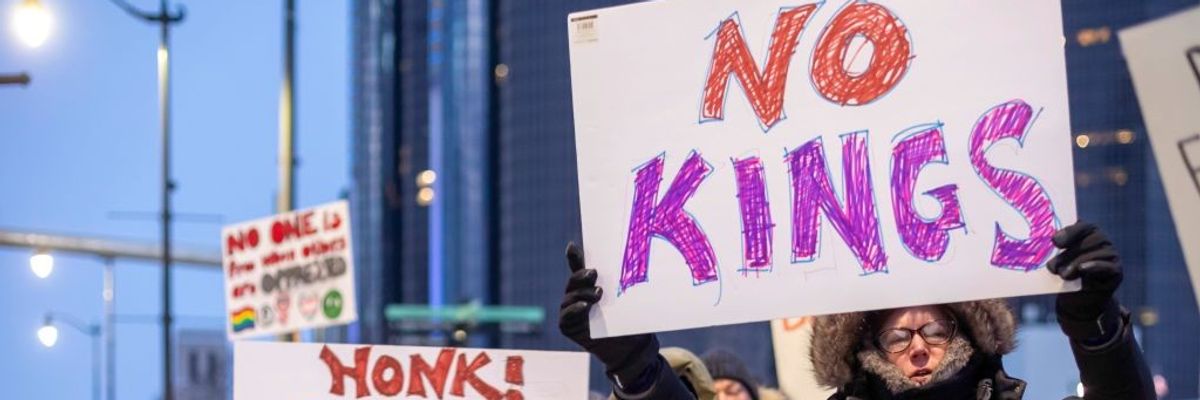
People say 'No Kings on Presidents Day' in response to what they say are President Trump's and Elon Musk's undemocratic actions on February 17, 2025 in Michigan.
(Photo by: Jim West/UCG/Universal Images Group via Getty Images)


John Bergmayer
Feb 20, 2025
Common Dreams

President Donald Trump on Tuesday signed an executive order that purports to place independent regulatory agencies, such as the Federal Communications Commission and the Federal Trade Commission, under his direct control. Based on the so-called “unitary executive” theory, which claims that any congressional limits on presidential control of every lever of government power are unconstitutional, this action poses a grave threat to the rule of law and the separation of powers—cornerstones of our constitutional system.

This executive order states that the president is charged with ‘faithfully executing the laws.’ This is true. However, the laws of our nation include the existence of independent regulatory agencies, the power of Congress to appropriate funds and direct how they are spent, and protection for certain government employees and officers from arbitrary dismissal.

Executive orders are not the law—they are statements of policy, and memos from the president about how the Executive Branch conducts its internal affairs. By attempting to use executive orders to override actual laws—the kinds that are passed by Congress, not issued on a whim from the Resolute Desk—the Trump administration is effectively asserting that it stands above the law. Indeed, that it is the law. But the role of the executive branch is not to decide what the law is, or to pick and choose which ones it likes, but to carry out and enforce the law, as written. Donald Trump is a high-ranking government employee—not a king. If there are laws he does not like, he can work with Congress to change them.

Donald Trump is a high-ranking government employee—not a king.

A nebulous and broad understanding of the phrase ‘executive power’ cannot prevail over duly enacted statutes passed by Congress and signed into law by presidents of both parties, over the course of decades. The U.S. Constitution did not change its meaning when President Trump took office. That this ‘unitary executive’ theory has made its way from the fringes of academia to the halls of power, and that it has even been accepted by some credulous judges, does not mean that it is right. Many legal observers have pointed out the shoddy scholarship and selective history that underpins it. We are a nation of laws, and we cannot be ruled by executive fiat.

In the order, the Trump administration purports to seize for itself the power Congress delegated to independent regulatory agencies, and as written, declares the White House’s interpretation of the law as ‘authoritative,’ with no mention of the courts. Of course, the president is not, and never has been, the final arbiter of what is lawful. Lawyers working for the government owe their allegiance to the American people, not to President Donald J. Trump. The many government lawyers who have already resigned rather than follow illegal or unethical directives from Trump's appointed political operatives are an inspiration, despite how frightening a hollowed-out Department of Justice might seem.

As for independent regulatory agencies, in addition to being the law of the land, they are often good policy. While I have sometimes disagreed with decisions taken by the FCC or FTC, under both Republican and Democratic control, I understand the importance of expert agencies that are free from day-to-day political interference. The FCC’s control over broadcast licenses, and its unenviable role of coordinating spectrum use between different industries and other government agencies, among other things, means it should be free to try to come to the best answer – not the one with the loudest political support. This applies to enforcement activities as well. Under the Biden administration, for instance, the FTC frequently investigated politically powerful companies, to the ire of many prominent Democrats and Democratic donors.

While I have sometimes disagreed with decisions taken by the FCC or FTC, under both Republican and Democratic control, I understand the importance of expert agencies that are free from day-to-day political interference.

President Trump, like other presidents have done, is free to express his views as to what the agencies should prioritize, and to nominate like-minded commissioners as vacancies arise. But, as directed by Congress, and reflected in commissioners' protection from being fired due to policy or political differences with the president, such agencies must make the final call on policy decisions.

The notion that independent agencies are ‘unaccountable’ is, on its face, absurd. The president nominates all agency commissioners, including ones of the opposite party, and names the Chair from among them. Agencies regularly answer to Congress, which controls their budget, and enacts the statutes that spell out the limited scope of their authority. Independent agencies cannot issue regulations without following the strict guidelines of the Administrative Procedure Act, and their rules and enforcement actions are regularly challenged in the courts, and occasionally reversed by Congress.

The wisdom of having independent agencies and tenure protections for certain government officials has been confirmed in recent weeks by the disastrous and irresponsible actions of the lawless Trump administration. One president should not be able to nullify statutes passed into law by past presidents and past Congresses with the stroke of a sharpie. Congress must re-assert its central constitutional role. Further, one hopes that federal judges and Supreme Court justices who, in the past, have lent their support to an imperial vision of the presidency, can see where this is going and act to limit the ability of the president to subvert our democracy and constitutional order.

Our work is licensed under Creative Commons (CC BY-NC-ND 3.0). Feel free to republish and share widely.


John Bergmayer is the Legal Director of Public Knowledge, which promotes freedom of expression, an open internet, and access to affordable communications tools and creative works as it aims to shape policy on behalf of the public interest.


In 'Profoundly Dangerous' Power Grab, Trump Moves to Seize Control of Independent Agencies

"Americans should understand exactly what this is: A giant gift to the corporate class and a Trumpian power grab."


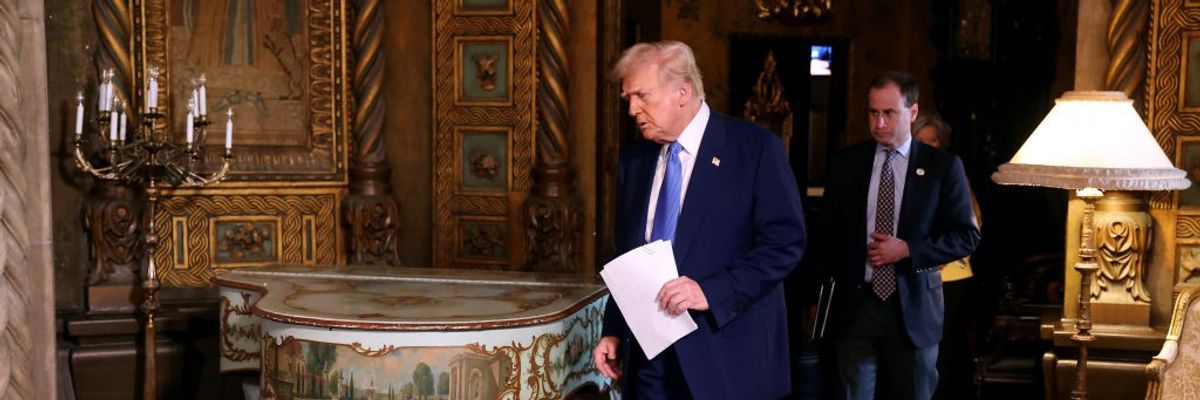
U.S. President Donald Trump, accompanied by White House staff secretary Will Scharf, delivers remarks before signing an executive order on February 18, 2025 in Palm Beach, Florida.
(Photo: Joe Raedle/Getty Images)


Jake Johnson
Feb 19, 2025
COMMON DREAMS

U.S. President Donald Trump on Tuesday signed an executive order aimed at bringing the nation's independent agencies—including the Federal Trade Commission and Securities and Exchange Commission—under his control, a sweeping power grab that's expected to spark a legal fight with enormous stakes for the country.

The new executive order, titled "Ensuring Accountability for All Agencies," laments that previous administrations "have allowed so-called 'independent regulatory agencies' to operate with minimal presidential supervision" and states that, going forward, "the president and the attorney general, subject to the president's supervision and control, shall provide authoritative interpretations of law for the executive branch."

The order goes on to require that "all executive departments and agencies"—including those granted some independence from the presidency by Congress—"shall submit for review all proposed and final significant regulatory actions to the Office of Information and Regulatory Affairs (OIRA) within the Executive Office of the President before publication in the Federal Register."

OIRA is part of the Office of Management and Budget, which is run by Project 2025 architect and far-right extremist Russell Vought.

In a fact sheet released alongside the order, the White House specifically names the FTC, the SEC, and the Federal Communications Commission (FCC) as agencies it claims have "exercised enormous power over the American people without presidential oversight."

The new order exempts from its far-reaching mandates the "monetary policy functions of the Federal Reserve."

"Not incidentally, both the FTC and SEC have ongoing investigations or enforcement actions against companies owned by Elon Musk."

Robert Weissman, co-president of Public Citizen, said in a statement that the executive order marks an "illegal" attempt to "shield corporations from accountability and centralize more power with Trump and his minions."

"This is a profoundly dangerous idea for the nation's health, safety, environment, and economy—and for our democracy," he added. "Congress made independent agencies independent of the White House for good reason."

Weissman noted that the independence of agencies such as the FTC and SEC is "designed to enable them to perform these duties without undue political pressure from giant corporations, the super-rich and the super-connected."

"Trump's EO would dissolve that independence and put the agencies under Trump's thumb, ensuring they turn a blind eye to wrongdoing by favored corporations and leave consumers and investors out to dry," Weissman continued. "Not incidentally, both the FTC and SEC have ongoing investigations or enforcement actions against companies owned by Elon Musk. Americans should understand exactly what this is: A giant gift to the corporate class and a Trumpian power grab."

The Washington Postreported that Trump's order sets the stage for "a potential Supreme Court fight that could give him significantly more power over those agencies' decisions, budgets, and leadership." Trump has already trampled decades of legal precedent by firing protected officials without cause, including the former chair of the National Labor Relations Board (NLRB).

"Courts have blocked or limited the reach of some of Trump's executive actions, but legal observers expect that the conservative-dominated Supreme Court may be open to broadening presidential power in at least some of the cases," the Post observed. "The justices are already considering a case regarding the scope of Trump's power over independent agencies, and Tuesday's executive order seems sure to prompt additional legal challenges."

Deborah Pearlstein, a constitutional scholar at Princeton University, told the newspaper that the White House is "deliberately teeing up a major question of constitutional law that will go to the Supreme Court for review."

The Supreme Court is currently controlled by a right-wing supermajority that includes three Trump-appointed justices.

Prior to Trump's order, the U.S. Justice Department—headed by Attorney General Pam Bondi—indicated that it would no longer defend the independence of the NLRB, FTC, and other agencies and would ask the Supreme Court to reverse precedent that has shielded independent agency leaders from termination without cause.

Reutersreported that "about two dozen companies, including Amazon and Elon Musk's SpaceX, have filed lawsuits since last year claiming the president should have the power to fire NLRB members at will."

"Several companies sued by the FTC have filed similar challenges against that agency," the outlet added. "They include Meta Platforms, Walmart, and Cigna's Express Scripts."


Baltic region prepares for war as Russia and US debate Ukraine's fate

As Russia and the US debate Ukraine’s future, countries on the Baltic Sea are ramping up preparations for a military conflict amid fears that Russia is preparing for a future war with NATO.


Issued on: 19/02/2025 - 
FRANCE24
By: Joanna YORK

01:52
A crew member monitors the horizon from the bridge deck of patrol ship HMS Carlskrona (P04) as part of the NATO Baltic Sea patrol mission on February 4, 2025. 
© Johan Nilsson, AFP

As Russia and the US held talks in Saudi Arabia this week over the future of the conflict in Ukraine, countries on the Baltic Sea released a flurry of intelligence reports warning of Russian President Vladimir Putin’s plans to expand military conflict further into Europe.

Estonia’s Foreign Intelligence Service warned that Russia is expanding its armed forces in a way that “prepares for a potential future war with NATO”. Danish intelligence, meanwhile, have forecast that Russia would be ready to wage a "large-scale war" in Europe within five years, if it perceived NATO as weak.

A weakening of the trans-Atlantic alliance now feels inevitable. Following a withering attack on Europe delivered by US Vice President JD Vance at the Munich Security Conference last week, and Russia-US talks on Ukraine in Saudi Arabia this week, rumours swirled that the US under new President Donald Trump planned to pull its NATO troops from the Baltic States.

Latvia, Lithuania and Estonia are all former Soviet States and share a land border with Russia.

“There is a feeling that, if the trans-Atlantic bridge is not falling apart, it has been seriously damaged,” says Dr. Māris Andžāns, director of the Center for Geopolitical Studies Riga, Latvia. “Biden travelled to Kyiv during the war and now Trump is ready to travel to Moscow. It’s quite a turn-around.”
‘Large-scale war’?

The Nordic-Baltic 8 (Denmark, Estonia, Finland, Iceland, Latvia, Lithuania, Norway and Sweden) have been some of Ukraine’s staunchest supporters since the full-scale Russian invasion began in 2022.

In the intervening years they have also ramped up their own efforts to counter possible Russian military aggression, from boosting defence spending to raising awareness among citizens of what to do in the event of large-scale conflict.

01:26
In Lithuania, the government has reintroduced military conscription, doubled the size of its armed forces and ramped up defence spending to 3.45% of GDP – one of the highest rates of any NATO country.

Should a Russian invasion happen tomorrow, “we’re a lot better prepared than a decade ago”, says Andžāns. Although, he says, “there is still space for progress. We still don’t have critical aerial defence”.

A Latvian intelligence report released this week assessed the threat of Russia engaging in a direct conflict with a NATO country in the next 12 months as “low” – as long as it’s military is still fighting in Ukraine.

Why Europe’s leadership is skeptical of negotiating with Putin

The idea that US President Donald Trump’s negotiations with Russian President Vladimir Putin will bring about lasting peace in Ukraine has been met with scepticism across Europe. FRANCE 24 spoke to political scientist Anton Shekhovtsov about what the US can learn from earlier attempts to end Russian occupation across the former Soviet Union.


Issued on: 19/02/2025 - 
By: Paul MILLAR

In this pool photograph distributed by the Russian state agency Sputnik, Russia's President Vladimir Putin chairs a meeting with members of the government via videoconference, at the Constantine Palace in Strelna, St. Petersburg, on February 18, 2025. © Mikhail Metzel, AFP


“About us, without us”. Hearing this slogan, popularised across what was then Czechoslovakia in the wake of the 1938 Munich agreement, it’s not hard to see why some commentators are reaching back to the eve of World War II to attack US President Donald Trump’s efforts to negotiate an end to the Ukraine conflict directly with Moscow. The Munich agreement, struck by the major European powers in 1938, ceded the country’s strategic Sudetenland to Nazi Germany to stave off the threat of war, in vain.

Kyiv, like Prague before it, has so far been left out of the talks taking place between negotiators from Russia and the US – talks that will quite literally determine the shape of Ukraine’s future. And while President Volodymyr Zelensky has not hidden his disappointment in being excluded from the first round of preliminary talks in Riyadh this week, Trump has been unsympathetic.

“I hear that they're upset about not having a seat," he told reporters at Mar-a-Lago on Tuesday. “Well, you've been there for three years ... You should have never started it. You could have made a deal."

Read moreTrump brands Zelensky 'a dictator'


But those sceptical of the prospects of such a deal being struck between the White House and the Kremlin don’t have to look as far back as the 1930s. Since the collapse of the Soviet Union, Russian troops have repeatedly occupied swathes of territory in former Soviet republics – and despite years of negotiations overseen by European powers, they still haven’t left.

In Moldova, Russian forces are still stationed in the breakaway region of Transnistria, which declared its – largely unrecognised – independence as the USSR fell in ruins around it. And a full fifth of Georgia’s territory is still occupied by Russian troops who routed Tbilisi's forces following the Georgian government’s efforts to violently suppress secessionist movements in Abkhazia and South Ossetia.

In both cases, fierce fighting gave way to frozen conflicts as European powers pushed for negotiated ends to the bloodshed.

Anton Shekhovtsov, a visiting professor at the Central European University in Vienna and a researcher on European nationalist movements, spoke with FRANCE 24 about what the US could learn from these long-stalled efforts to bring about lasting peace in the former Soviet Union.

Watch moreThe death of NATO? Europe in crisis over Trump-Putin talks

Looking back at the 2008 crisis in Georgia, we seem to have a couple of competing narratives. Former French president Nicolas Sarkozy as the mediator put forward the idea that this was a successful de-escalation, a way of ensuring that Russia’s advance towards Tbilisi was stopped. Whereas other people, especially in the context of what later happened in Ukraine, look back at this moment as almost having given the green light for Putin to extend Russian influence into other former Soviet republics. In your view, what are some of the lessons we should be learning from how that conflict was handled in 2008?

Before 2008 there was another case, and that case is actually older than any of the things that we are discussing today – it’s the case of Transnistria and Moldova. Transnistria is Moldovan territory, and it’s been occupied by the Russians since the beginning of the 90s. And there were several meetings, several conferences throughout the period that followed the occupation of Transnistria, where Russia agreed to withdraw its military forces, its occupation forces from Moldova – and it failed every deadline. The forces are still there.

As to 2008, I understand why Sarkozy was bragging about that being the conclusion of the conflict, but it wasn’t. Even that agreement stipulated that Russia would withdraw its forces, and that did not happen.
What is the Ukrainians' reaction to Trump blaming Ukraine for not ending the war?

03:00


And this is a pattern that we are observing, as I said from the case of Moldova in the 90s. Russia always tries to reach an agreement which it necessarily breaks. It's a pattern, it breaks the promises that it makes because it knows that nobody is going to enforce the agreements, nobody is going to hold Russia accountable for breaking its promises and agreements.

And this is the pattern that we are observing now with Ukraine – what Russia is trying to do at the moment is exactly the same thing as it did with Moldova and Georgia. And there is another pattern – every American administration, probably with the exception of Biden's presidency, has these illusions that it can make a lasting peace with Russia. It failed every time.

After 2008, Obama came up with this idea of a reset in 2009 of the relations between the US and Russia, thinking that it will somehow make Russia more agreeable or more peaceful – it failed. And now, the second Trump presidency is trying to do another reset – they don't call it a reset, but in the end, it is what it is, and the Russians will lie, they will try to fool, to cheat.

You’re painting quite a grim outlook on any attempt at a negotiated end to the conflict. What, in your mind, is the alternative to trying to establish that expectation of a normal relationship that Russia can have not just with its immediate neighbours but with the EU and the US?

This grim picture is based on observations, based on evidence, on what was happening. And I believe that, unfortunately, as long as Vladimir Putin is in power or has any relation to power in Russia, nothing will change with Russia with its relation to Europe, to the US, to Ukraine.

The only alternative today is to support Ukraine as long as possible. If Putin is still there, he will not abandon his maximalist plans regarding Ukraine, which are about the destruction of the Ukrainian state and nation. He has not changed his mind, he just wants to somehow fool the Western observers, especially in the US – I think Europeans are now very difficult to fool, Europeans know what Putin’s Russia is about – at least the mainstream elites know about that.

Andrey Kurkov: 'You can't write fiction when your houses, cities are shelled with missiles, drones'


Trump, he doesn't care about Europe, he doesn't care about Ukraine. He doesn't even care about Russia, in fact, he cares about the media headlines. He's a guy whose efforts are driven by the idea of getting a Nobel Prize for Peace, as Obama did – he cares about media visibility. But it doesn't solve the very complex and deep problems with Ukraine or Russia.

And I think that the only alternative today is to continue supporting Ukraine – all those negotiations, yes, this is all fine – but I just don’t believe that Russia is serious about ending the conflict. It wants the conflict to end with the destruction of Ukraine, or making Ukraine lose its sovereignty. I'm not even talking about territorial Integrity – the restoration of Ukraine's borders in the short or mid-term is unfortunately not going to happen. I mean making Ukraine basically a dysfunctional state – this is the aim. I don't believe Putin, because there is no single piece of evidence from the past that would make Putin a trustworthy politician.

You mentioned this idea that a lot of the European leadership has now lost some of their illusions in the prospect of how far diplomacy will get them with Putin. Do you see that process of disillusionment happening throughout the course of the negotiations around the enforcement of the Minsk agreementsAngela Merkel especially has been quite defensive about her own legacy in terms of seeking a rapprochement between Germany – and the wider European Union – and Putin's Russia.

It's not only about the Minsk agreements. I think these Illusions have been shattered by the full-scale invasion of Ukraine and by the atrocities that Russians have been committing in Ukraine during this full-scale invasion. That I think was the real understanding, this is when it came to the European leadership.

I don’t think anyone took the Minsk agreements seriously from any side. These agreements were basically dictated by Russia at gunpoint and this is not something that leads to peace. And for Ukraine the strategy was to somehow try to avoid those agreements because those were not the agreements that Ukraine wanted.

But it had to sign them. That was a forced decision. And I think morally, Ukraine has all the rights to avoid something that was imposed on the country. But now, Minsk III is off the table – Ukraine will not be fooled, and I’m sure Europe will not be fooled by those.

A lot of people reacted with some degree of shock, if not necessarily surprise, at how quickly President Trump reached out directly to President Putin and moved forward with this initial meeting in Riyadh – without a Ukrainian presence. You wrote recently about what you call the minimum requirements for victory for Ukraine that would have to emerge from any sort of negotiated end to this. What, in your mind, is the best framework that would give Ukraine the chance to obtain these minimum requirements?

So these minimum requirements, the first is about Ukraine being heavily armed – this is about giving Ukraine more advanced weapons, and in greater numbers. The second point is EU membership for Ukraine. And the third, the most important one and the most difficult one is, of course, security guarantees for Ukraine that a similar invasion will not happen at least in mid-term – nobody knows what's going to happen in the long term, of course. Security guarantees are the issue that is being most hotly discussed today.

And there are many options. Now, what is being discussed, and I think misleadingly actually, is sending troops to Ukraine – having European boots on the ground. This is all very good, but it’s misleading in the way that if we're talking about peacekeeping forces for Ukraine, we should not start with boots on the ground.

Yes, Ukraine may need additional military personnel but what Ukraine much more urgently needs is to secure its airspace – and for that you don’t really need boots on the ground, you need additional European air forces shooting down the rockets and drones that Russia is regularly sending to Ukraine. I’m not saying that those airspace peacekeeping forces should be functional today. But Europe could start with talking about this.

What happened in Israel when Iran attacked Israel with rockets and drones? You had Western forces just shooting down all those things. And in Ukraine, Russia continues to dominate the airspace. So, instead of trying to scare our domestic audiences about boots on the ground, these discussions would probably be better if they started with securing or pledges to secure Ukraine's airspace.

This interview has been edited for length and clarity.


Since the conflict escalated in 2022, Russia has paused planned military developments along its northern borders with NATO countries, such as more than doubling the 30,000 troops it has stationed along its border with Finland.

“But the concern is, especially if the war in Ukraine stops, Russia will focus very much on rebuilding its military organisation,” says Katarzyna Zysk, professor at the Norwegian Institute for Defence Studies.

According to Latvian intelligence, in this scenario Russia would be able to restore its military force enough to pose a significant threat to NATO within five years.

Even while engaged in the conflict, Putin in September ordered that the Russian army be increased by 180,000 troops to 1.5 million active service members, which would make it the world’s second largest army, after China.

“Russia wants to achieve the objectives which it has been pursuing systematically since the early 2000s,” Zysk says – namely, expanding Russia’s sphere of influence and undermining the US as a dominant international force, especially in Europe.

“They are very expansive ambitions, and they indicate that Russia is preparing for a large-scale confrontation,” Zysk adds.
Hybrid warfare

That is not to say that Russia is set on military conflict – more that “it is something that you cannot rule out”, Andžāns says.

Hence Latvia’s installation of defence infrastructure including anti-tank obstacles along its borders with Russia and Belarus, and similar measures in Finland, Latvia and Estonia – all EU and NATO members that share land borders with Russia.

In a bid to prevent Russia weaponising the electricity grid against them, Estonia, Latvia and Lithuania last week successfully connected to the European power grid, severing Soviet-era links with Russia's network.

Read moreBaltic states join European power grid after cutting ties with Russia's network

But the Baltic Sea, where eight EU and NATO countries share a maritime border with Russia, has already become a tension point, as several undersea telecom and power cables have been severed in recent months.

Moscow has denied deliberately targeting submarine infrastructure, which is frequently damaged by fishing trawlers. But experts, and politicians including Latvia’s president, have accused Russia of using non-military tactics to wage a "hybrid war".

Hybrid war tactics aiming to destabilise societies and spread discord take place in the “gray zone”, below the threshold of armed conflict and outside legal frameworks, making them difficult for Western countries to identify and respond to. But they add to a sense that a form of conflict with Russia has already begun.

“Russia is conducting espionage in the Baltic Sea, both in the technical space and also the virtual space, and it is conducting information operations in Latvia,” Andžāns says.

Read moreRussia accused of meddling in the GPS systems of Baltic Sea countries

In the Latvian capital of Riga, there has been an uptick in pro-Russian vandalism cases, including a Molotov cocktail thrown inside the Latvian Occupation Museum, which documents the Nationalist and Soviet occupations.

The museum’s director said the bomb constituted an attack “on the foundations of the Latvian state, the constitution and the truth”.

“Russia is playing a very long game using this full spectrum of tools,” Zysk says.

Looking to the future, “Russia is certainly going to use political, economic and informational means to influence politics, polarize debates and create chaos”, Zysk adds.

“And I don't see any reason why Russia would not use military means, under certain circumstances. It has proven time and time again that it is willing to do that.”


Fact-checking Trump's statements on Ukraine

05:32TRUTH OR FAKE © FRANCE 24

Issued on: 19/02/2025 - 

US President Donald Trump has launched a flurry of controversial claims about the war in Ukraine and President Volodymyr Zelensky, while addressing reporters at his Mar-a-Lago resort. Many of these claims were made without providing any evidence. We fact-check these claims in this edition of Truth or Fake.