Wednesday, March 05, 2025

 EV

California Awards $15M Grant to Build Two Electric Ferries for San Diego
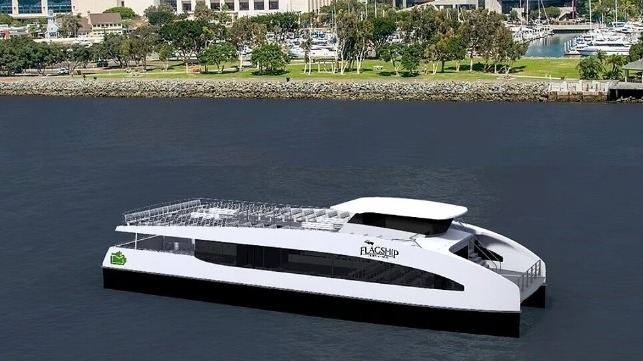
Flagship
Courtesy Flagship Cruises and Events

Published Mar 3, 2025 11:21 PM by The Maritime Executive


The California Air Resources Board has granted a dinner-cruise company a substantial award build two battery-electric ferries for service in San Diego. The ferries will reduce emissions from maritime transport, supporting the city's air pollution reduction goals. 

The two new ferries will be built for Flagship Cruises and Events, the largest leisure-boat operator in San Diego. The firm has nearly a dozen passenger vessels of varying sizes, from charter yachts to dinner cruise vessels.  The new ferries will operate on a route from downtown San Diego to Coronado, home of the West Coast's largest naval base. 

The grant is a CARB Advanced Technology Demonstration and Pilot Project award, funded by the California Climate Investments program. The total project cost for the two ferries comes to about $21 million, and work should begin later this year. Delivery is slated for as early as Q3 2026. 

“We are thrilled to partner with Flagship and the San Diego County Air Pollution Control District to deliver zero emission ferry services on San Diego Bay,” said Danielle Moore, chair of the Port of San Diego Board of Port Commissioners. “As a Port of progress anchored in people, we are committed to doing our part to improve public health and advance zero emission transportation."


CMA CGM Orders Electric Inland Container Barge for Nike Goods in Vietnam
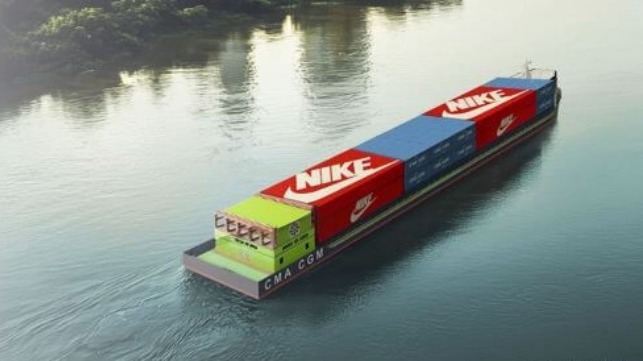
electric container barge
CMA CGM will operate an electric inland container barge to move product for Nike

Published Mar 3, 2025 8:04 PM by The Maritime Executive


CMA CGM Group is moving forward with the project it announced in December 2024 to develop and operate fully electric container barges on inland routes in Vietnam. The group placed an order for the first barge to be built by China’s Shandong Xinneng Shipbuilding.

The group called the order an important step to promote green inland river operations in the Asian market. The first barge was co-designed by CMA CGM’s New Build and R&D teams in partnership with China’s CATL for the battery technology. They are also working with China’s Jining Energy Group for the energy system which will include a solar-powered recharging facility to be located at the Gemalink terminal in Cai Mep, Vietnam.

The plan calls for an 80-meter (262-foot) barge. It will have a capacity of approximately 180 TEU. It is designed to sail entirely on battery power between Bihn Duong Province inland in Vietnam and the Gemalink terminal, a route of approximately 180 kilometers (112 miles). Annually they project the barge will transport more than 50,000 TEU annually. The operation is projected to start in 2026 and Nike has previously announced it would be using the barge to transport its products made in Vietnam.

Shandong Xinneng Shipbuilding was developed starting in May 2022 as China’s first domestic inland new energy shipbuilder. With this order, the yard has an orderbook of 165 ships. They highlight a capacity to annually build 400 inland ships in the size range of 1,000 to 5,000 tons. The company started construction in October 2022 and trial production in October 2023.

Vietnam is seen as a fast-growing market as the country develops its manufacturing capabilities. CMA CGM highlights that it has been in Vietnam since 1989 and currently operates 29 weekly mainline services from seven ports in Vietnam. The group says the new inland solution is part of its long-term commitment and decarbonization ambitions, along with Vietnam’s goal of being carbon net zero by 2050. The goal of the electric barge operation is to also create a model that can be replicated in other markets.


Zero-Emissions Ports

Government grants are boosting the use of battery-electric technologies at U.S. ports and terminals.
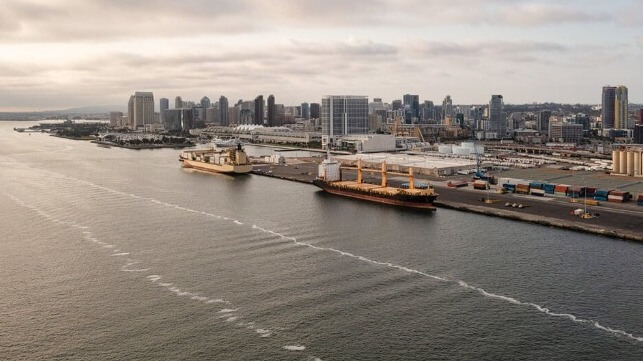
Taylor ZLC 996
iStock

Published Mar 2, 2025 11:56 PM by Tom Peters


(Article originally published in Nov/Dec 2024 edition.)


[By Tom Peters]

When the great scientific minds of Benjamin Franklin, Nikola Tesla and Michael Faraday started experimenting with electricity, it’s highly unlikely any of them saw their work as contributing to the logistics of moving marine cargo. But electrification, which has been key in the reefer world, is now becoming a priority in the employment of clean, green container-moving machines.

The Port of Los Angeles recently reached a milestone in its quest to become a zero-emissions (ZE) port by deploying the first commercially available, battery-powered electric cargo top handlers in the U.S. Top handlers are off-road vehicles used to load, unload and stack containers and resemble oversized forklifts.

The five electric Taylor ZLC 996 top handlers will replace diesel-powered equipment and are powered by a 650V, all-electric, battery-powered drive train capable of running two-full shifts under normal work cycles. They can be recharged with a five-hour boost using a 180W recharger.

Promoting the commercial use of ZE top handlers is one of many strategies underway at the port to boost the market for new emissions-free technologies.

Toward that end, the port received a $412 million grant from the U.S. Environmental Protection Agency (EPA) to support the deployment of 424 pieces of ZE cargo-handling equipment, 250 ZE drayage trucks and $50 million for community ZE initiatives. The EPA grant is being matched by an additional $236 million from the port and private sector partners.

Electrification Technologies

The Port of San Diego has a solid footing in reefer cargo through its long-time relationship with Dole Fresh Fruit and handled 76,869 FEUs (40-foot equivalent units) of reefer cargo in 2023.

Dole is the port’s primary reefer importer, mainly bananas and pineapples, and it’s the anchor tenant at the Tenth Avenue Marine Terminal. Dole is the largest importer of bananas and the second largest importer of pineapples to North America. Most vessels operate on a three-week tour that call on ports in Ecuador, Costa Rica and Guatemala.

Dole has followed the electrification trend and was the first importer on the West Coast to use battery electric utility tractor rigs (UTRs) for cargo handling. Dole currently has seven electric UTRs with plans to convert its remaining 10 diesel UTRs to electric and add one more electric UTR for a total of 18.

“Dole is a long-time and valued Port of San Diego tenant that has been an early adopter of electrification technologies and supporter of our accelerated efforts to significantly reduce harmful air emissions,” said Michael LaFleur, Vice President of Maritime.

The port was recently awarded a $59 million grant from the EPA to support an $86 million project for remaining improvements to the Tenth Avenue Marine Terminal’s (TAMT) legacy 12-kilovolt electrical distribution system. It will also advance a proposed ZE truck stop and purchase and deploy battery electric ZE equipment, vehicles and charging infrastructure.

Infrastructure Upgrades

The Port of New York and New Jersey is the East Coast’s busiest container port, handling 7.8 million TEUs (twenty-foot-equivalent units) in 2023 and up 14 percent over that number through September of this year.

Logistically, it’s making changes to improve cargo flow.

The ongoing Port Street Corridor Improvement Project is modernizing a main interchange in the Port Newark-Elizabeth complex, leading to safer and more efficient operations as well as significant time savings for truckers.

Earlier this year, the port and the U.S. Army Corps of Engineers outlined a package of significant investments including more resources for maintenance dredging and berth rehabilitation and additional funding to advance planning for deepening the harbor channel from 50 to 55 feet.

In October, Port Liberty Bayonne took delivery of four, new ship-to-shore (STS) gantry cranes that are now the largest in the port. APM Terminals expects to receive more new STS cranes in a few months. All new cranes will be operational in the first half of 2025.

Intermodally, the port will ramp up work on the Southbound Connector Project, allowing for more efficient freight-rail movement through its on-dock express rail system. The Southbound Connector will expedite train movement and expand the system’s capacity.

With the awarding of a $347 million EPA grant, the port expects to see several new pieces of ZE cargo-handling equipment come online and four new electric truck chargers to be operational at the Port Newark Truck Welcome Center.

“Our goal this year has been to continue setting the industry standard for efficiency and reliability while laying the foundation for a future that accommodates growing cargo demands through more environmentally friendly operations,” stated Port Director Bethann Rooney. “Through strategic investments in our infrastructure, strong collaboration with our government and private sector partners and a historic federal grant enabling us to make significant progress on our sustainability efforts, the East Coast’s busiest seaport is well-positioned to continue serving as a linchpin for the regional and national economy well into the future.”

Port Tampa Bay’s Omniport Project received a funding boost with a $22 million grant from the U.S. Department of Transportation for multimodal freight and highway projects. Omniport, one of Tampa Bay's newest port complexes, will create a deepwater berth capable of supporting a variety of cargoes.

Together with container terminal operator Ports America, Port Tampa Bay is making significant investments to expand capacity and improve cargo flow with the addition of three STS gantry cranes for a total of five and plans to acquire two more.

Adding to the improved logistics of cargo movement, an expanded, state-of-the-art gate complex is now open. Additional paved storage space is under development that will bring the container terminal’s footprint to 100 acres. Construction will soon begin on an on-dock, rail-served transload warehouse.

Paul Anderson, Port Tampa Bay CEO & President, said the East Port Omniport Project will create nearly 1,700 new jobs in the first year of operation and generate nearly $100 million in business revenue, state and local taxes and local purchases.

Down South

“Port Pascagoula is embracing an exciting new era of progress with the completion of a master plan that will shape the port’s future growth and strengthen our position as a vital shipping gateway on the Gulf Coast,” says Port Director Bo Ethridge. “This strategic plan focuses on enhancing infrastructure, optimizing operations and paving the way for long-term expansion.”

Key intermodal initiatives at the Mississippi bulk port include restoring and expanding over 3,000 feet of rail at the West Bank terminal, ensuring seamless, multimodal connectivity for customers and increasing warehouse and storage capacity at both the Pascagoula River and Bayou Casotte harbors.

Future projects include the construction of a 45,000-square-foot rail cargo-handling facility and the development of a 6.4-acre storage and staging yard to support the growing number of heavy lift and breakbulk shipments at South Terminal, one of the highest-rated docks on the Gulf Coast with a capacity of 4,000 lbs. per square foot.

Port Pascagoula is currently ranked 27th in the U.S. in total gross tonnage with 32 million tons of cargo annually.

Delivering the Goods

Coincidentally, container ports are not alone in making ocean cargo movement smoother, safer and more efficient. Container lines also protect cargo as it moves through the supply chain.

Atlantic Container Line (ACL) is a prime example of how a ship’s infrastructure can provide a safe logistical environment for containers.

ACL operates the world’s largest combination ro-ro/container ships to and from Europe and North America. Its unique, steel cell guide-racking system allows ACL to protect containers from rough seas and is key to extending the company’s record of never losing a container overboard in over 40 years of operation. 

Ports columnist Tom Peters writes from Halifax, Nova Scotia.

The opinions expressed herein are the author's and not necessarily those of The Maritime Executive.

Proposed U.S. Port Fee for Chinese Ships Fails to Stop $2.6B Order to CSSC

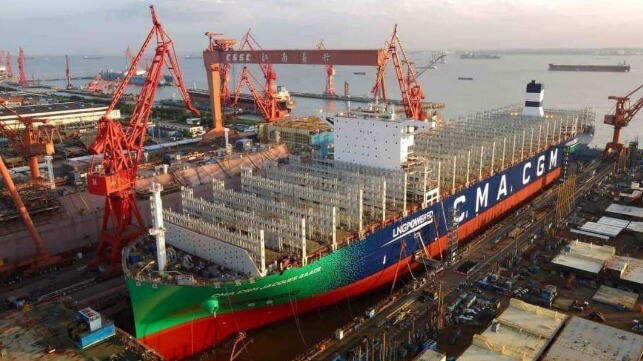
CMA CGM container under construction
CMA CGM has a long relationship building large containerships in China (CMACGM file photo)

Published Mar 4, 2025 2:46 PM by The Maritime Executive


China State Shipbuilding Corporation is reporting a giant new order for containerships valued at between $2.5 and $2.6 billion. While CSSC did not identify the customer, industry insiders widely believe it is from France’s CMA CGM Group following through on its earlier commitments and disregarding the U.S.’s threat to impose fees for Chinese-built ships.

The order is going to China’s Jiangnan Shipyard and calls for a dozen large 18,000 TEU containerships. The vessels will be fueled by LNG and incorporate the latest energy-saving technologies according to the filing from CSSC. The ships are due for delivery in 2028 and 2029.

CSSC highlights that this large agreement comes from a company that “has been a long-term partner.” The Chinese shipbuilder said it would be deepening its relationship with the customer. CMA CGM and Chairman Rodolphe SaadĂ© participated in a 2023 trade mission between France and the EU to China. The group signed a commitment for orders valued at $3.1 billion, which was called the largest order for the Chinese state shipbuilder.

CMA CGM highlighted in the past that it has a long-standing relationship with the Chinese shipbuilding industry. The group said in 2023 that it had ordered more than 70 containerships to be built in China. The yards built the Jacques Saadé class which were the first large LNG-fueled containership ships and a new generation of 18,000 TEU vessels.

CMA CGM highlights that it currently has a fleet of over 650 vessels and carried over 23 million TEU in 2024. Alphaliner calculates the group has an additional 94 containerships on order with a combined capacity of approximately 1.5 million TEU while the group has a current capacity of approximately 3.9 million TEU.

Confirmation of this new order comes just days after the U.S. Trade Representative’s Office made follow-up recommendations on specific steps to take to stem China’s unfair policies designed to increase its domination in shipbuilding. In the last days of the Biden administration, the office found that China had policies that were subsidizing the industry against foreign competition. 

The Trump administration has proposed a series of fees that would add to the operating costs of foreign companies that employ Chinese-built ships. Under the proposed actions, each U.S. port call for each vessel built in China, but operated by non-Chinese interests, could result in a fee of up to $1 million, depending on the proportion of Chinese-built ships in that operator's fleet. It also proposed an additional $1 million for each port call for operators who have newbuilds on order in China.

The Trade Office outlined several alternatives which are being reviewed by the White House on how to structure the fees on Chinese vessels. Most observers believe the Trump administration will proceed as it today, March 4, also moved forward with an additional 10 percent tariff on all Chinese imports, doubling the base rate, while some categories already had tariffs ranging from 25 percent to 50 percent or even 100 percent on Chinese EVs. 

CSSC however highlighted the shipbuilding contract as a major export order. They noted the deal is denominated in U.S. dollars, while other recent deals were switched to the Chinese currency. 

 WWIII

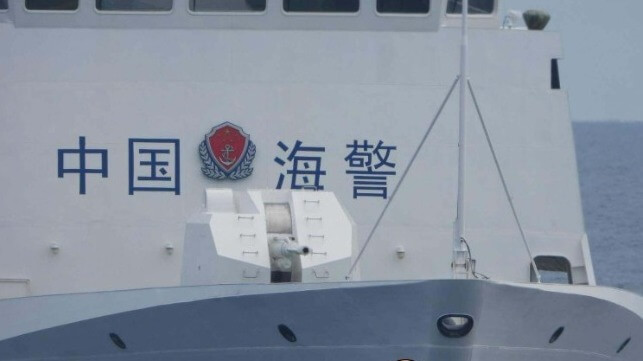
Philippine Gov't is Alarmed by Claims of Chinese Sovereignty Over Palawan

A China Coast Guard cutter in the Philippine EEZ (File image courtesy PCG)

Published Mar 5, 2025 5:59 PM by The Maritime Executive


The Philippine government is used to provocative statements from China's state-owned media empire, but has expressed alarm at a new theory circulating on  tightly-monitored Chinese social media: the newly-created concept that Palawan, one of the Philippines' home islands, is actually part of China. 

To date, all of China's expansionist claims in the South China Sea have been focused on reefs and small islands, most of them uninhabited. If the anonymous comments on Chinese social media were transformed into policy, Palawan would be the first major piece of inhabited sovereign territory that China has claimed in the Philippines. Though new, such a claim would be consistent with China's foreign policy objectives: Beijing has laid similar historical claim to Tibet, Taiwan and parts of northern India.

If the new Palawan claims were promoted on open-access Western platforms like X or Facebook, Manila would likely have little cause for concern. But since the Chinese internet is tightly governed and subject to rigid censorship, and China has allowed the Palawan claims to stay posted online, the Philippine government has reacted with alarm. 

"We categorically reject the baseless and revisionist claims circulating on Chinese social media that Palawan was historically part of China and should be returned to it," said Philippine National Security Adviser Eduardo Año in a statement. "Palawan has always been and will always remain an integral part of the Republic of the Philippines. No historical record, legal precedent or credible evidence support the claim that Palawan was ever under Chinese sovereignty."

The claim on Chinese social media suggests that Palawan is "Zheng He Island," named for the 14th-century Chinese explorer Zheng He. Año noted that there is no historical evidence that Zheng He visited Palawan, nor any sign of Chinese settlement in the province. "These false narratives, proliferated through digital disinformation and information warfare tactics, appear to be part of a broader effort to undermine Philippine sovereignty," Año warned. 

The "Zheng He" theory would extend China's ambitions beyond the boundaries of the well-known "nine-dash line" policy, Beijing's historically-derived claim to almost all of the South China Sea. The nine-dash line covers most of the Philippines' western exclusive economic zone, along with large sections of the Vietnamese, Malaysian, Indonesian and Bruneian economic zones. An international court invalidated the basis of that claim in 2016, but China has ignored the ruling. 


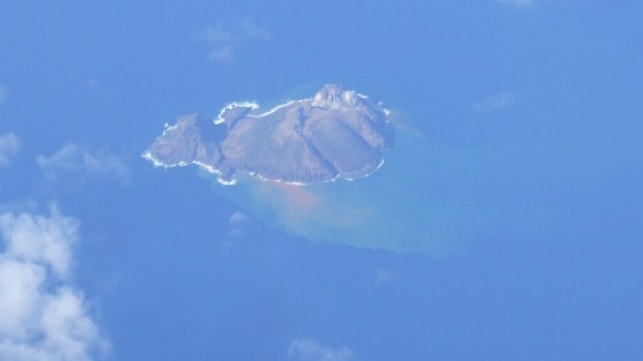
Uninhabited Ocean Speck Fuels Debate on Shipping’s False Flags

South Pacific uninhabited island
Mathew Island east of New Caledonia as seen in 2012 by Jd.Girard (CC BY-SA 3.0)

Published Mar 4, 2025 3:54 PM by The Maritime Executive


The issue of false flags continues to grow and promises to take center stage in an upcoming meeting of the IMO Legal Committee scheduled for the last week of April. Citing the dangers and the required steps, France and the Netherlands submitted proposals which are drawing attention as they highlighted two previously unheard-of registries. 

France’s note to the IMO Secretariat calls out the “Maritime Administration of Matthew Island” citing it as the latest example of fraudulent registries. It has sent everyone scurrying to the Internet and reference sources to answer the question: where is Matthew Island?

Turns out it is an uninhabited island in the southern Pacific east of New Caledonia. France claims it as its territory, but Vanuatu has sought to challenge the rights saying it belongs to the indigenous people of its country. It does not much matter, because it is a volcanic outcropping and most sources note the size of the island changes due to volcanic and ocean activity.

The Netherlands at the same time is warning of another fraudulent registry posing as the registry of Sint Maarten calling itself the MSTA Registry operated by International Maritime Registries & Regulatory. Sint Maarten is the Dutch side of the Caribbean Island shared with the French who call it Saint Martin. While it is a popular cruise ship destination, the papers to the IMO assert that no one has been authorized to operate this registry.

The submission highlights the lack of transparency in both of these operations a point that they contend is common among these false flag operations. They note these two websites have very similar interfaces.

Shaddy operators emerging to operate so-called international registries is nothing new. Guyana at the end of 2024 highlighted that five tankers sanctioned by the U.S. were falsely displaying Guyana as their registry. The authorities noted that the country has a closed registry only available to residents and none of the ships qualified. 

The IMO had previously said over 100 ships were showing in databases with false flags. As the shadow fleet of tankers grew to serve the Russian oil trade, as well as Iran, the number is thought to have increased dramatically. The UK in a submission to the IMO’s Legal Committee cited over 230 examples while some reports say it is now over 270 ships.

As part of the lead-up to the Legal Committee meeting, France and the Netherlands outlined a series of steps to continue the crackdown on false flags. In their submission they acknowledge “every state whether coastal or landlocked has the right to sail ships flying its flag on the high seas,” but they note there must be better records and transparency. They note there are various obligations of flag states and that communications are required among flag authorities or their managers, especially in the event of an accident or inspection.

They are calling for the IMO to require states to set conditions for registry in their national law. The IMO they said should use digital tools to confirm the authenticity of the registration certificate and enhance the procedures for the allocation of IMO numbers.

Liberia which uses an international manager for its flag also submitted a paper for the upcoming meeting. It supports the proposals previously submitted to the IMO while offering some suggested improvements for the effective use of resources and the enforcement of available tools.

The IMO started its latest efforts to step up the crackdown in 2019. At the time it outlined steps including the creation of the first database to track vessels under UN Security Council sanctions.


Top photo of Mathew Island in 2012 by Jd.Girard (CC BY-SA 3.0)


Slowly-Collapsing Bridge Disrupts River Navigation in Dresden

Carola Bridge
Carola Bridge's initial collapse in Sept. 2024 (Rainerhaufe / public domain)

Published Mar 3, 2025 5:00 PM by The Maritime Executive


A damaged and failing bridge briefly shut down inland shipping on the Elbe at Dresden last weekend, the second time in five months that barge traffic has been halted by the risk of falling concrete and steel. 

On September 11, 2024, at about 0300 hours in the morning, two spans of the Carola Bridge collapsed. A light-rail train had just gone by, but it was past and clear of the span, and no one was injured in the collapse. The bridge was one of four main crossings of the Elbe in downtown Dresden, and the loss of the span has been disruptive for businesses - and for shipping interests, which use the Elbe to access upriver regions as far as the Czech Republic (when water levels allow). 

The bridge was built under Communist rule in 1967-71. It had been inspected properly and passed all routine exams, according to Simone Pruefer, the head of the city's engineering office. "We were all very surprised," she told German media.

A post-accident study by the Institute of Concrete Structures at TU Dresden determined that the collapse was caused by hydrogen-induced stress corrosion of the bridge's steel components. This form of corrosion is nearly impossible to detect with conventional methods, the study concluded, as it affects steel elements that are hidden from view.  

The waterway was shut for four months for demolition and removal, a task made more challenging by the discovery of WWII-era bombs at the demolition site (common for Dresden, which was bombed heavily by Allied forces). Later testing revealed that the cause was hydrogen-induced stress corrosion. 

The surviving bridge spans have similar corrosion problems, and the surviving bridge spans will have to be completely demolished and rebuilt. To ensure safety of navigation in the interim, the city has installed acoustic monitoring systems. 

Last week, another prestressed steel component broke in the still-standing section of the bridge, prompting another temporary navigation shutdown. Every time the temperature fluctuates, it exerts stress on the surviving steel cables and raises the risk of another critical failure, bridge engineer Steffen Marx of TU Dresden told local media. The city has hired a contractor to complete the demolition of the rest of the bridge on an expedited basis, in hopes of finishing the job by the end of 2025. 

For now, ships are free to pass through during a limited two-hour slot from 0900 through 1100 hours each day. They must pre-register, and only necessary crew may be on board during the transit. 


U.S. Sanctions Houthi Leaders for Arranging Weapons Deals With Russia

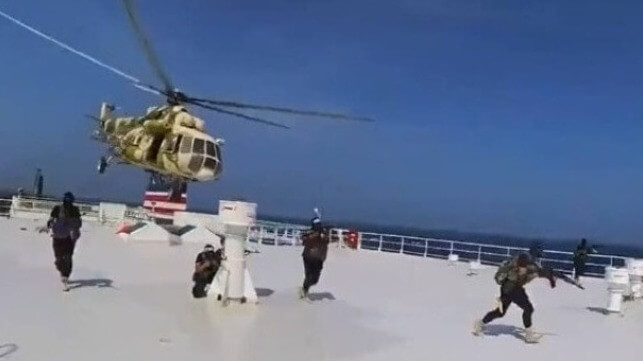
Galaxy Leader
Houthi fighters hijack the car carrier Galaxy Leader, Nov. 2023 (Houthi Military Media)

Published Mar 5, 2025 3:25 PM by The Maritime Executive


The U.S. Treasury has imposed new counterterrorism sanctions on seven Houthi leaders who worked to secure weaponry from the Russian government and supply Yemeni fighters for the Russian invasion of Ukraine. No Russian officials were sanctioned in the announcement. 

The Houthis repeatedly attacked merchant shipping in the Red Sea from late 2023 through the end of 2024, then paused their operations in January after the announcement of the group's stated objective - the phased ceasefire agreement between Israel and Palestinian terror group Hamas. The Houthis' primary military sponsor is the government of Iran, which has provided the group with weapons and funding for years, but the U.S. Treasury also has reason to believe that the terrorist organization has received support from Iran's Russian allies as well. 

"By seeking weapons from a growing array of international suppliers, Houthi leaders have shown their intent to continue their reckless and destabilizing actions in the Red Sea region," said Secretary of the Treasury Scott Bessent in a statement. "The United States will use all available tools to disrupt the Houthis’ terrorist activities and degrade their ability to threaten U.S. personnel, our regional partners, and global maritime trade."

According to the Treasury, Houthi spokesman Mohammad Abdulsalam has helped arrange the group's efforts to get weapons and support from the Russian government, working from offices in Oman. Abdulsalam has traveled to Moscow and met with the Russian foreign ministry, as well as members of the Russian military, according to the Treasury's staff. An aide to Abdulsalam, Eshaq Abdulmalek Abdullah Almarwani was also designated for his role in the talks.  

Ali Muhammad Muhsin Salih Al-Hadi, head of the Sanaa Chamber of Commerce (SCC), plays a key role in financing Houthi weapons purchasing. He has traveled to Russia to make arrangements "to secure defense equipment for Houthi militants and investment in Houthi-controlled industries," according to the Treasury.

Top Houthi leader Mahdi Mohammed Hussein Al-Mashat, chairman of the terror group's Supreme Political Council (SPC), has also worked to increase cooperation between the Russian government, Russian President Vladimir Putin and the Houthi movement, according to the Treasury. SPC member Mohamed Ali Al-Houthi helped coordinate the group's truce with Russia and China, which pledged a moratorium on Houthi strikes on maritime traffic linked to the Houthis' leading international supporters. 

Also named were two senior Houthi operatives - Abdulmalek Abdullah Mohammed E Alagri and Khaled Hussein Saleh Gaber - who also traveled to Russia to participate in the meetings. Alagri has also joined talks with the Chinese government, according to the Treasury. 

The Houthi military trade with Russia involves both imports and exports, according to the Treasury. The department asserts that Houthi operative and "major general" Abdulwali Abdoh Hasan Al-Jabri operated a "lucrative human smuggling operation, recruiting Yemeni civilians to fight for Russia in Ukraine." The recruits were not always well-informed of their new role, Treasury said, but their efforts have earned the terrorist group a new source of much-needed revenue.  

The weapons talks between Moscow and the Houthis may have had direct relevance to the safety of shipping in the Red Sea. In September, government sources told Reuters that Iran was helping the Houthis negotiate with Russia to acquire the P-800 Oniks (Onyx, Yakhont) supersonic antiship missile - a potent upgrade to the terrorist group's Iranian-supplied munitions, which sank two ships out of more than a hundred attacked. Houthi officials likely met with Russian representatives in Tehran twice last year, security sources told Reuters, and the talks about procuring the Oniks were expected to continue.


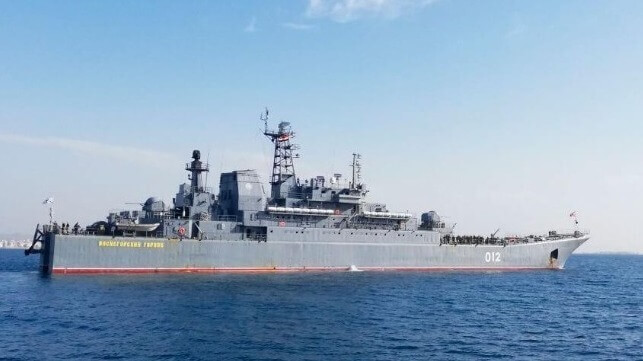
Russia Clings On in a Divided Syria

Ropucha
A Russian Navy Ropucha-class amphib at Tartus in better days (Russian Ministry of Defense)

Published Mar 3, 2025 11:44 PM by The Maritime Executive


The Russian evacuation of its heavy equipment from Syria continues, whilst the Russian naval presence lingers in the Mediterranean, for the time being making do without Tartus as a base facility.

The Russian military cargo ship Sparta IV was alongside in Tartus for several days up to February 25, loading wheeled armored vehicles. The Krivak-class Admiral Grigorovich (F745) appears to be lying just offshore, in Syrian territorial waters, providing protective cover and poised to escort the Sparta IV on its homeward journey. At the other end of the Mediterranean, the Gorshkov-class Admiral Golovko (F461) looks as if it may have been escorting the Baltic Leader, another Russian cargo ship last seen in Tartus in early February, as it made its way back eastwards across the Mediterranean. In between times, the Ropucha-class landing ship Alexandre Shabalin (L110) has also been loading in Tartus, a more obviously naval vessel. On March 2, Admiral Grigorovich, Alexandre Shabalin, Sparta IV and two other Russian cargo ships, the Syanie Severa and Asacalon, were noted by naval open source specialist MT Anderson leaving Tartus as a convoy.

These ship movements indicate that the Russians have business-like dealings with the new Hayat Tahrir al-Sham (HTS) government in Syria, who have also provided effective protection to allow the evacuation to continue without interdiction or hindrance. But the fact that heavy equipment is being withdrawn clearly implies that if the Russians manage to retain a foothold in Syria, it will be a smaller presence and will have a restricted role when compared with the operational freedom that the Russians had enjoyed since Soviet days.

Russian negotiations with the HTS government continue over a future presence. But as the talks continue, the political environment is changing. Given the recent global political upheavals, it should no longer be assumed that the United States is opposed to a continued Russian presence – as the Biden administration unambiguously was.

Israel has no wish to see an Iranian-dominated Syria, part of a Shi’a crescent of influence stretching from Iran, across Iraq and Syria, into Lebanon, replaced by Islamist influence supported from a dominant Turkey to the north. A continued Russian presence could act as a restraint on Turkey, as could a continued US presence in Syria. Israel’s interests are better served by a weak but stable Syria; hence its move into Syrian areas of the Golan Heights and its stated intention to support the Syrian Druze minority in areas south of Damascus, which have been threatened by HTS-aligned forces in recent weeks.

Israel also has an interest in preserving moderately-inclined Kurdish political autonomy in North East Syria and also in Iraq, as a counter-weight to both Sunni and Shi’a extremists and factional fighting, but also as a bulwark against increased Turkish influence.

The Russians have continued to maintain a naval presence in the Mediterranean, headed by its Kilo-class submarine Krasnodar (B265). Without its base facility in Tartus, it instead has used port calls in Algeria and Libya as a means of resting crews and replenishing ships, and its oiler auxiliaries have even still been permitted to top up in Tartus. It will be a while before such port calls overtax those hosting the Russians – by which time the Russians may have arrived at a new slimmed-down basing deal with the new Syrian government.

UK Tracks Russian RoRo Carrying Arms from Syria Escorted by Warship

Royal Navy tracking Russian ships
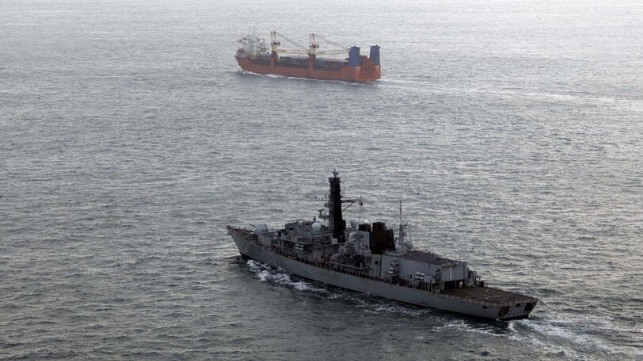
HMS Somerset monitoring Russian cargo RoRo Baltic Leader (Photos courtesy of Royal Navy)

Published Mar 5, 2025 10:08 AM by The Maritime Executive


The UK’s Royal Navy is reporting it has completed a three-day operation tracking the movements in the English Channel of a Russian warship and a military cargo ship believed to be bringing armaments back from Syria. It was the latest in a series of movements that have become so frequent The Times (London) reports it has been nicknamed “the Syrian Express.”

The Royal Navy reports that the Russian corvette Boikiy was first detected moving south from the Baltic and HMS Somerset, a Type 23 frigate based in Portsmouth, was dispatched to track the movements of the warship. The UK regularly tracks the movement of Russian warships in the Channel with Commander Joel Roberts of the frigate commenting, “Somerset is well versed in the escort of Russian ships, having conducted these operations on a number of occasions.”

This time it triggered a multi-day operation that included Somerset as well as coordination with UK patrol aircraft and NATO forces. The Somerset deployed her Merlin helicopter to gather additional information and the Belgian minehunter BNS Crocus also joined in the tracking.


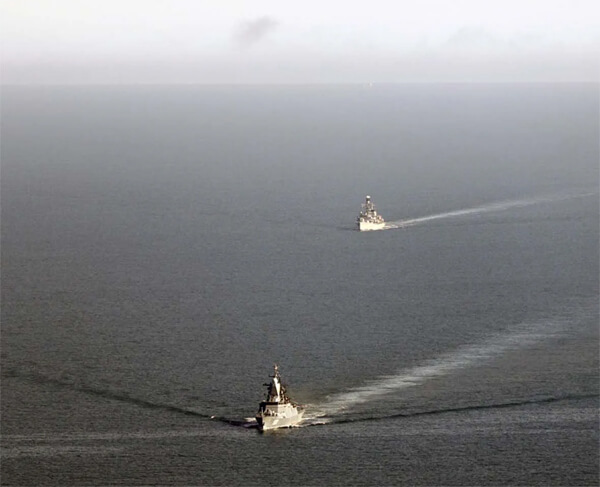
Somerset trailing the Russian corvette Boikiy


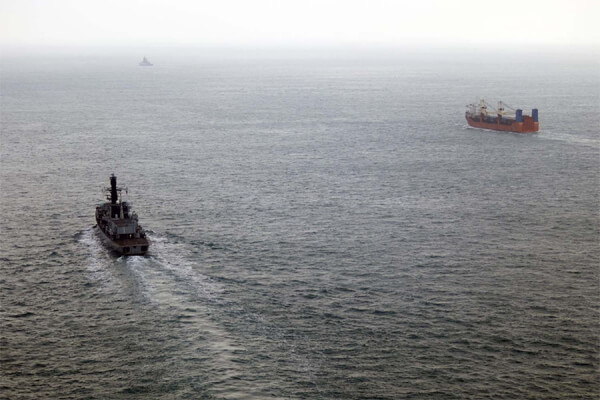
Boikiy rendezvoused with the cargo ship Baltic Leader which was believed to be coming from the Tartus base in Syria. Previous reports indicated the ship was being used to remove military equipment as part of the Russian evacuation after the fall of Syrian dictator Bashar al-Assad. In its report, The Times cites satellite images showing military equipment on the dock at Tartus on February 1 when the Baltic Leader docked.

In an exclusive, The Times published pictures of the transit of the corvette and cargo ship during the transit obtained from a fishing boat in the Channel. Men in military fatigues can be seen on the cargo ship and at times the Russians were manning their machine guns.

The operation continued from March 1 through March 3 as the Baltic Leader and the Boikiy made the transit heading toward the North Sea and the Baltic. 


Somerset (left) monitoring Baltic Leader with Boikiy ahead in the Channel mist


The RoRo cargo ship Baltic Leader (7,100 dwt) has become well-known for transporting Russian equipment. In 2022, France briefly detained the vessel for possible sanction violations and later attempted to prosecute the captain of the vessel. There was a dispute over the legal ownership of the vessel which led to the acquittal of the captain in October 2024. At the beginning of this year, the Portuguese reported tracking the vessel as it was inbound for the Mediterranean on another apparent voyage on the “Syrian Express.”

For Somerset, this was the second time this year it was activated to track Russian ships. In January, the Royal Navy reports Somerset along with the patrol ship HMS Tyne tracked the suspected Russian spy ship Yantar. Two weeks ago, HMS Iron Duke, HMS Tyne, and RFA Tideforce monitored five Russian ships. That convoy included three cargo ships that were also transiting from Syria and believed to be bound for a Russian Baltic port.


WAIT, WHAT?!

Report: White House Draws Up List of Sanctions Relief Measures for Russia

WHAT A FRIEND WE HAVE IN PUTIN


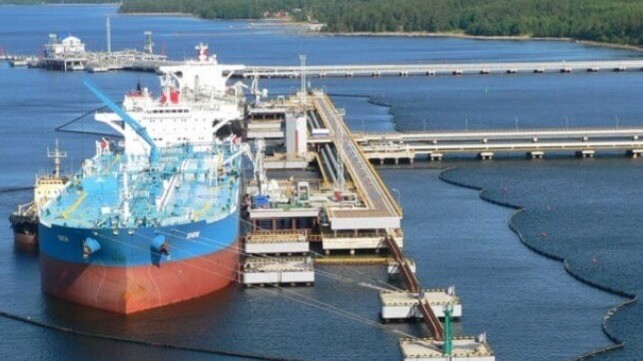
Russia's Primorsk oil loading terminal on the Baltic (file image)

Published Mar 4, 2025 11:29 PM by The Maritime Executive


Just as the Biden administration's tanker sanctions are beginning to affect Russian oil exports, the Trump White House has begun looking at options to lift U.S. restrictions on Russian entities, according to Reuters. The State Department and Treasury Department have been asked to draft a list of measures for potentially easing stringent U.S. sanctions, which have been the most effective tools of economic persuasion that the West has deployed against Moscow.

The news aligns with a personal falling-out between President Donald Trump and Ukrainian President Volodymyr Zelensky, which burst into public view with a contentious news conference at the White House on Friday. After a heated exchange with Trump and Vice President JD Vance, Zelensky was asked to leave the building. Trump subsequently announced a suspension of all military aid to Ukraine, a profound blow for Ukraine's front-line forces. 

Sources close to the White House told Reuters that the sanctions relief measures under consideration would be for individual Russian citizens and companies. Ukraine's government responded with a call for the White House to wait for more progress in peace talks, in order to maintain leverage to bring an end to the invasion. However, Russia has indicated that negotiations over Ukraine are only part of the discussion with the Trump administration: the bilateral talks also cover something else - "normalizing" relations between Moscow and Washington.

"Of course, if we are talking about normalizing bilateral relations, then [Russian interests] need to be freed from this negative burden of so-called sanctions," said Dmitri Petrov, spokesman for Russian President Vladimir Putin. "It is probably too early to talk about anything [being lifted] . . . we have not heard any official statements."

Current U.S. sanctions include significant restrictions on Russia's energy sector and its tankers. The previous administration's effort to target Russia-linked "shadow fleet" of aging tankers has forced Russian Urals exporters to drop their prices below $60 per barrel for the first time in more than a year, and tanker rates from Russian loading ports have soared. 


Greek Tanker Owners Are Returning to the Russian Oil Trade

Eagle S tanker
Courtesy Finnish Border Guard

Published Mar 2, 2025 11:39 PM by The Maritime Executive

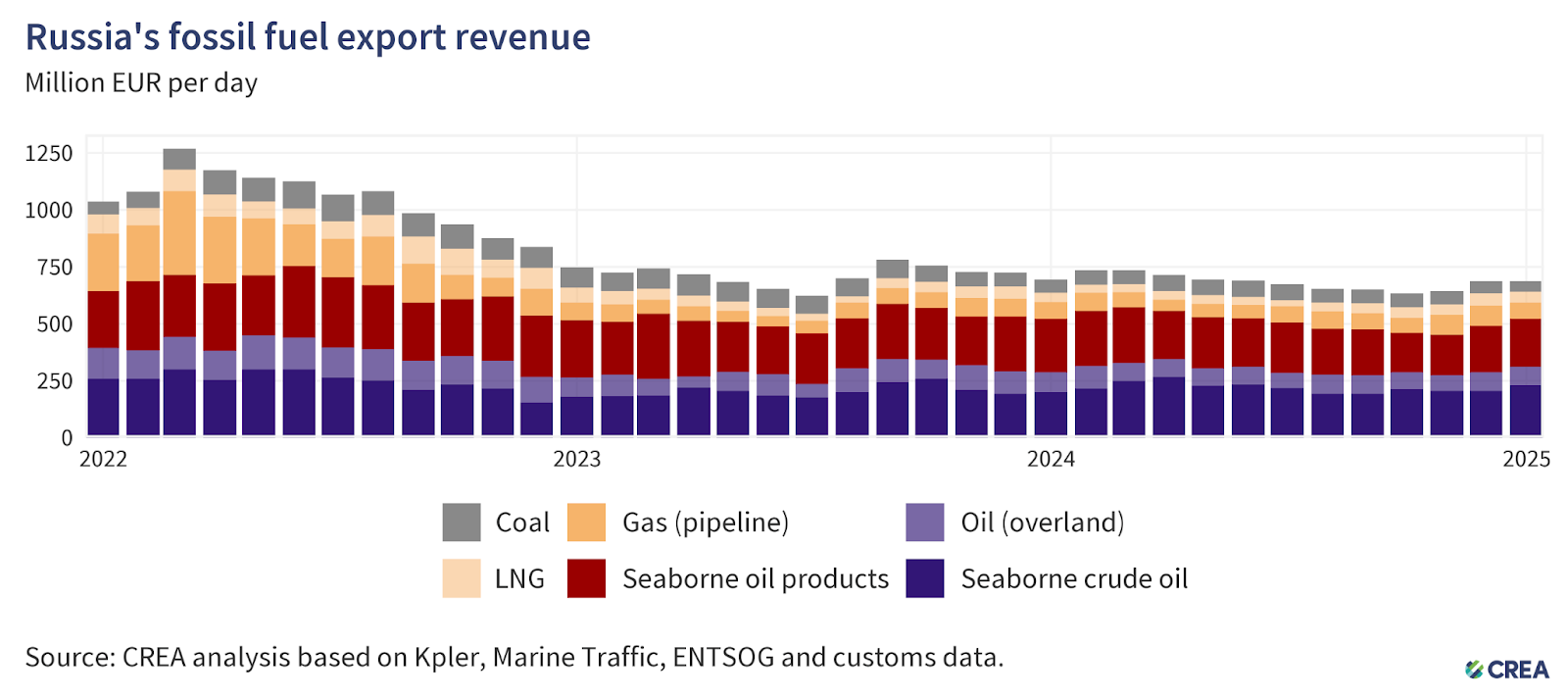
American sanctions have reduced Russia's ability to ship oil on lightly-regulated "shadow fleet" tankers, but Moscow is maintaining its fossil fuel export revenues at about $700 million per day, in part thanks to the renewed participation of Greek tanker owners. Greek owners have emerged as crucial players in keeping Russian crude flowing to global markets, particularly to India and Turkey, according to Vortexa. 

"Preliminary February data is showing Russian crude volumes carried by Greek operators at a 12-month high," said Mary Melton, a senior freight analyst at Vortexa, in a new research note. "Russian crude exports to India and Turkey will need to be offered below the price cap so that Greek operators can facilitate these volumes."

Bloomberg confirms that Russian Urals crude is now trading below $60 per barrel, a deep discount to Brent - and enough of a discount to allow Western tankers to legally participate in Russian energy exports. 

The need for a discount is clear. The U.S. Treasury Department sanctioned 183 Russia-linked vessels in January, targeting approximately one-third of Russia's "shadow fleet" — a collection of aging vessels that were purchased, renamed and reflagged in order to circumvent Western shipping restrictions. Until recently, that strategy has largely worked, allowing Russia to get around the $60 per barrel "price cap" imposed on Russian energy shipping by the G7 nations. Russian energy revenue has been stable since 2023, despite sanctions. 

Courtesy CREA

According to the Centre for Research on Energy and Clean Air (CREA), Russia's seaborne crude oil revenues surged by 13 percent in January compared to December, reaching $240 million daily. This suggests that Russia found ways to command higher prices despite the sanctions regime, according to the center's researchers. China is the country's largest buyer, and Russia has put particular emphasis on ensuring the continued flow of premium ESPO grade crude from the Russian Far East to China. 

Shadow fleet tankers transported 84 percent of the total volume of Russian seaborne crude oil in January, according to CREA, but in February, above-board Greek operators had an increasing share. "These Greek-operated vessels have migrated out of mostly Atlantic Basin trade, especially in the Mediterranean," Vortexa's Melton noted. "This could lead to significant tightening in Atlantic Basin Aframax supply, and higher earnings for vessel operators in those regions.


Polish Researchers Detect Ship-Based GPS Jammers in Baltic Sea

Sources have previously informed Lloyds List of clandestine, high-powered radio gear mounted aboard Russia-linked tankers (Finnish Border Guard file image)

Published Mar 3, 2025 2:09 PM by The Maritime Executive


A study carried out by Polish GNSS researchers has determined that the GPS interference observed in the Baltic recently exhibits capabilities beyond commercial grade, and it appears to emanate from ships in transit - not from a fixed land-based source in Kaliningrad, as some analysts have speculated. If accurate, the apparent discovery of powerful ship-mounted transmitters would help explain the shifting pattern of GPS disruption in the region. It would also align with past reports of high-power radio equipment fitted aboard vessels in the Russian "shadow fleet." 

The study monitored GPS disruption at ground level with a sensor installed at Gdynia Maritime University, 75 miles east of central Kaliningrad. It was mounted high enough for a line-of-sight radio horizon of about 20 nautical miles offshore (depending on transmitter antenna height). This is enough to reach out into the Gulf of Gdansk, but not far enough to cover the main east-west sea lanes of the central Baltic, where the vast majority of the region's traffic occurs. 

Over a period of six months beginning in June 2024, the sensor picked up 84 hours of GNSS interference, including 29 hours in October alone. Events lasted for up to seven hours at a time, and caused horizontal positioning errors of up to 100 feet - enough to affect navigation in confined waterways. 

Multi-constellation jamming (GPS, GLONASS, BeiDou and Galileo) was observed through September 2024; the pattern changed to multi-tone interference from October onwards. This interference "likely originated from a mobile maritime source, given its periodic occurrence and movement patterns," the researchers wrote. 

The ground-level disruption affects maritime interests, and did not correlate with observations of ADS-B aircraft navigational system disruption at higher altitude. Since the ground-level GNSS events aren't detected by airborne ADS-B monitoring, the team called for setting up a terrestrial sensor network for GNSS disruption with geolocation capabilities, which would be used to spot the offending vessels and identify them for possible enforcement action. 

"The interference . . . exhibited noticeable fluctuations in power levels, suggesting that the jamming source was in motion. Given the system's radio horizon, which primarily covers a portion of the Baltic Sea, and assuming that the interference source was not located within Poland’s borders, the most plausible explanation is that the jamming originated from a vessel in international waters," the researchers concluded.