West Papua and the Sweet Taste of Murder
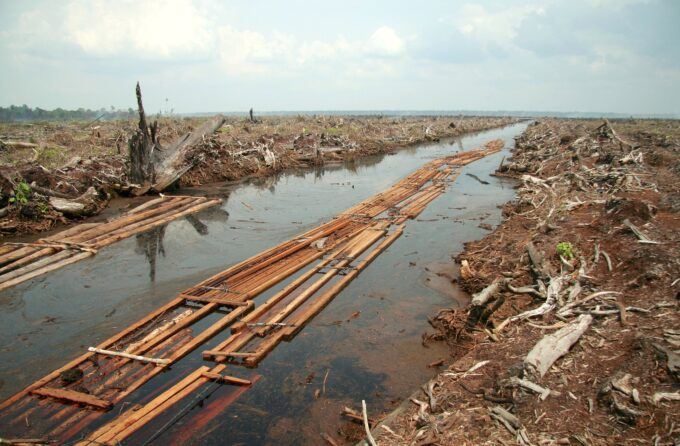
Remains of peat forests in Indonesia that were destroyed to make way for palm oil plantations.
Photo: Aidenvironment, 2006. CC BY-SA 2.0
There exists a solidarity among men as human beings that makes each co-responsible for every wrong and every injustice in the world, especially for crimes committed in his presence or with his knowledge. If I fail to do whatever I can to prevent them, I too am guilty.
– Karl Jaspers
What’s the relationship between an emaciated, dying Wondiwoi tree kangaroo (whose small joey in her pouch is also condemned to death) and tooth decay or obesity in a kid in any European city? The world’s perhaps only fifty remaining Wondiwoi tree kangaroos are gorgeous marsupials with large eyes, sweet faces, thick burnt-umber coats, and strong claws for grasping tree branches. Human kids are also gorgeous creatures, often with large eyes, sweet faces, thick overcoats, and grasping hands (especially if there’s a KitKat in sight). But that’s the superficial connection. The underlying, truly dangerous relational bond is palm oil. Each individual, the cute animal and the cute kid, represents the horrors of an insane system of consumption that’s destroying everything it touches on both sides of the story, the kid’s and the tree kangaroo’s.
It’s no news that unhealthy items stack shelves at child-eye level in supermarket checkout queues. You’re waiting, have nothing to do but look at the last tempting offers, so you throw a couple of KitKats into your basket or buy one to quieten a whining kid. KitKats will sweeten your day. They also kill all sorts of beautiful rainforest creatures, and they displace and kill people who once lived on and with the land where their ingredients are now grown. If you buy cigarettes, the packet screeches, with ghastly illustrations, that you’re courting head or neck cancer, and that your smoking can cause fatal lung disease in nonsmokers. KitKat wrappers show no pictures of dying Wondiwoi tree kangaroos or caries in tender little mouths.
I’m singling out KitKats to represent the vast array of products made from palm oil and because it’s among several supposedly seductive products listed in a boycott recently called by more than ninety West Papuan tribes, political organisations, and religious groups. The other products and labels they name are Smarties, Aero chocolate, Oreo biscuits, Ritz crackers, Pantene, and Herbal Essences. But the boycott is about more than a few products that are damaging at both production and consumer ends of the scale. It’s about late capitalist corporate imperialism where industrialists lawlessly operate in boundless, rather than delineated parameters of space and time, aided by the global data (mis)information economy, which splatters its fraudulent spiel everywhere in worldwide linkups. Hence the connection of KitKat with a treeless, starving tree kangaroo.
After being betrayed by the United Nations more than sixty years ago, Melanesian West Papua, occupied by Indonesia ever since, is a particularly poignant case in point. In its increasingly militarised torture mode of governance, the Indonesian regime—now headed by Prabowo Subianto, notorious for his war crimes in East Timor—is the world’s biggest palm oil exporter, to the tune of 47 million tonnes of crude palm oil in 2023, and 54% of global exports. The industry accounts for 4.5% of Indonesian GDP and directly or indirectly employs 16.2 million people. The total area of Indonesian palm oil cultivation is about 25 million hectares (out of 29 million hectares globally, which amounts to approximately 6.7% of the size of the European Union), and plantations covering many million more hectares are planned. In 2023, industrial oil palm plantations in Indonesia expanded by 116,000 hectares, a 54% increase compared with 2022. The largest oil palm project so far is Tanah Merah, in Boven Digoel Regency. Seven companies control the area of 280,000 hectares of which more than 140,000 hectares of land traditionally occupied by the Awyu people will be taken for oil palm production.
In West Papua this destructive extractivism also entails violent social change for the country’s Indigenous peoples. It’s impossible to know how many people have been displaced in the name of “food security” (security for KitKat production) as the Indonesian government is understandably averse to providing statistics of the genocide it has been committing in West Papua for more than sixty years. The Office of the High Commissioner on Human Rights calculates that there are between 60,000 and 100,000 internally displaced people. Mining, palm plantations, and logging by Indonesian and international companies are protected by the state transmigration programme which creates militarised buffer zones protecting the areas designated for Indonesian government “development” programmes. It’s calculated that Indonesian transmigrants outnumber West Papuans by about ten percent, and approximately 25% of the Indigenous population, or more than 500,000 people have been killed. Needless to say, the demographics represent atrocious human rights violations, including destruction of West Papuan languages and culture.
Taking rainforest land for palm oil monoculture also means taking water. In areas where these plantations are forcefully introduced, women are particularly affected. In West Papua and other parts of the world, they bring water to their villages for activities that sustain community social life and hence its reproductive cycle. When villages disappear with the land and the water, women suffer sexual violence when forced beyond the confines of their traditional safe territory to be exploited as cheap labour on plantations, or when they have to resort to prostitution in shantytowns in order to survive, in a chain of generalised abuse that includes sexually servicing uprooted men who are brought in and also exploited as cheap labour or (in the case of West Papua) as transmigrants.
Here’s an example of how a person eating a KitKat isn’t aware that he or she is also consuming the bravery and resistance of women forest guardians which, now mixed with sugar and trampled into the sludge of what was once rainforest, rots his or her teeth. In October 2023, dozens of women from the Tehit clans of the Afsya people in Kondo district, Sorong Regency, West Papua held an emergency meeting, where they shared and wrote down everything they knew about their community’s special places: where to find good sago, where to cultivate their crops, where to find medicinal plants, where their sacred places were, and all their deep connections with their habitat. But they can’t save this world of community solidarity because in 2014, the Indonesian government granted a concession of 37,000 hectares of what was then 96% intact rainforest to PT Anugerah Sakti Internusa, a subsidiary of the Indonusa Agromulia Group which is owned by Rosna Tjuatja. Subsequent permits gave the company permission to start destroying 14,467 hectares within this concession area and plant millions of oil palm trees.
Meanwhile, Indonesian president, Prabowo Subianto who, with a personal fortune of over $130 million and holdings of almost half a million hectares of land, poses as the great champion of planetary “food security”, says that palm oil expansion won’t deforest because “oil palms have leaves”. In fact, clearing forest for a palm plantation releases more CO2 than can be sequestered by growing oil palms on the same land. But the overriding message is that oil palms are fine because they have leaves and we need “indulgent products” that eat up rainforests to rot children’s teeth. Somehow, consumers swallow this rubbish with sweet junk in colourful wrappers. Nestlé, owner of KitKat (now with a KitKat cereal “designed to be enjoyed as an ‘occasional, indulgent’ breakfast option”) has recently fobbed off investor moves to reduce its high levels of salt, sugar, and fats, with an 88% shareholder vote in favour of said high levels. Nestlé, well known for its many human rights abuses, obtained this majority with the argument that any “move away from ‘indulgent products’ could harm its ‘strategic freedom’”. Strategic freedom, leaf-green and sweetly sugar-coated, to kill.
On the other side of the world, shoppers who are sickened by the slaughter of human kin and other animals, about the ravaging of Earth’s environments, can try to observe the West Papuan boycott by checking to see if products contain palm oil. But information overload is a form of lying, a way of bamboozling people, so palm oil is hidden in names like Vegetable Oil, Vegetable Fat, Palm Kernel, Palm Kernel Oil, Palm Fruit Oil, Palmate, Palmitate, Palm olein, Glyceryl, Stearate, Stearic Acid, Elaeis Guineensis, Palmitic Acid, Palm Stearine, Palmitoyl Oxostearamide, Palmitoyl Tetrapeptide-3, Sodium Laureth Sulfate, Sodium Lauryl Sulfate, Sodium Kernelate, Sodium Palm Kernelate, Sodium Lauryl Lactylate/Sulphate, Hydrated Palm Glycerides, Etyl Palmitate, Octyl Palmitate, Palmityl Alcohol, Laureth-7, Steareth-2, Cocamide MEA (fatty acid-derived) Cocamiede DEA (fatty acid derived), Stearamidopropyldimethylamine, Cetyltrimethylammonium chloride, Isopropylmyristate, Caprylic/capric Trigylceride, Fatty Isethionates (SCI), Alkylpolyglycoside (APG), and Laurylamine oxide. The large number of names behind which palm oil is hidden warns, in itself, what a destructive product it is. People can do their best to boycott these products, but any boycott also requires thinking about whether we actually need them, and how to overthrow the system that produces them, knowing how damaging they are, knowing how the profits are concentrated in ever smaller circles of greedy despoilers, and how these profits are plump with death and mayhem in societies we are supposed not to think about, unless in racist terms, let alone learn from them about their harmonious ways of living on this planet.
In its multifarious disguises, palm oil is everywhere, in about 50% of packaged products sold in supermarkets, from foodstuffs to deodorant, shampoo, toothpaste (for rotting teeth), makeup, “beauty” products (thus profiting from exploitation and control of women’s bodies), petfood, and biofuels. In other words, the question of the caries-producing KitKat is also a moral question because governments, political institutions, and the multinational companies they protect are lying to the people they are supposed to represent. Waivered so that corrosive, erosive and literally poisonous (in places like West Papua) food products can keep flooding markets, national and international legal provisions are facilitating the ruination of rainforests and their guardians. Hence, they are not legitimate. It’s pure madness. KitKats are unnecessary. Rainforests and their guardians are more necessary that ever in this age of climate catastrophe. The climate breakdown, “the severe and potentially catastrophic consequences of unchecked climate change, including extreme weather events, rising sea levels, and widespread environmental degradation, often used in a context of urgency and alarm” is also a generalised moral breakdown that is accelerating the calamity from which no one will be spared.
Freedom from hunger is a basic human right. But there’s a difference between a hungry child whining for a KitKat in a western supermarket and people, hungry to the point of starvation, who have been displaced to ensure that supermarket shelves can be stocked with KitKats. A couple of dollars satisfy a child who wants a KitKat but nothing will fill the bellies of Indigenous peoples who are displaced from their customary lands, deprived of resources which, more than just filling their bellies, constitute their livelihoods, their culture, community values, and physical and psychological wellbeing. In the language of “development”, this way of life that respects the environment is presented as backward and discardable. So, in the Merauke district, in the name of “national food sovereignty” and supposedly green “renewable energy”, more than a million hectares have been chopped down in the last decade for monocrop oil palm plantations, with the result of massive food insecurity among the local Marind people, as anthropologist Sophie Chao describes. No longer able to harvest their traditional rainforest food—fish, game, fruits, sago, and tubers—they are now obliged to subsist on instant noodles, rice, canned foods, and sugary drinks, a diet which, closer to KitKats than forest nutrition, has led to, “Stunting, wasting, and chronic protein-energy malnutrition are particularly high among women and children, rendering them vulnerable to pneumonia, parasitism, bronchitis, and a range of gastrointestinal and musculoskeletal diseases” which are aggravated by “collective feelings of sorrow, grief, pain, and anger”.
Unlike KitKat-producing tree killers, the Marind people understand the rainforest as having a sentient ecology that is manifested in seasonal rhythms and the natural signs of the rainforest, its features, and its dwellers. Every change, every sign tells them about the health of the forest and suggests how to care for it by knowing which animals they should hunt and when, by using the appropriate tracks or river sections, and by harvesting the vegetation in season. This care for the forest’s health is reflected in their own wellbeing. It is a harmonious way of life.
The hungry child in a supermarket can be satisfied with a tooth-rotting treat but hunger for West Papua’s dispossessed Indigenous peoples also means destruction of whole “ecosystems, soils, and water that these plants and animals depend on to survive and thrive in mutual relations of eating and being eaten that operate across species lines”, as Sophie Chao writes. Eating in the rainforest has a social significance expressed in traditional hunting and gathering, food preparing, and consumption practices that feed more than human bodies because they nurture ties between individuals and groups. The fact that there some 250 tribes with their own languages may, for a western shopper in a supermarket (where people rarely speak to or even look at each other), seem to be primitive and hostile fragmentation. Far from it. This is a complex system of democracy, rules and agreements among tribes that has worked well for some 50,000 years. People, identifying with their own tribes and also as West Papuans, have always understood the rules of the system. Lawless junk foods that destroy and replace this intricate system have no social meaning except for being trash and trashing everything.
A kid crying for a KitKat in a supermarket feels only his or her imperious individual need for instant satisfaction. But among the Marind people, hunger is contagious because it’s a social malaise. If one person is weak and malnourished, the group feels undernourished and fragile in what Chao calls “a form of transcorporeal and affective transference”. In rainforest “communities of fate”, the contagion spreads beyond humans, the plants wilt when their biodiverse ecologies are fenced off, or they are poisoned with pesticides, fertilisers, and contaminated water, or chopped down, burned, and crushed by heavy industrial farming and military equipment. Tree kangaroos, wild pigs, cassowaries, and birds of paradise are enslaved or killed in the pet and feathers trade, fish are poisoned in contaminated streams, and when homeless creatures are adopted in an effort to protect them, they too pine away.
Chao gives a moving account of the fate of a cassowary called Ruben, hatched by villagers from an egg rescued from a deserted nest in bulldozed rainforest. She was sitting with a group of villagers enjoying an after-dinner conversation when, “During a momentary lull in the conversation, Ruben’s shy whistle echoed through the night. I smiled and commented on how sweet his song was, and how lucky we were to have such a cute pet among us”. Her friends immediately fell sad. One old woman explained how mistaken she was. “This is no song, sister. This is a weeping. This is the cry of the cassowary. Can you not hear the sadness, child? Does it not rip through your heart with the speed of a hardwood ngef (Arenga pinnata) arrow? We hear only a weeping, a lament. We feel the grief of the khei (cassowary) as it seeps through our skin and bone. We hear death and mourning in its call. No longer wild (liar) or free (bebas), the cassowary has become plastik (plastic).”
In this “more-than-human ecology of hunger”, the oil palm too is hungry (lapar)—and this is exactly how the Marind people describe it—but it is voracious and antisocial, not unlike a kid throwing a tantrum in a supermarket, except that it does far more damage by insatiably devouring the rainforest, all living things in it, its social life, its identities, and its cultures, turning even cassowaries into “plastic” things, and extending all the way to rotting the teeth of people who insouciantly consume its products on the other side of the planet. Territory-gobbling roads and towns are also lapar and the Marind people very well understand that the governments, corporations, and obscenely rich individuals that are fuelling their fires and machines with plants, animals, humans, and traditions as they go devouring everything that is beautiful, valuable, and meaningful around them, are greedy things contributing nothing but rot to the world. They know all too well that hunger is a political phenomenon. National food security discourse dictates which bodies and ecologies must be fodder (literally, biofuel), to produce junk food for others.
Greenwashing organisations like the World Wildlife Fund, established by dodgy characters like the racist Duke of Edinburgh and Nazi-linked, leading man of the Lockhart bribery scandal, Prince Bernhard of Holland, as an elite club of an anonymous thousand-plus richest people in the world, influencing global corporate and policy-making power, and “setting up ‘round tables’ of industrialists on strategic commodities such as palm oil, timber, sugar, soy, biofuels and cocoa”, argue that oil palm boycotts aren’t “helpful”. No, of course they aren’t helpful for WWF funders, among them Coca-Cola, Shell, Monsanto, HSBC, Cargill, BP, Alcoa, and Marine Harvest. This pretence that there are sustainable solutions for the sugary rot of KitKat, is yet another smokescreen (obscuring everything like sooty clouds rising from burning rainforest to the extent of even halting air traffic) to hide the fact the West Papuan call for a boycott of KitKat and other palm oil products is a profoundly moral stance, challenging western consumption practices and all the lies underpinning them.
The names of many oil palm products, reveal how they lie (Nature’s Bounty, for example) and that they are nearly all “indulgent” (Pampers, for example). Lists might be boring but some names should be mentioned to show how the wreckage of most of what is good about human existence is wreaked by more than just a few useless, “indulgent”, corruptive products. They involve food retailers and companies like Aldi, Booths, Ocado, Spar, Monde Nissin, Vbites, Mitsubishi, Eat Natural, Nature’s Bounty (ultimately owned by Nestlé), Thai Union, Food Heaven, Almond Dream, East End Foods, Müller, Koko; drinks companies like Redbush Tea Co, Healthy Food Brands, SHS Group, Nichols, R. White’s, Fruitshoot; coffee shops including Soho Coffee Company, Caffè Nero, Caffè Ritazza, Coffee Republic, AMT Coffee, Esquires, Harris and Hoole, Muffin Break, Boston Tea Party, Puccino’s, and Bewley’s; fast foods, among them Leon, Domino’s Pizza, Yo! Sushi, Burger King, Yum! Brands (Pizza Hut, KFC), Itsu, Subway, Greggs, Pret A Manger; restaurant chains like Wahaca, TGI Friday’s, Giraffe, Mitchells and Butlers (Harvester, All Bar One), Greene King. Whitbread, Pizza Express, The Restaurant Group (Chiquito, Frankie and Benny’s, Wagamama), Azzurri (ASK), Jamie’s Italian, Colgate-Palmolive and Nestlé getting the worst ratings; perfumes like Holland and Holland (Chanel perfume), Shiseido Company Limited (Dolce and Gabbana perfume), Inter Parfums (Jimmy Choo, Karl Lagerfield, Oscar dela Renta, Paul Smith, Gap, Banana Republic perfumes), Pacifica, Bliss, L’Occitane, Coty (Max Factor, Wella, plus perfumes for Adidas, Burberry, David Beckham, Calvin Klein); Natura Cosmeticos (Aesop), Suntory (F.A.G.E), Wahl, The King of Shaves, Lansinoh (Earth Friendly Baby), Baylis and Harding, Koa (John Frieda, Molton Brown), Crystal Spring, PZ Cussons (Morning Fresh, Original Source Charles Worthington, Imperial Leather), WBA Investments (Boots, No7, Soap and Glory, Botanics), Tom’s of Maine, Superdrug, Midsona (Urtekram), Laverana (Lavera), Logocos (Logana, Sante), Li and Fung (Vosene, Clinomyn toothpaste), Church and Dwight (Arm & Hammer, Pearl Drops, Arrid, Batiste), Revlon (Revlon, Almay, Mitchum), Bull Dog, Clarins, Edgewell (Banana Boat, Wilkinson Sword, Carefree, Bulldog Skincare for men), and Holland and Barrett; and cleaning products including Mcbride (Frish, Surcare, Planet Clean, LimeLite), The London Oil Refining Co Ltd (Astonish), Enpac (Simply), Lilly’s Eco Clean, Active Brand Concepts (Homecare), WD-40 (1001), Jeyes (Jeyes, Bloo, Sanilav, Parozone), and Procter and Gamble (Fairy, Head and Shoulders, Pampers, Always).
Rainforests are essential for the planet and all life on it. The ethical reach of the West Papuan boycott has the same scope as Karl Jasper’s insight about the all-embracing nature of metaphysical guilt, because the rot in a child’s teeth resulting from capitalist consumption practices is tangible and often painful evidence of the rot throughout the whole system that peddles—as essential for human wellbeing—commodities that kill wondiwoi tree kangaroos, kill people, kill planet Earth, and where life, in the plans of the richest men, will be confined to the “strategic freedom” of “indulgent”, “intelligent” bunkers.