Wednesday, June 18, 2025

'War Crime': Iran Demands UN Action After Israeli Bombing of Media Building on Live TV


A regional director of the Committee to Protect Journalists said that "Israel's killing, with impunity, of almost 200 journalists in Gaza has emboldened it to target media elsewhere in the region."


A screengrab of video footage shows the headquarters of Islamic Republic of Iran Broadcasting on fire following an Israeli attack on June 16, 2025.
(Photo: Islamic Republic of Iran Broadcasting)


Jake Johnson
Jun 16, 2025
COMMON DREAMS


The Israeli military deliberately bombed the studio of an Iranian state television network during a live broadcast on Monday, an attack that Iran swiftly condemned as a "war crime."

Video footage posted to social media shows the moment the Islamic Republic of Iran Broadcasting (IRIB) complex was hit by Israeli forces, forcing the anchor to flee for safety as smoke and debris filled the broadcast room.

Watch:


Shortly before the attack, Israeli Defense Minister Israel Katz declared that the "Iranian propaganda and incitement mouthpiece is on its way to disappearing."

Katz made clear in a subsequent social media post that the Israel Defense Forces (IDF) intentionally targeted the media building.

"The Iranian regime's propaganda and incitement broadcasting authority was attacked by the IDF after a widespread evacuation of residents in the area," Katz wrote.

"Calling someone a mouthpiece doesn't give you permission to kill them."

The number of casualties from the attack was not immediately clear. Foad Izadi, professor of international relations at the University of Tehran, toldAl Jazeera that the number could be high.

"It's a huge building," said Izadi. "Iran's news channel is located on the first floor. It has four floors, and on every floor you have at least 200-300 people working."

“They were getting ready for the evening program. This is going to result in a lot of civilians—generally young people, young journalists—getting killed," he added. "Calling someone a mouthpiece doesn't give you permission to kill them."


Targeting journalists and media infrastructure is prohibited under international law—and the use of media facilities for propaganda purposes does not render them legitimate military targets.

The IDF claimed, without providing any evidence, that the targeted building "was being used for military purposes by the Iranian Armed Forces."

Esmaeil Baqaei, a spokesman for the Iranian Foreign Ministry, called the Israeli attack "a wicked act" and a "war crime." He went on to urge the United Nations Security Council to "act now to stop the genocidal aggressor from committing further atrocities against our people."

"The world is watching," he wrote.

Sara Qudah, Middle East and North Africa regional director for the Committee to Protect Journalists, said Monday that the press freedom group is "appalled by Israel's bombing of Iran's state TV channel while live on air."

"Israel's killing, with impunity, of almost 200 journalists in Gaza has emboldened it to target media elsewhere in the region," said Qudah. "This bloodshed must end now."
'Unprecedented Mass Deployment' of Warplanes Across Atlantic Fuels Fears of US War on Iran

"You don't spin up this kind of skyward muscle just to flex," said one observer.


Flight-tracking software shows U.S. Air Force refueling tankers on their way to Europe on June 15, 2025.
(Photo: Evergreen Intel/X)

Brett Wilkins
Jun 16, 2025
COMMON DREAMS

Flight-tracking websites showed dozens of Air Force aerial refueling planes departing from military bases in the United States and heading to Europe on Sunday, fueling speculation of direct U.S. involvement in the widening Israeli-Iranian war.

Military-focused news sites reported that around 30 U.S. Air Force KC-135R and KC-46A tankers were identified by flight-tracking software in what The Times of Israelcalled an "unprecedented mass deployment" to Europe.


According toThe Aviationist:
Most of these aircraft landed this morning at Ramstein Air Base in Germany and at MorĂ³n Air Base and [Naval Air Station] Rota in Spain, while two landed at Aviano Air Base in Italy and at least one landed at Prestwick International Airport in the U.K. At the time of writing, some tankers are in flight over the Balkans, headed south, possibly towards Souda Bay in Greece or Incirlik in Turkey.

"While tanker movements in this direction are far from abnormal, such a large, near-simultaneous migration of the jets was very peculiar, especially at a time of extreme crisis in the Middle East," The War Zone's Tyler Rogoway wrote Monday. "The exact reason for the mass deployment is unclear, although many of the potential answers would indicate a change, or preparations for a potential change, in the current conflict between Israel and Iran."


Speaking on condition of anonymity, two U.S. officials toldReuters Monday that the tankers are being deployed to provide the administration of President Donald Trump with flexibility to act in the Middle East. Military experts said the deployment could portend expanded U.S. support for Israel's war on Iran or even American strikes against the country.

The Trump administration—which recently concluded that Iran is not seeking nuclear weapons—insists that Israel is acting "unilaterally" against its enemy in an effort to prevent it from developing nukes.

However, Trump said Sunday that "it's possible" that U.S. forces could enter the fight. Iran has accused the United States of complicity in Israel's bombing—which Iran says has killed more than 200 people, 90% of whom are civilians—and warned Washington of potential dire consequences if it boosts involvement in the war.

Asked about possible U.S. intervention in the war, Trump told reporters during the Group of Seven (G7) summit in Alberta, Canada on Monday, "I don't want to talk about that."

"We're not involved in it. It's possible we could get involved. But we are not at this moment involved," the president added.

As Reuters noted:
The United States already has a sizable force in the Middle East, with nearly 40,000 troops in the region, including air defense systems, fighter aircraft, and warships that can help bring down missiles.

Last month, the Pentagon replaced B-2 bombers with another type of bomber at a base in the Indo-Pacific that is seen as being an ideal location to operate in the Middle East. The B-52 bombers can carry large bunker-busting munitions, which experts say can be used against Iran's nuclear facilities.

Iran has responded to Israel's bombardment with waves of apparently indiscriminate missile attacks against Israeli cites, killing at least 24 Israeli civilians including women and children and Palestinian citizens of Israel and wounding hundreds of others.

Iranian state media—which was bombed by Israeli forces Monday with reported fatalities—claimed late in the day that Tehran is "preparing for largest and most intense missile attack in history on Israeli soil," even as Iran's government reportedly signaled its willingness to negotiate an end to hostilities if the U.S. guarantees it will not attack.

However, Israeli Prime Minister Benjamin Netanyahu subsequently toldABC News that Israel would continue bombing Iran, dismissing Tehran's reported overture as a ruse meant to "lie, cheat, and string the U.S. along."
NO WWIII

Deranged Trump Demands 'Unconditional Surrender' After Threatening to Kill Iran's Leader


"If new talks take place and Trump insists on capitulation, he will get war," warned one analyst. "Iran will pay an immeasurable price. As will the region. But the U.S. will also pay a very heavy price."


A man looks at a billboard featuring the portraits of Hassan Nasrallah, the slain former leader of Hezbollah, Iran's late president Ebrahim Raisi, Iran's supreme leader, Ayatollah Ali Khamenei, and Iran's slain commander Qasem Soleimani in Srinagar, Jammu and Kashmir, on June 17, 2025.
(Photo: Firdous Nazir/NurPhoto via Getty Images)


Jake Johnson
Jun 17, 2025
COMMON DREAMS

U.S. President Donald Trump on Tuesday demanded "unconditional surrender" from the Iranian government after threatening to order the assassination of the country's leader, an escalation of rhetoric that observers said could signal imminent American intervention in the increasingly deadly conflict that Israel, without provocation, started last week.

Trump wrote on his social media platform that "we know exactly where" Iran's supreme leader, Ayatollah Ali Khamenei, "is hiding."

"He is an easy target, but is safe there," the U.S. president continued. "We are not going to take him out (kill!), at least not for now."

Minutes later, Trump wrote in a separate post, in all caps, "UNCONDITIONAL SURRENDER!"

Trump's use of "we" in his latest messaging on the war indicates that the president sees the U.S.—Israel's top ally and arms supplier—as a party to the conflict, a departure from his insistence just days earlier that the U.S. was "not involved."

"Trump's Iran war may destroy his presidency as Bush's Iraq invasion destroyed his. Iran will lose. But so will the U.S."

Citing unnamed U.S. officials, Axiosreported Tuesday that Trump "is seriously considering joining the war and launching a U.S. strike against Iran's nuclear facilities, especially its underground uranium enrichment facility in Fordow."

The same outlet reported over the weekend that Israeli officials had been pressuring the Trump administration to wade into the conflict directly, claiming that Israel "lacks the bunker buster bombs and large bomber aircraft needed to destroy Iran's Fordow uranium enrichment site."

New polling indicates that a U.S. military attack on Iran would be deeply unpopular with American voters, including those who supported Trump in 2024.

Trita Parsi, co-founder and executive vice president of the Quincy Institute for Responsible Statecraft, warned Tuesday that Trump now appears "determined to take the country to a war of choice."

"If new talks take place and Trump insists on capitulation, he will get war," Parsi wrote. "Iran will pay an immeasurable price. As will the region. But the U.S. will also pay a very heavy price. Scores of American soldiers may be killed. Oil prices will skyrocket, and gas prices in hot summer months in the U.S. will soar. Inflation will go up."

"Trump's Iran war may destroy his presidency as Bush's Iraq invasion destroyed his," Parsi added. "Iran will lose. But so will the U.S. Israel is perhaps the only country that will benefit from this war of choice."


'It’s biblical': House Republican defends his support for Israel


Image via Screengrab.
THE NEW CIVIL RIGHTS MOVEMENT
June 18, 2025 |

A Republican congressman is defending his support for Israel—and for President Donald Trump to act against Iran—by calling the conflict a “biblical” battle.

“We’ve got the best friend we’ve got in Israel,” declared U.S. Rep. Roger Williams (R-TX) on Fox Business Wednesday morning. “They’re doing a fantastic job. They’re controlling the airspace now. So we just need to see.

“Look, it’s biblical, okay?” Williams continued. “I’m one of those. It’s biblical. We support Israel. Israel is our friend. We need to be with them.”

Congressman Williams also criticized U.S. Senator Tim Kaine (D-VA), who is among several House and Senate lawmakers on both sides of the aisle demanding President Donald Trump adhere to the War Powers Resolution of 1973 and obtain congressional approval before engaging in war against Iran.

“I would say to Senator Kaine, whose side are you on for crying out loud? I mean, ‘Death to Israel, Death to America.’ What more do we need to hear?””

RELATED: ‘Unconditional Surrender’: Trump’s Iran Posts Trigger Fears U.S. Is Entering the War

“And I think President Trump is right. He’s got us to a point where these guys need to take a hard look at theirselves and surrender, if they don’t surrender, it may be that we have to we have to end it,” Williams decreed.

Fox Business host Maria Bartiromo appeared to be on the side of those who want President Trump to enter the war against Iran.

“President Trump is demanding unconditional surrender from Iran and is reportedly considering U.S. military involvement should things escalate further,” she told viewers. “And yet, you’ve got colleagues in the House right now and in the Senate, like Tim Kaine, who are trying to limit President Trump’s powers and decision-making at the time of war.: Yeah, it’s unbelievable.”

Watch the video below or at this link.


Sanders Bill Would Bar Trump From Using Federal Funds for 'Illegal War With Iran'

"Congress must make it clear that the United States will not be dragged into Netanyahu's war of choice," said Sen. Bernie Sanders.


Iranians aid injured people following an Israeli strike on downtown Tehran on June 15, 2025.
(Photo: ASAD/Middle East Images via AFP)


Jake Johnson
Jun 17, 2025
COMMON DREAMS

U.S. Sen. Bernie Sanders late Monday led the introduction of a bill that would prevent the Trump administration from using federal funds for a military attack on Iran without explicit authorization from Congress, as Israel's unlawful assault on the country continued for the fifth consecutive day.

"Netanyahu's reckless and illegal attacks violate international law and risk igniting a regional war," Sanders (I-Vt.) said in a statement. "Congress must make it clear that the United States will not be dragged into Netanyahu's war of choice."

"Our Founding Fathers entrusted the power of war and peace exclusively to the people's elected representatives in Congress," the senator added, "and it is imperative that we make clear that the president has no authority to embark on another costly war without explicit authorization by Congress."

Seven Democratic senators—Peter Welch (Vt.), Elizabeth Warren (Mass.), Jeff Merkley (Ore.), Chris Van Hollen (Md.), Ed Markey (Mass.), Tammy Baldwin (Wis.), and Tina Smith (Minn.)—joined Sanders in introducing the legislation, which is titled the No War Against Iran Act.

The legislation states that "no federal funds may be obligated or expended for any use of military force in or against Iran" unless Congress declares war or enacts "specific statutory authorization for such use of military force."

"Another war in the Middle East could cost countless lives, waste trillions more dollars, and lead to even more deaths, more conflict, and more displacement," Sanders said Monday. "I will do everything that I can as a senator to defend the Constitution and prevent the U.S. from being drawn into another war."


The bill came hours after Sen. Tim Kaine (D-Va.) introduced a war powers resolution similarly aimed at preventing the Trump administration from launching an unauthorized attack on Iran. Reps. Thomas Massie (R-Ky.) and Ro Khanna (D-Calif.) announced plans to introduce a companion resolution in the House, a sign of burgeoning congressional opposition to a U.S. war with Iran.

"This is not our war," Massie wrote on social media. "But if it were, Congress must decide such matters according to our Constitution. I'm introducing a bipartisan war powers resolution tomorrow to prohibit our involvement."

The legislative efforts kicked off as Israel expanded its aerial attacks on Iran and as Trump—who has suggested U.S. forces could get more deeply involved in the conflict—urged residents of the Iranian capital to "immediately evacuate," heightening chaos and panic in the densely populated city and fueling concerns of American intervention.

The National Iranian American Council (NIAC) condemned Trump's evacuation call as "both reckless and disturbing," noting that "Tehran is one of the most populous cities in the world, home to ten million people and many millions more in the surrounding suburbs."

"While many have tried to flee Israel's campaign of terror, the fact is that many cannot flee—the elderly, or those who can't get gas amid war shortages, and those who have nowhere to go," said NIAC. "We hope that this does not mean an unauthorized U.S. entry into the war, or that he has knowledge of further depraved attacks from Israel."

"There is a choice before Trump: take the pathway of peace by telling Bibi to stop the war, or join with a war criminal and wreak further havoc and endanger U.S. troops in a fight that isn't ours," the group added.

House Progressives Back War Powers Resolution as Trump Ratchets Up Rhetoric Against Iran


"The president does not have the power to unilaterally declare war," asserted Rep. Summer Lee. "Congressional authorization isn't optional."


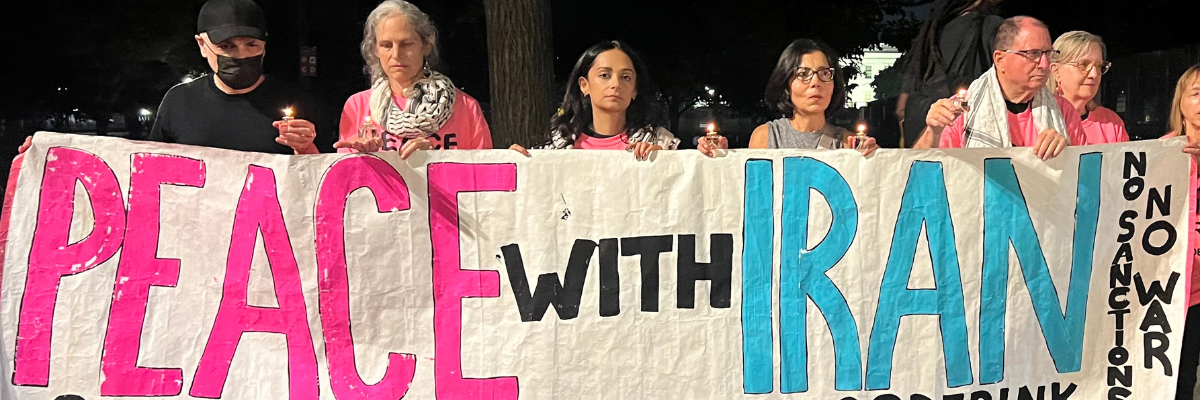
Members of the peace group CodePink march against war with Iran in this photo posted on June 12, 2025.
(Photo: CodePink)


Brett Wilkins
Jun 17, 2025
COMMON DREAMS


Numerous House progressives said Tuesday that they will support legislation that would force President Donald Trump to obtain congressional permission to wage war on Iran, a development that followed Monday's introduction of two Senate measures aimed at stopping Trump from dragging the United States into the widening Israel-Iran war.

Reps. Thomas Massie (R-Ky.) and Ro Khanna (D-Calif.) on Tuesday introduced legislation affirming the legal requirement under the War Powers Resolution of 1973—also known as the War Powers Act—for the president to notify lawmakers within 48 hours of committing troops to military action and limiting such action to 60 days, with a 30-day withdrawal period, unless Congress declares war or issues an authorization for the use of military force.

"The Constitution does not permit the executive branch to unilaterally commit an act of war against a sovereign nation that hasn't attacked the United States," Massie explained in a statement. "Congress has the sole power to declare war against Iran. The ongoing war between Israel and Iran is not our war. Even if it were, Congress must decide such matters according to our Constitution."


In a post on the social media site X, Massie thanked the resolution's co-sponsors, all of them Democrats: Don Beyer (Va.), Greg Casar (Texas), Alexandria Ocasio-Cortez (N.Y.), Lloyd Doggett (Texas), JesĂºs "Chuy" GarcĂ­a (Ill.), Val Hoyle (Ore.), Pramila Jayapal (Wash.), Summer Lee (Pa.), Jim McGovern (Mass.), Ilhan Omar (Minn.), Ayanna Pressley (Mass.), Delia Ramirez (Ill.), Rashida Tlaib (Mich.), and Nydia Velazquez (N.Y.).

More lawmakers—possibly including Republicans—are expected to sign on to the measure.

"The president does not have the power to unilaterally declare war. Congressional authorization isn't optional," Lee said on social media. "When some profit both financially and politically from endless war, the rest of us pay the price. We can't let them lie us into another conflict that will cost innocent lives."

Tlaib asserted that "the American people aren't falling for it again. We were lied to about 'weapons of mass destruction' in Iraq that killed millions [and] forever changed lives."

The progressive political action committee Justice Democrats welcomed Massie's measure: "Here's an opportunity for bipartisanship that doesn't sell out the American people. Every member of Congress should oppose U.S. involvement, funding, weapons, or troops fighting another endless war in the Middle East."

The House proposal follows Monday's introduction of a war powers resolution by Sen. Tim Kaine (D-Va.) and bill by Sen. Bernie Sanders (I-Vt.) that would prevent the Trump administration from using federal funds for a military attack on Iran without congressional approval. It also echoes a 2020 resolution proposed in the then-Democrat-controlled House that would have banned Trump from waging war on Iran without lawmakers' approval.

Explaining her support for Massie's legislation, Omar said, "I support this resolution because the American people do not want another war."

Indeed, an Economist/YouGov poll published Tuesday revealed that only 16% of surveyed voters "think the U.S. should get involved in the conflict between Israel and Iran." Just 10% of respondents who voted for former Vice President Kamala Harris last year and 19% of 2024 Trump voters want the U.S. to wage war on Iran, as do 15% of self-described Democrats, 11% of Independents, and 23% of Republicans.


A separate survey commissioned by Demand Progress and conducted by the Bullfinch Group recently found that 53% of registered voters—including 58% of Democrats, 47% of Independents, and 56% of Republicans—want Trump to "obtain congressional authorization before striking targets in other countries."

"We applaud Rep. Massie and Sen. Kaine for introducing these resolutions to keep us out of yet another war in the Middle East," Demand Progress senior policy adviser Cavan Kharrazian said Tuesday. "It should be in the interest of Republicans and Democrats to uphold the Constitution and prevent Israel from dragging us into a disastrous war with Iran."

"The American people, including a clear majority of Republican voters, believe the president must obtain congressional authorization before initiating strikes against another country," Kharrazian added. "Congress must listen to them and reassert its constitutional war powers authority by passing these resolutions."

Israel claims it attacked Iran to stop it from obtaining nuclear weapons. However, successive U.S. intelligence assessments have concluded for decades—most recently in March—that Iran is not trying to build nukes. On Tuesday, Trump brushed off his own director of national intelligence's findings that Iran is not close to having a nuclear bomb.

As Trump ratcheted up his cryptic threats against Tehran amid ongoing Israeli attacks on Iran and Iranian counterstrikes, anti-war voices including the National Iranian American Council (NIAC) and the peace group CodePink urged restraint and negotiation to avert escalating the Mideast crisis.

NIAC, which is circulating a petition demanding Congress act to avert U.S. intervention, is planning to hold a Tuesday afternoon No War With Iran Action Hour co-hosted with Peace Action and Action Corps.

"Trump continues to renege on his own commitments to diplomacy and an end to wars by perpetuating [Israeli Prime Minister Benjamin] Netanyahu's war of aggression through his own vocal support and U.S. military equipment and personnel in the region," NIAC said Tuesday. "Israel's assaults on Tehran have killed upwards of 224 Iranians and hospitalized over 1,277 more."

"Happening at the same time, in just the last day alone, Israeli forces have also killed at least 51 Palestinians desperate for aid and food at a World Food Program site in southern Gaza," NIAC noted. "There is no telling how much more devastation for Iran, Israel, and the U.S. an expanded war on Iran would bring."

"President Trump must immediately halt military aid and support for the Israel war on Iran," the group added, "and if he will not, Congress must act within its constitutional authority to save millions of American, Iranian, Israeli, and Palestinian lives."


David Hogg Says Any Democrat Who Supports War With Iran 'Should Be Primaried'

"Our generation grew up going through two multi-trillion dollar wars we should have never been involved in," said the youth organizer recently ousted by the DNC. "If you think this is a good idea read a history book."


David Hogg speaks onstage during the Fast Company Innovation Festival 2024 at BMCC Tribeca PAC on September 17, 2024 in New York City.
(Photo: Eugene Gologursky/Getty Images for Fast Company


Julia Conley
Jun 17, 2025
COMMON DREAMS

With just a handful of Democratic lawmakers so far backing a push to prevent an overwhelmingly unpopular march to war with Iran, progressive organizer David Hogg on Tuesday said those who don't align themselves with the vast majority of Americans on the issue should face primary challenges in upcoming elections.

"Any Democrat who supports this war with Iran needs to be primaried," said Hogg, a gun control activist who briefly served as co-vice chair of the Democratic National Committee and angered leaders by pushing for primary challenges. "Our generation grew up going through two multi-trillion dollar wars we should have never been involved in. We are not fucking going back to that. If you think this is a good idea read a history book."

Hogg's comments came days after Israel launched sweeping attacks on Iran amid U.S.-Iran talks on the Middle Eastern country's nuclear development.

At least 224 people have been killed and 1,481 wounded since the Israel Defense Forces (IDF) began launching air strikes on hundreds of targets last Friday, including nuclear facilities and the Islamic Republic of Iran Broadcasting headquarters.

U.S. President Donald Trump said Sunday that American forces "could get involved" in the conflict between the two countries, and the U.S. military has already had "full and complete coordination" with the IDF, as one Israeli official said after the bombing campaign began in Iran last week, with American fighter jets reportedly "patrolling the sky" in the Middle East and dozens of Air Force refueling planes headed for Europe over the weekend.

The reports intensified concerns among progressives of more direct U.S. involvement in the conflict, and led to renewed calls for the Trump administration to end its support for Israel as the IDF also continued its U.S.-backed slaughter of Palestinians in Gaza.

As Common Dreams reported Monday, U.S. Sen. Tim Kaine (D-Va.) introduced a war powers resolution to stop Trump from attacking Iran without congressional approval.

The resistance to war with the Middle Eastern country has bipartisan backing, with Rep. Thomas Massie (R-Ky.) introducing a similar resolution in the House and garnering the support of progressive Reps. Alexandria Ocasio-Cortez (D-N.Y.), Ro Khanna (D-Calif.), Rashida Tlaib (D-Mich.), Ilhan Omar (D-Minn.), and Don Beyer (D-Va.).

Zeteo reporter Prem Thakker said Monday evening that just over 2% of members of Congress have backed legislative efforts to stop the U.S. from expanding its involvement in Israel's bombardment of Iran—even as a Brookings Institution poll showed that more than two-thirds of Americans back diplomatic talks to limit Iran's nuclear program and just 14% of Americans support military action to stop Iranian nuclear development.


At the Center for International Policy, executive vice president Matt Duss said Israeli Prime Minister Benjamin Netanyahu was clearly starting a "war of choice" with Iran "to sabotage diplomacy" regarding its nuclear program after having pushed Trump to "make the terrible mistake" of withdrawing from the 2015 Iran nuclear deal.

"Netanyahu has now outmaneuvered him to the severe detriment of U.S. interests and put American military and diplomatic personnel in harm’s way," said Duss. "Responsible lawmakers who prioritize American safety and security are rightly speaking out against Netanyahu’s irresponsible provocation, reflecting the views of an overwhelming majority of Americans who favor diplomacy over war to restrain Iran’s nuclear activities."

"Immediately ending this violence and finding a path back to viable negotiations should be the guiding priority for the U.S. government, rather than belligerent rhetoric and the continued supply of offensive weapons that enables yet another horrific conflict endangering millions," he added.

Lily Greenberg Call, a former Interior Department official who was appointed by former President Joe Biden but resigned in protest of his administration's support for Israel's assault on Gaza, condemned Democratic leaders for their "shameful fucking silence" on potential war with Iran.

"Most Americans, including their base, don't want the U.S. under Trump to go to war with Iran and have been horrified at almost two years of footage of murder in Gaza," said Greenberg Call. "We won't accept this and we won't forget in '26 and '28."

Hogg demanded that Democrats unite "against Trump and his war" and pointed out that lawmakers from both sides of the aisle regularly claim that broadly popular proposals for investments in effective programs like Medicare for All and universal childcare are unaffordable.

"Where are all the 'we can't afford it' politicians," asked Hogg, "now that we're on the brink of what could be another multi-trillion dollar war?"


Israel’s War with Iran Exposes the Fragility of Jewish Supremacy

Netanyahu’s government is ceding violence against its own people in order to obscure its lack of political power.


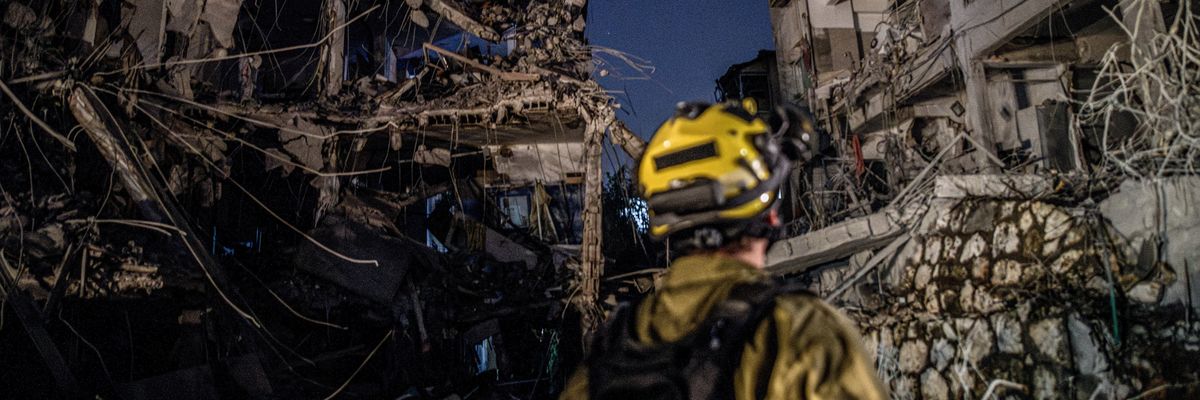
Israeli Home Front Command soldiers inspect a building that was directly hit by an Iranian ballistic missile in Tel Aviv, Israel on June 14, 2025.
(Photo: Matan Golan/SOPA Images/LightRocket via Getty Images)


Miko Zeldes-Roth
Jun 18, 2025
Common Dreams

I arrived in Jerusalem last Thursday evening.

Twelve hours later, I awoke to the news of the Israeli military’s attack on Iran—having slept through the sirens in the night. I am an American Jewish activist and researcher; I have spent time on and off in Israel/Palestine throughout my life. But this visit has been unlike any other. Four days in, I have found my eyes opened by the breathtaking recklessness of the current Israeli government. The attacks on Iran are but the latest action by a political leadership that, lacking public legitimacy since the October 7 attacks, seems determined to use terror to resecure a public mandate for its otherwise vulnerable project of Jewish supremacy.

Power and violence, the political theorist Hannah Arendt argued, are negatively correlated. “Rule by sheer violence comes into play where power is being lost,” she noted in her 1969 treatise, On Violence. “To substitute violence for power can bring victory, but the price is very high; for is not only paid by the vanquished, it is also paid by the victor in terms of his own power.” Arendt’s argument rests on the insight that a government’s power is constituted through public support and participation. Violence can sustain regimes that otherwise lack public legitimacy, but at tremendous cost. If the cost of Israeli state violence has been borne by Palestinians for decades—and with untold brutality since the October 7 Hamas attacks—Israel’s new front with Iran signals the Netanyahu government’s willingness to use its own public as bait for Iran, in a desperate bid to resecure legitimacy with that very public.

The currency of the Netanyahu government’s military gambles are human lives across the Middle East.

By initiating this confrontation, Prime Minister Benjamin Netanyahu and his government are knowingly courting a situation in which Israelis will be terrorized by Iranian missiles. Less than a week ago, this same government narrowly survived a vote of no-confidence; now, that threat has been preempted by the war. Yet the dynamic at hand runs deeper than electoral politics. To understand this, it’s worth considering past episodes of mass anti-Palestinian violence and expulsion. For instance, the late historian Alon Confino argues that in the run-up to 1948, there emerged in the Jewish public a “shared conception of Jewish sovereignty with fewer Palestinians.” By conditioning Jewish sovereignty and self-determination on Jewish ethnic homogeneity, the Zionist movement created a Jewish public appetite for the Nakba.

There is a similar, but shifted, logic at play today. As in 1948, there is apparently widespread Israeli-Jewish support for anti-Palestinian expulsion and killing. But today, this support is modulated through the neoliberalization of Israeli society—a shift Louis Fishman identified back in 2021. Jewish sovereignty may still be the rationale of the state, but it is also now at least partially instrumental for ideals of personal safety, material comfort, and enrichment. (Fishman notes that the entrenchment of these ideals into the Israeli-Jewish political imaginary is one of Netanyahu’s signal accomplishments.) As such, I think it is worth considering how ideals of Jewish sovereignty and supremacy are more limited in their ability to induce the kind of active support the current Israeli government would need to fully implement its extremist vision of anti-Palestinian dispossession and removal. If in 1948, as Confino argues, the “dream of an ethnonational state” was a strong enough incentive to induce Jews into expelling their own neighbors, now a stick is needed to complement the carrot of Jewish sovereignty.

It seems clear that the current “stick” is Israeli experiences of terror, induced by the Iranian missile attacks. As in the aftermath of the October 7 attacks, the Israeli government is apparently hoping that these missile attacks will induce sufficient terror and trauma amongst its own public to underwrite support for both an extended campaign in Iran and continued mass violence in Gaza. To return to Arendt’s parlance, we might reckon with how the government is ceding violence against its own people in order to obscure its lack of political power. This is a depraved gamble by the Netanyahu government that rests on the dehumanization of Palestinians. Gaza may now be a “secondary arena” for the Israel Defense Forces, but continued mass violence against Palestinians in Gaza and the West Bank is the implied byproduct of the war with Iran.

But this approach endangers Israeli Jews, too, even if the scale of destruction between Tel Aviv and Gaza is not remotely comparable. Growing numbers of Israelis have already been injured and killed in the missile attacks. Those numbers may seem small from afar, especially in comparison to the IDF’s crimes in Gaza. But there is no guarantee that those numbers won’t rise dramatically over the course of the war. The currency of the Netanyahu government’s military gambles are human lives across the Middle East.

As I walked towards a bomb shelter on Saturday night, I saw the glowing streaks from missile interceptions: it felt like the sky itself had come alive. Within the shelter, kids and parents slept in the corners. Others sat refreshing their phones amid intermittent cell service. Jerusalem, at least as I have known it in the past, now feels like it is in a suspended state.

Continued escalation is not inevitable—although it can certainly feel that way to me here. But to change direction, I think we as Jews in both Israel and the Diaspora have to overcome investments in the current frameworks of Jewish supremacy and sovereignty. This is no small feat in a moment when the Israeli political leadership is invested in mobilizing Israeli and global Jewry toward precisely those ideals.

But an alternative is always possible. Even now.


Our work is licensed under Creative Commons (CC BY-NC-ND 3.0). Feel free to republish and share widely.


Miko Zeldes-Roth
Miko Zeldes-Roth is a PhD candidate in political theory.
Full Bio >
Not Just Progressives: Over Half of Trump Voters Oppose US War on Iran


A majority of respondents across all gender, race, age, and income categories don't want military action against Iran.


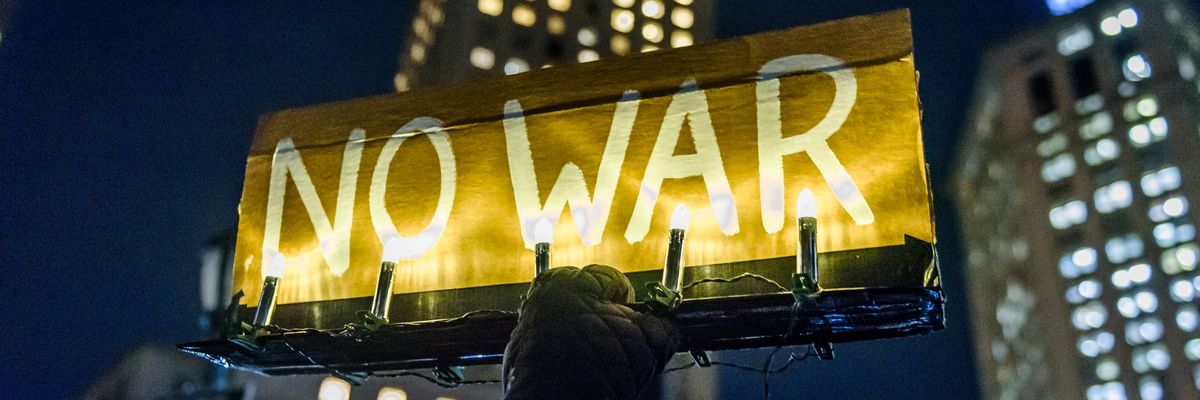
A protester holds a sign opposing war with Iran during a January 9, 2020 rally in New York.
(Photo: Erik McGregor/LightRocket via Getty Images)


Brett Wilkins
Jun 17, 2025
COMMON DREAMS


While it is widely known that American progressives overwhelmingly oppose the war on Iran at which President Donald Trump is increasingly hinting, new polling published Tuesday revealed that a thin majority of respondents who voted for the Republican president are also against U.S. involvement in the widening Israel-Iran war.

According to the Economist/YouGov survey of 1,512 U.S. adults conducted between June 13-16, 60% of all respondents oppose U.S. involvement in the war, while just 16% supported military action and 24% were unsure. Among those who voted for former Vice President Kamala Harris for president last year, 71% opposed war on Iran.

So did 53% of Trump voters. In fact, a majority of respondents across all gender, race, age, and income categories opposed military action against Iran.'

The survey also found that more Republican-identified respondents supported U.S. negotiations with Iran than did Democrats, 61% to 58%. Fifty-six percent of all those surveyed back talks, while 18% oppose negotiations.

Reflecting disenchantment among people who voted for Trump because they believed his claim to be a "peace president," Trump's favorite pollster, Rich Baris, director of Big Data Poll—who calls neoconservative Republicans like Sen. Lindsey Graham (R-S.C.) "war whores"—warned of dire electoral consequences should the U.S. go to war.


The National Iranian American Council also partnered with YouGov to ask 585 Iranian Americans how they feel about a possible U.S. war on Iran. Fifty-three percent of overall respondents said they "strongly" or "somewhat oppose" such action, while 36% strongly or somewhat back war. Strong opposition—37%—was 20 points higher than strong support for an attack on Iran.

The poll also found that a strong majority of Iranian Americans want a new nuclear agreement that prevents Iran from developing nuclear weapons. The Trump administration—which, like multiple preceding ones concluded that Tehran is not seeking nukes—unilaterally withdrew from the landmark Joint Comprehensive Plan of Action (JCPOA), also known as the Iran nuclear deal, in 2018.


While there were hopes of a renewed deal during the tenure of former U.S. President Joe Biden, no agreement was reached, and Iranians continue to suffer under economic sanctions that critics have said are killing people and crippling the country's economy.

"We expect that Israel's military operations have only tilted opinion further against war in recent days," NIAC president Jamal Abdi said in a statement. "Regardless, these results reinforce what we already know—our community is overwhelmingly against war and demands a foreign policy rooted in diplomacy, not destruction. We will share additional results from this timely survey next week."

Trump, who has been threatening to attack Iran since his first term, earlier this year sent a letter to Iranian Supreme Leader Ayatollah Seyyed Ali Khamenei in which he claims to have written, "I hope you're going to negotiate because if we have to go in militarily, it's going to be a terrible thing."

"If they don't make a deal, there will be bombing, and it will be bombing the likes of which they have never seen before," Trump said during a March NBC News interview.

A poll commissioned by Demand Progress and conducted by the Bullfinch Group recently found that 53% of registered voters—including 58% of Democrats, 47% of Independents, and 56% of Republicans—want Trump to "obtain congressional authorization before striking targets in other countries."

Legislation that would compel Trump to get congressional approval to attack Iran under the War Powers Resolution of 1973 was introduced Tuesday by Reps. Thomas Massie (R-Ky.) and Ro Khanna (D-Calif.) and co-sponsored by at least 14 mostly progressive Democrats, while Sens. Tim Kaine (D-Va.) and Bernie Sanders (I-Vt.) have introduced similar measures in the Senate.


Public support for Iran strike high among Jewish Israelis, deeply divided from Arab Israelis


The Hebrew University of Jerusalem


A new public opinion survey conducted in mid-June captures Israeli views on the ongoing military campaign against Iran. The research was carried out by Dr. Gayil Talshir and postdoctoral researcher Dr. Nimrod Nir from the Department of Psychology at the Hebrew University of Jerusalem.
A new survey conducted by researchers from the Hebrew University and Tel Aviv University reveals broad public support among Israeli Jews for the ongoing military campaign against Iran, with 83% backing the strike and a majority expressing confidence in Israel’s security institutions, emotional resilience, and preparedness for prolonged conflict. In contrast, Arab Israelis overwhelmingly oppose the campaign (only 12% support it), favor diplomacy over military action (73%), and report significantly higher levels of fear and despair. The study highlights a deep divide between the two communities not only in terms of policy preferences and emotional response, but also in perceptions of national unity, trust in institutions, and willingness to continue the campaign without U.S. backing. While Jewish Israelis largely see the Iran strike as unifying and justified even at high cost, Arab Israelis view it as divisive, dangerous, and diplomatically unjustified — underscoring a profound gap in public sentiment across Israeli society.

Online Link: https://acesse.one/juHeD 

Key Findings: Strong Support, Conditional Backing, and Emotional Complexity
The survey indicates strong support for the Iran campaign among Israeli Jews, even in scenarios without U.S. backing — whereas among Arab Israelis, the sentiment is largely the opposite.
•    83% of Jewish Israelis support the attack on Israel, compared to only 12% among Arab Israelis. 
•    Among Jewish Israelis 46% of support striking Iran’s nuclear facilities even without American backing; 34% support military action only with U.S. cooperation and 16% prefer a diplomatic route.
•    Among Arab Israelis 11% of support striking Iran’s nuclear facilities even without American backing; 6% support military action only with U.S. cooperation and 73% prefer a diplomatic route.
Emotional reactions among the public are varied and there are significant differences between the feelings of Jewish and Arab Israelis. Whereas amongst Jewish Israelis, positive sentiments such as hope and pride are more dominant than sentiments such as fear and despair, the opposite is true for Arab citizens.
•    Among Jewish Israelis 35% said they felt fear, 28% pride and 23.5% hope and 13.5% despair.
•    Among Arab Israelis 69% said they felt fear, 2% pride and 3.5% hope and 25% despair.
Notably, public sentiment reflects a growing sense of national unity among Jewish Israelis. 
•    Jewish Israelis – 57% thought the campaign against Iran will make society more united, 36% thought it will have no effect and 7% thought it will make society more divided.
•    Arab Israelis – 23% thought the campaign against Iran will make society more united, 21% thought it will have no effect and 56% thought it will make society more divided.

Trust in Security Agencies Remains High, but Government Lags Behind
While trust in security forces remains robust, the survey reveals stark contrasts in public confidence across institutions:
•    The Israeli Air Force and Mossad rank highest in public trust.
•    The government and security cabinet receive the lowest confidence ratings.
•    Among individual figures, the Mossad Director, Air Force Commander, and IDF Chief of Staff are most trusted.
•    Government receives a moderately low trust score.
 
Divergence on Strategic Goals and U.S. Involvement
The public remains divided over the ultimate objectives of the campaign – and again we see large differences in opinion between Jewish and Arab Israelis.
•    Jewish Israelis – 56% favor a full military dismantling of Iran’s capabilities, while 44% support a diplomatic resolution. While only 24% believe Israel can eliminate the Iranian nuclear threat without U.S. support. 32% respondents say Israel should comply with U.S. requests to halt the campaign if asked, 35% say the US demand should be refuse and Israeli should continue attacking and 33% are uncertain.
•    Arab Israelis – only 14% favor a full military dismantling of Iran’s capabilities, while a large majority (86%) support a diplomatic resolution. 78% respondents say Israel should comply with U.S. requests to halt the campaign if asked, 5% say the US demand should be refuse and Israeli should continue attacking and 17% are uncertain.

Hostage Deal and Gaza Campaign
Support of a deal that will end the war in Gaza for the return of the hostages increased following the Iran campaign (from 68% pre campaign to 76% following the campaign).
•    Jewish Israelis - 71% support a hostage deal that would bring the Gaza campaign to an end, a marked increase in support since the Iran campaign began. 30% favor rejecting the hostage release and continuing the military campaign even at the cost of risking the lives of the remaining hostages.
•    Arab Israelis - 99% support a hostage deal that would bring the Gaza campaign to an end, a marked increase in support since the Iran campaign began. 1% favor rejecting the hostage release and continuing the military campaign even at the cost of risking the lives of the remaining hostages.

Preparedness and Risk Tolerance
•    Jewish Israelis - Around 68% believe the Israeli home front is moderately or highly prepared for a prolonged conflict and 32% consider the country not well-prepared.
•    Arab Israelis - Only 25% believe the Israeli home front is moderately or highly prepared for a prolonged conflict and 75% consider the country not well-prepared.

Methodology
•    Sample size: 1,057 Israeli citizens aged 17–86
•    Sampling design: the full data is weighted to reflect demographic and political diversity of Israeli society, including gender, age, religion, region, voting behavior (25th Knesset), religiosity, and Jewish ethnic origin
•    Data collection: June 15–16, 2025 (two waves)
•    Margin of error: ±4.2% at a 99% confidence level
•    Panel source: Majority of respondents are part of Agam Institute's panel, enabling cross-analysis with prior data on media use, political attitudes, and more.