Monday, July 21, 2025

TAX THE CHURCHES

What Is A ‘Church’ For US Federal Tax Purposes? – Analysis

A country church in rural Mississippi.


By   The Congressional Research Service 

By Milan N. Ball


Entities that are “churches” under Internal Revenue Code (IRC) Section 170(b)(1)(A)(i) also qualify as “religious organizations” under IRC Section 501(c)(3) and thus are generally exempt from the federal income tax under IRC Section 501(a). However, “churches” receive additional tax benefits that make it more advantageous for an organization to qualify as a “church” under IRC Section 170(b)(1)(A)(i) than merely as a “religious organization.”

For example, churches are generally subject to fewer filing obligations and receive special procedural protections during audits. Congress has not defined “church” in the IRC, and the Department of the Treasury and Internal Revenue Service (IRS) have not defined the term in regulations corresponding to IRC Section 170. Courts have stated that the additional statutory allowances provided to churches indicate that Congress intended the term “church” to have a more restrictive definition than “religious organization.”

Over time, courts and the IRS have developed several tests and applied a number of factors to determine whether an organization qualifies for church status. In applying these tests and factors, courts and the IRS have routinely avoided evaluating an organization’s beliefs. Accordingly, “church,” as used in the IRC, is not limited to a particular faith, denomination, sect, ritual, or practice, and can include several houses of worship.

This In Focus reviews how courts and the IRS determine when a religious organization is a “church” for the purpose of federal income tax exemption.

Qualification Under IRC Section 501(c)(3)

Churches must first qualify for federal income tax exemption under IRC Section 501(c)(3). To so qualify, (1) the organization must be “organized and operated exclusively” for religious, educational, scientific, or other charitable purposes; (2) the organization’s “net earnings” may not “inure[] to the benefit of any private shareholder or individual”; (3) “no substantial part” of an organization’s activities may be “attempting[] to influence legislation”; and (4) the organization may not “intervene in . . . any political campaign on behalf of (or in opposition to) any candidate for public office.” An organization that is organized and operated exclusively for religious purposes and satisfies the rest of IRC Section 501(c)(3)’s requirements is a “religious organization.” 


On July 7, 2025, in a Joint Motion for Entry of Consent Judgment filed in the U.S. District Court for the Eastern District of Texas, the IRS advanced a narrow exception to the political campaign participation and intervention restriction based on the First Amendment’s Establishment Clause. The IRS stipulated that the restriction on political campaign activity “d[id] not reach speech by a house of worship to its congregation, in connection with religious services through its customary channels of communication on matters of faith, concerning electoral politics viewed through the lens of religious faith.”

Relying on the Supreme Court’s decision in Bob Jones University v. United States461 U.S. 574 (1983), the IRS asserts that there is another requirement for exemption from the federal income tax under IRC Section 501(c)(3)—an organization’s purpose and activities must “not be illegal or violate fundamental public policy.” 

In Bob Jones University, the Supreme Court upheld the IRS’s revocation of a university’s 501(c)(3) status because the university had a disciplinary rule that prohibited interracial dating and marriage, which was in violation of a fundamental public policy. The disciplinary rule, carried out on the basis of the university’s religious beliefs, called for students to be expelled if they dated outside their race, were in an interracial marriage, or encouraged others to violate the disciplinary rule. The university also denied admission to applicants “in an interracial marriage or known to advocate [for] interracial marriage or dating.”

The Supreme Court in Bob Jones University “analyzed and construed [IRC Section 501(c)(3)] within the framework of the [IRC] and against the background of the congressional purposes.” Its examination revealed that “underlying all relevant parts of the [IRC], is the intent that entitlement to tax exemption depends on meeting certain common-law standards of charity—namely, that an institution seeking tax-exempt status must serve a public purpose and not be contrary to established public policy.” The government’s compelling interest in eradicating racial discrimination in education “substantially outweigh[ed] whatever burden denial of tax benefits” placed on the university’s exercise of its religious beliefs, which were otherwise “substantial[ly] protected” by the First Amendment’s Free Exercise Clause. The Court also notedthat the IRS’s policy was founded on a “‘neutral, secular basis‘” and did not violate the Establishment Clause.

The De La Salle Approach

In De La Salle Institute v. United States195 F. Supp. 891 (N.D. Cal. 1961), a district court determined that in the absence of congressional guidance, the term “church” is to be interpreted in light of its “common understanding.” Applying this approach, the district court said “[a]n organization established to carry out ‘church’ functions, under the general understanding of the term, is a ‘church.'” In decisions after De La Salle, courts have declined to adopt this approach. Some courts have expressed doubt about the soundness of the De La Salle approach given the “‘plurality of religious beliefs,'” the range of “‘organized activities undertaken,'” and the assortment of “‘church’ structures” in the United States. 

The IRS’s 14 Criteria

In 1978, the IRS announced a list of 14 criteria to evaluate whether a religious organization qualifies as a “church”: 

(1) a distinct legal existence; (2) a recognized creed and form of worship; (3) a definite and distinct ecclesiastical government; (4) a formal code of doctrine and discipline; (5) a distinct religious history; (6) a membership not associated with any other church or denomination; (7) an organization of ordained ministers; (8) ordained ministers selected after completing prescribed [courses of] stud[y]; (9) a literature of its own; (10) established places of worship; (11) regular congregations; (12) regular religious services; (13) Sunday schools for the religious instruction of the young; and (14) schools for . . . prepar[ing] ministers. 

Courts and the IRS generally use these 14 criteria as a guide, along with any other facts and circumstances that may bear on an organization’s claim that it is entitled to church status.

Some courts have questioned the “mechanical application” of the IRS’s 14 criteria to varied religious practices and a diverse group of religious organizations. For example, in Spiritual Outreach Society v. Commissioner, T.C. Memo 1990-41, the Tax Court acknowledged that the 14 criteria may be inapplicable to certain organizations, such as newly formed rural organizations. To address these concerns, some courts have placed special emphasis on four of the IRS’s 14 criteria: (1) “the existence of an established congregation served by an organized ministry”; (2) “the provision of regular religious services”; (3) “religious education for the young”; and (4) “the dissemination of a doctrinal code.”

In Foundation of Human Understanding v. Commissioner88 T.C. 1341 (1987) (Foundation I), the Tax Court explained it must take care when determining whether an organization is a “church” because “all of us are burdened with the baggage of our own unique beliefs and perspectives.” As a result, the Tax Court stated that it must “assiduously avoid . . . inquiry into the merits of [an organization’s] beliefs[,] or risk running afoul of First Amendment religious protections.” 

Associational Test

While the IRS has stated no one factor has controlling weight, some courts have ruled that a religious organization must serve an associational role to qualify as a church. In the frequently cited case American Guidance Foundation, Inc. v. United States490 F. Supp. 304 (D.D.C. 1980), a district court articulated the associational test: “At a minimum, a church includes a body of believers or communicants that assembles regularly in order to worship.” The district court explained, “[u]nless the organization is reasonably available to the public in its conduct of worship, its educational instruction, and its promulgation of doctrine, it cannot fulfill this associational role.”

Several courts have since adopted this threshold standard and fine-tuned it. When the Tax Court applied the associational test in Foundation I, it clarified that, “[w]hen bringing people together for worship is only an incidental part of the activities of a religious organization, those limited activities are insufficient to label the entire organization a church.”

In Foundation I, a large percentage of the religious organization’s total receipts and expenditures went toward broadcast and publishing efforts that had the potential to reach millions of people. Even so, the Tax Court ruled in favor of the religious organization. The Tax Court found that the religious organization’s associational aspects were “more than incidental” and thus satisfied the associational test, because there was an ordained ministry that conducted regular religious services for congregations consisting of 50 to 350 persons at established places of worship.

A federal court of appeals upheld the IRS’s revocation of the same organization’s church status in a later case, Foundation of Human Understanding v. United States614 F.3d 1383 (Fed. Cir. 2010) (Foundation II). In Foundation II, the organization failed to “establish that it held regular services with a regular congregation during the years at issue.” The organization argued that it served an associational role through its “virtual congregation,” which listened to sermons over broadcast and the internet at set times. The court held that the organization’s “electronic ministry” did not satisfy the associational test. The court concluded that the organization did not serve an associational role when it disseminated religious information through print or broadcast media or through its call-in show, because these forums did not provide “individual congregants with the opportunity to interact and associate with each other in worship.”

Considerations for Congress

Congress has left the question of how to distinguish “churches” from other religious organizations for tax purposes largely to the courts and the IRS. Some courts have suggested that First Amendment considerations have hindered legislation in this area. Over time, courts and the IRS have seemed to settle on relying on the IRS’s 14 criteria and the associational test. Some tax commentators have critiqued the IRS’s 14 criteria as being unpredictable, outmoded, and of limited application to all but a few religious practices. While some of these commentators have called for the abandonment of the IRS’s 14 criteria and for the adoption of the associational test, some tax commentators have raised concerns about that test as well.

Some tax commentators have questioned how the associational test should apply today, given the rise in virtual religious services and changes in technology that allow for members of religious organizations to interact and associate with each other in new ways. Congress may continue to permit courts and the IRS to refine the criteria by which “church” status is determined, or it may attempt to clarify through legislation the definitional standard that should be applied to assess whether an organization is a “church” for tax purposes.


CRS

The Congressional Research Service (CRS) works exclusively for the United States Congress, providing policy and legal analysis to committees and Members of both the House and Senate, regardless of party affiliation. As a legislative branch agency within the Library of Congress, CRS has been a valued and respected resource on Capitol Hill for nearly a century.

Forgotten 'weeds' prove a culinary hit in Kenya

Basillioh Rukanga
BBC News, Nairobi
JULY 21, 2025
AFP/Getty Images
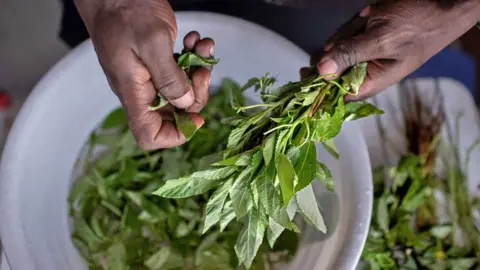
Mrenda, being prepared here by a chef in Nairobi, has many more micronutrients than cabbage

Once dismissed as wild weeds and a "poor man's food", indigenous leafy vegetables in Kenya are now becoming much more common - grown on farms, sold in markets and gracing the menus of restaurants.

At the busy Skinners Restaurant in Gachie just outside the capital, Nairobi, one employee says demand for "kienyeji" - as all local vegetable varieties are known - is higher than for other greens.

"Many people ask for kienyeji when they come here," Kimani Ng'ang'a tells the BBC, despite the fact the restaurant charges extra for them as he says they are harder to source.

Vegetables like cabbage, spinach, kale and spring greens, introduced by colonial authorities before the 1960s, are more readily available and cheaper. Spring greens are known as "sukumawiki", meaning "stretch the week" in Swahili, reflecting how they have become a daily staple.

But diners in Gachie are part of the growing wave of Kenyans who see the benefits of eating local, organically produced nutrient-rich varieties of greens.

"It detoxifies the body and is good in weight loss," says James Wathiru, who ordered "managu" - or African nightshade.

Another person told me: "It's all about its taste, which is better."

According to horticulture professor Mary Abukutsa-Onyango, this trend is reflected in government data and some of the health benefits are backed by research.

Over the last 10 years, production of local greens has doubled - with 300,000 tonnes produced by local farmers last year, she says.

It is a remarkable change in attitudes, given people used to look down on traditional crops as inferior - not realising they were often more resistant to diseases and pests, meaning they can be grown organically.


Mary Abukutsa-Onyango

We never learnt about African indigenous vegetables. They were calling amaranth 'pigweed'; spider plant, they were calling it 'spider weed'"Prof Mary Abukutsa-Onyango
Horticultural scientist


In the 1980s, when Prof Abukutsa-Onyango began her studies, she says she was perplexed to find them referred to as "weeds".

"We never learnt about African indigenous vegetables. They were calling amaranth 'pigweed' [and] spider plant, they were calling it 'spider weed'," she tells the BBC.

Her postgraduate research on traditional plants was also tricky as there was no literature about them, but she persevered and now works with the government to promote them for food security.

She says managu and other local vegetables like "mrenda" (jute mallow) and "terere" (amaranth) have more essential minerals than sukumawiki, as well as "higher levels of vitamin A and C [and] antioxidants" that boost immunity and reduce the risk of disease.

Some varieties also contain protein, making them an excellent option for vegetarians. She notes for instance that 100g (3.5 ounces) of mrenda - known for its distinctive slimy texture when cooked - contains more nutrients than a similar portion of common cabbage.

The progress people like Prof Abukutsa-Onyango have made in promoting the diversity and knowledge of indigenous vegetables was acknowledged by Unesco in 2021, when the UN cultural agency commended the East African nation for the "safeguarding of intangible cultural heritage" that had been threatened by "historical factors and the pressures of modern lifestyles".

It noted that Kenya had begun a project in 2007 involving scientists and local communities to record an inventory of traditional foods, which now includes 850 indigenous plants and their local names.

Some of these vegetables are eaten nationwide, while others are specific to certain areas or communities.

But sukumawiki, first introduced to Kenya from the Mediterranean as animal feed, is still favoured by many farmers - with more than 700,000 tonnes produced in 2023 - more than double the volume of all indigenous leafy vegetables combined.

Francis Ngiri, who used to farm in Kirinyaga in central Kenya where cabbages are a mainstay crop, explains that this is because, especially during the 1970s, those growing imported leafy vegetables used fertilisers and pesticides that damaged the local biodiversity.

Today, he tells the BBC, only the introduced varieties thrive as the soil has become too acidic to support many native species.


Sukumawiki is often paired with ugali, a type of maize porridge popular in Kenya


Determined to do something so they would not be lost forever, Mr Ngiri moved his operation to Kenya's Rift Valley - an area he considers relatively untouched by chemical contamination - so he could practise organic farming of indigenous crops.

On a four-acre (1.6 hectare) farm in Elementaita, he began with 14 native varieties in 2016. Today that has grown to 124, many of which he has sourced through seed exchanges with fellow farmers. His farm now draws visitors from across Kenya and neighbouring countries.

They come to see how he collaborates with 800 other regional farmers, who also grow organic food for local markets, to preserve and regenerate "forgotten plants", ensuring their genetic diversity is safeguarded for future generations.

Nonetheless by swapping seeds, Mr Ngiri and his colleagues are actually breaking the law as the government only allows the planting of certified seeds.

This controversial law was introduced in 2012 with the intention of protecting farmers from purchasing poor quality seeds.

Wambui Wakahiu, who trains farmers on seed conservation, says such policies do not support efforts to save indigenous crop varieties, as their seeds are not available in farm-supply shops.

She works for Seed Savers Network, a non-governmental organisation with 400,000 members, which helps establish seed banks for farmers to safely store and preserve their local seeds.

Her team found that more than 35 traditional plant varieties had been "completely lost" in one county alone because of the law.

"If [the farmers] focus more on the exotic [foreign] seeds, then the traditional seeds continue going away. And we have seen most of them go extinct," she tells the BBC.

Mr Ngiri and others who have been exchanging seeds have not been pursued by the authorities, but he says the law does prevent them from marketing them: "If I can't sell the seed, I don't own it."

And getting certification is a rigorous, costly process, as seeds need to be tested in a laboratory for their purity and things like how well they germinate.


Vegetable vendor Priscilla Njeri says indigenous vegetables are now more popular than cabbages, spinach or kale


Dr Peterson Wambugu, a chief research scientist with the national gene bank at the Kenya Agricultural and Livestock Research Organization (Kalro), acknowledges that under the current law, the exchanging and sale of uncertified seeds - including those saved by farmers - is criminalised.

However, he points out that this is at odds with the International Treaty on Plant Genetic Resources for Food and Agriculture, of which Kenya is a signatory, as it sets out farmers' rights to save, use and exchange their seeds.

The national gene bank has been working with other groups to draft regulations through the agriculture ministry to align Kenyan law with the treaty.

The proposals, once passed by parliament, will allow farmers to exchange their seeds "without fearing that what they are doing is criminal", he tells the BBC.

However, the selling of such seeds would still remain outlawed - something Dr Wambugu knows means the journey to full acceptance of indigenous crops continues.

For Priscilla Njeri, a vegetable vendor in the bustling Wangige market in Kiambu county just outside Nairobi, there is no turning back, as she can see first-hand that indigenous greens are now the most popular with her customers - something she puts down to the media campaigns that promote them.

"The most preferred are managu, terere and kanzira [African kale] - which is popular for those who have sensitive stomachs as it has no gas," she tells the BBC.

"But all the kienyeji greens are good because they have a better taste."
India’s Naxals: Why do they fight?

A communist insurgency in India has confoundedly persisted for decades.


Bullet fragments recovered in Gadchiroli district, Maharashtra, following a Naxal attack (Satish Bate/Hindustan Times via Getty Images)


Abhijnan Rej
Published 21 Jul 2025 
THE INTERPRETER/ THE LOWY INSTITUTE

A degree from a well-known engineering college in 1970s and ‘80s India served as a stepping stone towards a financially secure and respectable, if staid, life. That was not to be for some students of the Regional Engineering College in Warangal, a small city in south-central India.

As revolutionary fervour, indigenous and imported in equal parts, swept through the country’s educated middle-class youth, they joined a fledgling communist insurgency, which went on to become a recurring headache for the Indian state for more than half a century.

One of those rookie engineers, Nambala Keshava Rao, was killed by security forces in May. His death marks a pivotal moment in the history of India’s Naxalite movement, once described as the “greatest internal security threat” to the country. New Delhi assesses, with good reason, that Naxals are facing extinction, the elimination of a key leader being the coup de grâce.

Near its peak, around 2008, the Naxal insurgency had spread across nine states in eastern, southern and central India.

And yet, why they continue to persist in the first place is something of a mystery.

Could be it poverty? As two economists concluded from a detailed empirical analysis in 2017, the causal links between underdevelopment and Naxalism are anything but straightforward.

Could it be language and ethnicity? Near its peak, around 2008, the Naxal insurgency had spread across nine states in eastern, southern and central India, a veritable babel; Naxals came from upper and lower caste Hindu families and diverse tribes alike.

Could it be the political and social orientation of the country? Over the past 60 years – the rough span of the Naxal insurgency – the Indian state has experimented with socialism, state capitalism, left-style populism, liberalism, and conservative nationalism. Naxals apparently find all of them disagreeable.

The most important clue in demystifying the longevity of the Naxalite movement is its strongly ideological nature. It keeps going through sustained cultivation of an internally consistent belief system and supporting narratives that continue to find purchase for a variety of socio-economic reasons. It is the siren song of uncompromising and radical solutions to problems, real and imagined, that draw educated youth to the movement, not the problems themselves.

Consequently, when it comes to Naxals, political psychology and the emerging discipline of political neuroscience are excellent analytical guides.
A villager at Markegaon village, scene of a 2017 shoot out between police and Naxals in the region of Gadchiroli (Satish Bate/Hindustan Times via Getty Images)

In a landmark study of the Naxalite movement, the anthropologist Alpa Shah interrogates the motivations of the most committed adherents of Naxalism she encounters during her field research; men who, like Rao, had spent years, if not decades, waging an increasingly unwinnable war against the state.

Shah’s account makes it plain that the insurgents sorely lack a theory of victory, clear political goals that must be unambiguously achieved through strategic use of force. While criminality – in the form of extortion and protection payments – is a motivating factor for many Naxals, it too does not fully explain the story. Instead, in Shah’s telling, abstract notions of class struggle, social and economic justice, and tales of communist revolutions animate adherents, especially its upper-caste, educated leadership. They not only help the insurgents interpret the world around them and act accordingly, but also furnish a shared vocabulary. Ideology cements in-group ties amid tremendous hardship and significant personal sacrifices.

While for the rest of the world, the Indian society’s “feudal” nature would only be debated in sophomoric late-night bull sessions, for the Naxals it is an existential issue. To wit, agriculture accounts for only a little more than 18 per cent of India’s GDP, provides livelihoods for a minority (albeit a large one), and the country is urbanising rapidly. Therefore, some Naxals rightly apprehend that the entire movement, premised on an eventual large-scale rural uprising, is becoming moot, or worse, has been so for some time.

The extent to which arcane blinkers shape the Naxal worldview became clear in a secret memorandum the insurgent leadership had circulated in August last year, which identified “postmodernism” as one of the reasons behind eroding support. Meanwhile, Indian security forces eliminated some 300-odd Naxals last year alone, while the once-Naxal-hub Andhra Pradesh – Rao’s birthplace – became, by per capita income, one of the fastest growing Indian states.

But all this is not to argue that Naxals have been mostly talk and little action. They have been responsible for around 12,000 deaths (including that of more than 4000 civilians) over the past 25 years. But what is interesting is how most acts of Naxal terrorism resemble “propaganda of the deed” where the objective is “to galvanise … before offering an internally legitimate narrative”, as three experts of the phenomena noted in a 2008 RUSI report. After all, killing a significant number of security personnel in sporadic attacks – a common Naxal play – is sure to draw significant retribution, especially from a determined, numerically and materially superior adversary. Therefore, other than as spectacle for the wider world, and rousing the rank and file, they serve no meaningful political purpose.

Such is the causative power of ideological thinking.

District Reserve Guard personnel in Dantewada, Chhattisgarh state, in March, with authorities waging an offensive against the last vestiges of its Naxalite rebellion (Jalees Andrabi/AFP via Getty Images)

The global resurgence in extreme ideologies over the past decade or so has had a sole happy corollary, namely, a corresponding resurgence in insightful research in political psychology. A recent book by the neuroscientist Leor Zmigrod fleshes out a research program where commonalities between diverse ideologies – independent of political orientation – are teased out to reveal the underlying physiological, psychological and social bases of inflexible political convictions, the “epigenetics of extremism”, as she terms it.

As Indian policymakers commit themselves to ending the Naxal insurgency once and for all by next March, they would do well to pay heed to a key claim Zmigrod makes.

In her analysis, ideologies are the brain’s way of developing shortcuts that allow us to cope with an unpredictable world as well as create and strengthen social bonds, “to understand the world and be understood back”. A defining characteristic of ideological thinking is that it renders the mind resistant to the Bayesian template, where new evidence does not necessarily lead to rethinking of conclusions, or is processed in a way as to leave the conclusions intact. For Naxal ideologues, Indian society has hardly evolved over the past 50 years, economically or politically. As strange as it may seem, that has been a fundamental source of their allure.

The irony of course is that we are particularly susceptible to ideological thinking in times of great churn. And India is certainly amid one. It is quite likely that the Naxal insurgency, in its current form, will end, sooner rather than later. But it could yet be resurrected.