Friday, August 15, 2025


Africa’s second-largest aluminum smelter at risk of shutdown


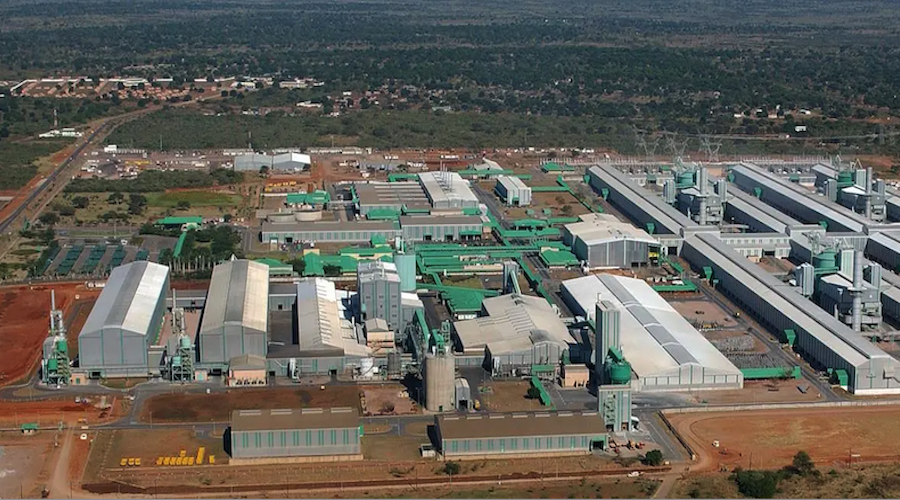
Mozal Aluminium is the largest industrial employer in Mozambique. (Image courtesy of South32.)

Africa’s second-biggest aluminum smelter may close in March after operator South32 Ltd. is yet to secure a new electricity supply agreement before the current one expires. The company’s shares plunged.

The Mozal plant, located outside Mozambique’s capital Maputo, will no longer be viable under a proposed new tariff set to replace the existing one early next year, the company said in a letter to affected parties seen by Bloomberg and verified by the company.

“As it stands, negotiations are deadlocked,” Rob Jackson, vice president of supply at South32, said in the letter. “Given the impasse, the most likely scenario is for Mozal to operate until the end of the current electricity supply agreement and be placed on care and maintenance in March 2026.”

For Mozambique, the closure threatens the jobs of 2,500 workers and contractors at the smelter, in a country battling with youth unemployment. Aluminum was Mozambique’s third-biggest export last year at $1.1 billion with all of it coming from Mozal. South32 on Thursday booked a $372 million write-down due to the likely shutdown. The share price traded 6.3% lower on the Johannesburg Stock Exchange at 5:14 p.m. local time.

When the smelter opened 25 years ago, shortly after the nation emerged from a brutal 16-year civil war, South Africa had the world’s cheapest electricity. That enabled South32’s predecessor to secure a highly favorable investment deal, under which the smelter paid no income tax and only a 1% royalty on sales.

The smelter is supplied by South Africa’s Eskom Holdings SOC Ltd., which also has a deal to buy power from Cahora Bassa SA, a state-owned hydorpower company in Mozambique.

The new government, led by Daniel Chapo, who came to power early this year, pledged to revise such deals when they came up for renegotiation.

Still, the smelter’s closure could free up 950 megawatts of power. Joaquim Ou-Chim, chief executive officer at state-owned Electricidade de Moçambique, last month said Mozambique could trade that power regionally.

There’s no shortage of demand. Copper producers in Zambia and the Democratic Republic of Congo are desperate for alternative power supplies as those two nations face severe shortages. Electricity was Mozambique’s fourth-biggest export last year at $689 million.

(By Matthew Hill)


Indonesia president signals intention to go after illegal mines


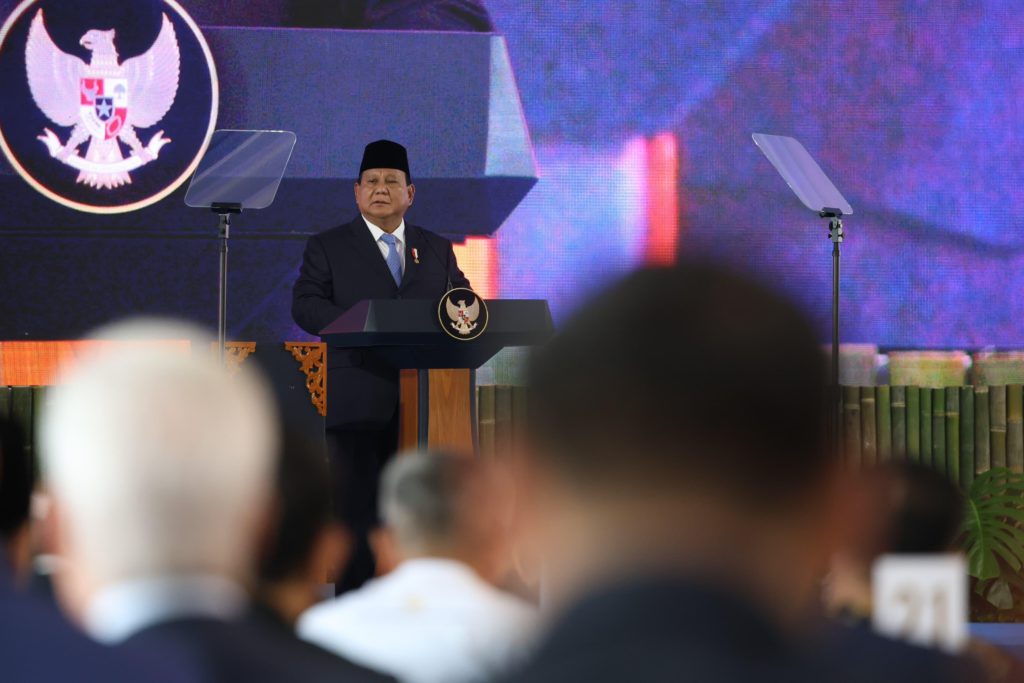
Indonesian president Prabowo Subianto. Credit: Prabowo Subianto via X

Indonesia will move to “rectify” illegal mines estimated to have caused $19 billion in state losses, President Prabowo Subianto said in his first State of the Nation address.

The government has identified 1,063 illegal mining sites and is seeking support to crack down on them, Prabowo said in the annual speech in Jakarta on Friday. The illicit mines may be causing 300 trillion rupiah in losses to the state, he said, without specifying over what time period.

Illegal and poorly regulated mining is a major problem in Southeast Asia’s largest economy, causing disproportionate environmental damage and depriving the government of tax revenue. However, any crackdown could impact the supply of major export commodities like coal, nickel and tin.

A push against illegal mining would follow the seizure of 3.1 million hectares of palm oil plantations that the government says have violated regulations. Prabowo has gotten tough on the sector, with his attorney general’s office launching a legal case against major producer Wilmar International Ltd.

Since coming to power in October, Prabowo has targeted the country’s vast commodity sector more aggressively than his predecessor. Alongside the Wilmar probe, the attorney general’s office is investigating corruption at state oil firm PT Pertamina. The Ministry of Environment also plans to punish companies in the Indonesia Morowali Industrial Park — a major nickel smelting center — for environmental breaches.

(By Eddie Spence and Chandra Asmara)


Dubai investor offers $10M lifeline to Lucapa Diamond

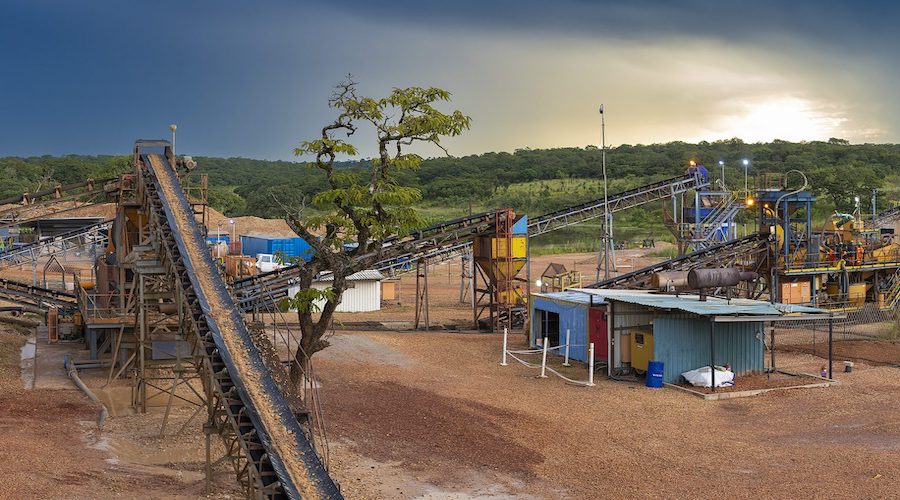
Lulo mine plant, where gravel is washed and screened for diamonds. (Image courtesy of Lucapa Diamond.)

Lucapa Diamond (ASX: LOM), the operator of Angola’s Lulo alluvial mine and Australia’s Merlin project, has struck a rescue deal with a Dubai-based group that could pull it out of administration.

Administrators KordaMentha have signed a deed of company arrangement with Jemora Group’s Gaston International, which has agreed to inject about A$15 million ($10 million).

The deal would see creditors paid in full and shareholders receive a partial payout of up to 1.8 Australian cents per share — an improvement on Lucapa’s May 12 closing price of 1.4 AUD cents. Over the prior 12 months, Lucapa shares traded between 1.3 and 9.7 AUD cents.

Jemora, a metals and mining conglomerate aiming to make the United Arab Emirates a hub for resource investment, operates Gaston as its energy and precious metals arm.

Lucapa entered administration in May due to a combination of slumping diamond prices, intensifying competition from synthetics and mounting operational setbacks.

The collapse followed last year’s sale of its Mothae mine in Lesotho, leaving Lulo as its only source of income. That operation has suffered from flooding in higher-grade areas and a blockade by local leaders in February this year.

Efforts to raise equity in April 2025 failed, as did a sale of a 40% stake in Merlin. Administrators determined Lucapa became insolvent by May 21, though financial stress had been evident since 2023.

If creditors and the court approve, the proposed deal would restructure the company and transfer its shares to Jemora’s control. A creditor meeting is scheduled for August 20.


Hybrid navigation system successfully deployed in Europe’s deepest mine

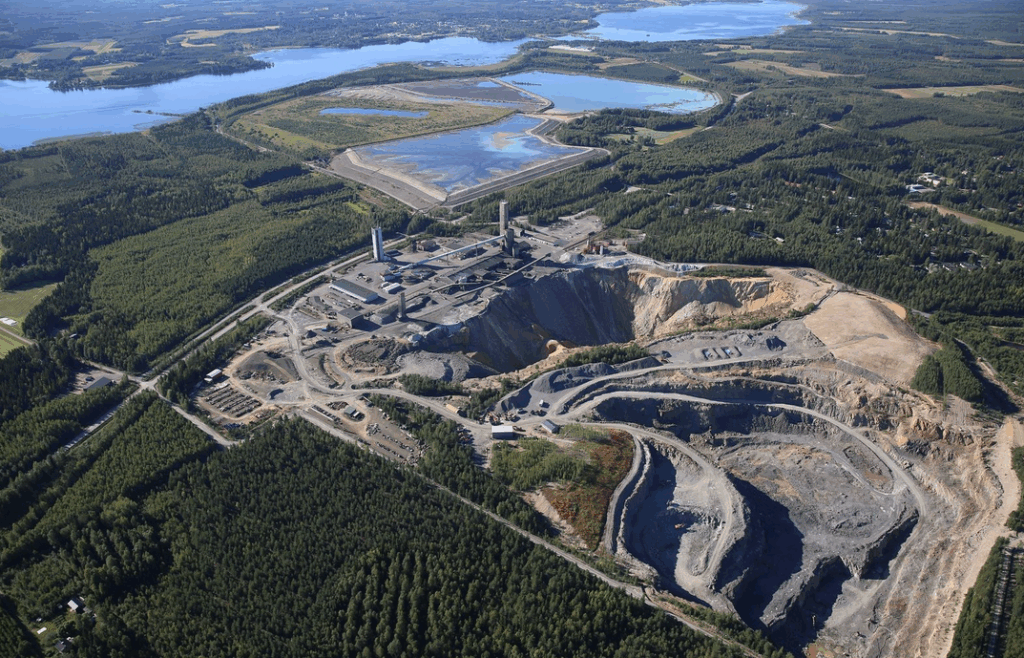
Aerial view of Pyhäsalmi, the deepest base metals mine in Europe. Image from Advanced Navigation.

Mining technology company Advanced Navigation, as part of BHP’s Deep Mining Challenge, has successfully deployed its hybrid navigation system in Europe’s deepest mine in Pyhäjärvi, Finland, at 1.4 km underground.

Pyhäsalmi is the deepest base metals mine in Europe, at a depth of 1,444 metres. The zinc and copper mine, located in Northern Ostrobothnia province, is owned by Canadian miner First Quantum Minerals.

The system entered a completely new environment – no GPS, no fixed infrastructure, no maps – and returned with precise positioning data, proving that the future of fully autonomous mining is within reach, the company said.

Challenges in underground navigation

Navigating the vast subterranean network of the Pyhäsalmi mine poses significant challenges. Located 1.4 km underground with a 63 degree latitude – just two degrees below the Arctic Circle, where traditional systems fail – the mine is completely impervious to GNSS signals, Advanced Navigation said.

Its repetitive, multi-level tunnel network creates a high risk of visual disorientation, while its metallic ores distort magnetic fields and scatter radio waves.

To overcome these conditions, mines typically rely on infrastructure-heavy solutions such as ultra-wideband beacons, Wi-Fi, 5G repeaters, or perception-based techniques such as SLAM (simultaneous localization and mapping), which require cameras.

These methods are costly to integrate and maintain, slow to install, and often unavailable in hazardous or unmapped zones where reliable navigation is most critical, the company said.

The hybrid navigation system, combining a laser velocity sensor (LVS) with the Boreas D90 fiber-optic gyroscope (FOG) inertial navigation system (INS), achieved consistent sub-0.1% navigation error across multiple runs, without relying on any fixed positioning infrastructure, pre-existing maps or external aiding.

“Unreliable navigation underground isn’t a minor technical constraint – it’s a major operational bottleneck,” Advanced Navigation product manager Joe Vandecar said in a news release.

“Maintaining precision over a 22.9-km subterranean course in Europe’s deepest underground mine demonstrates a level of performance that few systems in the world can rival without any prior intelligence of the environment,” Vandecar added. “These results prove we’re one step closer to unlocking scalable underground autonomy.”


Trump to offer Russia access to minerals for peace in Ukraine


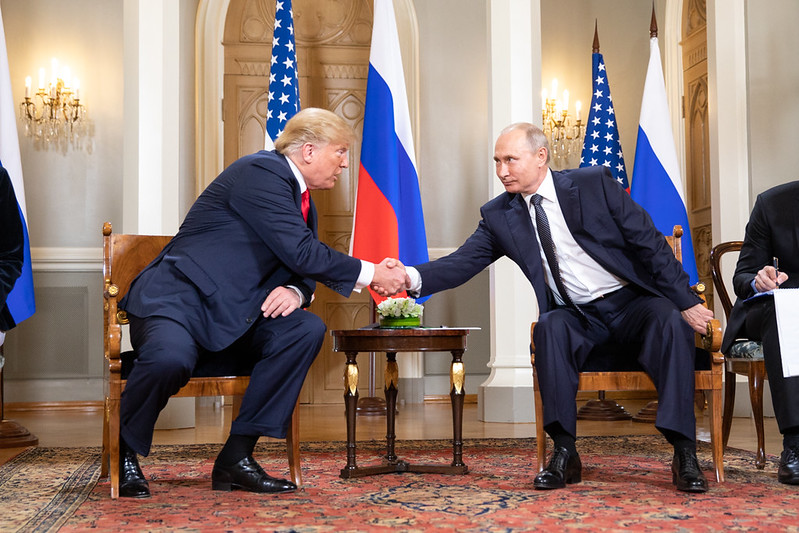
US President Donald Trump and Russia President Vladimir Putin. Credit: Trump White House Archived, under public domain license

The US may offer Russia access to its critical minerals alongside other economic incentives in an effort to bring an end to the war in Ukraine, according to The Telegraph.

The British paper reported on Wednesday evening that US President Donald Trump is prepared to let Moscow tap into its natural resources in Alaska and lift some sanctions on Russia’s aerospace industry. Another key element of the proposal is granting Kremlin access to rare earth deposits in Ukrainian territories currently under Russian occupation.

The deal will likely be presented to Russian President Vladimir Putin during an upcoming meeting in Anchorage, says The Telegraph. The meeting, scheduled for Aug. 15, represents the first between the nations’ leaders since Trump’s re-election in 2024.

US Treasury Secretary Scott Bessent is said to be coordinating the economic package, which could involve joint mining ventures to speed up the development of mineral deposits in Ukraine. The Eastern European nation is said to host significant deposits of critical minerals, most of which are unexplored.

The Ukrainian Geological Survey estimates that its critical minerals account for 5% of the world’s total. Amongst the most prominent are graphite, with 19 million tonnes in reserves, and lithium, for which it holds about a third of Europe’s endowment. Other key minerals featured in the state agency database are copper, lead, zinc, silver, nickel, cobalt, manganese and rare earth elements.

In addition to minerals on the ground, the US deal could also involve giving Russia development rights in the oil and gas-rich Bering Strait, a region estimated to hold 13% of the world’s oil reserves.

UK officials told The Telegraph that the proposed measures may be acceptable to European leaders — many of whom had expressed concerns over Ukraine’s exclusion from the summit.

Ahead of the summit, Trump told Fox News Radio that no comprehensive peace deal will happen without Ukraine’s participation. Meanwhile, European leaders and Ukrainian President Volodymyr Zelenskiy have strongly opposed any agreement that sidelines Ukraine or requires it to cede territory.

Earlier this week, Trump held a video call with Zelenskiy and other European leaders, emphasizing that securing a ceasefire is the top priority of his meeting with Putin.


Trump’s ‘Deadly Serious’ Russia Squeeze Shown in Big Tariffs on Ally India

  • Trump has doubled tariffs on Indian imports to 50% over New Delhi’s continued purchases of Russian oil.

  • The move risks nearly 1% of India’s GDP this year but underscores U.S. determination to coordinate with the EU on sanctions to weaken Russia’s economy and deter its geopolitical ambitions.

  • India, alongside China and Turkey, remains a top buyer of Russian oil, and Washington is preparing similar tariff threats.

“India is not only buying massive amounts of Russian Oil, they are then, for much of the Oil purchased, selling it on the Open Market for big profits,” U.S. President Donald Trump posted last week on Truth Social. “They don’t care how many people in Ukraine are being killed by the Russian War Machine. Because of this, I will be substantially raising the Tariff paid by India to the USA.” These words directly implicate buyers of Russian oil as accomplices in the murder of tens of thousands of Ukrainian people in the war started by the Kremlin on 24 February 2022, as indeed they have been. Had these words been said in 2008 when Europe continued to buy Russian oil after it attacked Georgia, or in 201,4 when the continent continued to buy Russian oil after it annexed Ukraine’s Crimea region, then the 2022 full-scale invasion of Ukraine might never have happened. They were not said, it did happen, but this time around, the U.S. President is looking to the future in his actions today. His seriousness is further underlined by the fact that India – long seen as a key ally to Washington in the Asia-Pacific region – now faces big tariffs. So what does this all mean, and what will happen next?

Slightly in advance of the 8 August deadline imposed by Trump on Russia to make a peace deal with Ukraine, the U.S. doubled its tariffs on India to 50% -- a rate that will come into effect on 27 August. The U.S. is India’s top export market, constituting 18% of its exports and 2.2% of its gross domestic product (GDP). Many of the country’s major exporting firms had already stated that they could not deal with the 25% tariffs, as they are too high to absorb, and passing them on to customers makes their products uncompetitive. Initial analysts’ estimates are that 50% tariffs could reduce India’s GDP by nearly 1% this year. But the U.S. knows all this, which is one of the reasons why it has chosen to do it, according to a very senior European Union (E.U.) energy security source who spoke exclusively to OilPrice.com on the day of the new Indian tariffs announcement. “India is known as a key ally of the U.S. globally, and especially in Asia Pacific, and the thinking is that if he [Trump] is willing to do that to India, then he would be willing to do that to anyone else, and this is absolutely the case – he [Trump] is deadly serious on squeezing Russia’s economy from here,” he said. “The message should not be lost on European countries who might be thinking of easing up on the sanctions being rolled out on Russia from now to December 2027 [when the intention is to end all imports of Russian oil and gas],” he added. Indeed, a closely co-ordinated ramping up of sanctions against Moscow by the U.S. and E.U. is seen by both sides as key to preventing Russian President Vladimir Putin from realising his dream of reconstituting the full scope of the U.S.S.R.’s previous European empire, as analysed in full in my latest book on the new global oil market order. “Trump believes that the continuation of European purchases of Russian oil and gas after the annexation of Crimea, especially in 2014, was key to the Russian action in Ukraine in 2022, as underlined in his comments on the Nordstream gas pipelines [from Russia to the heart of Europe],” he highlighted.

In this context, India has a multi-layered strategic importance to the U.S. The most notable of these is the objective of positioning it as the regional counterweight to China’s economic, political, and military presence in the Asia-Pacific region, as analysed in full in my latest book on the new global oil market order. Washington’s efforts in this regard intensified following the 15 June 2020 clash between Chinese and Indian troops in the disputed territory of the Galwan Valley in the Himalayas, as the U.S. believed this marked a new push back strategy from India against China’s policy of seeking to increase its economic and military alliances through its multi-generational power-grab project, the ‘Belt and Road Initiative’ (BRI). The U.S. further believed that this push back might also be echoed in India’s economic desire to finally make substantive progress on its ‘Neighbourhood First’ policy as an alternative to China’s BRI programme. However, for this to work, India would need access to secure energy sources over the long term, as – like China – it has few oil and gas sources of its own. Indeed, given the potential economic growth projections for India, the International Energy Agency forecast that the Asian sub-continental power would constitute the biggest share of global energy demand growth at 25% in the coming two decades. In fact, the IEA predicted India would overtake the European Union as the world’s third-biggest energy consumer by 2030. It was at this point – in Trump’s first term as president – that the plan was hatched to link this plan to use India to challenge China as Asia’s major power in parallel with a corollary objective to use the UAE to promote further relationship normalisation deals (‘Abraham Accords’) between Israel and key Arab states in the Middle East. This remains a second key reason why India is so important to Washington.

Nevertheless, India – along with China and Turkey – is still one of the biggest buyers of Russia's energy exports three years into Moscow’s war in Ukraine. According to industry figures, last month saw it receive 1.6 million barrels per day (bpd) of oil from Russia, while China imported around 1 million bpd and Turkey about 500,000 bpd. Over the entirety of 2024, China was the largest buyer of Russian oil, at about 2.2 million bpd, followed by India on 1.76 million bpd, and Turkey on 0.3 million bpd. The U.S. has already warned China that ongoing imports of Russian oil could lead to huge tariffs being imposed on the country, according to the E.U. source. “During the talks [end-July U.S.-China trade talks in Stockholm], [U.S. Treasury Secretary Scott] Bessent told his opposite number [Vice Premier He Lifeng] that legislation [‘Sanctioning Russia Act of 2025’] is being drawn up in Congress authorising the imposition of up to 500% tariffs on countries that buy sanctioned Russian oil,” he exclusively told OilPrice.com last week. In reality, the Act goes wider to encompass any country that “knowingly sells, supplies, transfers, or purchases oil, uranium, petroleum products, or petrochemical products that originated in the Russian Federation”. It currently has 84 listed co-sponsors in the U.S. Senate alone, according to the U.S. Congress website, and the Speaker of the House has also indicated his chamber’s support to pass the bill.

The U.S. has also suggested to China that it may treat Beijing’s assistance to Russia in much the same manner as it has started to treat the same for Iran. This was seen in the very recent U.S. State Department announcement on Iran-related sanctions that it would impose sanctions on 20 entities it believes are engaged in trading Iranian oil and petrochemical products, including China’s Zhoushan Jinrun Petroleum Transfer Co., an oil terminal in the greater Zhoushan port area. Under Secretary of the Treasury for Terrorism and Financial Intelligence Brian E. Nelson said of these China sanctions that: “The Iranian regime continues to fuel conflict in the Middle East to fund its destabilizing activities, [and] Today, the United States is taking action to stem the flow of revenue that the regime uses to support terrorism abroad, as well as to oppress its own people.” Zhoushan Jinrun was highlighted by the State Department for: “…knowingly engaging in a significant transaction for the purchase, acquisition, sale, transport, or marketing of petroleum or petroleum products from Iran”. The port is the fourth of China’s to be sanctioned by Washington in recent weeks, following similar actions against Huaying Huizhou Daya Bay Petrochemical Terminal Storage in March, Guangsha Zhoushan in April, and Dongying Port in May. “More is to come,” the very senior U.S. legal source told OilPrice.com at the time of the sanctions announcement and could include a dramatically increased list of blacklisted Chinese officials, businesses, banks, financial houses, ports, ships, and supportive infrastructure to the facilitation of Russian oil imports.

By Simon Watkins for Oilprice.com
Roblox rolls out open-source AI system to protect kids from predators in chats

By The Associated Press
 August 07, 2025 

The gaming platform Roblox is displayed on a tablet. (AP Photo/Leon Keith)

Roblox, the online gaming platform wildly popular with children and teenagers, is rolling out an open-source version of an artificial intelligence system it says can help preemptively detect predatory language in game chats.

The move comes as the company faces lawsuits and criticism accusing it of not doing enough to protect children from predators. For instance, a lawsuit filed last month in Iowa alleges that a 13-year-old girl was introduced to an adult predator on Roblox, then kidnapped and trafficked across multiple states and raped. The suit, filed in Iowa District Court in Polk County, claims that Roblox’s design features make children who use it “easy prey for pedophiles.”

Roblox says it strives to make its systems as safe as possible by default but notes that “no system is perfect, and one of the biggest challenges in the industry is to detect critical harms like potential child endangerment.”

The AI system, called Sentinel, helps detect early signs of possible child endangerment, such as sexually exploitative language. Roblox says the system has led the company to submit 1,200 reports of potential attempts at child exploitation to the National Center for Missing and Exploited Children in the first half of 2025. The company is now in the process of open-sourcing it so other platforms can use it too.

Preemptively detecting possible dangers to kids can be tricky for AI systems — and humans, too — because conversations can seem innocuous at first. Questions like “how old are you?” or “where are you from?” wouldn’t necessarily raise red flags on their own, but when put in context over the course of a longer conversation, they can take on a different meaning.


Roblox, which has more than 111 million monthly users, doesn’t allow users to share videos or images in chats and tries to block any personal information such as phone numbers, though — as with most moderation rules — people constantly find ways to get around such safeguards.

It also doesn’t allow kids under 13 to chat with other users outside of games unless they have explicit parental permission — and unlike many other platforms, it does not encrypt private chat conversations, so it can monitor and moderate them.

“We’ve had filters in place all along, but those filters tend to focus on what is said in a single line of text or within just a few lines of text. And that’s really good for doing things like blocking profanity and blocking different types of abusive language and things like that,” said Matt Kaufman, chief safety officer at Roblox. “But when you’re thinking about things related to child endangerment or grooming, the types of behaviors you’re looking at manifest over a very long period of time.”

Sentinel captures one-minute snapshots of chats across Roblox — about 6 billion messages per day — and analyzes them for potential harms. To do this, Roblox says it developed two indexes — one made up of benign messages and, the other, chats that were determined to contain child endangerment violations. Roblox says this lets the system recognize harmful patterns that go beyond simply flagging certain words or phrases, taking the entire conversation into context.

“That index gets better as we detect more bad actors, we just continuously update that index. Then we have another sample of what does a normal, regular user do?” said Naren Koneru, vice president of engineering for trust and safety at Roblox.

As users are chatting, the system keeps score — are they closer to the positive cluster or the negative cluster?

“It doesn’t happen on one message because you just send one message, but it happens because of all of your days’ interactions are leading towards one of these two,” Koneru said. “Then we say, okay, maybe this user is somebody who we need to take a much closer look at, and then we go pull all of their other conversations, other friends, and the games that they played, and all of those things.”

Humans review risky interactions and flag to law enforcement accordingly.

Barbara Ortutay, The Associated Press


Bolivia election and lithium: What you need to know


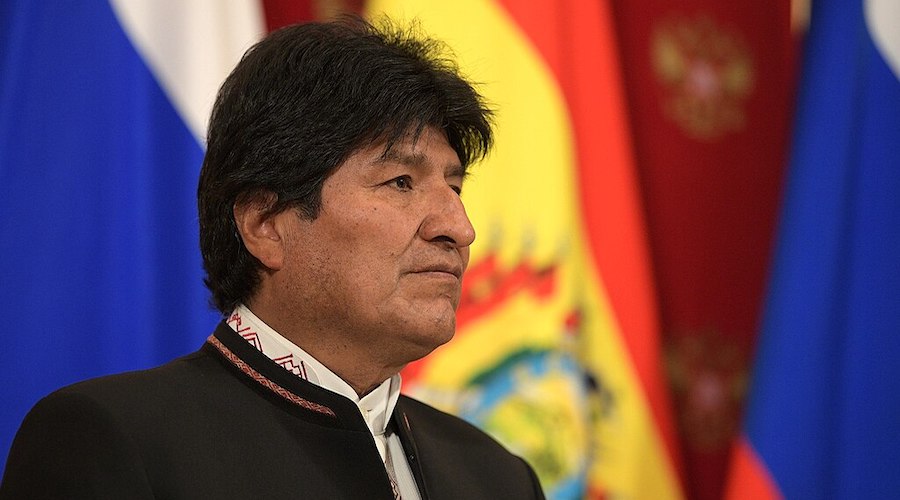
Former President Morales has called for “null voting” in upcoming presidential election. (Image courtesy of Russian government.)

Almost eight-million Bolivians are set to vote on August 17 for a new president, vice president and all legislative seats – 26 senators and 130 deputies.

Ex-President Evo Morales, Bolivia’s dominant political figure of recent decades, is barred from running and has called on the electorate to boycott the race, but polls suggest his influence is waning.

Top of mind for voters is the fragile economy. Natural gas exports have plummeted, inflation is at a 40-year high, and fuel is scarce.

If no candidate wins the August vote outright the election heads to a runoff, scheduled for October 19.

The new president takes office on November 8.

Here’s a guide to the election:

What’s at stake?

Bolivia’s incumbent Movement for Socialism, or MAS, which has governed almost continuously since 2006, approaches the election as a weak, fragmented political force, with voter support waning amid the country’s worst economic crisis in decades.

Opinion polls suggest growing support for right-wing parties pledging a change of direction and stabilization of the economy.

Morales, a three-time former president and co-founder of MAS, was barred from running after a failed attempt to change the constitution to allow a fourth term. President Luis Arce is not seeking reelection.

What about lithium?

Bolivia’s vast salt flats are home to the world’s largest resources of the battery metal, but the country has long struggled to ramp up production or develop commercially viable reserves.

Russian and Chinese companies are among the few that have moved forward with development proposals, but the deals have not received approval from the legislature, where the ruling party is fractured and Arce lacks a congressional majority.

Some investors are hopeful that a political shift could lead to changes in the country’s regulatory environment and open the way to access the largely untapped lithium resources.

Bolivia’s electoral tribunal plans to roll out a new system this year in response to fraud claims made after the 2019 presidential vote that led to widespread unrest and the resignation of then-president Morales.

Under the new system, vote tally sheets will be photographed at polling stations and transmitted directly to counting centers. International observers from the European Union and Organization of American States are due to oversee the process.

Polls open at 8 a.m. (1200 GMT) and close at 4 p.m. locally. The tribunal aims to publish 80% of preliminary results on election night. Official results are due within seven days.

Who are the candidates and what are their platforms?

None of the crowded field of candidates vying for the five-year term are polling above 30%, with about a quarter of voters saying they remain undecided.

In the lead is 66-year-old Samuel Doria Medina, a center-right real estate tycoon who brought Burger King to Bolivia. Doria Medina’s main proposals include cutting government subsidies, privatizing state firms, and shoring up the economy.

Polling second is another conservative, Jorge “Tuto” Quiroga, 65, who briefly served as president from 2001 to 2002. He’s a vocal critic of leftist governments in Latin America, and his platform includes restoring private property rights and expanding free trade.

Support for left-wing and MAS-affiliated candidates is trailing the right-wing opposition. The leading leftist contender, with around 6% support, is Andronico Rodriguez, 36, who was once seen as Morales’ political heir but has distanced himself from MAS.

His platform focuses on rural voters and “intelligent austerity” proposals that aim to reduce government spending while prioritizing the disadvantaged.

(By Lucinda Elliott and Camille Ayral; Editing by Rosalba O’Brien)


U.S. Intercepts 32 Stolen Cars Before Export From the Port of Houston

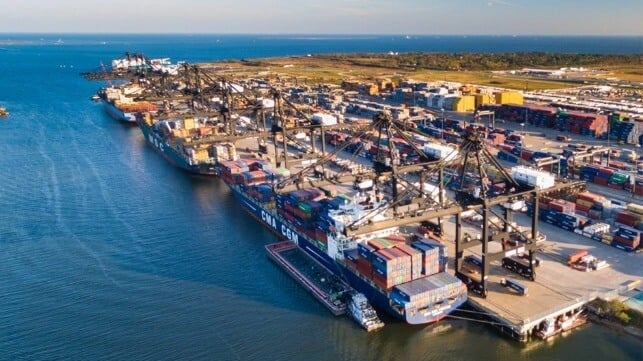
Houston container port
CBP reports the 32 cars would likely have been loaded into containers for export via the Port of Houston (Port of Houston file photo)

Published Aug 15, 2025 5:42 PM by The Maritime Executive


Authorities in the U.S. are intensifying a crackdown on criminal syndicates masterminding the illegal exports of stolen vehicles that are often hidden in containers. In the latest report, U.S. Customs and Border Protection (CBP) announced that it has intercepted 32 vehicles at the ports of Houston/Galveston since October 2024, preventing their illegal export to countries in the Middle East, West Africa, Central America, and South America.

The recovered vehicles, which ranged from luxury sedans to pickup trucks, were valued at over $3 million. They had arrived at the ports and would have been smuggled out of the country, hidden in containers.

CBP reports it flagged the vehicles for examination prior to exporting after officers identified discrepancies in export documentation. They conducted thorough examinations, uncovering vehicles reported as stolen from various locations across the U.S.

The agency said that the interception of the stolen vehicles is part of a broader initiative to combat transnational criminal organizations that exploit global trade routes for illicit activities. Stopping them from leaving the U.S. was critical in helping deter crime and safeguard the integrity of international commerce.


One of the 32 stolen cars intercepted before being exported from the port (CBP)


“These interceptions highlight the critical role CBP plays in protecting American communities and businesses from criminal activity,” said Thomas Mahn, Area Port Director. “Our officers are dedicated to ensuring that stolen property does not leave the country and that those responsible for these crimes are held accountable.”

CPB says that auto theft remains a rising concern in the U.S., a menace that has forced the agency to double its efforts to stop the illegal trade. The seizures are part of a wider crackdown that also targets narcotics, firearms, counterfeit consumer goods, illicit currency, and other contraband that violate U.S. export laws.

The interceptions come just two months after two Cuban nationals were arrested and charged over allegations of being involved in a large criminal ring linked to the exportation of stolen motor vehicles. Most of the vehicles were allegedly exported to Mexico through ports of entry in Hidalgo County and El Paso.


Australian Icebreaker Nuyina to Visit Remote Islands for Scientific Mission

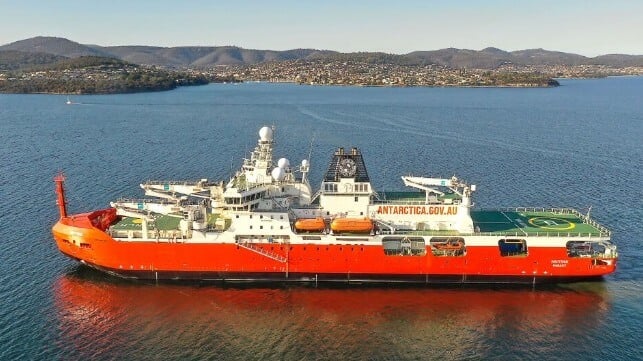
Australian research ship Nuyina
Nuyina is a state-of-the art research ship and after problems is increasing its deployment to unique locations (AAP)

Published Aug 15, 2025 5:19 PM by The Maritime Executive


Australian expeditioners and scientists are set to return to the uninhabited and remote territories of Heard Island and McDonald Islands (HIMI) after more than two decades. The voyages that will take place aboard the RSV Nuyina are being described as critical for understanding the current state of the islands and ensuring protection from the threats of climate change.

The Australian Antarctic Program (AAP) announced that in September, the country’s icebreaker, the RSV Nuyina, will make a debut voyage to HIMI. The islands form part of the most undisturbed and dynamic ecosystems in the world and where the topography and weather are notoriously bad.

In December, the vessel will return to HIMI for a second voyage. In both voyages, the icebreaker will take expeditioners and scientists to check on the state of the islands’ flora and fauna and carry out marine science and surveys.

The vessel, which was plagued by commissioning issues, has also been criticized for sluggishness in conducting scientific missions. The organizers look to accelerate the deployment of the 160-meter (525-foot) long vessel that started construction in 2017 and was finally handed over in 2021. Mechanical issues, however, kept her out of service till 2023.

The two islands of Heard and McDonald are two of Australia’s most remote territories located in the southern Indian Ocean, some 4,000 kilometers south-west of the Australian mainland. Heard Island has been described as a land of fire and ice owing to the fact that it is home to Australia’s only active volcano and has 12 major glaciers carving through the landscape. Penguin and seal colonies dot its coastline.

Both islands have not been visited for more than two decades, with Australia now planning expeditions to conduct terrestrial and marine surveys that can help inform fisheries management and also undertake the mapping of the bathymetry (sea floor) around the islands. The missions will also involve conducting climate science to better understand glacial retreat and surveying the current status of threatened seabirds and seals.

On the seabirds and seals, the scientists will particularly want to know if the H5 bird flu, which has killed hundreds of thousands of seabirds and seals around the world, has reached HIMI. This is due to the fact that some affected animals have been found on the French Kerguelen and Crozet sub-Antarctic islands, which are only 450 kilometers from HIMI.

“Understanding the current status and trends of the wildlife, ecosystems and environment is essential for managing this unique world heritage area and marine reserve,” said Annette Dunkley, AAP Protected Areas and Species Director.

In the first voyage in September, Nuyina will sail to Heard Island for 10 days with a science team of seabird and seal ecologists and glaciologists. Another team will have the responsibility of setting up state-of-the-art reflectors around the island to improve satellite geo-positioning. In December, the vessel will return to HIMI for 25 days with a team that will focus on marine science and surveys of terrestrial ecosystems.

The two voyages come just months after Australia significantly expanded the marine reserve, placing almost 90 percent of the exclusive economic zone around HIMI under protection. Following the move in January, visitation is strictly controlled to limit human impacts and the possible introduction of non-native species.


Ukraine Strikes Caspian Seaport Hitting Ship Delivering Iranian Drones

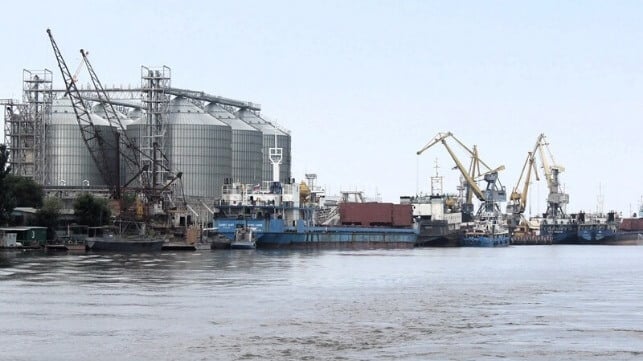
Olya Russia sea port
Olya is the largest Russian sea port in the Caspian region (Rosmorport photo)

Published Aug 15, 2025 11:36 AM by The Maritime Executive


Ukraine’s armed forces are reporting they struck the Port of Olya, the largest in Russia’s Caspian region, and a key port for the transport of arms and other munitions for the war in Ukraine. Unconfirmed reports are that they were able to damage a Russian cargo ship that was offloading components for Iranian-made Shahed drones.

“According to available information, the ship Port Olya 4, loaded with components for the Shahed type UAV and ammunition from Iran was hit,” the General Staff reported in a social media posting. They said that the results of the attack were still being “clarified,” but Ambrey Analytics is reporting the vessel has sunk while alongside the pier.

The vessel is a general cargo ship built in 2012 and registered in Russia. It is 403 feet (123 meters) in length and 5,185 gross dwt. 

Russian drone attacks have become a nightly occurrence, report the Ukrainian media, focusing on infrastructure targets. Ukraine’s General Staff reports it has “launched a broader campaign to degrade Russia’s ability to launch air attacks.”

Iran has been frequently cited for supplying drones and other equipment to Russia. In addition to drones, it is supplying ballistic missiles. Ukrainian media, however, notes that with Iran’s help, Russia has begun manufacturing its version of the Shahed called Gerans. 

Olya is located 500 miles from the front lines in Ukraine on the Bakhtemir River of the Volga Delta. It is part of the Volga-Caspian Canal system and, according to the port’s online data, handles approximately 1.5 million tons of cargo a year.  It is reported to have 10 docks with a depth of more than 16 feet.

“This facility is used by Russia as an important logistics point for the supply of military goods,” reported Ukraine’s General Staff. 

The attack, which took place on August 14, comes ahead of the meeting between Donald Trump and Vladimir Putin, and as both sides have increased their attacks. Ukraine reported there were 149 combat clashes on Thursday, followed by an additional 65 so far on August 15. For its part, Russia claimed to have shot down 53 Ukrainian drones overnight.