‘Release the Tapes’: Lawmakers Demand Answers Over Alleged $50,000 Bribe of Trump Border Czar Tom Homan
“Seriously though, has anyone ever been handed $50,000 cash in a paper bag for something legit?”
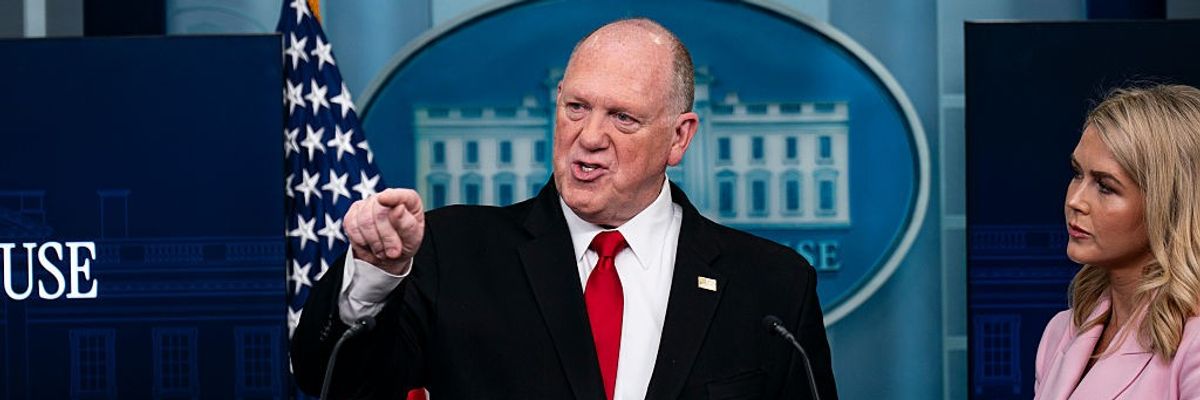
White House border czar Tom Homan speaks while joined by White House Press Secretary Karoline Leavitt, during a press briefing at the White House, on Monday, April 28, 2025 in Washington, DC.
(Photo by Al Drago for The Washington Post via Getty Images)
Jon Queally
Sep 21, 2025
COMMON DREAMS
Accusations of supreme corruption, demands for an investigation, and calls for impeachment proceedings for several high-level Trump administration officials erupted on Saturday after it was reported that a Justice Department probe into Tom Homan, who serves as President Donald Trump’s border czar, was dropped despite documented evidence he accepted a bribe of $50,000 delivered in a bag by undercover FBI agents as part of a sting operation.
Citing multiple people “familiar with the probe,” a review of internal documents, MSNBC was the first to report that during “an undercover operation last year, the FBI recorded Tom Homan [...] accepting $50,000 in cash after indicating he could help the agents—who were posing as business executives—win government contracts in a second Trump administration.”
The New York Times, which also spoke to people familiar with the case, reported that the “cash payment, which was made inside a bag from the food chain Cava, grew out of a long-running counterintelligence investigation that had not been targeting Mr. Homan,” and that the encounter, as MSNBC also reported, was recorded. The Times indicates that the recording was audio, while MSNBC‘s version of the evidence suggests that video footage exists.
“Americans deserve disclosure of evidence showing top DHS official Homan accepting a bag full of $50,000 in cash We need to know why the investigation was dropped—all the facts and evidence.” —Sen. Richard Blumenthal
The case implicates both FBI Director Kash Patel and Attorney Pam Bondi, who heads the Justice Department. Both were appointed by Trump and are deeply loyal to him politically.
MSNBC reports:
It’s unclear what reasons FBI and Justice Department officials gave for shutting down the investigation. But a Trump Justice Department appointee called the case a “deep state” probe in early 2025 and no further investigative steps were taken, the sources say.
On Sept. 20, 2024, with hidden cameras recording the scene at a meeting spot in Texas, Homan accepted $50,000 in bills, according to an internal summary of the case and sources.
The federal investigation was launched in western Texas in the summer of 2024 after a subject in a separate investigation claimed Homan was soliciting payments in exchange for awarding contracts should Trump win the presidential election, according to an internal Justice Department summary of the probe reviewed by MSNBC and people familiar with the case. The U.S. Attorney’s office in the Western District of Texas, working with the FBI, asked the Justice Department’s Public Integrity Section to join its ongoing probe “into the Border Czar and former Acting Director of Immigration and Customs Enforcement Tom Homan and others based on evidence of payment from FBI undercover agents in exchange for facilitating future contracts related to border enforcement.”
The revelations prompted Rep. Pramila Jayapal (D-Wash.) to declare that Trump’s second term is the “most corrupt administration we have ever seen.”
Matt Duss, executive vice-president at the Center for International Policy, asked: “Seriously though, has anyone ever been handed $50,000 cash in a paper bag for something legit?”
While that’s not a legal standard, news of the dropped case against Homan, given his central role in Trump’s ramped-up attacks on migrants and communities nationwide, sparked an array of outrage, many questions, and a demand for more answers from the Justice Department.
“Who’s the illegal now, Tom Homan?” asked Rep. Alexandria Ocasio-Cortez (D-N.Y.).
“Tom Homan should be fired immediately and charged,” said Rep. Bonnie Watson Coleman (D-N.J.). “Kash Patel should be suspended pending impeachment proceedings, and anyone who aided in this cover-up should be held accountable. Homan’s relationship with GEO Group, who own Delaney Hall in Newark, should be thoroughly investigated, and the facility closed pending that investigation. The amount of corruption in this administration is endless.”
Sen. Ed Markey (D-Mass.) had a similar reaction. “Corruption that’s stunning even for this administration,” Markey said. “Homan and anyone who knew and covered this up must resign.”
As the Times reporting notes, the “episode raises questions about whether the administration has sought to shield one of its own officials from legal consequences, and whether Mr. Homan’s actions were considered by the White House when he was appointed to his government role.”
In response to questions from MSNBC and the Times, Trump officials downplayed the seriousness of the case. They said that after it was investigated, the bribery allegations did not stand up.
White House Deputy Press Secretary Abigail Jackson told MSNBC the probe that led to the recording of Homan was a “blatantly political investigation.” However, it’s clear from the reporting that the original investigation was not targeting Homan at all.
In a joint statement issued Saturday, Patel and Todd Blanche, the deputy attorney general, said the investigation “was subjected to a full review by F.B.I. agents and Justice Department prosecutors. They found no credible evidence of any criminal wrongdoing.”
That hardly satisfied Democrats in Congress, who said it’s clear the public has a right to know every detail about what occurred and why the case was dropped.
“Release the tapes—Americans deserve disclosure of evidence showing top DHS official Homan accepting a bag full of $50,000 in cash,” said Sen. Richard Blumenthal (D-Conn.). “We need to know why the investigation was dropped—all the facts and evidence.”
Trump official accused of bribery scheme now faces 'another legal hazard': experts
David McAfee
September 21, 2025
“Seriously though, has anyone ever been handed $50,000 cash in a paper bag for something legit?”
White House border czar Tom Homan speaks while joined by White House Press Secretary Karoline Leavitt, during a press briefing at the White House, on Monday, April 28, 2025 in Washington, DC.
(Photo by Al Drago for The Washington Post via Getty Images)
Jon Queally
Sep 21, 2025
COMMON DREAMS
Accusations of supreme corruption, demands for an investigation, and calls for impeachment proceedings for several high-level Trump administration officials erupted on Saturday after it was reported that a Justice Department probe into Tom Homan, who serves as President Donald Trump’s border czar, was dropped despite documented evidence he accepted a bribe of $50,000 delivered in a bag by undercover FBI agents as part of a sting operation.
Citing multiple people “familiar with the probe,” a review of internal documents, MSNBC was the first to report that during “an undercover operation last year, the FBI recorded Tom Homan [...] accepting $50,000 in cash after indicating he could help the agents—who were posing as business executives—win government contracts in a second Trump administration.”
The New York Times, which also spoke to people familiar with the case, reported that the “cash payment, which was made inside a bag from the food chain Cava, grew out of a long-running counterintelligence investigation that had not been targeting Mr. Homan,” and that the encounter, as MSNBC also reported, was recorded. The Times indicates that the recording was audio, while MSNBC‘s version of the evidence suggests that video footage exists.
“Americans deserve disclosure of evidence showing top DHS official Homan accepting a bag full of $50,000 in cash We need to know why the investigation was dropped—all the facts and evidence.” —Sen. Richard Blumenthal
The case implicates both FBI Director Kash Patel and Attorney Pam Bondi, who heads the Justice Department. Both were appointed by Trump and are deeply loyal to him politically.
MSNBC reports:
It’s unclear what reasons FBI and Justice Department officials gave for shutting down the investigation. But a Trump Justice Department appointee called the case a “deep state” probe in early 2025 and no further investigative steps were taken, the sources say.
On Sept. 20, 2024, with hidden cameras recording the scene at a meeting spot in Texas, Homan accepted $50,000 in bills, according to an internal summary of the case and sources.
The federal investigation was launched in western Texas in the summer of 2024 after a subject in a separate investigation claimed Homan was soliciting payments in exchange for awarding contracts should Trump win the presidential election, according to an internal Justice Department summary of the probe reviewed by MSNBC and people familiar with the case. The U.S. Attorney’s office in the Western District of Texas, working with the FBI, asked the Justice Department’s Public Integrity Section to join its ongoing probe “into the Border Czar and former Acting Director of Immigration and Customs Enforcement Tom Homan and others based on evidence of payment from FBI undercover agents in exchange for facilitating future contracts related to border enforcement.”
The revelations prompted Rep. Pramila Jayapal (D-Wash.) to declare that Trump’s second term is the “most corrupt administration we have ever seen.”
Matt Duss, executive vice-president at the Center for International Policy, asked: “Seriously though, has anyone ever been handed $50,000 cash in a paper bag for something legit?”
While that’s not a legal standard, news of the dropped case against Homan, given his central role in Trump’s ramped-up attacks on migrants and communities nationwide, sparked an array of outrage, many questions, and a demand for more answers from the Justice Department.
“Who’s the illegal now, Tom Homan?” asked Rep. Alexandria Ocasio-Cortez (D-N.Y.).
“Tom Homan should be fired immediately and charged,” said Rep. Bonnie Watson Coleman (D-N.J.). “Kash Patel should be suspended pending impeachment proceedings, and anyone who aided in this cover-up should be held accountable. Homan’s relationship with GEO Group, who own Delaney Hall in Newark, should be thoroughly investigated, and the facility closed pending that investigation. The amount of corruption in this administration is endless.”
Sen. Ed Markey (D-Mass.) had a similar reaction. “Corruption that’s stunning even for this administration,” Markey said. “Homan and anyone who knew and covered this up must resign.”
As the Times reporting notes, the “episode raises questions about whether the administration has sought to shield one of its own officials from legal consequences, and whether Mr. Homan’s actions were considered by the White House when he was appointed to his government role.”
In response to questions from MSNBC and the Times, Trump officials downplayed the seriousness of the case. They said that after it was investigated, the bribery allegations did not stand up.
White House Deputy Press Secretary Abigail Jackson told MSNBC the probe that led to the recording of Homan was a “blatantly political investigation.” However, it’s clear from the reporting that the original investigation was not targeting Homan at all.
In a joint statement issued Saturday, Patel and Todd Blanche, the deputy attorney general, said the investigation “was subjected to a full review by F.B.I. agents and Justice Department prosecutors. They found no credible evidence of any criminal wrongdoing.”
That hardly satisfied Democrats in Congress, who said it’s clear the public has a right to know every detail about what occurred and why the case was dropped.
“Release the tapes—Americans deserve disclosure of evidence showing top DHS official Homan accepting a bag full of $50,000 in cash,” said Sen. Richard Blumenthal (D-Conn.). “We need to know why the investigation was dropped—all the facts and evidence.”
Trump official accused of bribery scheme now faces 'another legal hazard': experts
David McAfee
September 21, 2025
RAW STORY

U.S. President Donald Trump's "border czar" Tom Homan speaks to reporters at the White House in Washington, D.C., U.S., April 23, 2025. REUTERS/Kevin Lamarque
A Donald Trump official who reportedly was under investigation for accepting a bribe now has "another legal hazard" to look forward to, according to experts.
Raw Story reported on Saturday about a MSNBC exclusive in which the outlet claimed that Trump border czar Tom Homan had previously been investigated for accepting $50,000 from undercover FBI agents. That caused U.S. Rep. Alexandria Ocasio-Cortez (D-NY) to issue a stinging four-word response to Homan.
It also caused a senator to declare that Attorney General Pam Bondi "knew" about the reported bribery operation.
But legal experts warned that Homan might not be out of the woods yet, even if charges were never brought.
Constitutional law professor Anthony Michael Kreis said, "Your occasional reminder that bribes are reportable income."
Former Bush adviser David Frum chimed in, "If Tom Homan accepted $50,000 in cash in September 2024, that money should have been declared on his tax return in April 2025. If not, that's another legal hazard for him."
Brendan Fischer wrote, "It is unclear whether Homan held on to the $50k bribe, or whether he disclosed the payment on his financial disclosure report, which requires that he report all clients who paid him over $5k/year."
Other users asked Elon Musk's AI chatbot, Grok, about the purported non-disclosure. Grok responded, "There's no public info on whether Tom Homan claimed the alleged $50,000 as income on his taxes. The 2024 FBI probe was closed in 2025 by the Trump DOJ, citing insufficient evidence for charges, according to MSNBC, Politico, and NYT reports. Tax details remain private."
U.S. President Donald Trump's "border czar" Tom Homan speaks to reporters at the White House in Washington, D.C., U.S., April 23, 2025. REUTERS/Kevin Lamarque
A Donald Trump official who reportedly was under investigation for accepting a bribe now has "another legal hazard" to look forward to, according to experts.
Raw Story reported on Saturday about a MSNBC exclusive in which the outlet claimed that Trump border czar Tom Homan had previously been investigated for accepting $50,000 from undercover FBI agents. That caused U.S. Rep. Alexandria Ocasio-Cortez (D-NY) to issue a stinging four-word response to Homan.
It also caused a senator to declare that Attorney General Pam Bondi "knew" about the reported bribery operation.
But legal experts warned that Homan might not be out of the woods yet, even if charges were never brought.
Constitutional law professor Anthony Michael Kreis said, "Your occasional reminder that bribes are reportable income."
Former Bush adviser David Frum chimed in, "If Tom Homan accepted $50,000 in cash in September 2024, that money should have been declared on his tax return in April 2025. If not, that's another legal hazard for him."
Brendan Fischer wrote, "It is unclear whether Homan held on to the $50k bribe, or whether he disclosed the payment on his financial disclosure report, which requires that he report all clients who paid him over $5k/year."
Other users asked Elon Musk's AI chatbot, Grok, about the purported non-disclosure. Grok responded, "There's no public info on whether Tom Homan claimed the alleged $50,000 as income on his taxes. The 2024 FBI probe was closed in 2025 by the Trump DOJ, citing insufficient evidence for charges, according to MSNBC, Politico, and NYT reports. Tax details remain private."
Ex-Trump 'fixer' slams Tom Homan for selling America's borders 'to the highest bidder'
Robert Davis
September 21, 2025
Shutterstock
President Donald Trump's former "fixer" roasted the administration's border czar on Sunday for accepting a $50,000 bribe in a restaurant to-go bag.
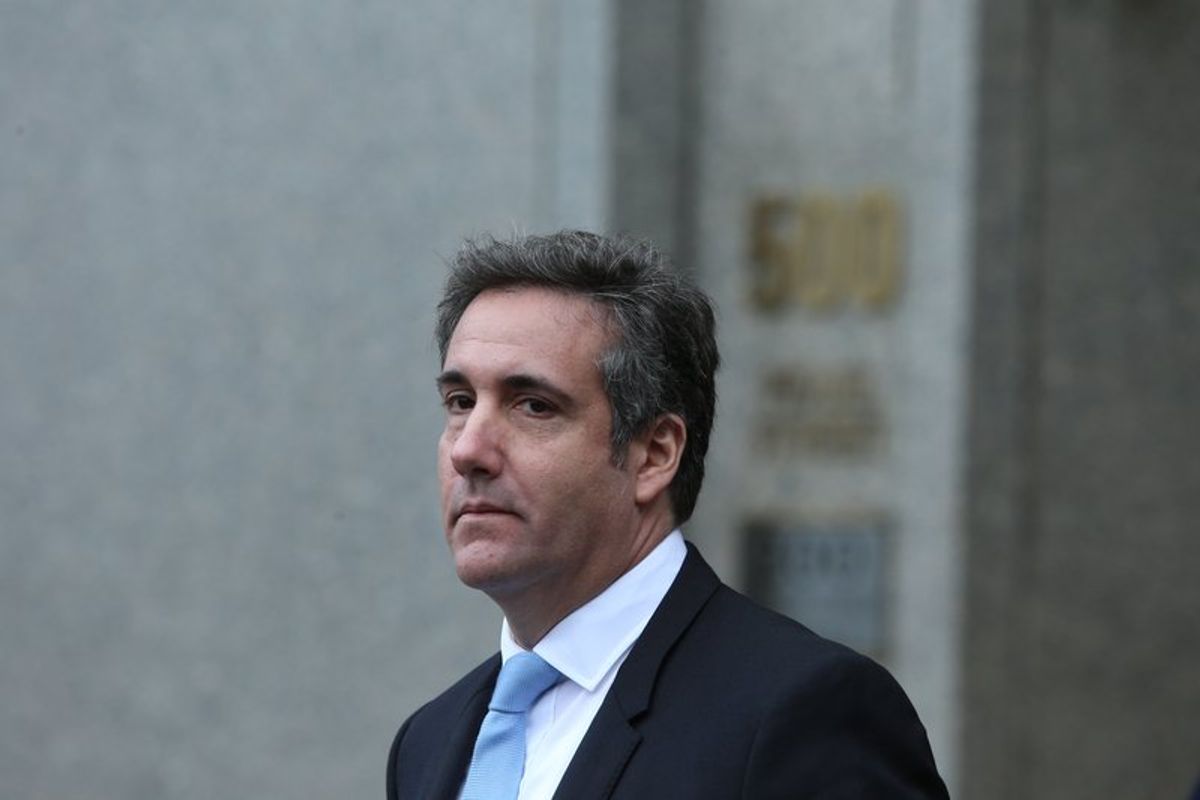
Michael Cohen, who was once described as Trump's personal "fixer," penned an op-ed on Sunday criticizing Trump's border czar, Tom Homan, for allegedly accepting a $50,000 bribe as a private citizen from undercover FBI agents. Legal experts have said the event presents several legal pitfalls for Homan, even though the FBI declined to indict him after Trump was elected.
"He loved the image of the tough cop, the no-nonsense border enforcer. But what we’re seeing now strips that image down to what it always was: a performance," Cohen wrote. "Behind the scenes, Homan wasn’t protecting America’s borders. He was selling them off to the highest bidder."
According to a MSNBC report, Homan allegedly promised to help the FBI agents with government contracts once he was in office. The FBI planned to wait and see if Homan would deliver on the promise before charging him, the outlet reported.
The White House, Justice Department, and FBI all dismissed the investigation as politically motivated and baseless, MSNBC News reported. Deputy Attorney General Todd Blanche said the investigation has revealed “no credible evidence of wrongdoing.”
"What do you call a video of a man pocketing $50,000 in cash and offering government contracts in return?" Cohen wrote. "If that isn’t credible, then nothing is."
"That money was a down payment," he added. "A test. A handshake sealed in cash. And Homan took it."
Read the entire essay by clicking here.
Robert Davis
September 21, 2025
RAW STORY
Shutterstock
President Donald Trump's former "fixer" roasted the administration's border czar on Sunday for accepting a $50,000 bribe in a restaurant to-go bag.
Michael Cohen, who was once described as Trump's personal "fixer," penned an op-ed on Sunday criticizing Trump's border czar, Tom Homan, for allegedly accepting a $50,000 bribe as a private citizen from undercover FBI agents. Legal experts have said the event presents several legal pitfalls for Homan, even though the FBI declined to indict him after Trump was elected.
"He loved the image of the tough cop, the no-nonsense border enforcer. But what we’re seeing now strips that image down to what it always was: a performance," Cohen wrote. "Behind the scenes, Homan wasn’t protecting America’s borders. He was selling them off to the highest bidder."
According to a MSNBC report, Homan allegedly promised to help the FBI agents with government contracts once he was in office. The FBI planned to wait and see if Homan would deliver on the promise before charging him, the outlet reported.
The White House, Justice Department, and FBI all dismissed the investigation as politically motivated and baseless, MSNBC News reported. Deputy Attorney General Todd Blanche said the investigation has revealed “no credible evidence of wrongdoing.”
"What do you call a video of a man pocketing $50,000 in cash and offering government contracts in return?" Cohen wrote. "If that isn’t credible, then nothing is."
"That money was a down payment," he added. "A test. A handshake sealed in cash. And Homan took it."
Read the entire essay by clicking here.
