Sunday, November 16, 2025

Donald Trump Deserves the Nobel Prize for War

From Iran to Venezuela, the Trump administration has restored military action as a top option in US foreign policy.


John Feffer
Nov 15, 2025
The Hankyoreh


On his recent tour of Asia, President Donald Trump picked up a number of gifts, including a golden replica of a Silla crown in South Korea and a golden golf club in Japan. Trump has a well-known penchant for gold: The Oval Office has been redecorated in gold, complete with gold trophies and golden coasters with Trump’s name on it.

Trump loves gold, but what he really covets, because it is much rarer, is a Nobel Peace Prize.


‘They’re Going to Be, Like, Dead’: Trump Says Land Strikes on Venezuela Are Next

Echoes of Obama Libya Strikes as Trump Argues Boat Bombings Are Immune From War Powers Law

In the hopes of getting into the good graces of the US president, many world leaders have promised to nominate him for one. On this recent trip, he received such promises from the new conservative prime minister of Japan, Sanae Takaichi, as well as from Cambodian Prime Minister Hun Manet. Earlier this year, Park Sun-won of the now ruling Democratic Party submitted a nomination of Trump to the Nobel committee in Norway. Many other leaders around the world, from the Israeli prime minister to the foreign minister of Malta, have joined the chorus of adulation.

Like all the gold tributes paid to Trump, these nominations are naked attempts to flatter an erratic, cruel, and autocratic leader. They also fly in the face of reality.

One last reason why Donald Trump deserves a Nobel War Prize is his determination to increase the budget of what he now calls the War Department.

Trump, after all, no more cares about peace than a mafioso does. Both Trump and the mafioso want only that underlings follow their orders and adversaries cower in fear. Trump wants Russian leader Vladimir Putin to kowtow to the US president and come to the negotiating table with Ukraine. Trump wanted Israeli Prime Minister Benjamin Netanyahu to stop defying US pressure and negotiate with Hamas on a ceasefire in Gaza. Like a mafioso, Trump wants to demonstrate that he is the absolute authority who distributes favors and punishments according to his whims.

Trump often tries to change the fabric of reality by asserting the truth of absolute falsehoods—that former President Barack Obama was born in Africa, that the 2020 elections were stolen, that he’s the smartest person in every room.

So, too, with the Nobel Peace Prize. Trump boasts that he has ended “seven or eight” wars. It’s a questionable claim given that he was barely involved in negotiating ceasefires in several of those conflicts (Kashmir, Thailand vs. Cambodia) while some of the “successes,” like Gaza, remain largely unresolved. In the case of Egypt and Ethiopia, there wasn’t even a war to end.

Instead, through his rhetoric and actions, Trump deserves the opposite: a Nobel prize for war.

For the most part, Trump has been using tariffs as his favorite form of punishing friends and enemies alike. However, he also uses the threat of war, and here too he doesn’t necessarily distinguish between allies and adversaries. For instance, he has threatened to send troops to Greenland, which would set up a conflict with fellow NATO member Denmark. He has also threatened to annex Canada, a friendly neighbor.

More recently—and even more troubling—the Trump administration is seriously considering drone strikes and even the dispatch of US troops to Mexico to attack drug cartels. The Mexican government has strongly rejected any such plans, but that hasn’t deterred the Trump administration.

The possible plan to intervene in Mexico—against the wishes of the government—is an expansion of the drug war the administration is conducting in the Caribbean and the Pacific. It has already attacked more than a dozen ships and killed more than 60 people. The designation of a “war” by the Pentagon is fallacious since it is based on the notion that the United States is engaged in “defensive” actions. But the administration has not furnished any proof that the boats have attacked or had any plans of attacking US targets.

Nor is there any proof that the boats are actually engaged in drug trafficking. But even if the administration could prove that narco-traffickers are piloting the ships, it would mean that the cases should be subject to law enforcement. Instead, the Trump administration has engaged in extrajudicial murder.

The United States has also positioned sufficient firepower in the region to pursue regime change in Venezuela. Although Trump has said that war with the country is unlikely, he has nevertheless ratcheted up the pressure on Venezuelan President Nicolás Maduro by conducting naval attacks near his border, authorizing CIA action inside the country, and considering a plan to seize the country’s oil fields.

Potential wars in Mexico and Venezuela are only the most recent reasons why Trump should be awarded a Nobel War Prize.

For instance, Trump piggybacked on Israel’s attacks against Iran by bombing three nuclear sites in the country. If the president hadn’t destroyed the nuclear agreement with Iran at the start of his first term, there would have been no need for either Israel or the United States to use force against the country’s nuclear program.

Trump has also dispatched the army to American cities, an unprecedented move that has sharpened divisions in US society. He has threatened to use military force against protest movements domestically, even to deport US citizens to prisons overseas.

Trump recently announced that the United States will resume testing of nuclear weapons, in direct violation of the Comprehensive Test Ban Treaty (which the United States signed but did not ratify). His Energy Department insists that the United States will only test the non-nuclear components of the weapons—such as the delivery systems—but Trump wants the return of underground tests to match what he alleges are similar tests by Russia and China.

One last reason why Donald Trump deserves a Nobel War Prize is his determination to increase the budget of what he now calls the War Department. In May, the president presented the first trillion-dollar defense budget: almost $900 billion in spending plus almost $120 billion in supplemental spending from the reconciliation bill.

A trillion dollars to conduct wars and prepare for wars. Much of that money is for the big-ticket items in the Pentagon arsenal that are designed to fight a war with China.

The Biden administration was not exactly peaceful, though it did withdraw troops from Afghanistan and refuse to send troops to Ukraine (or even establish a no-fly zone over the country).

Today, the Trump administration has restored military action as a top option in US foreign policy. Trump deserves an award for this transformation. But it’s not the prize he thinks he should be given.
GOP Lawmakers Are Using a Wild Conspiracy Theory to Attack Medication Abortion

House Republicans are now talking about combing through sewers in search of microscopic evidence of our abortions.
November 15, 2025

Anti-abortion politicians want to spend government funds to investigate the claim that abortions are floating around in your drinking water.
Carl Lokko via Getty Images

Anti-abortion activists have been trying to convince the broader public that medication abortion is dangerous for years, but their latest argument is a decades-old asinine conspiracy theory. In a June 18 letter to Environmental Protection Agency (EPA) Administrator Lee Zeldin, 25 House Republicans asked the agency to study the alleged “byproducts” of Mifepristone (the first medication administered in a medication abortion regimen) in water systems. In the letter, the Republican legislators make an unfounded assertion that “residual amounts of the drug and its metabolites” in wastewater “could potentially interfere with a person’s fertility, regardless of sex.” The anti-abortion lawmakers wanted clarification on whether the agency has methods for detecting the medication and its “byproducts” in water supplies and, if not, what resources are needed to develop such methods.

To be clear: Anti-abortion politicians want to spend government funds to investigate the claim that abortions are floating around in your drinking water.

If this preposterous claim weren’t unsettling enough, former EPA officials told The New York Times that the EPA had already developed “general technology … [that] could be used for surveillance in states where abortion is illegal.” The surveillance technology could be used to isolate the source to “a particular street or home where the pills were used, though such measures would be legally fraught and extremely costly.”

In an era when cops are using license plate readers to track people traveling for abortion care, and social media companies like Facebook are handing over private messages between a mother and daughter seeking an abortion to police leading to their incarceration, this is another alarming development.

The anti-abortion movement has been injecting this deliberate disinformation into mainstream politics for years — including this exact myth of abortion pills poisoning our water, which we detail in our book Liberating Abortion: Claiming Our History, Sharing Our Stories, and Building the Reproductive Future We Deserve.


GOP Wants to Mandate “Fetal Development Education.” It’s Anti-Abortion Nonsense.
Republicans can’t seem to convince adults to vote against abortion, so they’re trying to brainwash kids instead.  By Lauren Rankin , Truthout  October 31, 2025

I (Renee) first encountered this myth in 2015 when I visited a Maryland anti-abortion crisis pregnancy center as part of an investigation into tactics used by the center’s volunteers to coerce people out of an abortion. While I sat at the table waiting for them to notify me of the positive pregnancy test, they claimed that not only was abortion dangerous to my fertility, but that the remnants of abortion medication and fetal remains were in the very water we all drank. This seemingly small conspiracy theory designed to convince unknowing people out of their decision to have an abortion is now shaping federal policy, with the intention to surveil millions.

Abortion disinformation has spread wildly since that encounter at the crisis pregnancy center a decade ago, as fringe anti-abortion groups circulate it online. In a 2023 TikTok video, Students for Life claimed that the government hasn’t investigated the prevalence of abortion pills in our nation’s wastewater system in two decades, coincidentally the same amount of time since abortion pills were first approved for prescription by the Food and Drug Administration (FDA). The organization claims that people using medication abortion are flushing human bodies down the toilet and destroying the environment, and that this warrants investigation by the FDA. (We should note that the Environmental Protection Agency is the agency that oversees the safety of drinking water, not the FDA.)

When we detail this example during book tour stops, it elicits giggles, shock, and the assumption that we’re joking. We wish this were just a laugh line, but it’s not. The right’s focus on traces of abortion medication in wastewater is another example of the anti-abortion movement’s most radical and anti-science ideas inevitably leading to the criminalization of pregnant people. Anti-abortion activists have led campaigns to smear medication abortion through the spread of disinformation, misleading data about its safety, or by calling it “chemical abortion” in order to instill fear and confusion through this misnomer.


The right’s focus on traces of abortion medication in wastewater is another example of the anti-abortion movement’s most radical and anti-science ideas inevitably leading to the criminalization of pregnant people.

Their “abortionsplaining” efforts — what we call their abortion disinformation tactics — have redoubled in the years following the height of the COVID pandemic, when medication abortion use increased due to social distancing regulations and our health care system’s shift toward telehealth. Medication abortion is now the most common method of abortion in the United States; it allows people to receive abortions in their communities, potentially evading state surveillance.

Over the years, we have seen our fair share of absurd anti-abortion assertions, such as lawmakers claiming that abortions cause tornadoes, hurricanes, and droughts — even a congressional witness testimony claiming abortions power the electrical grid in Washington, D.C. went unquestioned by members of Congress. Each time, people are shocked that something so ludicrous would be spread by fringe activists, becoming offhand remarks by politicians, and soon after the basis for anti-abortion regulations.

Under this second Trump administration, however, this rhetoric, alongside a long-term coordinated disinformation campaign, is being weaponized by congressional lawmakers who seem eager to expand their dragnet for arresting and prosecuting already over-policed communities. According to Pregnancy Justice, more than 400 people were prosecuted with pregnancy-related crimes in the first two years since the Dobbs decision allowed states to re-criminalize abortion. That’s in addition to over 60 people who were criminalized between 2000 and 2020, while Roe v. Wade was the law of the land, according an If When How report.

The number of cases is rising due to the expansion of so-called “fetal personhood,” an effort by anti-abortion legislators to give an embryo or fetus legal rights that often supersede the rights of a pregnant person. It is within this “fetal personhood” framework that we should view the wastewater surveillance tactic — particularly the way criminal charges might be applied. Reproductive justice legal scholars like Dorothy Roberts and Michele Bratcher Goodwin have documented cases of low-income women (often women of color) who have been incarcerated and had their parental rights severed by the state because they refused medical interventions, tested positive for various substances (including safe and legal foods and medications) during their pregnancies, or experienced violence during pregnancy. Fetal endangerment laws are rarely applied to address harm that befalls a pregnant person, rather they are used to criminalize pregnant people, pitting their autonomy against the embryos and fetuses they carry.


It may have felt easy to dismiss outlandish claims about abortion as radical right-wing conspiracy theories, but our government is now run by fanatics.

The anti-abortion lawmakers have always promoted their claims of fetal endangerment under the guise of protecting the fetus. Similarly, restrictions on medication abortion are pushed under the pretense of protecting fertility concerns, but those so-called concerns have historically expanded surveillance and generally translate to prosecution and incarceration of Black and Brown pregnant people.

The claims to protect life were always a farce, especially for immigrants and communities of color. With our own eyes we are witnessing how violent our government is when it comes to destroying families, with little to no regard for pregnant people and their children.

It may have felt easy to dismiss outlandish claims about abortion as radical right-wing conspiracy theories, but our government is now run by fanatics. The House Republicans’ letter indicates they are not above combing through the sewers like Pennywise in search of microscopic evidence of our abortions. The fall of Roe gave them the opportunity to fuse anti-abortion policies with surveillance and criminalization efforts.

Combined with our nation’s ever-growing military, digital, and physical surveillance apparatus, the right to privacy is a mere pipe dream. But the right’s pro-natalist fascist project is dependent on us complying — snitching on loved ones, turning over private communications, and allowing white supremacy to guide our thoughts about whose pregnancies deserve punishment.

Our only hope is to keep organizing against government intrusion and to call for the decriminalization of pregnancy before it’s too late. It will take all of us, recognizing the seriousness of their seemingly silly threats, to protect our lives.


This article is licensed under Creative Commons (CC BY-NC-ND 4.0), and you are free to share and republish under the terms of the license.


Renee Bracey Sherman
Renee Bracey Sherman is the founder and executive director of We Testify, an organization dedicated to the leadership and representation of people who have abortions. She and journalist Regina Mahone are coauthors of the forthcoming book Liberating Abortion: Our Legacy, Stories, and Vision for How We Save Us from Amistad/HarperCollins and co-hosts of the podcast “The A Files: A Secret History of Abortion” from The Meteor.


Regina Mahone
Regina Mahone is a writer and editor whose work explores the intersections between race, class, and reproductive rights. She currently serves as a senior editor at The Nation magazine. She is also the co-author of Liberating Abortion: Claiming Our History, Sharing Our Stories, and Building the Reproductive Future We Deserve and co-host of The A Files: A Secret History of Abortion, a podcast from The Meteor.
Dems Are Right: Trump Is Undermining Democracy. So Is Their Party’s Right Wing.

Democratic mayors in some US cities have taken anti-democratic steps to subvert the will of their constituents.
November 14, 2025

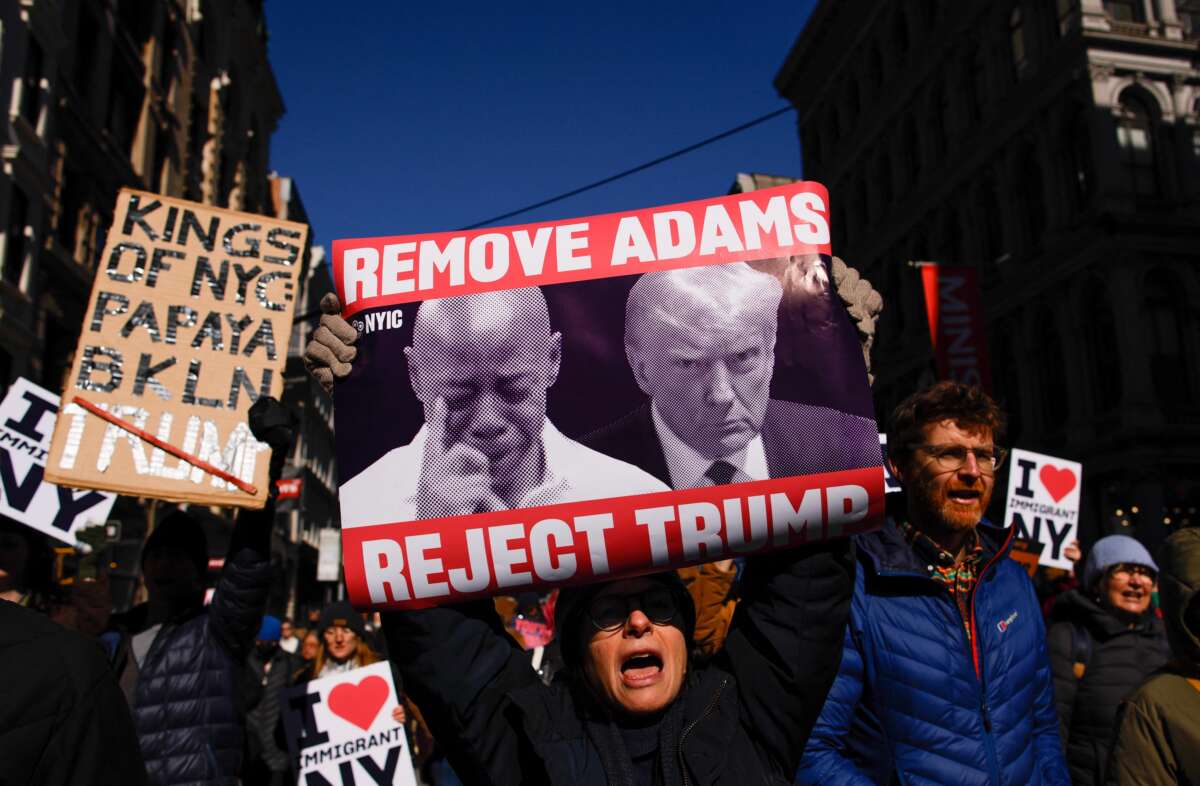
People march as they take part in a protest calling for the removal of New York City Mayor Eric Adams and against the administration of Donald Trump in New York on February 22, 2025.KENA BETANCUR / AFP via Getty Images

The Democratic Party’s rallying cry for years has been steady: Donald Trump is an existential threat to our democracy. And with the de facto occupation of U.S. cities by the National Guard, we hear a whole lot from the party about “defending democracy” against Trump. A proper defense of democracy, however, requires acknowledging how moderate and right-wing Democrats have undermined it themselves.

When Senate Democrats caved to their Republican counterparts over the most recent government shutdown, they did so at the expense of subsidies for the Affordable Care Act, which will make health care even more unaffordable for millions. The capitulation came despite the fact that most voters want to extend the subsidies, and a large majority of Democrats wanted their elected officials to hold the line and refuse to approve a budget that didn’t include the subsidies.

The shutdown is but one example of the lack of resolve from the party’s moderate and right wings in defending the interests of the majority. From the neglect of Democratic voters’ desire to end the genocide in Gaza, to the virtual coronation of Kamala Harris as the successor to Biden as the Democratic candidate for 2024 election, Democrats have hardly been a paragon for democracy or reflected the will of the people in national politics. The Democratic Party’s role in undermining democracy doesn’t just happen at the national level though: In Philadelphia, my hometown, and the birthplace of American democracy, moderate democrats are ruling through closed-door negotiations and shortened public engagement opportunities, outright ignoring community demands while entertaining business interests.

The most publicized instance of “democracy” by Democrats involved a proposed arena for the Sixers, Philly’s basketball team, in the city’s Chinatown neighborhood. In part, these negotiations focused on how much the team would pay as a part of a Community Benefits Agreement, which would fund a variety of initiatives to attempt to mitigate the negative impacts of the stadium on the neighborhood, instead of real estate taxes. (Real estate taxes would cost more for the Sixers but generate more revenue for the city.) The Sixers initially proposed paying $50 million. After a proposal from some councilmembers of $300 million, collaboratively developed with the Philadelphia Chinatown Development Corporation and Asian Chamber of Commerce, was rejected, the city council and the mayor’s office officially countered with a price tag of $100 million. Nevertheless, after closed door negotiations, the Sixers, council, and the mayoral administration agreed to a $60 million figure paid over 30 years (a measly $2 million per year). Throughout the process, Mayor Cherelle Parker’s administration refused meetings with Chinatown residents. The legislation passed Council, but the arena project was ultimately abandoned by the Sixers, and, despite Parker’s claims that no city tax dollars would be spent on the stadium, the harebrained idea wasted at least $469,095 in tax revenue.

However, this was not an isolated incident.

In June, the Housing Committee of City Council went behind closed doors again while considering the Safe Healthy Homes Act, a three-bill package on tenants rights. Before voting, the committee took a long 50-minute recess to deliberate, despite telling the hundreds of people in attendance that were there they would only be gone for 15 minutes. When they returned, only one bill was passed (which was returned to council unsigned by Mayor Parker); the other two bills — which covered the right to repairs, and the right to safety — were held in committee, but will be heard again in February 2026. Interestingly, the committee returned with Councilmember-At-Large Katherine Gilmore Richardson, who wasn’t present before the committee went behind closed doors. While one can only speculate as to what may have been said, what we do know is that Gilmore Richardson, as well as Housing Committee members Cindy Bass and Mark Squilla, were in that back room, and all of them have received significant campaign donations from the real estate and building industry.

Gilmore Richardson previously also publicly opposed a housing affordability bill, which would have reduced move-in costs for Philadelphians by allowing them to pay security deposits in installments and reduced application fees for tenants. It is clear that certain councilmembers and the mayor’s office, whose campaigns have received nearly $1 million in campaign contributions collectively from the real estate and business industry, consistently stand in the way of progressive housing legislation in Philadelphia.

Meanwhile, Mayor Parker’s H.O.M.E. (Housing Opportunities Made Easy) initiative, which dedicates over $200 million to developers, is moving forward. However, Councilman Isaiah Thomas (who was confronted outside of city hall by members of Mayor Parker’s staff for disagreeing with major parts of her H.O.M.E. initiative) and council staffers from offices not entirely in line with the mayor’s vision have reported being almost entirely shut out of the negotiation process for the city’s budget, which includes the H.O.M.E. initiative. Moreover, Council President Kenyatta Johnson, who received over $350,000 in contributions from the building and real estate industry, has also stated that he and Parker are in “lockstep,” while they go behind closed doors and make budget decisions without other members of council. Meanwhile, housing advocates and critics have been arguing that much of the “affordable housing” in the program is not going to those who need it the most.

But it is not just the backroom deals pushing through policy pulling the democratic party right in Philadelphia; the Parker administration has also taken up a number of right-wing, tough-on-crime stances, such as supporting “terry stops” (or “stop and frisk by another name”), vowing that “not one city dollar” will go to the city’s needle exchange, and has taken measures, which some law advocacy organizations have labeled “draconian,” even floating the idea of inviting the National Guard to assist. The mayor’s proposed “wellness court” is a drug diversion program that fast-tracks (often unhoused) individuals arrested for low-level offenses, forcing them to choose between treatment or a same-day trial. The ACLU has suggested that forcing these choices on these individuals is a violation of their rights. Local reporting by Kensington Voice has pointed out that only eight out of 87 people who have taken up the treatment program have completed the program between January and May of this year.

It is also worth noting that Parker has never really taken a stance against Trump, and It is also worth noting that Parker has never really taken a stance against Trump, and that may be because she has solicited GOP donors herself. After all, she does tout her successes working across the aisle, and even supported a GOP redistricting of Pennsylvania in 2011, which resulted in 13 of 18 seats up for re-election in the Pennsylvania House of Representatives going to Republicans.

But democracy-demolishing Democrats are not just in Philadelphia.

Democratic mayors across the country, including Mayor Daniel Lurie of San Francisco and the outgoing Mayor Eric Adams of New York City, are passing policies very much aligned with President Trump’s attacks on progressive “harm reduction” tactics (e.g. safe injection sites, needle exchanges, etc.) meant to mitigate the effects of the opioid epidemic.

In Washington, D.C. this summer, Mayor Muriel Bowser praised Trump for commandeering the city’s police department and its supposed impacts on local crime, which were already at a historic low.

In New York City, Eric Adams, supported a rather draconian measure by Gov. Kathy Hochul to deploying National Guard to the city’s subways. Adams even praised Trump’s immigration and tariff policies despite majority opposition in his party. Meanwhile, the Democratic establishment’s hesitancy and even refusal to endorse mayor-elect Zohran Mamdani reflects a concerted effort by the party’s moderates and right wing to undermine its left-flank and the will of the people.

It should be remembered that the term “democracy” is derived from the combination of two Greek words: “demos” (people) and “kratos” (power). Democracy loosely translates to “people power”, and is therefore supposed to be a system of governance where political power rests with the people. So, in Philadelphia, and across the nation, when elected officials make deals with business interests behind closed doors whilst they hide from us — the very people who elected them — they are guilty of undermining the democracy no matter their party membership.

It is not just Trump we have to focus on. If we really want to defend democracy, we have to take the fight to right-wing democrats just as hard. And if Mamdani’s victory over former Gov. Andrew Cuomo in New York City shows us anything, it’s that we can successfully do so.

This article is licensed under Creative Commons (CC BY-NC-ND 4.0), and you are free to share and republish under the terms of the license.

Jeff Wasch is a resident of South Philadelphia, cares about democracy, and is a tenant rights advocate.
Trump’s Reckless Tariff Flailing Is a Destructive Turn by a Declining Power

The recent US-China trade truce may hold, but Trump’s constant policy swerves make industrial peace unlikely.
November 15, 2025

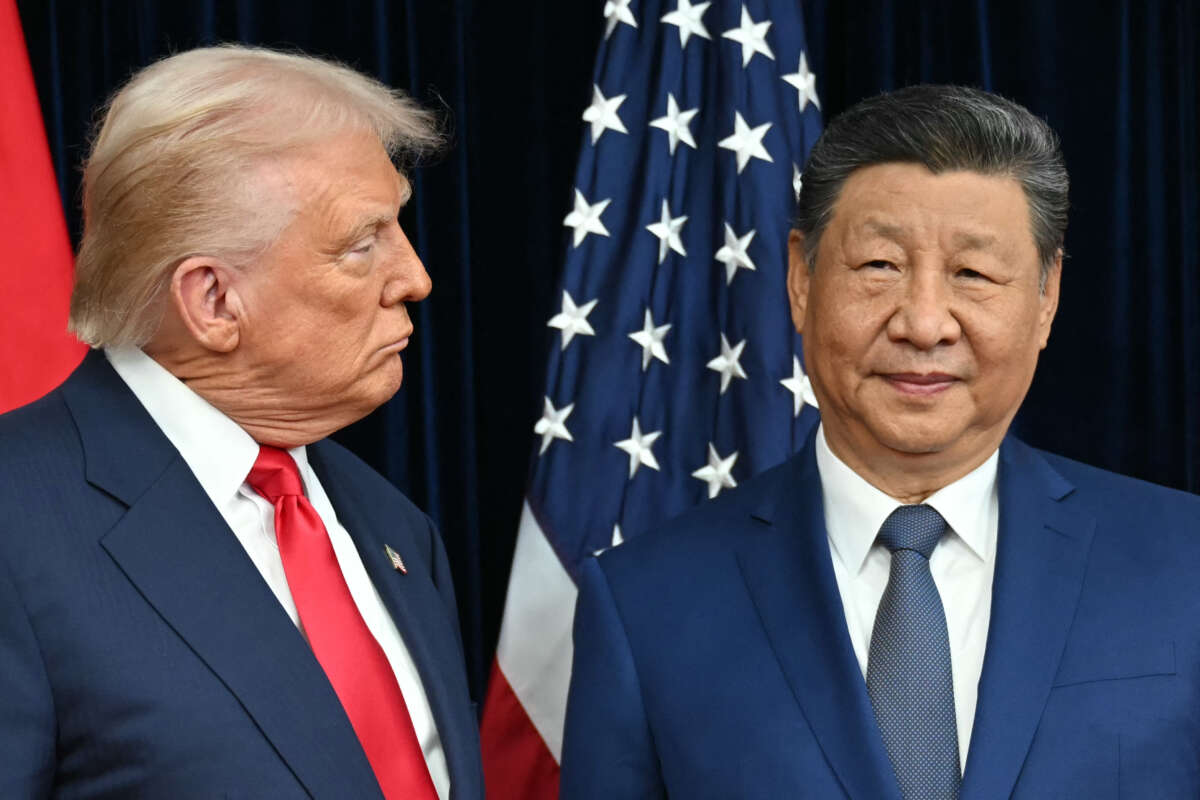
U.S. President Donald Trump and China's President Xi Jinping arrive for talks at the Gimhae Air Base on October 30, 2025
.ANDREW CABALLERO-REYNOLDS / AFP via Getty Images

U.S. workers as a whole have endured a lot of losses in the class war. Globally-mobile companies have deserted communities with unionized workforces, successive administrations raised up oligarchs by slashing taxes on the rich, a major epidemic put the country on edge, and landlords are using technology to collude on raising rents more rapidly.

But all this conventional class war is now joined by a trade war — an international conflict over trade barriers like import taxes. Trump’s tariff campaign has been undertaken with a goal of re-shoring outsourced U.S. industry after years of corporate globalization, which firms have carried on under the investment provisions of trade treaties. The tremendous scale of these moves, their baffling and shambolic rollout, and retaliation by foreign powers are just the newest trials of the American working class. And while a recent deal between the U.S. and China — Trump’s most prominent antagonist in such a trade war — offers some hope that the worst effects of such a war could be easing, any agreement with the constantly vacillating Trump is a thaw at best, not a true peace.
Threat Inflation

Tariffs are a tax paid by importers bringing foreign commodities into the United States. They are definitely not, as the Dear Leader has claimed, a tax on foreign countries. Tariff taxes are paid by the importing company that usually produces and/or sells the commodity, like Apple when it brings Chinese-assembled iPhones into U.S. ports.

The importers may trim their profit margins (as the auto industry has done) to pay some of the import duty, but many companies will simply increase prices paid by consumers. These higher prices for imports don’t attract consumers, who then buy domestic goods made in the home country, if they are available. This, of course, is a goal of protectionism — to shelter domestic manufacturers from imported goods and services. This creates captive demand for domestic industry, which is then able to grow and gain the scale and skill needed to satisfy the domestic demand with less competition from foreign capital.

Tariffs are a tax paid by importers bringing foreign commodities into the United States. They are definitely not a tax on foreign countries.

Trump himself claims his tariffs are justified by our trade deficits with other nations, apparently viewing any such deficit as proof of these countries benefiting from U.S. offshoring, and has openly celebrated that foreign goods will cost more. Despite acknowledging this impact, Trump has strongly resisted the idea that the higher prices deliberately sought by tariffs will aggravate inflation, despite imports being 14 percent of GDP. Inflation is still a painful sore point for many Americans after the last punishing wave, due to the 2022 COVID re-openings and the spike in energy prices caused by the Russo-Ukrainian War.


Related Story

Experts See Echoes of the 1930s Amid Trump’s Tariff Tantrums
If a US-European tariff war really does kick off in earnest, the consequences could be hugely damaging.   
By Sasha Abramsky , Truthout July 24, 2025

But it should be understood that trade deficits for the U.S. are trade surpluses for countries like China and Japan, which often take the proceeds and invest large flows of capital back into the U.S. Trade partners invest their large net earnings in Treasury bonds, U.S. real estate, and other sectors. Interest rates in the U.S. are lower than they would be otherwise due to these capital inflows, as they add to the supply of investible capital in the country.

The scale of resulting inflation will depend on the breadth and depth of the tariffs; because Trump is a shallow thinker and impulsive decision-maker, it remains unclear where average tariffs will settle. Tariffs on goods from China, our largest trading partner, were 10 percent on February 1, then 20 percent on March 1, then 54 percent on April 2, then an astronomical 145 percent on April 9, then 30 percent again on June 11, but now 47 percent on average across various products. China has mirrored the U.S. with similar tariffs through this period. The main U.S. allies are now subject to large trade taxes, with 15 percent for European exports and for most Japanese goods, with higher rates on materials and cars. At the same time, huge tariffs of 50 percent have been imposed on many goods from Brazil and India in retaliation for those countries’ domestic political decisions, without any regard for economic policy. The cumulative potential for stubborn inflation is clearly real.
Stag Party

Today’s extensive border-crossing supply chains, built up over decades of globalization, will likely be at least somewhat snarled by whatever exact tariff regime is in place when the dust settles. Modern production systems often cross international borders as freely as borders between U.S. states, and having to apply tariff taxes to each step for all the parts of a complete product, along with the paperwork, will likely work an ugly effect. Car and truck parts made in the U.S. are sent to Mexico to turn into systems like the chassis or engine, returned to the U.S. for further work, then shipped back to Mexico for final assembly. Prices are liable to ultimately increase for many goods, to make importers whole or to limit profit reductions, contributing to inflation. But we may also see widespread layoffs due to the combined effects of the new trade barriers, significant retaliation by trading partners, and the constant policy shifts which create uncertainty for investors. These will slow economic growth to the point of stagnation and possibly recession.

“Stagflation” is the term for this ugly combination of recession and inflation, a loathsome condition last seen during the 1970s, when government spending on the Vietnam War collided with an oil embargo by the newly-formed Organization of the Petroleum Exporting Countries (OPEC) against the West over its support for Israel in the 1973 Israel-Arab war. High energy prices fed into prices for all goods, adding to already high price pressures. But the productivity shock also caused a recession, when the economy shrinks instead of growing.

Even with the largest “reciprocal” tariffs on the rest of the world suspended for now, a number of economists, including at the Federal Reserve, have argued that the constant policy uncertainty and the major shock to consumer, executive and investor confidence could do more damage to the economy than the tariffs. A Pew survey found 52 percent of Americans thought the tariffs would have a bad effect on the U.S. economy, and trade association CEOs say the baffling swirl of contradictory tariff news is “undermining long-term investment and growth,” language usually reserved for policies that attempt to ameliorate inequality or fund public goods (what the right often maligns as “socialism”). Falling consumer and investor sentiment, if sustained, will themselves have recessionary effects.

Further, the potential combination of recession, weak growth, and inflation means the Fed can’t easily turn to its usual tool: interest rates. Normally the central bank cuts rates to boost the economy during recession, or raises them to cool off the system during high inflation, as in this last cycle. But with weak conditions and high prices, the bank is over a barrel, which, for all its many, many shortcomings, reduces an important institution’s ability to help steer the ship away from disaster. Trump’s threats to fire his first-term appointee, Fed President Jerome Powell, adds to the stress and is terrifying financial markets. The relative decline of U.S. dominance of global finance systems clears the way for the loose BRICS alliance of developing world countries to gradually build up their alternatives for development financing and payment clearance.

For all his endless spouting of “America First,” Trump really is the mortar of the BRICS.
Tariff You Do, Tariff You Don’t

The moves are already bringing retaliation against the U.S. by its trading partners, adding to recession pressures. The European Union had prepared a sturdy retaliation package of tariffs before a milder deal was reached. But the Chinese countermeasures are most important, including an “unreliable entities” list of Western firms barred from doing business with domestic Chinese firms. Further retaliation has taken simpler forms, like China steering its great soybean orders to feed its millions of chicken and swine to Brazil, as it did in Trump’s first term.

More seriously, China has announced a new bureaucratic process for exports of extremely important raw materials and goods made from them. China produces and refines much of the world’s rare earth metals, a small class of scarce chemical elements that are essential for a vast number of technological products, from car steering components to capacitors to lasers to computer chips. It produces 90 percent of the powerful magnets derived from these elements, some of which are used in EV motors and cruise missiles. Export licenses are now required to export these from China, and the system for these is in the early stages. The large U.S. industrial firms that need these materials may lay off workers once they exhaust their supplies.

This tactic more than any other appears to have precipitated the recent truce between the two countries, with the U.S. lowering its average tariff to 47 percent, although the duty now varies greatly by product category. China agreed to a looser rare earth review process, restrictions on exports of chemicals used in manufacturing fentanyl, and larger purchases of U.S. soybeans, which have been languishing in grain silos following China’s shift in sourcing to Brazil.

China also has further economic weapons up its sleeve, but many of them are seen as too risky to the global trading system. These include heavily devaluing its own currency to take greater shares of world markets, or purposefully selling its mountain of U.S. Treasury bonds, which were bought with the years of large trade surpluses that vex the Trump administration.

Because many of the duties have been delayed or changed so many times, the full effects are taking time to express themselves in the broader economy. Important sectors like autos are just now feeling the pain of higher steel and aluminum costs, higher prices for parts, and White House threats against raising prices. As the Biden-era EV mandates end, car companies are beginning to retrench.


Attention to today’s drastically lopsided wealth distribution and the oligopolistic corporate economy are needed if any gains from protectionism are to ever reach the average person on the street.

These twisted developments have been accompanied by a dramatic decline of the dollar, which normally would strengthen when tariffs are hiked. Instead there’s been steep off-loading of bonds and dollars in currency markets, although these have partially recovered as the tariffs move up and down. The simultaneous sell-off of U.S. equities, Treasury bonds, and the dollar suggests a real, perhaps lasting change in how world investors view the formerly-ironclad economic stability of the U.S. “De-Americanization” is actually starting to be discussed in investment circles. The Wall Street Journal quotes a fund manager stating “U.S. exceptionalism has peaked.”

In particular, the drastic whiplashing of trade policy appears to be further eroding the status of the U.S. dollar as the world reserve currency, which is used to collateralize trillions of dollars in world commodities trades. It is also jeopardizing the role of U.S. Treasury bond yields in guiding interest rates on trillions of dollars in loans worldwide, which means global investors may no longer buy up essentially any amount of U.S. bonds to finance our ever-widening budget deficits. Loss of this reserve status could one day sharply reduce capital flows into the the country and require far higher interest rates to compensate by making the U.S. a more attractive destination for globally-mobile capital.

It’s uncharted territory, but for many American voters, the U.S. dollar’s world reserve status is like their gall bladders — something they only hear about when it goes wrong.
Brotectionism

In addition to the economic consequences, there’s another downside to Trump’s trade war: It’s giving protectionism a bad name.

Make no mistake, Trump’s trade policy won’t work. The hyper-unpredictability of the policy moves is killing investor confidence, and will also limit the desired return of domestic production. State-of-the-art manufacturing plants can take three to five years to build, with costs ranging between tens of millions up to billions. Trump caved relatively quickly on the global “reciprocal” tariffs, lasting less than a week into negative coverage before he was moved once again, as in his first term and like most presidential administrations, by the gyrations of the markets.

In a further stunning act of contradictory foolishness, current sectoral tariffs cover not just the consumer goods that the administration wants made in the U.S., but also materials needed for capital goods, like steel and aluminum. These of course drive up the cost of essential capital goods made from them, from nails to screws and steel panels, pushing up the cost of factory-building goods. These tariffs on physical capital mean that even for companies that had already wanted to obey Trump and invest domestically, the costs are now so daunting that even phone assembly (let alone making all the components) is “way down the road now,” as a sourcing researcher put it.

But looking past these clownish blunderings, protectionism has a whole history as a legitimate and successful, if challenging to develop, policy tool. Its negative reputation predates Trump, thanks to the fact that its frequent political setting has been various forms of disgraceful authoritarianism, from the U.S. slave republic to the USSR to the Korean military dictatorship of the 1960s and 70s to U.S.-occupied Japan.

But we absolutely do not have to accept ugly hierarchical power-mongering to recognize that various forms of protectionist policies have played major roles in lifting up large populations from poverty, even though they are abhorrent to the average U.S. economist. Modern republics can use these tools to develop or further evolve their economies based on the expressed will of the public, and in settings that bring people to a greater level of internal equality as well. No amount of ham-fisted incompetent bungling from a hideous race-baiting billionaire can change that.

A conspicuous case is Japan, where the famous Ministry of International Trade and Industry was the center of the country’s industrial policy as it rebuilt from being firebombed and nuked into oblivion by the U.S. in World War II. It led a complex system of subsidies, research grants, technology access, and trade barriers to rebuild the country into a cutting-edge industrial colossus. For years, aspiring Japanese prime ministers were expected to serve as MITI minister to prepare them for office.

When what became South Korea was recovering from its own annihilation in the Korean War, the U.S.-backed Park military dictatorship had a tight, state-led development regime, including trade barriers, investment in strategic sectors, and extensive restrictions on capital. In particular, forms of capital flight in the country were punishable by death. The ugly authoritarianism came alongside a successful national development program based on protectionism and state guidance, which could be argued to have helped created the minimal living standards that helped bring the large public movement that brought down the Park regime in 1979.

Protectionism though, even if done right, is nowhere near enough for actual improvements in the lot of the common family. Attention to today’s drastically lopsided wealth distribution and the oligopolistic corporate economy are needed if any gains from protectionism are to ever reach the average person on the street. Considering the major social movements needed for these core economic issues to be addressed, through wealth confiscation and nationalization of monopolies, mere tariffs are a smaller lift.

Trump’s reckless tariff flailing is a destructive turn by a declining power. Countries in decline relative to the influence and power of their rivals often lash out in ways they hope will preserve their power, but in fact hasten its decline — such as the Anglo-French war for the Sinai in 1956, or the Russo-Ukrainian War. Trump’s clumsy planless blundering at trade barriers likely falls in this category.

Trade war is hell. Hellishly expensive, anyway.


This article is licensed under Creative Commons (CC BY-NC-ND 4.0), and you are free to share and republish under the terms of the license.

Rob Larson  is professor of economics at Tacoma Community College in Washington State. He is the author of Bleakonomics from Pluto Press and the forthcoming Capitalism vs. Freedom. Follow him on Twitter @IronicProfessor.
As Dr. Oz Helps Prove ‘There Is No Republican Health Care Plan,’ Democrats Have Solution Most Refuse to Embrace: Medicare for All.

“Healthcare is becoming unsustainable under Trump,” says one progressive politician running for US Senate. “Medicare for All would fix it.”


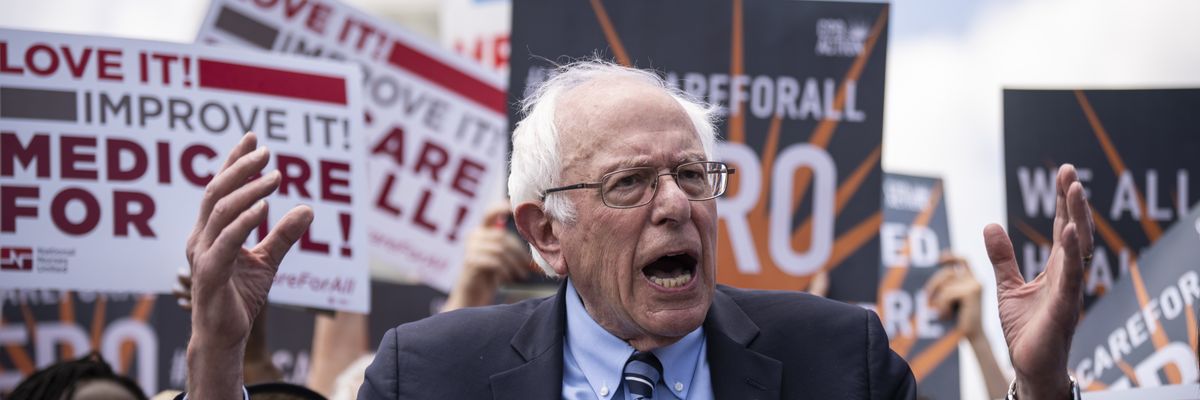
Sen. Bernie Sanders (I-VT) speaks during a news conference to announce the re-introduction of the Medicare For All Act of 2023, outside the U.S. Capitol May 17, 2023 in Washington, DC. On the House side, the proposal will have 112 co-sponsors from the House Democratic caucus, more than they have ever had at the introduction of the bill.

Photo by Drew Angerer/Getty Images

Jon Queally
Nov 16, 2025
COMMON DREAMS

The Trump administration came under fire on Sunday after sending Dr. Mehmet Oz, the Administrator of the Centers for Medicare and Medicaid Services, onto CNN‘s weekend news show to try to explain the Republican Party’s elusive “solution” to the nation’s healthcare crisis, a topic of much interest in recent weeks amid the longest government shutdown in the nation’s history and growing fears over massive premium increases or loss of coverage for tens millions of Americans.

Asked during his appearance to explain what Republicans are considering to address the surging cost of healthcare, Oz talked about direct cash payments—something Trump himself has floated in recent weeks—as well as the idea of health saving accounts (or HSAs) which allow for personalized accounts set up to help pay for out-of-pocket medical needs, though not premium payments.


Trump Healthcare Payment Proposal Sparks Fresh Medicare for All Demands to Fix ‘Broken’ Healthcare System


CNBC Host Doesn’t Know How to Fix Runaway Healthcare Costs. Ro Khanna Says: Medicare for All

“If you had a check in the mail, you could buy the insurance you thought was best for you,” Oz stated without explaining in what way that is different from people who received tax credits to purchase plans on the insurance exchanges established by the Affordable Care Act signed into law by former President Barack Obama.

Pushing such empty ideas while claiming them as viable solutions to soaring costs is partly what led critics like Sen. Patty Murray (D-Wash.) this week to issue a public service announcement which stated flatly: “There is no Republican health care plan”—despite repeated claims to the contrary by GOP lawmakers, including Speaker of the House Mike Johnson (R-La.).


“Dr. Oz a few years ago was pitching Medicare Advantage for All—a scheme to put every person on the corporate health insurance plans he used to sell,” said Andrew Perez, a politics editor for Zeteo, in response to the interview. “Now, he’s saying let’s take away insurance from millions and give them a few bucks for their health care instead. Insane.”

In a blog post published last week, Nicole Rapfogel, a senior policy analyst with the Center on Budget and Policy Priorities (CBPP), a nonpartisan policy think tank, explained why expanded HSAs, backed by the government or otherwise, would do little to nothing to improve access or lower costs for healthcare.

“Expanding HSAs has been a consistent theme, including in the House-passed version of the Republican megabill, though those provisions didn’t pass the Senate,” explained Rapfogel. “But these policies are misguided and would do little to preserve access to affordable, comprehensive coverage.”

She further explains that HSAs generally are better for wealthier people who have spare income to direct into such accounts, but of little use to poorer Americans who are already struggling to make ends meet each month. According to Rapfogel:
Most people do not have spare cash to set aside in HSAs; an estimated 4 in 10 people are in debt due to medical and dental bills.

People in lower tax brackets also benefit less from HSA tax savings. For example, a married couple making $800,000 saves 37 cents for each dollar contributed to an HSA, more than three times the 12 cents per dollar a married couple making $30,000 would save.

Further, HSAs do not promote efficient use of health care services. Research has shown that HSAs do not reduce health care spending, but rather shield more of that spending from taxes.

Given that understanding of the well-known limitations of HSAs or other avenues of government backstopping of private insurance, the level of bullshitting or straight up ignorance by Oz on Sunday morning, for many, was hard to take.


It’s “pretty amazing,” said economist Dean Baker on Sunday, “that Dr. Oz doesn’t know that people choose their insurance under Obamacare, but no one ever said Dr. Oz knew anything about healthcare.”

In an interview with Newsmax earlier this month, Johnson—who has argued that the GOP has reams of policy proposals on the topic—accused Democrats of having no reform solutions to the nation’s healthcare crisis other than permanently fighting to save the status quo, including the “subsidizing the insurance companies” which is at the heart of the Affordable Care Act.

Taxpayer subsidies for private insurance giants “is not the solution,” Johnson admitted at the time, though his party has refused to offer anything resembling a departure from the for-profit model which experts have demonstrated is the central flaw in the US healthcare system, one that spends more money per capita than any other developed nation but with the worst outcomes.

Meanwhile, as Republicans show in word and deed that they have nothing to offer people concerned about healthcare premiums in the nation’s for-profit system, only a relative handful of Democratic Party members have matched renewed focus on the nation’s long-simmering healthcare crisis with the popular solution that experts and economists have long favored: a single-payer system now commonly known as Medicare for All.

Sen. Bernie Sanders, the Independent from Vermont who caucuses with the Senate Democrats, made the demand for Medicare for All a cornerpost of his two presidential campaigns, first in 2016 and then again in 2020. On the heals of those campaigns, which put the demand for a universal healthcare system before voters in a serious way for the first time in several generations, a growing number of lawmakers in Congress embraced the idea even as the party’s establishment leadership treated the idea as toxic.

While a 2018 study by the Political Economy Research Institute (PERI) at the University of Massachusetts at Amherst detailed why it is “easy to pay for something that costs less,” people in the United States exposed to the arguments of Medicare for All over the last decade a majority have shown their desire for such a system in poll after poll after poll.

A single-payer system like Medicare for All would nullify the need for private, for-profit insurance plans and the billions of dollars in spending they waste each year in the form of profits, outrageous pay packages for executives, marketing budgets, and administrative inefficiences.

Despite its popularity and the opportunity it presents to show the working class that the Democratic Party is willing to turn its back on corporate interests by putting the healthcare needs of individuals and families first, the party leadership continues to hold back its support.

Lawmakers like Rep. Ro Khanna (D-Calif.), who served as national co-chair to Sanders’ second presidential run, has been arguing in recent weeks, amid the government shutdown fight, that Democrats should be “screaming” their support for universal healthcare “from the rooftops” in order to seize on a moment in which voters from across the political spectrum are more atuned than usual to the pervasive and fundamental failures of the for-profit system.

Rep. Pramila Jayapal (D-Wash.), lead sponsor of the Medicare for All Act in the US House, on Thursday reiterated her support for universal coverage by saying, “Instead of raising premiums for millions, how about we just get rid of them? Medicare for All!!”

As former Ohio state senator and progressive organizer Nina Turner said on Saturday, “This is a moment to mobilize for Medicare for All.”


Dr. Abdul El-Sayed, another former Sanders surrogate now running for the Democratic nomination in Michigan’s US Senate race, has been another outspoken champion of Medicare for All in recent weeks.

“While MAGA slowly suffocates our healthcare system, we’re watching corporate health insurance choose profits—and corporate Democrats capitulating,” El-Sayed said last week, expressing frustration over how the shutdown fight came to end. “Who suffers? The rest of us. It’s time for a healthcare system that doesn’t leave our insurance in the hands of big corporations—but guarantees health insurance for all of us.”

Following Dr. Oz’s remarks on Sunday, El-Sayed rebuked the top cabinet official as emblematic of the entire healthcare charade being perpetrated by the Republican Party under President Donald Trump.

“They think we’re dumb,” said El-Sayed of Oz’s convoluted explanation of direct payments. “They know that no check they send will cover even a month of the healthcare Trump bump we can’t afford—but they think we’re not smart enough to know the difference. Healthcare is becoming unsustainable under Trump. Medicare for All would fix it.”

In Maine on Sunday, another Democratic candidate running for the US Senate, Graham Platner, also championed the solution of Medicare for All.


After watching Oz’s peformance on CNN, Tyler Evans, creative director who works for Rep. Alexandria Ocasio-Cortez (D-N.Y.) declared in a social media post: “If we had Medicare for All, you could simply go to the doctor.”
Backfire: More white clergy running as Dems after Trump 'duped' churches

Adam Lynch, 
Alternet
November 15, 2025 

Priest with crucifix (Shutterstock www.shutterstock.com)

The Guardian reports roughly 30 Christian white clergy, including pastors, seminary students and other faith leaders, are filing or have already filed to be Democratic candidates in next year’s midterm elections.

“I … think the stereotypes of Republicans being pro-faith are bull—— …,” said Justin Douglas, who is running for a House seat in Pennsylvania. “We’re seeing a current administration bastardize faith almost every day. They used the Lord’s Prayer in a propaganda video for what they’re now calling the Department of War. That should have had every single evangelical’s bells and whistles and alarms going off in their head: this is sacrilegious.”

Douglas, 41, is among a new generation of the Christian left looking to evolve the Democratic brand beyond college-educated urbanites and connect it with white working-class churchgoers. This, said the Guardian, breaks the traditional racial divide between Republicans and Democrats with Black pastors who run for office typically bring Democrats and their white counterparts often Republicans. For years, that divide has strengthened the Republican brand among the religious right and evangelical voters.

Douglas numbered himself among that faction. He grew up on an Indiana farm, the son of a factory worker and eldest of five children. He studied at Liberty University, founded by conservative pastor and televangelist Jerry Falwell, reports the Guardian, and he recalls wearing a T-shirt expressing opposition to Democratic presidential candidate John Kerry.

But that was two decades ago, before Trump entered the scene with his multiple wives, mistresses, assault accusations and his admission to Access Hollywood of how exactly to “grab” women.

James Talarico is a Texas state representative and a 36-year-old part-time seminary student who the Guardian said has amassed a sizable social-media following. Talarico uses scripture to champion the poor and vulnerable while castigating Republicans for what he casts as their “drift towards Christian nationalism and corporate interests.”

In Iowa, state representative Sarah Trone Garriott, an Evangelical Lutheran pastor, is seeking her party’s nod to challenge Republican incumbent Zach Nunn in what is already billed as one of the nation’s marquee congressional races.

“I joke sometimes that the two people who have changed my life more than any others are Jesus and Donald Trump, for very different reasons,” Garriot told the Guardian. “Donald Trump is absolutely inconsistent with Christian principles of love and compassion, justice, looking out for the poor, meeting the needs of the marginalized.”

In Arkansas, Christian pastor and former Republican Robb Ryerse is mounting his own challenge to Rep. Steve Womack, but he told the Guardian that the other person he’s running against is the president.

“We realize, hey, our churches and the people in our churches have been duped by this guy and so rather than hope someone else will clean up the problem, what we’ve seen is a lot of pastors respond with, you know what, I’m going to jump in and I’m going to be a part of the solution.”

“Donald Trump has also used and been used by so many evangelical leaders who want political power,” Ryerse added. “He has used them to validate him to their followers and they have used him to further their agenda, which has been a Christian nationalist culture war on the United States, which I think is bad for both the church and for the country.”

Read the Guardian report at this link.
Trump official hit over new target: 'Why in the world is the FCC chairman posting this?'

David McAfee
November 15, 2025 
RAW STORY


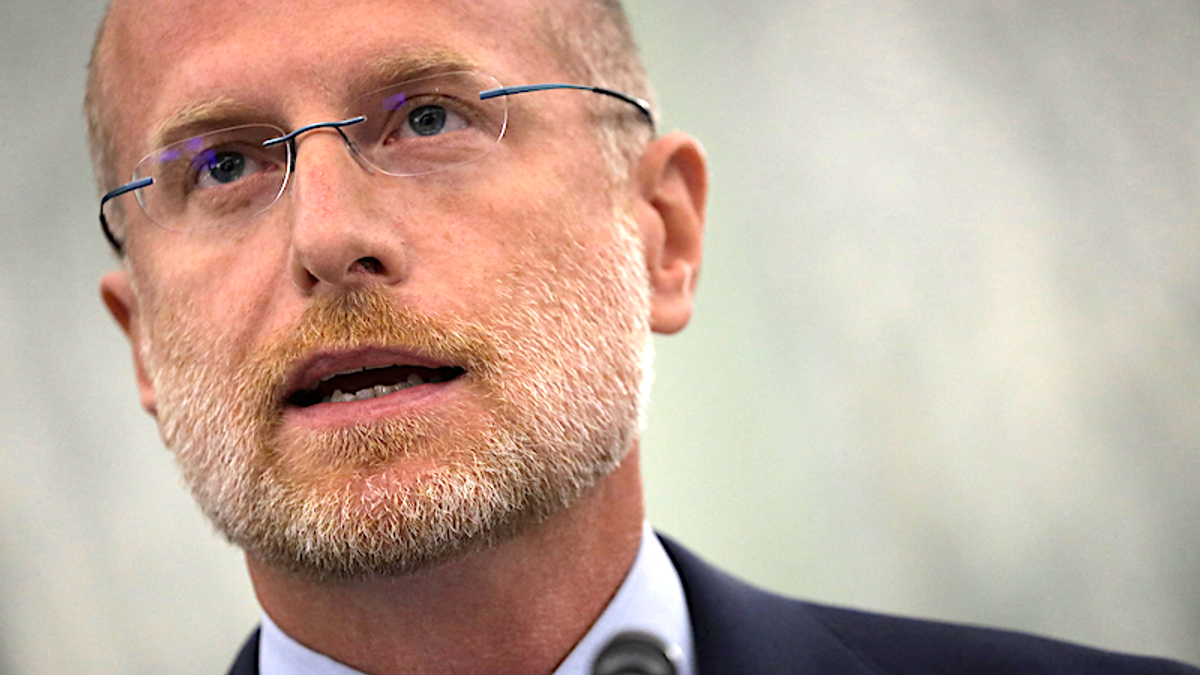
Commissioner of Federal Communications Commission Brendan Carr testifies during an oversight hearing held by the U.S. Senate Commerce, Science, and Transportation Committee to examine the Federal Communications Commission (FCC), in Washington, U.S. June 24, 2020. Alex Wong/Pool via REUTERS/File Photo

Donald Trump on Saturday took to Truth Social, his own social media site, to rage against Seth Meyers, and Commissioner of Federal Communications Commission Brendan Carr raised eyebrows by amplifying the attack.

"NBC’s Seth Meyers is suffering from an incurable case of Trump Derangement Syndrome (TDS)," Trump wrote over the weekend. "He was viewed last night in an uncontrollable rage, likely due to the fact that his 'show' is a Ratings DISASTER."

Carr shared the exact quote on social media, without even adding a caption.

Gregg Nunziata, an attorney, public policy professional, and veteran of the conservative legal movement, asked, "Why in the world is the FCC chairman posting this?"

NPR's David Folkenflik wrote, "Nation's top broadcast regulator amplifies President Trump's call for network to fire satirist who mocked him."

Politics & Poll Tracker wrote, "The chairman of the FCC, Brendan Carr, posts a screenshot of Trump post calling for Seth Meyers to be fired."

Scholar Norman Ornstein said, "Utter disgrace. Unfit for any office."

Protect Kamala Harris wrote, "NEW: Donald Trump has called for NBC Late Night host Seth Meyers to be taken off the air in an an evening tirade on social media. FCC Chairman Brendan Carr shared the post, hinting he may take action against the network."

OSINTdefender wrote, "Brendan Carr, the Chair of the Federal Communications Commission (FCC), has just posted a screenshot of a Truth Social post earlier from President Donald J. Trump calling for NBC to fire Seth Meyers."


Greenpeace says French 

uranium being sent to 

Russia


'France should end its contracts with Rosatom,' said Greenpeace
- Copyright AFP Olesya KURPYAYEVA

NOVEMBER 16, 2025

The Greenpeace environment group said Sunday that France was sending reprocessed uranium to Russia for treatment so it can be reused, despite the Kremlin’s war in Ukraine.

The group argued that while it was legal, the trade was “immoral” as many nations seek to step up sanctions on the Russian government over its invasion launched in 2022.

Greenpeace members on Saturday filmed the loading of about 10 containers with radioactive labels onto a cargo ship in the Channel port of Dunkirk, the NGO said.

The Panamanian-registered ship, the Mikhail Dudin, is regularly used to carry enriched or natural uranium from France to St Petersburg, according to Greenpeace.

But Saturday’s consignment was the first of reprocessed uranium to be observed for three years, it added.

“It is not illegal, but it is immoral,” Pauline Boyer, the head of Greenpeace France’s nuclear campaign, told AFP.

“France should end its contracts with Rosatom, a state company that has occupied the Ukrainian nuclear power plant at Zaporizhzhia for three years,” she added.

French state-controlled energy giant Electricite de France (EDF) signed a 600-million-euro ($700 million) deal in 2018 with a Rosatom subsidiary, Tenex, for the recycling of reprocessed uranium. These operations have not been affected by international sanctions over the Ukraine war.

Rosatom has the only facility in the world — at Seversk in Siberia — capable of carrying out key parts of the conversion of reprocessed uranium to enriched reprocessed uranium.

Uranium can be reprocessed so it can be reenriched and reused. With uranium prices rising again on international markets, it is increasingly worthwhile for power companies to seek reprocessing of spent fuel.

Only about 10 percent of the reenriched uranium sent back to France by Russia is used at its Cruas nuclear power plant, in southern France, the only one in the country that can use enriched reprocessed uranium, according to Greenpeace.

France’s energy ministry and EDF did not respond to AFP’s questions on the consignment or trade.

France ordered the EDF to halt its uranium trade with Rosatom in 2022 when Greenpeace first revealed the contracts in the wake of Russia’s invasion.

France said in March 2024 that it was “seriously” looking at the possibility of building its own conversion facility to produce enriched reprocessed uranium.