
Venezuela: “War Is Peace”

After declaring his second presidential victory on 6 November 2024, Donald Trump said of his first term:
‘You know, we had no wars for four years. We had no wars. Except we defeated ISIS, we defeated ISIS in record time. But we had no wars. They said, “He will start a war.” I’m not going to start a war. I’m going to stop wars.’
On New Year’s Eve, 2025, with Gaza in ruins, Trump’s anti-war fervour still burned bright. A journalist asked him: ‘Mr. President, do you have a New Year’s resolution?’
Trump replied: ‘Peace. Peace on Earth.’
Three days later, Trump launched 150 bombers, fighter bombers and attack helicopters in an illegal and unprovoked war of aggression, ‘the supreme international crime’, on Venezuela, killing around 100 people, including two civilians. Protected by intense bombing of the capital, Caracas, US troops kidnapped the Venezuelan president Nicolás Maduro and his wife, Cilia Flores.
In classic totalitarian style, JD Vance, the US vice-president, clarified that the US was, in fact, the victim and had acted in self-defence:
‘I understand the anxiety over the use of military force, but are we just supposed to allow a communist to steal our stuff in our hemisphere and do nothing? Great powers don’t act like that.’
The stolen ‘stuff’ being Venezuelan oil. Part of Vance’s claim to victimhood rests on the assertion that Maduro refused to negotiate and take ‘the off ramp’. Standing beside Trump, US Secretary of State Marco Rubio said:
‘Nicolas Maduro had multiple opportunities to avoid this. He was provided multiple very, very, very generous offers, and chose instead to act like a wild man.’
Earlier that same day, Trump had told Fox News:
‘You know, he [Maduro] wanted to negotiate at the end and I didn’t want to negotiate. I said, nope.’
The 100-death toll may come as a surprise to consumers of ‘mainstream’ media, which have shown zero interest in the people killed and maimed. If US soldiers had died, we would know their names, faces, army units, back stories, with spouses and parents expressing their grief in heart-rending interviews.
For ‘mainstream’ politics and media, the latest killing spree is just another Groundhog Day. Maduro is not perceived as a particular individual; he is perceived as the latest incarnation of the generic ‘Bad Guy’: Milosevic, bin Laden, Saddam Hussein, Gaddafi, Assad, Nasrallah and Sinwar. The Venezuelans are another anonymous crowd of (mostly) brown-skinned people indistinguishable from Iraqis, Iranians, Libyans, Syrians and Palestinians.
How did the BBC respond to this clear example of Great Power criminality? One front-page news report was illustrated by an image of a smiling woman waving both the Venezuelan and US flags. Another headline featured a woman draped in a Venezuelan flag holding a sign that read: ‘Thank you TRUMP!’
The consistent focus on women in pro-regime change propaganda is no accident, but a cynical attempt to co-opt #MeToo movement sympathies.
‘Mainstream’ outlets were happy to republish humiliating pictures originally posted by Trump on social media of the abducted Maduro handcuffed and blindfolded. Article 13 of the Third Geneva Convention (1949) states:
‘… prisoners of war must at all times be protected, particularly against acts of violence or intimidation and against insults and public curiosity’.
According to the International Committee of the Red Cross and other human rights organisations, posting and broadcasting identifiable images of prisoners of war on social media violates this article.
A ‘Brilliantly Executed Operation’
While opinion pieces were sometimes more honest, virtually all ‘mainstream’ news reports used the word ‘captured’, ‘seized’, ‘taken’, or even ‘arrested’, with Maduro said to be ‘held in custody’, as if subject to an international law enforcement operation.
In the Guardian, Aditya Chakrabortty, did at least use ‘kidnap’ and ‘abduction’ to describe the event. He added:
‘Any other country that did this wouldn’t receive indulgent op-eds about its “gunboat diplomacy” – it would rightly be condemned as a rogue state, and its oligarchs’ foreign assets impounded.’
In fact, if that ‘other country’ had been an Official Enemy, the attack would have been denounced as terrorism. Instead, it was an ‘illegal military intervention’ for the Guardian. Elsewhere, the Guardian commented:
‘Trump began his five-month campaign of military pressure in August.’
Again, a better term for a ‘campaign of military pressure’ is terrorism. Trump has quite obviously been using the threat and commission of violence to terrorise the Venezuelan government and people, and other countries, into submission.
ABC News described the attack as ‘DARING’. The New York Times described it as ‘virtually flawless’. Former BBC journalist Jon Sopel, now hosting the podcast, The News Agents, wrote:
‘There is no doubt that this has been an effective operation, brilliantly executed.
‘But what comes next?’
What Sopel would not have said if a foreign power had bombed London and kidnapped Sir Keir Starmer, or if Russia had ‘captured’ Zelensky, and what he did not say in the aftermath of 11 September 2001:
‘There is no doubt that this has been an effective operation, brilliantly executed.’
Ione Wells’ piece for the BBC contained some darkly amusing cognitive dissonance:
‘The US may want many of its foes gone from power. It doesn’t usually send in the military and physically remove them.’
True enough, if we can somehow ignore recent, salient examples like Serbia, Afghanistan, Iraq, Libya and Syria. Wells then flatly contradicted herself:
‘Even some who dislike Maduro and want to see him gone are wary of US intervention being the means – remembering decades of US-backed coups and regime change in Latin America in the 20th century.’
These being ‘decades of US-backed coups’ targeting foes when the world’s superpower did ‘send in the military and physically remove them’.
Ordinarily highly critical of Trump, the Washington Post editorial board praised the assault as a ‘major victory for American interests’ in an article with the Orwellian title ‘Justice in Venezuela’. The Post commented:
‘Trump had telegraphed for months that Maduro could not remain in power, yet Venezuela’s arrogantly illegitimate leader clung on. What are Iranian leaders thinking now as they consider how to respond to widespread anti-government protests? Are the communists in Cuba sleeping well?’
It is ‘arrogant’ for a leader of a foreign minnow to cling to power in the face of US disapproval, on the understanding that might makes right (‘justice’). It is also fine to celebrate an extension of the US terror campaign to Cuba.
At the far margins of US dissent, former Fox News host Tucker Carlson said he was ‘grateful for the wisdom of [Trump] not taking out the entire government. Not because I support the government, but because we have clear models in Iraq and Libya and a lot of Syria: it can be very hard to put those things back together again.’ Carlson said it ‘seems like a much wiser approach’ to keep the government structure in place but ‘making sure it’s pro-American’.
A stirring defence of democracy-as-slavery. Carlson, a vocal Christian, added:
‘To spend all your time worrying about Cuba? I love the Cubans here. Love them. But how much money do you want to spend out of your kid’s college fund on regime change in Cuba?’
As ever, principled dissent stretches all the way to concern for the cost to ‘us’. Tolstoy, also a Christian, would have reviled this as cruel and unchristian.
‘They Have All That Oil’
Where once leaders like George Bush, Tony Blair and David Cameron span complex lies to camouflage their efforts to steal Iraqi and Libyan oil, Trump hardly bothers. On 3 January, he stated openly that the US would ‘run’ Venezuela and take control of its oil industry:
‘We’re going to have our very large United States oil companies… go in, spend billions of dollars, fix the badly broken infrastructure… and start making money for the country… and it goes also to the United States of America in the form of reimbursement for the damages caused us.’
On 17 December 2025, Trump said of Venezuela:
‘They took our oil rights — we had a lot of oil there. As you know they threw our companies out, and we want it back.’
In June 2023, Trump lamented a missed opportunity:
‘When I left, Venezuela was about to collapse. We would have taken it over; we would have kept all that oil; it would have been right next door.’
Any doubt about the US motivation was removed by Trump’s brazen hosting of senior oil executives at the White House last week. The US would decide which companies could extract oil in Venezuela, Trump declared, with Venezuela ‘turning over’ up to 50 million barrels of oil to the US.
It has been taboo for the likes of the BBC and Guardian to mention oil as a motivation for war on Iraq, Libya and Syria. With that wilful blindness made absurd by Trump’s sociopathic ‘honesty’, even the Guardian has mentioned the three-letter O-word:
‘Operation Absolute Resolve was about exercising raw power to dominate a sovereign nation, and controlling Venezuela’s future oil production.’
Before his abduction, Maduro dismissed the alleged motives for invasion:
‘Since they can’t accuse me or accuse Venezuela of having weapons of mass destruction … since they can’t accuse us of having nuclear missiles … or chemical weapons … they have invented a claim that the US knows is as false as the claim about weapons of mass destruction that led them into a forever war. I believe that we need to set all this aside and start serious talks.’
If Maduro cannot be targeted as a ‘new Hitler’ for these reasons, Western commentators can always condemn his economic and democratic failings from their imaginary moral high ground. A January 4 Guardian editorial made the point:
‘Venezuelans have endured a repressive, kleptocratic and incompetent regime under Mr Maduro, widely believed to have stolen the last election.’
That might also be said of the US and UK governments, and certainly of their long list of tyrannical, indeed genocidal, allies. The concern for a stolen election might seem bitterly ironic given that, according to Trump, the whole country has now been stolen. Keeping Venezuela ‘pro-American’ naturally rules out any prospect of genuine democracy. Tragicomically, the Telegraph reported:
‘The US ruled out immediate elections in Venezuela yesterday. Marco Rubio, the US secretary of state, said talk of a vote was “premature”, adding that America would run Venezuelan policy through the parts of the regime still in power.’
Rubio has been nicknamed the ‘viceroy of Venezuela’ after Trump appointed him and others to ‘run’ the country – as a ‘democracy’, of course.
On January 12, Trump posted his image over the words: ‘Acting President of Venezuela’
Missing Context
Missing from the heartfelt lamentations on the state of Venezuela’s economy is the kind of context supplied in 2019 by economist Jeffrey Sachs of Columbia University:
‘Well, it’s not an economic standstill. It’s a complete economic collapse, a catastrophe, in Venezuela. There was a crisis, for sure, before Trump came to office, but the idea of the Trump administration, from the start, has been to overthrow Maduro. That’s not a hypothesis. Trump was very explicit in discussions with presidents of Latin America, where he asked them, “Why shouldn’t the U.S. just invade?” He said that already in 2017. So the idea of the Trump administration has been to overthrow Maduro from the start. Well, the Latin leaders said, “No, no, that’s not a good idea. We don’t want military action.” So the U.S. government has been trying to strangle the Venezuelan economy.
‘It started with sanctions in 2017 that prevented, essentially, the country from accessing international capital markets and the oil company from restructuring its loans. That put Venezuela into a hyperinflation. That was the utter collapse. Oil earnings plummeted. The earnings that are used to buy food and medicine collapsed. That’s when the social, humanitarian crisis went spiraling out of control. And then, in this year, with this idea, very naive, very stupid, in my view, that there would be this self-proclaimed president [Juan Guaidó], which was all choreographed with the United States very, very closely, another round of even tighter sanctions, essentially confiscating the earnings and the assets of the Venezuelan government, took place…. What the U.S.—what Trump just doesn’t understand and what Bolton, of all, of course, never agrees to, is the idea of negotiations. This is an attempt at an overthrow. It’s very crude. It’s not working. And it’s very cruel, because it’s punishing 30 million people.’
Political analyst James Schneider supplied some missing military context:
‘But if you want the political base, you must look… to a long history of coercion dressed up as “freedom”: efforts to break Venezuelan resource sovereignty, dismantle Bolivarian socialism and roll back an explicitly anti-imperial project of regional integration. In 2002, Washington backed a coup that briefly removed Hugo Chávez before a mass popular mobilisation reversed it. In 2019, the United States supported the installation of Juan Guaidó as “interim president” in an international farce that collapsed under the weight of its own fiction. There have been mercenary incursions, paramilitary plots and repeated efforts to fracture Venezuela’s armed forces. Each failed…’
On BBC Radio 5 Live, Nicky Campbell asked Schneider:
‘Let’s just establish one thing: are you pleased – take away what’s happened – are you pleased that Maduro, a corrupt man, a brutal despot, are you pleased that he’s no longer the president?’
This is the question asked of every critic of US-UK-Israeli foreign policy and is intended to present criticism of Western crimes as apologism for crimes, real and imagined, of whoever happens to be the latest Official Enemy.
Maduro is consistently damned on the grounds that the presidential elections of 28 July 2024 were unfair. In July 2024, The Carter Centre commented on the election:
‘Venezuela’s electoral process did not meet international standards of electoral integrity at any of its stages and violated numerous provisions of its own national laws. The election took place in an environment of restricted freedoms for political actors, civil society organizations, and the media. Throughout the electoral process, the CNE [the National Electoral Council] demonstrated a clear bias in favor of the incumbent.
‘Voter registration was hurt by short deadlines, relatively few places of registration, and minimal public information… The registration of parties and candidates also did not meet international standards. Over the past few years, several opposition parties have had their registrations changed to leaders who favor the government. This influenced the nomination of some opposition candidates.’
Such failings are deemed despotic, intolerable, defining Maduro as an ‘arrogantly illegitimate leader’. But how would Britain’s famed democracy respond to a 25-year campaign by an overwhelmingly superior foreign power to violently overthrow the government and steal its natural resources?
In the 1930s and 1940s, Britain was menaced by Nazi Germany, a major threat to be sure, but one which constituted a far lesser threat than that offered by the nuclear-armed US global superpower attacking tiny Venezuela. In response, the UK Emergency Powers (Defence) Act of 1939 granted the government the authority to rule by decree through Defence Regulations. As a result, British democracy was simply suspended. The general election scheduled for 1940 was cancelled and there were no local or general elections at all held between 1935 and 1945.
Habeas Corpus was also suspended, with Defence Regulation 18B allowing the Home Secretary to intern people indefinitely without trial. Under Regulation 2D, the government could suppress newspapers without warning if they published material ‘calculated to foment opposition to the prosecution of the war.’ The Daily Worker newspaper, for example, was banned.
BBC broadcasts were also vetted, with thousands of people employed to read private letters and telegraph messages. Even the spreading of ‘alarm or despondency’ became a criminal offence. People making pessimistic remarks about the war’s outcome in pubs or on street corners were prosecuted. The ‘Silent Column’ campaign encouraged citizens to report neighbours who engaged in ‘defeatist talk.’
More recently, Chelsea Manning, Julian Assange and Edward Snowden have been variously imprisoned, tortured and persecuted for leaking or publishing state secrets. Imagine the grim fate that would await a high-profile US opposition leader, the equivalent of Venezuela’s Maria Corina Machado, who helped lead failed military coups and violent street riots, and who openly supported foreign military intervention.
Whenever governments in Venezuela, Iraq, Libya, Syria and Iran face the existential threat of the Western war machine, ‘independent’, ‘objective’ Western journalists simply ignore the fact that normal democratic freedoms will be ruthlessly exploited by extremely violent Western interests bent on regime change.
In 1953, US-supplied armoured cars took to the streets of Iran to help depose the democratically elected nationalist Mohammad Mosaddegh, replacing him with the tyrannical Shah. The motivation? Oil. According to then CIA agent Richard Cottam:
‘… that mob that came into north Teheran and was decisive in the overthrow was a mercenary mob. It had no ideology. That mob was paid for by American dollars and the amount of money that was used has to have been very large’. (Quoted, Mark Curtis, The Ambiguities of Power – British Foreign Policy Since 1945, Zed Books, 1995, p.93)
On December 29, as hundreds of people were being killed in Iran’s ongoing protests, The Jerusalem Post reported:
‘On Monday, the Mossad [Israeli secret service] used its Twitter account in Farsi to encourage Iranians to protest against the Iranian regime, telling them that it will join them during the demonstrations.
‘“Go out together into the streets. The time has come,” the Mossad wrote.
‘It continued, “We are with you. Not only from a distance and verbally. We are with you in the field.”’
Mike Pompeo, former director of the CIA and former Secretary of State, posted on X:
‘Happy New Year to every Iranian in the streets. Also to every Mossad agent walking beside them…’
These brutal realities are omitted from virtually all ‘mainstream’ coverage. Targets of the Western Perpetual War machine do not have the luxury of pretending they do not exist.
DE
David Edwards is the author of the forthcoming political science fiction novel, The Man with No Face, to be published by Roundfire Books in 2026.
Asian Solidarity with Venezuela
Speak, your lips are free.
Speak, it is your own tongue.
Speak, it is your own body.
Speak, your life is still yours.
See how in the blacksmith’s shop
The flame burns wild, the iron glows red;
The locks open their jaws,
And every chain begins to break.
— Faiz Ahmed Faiz, ‘Speak’ (Bol), translated by Azfar Hussain
In the early hours of 3 January 2026, the United States carried out Operation Absolute Resolve – a large-scale military strike on Venezuela followed by the illegal abduction of President Nicolás Maduro and First Lady Cilia Flores. At least 80 combatants were killed defending the Bolivarian Revolution, including 32 Cuban internationalists who gave their lives in the service of socialist solidarity. Over the last days, across Asia and into the Pacific, people have risen to speak.
The peoples of Asia know well the weight of empire. From the anti-colonial struggles of the twentieth century to the ongoing resistance against neocolonial extraction, the history of imperialist intervention runs deep. When news emerged of US bombs being dropped on Venezuelan cities, of Delta Force commandos storming a presidential residence, of a head of state kidnapped to a New York courtroom, working people across the continent recognised the echoes of Iraq, Libya, and Afghanistan.
The list goes on.
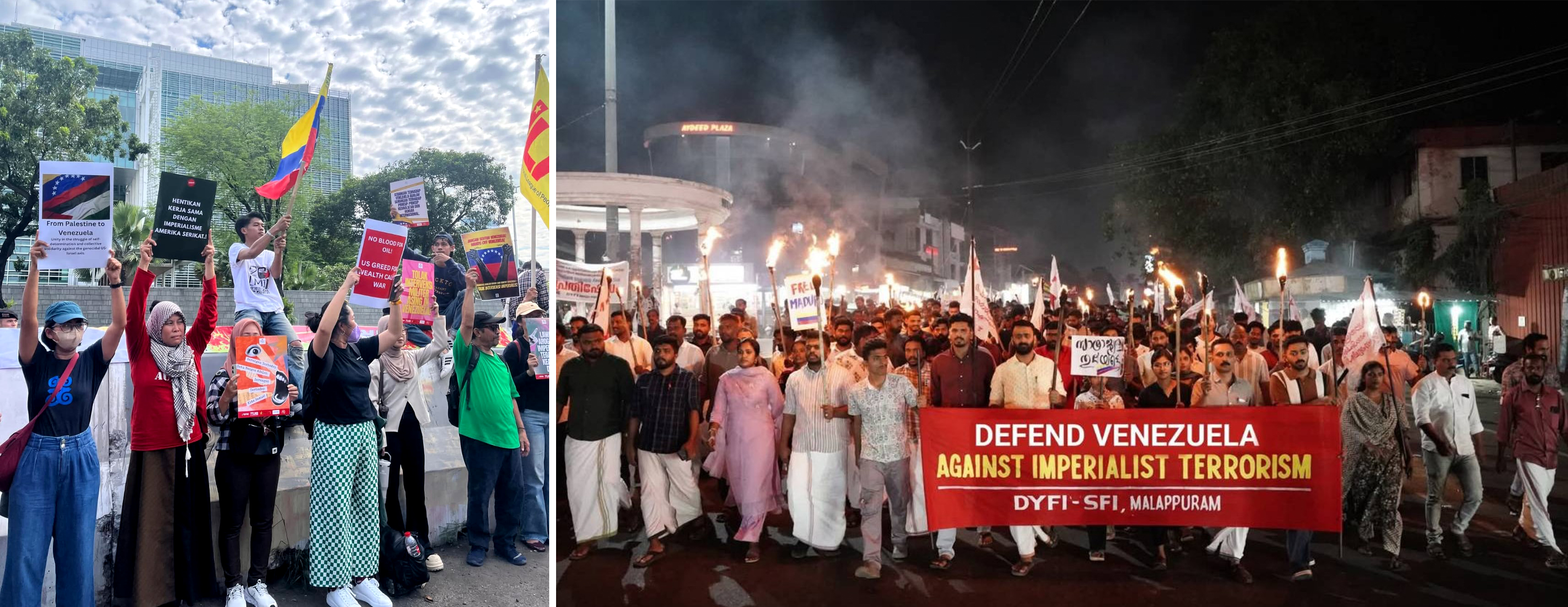
The people began to mobilise. In India, the Communist Party of India (Marxist), Communist Party of India, Communist Party of India (Marxist-Leninist) Liberation, and allied left parties issued a joint statement on 4 January calling for a nationwide day of protests. Large-scale rallies were organised across the country. In Visakhapatnam, thousands of workers at the Centre for Indian Trade Unions conference carried out an immediate march upon hearing the news. The Students Federation of India rallied in Hyderabad to condemned the assault. In Chennai, CPI(M) activists led by Control Commission Chairperson G. Ramakrishnan were detained while attempting to march towards the US Consulate. In Kolkata, activists burned effigies of Donald Trump. The left parties criticised the Indian government’s muted response and called for diplomatic actions to pressure Washington for Maduro’s immediate release.
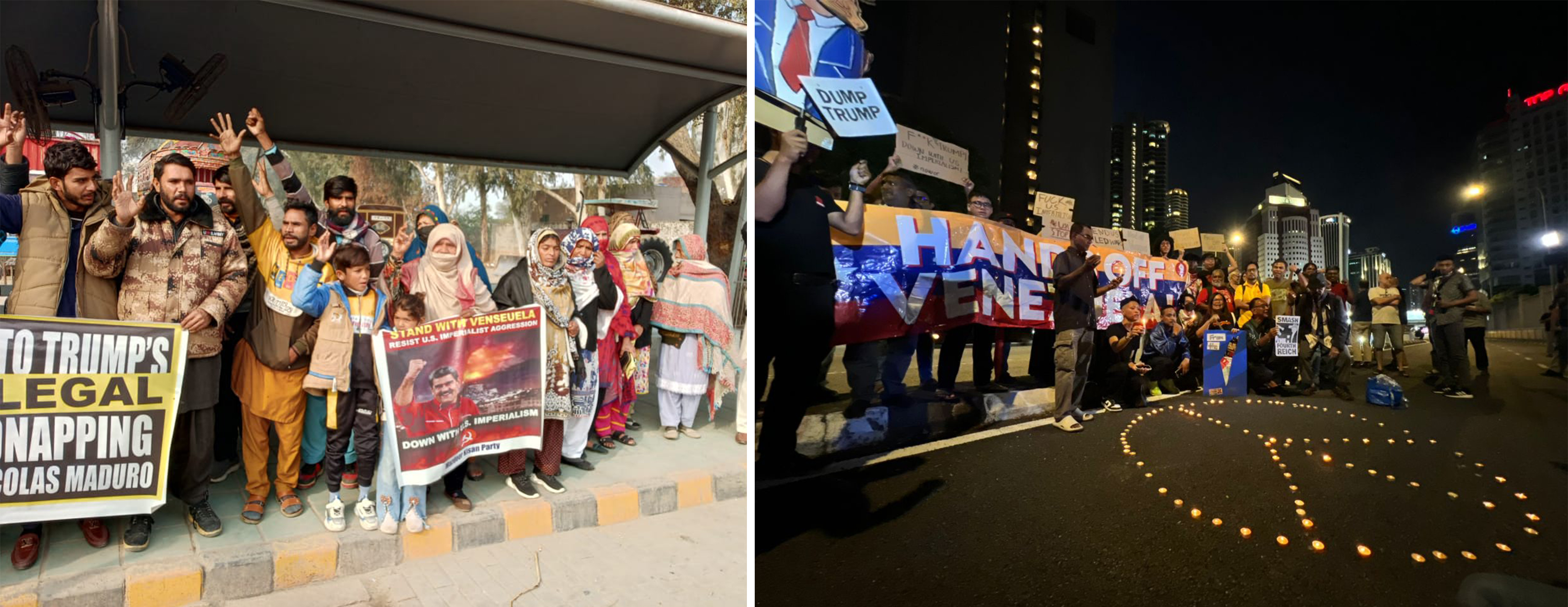
In Pakistan, the Mazdoor Kisan Party organised a protest on 6 January in Lahore, joined by workers from Malmo Foods Workers Union, Punjab Rickshaw Union, and High Tech Feeds Workers Union. The protesters understood that this aggression is not only against Venezuela but constitutes a terrifying war against working people worldwide, with US imperialism considering the resources of the entire world its property. In Karachi, the National Trade Union Federation led a large rally. The Haqooq-e-Khalq Party also organised a public meeting in Lahore expressing solidarity with Venezuela.
In Jakarta, GEBRAK (Gerakan Buruh Bersama Rakyat) – a coalition of democratic, progressive unions, student organisations, and political groups – organised a ‘Free Maduro, Hands Off Venezuela’ action at the US embassy on 6 January. Indonesia’s Non-Aligned Movement Youth Group denounced the kidnapping as a grave violation of international law.
The Socialist Party of Malaysia issued a forceful condemnations within hours of the operation: ‘The United States has once again revealed its true face – a global bully driven not by human rights or democracy, but by an insatiable greed for oil and minerals.’ Members marched to the US Embassy in Kuala Lumpur demanding respect for Venezuela’s sovereignty. A solidarity vigil was attended by Cuba’s Ambassador, who reminded participants that ‘we are the heirs of Bolívar, Martí, Fidel Castro, and Chávez’.
In the Philippines, progressive groups including Bagong Alyansang Makabayan and the Philippines-Bolivarian Venezuela Friendship Association staged an indignation protest at the US embassy, with demonstrators carrying banners declaring ‘Hands Off Venezuela’. The action exposed the contradictions facing the Philippine government, which invokes international law in its disputes with China over the West Philippine Sea while maintaining close military ties with Washington.
Across the region, the chorus continued. In Nepal, the Nepal-Venezuela Friendship Association and the Nepali Communist Party expressed solidarity; students protested at the US embassy in Kathmandu. In Bangladesh, the Workers Party of Bangladesh expressed ‘unwavering solidarity with the brotherly people of Venezuela’, characterising the US action as ‘a criminal act that recalls the darkest chapters of colonial intervention’.
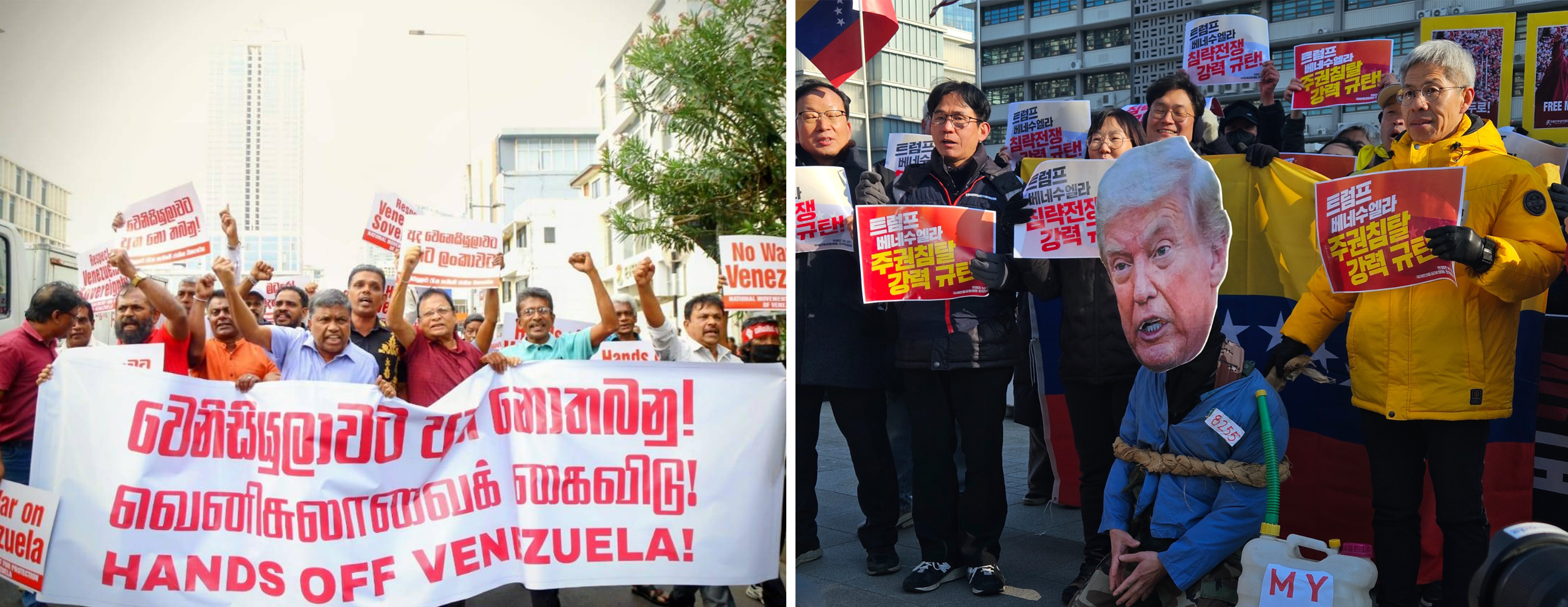
In Sri Lanka, the Janatha Vimukthi Peramuna (the main constituent of the ruling alliance), led by President Anura Kumara Dissanayake, issued a statement condemning the US military invasion: ‘Powerful countries do not have the right to violate this principle… Military aggressions and invasions against sovereign states in violation of these principles cannot be justified.’ The Communist Party of Sri Lanka also issued a statement calling the abduction ‘an act of international piracy’, and protested outside the US embassy in Colombo alongside other left-wing parties on 6 January.
The solidarity extended into the Pacific. In South Korea, a rally was organised on Monday demanding ‘US hands off Venezuela’ and its natural resources. Protesters equated the US attacks and kidnapping of Maduro with piracy and called for accountability for violations of international law. The International Strategy Center, which has long worked to build solidarity between Korean and Latin American movements, helped coordinate the action.
In Australia, thousands rallied in Melbourne, Sydney, Brisbane, Canberra, and Perth on 4–5 January. More than 1,000 people gathered outside Flinders Street Station in Naarm/Melbourne, where speakers from Red Spark, Socialist Alliance, and First Nations groups addressed the crowd, demanding that the Albanese government condemn the US and call for Maduro’s release.
What unites these mobilisations is not merely opposition to a single act of aggression, but a deeper understanding of the stakes. The US has sought to destroy the Bolivarian Revolution for a quarter century – through coups, sanctions, and sabotage – because Venezuela dared to nationalise its oil and build institutions of regional solidarity like CELAC, ALBA-TCP, and PetroCaribe that challenge US hegemony. Despite everything, the base of support for the revolution has proven resilient. Venezuela counts over 5,336 communes and Bolivarian Militias with more than eight million citizens armed. The civic-military unity demonstrated in Vice President Delcy Rodríguez’s press conference alongside Diosdado Cabello, Vladimir Padrino López, and the high command of the National Bolivarian Armed Forces of Venezuela confirms that chavista forces maintain effective control of the state apparatus.
The psychological operations of empire seek to fracture this unity through unfounded allegations of ‘betrayal’ and ‘surrender’, narratives that we should firmly reject. Revolutions are not reducible to individuals – they are collective processes rooted in the political consciousness and organisation of millions. President Maduro may be held captive in New York, but the Bolivarian project lives on in the communes, the militias, the party structures, and the streets of Venezuela

The peoples of Asia and the Pacific have shown through these mobilisations that solidarity with Venezuela is not symbolic – It constitutes a front in the broader and long-standing struggle against imperialism. The coming period calls for sustained action: building the broadest possible unity in defence of sovereignty, self-determination, and the continuity of emancipatory projects throughout the Global South.
At the centre of any common strategy stands a clear demand: the immediate liberation of Nicolás Maduro and Cilia Flores, and their return to Venezuela.
Hope will emerge from below, as it always has – from the organised people and from a committed internationalist movement willing to fill the streets and confront imperial aggression.
On 10 January, Tricontinental Asia is hosting the event ‘Kidnapping Venezuela’s Sovereignty’, a conversation on US hyper-imperialism, military intervention, and hybrid warfare against Venezuela. Please join us by registering here or watching the livestream on Facebook and YouTube.
Speak, this brief hour is long enough
Before the death of body and tongue:
Speak, ’cause the truth is not dead yet,
Speak, speak, whatever you must speak.
Warmly,
Tings Chak and Atul Chandra
Asia Co-coordinators of Tricontinental: Institute for Social Research
