Resisting the monstrous trifecta of war, genocide and ecocide
Everywhere, especially the Global South, is suffering from the ongoing effects of the imperialist carve up of the world in the 19th and early 20th centuries. This was achieved by war, genocide, colonisation and semi-colonialism, and the expropriation and theft of the Global South’s wealth.
As the damaging legacies of historic imperialism continue to play out, today’s United States-led imperialism and global capitalism has wrought even more destruction of peoples and planet; it has increased economic inequality between the Global North and South, as well as between workers and oppressed people and capitalists.
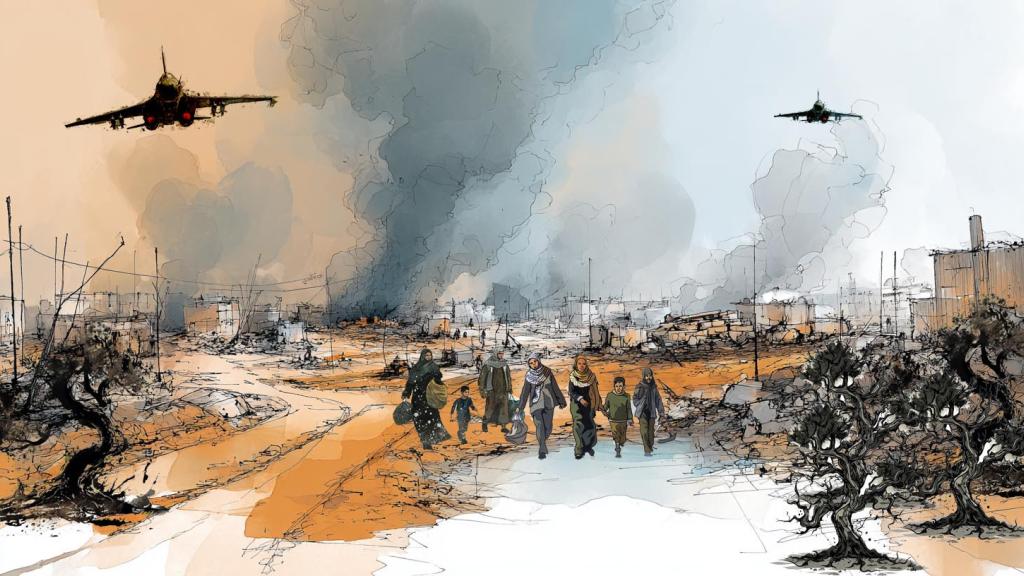
US-led imperialism and global capitalism are now reaching ever-higher levels of depravity; this is evidenced by more than two years of genocidal war on Gaza, the US’ recent illegal military assault on Venezuela and the global rolling back of already inadequate climate protections, led by US President Donald Trump.
We are now facing a monstrous trifecta of genocide, war and ecocide.
But at the same time, we are witnessing a resurgence in popular resistance to imperialism, particularly in the global movement for Palestine solidarity, Mayor Zohran Mamdani’s and the Democratic Socialists of America’s success in New York, the rise of Your Party and the Greens in Britain, the Gen-Z uprisings, pro-democracy protests in Iran and, potentially, an upsurge in anti-imperialist organising after the events in Venezuela.
Unlike earlier US administrations, the Trump administration no longer keeps up even the pretence of following “international law” because it either no longer deems that necessary, or worth the political or economic cost.
Israel and the US’ genocide in Gaza have already paved the way for the complete flouting of post-World War II institutions — the United Nations, the International Criminal Court and the International Court of Justice. While each is incredibly flawed, they were set up to purportedly prevent war and promote international human rights.
Trump’s recent actions in Venezuela, and elsewhere, are a big middle finger to these institutions and to humanity in general. When asked on January 9, if there were any limits to his power, Trump said: “Yeah … My own morality. My own mind. I don’t need international law.”
The current international situation is shaped by US imperialism’s (and particularly Trump’s) desire to shed all pre-existing fetters and solidify the US’ global hegemony.
Jason Hickel put it well on X:
Bombing Venezuela while coordinating a genocide in Palestine while threatening to attack Iran (Again) while destabilising Somalia, while carrying out a heist in the DRC [Democratic Republic of the Congo]. US imperialism is the greatest threat to peace and security in our world today.
Leaders in the Global North have largely failed to condemn the US, although French President Emmanuel Macron and German President Frank-Walter Steinmeier have criticised its aggression and denounced “new colonialism”, although without naming the attack on Venezuela.
If anyone was doubtful that there is a direct, causal link between US-led imperialism and capitalism on the one hand, and war, ecocide and genocide on the other, you only have to read one of Trump’s recent tweets:
I am pleased to announce that the Interim Authorities in Venezuela will be turning over between 30 and 50 MILLION Barrels of High Quality, Sanctioned Oil, to the United States of America. This Oil will be sold at its Market Price, and that money will be controlled by me, as President of the United States of America!
It’s clear: war and invasion for the purpose of grabbing resources (in this case oil) to make profits, control the market and create economic “growth”. Oil emissions will increase global warming and ecocide; the profits from oil sales will then be used to fuel and fund further wars and genocides, and the cycle continues.
Threat to ecosystem
We know that capitalism is incompatible with human life and the planet’s ecosystem, but the question is how much longer before it becomes uninhabitable. Many parts of the Earth are already uninhabitable. We have just experienced a record breaking heat wave in the South and Eastern states of Australia, and another bushfire season has started in Victoria. A Lancet climate change report published in October said that “heat-related deaths have risen by 63% since the 1990s, causing, on average, 546,000 deaths annually in 2012–21”.
The World Weather Attribution Annual Report said in 2025 that “human-driven greenhouse gas emissions meant global temperatures were exceptionally high [causing] … prolonged heat waves, worsened drought conditions and fire weather” as well as increasing extreme rainfall and winds associated with severe storms and floods. These have led to thousands of fatalities and displaced millions of people.
“The events of 2025 demonstrate the growing risks already present at approximately 1.3°C of anthropogenic warming and reinforce the urgent necessity of accelerating the transition away from fossil fuels,” it said.
We should note that the Intergovernmental Panel on Climate Change (IPCC) has said global warming must be limited to a 1.5°C rise by 2030 to avoid “ catastrophic climate breakdown”.
Global South countries are the most badly impacted, despite being the lowest emitters, historically and currently, as well as being victims of the colonial extractivism of resources.
Recent research by Hickel reveals that the Global North is responsible for 86% of all emissions in excess of the safe planetary boundary, which is set by scientists as 350 parts per million. This figure refers to the concentration of carbon dioxide in the atmosphere.
Global North governments, such as Australia, are driving global climate change to seek profits. They are often paid off or supported by billionaire oil and gas magnates. Currently Australia is the second-biggest exporter of greenhouse gas emissions through coal and gas. Climate Analytics says that its global fossil fuel carbon footprint is three times larger than its domestic footprint.
Capitalism incompatible with sustainability
The logic of the capitalist mode of production itself — the need for ongoing economic growth, ever increasing rates of profit and ongoing capital accumulation — is at the root of today’s ecocide.
As John Bellamy Foster states:
Economic growth, based on non-stop capital accumulation, is the main cause of the destruction of the earth as a safe place for humanity.
Renewables are necessary, but in a capitalist system they cannot provide a solution for two main reasons.
First, renewables are attractive for some capitalists, however they are utilising renewables for their own profit-making, rather than to seriously ameliorate the climate crisis.
Secondly, capitalists do not see renewables as capable of providing maximum ongoing profits. Fossil fuels are a better option because they are more marketable. There are significant costs to set up and production of renewables and the profits they return are not deemed high enough to outweigh the costs.
Economist Brett Christophers argues that solar and wind projects are simply not financially viable in a capitalist economy.
Rather than being able to thrive in the free market, renewables projects are still almost entirely reliant on some extent of state support to remain commercially viable.
The Trump administration has declared war on climate protection policies. Trump’s mantra “We will drill baby drill” is not only applied to the US, but most dramatically, in recent times, to Venezuela.
The news that Trump has withdrawn the US from the IPCC follows a litany of attacks on climate protections after he returned to office. The Trump administration withdrew from the Paris agreement for the second time; ramped up oil and gas production; massively cut funding to climate science; scrapped major offshore wind projects, and rolled back more than 140 environmental rules and regulations including pollution and greenhouse gas emission restrictions. Cutting rules and regulations on pollution and emissions will make whole communities sick.
Trump has also successfully pressured other Global North countries to back track on their existing already too weak climate targets. Following trade pressures, last year Canada agreed to boost oil and gas production. Last December, European Council and European Parliament negotiators caved under pressure from the fossil fuel industry, business associations and the Trump administration, agreeing to major rollbacks of their climate obligations.
COP30 was a cop-out. The climate conference was dominated by fossil-fuel lobbyists, and failed to secure any commitment to cut fossil fuels, protect forests, or commit to adequate financial reparations to Global South countries.
Wellthon Leal, a member of the Global Ecosocialism Network reported from COP30 that the “sustainable solutions” that lobbyists from the Global North were pushing “in reality, deepen the exploitation of Global South countries.
“Never before had the South been so sought after as a carbon-offset zone, a sacrifice area for data centers, and a region targeted for rare-earth extraction — all disguised as investment promises.”
As Hickel explained in a recent article for TriContinental:
The disaster that is being wrought is a direct continuation of colonial violence … when we understand that this is the trajectory that our ruling classes are currently planning to achieve (and which could very easily be avoided), it is difficult to see it as anything other than genocidal.
Although the organised climate movement seems to be at a low ebb in the Global North, indigenous activists are leading actions in Global South countries.
In Belem, Brazil, a People’s Summit was organised in parallel to the official COP; it brought together more than 1000 climate organisations and culminated in a 70,000 strong Global Climate March. Protesters held signs which read “agribusiness is fire”, “there is no climate justice without popular agrarian reform”, and “environmental collapse is capitalist”.
Ecocide: no longer a byproduct of war
The legal use of the term “ecocide” began with scientists raising alarm about the US’ deployment of environmental warfare during the Vietnam War, with Agent Orange and the purposeful destruction of agricultural crops.
From the mid 20th Century onwards, ecocide is no longer just a byproduct of genocide and war, but is increasingly used a weapon in itself.
This has been made painfully clear in Gaza, where Israel has embarked on a systematic process of environmental destruction involving polluting weapons: Gaza is now polluted by 40 million tonnes of debris and hazardous material, much of it containing human remains, which the UN estimates will take decades to clear. On top of this, Israel has purposefully destroyed sewage treatment plants allowing seawater to become contaminated.
Israel has fundamentally altered Gaza’s landscape through a process of forced topographic change caused by constant bombardment and bulldozing, the destruction of about 90% of agricultural land and the large-scale extraction of water.
All this is deliberately aimed at making Gaza uninhabitable. The winter storms there were extremely severe due to the effects of climate change. Israel lost no time in weaponising the storms to kill more Palestinians by preventing them accessing appropriate shelters for wet and cold weather as well as the aid blockade.
The apocalypse in Gaza continues. Israel has violated the fake ceasefire agreement, brokered by Trump in October, by up to 900 times. At least 425 Palestinians have been killed and 1158 injured since the so-called ceasefire began.
Israel has suspended more than 48 humanitarian organisations, including Medicine San Frontiers and the Norwegian Refugee Council “for failing to meet its new rules for aid groups working in the war-ravaged Gaza Strip”.
There is no doubt that the Trump administration has given Israel the green light to do what it wants in Gaza and the West Bank, which is turning increasingly into another Gaza.
Trump also gave Israel the go ahead to attack at least six countries last year, including Iran, Lebanon, Qatar, Syria and Yemen. Israel also carried out strikes in Tunisian, Maltese and Greek territorial waters on the Sumud aid flotillas heading for Gaza.
The US brokered “Peace Plan” is a new colonial project; a Mandate 3.0. It means Gaza will be dominated, occupied and under the military, economic and political control of Israel and the US. It means that Palestinians will lose any possibility of self-determination.
The UN Security Council, on November 17, 2025, endorsed this Peace Plan, with China and Russia abstaining, rather than using their veto power. This seems to confirm that China and Russia, along with other BRICS countries, do not have the political will to stand up against US hegemony on behalf of the Global South.
While the global Palestine solidarity movement continues, with key highlights being the Sumud Flotilla and the general strikes for Palestine in Italy and Spain, the trend is for Global North governments to pass new laws allowing for severe repression of the anti-genocide movement.
The weaponisation of antisemitism has led to the curtailing of basic civil liberties and the right to protest, especially in Britain and Australia. In the latter, the federal and NSW Labor governments are weaponising the Bondi attack to attack anti-genocide activists.
The unceasing horror of Israel’s genocide in Palestine has sharpened anti-colonial consciousness, including that US imperialism needs Israel as its bulwark in the Middle East.
Sudan genocide
In addition, the genocides in Sudan and the Congo are equally horrific. The so-called civil war in Sudan is the world’s worst humanitarian crisis. This genocide is visible from the air—dark spots of blood appear on satellite images.
Since 2023, when the war between Sudan Armed Forces (SAF) and RSF (Rapid Support Forces) began, more than 150,000 have been killed, 13 million have been displaced, and half the population is facing famine.
Sidgi Kaball, of the Sudanese Communist Party, says the war in Sudan is not a civil war in the traditional sense but a counterrevolutionary war, conducted by a parasitic comprador elites in the military, who are using the war to completely crush Sudan’s pro-democracy revolution of 2018.
At the same time, the United Arab Emirates (UAE), which is bankrolling the RSF, has already extracted and profited from Sudan’s gold and wants to continue to do so.
US allies in the region — Egypt, Saudi Arabia and the UAE — have formed the “Quad” group to supposedly take charge of negotiating an end to the ongoing war. They are not neutral actors; all are working to maintain their contracts in Sudan with corporations such as Caltex and BP.
The Quad countries have a direct economic stake in continuing the violence, because they make profits from the resources extracted during the war in Sudan.
Meanwhile, there is now evidence that Australia is involved in the genocide in Sudan. The UAE (which is arming the RSF), purchases most of its military equipment from the US and its Western allies, including Britain, France, Germany, Israel and Australia. According to the UN’s Comtrade database, over the last five years, the UAE has been the single biggest customer for Australian arms exports and Australia was UAE’s fourth-largest supplier of weapons over that same period.
The people of the Democratic Republic of the Congo (DRC) are also dealing with a genocide, which has been ongoing for more than 30 years. The wars are being fought over minerals, such as cobalt and gold, and now the various rare-earth minerals used for high tech industry and electronic devices.
The situation escalated in 2025 when the Rwanda-backed M23 militia drove the national Congolese army out of Goma. The ensuing conflict has caused record levels of violence against the civilian population. At the same time rare-earth minerals continue to be extracted providing super profits for capitalists in the Global North and China.
Constant wars the corollary to genocide
US imperialism needs war. A new war with Venezuela and the threat of conflict with the rest of Latin America and Greenland shows up Trump’s hollow claim to want to end all wars.
US-led imperialism faces, but can’t resolve, threats to US hegemony from China’s growing economic strength, the environmental crisis and capitalism’s recurring economic crises.
To counter these threats, the Trump administration is making sure its military domination is unchallenged. Its solution is more war. At the same time, the global imperialist ruling class is falling over itself to defend US hegemony.
The US National Security Strategy (NSS) 2025 document, released in December, unabashedly describes the new policy as a return to unchallenged domination of the Western Hemisphere through a revival of the Monroe doctrine. Trump calls his Monroe doctrine the “Donroe doctrine”.
Rise of the far right
US-led imperialism, in combination with four decades of neoliberal policies, are fuelling the rise of the far right. The ruling class is using the far right to enlist a part of the working class in its battle to defend US hegemony. This is very different to the ways in which fascism was used to crush a huge socialist and communist working class, and its real power, in the 1930s.
The contradiction here is that the ruling class is making more profits than ever; recent statistics show the top 0.001% own three times more wealth than the poorest half of the world’s population combined. US imperialism is still the world’s dominant economic, military and cultural power.
An article in Foreign Affairs early in 2025 noted its corporations still control the commanding heights of the global economy. But, despite this, ideologically their power is uncertain, as is their economic hegemony.
Trump’s demand on NATO countries to increase their military spending proves the point that war is necessary to Trump’s project. It is akin to Hitler’s move to make re-armament a national economic priority before World War II.
But because the US already spends more than any other country on the military, his announcement reveals a certain desperation to hold onto global power and to cement it by any means necessary. Trump claims tariffs will pay for this, but we all know the US’ own working class and oppressed groups are the ones who will pay.
Trump eyes off oil
Although Venezuela is Trump’s key target, he has threatened Colombia and Mexico, and his Secretary of State, Marco Rubio, has threatened Cuba. Trump wants full domination of the Americas to the exclusion of rival capitalist powers.
The attack on Venezuela was Trump’s most aggressive foreign military action yet, striking Caracas, as well as other parts of the country and kidnapping President Nicolas Maduro and Cilia Flores.
While for more than 20 years, the US has been trying to overthrow the Venezuelan government and has backed coups in Latin America throughout the 19th and 20th centuries, there is a difference in the level of audacity.
This was not a covert operation, but one announced with pride and fanfare. The US military build-up, including warships, planes and soldiers in the Caribbean, was at first posed as necessary to fight drug trafficking and narcoterrorism, despite no evidence being produced.
Trump has since made clear the attack is all about Venezuela’s oil and economic control of the region. Tellingly, Trump tipped off oil CEOs about the attack before he consulted anyone else in his administration. Trump said that, as part of the takeover, major US oil companies would move into Venezuela, which has the world’s largest oil reserves, and refurbish supposedly badly degraded oil infrastructure, a process experts said could take years.
While Socialist Alliance has expressed criticism of Maduro for failing to publicly show the 2024 election results and for his suppression of dissent, it has always condemned the brutal US sanctions and blockade, which has led to the deaths of thousands of Venezuelans and destabilised the country. We demand the US leave Venezuela and allow Venezuelans their right to self-determination.
Latin American unity is unraveling as far-right governments are elected, including Argentinean President Javier Milei, a Trump supporter, and José Antonio Kast in Chile, the son of a Nazi Party member and an admirer of Pinochet.
The attack on Venezuela raises the question of how this will affect Russia’s war on Ukraine, the US’ rivalry with China and other global conflicts.
The US’ policy of “containing” China and expanding NATO to encircle Russia has not changed.
However, Trump has made clear he wants NATO members and the EU to take greater fiscal responsibility for the Ukraine war. In June they succumbed to pressure and agreed to increase their military spending to 5% of GDP annually. Trump is likely to broker a deal for Ukraine, where Ukraine loses more.
The aggression of countries, including Russia and China, on their neighbours should not be seen as inter-imperialist rivalry, but as attempts to pursue their own independent economic projects and military strategies — which are not in the interests of working people.
However, the ultimate domination of US-led imperialism exacerbates the conflicts and antagonisms of non-imperialist states, with often horrific repercussions. The situation for the Kurds in North East Syria epitomises this.
Kurds have been the target of slaughter at the hands of competing countries, such as Turkey, Iran, Iraq and Syria, for decades. Now, the Ahmed al-Sharaa Syrian regime, backed by Turkish armed forces and allied mercenary militias, are attacking and destroying Kurdish neighbourhoods of Aleppo, in northern Syria.
Diplomacy, not more war
Four years after Russia’s invasion of Ukraine, with loss of life and environmental destruction in the extreme, it is evident that it is a catastrophe for both countries. According to the British Ministry of Defence, more than one million Russian troops have been killed or injured since February 24, 2022 and between 60–100,000 Ukrainian personnel have been killed with total casualties reaching approximately 400,000.
Diplomacy, rather than more war, is needed to resolve the conflict. But war is profitable, and means that the United States and its Western allies’ can continue to dominate the global capitalist world order. Russia’s war on Ukraine is also profitable for Putin and Russian elites, and for big oil companies which have made billions since the invasion.
China’s response to Venezuela has, so far, been lukewarm and primarily shaped by its desire to protect its economic interests, which include oil, in the country.
China, like other members of BRICS, have been incapable of condemning the US. They are not a real counter to US-led imperialism because they too want to maintain their own capitalist interests; they need to maintain growing profits in the global market and balance their own sovereignty with maintaining a mutually beneficial relationship with the US.
China does not play the role the former Soviet Union (with all its flaws) once did.
US-led imperialism and global capitalism is at the root of ecocide, genocides and constant wars.
What is the antidote? The only force capable of making meaningful cracks in the imperialist and capitalist armour is a mass movement of international ecosocialism. And this is what we need to build.
