Will China, Kazakhstan back plan to form a river trade route to Russian Arctic ports? The odds have shortened
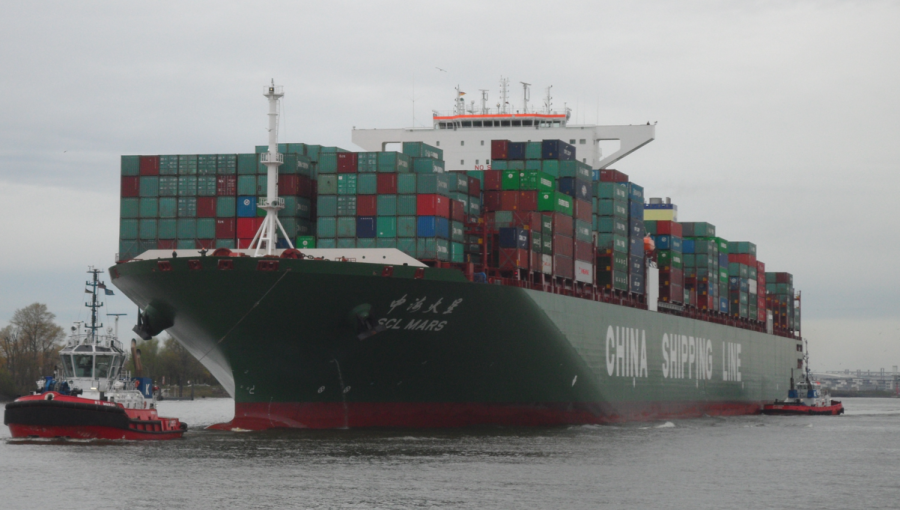
Proposals for a grand project that would open up a river trade route linking China and Kazakhstan to Russian Arctic ports are getting another look from the three parties.
The northern trade corridor would see shipments transit the Irtysh and Ob rivers. If successfully delivered, the initiative would provide Arctic port infrastructure at the base of Russia’s Yamal Peninsula for the export of Chinese and Kazakh goods. However, the use of an Irtysh-Ob river system for such trade would not be new. In fact, in the 1970s, shipments on the route hit an estimated high of 9mn tonnes/year. Trade flows, however, crashed after the 1991 disintegration of the Soviet Union.
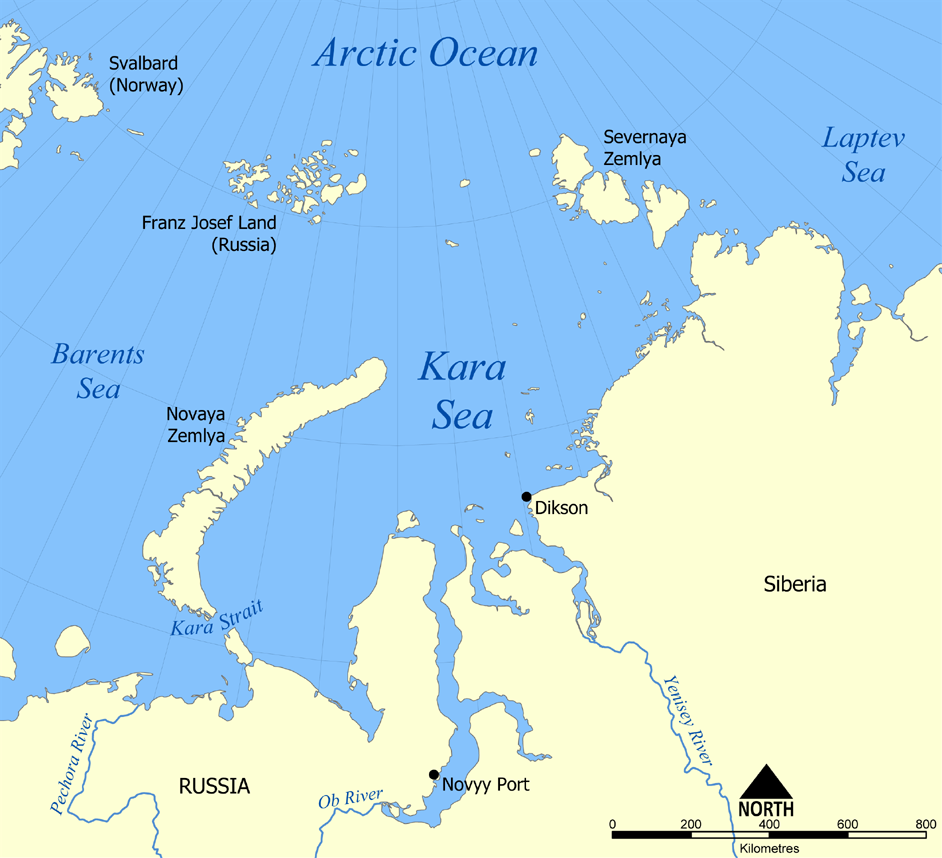
Russia's Ob River flows to the Yamal Peninsula, where it empties into the Karal Sea, a marginal sea of the Arctic Ocean (Credit: Norman Einstein, cc-by-sa 3.0).
The growing appetite for reviving the corridor appears to stem from renewed interest shown by Beijing. The big difficulty is that the project would not come cheap. Some observers think tens of billions of dollars in investments would be required.
Kazakhstan, nevertheless, published an ambitious development plan in 2024 for its section of the envisaged river system. The plan, if implemented, would boost river cargo volume from almost nothing to 2.5mn tonnes/year by 2028. It would also mean the construction of dock and loading facilities with the capacity to handle 4mn tonnes/year and create a passenger ferry service that could transport up to 700,000 passengers/year, strengthening tourism in the process.
“Billions can be earned by transporting cargo along our own section of the Irtysh alone,” official news agency Kazinform quoted economist Askat Dyusembayev as saying.
Russian interest growing too
If there is revived Chinese and also Kazakh enthusiasm for the corridor to the Arctic, where does Russia stand?
Eurasianet reported on September 1 that the “exigencies of the war in Ukraine” have generated a sense of urgency that is pushing Russia to back the Irtysh-Ob project.
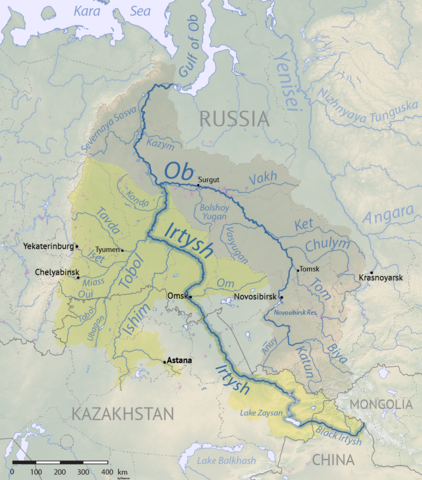
The Irtysh flows for 4,250 kilometres (2,641 miles) from Xinjiang, China and through Kazakhstan and Russia prior to merging into the Ob (Image: Shannon 1, cc-by-sa 4.0).
Quite apart from offering Russia’s war-stressed economy a dose of new momentum, the development of the cargo route to the country’s northern seas could potentially offer the Kremlin an alternative logistics channel for obtaining goods that are subject to Western sanctions, including dual-use items relevant to Russia’s military needs.
Evolving position of China
China’s position on the proposed route is evolving, but might best be described as showing a cautious openness. An August 30 report by Hong Kong’s South China Morning Post (SCMP) might be taken as indicating a receptive Beijing’s keenness to obtain a Russian gateway to Arctic shipping.
SCMP’s assessment suggested that the strategic and geoeconomic considerations of China – where the Irtysh originates as the Black Irtysh in its western Xinjiang Province in the Altai Mountains – could increasingly outweigh Beijing’s concerns about the project’s expense.
Looking for better resilience in its world trade transit options, given the potential for further disruptive clashes with superpower rival the United States, China could decide that dependable access to the Arctic seas would help defend Beijing’s economic interests. If key sea trade lanes running to and from China, became entangled in geopolitical tensions, the Russian Arctic opening could provide a valuable alternative. The use of Arctic shipping routes has nowadays also been made more attractive by climate change, with the melting of ice opening up previously ice-bound passages of the far north.
Of course, if the ambitious investment were to move forward, China would be expected to provide a substantial share of the financing, given its strategic interest rolling out the project.
River of ‘friendship and development’
The proposals for the corridor were discussed at an international forum, titled “Irtysh – River of Friendship, River of Development”, held in Pavlodar in northeastern Kazakhstan and attended by more than 150 delegates from Kazakhstan and Russia, Zakon.kz reported on September 28.
The forum brought together representatives from the Pavlodar, East Kazakhstan and Abai regions with officials from Russia’s Omsk and Tyumen regions and Khanty-Mansi autonomous district. A central focus was the development of navigation on the Irtysh and the use of the river for cargo transport, including the possibility of connecting river routes with existing road, rail and air infrastructure.
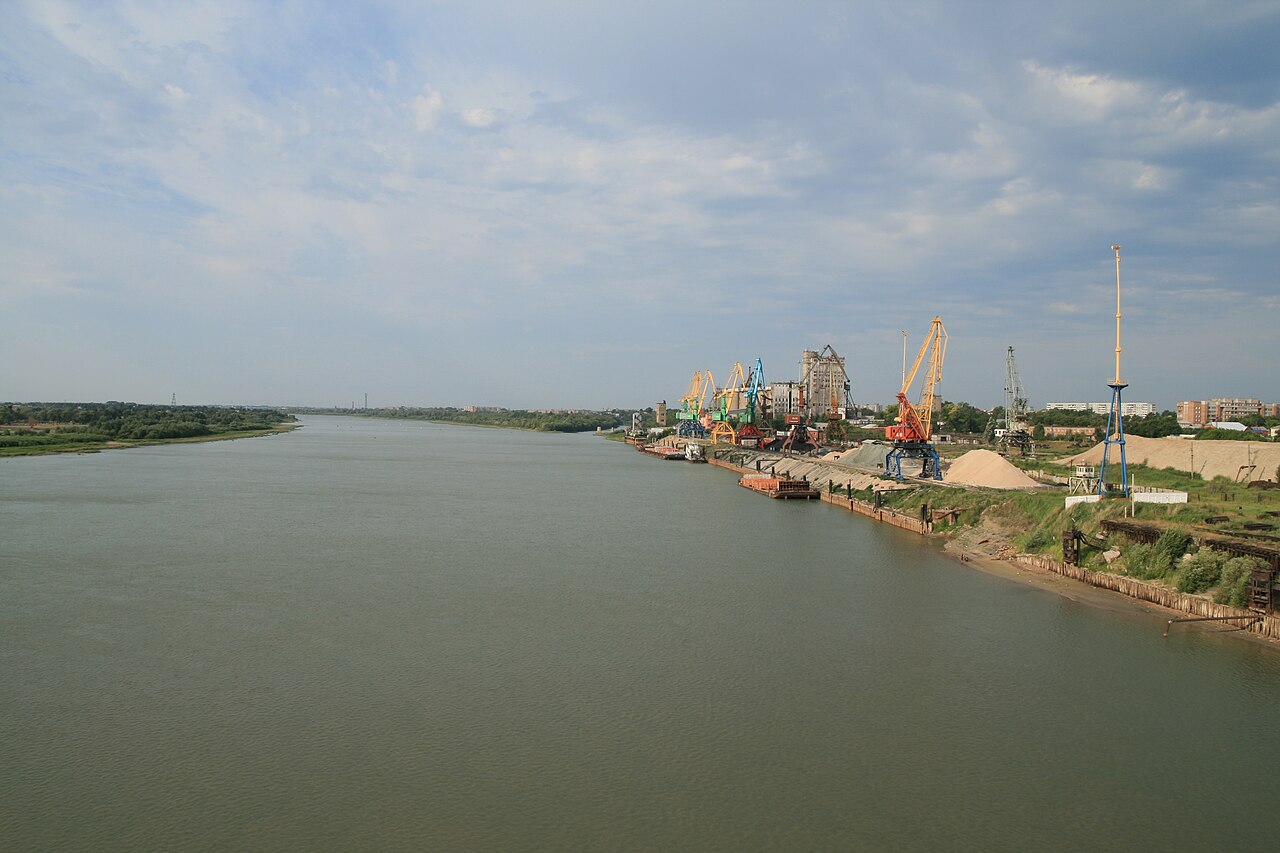
The Irtysh and riverside docks seen in Omsk, Russia (Credit: Bernt Rostad, cc-by-sa 2.0).
Pavlodar is positioned as a potential hub because of its location on the Irtysh and its links to both Russia and China. The region shares a border with Russia that runs for more than 700 kilometres (435 miles) and is one of Kazakhstan’s largest industrial centres, producing 42% of the country’s electricity, 60% of its coal, 56% of its ferroalloys, 32% of its fuel and all of its aluminium.
Pavlodar regional akim (governor) Asain Baikhanov was reported as saying that the development of transport infrastructure would have to be matched by sufficient cargo volumes and greater multimodal integration between different modes of transport.
“Our specific task is to create a modern transport and logistics system that will unite river, rail, road and air transport and ensure more efficient movement of cargo between Kazakhstan and Russia,” Baikhanov was quoted as stating.
Russia is already a major trading partner to Pavlodar. Bilateral trade between the region and Russia reached $1.6bn in 2025 and stood at $720mn in the first six months of 2026 (trade between Russia and Kazakhstan as a whole stood at approximately $27.4bn in 2025).
Zakon.kz cited Russia’s Omsk Region governor Vitaly Khotsenko as outline how the Irtysh and Ob could provide a trade channel leading to the Northern Sea Route and the Kara Sea, an extension of the Arctic Ocean north of Siberia.
Khotsenko also said that Omsk in southwestern Siberia was discussing the creation of a multimodal transport hub with customs facilities as part of the potential China-Kazakhstan-Russia corridor developed along the Irtysh.
“It will only be viable if there is sufficient cargo flow,” he reportedly said, adding that Russian and Chinese partners were already working to identify goods that could be transported along the route.
Infrastructure work was already being considered to support greater river traffic, according to Baikhanov. Pavlodar authorities were clearing and deepening sections of the Irtysh and had proposed coordinating those works with Russia, he added. Baikhanov also reflected that the involved countries would have to identify cargoes for which river transport would be economically viable and establish permanent shipping routes.
“For business, the speed and predictability of delivery are just as important as the cost of transportation,” Baikhanov said, calling for infrastructure development to be accompanied by digital integration and coordinated decision-making across the board.
The forum also produced a broader proposal for an “Irtysh transport-logistics and environmental corridor”. It would combine cargo transportation with environmental management along the river. Chingiz Kusegenov, founder of Waste Management Holding, was cited as saying that the corridor could shift some existing freight flows to water transport, reduce pressure on road and rail infrastructure and create additional opportunities for trade.
It is this “environmental corridor” that probably needs to be higher on the priority list of the Kazakh, Russian and Chinese authorities. It is unclear as things stand what exactly this corridor will address, though Kazakhstan in recent years has seen mounting fears of shallowing rivers.
Shallowing water levels or poor management?
A 2023 investigation by Orda.kz examined sharp fluctuations in the level of the Irtysh River in Kazakhstan, after water levels in Pavlodar fell during the year before rising sharply in autumn. The episode raised questions over whether China’s growing water withdrawals from the transboundary river were responsible, or whether Kazakhstan’s management of its reservoirs was a larger factor.
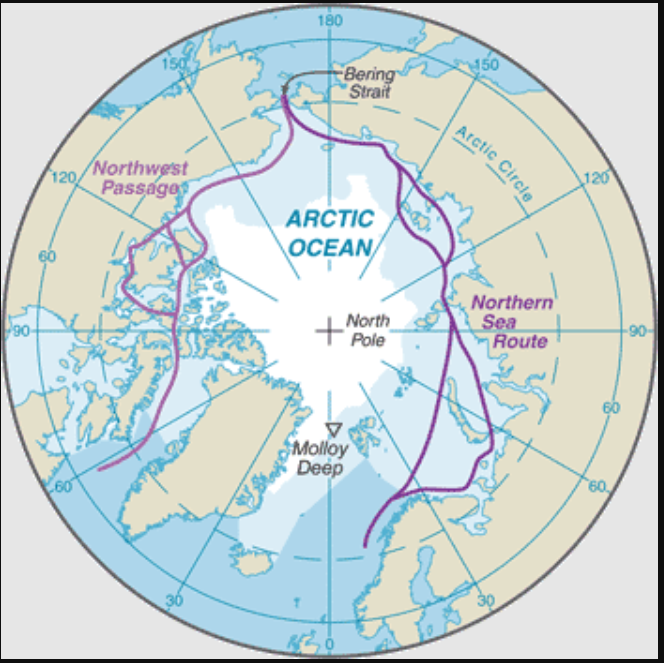
Effects of climate change are making Arctic Ocean routes increasingly navigable. On the other hand, if water levels of the Irtysh drop too far amid global heating, the idea of an Irtysh-Ob river transit system running to Russia's far north may become impracticable (Credit: CIA, public domain).
Orda.kz’s assessment pointed out that China was taking rising volumes of water to meet needs of arid Xinjiang, while an agreement signed by Kazakhstan and China in 2002 provided only broad principles for the use and protection of such transboundary rivers. A separate agreement on water allocation has been under discussion for about a decade.
Svetlana Mogilyuk, chair of the Ecoforum Kazakhstan association, told Orda.kz that China’s influence on the overall volume of the Irtysh was limited, as Chinese inflows accounted for only around one-third of the river’s flow. Kazakhstan and Russia account for most of the remainder.
Mogilyuk also pointed to Kazakhstan’s water-management data, which showed that inflows from China had fallen by 21.5% over the preceding decade. In absolute terms, however, that represented a decline of approximately 2.1 cubic kilometres of water against an annual Irtysh flow of approximately 95 cubic kilometres.
Mogilyuk cautioned against describing the situation simply as the river becoming shallower. “When it comes to the Irtysh, the word ‘shallowing’ should not be used,” she said, arguing that the river is heavily regulated by a cascade of reservoirs, particularly the Bukhtarma and Shulba reservoirs.
She suggested that natural factors, including recurring low-water years such as 2023, also affected the river, but considered human management the more important factor determining water levels.
Comments from Pavlodar regional lower house of parliament member Nurzhan Ashimbetov were in tune with those of Mogilyuk. He attributed the year's fluctuations primarily to reservoir regulation and the absence of adequate water release.
"In the spring, a portion of the water must be released from the reservoirs into the river floodplain. This is known as an environmental flow. However, in the Bukhtarma Reservoir, for instance, the required volume of water is not being accumulated for this purpose. This year, it held only 24 cubic kilometres, compared to its design capacity of 49 cubic kilometres,” Ashimbetov told Orda.kz.
Likewise, Ashimbetov attributed the subsequent rise in autumn water levels to poor reservoir management.
Mogilyuk argued that Kazakhstan needed to change its approach to managing water resources by taking into account the management of the entire river basin rather than treating rivers themselves as the primary channels for moving water.
“Water managers, when talking about rivers, often proceed from the technical parameters of flow, treating rivers as channels or even as water-supply systems,” she said. “They completely fail to take into account the role of basin territories where the flow is formed.”
Will Irtysh issues remain unaddressed?
The more widely-known Irtysh projects do not appear to adequately address key issues plaguing the river. For instance, canals remain an essential part of Kazakhstan’s water infrastructure and that is particularly the case when it comes to regions that rely on water transferred from the Irtysh to meet industrial and municipal demand, including water-deficient Karaganda Region. And this demand is growing.
Reports published in May showed that Kazakhstan is carrying out a major reconstruction of Satpayev Canal, which transfers water from the Irtysh to central regions, including Karaganda.
Such projects are not well aligned with attempts to weigh and address the realities, or otherwise, of lower water levels. Compounding environmental issues are overall likely to become additional obstacles to the bid to reach the Arctic via an Irtysh-Ob corridor.
Other challenges that could limit the viability of forming an Irtysh-Ob-Artic shipping route, include the fact that parts of the Ob freeze over for as much as six months each year, while drought and intensive irrigation have contributed to lower water levels and disrupted barge traffic in some Russian regions, according to Eurasianet’s report.
On top of that, as reported by the media outlet, a report published this year by Rivers without Boundaries describes how water levels on the Irtysh in Kazakhstan’s northeastern region of Abai can fall to around 105 centimetres, making the river too shallow for cargo vessels.
By comparison, water levels in Russia’s Omsk average around 2.5 metres. To address this issue, Kazakh authorities have brought in Russian experts to assist in developing measures aimed at maintaining a depth of at least 1.6 metres along Kazakhstan’s section of the Irtysh.
Restoring navigation would also require substantial upgrades to the locks and bypass infrastructure around Soviet-era power stations, as the poorly constructed locks make parts of the river impassable, Eurasianet’s report said, citing Kazakh experts.
In Orda.kz’s assessment, Mogilyuk also warned of a potential longer-term pressure on the Irtysh from gold-mining projects being developed along tributaries, although she described this as a prospective rather than an established problem.
Moving ahead, Moscow, Beijing and Astana will no doubt face a tough challenge in addressing all the difficulties undermining Kazakhstan’s water infrastructure, if the megaproject to send cargo all the way to the Arctic is to see the light of day.

No comments:
Post a Comment