Showing posts sorted by date for query Josephine Baker. Sort by relevance Show all posts

Saturday, October 24, 2026

Josephine Baker: the woman behind the icon


A festival celebrating Josephine Baker takes place on 24 and 25 October at her former home, the Château des Milandes in Dordogne. Organised by the anti-racism group LICRA, it honours the actress, singer, wartime spy and civil rights campaigner. To mark the occasion, we look back at her extraordinary life, from the stages of Paris to the fight against racism. #RFI360

Monday, July 13, 2026


France: Anti-Fascist Historian Marc Bloch Inducted Into National Panthéon


Pablo Meriguet |


The medievalist scholar was captured by the Gestapo while participating in the French Resistance and was later tortured and executed by firing squad.


Historian and resistance fighter Marc Bloch is inducted into French pantheon. Photo: AP

Those of us who studied history in university will likely remember the day a professor told us about the historian who changed the course of historical studies by moving away from the traditional way of recounting the past, which, until then, had focused on great figures, a military history of famous generals, and an almost obsessive examination of diplomatic documents.

This historian, along with other greats of the field, had set out to study the past in terms of its deep social interrelationships, drawing on methods from other sciences such as sociology, economics, and even psychology.

Up to that point, nothing in the story could inspire even the least enthusiastic of the students. But then the teachers told us about this historian’s life – or rather, about his death. A great lover of history and the French people, during World War II (after being removed from his professorship for being Jewish) he wrote a sort of academic testament in which he masterfully demonstrated what a historian’s work entails, but he never finished it because he decided to join the Resistance against the Nazis and their collaborators.

He was captured by the Gestapo, who tortured him for several hours before putting him before a firing squad. It is said that his last words were “Vive la France!” before the thunderous sound of German rifles ended the life of one of the most brilliant minds of the 20th century.

The legacy and the Panthéon

His name was Marc Bloch, and a few days ago the French government decided that his remains should be interred in the Panthéon, a place where the remains of some of the most important men and women in French history rest. Voltaire, Rousseau, Victor Hugo, Jean Jaurès, Marie Curie, Simone Veil, Aimé Césaire, among others, are part of a place that seeks to honor and immortalize the spirit of a nation – a place to which the historian is now added.

Bloch was born on July 6, 1886, in Lyon, into a Jewish family, although Bloch himself would say that the only time he would openly state that he was Jewish was when an anti-Semite was present. He fought in World War I, where he rose to the rank of sergeant and later to captain due to his valiant service, for which he was awarded the national Order of the Legion of Honor.

After the Great War, he returned to university classrooms, first in Strasbourg and then at the Sorbonne. In 1929, together with Lucien Febvre, he founded the now-famous “Annales d’histoire économique et sociale,” a journal that embodied the aspiration for a new way of telling history, focused on a vision of the past that moved away from mere biographies of great figures and accounts of major battles.

He wrote the now-classic history books “The Royal Touch: Monarchy and Miracles in France and England, Feudal Society,” and “Strange Defeat: A Statement of Evidence Written in 1940,” among others. But his most celebrated book is probably “The Historian’s Craft,” the aforementioned academic testament that seeks to synthesize his vision of the historian’s craft – a text that is absolutely indispensable for anyone interested in historical studies and that marked a turning point in the discipline.

And perhaps the most curious thing of all is that his most famous book is incomplete. Facing the nefarious Vichy regime, Bloch (who had already lost his property and his university positions because he was Jewish) decided to leave everything behind and join the French Resistance against the Nazis and the French collaborators. Precisely because he was a great historian, Bloch understood that although history is written in books, in moments of life such as those of World War II, it demands to be written even with one’s own spilled blood.

A symbol of resistance

The anti-fascist Bloch thus became a symbol of the militant historian – one who, most radically, breaks away from any conception of the academic as an immune sage detached from reality. This image of Bloch, forged over time, inspired thousands of history students to approach the past with the seriousness required of those who dare to change a reality that, by all accounts, falls short.

Furthermore, he definitively shattered the old myth of the historian as that unblemished being who, neutral in his aspirations, chooses not to get involved in history so as not to taint a judgment that was supposedly meant to remain pristine. Bloch knew that pursuing impartiality in the face of history was impossible, so he decided to give his life for a nation he loved deeply.

Macron and his intentions

President Emmanuel Macron has thus decided to induct another anti-fascist into the Panthéon. He had previously honored politician Simone Veil, artist Josephine Baker, and Armenian poet Missak Manouchian – all of whom, alongside Bloch, suffered and fought in their own way against the racist and predatory machinery of the Third Reich.

In his official speech, Macron highlighted Bloch’s “ardent defense of secularism.” “With heart and reason, a true republican, an ardent and tireless defender of secularism, Marc Bloch suffered the consequences of the state-sanctioned anti-Semitism instituted by Marshal Pétain’s government … Marc Bloch unites France and history, the Republic and science, government and reason. This approach and this connection remain today the best antidotes to the poisons of historical revisionism.”

Macron hopes to send a clear message against the far right, which appears to be growing by the day in France. In fact, the Bloch family requested that no representatives of any far-right political party be present at the induction of their ancestor into the Panthéon, a right that party leaders would normally have at such ceremonies.

This is because, curiously enough, intellectuals in France still play a very prominent role in public debate, and the far right’s reinterpretation of history – especially that which, in one way or another, vindicates the French far right to a greater or lesser extent (including those who collaborated with the Nazis and others) – has gained traction in recent years.

However, Macron is also facing criticism suggesting that his political decisions have facilitated the rise of the far right, such as when he dissolved parliament or, despite certain unofficial promises, decided to form a government without the participation of the left, which had pulled off a surprise victory at the polls despite the far right’s advance.

Despite this, the move has been applauded by most of the left, the center, and even by that nationalist wing of the French right that sees this medieval historian as a shining symbol amid a regression to very dark times for France. Bloch has thus become the heir to those who view the past as a fundamental tool for transforming the present.

And although he was a medieval historian, he was well aware of the dangers looming over France in the 1930s and 1940s precisely because he understood that history is sometimes a beast that seems very slow, but which at any moment can deliver a devastating blow that changes everything. Today, his example sheds light on the dark days of those who will come face to face with other beasts that are quickening their pace.

Courtesy: Breakthrough News

Monday, June 01, 2026

Swing Youth: In Nazi Germany, jazz was an act of defiance
DW
05/31/202

The Nazis denounced jazz music as "degenerate art," despite its widespread popularity in Germany. As the Nazis clamped down on expression, groups of jazz-loving teenagers formed the Swing Youth to rebel.


Josephine Baker was a star in Germany before the Nazis seized power
Image: TT/IMAGO


The interwar Weimar Republic period is often referred to as a "Golden Age" of culture and creativity in Germany. It was a time when groundbreaking movements, from Bauhaus architecture and experimental cinema to avant-garde art and theater, flourished against the backdrop of economic catastrophe and extreme political polarization.

In cities such as Berlin, where speakeasies, cabarets and hedonistic nightlife were the norm, a radical new genre of music became immensely popular. Jazz, which emerged from African American communities in the Deep South, was first brought to Germany by pioneering artists from the US, UK and France after World War I.

Josephine Baker, the US-born dancer, actress and jazz artist who found fame in 1920s Paris, became a huge star in Germany after her sensational debut as the "Black Venus" in Berlin in 1926. By the 1930s, records by jazz icons such as Louis Armstrong and Duke Ellington were being played all over Germany.

Baker would become known for her civil rights activism in the USImage: Keystone Archives/HIP/picture-alliance

But after the Nazis seized power in 1933, modern art forms like jazz came under extreme pressure. The white supremacist Nazis, who believed that Germanic peoples belonged to a superior "Aryan master race", sought to align German society through a process known as Gleichschaltung (synchronization).

This was the process of Nazification through which all aspects of society from politics and law, into art, music and everyday life, were submerged into a totalitarian system of control. The Reich Culture Chamber (Reichskulturkammer) placed music, arts, literature, theater, radio, film and the press under state supervision, allowing only artists belonging to Nazi-affiliated bodies to work.

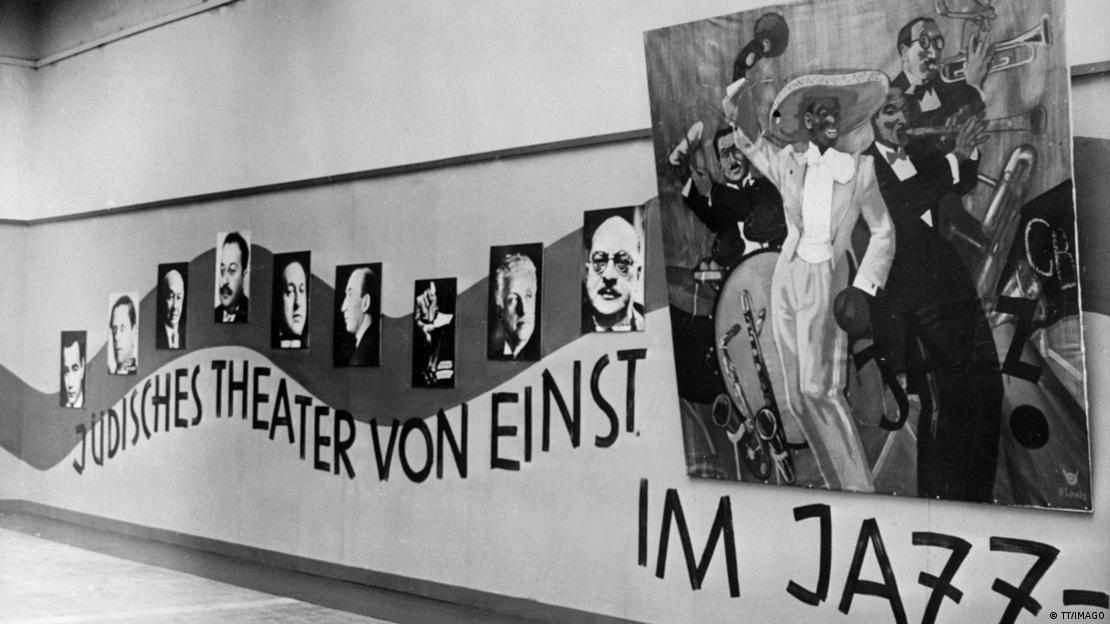
The Nazis produced touring exhibitions denouncing so-called 'degenerate' art and music, pictured here in Düsseldorf in 1938, and sought to link jazz with Jewish identity
Image: TT/IMAGO

In 1937 and 1938, the Nazis introduced the labels "degenerate art" ("entartete Kunst") and "degenerate music" ("entartete Musik") to persecute artists and artworks that did not conform to the Nazi ideal of art and beauty, or to the Nazis' racial worldview.

By 1935, it was forbidden to broadcast jazz, which, with its Black American roots, the Nazis denounced as inferior. Many jazz promoters and musicians were also Jewish, and the Nazis spread antisemitic and racist propaganda about its origins, linking jazz with Jewish people.

A racist caricature of a jazz musician wearing a Star of David appeared on a propaganda poster for the 1938 Nazi exhibition 'Entartete Musik' ('Degenerate Music')
Image: Fine Art Images/Heritage Images/IMAGO

Individual artists were eventually banned, as was listening to foreign radio stations. However, jazz music was never completely outlawed by Nazis. Due to its widespread popularity, there were even attempts to create a more "Germanic" form of jazz music.

Enter the Swing Youth (Swing-Jugend), which emerged as a counterculture movement among affluent teenagers in the northern city of Hamburg in 1939. The movement quickly spread to other cities like Berlin.

ADVERTISEMENT

Youth under Nazi rule: from repression to resistance

German youth had been the target of Nazi propaganda since the 1920s. After 1933, escaping indoctrination became almost impossible as youth organizations had become a key tool of ideological control.

After it restricted freedom of association and dissolved independent youth groups, the National Socialist regime established organizations such as the Hitler Youth (Hitlerjugend) and the League of German Girls (Bund Deutscher Mädel). Their purpose was to mold young Germans into loyal and disciplined members of the "people's community" ("Volksgemeinschaft"), starting from an early age.

The purpose of the Hitler Youth, pictured here in Nuremberg in 1940, was to indoctrinate young people in Nazi ideology
Image: United Archives/kpa Keystone/IMAGO

But not all young people in Nazi Germany supported the regime's ideology, and for the Swing Youth, jazz music became a vehicle for rebellion. Its members tried to distinguish themselves from Nazi youth movements by appropriating American fashion trends and names. They wore their hair long and dressed in plaid jackets to meet in cafes and clubs playing swing, a jazz sub-genre. They were also said to have greeted one another with the phrase: "Swing Heil!"

The term "Swing Youth" likely originated with the authorities who persecuted them as a label for young people who distanced themselves from the Nazi regime primarily through their preference for swing.

"They stood up for a certain form of freedom, resisting the idea of being the same as everyone else," historian Mascha Wilke from the Foundation for Remembrance, Responsibility and Future (EVZ) told DW.

Historian Mascha Wilke emphasized the bravery of the young people who 'dared to be themselves'
Image: Melissa Escarria Parra/DW

While the Swing Youth's resistance to Nazi ideology was more cultural than political, it nevertheless became a target of repression. Its adherents were even monitored by the Nazi Security Services, which according to musicologist Ralph Willett, accused them of "hankering after democratic freedom and American casualness."

Some were arrested and even sent to concentration camps. Wilke also refers to an incident in which detainees reportedly sang and danced to Louis Armstrong's "Jeepers Creepers" inside a camp — an act she describes as "incredibly brave."

\
The memory of the Swing Youth was honored at a 'Liberation Dance' in Berlin on May 8, 2026
Image: Melissa Escarria Parra/DW

Jazz and swing enthusiasts of all generations gathered at Berlin's Besselpark on May 8, 2026, to mark the 81st anniversary of Liberation Day (Tag der Befreiung), commemorating the unconditional surrender of the Wehrmacht, and to honor those persecuted for their love of jazz and swing music.

Organized by the EVZ, participants were invited to dance to swing. Newcomers could also receive guidance from Natalie Reinsch, a historian and professional swing dancer working for the Bremen Alliance for German-Czech Cooperation, who was invited by the EVZ.

"Totalitarian regimes have always suppressed art forms like swing and jazz, because they stand for individuality," Reinsch said.

Edited by: Helen Whittle


Thursday, October 16, 2025

BANNED IN AMERIKA, MADE IN CANADA

Antifa: A Graphic History of its Origins


 October 16, 2025

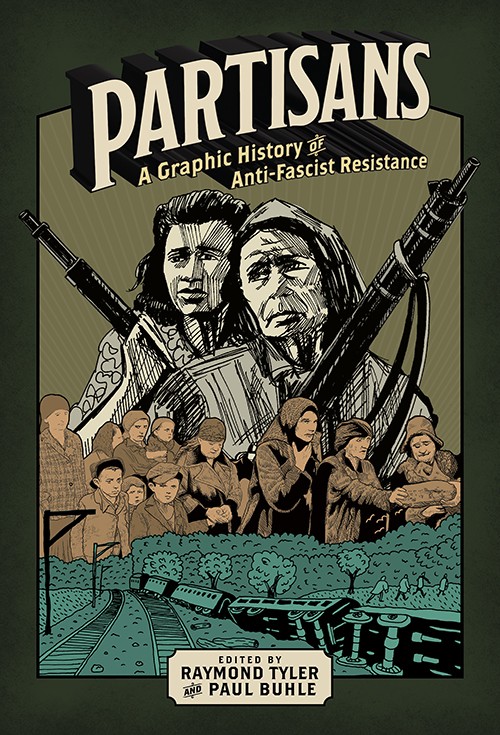
Cover art for the graphic novel Partisans: A Graphic History of Anti-fascist Resistance edited by Paul Buhle and Raymond Tyler

Leonard Cohen sings a song called “The Partisan”. It tells the story of an antifascist fighter in the heart of the war against Nazism. Beautifully rendered by Cohen on his 1969 album Songs From a Room, it tells the story of an antifascist fighter and his squad in what I assume to be the French countryside. By the time the tune is over, the teller of the tale is the only survivor. In the middle verses, the listener is introduced to a woman who gives the three fighters shelter and “Kept us hidden in the garret/Then the soldiers came/She died without a whisper.” The tragedy in this verse, so beautifully told, represents the facts of resisting fascists; fascists whose concern for the lives of those whose opinions they don’t share is virtually non-existent and is perhaps exceeded only by the anonymity of those who bomb and kill from the sky.

Recently, the Trump regime made the modern antifascist movement—known as antifa—a primary target in its establishment of a fascist USA. Although my immediate reaction to the announcement labeling antifa as a domestic terrorist organization involved at least a couple jokes regrading the essential ignorance of the White House declaration, it was underlined by the potentially greater danger that ignorance created for opponents of the trumpist movement. Because there is no actual entity that is antifa, the forces of law and order can label anyone opposed to Trump and his authoritarian program a domestic terrorist. Once an individual or organization is labeled in such a manner, even the pretense of civil rights and liberties pretty much disappears. Likewise, so do people.

Fighting fascism is a serious business. The recent case of writer and scholar Mark Bray is but one example of this. Bray’s primary work opposing fascism was to write a book titled Antifa: The Antifascist Handbook discussing fascism’s modern manifestations and the nature of the opposition to it. Right wing students at Rutgers University where he taught began a campaign of harassment in an ultimately successful campaign to force him out of his job. The harassment included threats to his family and himself; threats that convinced him they should leave the United States. For people who know the history of those opponents of Nazism who left Germany during the early years of the so-called Third Reich, Bray’s exile can’t help but make them wonder who will be next. Or how far will the installation of fascism progress around the world in the current period. When does the opposition to fascism require more than sarcasm, more than protest and how would that opposition look?

Of course, only time will give us the answers to those questions. In the meantime, it seems like a good practice would be to familiarize oneself with the history of resistance to fascism. There are dozens of texts, films and websites that are quite instructive for that pursuit. Some are fictive in nature and others are straight-up history and analysis. One recent addition to this collection of antifascist history is a supremely rendered graphic history titled Partisans: A Graphic History of Anti-Fascist Resistance. Edited by comics writer Raymond Tyler and longtime leftist historian Paul Buhle, this collection of handsomely depicted histories of various elements of the resistance to European fascism during World War Two is an inviting introduction to this under acknowledged aspect of the war against fascism in the twentieth century. The artwork, which ranges from the vivid colors of Seth Tobocman’s portrayal of the Yugoslav partisans under the leadership of Josip Broz Tito to the classical black and white cartoon panels of Daniel Selig’s entry on the French Partisans, invites readers young and old into a history that is simultaneously informative and inspirational. The narratives bend from the first person narrative of David Lasky’s water colored story of a Jewish uprising in eastern Europe to a story about the Soviet Partisans written and drawn by Raymond Tyler that reminded this reviewer of vintage Our Army at War comics from my 1960s childhood.

The different politics of various partisan groups is part of the conversation in several of the dozen stories in this collection. So are the differences based on ethnicity and religious beliefs. Women’s roles in the resistance are mentioned. Indeed, longtime comics writer Trina Robbins’ (the creator of Wimmen’s Comix) collaboration with artist Anne Timmons tells the story of three young Dutch women who served with the partisans in the Netherlands. Another story titled “Piccola Staffetta:My Small Contribution to the Resistance Against Mussolini” composed by Franca Bannerman, Isabella Bannerman, and Luisa Caetti is a tale about a girl who realizes she has been brainwashed by the fascists and joins the resistance performing small but important tasks. While reading this particular chapter, I was reminded of Hans Fallada’s novel about Nazi Germany and the small acts of resistance of a middle-aged couple, Every Man Dies Alone.

The moral of these stories and the watchword for any opposition to fascism is simple and evident throughout this graphic history. It’s not any kind of heroism that matters, but the resistance itself.

Ron Jacobs is the author of several books, including Daydream Sunset: Sixties Counterculture in the Seventies published by CounterPunch Books. His latest book, titled Nowhere Land: Journeys Through a Broken Nation, is now available. He lives in Vermont. He can be reached at: ronj1955@gmail.com


Partisans

A Graphic History of Anti-Fascist Resistance

Edited by Raymond Tyler and Paul Buhle


Add to Cart 
Paperback
Ebook
$34.95

148 pages
 ISBN 9781771136525
 Published August 2025

With eleven brand new comics created by legendary and upcoming writers and comics artists, Partisans flips a new page in the popular understanding of anti-Nazi and anti-fascist resistance. Through vivid illustrations and compelling narratives, Partisans brings to life the struggles and triumphs of those who resisted fascism. Within these pages, readers will encounter stories of resistance from the rugged mountains of the Balkans to the urban landscapes of occupied Europe. This comics collection reminds us that the fight against fascism is far from over and that the courage and sacrifices of those who came before us continue to light the way. Partisans is a must-read for anyone interested in history, social justice, and the transformative power of history and art.


Praise


“Vibrant, compelling stories of personal bravery and collective struggle—Partisans provides much-needed insights into the struggle for a better world.”
– Kate Evans, author of Red Rosa: A Graphic Biography of Rosa Luxemburg


“A stellar collection documenting the brief history of anti-fascists in Europe. By the end, you too will be excited to slap a fascist or two.”
– Yazan Al-Saadi, author of Lebanon is Burning and Other Dispatches


“Partisans, a graphic novel anthology of anti-fascist resistance, covers a wide scope of heroic activity by Russians, Ukrainians, Yugoslavians, Greeks, French, and others. It relies upon the latest research, which highlights the efforts of a variety of actors, including children, and illuminates the backdrop for armed struggle. Explaining this little-known though extremely compelling part of history to new readers will go far to puncture anti-Left myths and recover the real story, as lived first by the veterans of the Spanish Civil War and culminating with those who contributed to the final defeat of the Axis. The outstanding comic art both entertains and educates, political proof of an emerging and powerful form of storytelling.”
– Oliver Stone and Peter Kuznick, coauthors of The Untold History of the United States


“Partisans is masterful. Tyler and Buhle encapsulate complicated histories in compelling and easily understood narratives that burst to life through gorgeous illustrations. There is much to learn and enjoy in this book for young readers, newcomers to anti-fascist history, and even knowledgeable historians and activists.”
– Mark Bray, author of Antifa: The Anti-Fascist Handbook


“Vital history, the lessons of which should inform our thinking on what resistance can look like in the present.”
– Michael DeForge, author of Holy Lacrimony


“Partisans is a powerful, visually stunning tribute to the resisters who defied totalitarian regimes. Through evocative graphic novel chapters, each by a different artist, this book brings to life the stories of Partisans from all walks of life—young and old, women and men—from across the many lands darkened by fascism. You will learn their names. You will remember their courage. Historically rich and visually arresting, Partisans does more than explain the past; it will inspire readers to resist injustice now.”
– Diana Garvin, University of Oregon; author of Feeding Fascism: The Politics of Women's Food Work


“Partisans were a vital, but often overlooked, part of the defeat of Nazi Germany and its Axis allies during World War II. In every occupied country, Partisan groups waged anti-fascist guerrilla war against the Nazi invaders, carrying out raids, ambushes, and widespread sabotage. Partisans highlights different aspects of this struggle with a variety of art styles and stories ranging from personal accounts to historical overviews of Partisans in various countries, including Holland, Hungary, France, Yugoslavia, and the Soviet Union. A valuable contribution to the history of Partisan anti-fascist resistance.”
– Gord Hill, author of The Antifa Comic Book


“Don’t let the comic-book format fool you. This is a gut-wrenching story of people from all walks of life who made moral choices they never thought they would have to make. Especially notable is the emphasis on the role of women. From teenagers in Holland to an internationally known star such as Josephine Baker, these women, too, risked all. Most US leftists know about the Partisans of the Abraham Lincoln Brigade and the French Resistance. Now they’ll know about those in other places who are too often forgotten.”
– Maxine Phillips, coeditor of religioussocialism.org; former executive editor of Dissent Magazine


“Visually stunning and deeply informative, Partisans demonstrates why comics are such a powerful and potent art form. This book brilliantly delivers the histories that will give us the heart to fight current threats to democracy at home and abroad.”
– Peter Kuper, author of Insectopolis: A Natural History


Contents

Partisans: An Introduction
Raymond Tyler and Paul Buhle

World War II in Europe: A Timeline
Veterans of the Spanish Civil War
Sharon Rudahl

The Hungarian Resistance
story by Sander Feinberg, art by Summer McClinton

Freedom or Death: The French Partisans
story and art by Daniel Selig

Secret Agent
story and art by Sharon Rudahl

Tito’s Partisans
story and art by Seth Tobocman

Piccola Stafetta
story by Franca Bannerman and Luisa Cetti, art by Isabella Bannerman

Andartiko: Fighting Fascism in Greece
story and art by David Lester

Three Dutch Girls: Teenage Partisans in Holland
story by Trina Robbins, art by Anne Timmons

Uprising: A Jewish Partisan in Eastern Europe
story and art by David Lasky

Spomenik
story and art by Kevin Pyle

Soviet Partisans
story by Raymond Tyler, art by Gary and Laura Dumm

Afterword
Paul Buhle and Raymond Tyler
Acknowledgments
References
Contributors


The Antifa Comic Book: Revised and Expanded


Show Details

By Gord Hill
Foreword by Mark Bray
Paperback CAD $24.95

Read Excerpt (PDF)

Media   CBC comics list includes The Antifa Comic Book: Revised and Expanded


Description

With fascism in our midst, Indigenous artist Gord Hill revises and expands his brilliant graphic history of fascism and anti-fascist movements

When it was first published in 2018, Gord Hill's The Antifa Comic Book was heralded for its searing imagery documenting the history of fascism and anti-fascist movements over the last century. In the years since its publication, the term "antifa" has been co-opted by the right to falsely describe far-left political extremism and even terrorism. But the role played by antifa movements in fighting fascism and racism around the world remains as relevant and important as ever.

For this expanded edition, Gord Hill adds new material depicting more recent flashpoints of fascist activity, including the January 6, 2021, US Capitol attack, the murderous spree by Norwegian terrorist Anders Breivik, the infamous 2022 Canadian convoy protests, and Islamophobic and anti-migrant sentiment in a growing number of fascist governments in Europe. At the same time, Hill depicts the important work being done by anti-fascist individuals and organizations to combat this worrisome trend, made all the more crucial by Donald Trump's return to the White House.

Powerful and inspiring, The Antifa Comic Book is an important reminder of fascism in our midst and what can be done to stop it.

The book includes a new foreword by Mark Bray, historian and author of Antifa: The Anti-Fascist Handbook.

Reviews

Gord Hill's The Antifa Comic Book is so vitally important because it crafts a visual hymn to the everyday heroes, past and present, who put their bodies on the line to crush the ambitions of would-be fascist supermen. -Mark Bray, from the foreword

Sunday, July 20, 2025

Paris unveils mural of Josephine Baker to honor her legacy

Published : July 20, 2025 -
Korea Herald

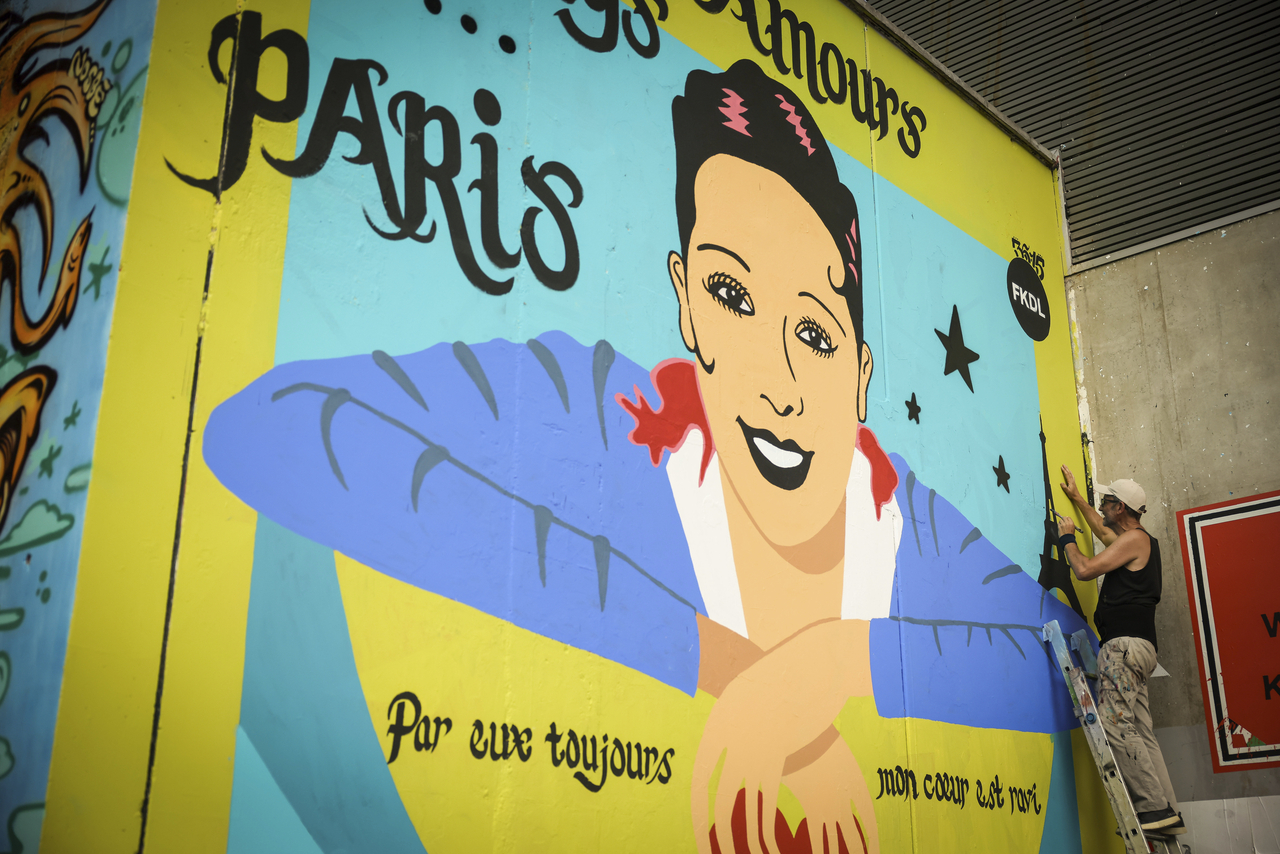
The mural of Josephine Baker in Paris, Saturday (AP-Yonhap)

PARIS (AP) — Paris is reviving the spirit of US-French entertainer and civil rights activist Josephine Baker with a new mural.

Fifty years after her death, Baker now gazes out over a diverse neighborhood of northeast Paris, thanks to urban artist FKDL and a street art festival aimed at promoting community spirit.

Born in St. Louis, Missouri, Baker became a megastar in the 1930s, especially in France, where she moved in 1925 as she sought to flee racism and segregation in the United States.

In addition to her stage fame, Baker also spied on the Nazis for the French Resistance and marched alongside Martin Luther King Jr. in Washington. She died in Paris in 1975.

"I feel moved and I feel happy, because this is part of a memory of my mother," her son Brian Baker told the Associated Press at the unveiling of the mural Saturday. He was one of 12 children Josephine Baker adopted from around the world that she called her "rainbow tribe" and what her son called "a little United Nations."

The mural of Baker, meant to symbolize freedom and resistance, is among several painted in recent days in the neighborhood and organized by the association Paris Colors Ourq.

The artist FKDL said he focuses on "bringing women back into the urban landscape."

"Josephine Baker has always been, for me, a somewhat iconic figure of that era. Both wild and free-spirited, but also deeply connected to music, musicals, and dance," he said. "She was an extraordinary character, an incredible woman."

Baker was the first Black woman inducted into France's Pantheon, joining such luminaries as philosopher Voltaire, scientist Marie Curie and writer Victor Hugo.

"My mother wouldn't have liked words like iconic, star, or celebrity. She would have said, no, no let's keep it simple," her son said.

khnews@heraldcorp.com

Sunday, May 11, 2025

FASCISTS HAVE NO RIGHT TO EXIST

Court allows controversial ultra-nationalist rally in Paris


Around 1,000 activists, many clad in black and wearing masks, marched through the streets of Paris on Saturday to commemorate the 1994 death of an ultra-nationalist student. The event, which was initially banned, took place without major incident, according to police, though 13 arrests were made.

MODELED ON THE NAZI MARTYR HORST WESSEL

 A counter rally was not authorised.


Issued on: 11/05/2025 - RFI

Members of far-right group "Comite du 9 Mai" (C9M- Committee of May 9) march behind a banner reading "Sébastien Deyzieu present!" in homage to the young ultra-nationalist who died during a march 31 years ago. AFP - GEOFFROY VAN DER HASSELT


Demonstrators carried a banner reading “Sébastien Deyzieu Présent” and walked to the beat of drums while chanting “Europa, Youth, Revolution" – the slogan of the GUD, a violent, far-right student union officially disbanded in 2024.

Many participants covered their faces, which is prohibited in France. Some carried torches and displayed symbols linked to far-right movements such as Celtic crosses, and wore black t-shirts with neo-Nazi and hooligan imagery.

The march was organised by the May 9 Committee (C9M). It holds the rally around May 9 every year to mark the anniversary of the death of Sébastien Deyzieu who fell from a building when he was trying to escape the police during a march against American imperialism on 9 May 1994.

Deyzieu was a member of "Oeuvre Française" – a French nationalist, anti-semitic movement founded in 1968 by the son of a Nazi collaborator. Described by the interior ministry as "propagating xenophobic and anti-semitic ideology, racist and Holocaust-denying theories", it was dissolved in 2013.

Members of far-right group "Comite du 9 Mai" (C9M- Committee of May 9) stand with flags as they take part in a demonstration to commemorate the 30th anniversary of the death of Sebastien Deyzieu of the "Oeuvre Francaise" ultranationalist group, during a rally at Port-Royal in Paris, on May 10, 2025. AFP - GEOFFROY VAN DER HASSELT

Thirteen arrested

Some people attending the rally had come from abroad, including Germany, Italy, Hungary, and Spain.

Thirteen people, including counter-protesters, were arrested during the event though police said no major clashes occurred.


Last Wednesday, the Paris prefecture banned both the ultra-right C9M rally and a counter rally described as "antifascist and antiracist", citing public safety concerns.

However, the Paris administrative court overturned the ban on the C9M rally on Friday evening, noting that last year’s march had not led to any legal action.

The counter-march was not authorised. But left-wing activists, backed by the hard-left France Unbowed (LFI) party, organised an "antifascist village" near the Patheon where figures of the French Resistance such as Jean Moulin, Josephine Baker, Missak and Mélinée Manouchian are honoured.

The event, in its second year, is designed to be a "reminder that neo-nazis have no more place in our streets than their ancestors". Some 3,000 people attended, according to the organisers.


Xenophobic groups banned


In 2023, the ultra-nationalist rally sparked controversy when around 600 neo-Nazis marched through Paris on 8 May, when Europe commemorates the victory of Allied forces over Nazi Germany.

Facing criticism for allowing the march, Gérald Darmanin, interior minister at the time, told police chiefs to ban far-right extremist demonstrations in France, leaving it up to the courts to authorise them or not.

In December 2023, the ultra-right Division Martel group was disbanded following violent clashes with police in the south of France. Founded in 2022, it promoted "the use of violence to foster the advent of nationalist and xenophobic supremacy".

Government bid to outlaw French far-right group prompts online petition

Génération Identitaire (Generation Identity), which gained notoriety through several attempts to block migrants from entering the country, was banned in 2021, and the Turkish ultra-nationalist Grey Wolves movement in 2020.