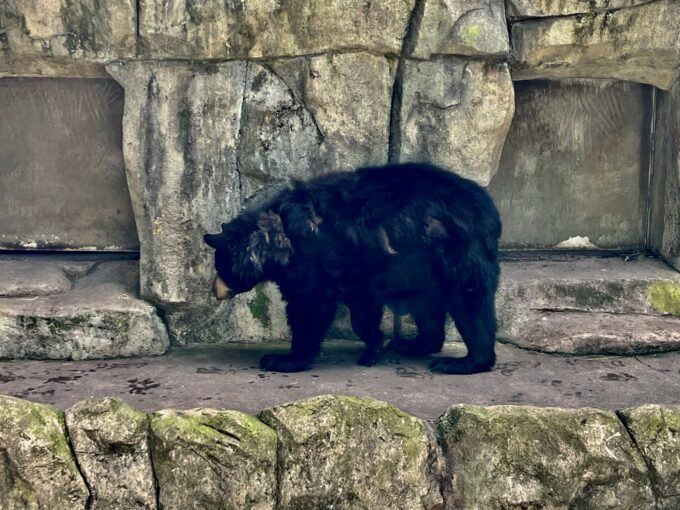
Black bear, Portland Zoo. Photo: Jeffrey St. Clair.
In recent decades, scientists and public health experts have increasingly examined how human interactions with wildlife and ecosystems can contribute to the emergence of infectious diseases. Two human activities that directly contributed to climate change are extensive deforestation and increased livestock farming, which have had devastating effects on the health of both humans and nonhuman animals.
Deforestation deprives many animals of their native habitats, and the few who can adapt are driven into proximity with human-made environments, which also increases the likelihood that a disease will adapt to a new population (from human to nonhuman animal, or vice versa).
Intensified livestock farming traps animals and their waste in a small area, creating an environment for a virus to spread and mutate. Specifically, bird and pig farming involves a high degree of antibiotic use, which helps pathogens become increasingly resistant to antibiotics. This results in infections becoming “difficult or impossible to treat” in human patients.
Zoos—along with circuses, rodeos, and petting zoos—are other examples of human-dominated ecosystems where disease can increase and spread between species. There are many factors in the care of captive animals that increase the likelihood that they will transmit diseases to humans.
Keeping animals locked up causes them stress and contributes to the deterioration of their overall health, making them more vulnerable to disease. Laws and regulations governing captive animals are often inadequate, and even where citations are issued, they can still fail to resolve matters relating to animal welfare and mismanagement. Animals can pass diseases to zookeepers, and, conversely, humans can infect captive animals with diseases they may not otherwise encounter in their natural habitat. They will not have a natural resistance to these diseases.
Finally, zoos are often willing to bolster the illegal wildlife trade to obtain rare species. Not only do poaching and smuggling contribute to the stress, poor health, and untimely death of countless animals, but these criminal acts also threaten the survival of entire species. Humans are one species among many, and our health outcomes are connected to those of nonhuman animals. Their health is our health. It is in our best interests to treat wild animals well and leave them alone so they can thrive in their native habitats.
Captivity and Stress
One reason zoos can be hotbeds for the transmission of diseases is that captive animals can suffer from compromised immune systems due to the confines of captivity, rendering them more susceptible to illnesses.
Captivity is a stressor and can lead to severe psychological and physiological problems. Many animals become stressed and depressed, just as many humans do when institutionally confined. This kind of stress is such a common phenomenon that there is a term for it: zoo-induced psychosis, or zoochosis, a condition in which animals self-soothe by engaging in monotonous, obsessive, and repetitive behaviors—behaviors that they do not exhibit in the wild. These are reminiscent of obsessive-compulsive disorder symptoms in humans.
Certain species are more susceptible to stress and early death in captivity. This is especially true of animals with a long lifespan, low reproductive rate, and low predation in the wild. While earlier studies flagged this issue, recent science confirms that Asian elephants in Western zoos remain non-self-sustaining and continue to face high infant mortality and severe welfare challenges. A data review by my organization, In Defense of Animals, found that 75 percent of captive-born elephants in North America die before reaching middle age, and 1 in 4 calves die before their fifth birthday. The mortality rate is so high that zoos cannot breed elephants fast enough to replace those who die. Without restocking from the wild, the North American elephant population would go extinct within 50 years.
Zoos and the Law
Animals have evolved to live in the wild, and confining them to an artificial environment is usually not in their best interest. The bottom line is that zoos and aquariums are profit-making enterprises underpinned by the legally enshrined assumption that we can use animals for our entertainment. The concept of a zoological garden rests on the belief that animals are here to serve us and that their needs are less important than our wants.
In most of the world, there are no laws about how to treat animals in captivity. In some countries, laws governing animal welfare in zoos exist, but they are insufficient and rarely enforced. Generally, an animal’s welfare depends on the adaptability of the species—for example, their ability to live in an environment where they cannot satisfy their instinct to avoid the gaze of humans. Beyond that, animal well-being is a matter of chance that depends on the particular zoo’s ethics, resources, and professional competence.
This system can create serious welfare challenges for captive animals.shou Examples of shocking neglect and maltreatment include the case of Noor Jehan, a teenage African bush elephant who died in a Pakistani zoo in 2023, and the case of the giant pandas Ya Ya and Le Le, who languished for years in the Memphis Zoo. While Le Le tragically passed away before getting the chance to return to China, Ya Ya returned to her homeland in April 2023.
Even when zoos finally close controversial exhibits, they often betray the public trust by merely shuffling animals to other inadequate facilities rather than retiring them to sanctuaries.
In May 2025, after being named the No. 1 Worst Zoo for Elephants for two consecutive years, the Los Angeles Zoo closed its elephant exhibit. However, instead of sending Billy and Tina to a sanctuary, the zoo transferred them to the Tulsa Zoo, a facility that also appeared on the 2025 list of the “10 Worst Zoos for Elephants.” Critics argue that such transfers can cause significant physiological stress and disrupt elephants’ social bonds. Research suggests that moving elephants between facilities may increase the risk of mortality in bulls.
Transfers may also increase the risk of elephant endotheliotropic herpesvirus (EEHV), a hemorrhagic disease that is the leading cause of death for captive elephant calves. Chronic stress is believed to contribute to outbreaks among captive elephant populations. Some zoos have instead chosen to retire elephants to accredited sanctuaries. The Oakland Zoo and Louisville Zoo, for example, transferred their remaining elephants to the Elephant Sanctuary in Tennessee after concluding they could no longer meet the animals’ complex needs. Both institutions later received the Path to Progress Award from In Defense of Animals.
Supporters of sanctuary retirement point to elephants such as Lulu, a former San Francisco Zoo elephant who lived for 19 years at the PAWS sanctuary and became the oldest African elephant in North America before her death in 2024.
Animal advocacy groups such as the Nonhuman Rights Project have filed habeas corpus appeals on behalf of captive zoo animals, arguing that highly intelligent species should receive stronger legal protections. In the case of Happy, an Asian elephant held at the Bronx Zoo for more than 40 years, New York’s Court of Appeals ruled that she was not legally entitled to personhood rights.
In January 2026, a Pennsylvania judge issued a habeas corpus order requiring the Pittsburgh Zoo to justify the confinement of its elephants in court. Advocates viewed the ruling as a potentially significant development in legal debates over the rights and welfare of captive animals.
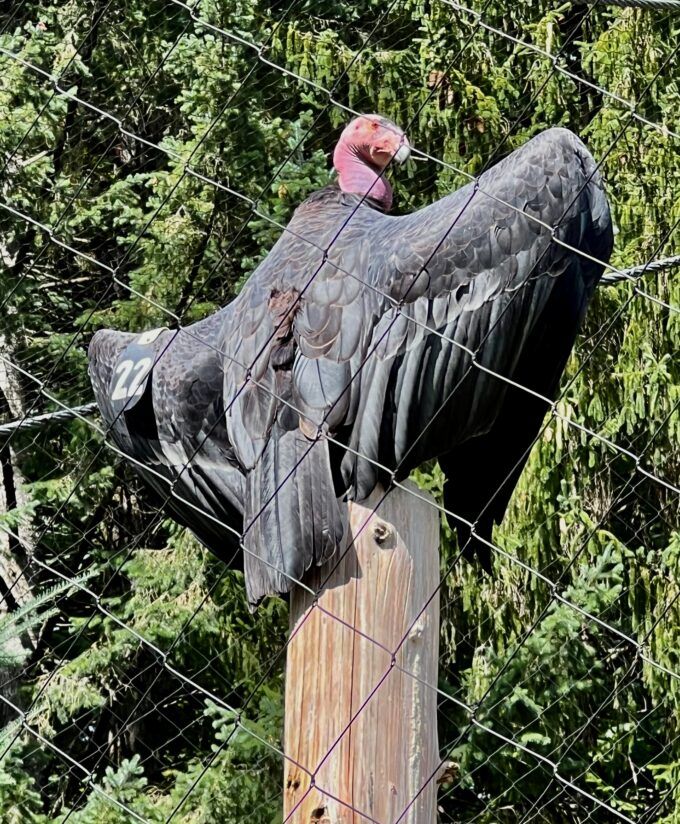
California Condor, Portland Zoo. Photo: Jeffrey St. Clair.
Zoonotic Disease
Livestock farms are another acknowledged source of zoonotic outbreaks. Here, the disease may spread through contact between the animals and farm staff, and through environmental pollution, which facilitates transmission to humans. Middle East Respiratory Syndrome Coronavirus (MERS-CoV), which killed 888 people between mid-2012 and 2022, was transmitted to humans through camels farmed for milk, meat, and sport in the Middle East, Africa, and South Asia.
Deforestation and climate change destroy wildlife habitats, displacing animals and bringing them closer to humans, increasing the likelihood of spillover events. The Nipah virus outbreak is one example of a spillover event involving habitat loss and intensive farming. As a report titled “Poverty, Health, and Ecosystems: Experience from Asia” states: “In 1997-1998, slash-and-burn deforestation in Kalimantan and Sumatra produced a severe haze that blanketed much of Southeast Asia in the months directly preceding the Nipah virus outbreak. A drought exacerbated the forest fire. This series of events led to an acute reduction in the availability of flowering and fruiting forest trees for foraging by fruit bats.”
Some displaced fruit bats settled in cultivated fruit orchards in parts of Malaysia that contained large pig farms. Pigs who ate swill contaminated by bat droppings were infected with the Nipah virus, which spread to humans through contact with the pigs. In the human population, this outbreak caused 265 cases of acute encephalitis and 105 deaths. The resultant mass killing of pigs to control the spread of the virus also caused the near collapse of the billion-dollar pig farming industry.
In 2021, Sir Alimuddin Zumla, professor of infectious diseases and international health at University College London Medical School, said, “The number of new infectious diseases with epidemic potential has increased nearly four-fold over the past six decades. Since 1980, the number of new outbreaks per year has more than tripled.” This alarming surge occurred in lockstep with the massive growth of industrial agriculture, deforestation, and biodiversity loss.
Reverse Zoonosis
The threat goes both ways: Animals can also get sick from humans. In reverse zoonosis, diseases such as the influenza A virus, herpes simplex 1, measles, and methicillin-resistant Staphylococcus aureus(MRSA) pass from humans to animals.
An incident of reverse zoonosis occurred at the Bronx Zoo. In April 2020, the zoo announced that one of its tigers tested positive for COVID-19. Later, four more tigers and three African lions also tested positive. Similarly, a zookeeper at a private zoo in Johannesburg transmitted COVID-19 to an exotic puma (July 2020) and three lions (July 2021). One lion developed pneumonia, while the other three cats had mild infections.
Tuberculosis in Zoos
Across zoos in the United States, a dangerous zoonotic disease has long been lurking: tuberculosis (TB), a deadly, highly infectious disease that has long existed in captive populations of African and Asian elephants in zoos and circuses across the U.S. According to the World Health Organization (WHO), TB is one of the top causes of death worldwide, killing millions of people yearly.
While TB is no longer common in the U.S., the Centers for Disease Control and Prevention (CDC) logged more than 10,000 cases in 2024, marking a fourth consecutive year of rises. Children are not vaccinated against TB, making them particularly susceptible.
While TB remains a rare disease in the U.S., it has long been known as a potentially serious issue in U.S. zoos. Over the years, many people have been infected with the disease. Seven staff members at the Oregon Zoo in Portland were infected with the disease in 2013 during an outbreak among three bull elephants. Elephant infections persisted there into 2019.
In 2019, some staff members tested positive for latent TB at the Point Defiance Zoo and Aquarium in Tacoma, Washington. The Saint Louis Zoo in Missouri and the Bronx Zoo in New York City had elephants test positive for the disease in 2011 and 2017, respectively.
The problem may not all be one way: Studies have shown that the causative agent that leads to human infection of TB is also present in elephants, suggesting a reverse zoonosis of the disease from humans to elephants. This raises the possibility that humans could transmit TB infections to captive elephants.
Captive Elephants Are TB Reservoirs
Although captive elephants represent a persistent tuberculosis reservoir, “licensees and registrants who own elephants” are not required by the U.S. Department of Agriculture (the federal body regulating the nation’s zoos) to test elephants for the bacteria.
Even if the tests are required under state laws, these tests, known as “trunk washes,” are difficult to conduct and unreliable. This means zoos may bring the unsuspecting public into contact with infected elephants. That becomes even likelier considering that, according to a 2020 National Geographic report, “an estimated 5 to 6 percent of the nearly 400 elephants in U.S. zoos, sanctuaries, and circuses are infected with TB.” A 2013 study of captive elephants in Malaysia pegged the TB incidence much higher—around 20 percent. So the question becomes, “What is the most accurate method of conducting TB tests in elephants?”
The risk of elephants transmitting TB to humans is more significant among those who work closely with elephants, but research suggests that TB can spread from elephants to humans through the air. Based on this finding, the risk of broader contagion, especially to zoo guests, is possible.
Many zoo exhibits include indoor barns, where visitors and elephants are separated only by bars and a few feet of space. Even more intimate encounters, such as rides or feedings that allow visitors to come into direct physical contact with elephants, are particularly concerning because they all increase the opportunities for TB transmission.
The fact that TB has continued to infect captive elephant populations in the U.S. for decades reveals that zoos cannot provide proper living conditions to prevent the spread of this disease. These concerns support the case that elephants require environments that more closely resemble their natural habitats.
Zoos and the Illegal Wildlife Trade
One aspect of zoos relevant to spillover events is that they are adjacent to, and sometimes complicit in, the international illegal wildlife trade (IWT). In the wake of COVID-19, IWT has been identified as the “most serious form of trafficking” because of the high likelihood of causing future pandemics and epidemics.
According to a 2020 report by the Wildlife Conservation Society, the estimated value of the global IWT ranges from $7 to $23 billion, not accounting for illegal fishing and logging, “which are valued at approximately $30-$100 billion and $23.5 billion respectively.” This makes IWT the fourth most profitable criminal activity in the world, following drug trafficking, human trafficking, and arms trafficking. It is one of the most significant drivers of extinction and biodiversity loss. Notably, it has been established that biodiversity loss is intimately connected to an increasing number of pandemics.
Smuggled animals may end up in live animal markets, such as the one in Wuhan, China, that is known to be the epicenter of the COVID-19 outbreak. This has had global ramifications. These animals are often killed for meat or body parts that can be used as ornaments or ingredients in scientifically unproven concoctions usually associated with folk medicine. Because of the medicinal value attributed to their meat and scales, pangolins are the world’s most trafficked animal and are hurtling toward extinction.
Some zoos have distanced themselves from the illegal wildlife trade and have publicly denounced this serious environmental crime. In June 2024, for example, the Los Angeles Zoo, in collaboration with the Association of Zoos and Aquariums’ Wildlife Trafficking Alliance, installed a wildlife trafficking display at Los Angeles International Airport, an initiative aimed at reducing demand for illegal wildlife products by educating travelers about the impact of their purchases. In February 2025, Lincoln Park Zoo in Chicago joined the Wildlife Confiscations Network, a program led by the Association of Zoos and Aquariums that fights wildlife trafficking and provides urgent care for animals seized at U.S. ports. The zoo has already helped care for hundreds of confiscated animals and has a longstanding relationship with O’Hare International Airport and the U.S. Fish and Wildlife Service.
This crucial work is poised to receive vital federal backing. In May 2025, the Wildlife Confiscations Network Act (H.R. 3538) was introduced in Congress to establish and fund this network. Once passed, this legislation will ensure that seized animals receive immediate, high-quality care rather than languishing in transit, turning a voluntary patchwork of aid into a robust, federally supported safety net.
Nevertheless, many trafficked animals do end up in zoos. A zoo in North Sumatra illegally exhibited threatened species without punishment until conservationists brought it to the public’s attention by filing a lawsuit, according to Jacob Phelps, a senior lecturer in conservation governance at Lancaster University, in a 2021 article in the Conversation.
While laws forbid zoos from purchasing illegally traded animals, this does not stop such animals from ending up in accredited zoos. A study focusing on a rare Borneo lizard found that several respected zoological institutions worldwide had acquired specimens of the earless monitor lizard without documentation showing they were obtained legally.
Better protections for wildlife and captive animals can play an important role in reducing the risk of zoonotic diseases for both humans and nonhuman animals.
This article was produced by Earth • Food • Life, a project of the Independent Media Institute.


