U.S. Coast Guard Works Fast to Get Ports Back Online After Hurricane Isaias

The U.S. Coast Guard and its agency partners are working hard to bring ports back online in the wake of Hurricane Isaias, and they are getting quick results.
The storm made landfall near Destin, Florida on Friday night as a Category 2 hurricane, weakening fast as it moved inland. At least three people were killed in storm-related accidents, and hundreds of thousands of people remained without power as of Saturday. Florida's utilities expect to fully restore power across the region for 95 percent of all customes by Monday, according to the governor's office.
The recovery effort for regional seaports moved quickly. Gulfport, Mobile, and Pascagoula are already back up and running in normal mode, and other nearby ports are not far behind, the Coast Guard announced Saturday.
“Our priority is to safely reopen the port and restore the flow of maritime commerce as quickly as conditions allow,” said Capt. Mike Vega, commanding officer of Coast Guard Sector Mobile. “Our crews are working across the affected region to assess critical infrastructure, restore communications and identify hazards to navigation."
The most substantial assessment efforts were centered on Destin, Panama City and Pensacola, Florida, where the service kept traffic restricted while assessments continued. The effort is well-resourced: there are seven separate ATON teams looking at the condition of the aids to navigation around the region, plus five different teams assigned to assessing port infrastructure. Five more teams are assigned to reconstituting comms infrastructure and setting up temporary VHF radio coverage.
Meanwhile, Coast Guard aircrews operating out of unaffected areas - notably a training airfield in Mobile - are conducting aerial assessments. The Trump administration has issued a disaster declaration for the state of Florida, and the National Guard is out in force to clear downed trees and restore road access.
Hurricane Isaias Prompts Shut-Ins for 60 Percent of Gulf Oil Production
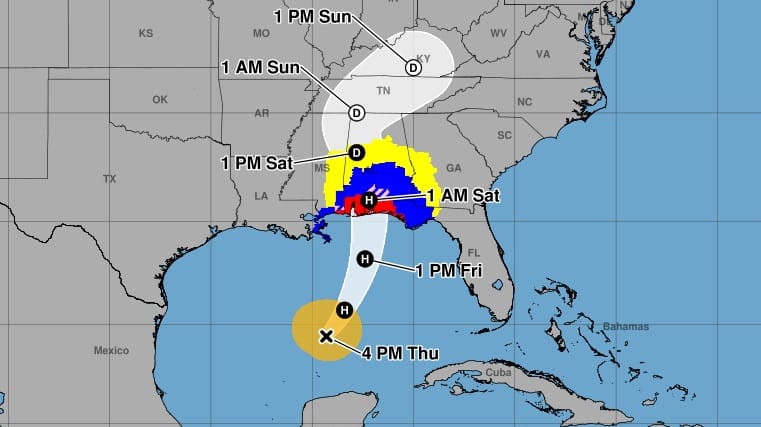
As Hurricane Isaias closes in on the Gulf coast, the National Hurricane Center is warning residents from eastern Louisiana to the Florida Panhandle to get ready for a "life-threatening storm surge."
Isaias intensified as expected overnight Wednesday, and the latest Hurricane Hunters flight into the storm suggest surface wind speeds in the range of 85 knots. The system is moving swiftly at about 10 knots to the northeast, and is expected to turn to the north, putting it on track to make landfall somewhere in the vicinity of the Panhandle late Friday night.
Isaias is moving over warm waters in the northern Gulf, conditions that would normally favor intensification. However, intensifying vertical wind shear will likely offset the effect as the storm gets closer to shore. The relative impact of these two competing factors remains to be seen, but in all events, "Isaias is expected to remain a dangerous hurricane through landfall," the center warned.
The worst of the storm's winds will be concentrated along the coasts of Mississippi, Alabama and the Panhandle, home to the heart of the Gulf shipbuilding industry. But the storm surge - often the most dangerous element of a hurricane - will extend further, from the mouth of the Mississippi eastwards to Suwannee, Florida.
To prepare, the U.S. Coast Guard Heartland is getting ready to reconstitute its forces for post-storm recovery, and it warned on Thursday that this process typically means that its ability to perform SAR operations will be reduced in the run-up to the hurricane's arrival. It advised boaters to secure their craft, ensure that EPIRBs can't come loose and activate, and monitor the National Hurricane Center's alerts. Coast Guard Sector Mobile has set Condition Yankee and advised commercial shipping to prepare to depart port or contact the Captain of the Port for alternatives.
Long before it makes landfall, the storm will sweep past offshore oil and gas infrastucture at the eastern edge of the Gulf oil patch. According to the Bureau of Safety and Environmental Enforcement - recently folded into the new Marine Minerals Administration - fully 121 production platforms have been evacuated in the Gulf as a precautionary measure, about one third of the offshore production footprint. Another five non-DP rigs have been evacuated, and four DP rigs have repositioned off location to avoid the worst of the wind and waves.
The evacuations are accompanied by temporary well shut-ins to ensure safety. About 60 percent of all Gulf oil and gas production is now shut in, the agency said in a statement. The brief shutdown will take about 1.3 million barrels per day - more than one percent of all global production - offline until after the storm has passed and facilities are inspected for safety. Though temporary, the shut-in protocol will add to the global energy supply shortfall caused by disruption at the Strait of Hormuz and the southern Red Sea.

No comments:
Post a Comment