Wednesday, October 28, 2026


Dog scared of fireworks? Switzerland could bring in a nationwide ban if public votes yes

Fireworks illuminate the night sky over Zurich, Switzerland, during the New Year's Eve celebrations, on Thursday, Jan. 1, 2026.
Copyright Andreas Becker/Keystone via AP

By Angela Symons
Published on

Fireworks were banned in the Netherlands earlier this year on safety and environmental grounds.

Swiss citizens are gearing up for an explosive vote: whether to ban noisy fireworks.

Spurred on by animal welfare and environmental groups, the citizen-proposed ‘popular initiative’ will be put to the ballot on 29 November.

“For pets, wild animals, and farm animals, fireworks are not a celebration, but pure stress,” says non-profit Schweizer Tierschutz STS (Swiss Animal Protection), which is supporting the initiative.

The proposal also calls for better protection for people and the natural environment against noise, air pollution, litter, accidents and fires caused by fireworks.

An initial Swiss Broadcasting Corporation (SBC) poll released on Friday (23 October) showed promising support for the ban, with 69 per cent of voters backing it.

While the proposal proved most popular among left-wing voters, it received majority support across the political spectrum, and particularly among women.

Votes like these are common in Switzerland, where any citizen or group can launch an initiative by gaining 100,000 valid signatures from eligible voters. Recent examples include the neutrality initiative, rejected in September, and the pending nuclear disarmament initiative.

Would it mean a complete ban on fireworks in Switzerland?

The proposal seeks to “significantly restrict particularly loud and disruptive fireworks” in private settings by banning the sale of noisy pyrotechnics. Quieter alternatives would still be permitted, such as sparklers and fountain-style volcano fireworks.

It would also allow ‘cantons’ (local areas) to grant exemptions for events of “supra-regional significance”, such as 1 August (Swiss National Day) and New Year’s Eve, but still with a focus on quieter alternatives.

Currently, Swiss cantons and communes may restrict or ban the sale and use of fireworks on a local level. Age limits and licensing requirements also govern their use.

STS says the initiative, ‘For a restriction on fireworks’, would create a clear rule for the entire country.

But industry association the Swiss Fireworks Coordination Office (SFK) argues that the proposal is a “threat to Swiss tradition”, while some politicians have said that it would infringe on citizens’ personal freedoms and should be left up to the cantons to govern.

The Swiss People’s Party, the Centre Party and the Swiss Trade Association have launched a campaign to vote against the measure, warning of its impact on business owners and potential to fuel a "prohibition culture".

After initially being submitted in 2023, the proposal received over 137,000 signatures. A failed counter-proposal in summer means it will now be followed by a public vote.

If successful, it could see Switzerland follow in the footsteps of the Netherlands, where a broader firework ban came into force this summer, primarily for safety reasons but also on animal and environmental welfare grounds. Other countries in Europe have their own rules and restrictions, such as Belgium where the use of large, powerful fireworks is restricted to professionals only.

How do fireworks impact the environment?

When fireworks explode, they release tiny dust particles, which are rich in toxic metals from the gunpowder and colouring compounds they contain.

According to the Swiss Federal Office of Police, between 1,000 and 2,000 tonnes of fireworks – three-quarters of which is made up of packaging – are used annually in Switzerland, producing between 200 and 400 tonnes of particulate matter per year.

This accounts for two-to-three per cent of the country’s annual particulate matter emissions, according to the Federal Office for the Environment (FOEN).

As well as contributing to air, water and soil pollution, these fine particles can be inhaled with harmful health impacts, particularly for vulnerable people with existing conditions.

Unfavourable weather conditions can heighten the harms, such as fog which can trap particles in the air for longer, or hot and dry conditions which can increase wildfire risk.

FOEN urges responsible disposal of used fireworks, which can be placed in regular household waste once cooled down, while packaging should be recycled as normal.

Fireworks trigger ‘fear, panic and disorientation’

Animal welfare groups have been vocal in their support of a firework ban.

“The sudden noise triggers fear, panic, and disorientation [in animals],” says STS. “The consequences range from flight behaviour and acute stress to injuries or even death. Protecting animals from unnecessary noise is therefore a central concern of animal welfare.”

Speaking in a campaign video for the initiative, Swiss veterinarian Maruschka Blaser says that animals hear high-pitched sounds and loud bangs more acutely than humans. Giving horses as an example, she says “things can become dangerous very quickly when they run uncontrollably because of fireworks”, either for people in crowds or other animals in fields.

“When it comes to domestic animals such as cats and dogs, they sometimes need to be given medication to calm them down days in advance” of firework displays, says Blaser. “I also know families who spend the night in an air-raid shelter with their pets, but somehow that isn’t a solution either,” she adds.

“Millions of pets live in Switzerland. For many of them, fireworks trigger stress or panic,” says Casimir von Arx, President of the Bern branch of Schweizer Tierschutz STS (Swiss Animal Protection SAP) in a campaign video. “We can only protect them if, as a society, we show consideration for one another.”


 

Small and very scary: Rare miniature T.rex dinosaur skeleton fetches €42 million at auction

FILE: Jodi, a mounted Nanotyrannus skeleton, of the Cretaceous Period, approximately 67 million years ago, on display at Sotheby's, 13 Oct 2026, New York
Copyright AP Photo/Yuki Iwamura

By Tokunbo Salako with AP
Published on

A dinosaur that looks like a tiny Tyrannosaurus rex is now one of the world's most expensive fossils having been sold at a Sotheby's auction for €42.6 million in New York.

A rare skeleton of a smaller cousin of the Tyrannosaurus rex has sold for a record €42.6 million at an auction in New York.

The Nanotyrannus, nicknamed "Jodi" after the person who discovered the remains in 2019, was bought by a mystery buyer after a 12-minute bidding battle online and over phones. Sotheby's had expected it to fetch anywhere from €4 to €7 million.

In a statement, the auction house said the deal now ranks the junior T.rex as the world's second most valuable dinosaur ever sold. This summer, a T. rex fossil known as “Gus” sold for a record €44 million at Sotheby's

FILE: Jodi the Nanatyrannus on display at Sotheby's in New York, 13 Oct 2026
 AP Photo/Yuki Iwamura

Close family claws and controversy

A Nanotyrannus was about half the length of an adult T. rex, and the two creatures coexisted during the Cretaceous period some 67 million years ago. Nanotyrannus had relatively longer forelimbs and larger hand claws, as well as more slender, blade-like teeth than its famous cousin.

“Jodi” is one of only three such skeletons known to exist. Standing 2.9 metres and stretching nearly 6 metres, it has been on display at the auction house’s upper Manhattan headquarters since earlier this month, and is considered almost 70% complete.

However, some scientists have opposed such private sales, saying “Jodi” and other significant fossils should be displayed in museums or other institutions so they can be studied by researchers and viewed by the public.

Sotheby’s, in a statement, thanked the team of professional fossil hunters whose efforts to discover and excavate the specimen were the focus of the Discovery Channel documentary series “Dino Hunters” in 2020.


Italian archaeologists discover links to tomb of Jesus underneath Jerusalem's Church of the Holy Sepulchre

A performer dressed as Jesus Christ re-enacts the Way of the Cross along the Via Dolorosa towards the Church of the Holy Sepulchre
Copyright Copyright 2018 The Associated Press. All rights reserved.

By Kevin Koehrmann
Published on

Italian researchers have found a burial ground beneath Jerusalem's Church of the Holy Sepulchre, matching biblical accounts of the location of Jesus' burial.

Whether God exists or not is a matter of dispute around the world. A large majority of modern historians are, however, convinced that Jesus of Nazareth was a real historical figure who lived in the 1st century and was crucified under the Roman governor Pontius Pilate. Christians across the globe have long believed that the tomb of the Jewish itinerant preacher lies beneath the Church of the Holy Sepulchre in Jerusalem.

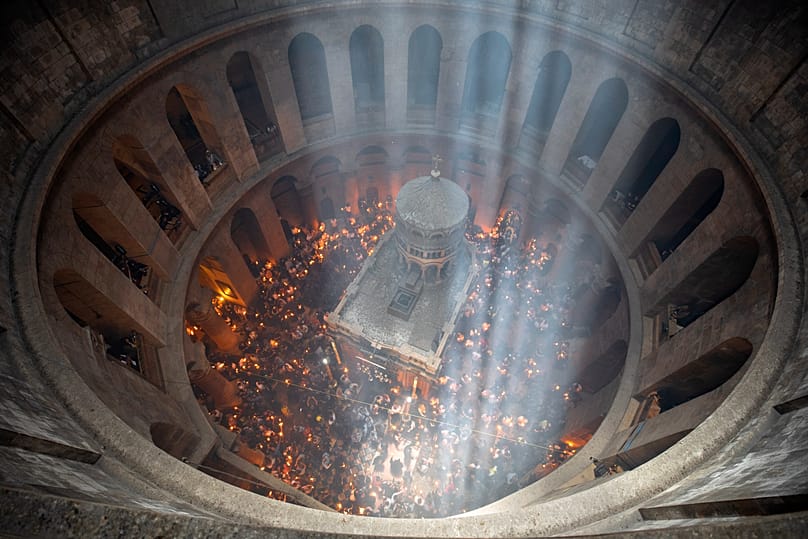
Christian pilgrims hold candles as they gather in the Church of the Holy Sepulchre in Jerusalem's Old City.
Christian pilgrims hold candles as they gather in the Church of the Holy Sepulchre in Jerusalem's Old City. Copyright 2021 The Associated Press. All rights reserved.

The Church of the Holy Sepulchre, known to Orthodox Christians as the Church of the Resurrection, stands in the Christian Quarter of Jerusalem's Old City. It is one of the most important shrines in Christianity, as it is believed to have been built on what was thought to be the site of the crucifixion, burial and resurrection of Jesus Christ. It was commissioned by the Roman emperor Constantine the Great, and was built in the fourth century.

The first church was consecrated in 335 AD. Over the course of its history, the building was destroyed and rebuilt several times. It suffered particularly heavy damage in 1009 under the Fatimid caliph al-Hakim. In the following decades the church was partially restored.

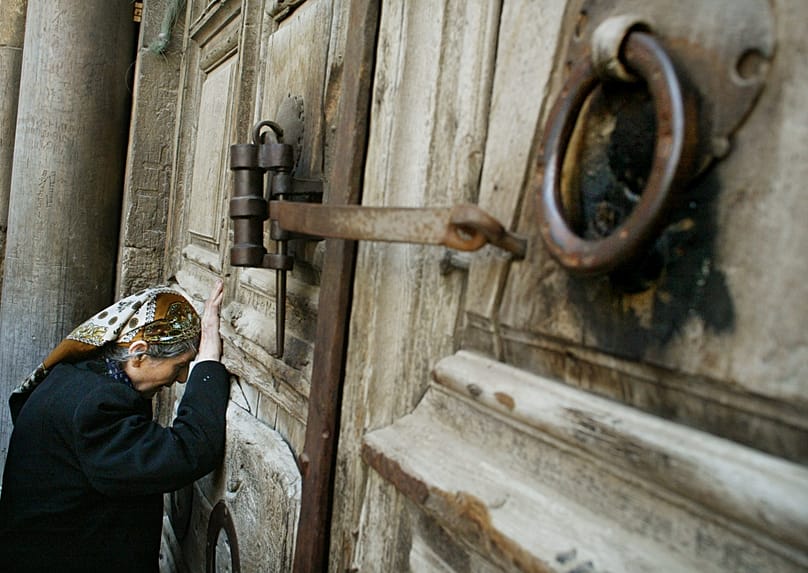
A Christian pilgrim prays in front of the doors of the Church of the Holy Sepulchre in Jerusalem's Old City.
A Christian pilgrim prays in front of the doors of the Church of the Holy Sepulchre in Jerusalem's Old City. KEVIN FRAYER/AP

After the Crusaders captured Jerusalem in 1099, extensive alterations were carried out. The church's present appearance is therefore the result of numerous phases of construction and restoration.

For a long time hardly any structural changes, renovation work or excavations were permitted, because several Christian denominations share the church and each feared that changes could weaken their rights and influence. Now the different parties have reached agreement. Since 2016 the Church of the Holy Sepulchre has been undergoing restoration, for the first time in more than 200 years.

Ancient tombs and a garden found beneath the church floor

In 2022 a comprehensive restoration of the church floor was initially planned. As work progressed, it turned into an extensive excavation project. Researchers discovered, beneath the church, an abandoned stone quarry, agricultural plots, a garden and rock-cut tombs.

A member of the restoration team works on the floor of the Church of the Holy Sepulchre, where many Christians believe that Jesus was crucified, buried and rose from the dead.
A member of the restoration team works on the floor of the Church of the Holy Sepulchre, where many Christians believe that Jesus was crucified, buried and rose from the dead. Copyright 2022 The Associated Press. All rights reserved

The garden is of particular significance, as the Gospel of John mentions a garden at the place of Jesus's crucifixion. According to the Bible, the crucifixion took place close to the city limits of Jerusalem. The Letter to the Hebrews notes that Jesus suffered outside the city gate. This, too, is consistent with the archaeologists' findings.

Lead archaeologist Francesca Romana Stasolla of Rome's "La Sapienza" university interprets the finds as evidence of a burial landscape. The excavations suggest that cultivated land once lay between Golgotha, known as Calvary in the Bible's new testament, and the tomb, according to Stasolla.

The archaeologists also found traces of olive trees and vines, dated to around 33 AD, the period in which Jesus's death is usually placed.

Christian worshippers pray at the stone on which, according to belief, Jesus Christ was washed after his crucifixion.
Christian worshippers pray at the stone on which, according to belief, Jesus Christ was washed after his crucifixion. Copyright 2006 AP. All rights reserved.

According to Stasolla, the tombs carved into the rock also point to an earlier burial site. The Gospels of Matthew, Mark and Luke describe Jesus's tomb as a burial chamber hewn from rock, so this detail fits as well.

No conclusive proof

The finds do not provide scientific proof that Jesus was buried underneath the site of the Church of the Holy Sepulchre. There is no inscription to that effect, nor can it be shown that the tomb chamber was unused or belonged to Joseph of Arimathea, who, according to the Gospels, laid Jesus in his new rock-cut tomb. The plant remains also cannot yet be dated precisely to the time of the crucifixion.

The excavations therefore do not settle the question of Jesus's actual burial place. They do, however, show that the site venerated by Christians for centuries has geographical and archaeological features that correspond to the descriptions in the New Testament.

Starlink Is A Lifeline, Its Rules Are Now A Global Security Issue – OpEd


By Burak Oktenli

Key Takeaways:

Ukraine’s October 2026 Starlink and Starshield restrictions, which briefly impaired frontline operations, illustrated that a satellite service can remain technically functional while contractual or policy limits suddenly remove authorized access.

The episode underscores three distinct risks—technical compromise (as in the 2022 Viasat attack), malicious use of working terminals by scammers, and abrupt loss of access through provider or government decisions—each requiring different controls.

Governments and operators should pre-negotiate mission-specific service terms, enable targeted rather than blanket suspensions, test independent fallbacks, and treat diversification (including Europe’s future IRIS² constellation) as essential to resilience.


Ukraine’s October service restrictions and international scam crackdowns show why satellite resilience requires more than coverage: secure networks, predictable access decisions and credible alternatives.

On October 24, Ukraine said its Starlink and Starshield connections were again working at speeds needed for frontline operations. The Ukrainian Defense Ministry reported stable service on equipment moving at more than 400 kilometers per hour, following restrictions that had affected drone missions, communications and logistics. The satellites had not fallen out of the sky, and Ukraine was not reporting a hack of the constellation. A service restriction, whatever its disputed origin, had nonetheless become an operational problem for a country fighting a war.

Elon Musk said commercial Starlink service had been restricted because Ukraine was using it contrary to conditions governing weapon-related activity. Ukrainian officials disputed his account. Responsibility for restrictions involving the distinct military-focused Starshield service was also publicly contested. These disputes deserve careful reporting rather than premature verdicts. What they reveal is broader than the argument between any government and provider: a communication service can remain technically functional while the terms under which a user can rely on it change.


Two weeks earlier, the U.S. Justice Department named Starlink among technology companies supporting an international operation against scam centers in West Africa. The participating companies collectively reported removing more than 3.7 million fraudulent accounts, pages and groups. Those collective removals must not be credited to Starlink individually. But its presence among the partners underscores the other side of the dilemma: the same cross-border connectivity that helps emergency responders can also sustain criminal organizations.

Global satellite internet is becoming a tool of national resilience and a channel that states and private providers must sometimes restrict. Cybersecurity policy needs to manage both facts at once. A dish on a roof is not the same thing as dependable, authorized and secure connectivity.

A useful lifeline can become a strategic dependency

Starlink earned its standing as crisis infrastructure through real service, not advertising. A 2025 USAID inspector general review documented how terminals helped restore civilian internet access in Ukraine and supported government and emergency communications after Russia attacked terrestrial networks. The same inspection found that safeguards and oversight for 5,175 U.S.-provided terminals had been insufficient. It called for assessing units at risk of misuse or theft and coordinating narrowly targeted suspension. It did not establish that every terminal in a risky location had been misused.


That experience captures the dilemma better than a demand that a private provider never suspend service. A provider must comply with law, sanctions and contractual conditions and must be able to counter misuse. A government, hospital or emergency operator must also know which service it actually purchased, what uses it authorizes, which changes may affect it and what recourse is available when essential work is interrupted.

Starlink’s published service terms distinguish ordinary commercial connectivity from use in offensive or defensive weapons and describe export-control obligations. Starlink and Starshield do not have identical purposes or contractual arrangements. Treating a commercial subscription as an unconditional military right would be untenable. Treating every consequential service change as an ordinary customer-support matter would be equally shortsighted where governments have built vital functions around the connection.

The cyberattack, the abusive user and the access decision are different risks

The first risk is technical compromise. In February 2022, an attack on Viasat’s KA-SAT network disrupted internet service across Ukraine and parts of Europe. Viasat described intrusion through a misconfigured virtual private network appliance into its management environment and malicious commands that disabled customer modems. This was a Viasat incident, not a Starlink breach, and Viasat reported no evidence that the satellite itself had been compromised. It demonstrated why the ground and management layers can be decisive even when the network has assets in orbit.


A March 2026 joint advisory from the United States, Australia and other partners treats low-Earth-orbit satellite security as a problem spanning spacecraft, ground stations, terminals, user devices, communications links and the supply chain. A remote satellite cannot clean ransomware from a hospital computer. Nor does a functioning antenna protect an organization whose administrator credentials or endpoint devices have been stolen. Availability, integrity and confidentiality require different controls.

The second risk is malicious use of otherwise functioning connectivity. An Associated Press and FRONTLINE investigation found Starlink-linked connections among scam operations in Myanmar even after previous enforcement efforts. A terminal used in fraud is not evidence that the satellite network was penetrated. It is evidence that legitimate infrastructure can be purchased, diverted or concealed by an abusive customer. The October operation in West Africa shows that network providers, financial firms, technology platforms and police can make better progress when they coordinate on specific evidence instead of treating every user in a troubled region as suspect.

The third risk is loss of access through policy or contracts rather than technical failure. Ukraine’s October dispute illustrates this risk, although responsibility for Starshield restrictions remains contested. No hack was reported, and a firewall could not resolve such a service restriction. The response must involve clear contracts, transparent responsibility where feasible, valid emergency contacts and practical alternatives. It must also respect the need for immediate intervention when the service is being used unlawfully or presents serious security risks.

Build a crisis service, not just a backup connection

Governments buying satellite access for essential services should require a mission-specific service annex before a crisis. It should distinguish civilian relief, ordinary government connectivity and security operations, identify the responsible public and private officials, describe lawful restrictions and escalation routes, and state what notice or urgent review is possible when access changes. No agreement can promise continued service regardless of sanctions, attacks or misuse. It can make the decision process less ambiguous and reduce avoidable surprises for legitimate users.

Providers and authorities should also be able to restrict abuse as precisely as the evidence permits. Terminal identity, account verification and a traceable incident process can help isolate suspect devices or activities rather than disconnecting whole populations. Where feasible, especially for protected emergency uses, suspension decisions should allow rapid correction of mistaken identity. Cross-border information sharing must remain consistent with law and data minimization, rather than creating a centralized list of everyone who needs to stay online.

Customers have an equally important duty. A satellite backup should be tested with the principal internet link gone, corporate identity services unavailable and a compromised device removed from the network. Staff should demonstrate that they have trusted devices, independent access credentials, power, procedures and the ability to use a different communications route when necessary. Two providers that depend on the same authentication platform, terminal-management service or local electricity supply may still fail together. The test of resilience is the essential work completed, not the number of antennas purchased.


Diversification is becoming a strategic policy choice. In August, the European Union advanced its 348-satellite IRIS² program to strengthen independently governed secure connectivity for public institutions and emergency services. Its first launches are planned for 2029, so it is not a replacement for today’s emergency links. Its relevance is that governments increasingly regard the governance and availability of satellite service, not only signal strength, as part of infrastructure security. Other regions will need options suited to their resources and laws, not necessarily a copy of Europe’s public investment.

This is not a case for nationalizing Starlink or making any provider an international utility by decree. Competition, innovation and provider discretion have helped bring satellite service to places terrestrial networks cannot reliably reach. The policy opportunity is narrower: public purchasers and providers can agree in advance on authorized use, targeted enforcement, incident notification, safe restoration and independently tested fallbacks.

The next global cyber emergency may involve an attack on a ground control system, the exploitation of terminals by criminal networks, or a legitimate user losing a service on which an urgent operation depends. Those are different failures. A country that treats them all as a question of satellite coverage will prepare for none of them adequately.

Starlink can help keep a nation connected in crisis. Real resilience begins when that nation knows how the connection can be protected, restricted and, when necessary, replaced.


About Burak Oktenli
Burak Oktenli holds an MBA and a Master of Professional Studies in Applied Intelligence from Georgetown University. His research addresses the governance of authority in autonomous and AI-enabled systems, and his writing has appeared at the Modern War Institute at West Point, RUSI, RealClearDefense, RealClearMarkets, and Geopolitical Monitor. He is the author of Authority Architectures for Autonomous Systems, a ten-volume series on how authority in autonomous systems is delegated, monitored and recovered, at authority-architecture.me.
View all posts by Burak Oktenli →

Norway says 'successful' cyberattacks against the country have tripled in last six months

This June 19, 2017 file photo shows a person working on a laptop.
Copyright Copyright 2017 The Associated Press. All rights reserved.

By Nathan Rennolds
Published on

The country's National Security Authority said the rapid growth of artificial intelligence technology also posed a "serious risk" to Norwegian businesses and organisations.

Norway's National Security Authority (NSM) said on Tuesday that the number of "successful" cyberattacks targeting Norwegian organisations had trebled in the last six months as it warned of a continued threat to national security.

In a new report, the NSM - which is involved in efforts to counter espionage and hybrid threats - said the country's defence industry and space sector were particularly exposed to cyber risk.

"This also applies to critical infrastructure and service providers to organisations that are important to national security," it said.

"NSM has not previously made this type of assessment public," director Arne Christian Haugstøyl added. "We are doing so now because it is absolutely necessary to strengthen both the resilience and the ability to handle cyber operations in Norwegian organisations."

The report follows increasing warnings across Europe of suspected Russian hybrid attacks, including cyber operations.

In August, Norwegian media reported that a Russian hacker group had declared war on Norway while also claiming responsibility for a distributed denial-of-service (DDoS) attack that had reportedly impacted multiple government digital services.

In its report published on Tuesday, the NSM did not point to a specific actor but said that certain businesses and organisations were being increasingly subjected to reconnaissance and ransomware and DDoS attacks.

The agency also warned of the threat posed by artificial intelligence technology, which it said posed a "serious risk" to Norwegian businesses and organisations.

“AI analyzes large amounts of data and identifies vulnerabilities faster than humans have been able to," Haugstøyl said. "These vulnerabilities open up new opportunities for cyberattacks at a faster pace and on a larger scale.

"This means that the risk is increasing, and the pace at which security measures are implemented must be accelerated."


Norwegian media sue Meta over plans to use their journalism for AI

Source: AP Photo
Copyright Copyright 2026 The Associated Press. All rights reserved

By Jonathan Benton with AFP
Published on

Publishers say new terms for Facebook and Instagram business accounts could allow Meta to collect articles, images and videos from their websites without permission.

A coalition of Norwegian media organisations has launched legal action against Meta, arguing that the company’s new terms for business accounts could undermine publishers’ control over their own journalism and allow it to be used in AI products without their agreement.

According to the 10 media groups, the new terms would give Meta — which owns Facebook, Instagram, WhatsApp and Threads — the right to collect their articles, photos and videos, including those behind a paywall, and use them to develop artificial intelligence products, among other things.

Meta quietly announced it was changing its Commercial Terms on 8 October, with plans to roll out on 30 October. However, the company postponed the roll-out after receiving widespread pushback from European publishers and antitrust authorities.

The launch is now set for 20 November, "to allow more time for us to explain to our partners and stakeholders what's changing and what's not", said Meta.

Critics say news publishers are being forced into an "all-or-nothing" choice by the US tech giant: allow Meta to scrape their journalism, potentially for AI training, or lose their Facebook and Instagram presence entirely.

The Norwegian media groups’ legal challenge will test whether publishers can block the changes before they take effect.

"The fear is that the companies will use this power to secure rights over journalistic content," the head of the Norwegian Media Businesses' Association (MBL), Lene Eltvik Vindfeld, said in a statement.

"Meta uses media groups' investments to develop artificial intelligence services that compete with them directly. This is both unacceptable and distorts competition," she added.

According to the plaintiffs, Meta’s new terms of use would apply to all professional account holders — media outlets as well as companies and retailers — and would leave them no way to opt out other than deleting their accounts.

They said they had filed a request with the Oslo District Court for a provisional injunction against the entry into force of the terms of use, pending a ruling on the substance of the case.

The plaintiffs include public broadcaster NRK, media groups Schibsted, Amedia, Polaris and Aller, as well as Norwegian news agency NTB.

On 14 October, MBL and NRK had also threatened to sue Meta, accusing the American tech giant of profiting from fraudulent advertisements impersonating them in order to defraud internet users.

A global shift

The Norwegian case reflects a broader dispute over the rights of publishers whose journalism appears on major tech and AI platforms.

Since May this year, more than 340 local and national news sites including the Guardian, the New York Times and USA Today have blocked internet archive crawler bots to prevent them from collecting data for training AI models.

And in June, France’s competition authority warned Meta that its approach to copyright talks with news outlets could "seriously harm" the press.


Neil Young sues Donald Trump's political committee for copyright infringement - again

Neil Young sues Donald Trump's political committee for copyright infringement - again
Copyright AP Photo

By David Mouriquand
Published on

Neil Young has filed a $10 million suit against Donald Trump's political action committee, Trump 47 Committee Inc., for using his hit song ‘Rockin’ in the Free World’ - six years after a prior settlement over the same song.

Legendary Canadian rocker Neil Young has filed a lawsuit against Donald Trump’s political committee, alleging copyright infringement over the organisation’s ongoing use of his song ‘Rockin’ in the Free World’ during midterm election rallies. The 1989 hit is frequently used as Trump's walk-on music.

Young’s camp is requesting $10 million (approx. €8.9m) in damages and that Trump’s team be barred from playing the song in public.

The lawsuit, filed on Monday and seen by Variety, highlights how Trump 47 Committee Inc.’s unsanctioned use of Young’s song violates the terms of a past settlement, as the musician and his publishing company, Silver Fiddle Music, filed a copyright infringement suit against Trump’s presidential campaign in 2020.

Young later dismissed the lawsuit, but only after reaching a settlement with the Trump campaign – which included the promise that they would not use ‘Rockin’ in the Free World’ without permission.

“The Committee does not now have, and did not at the time of the Youngstown Rally or any other rally financed and conducted by the Committee, have a license or Young’s permission to play the Song at any public political event,” states the new lawsuit.

The lawsuit also highlights that Trump has clearly not listened to (or bothered to read) the song’s lyrics, as it is a famously anti-Republican.

Young wrote the track as a critical commentary on politics and American society during the George H.W. Bush years. The song clearly paints the contradictions and pitfalls of the so-called "American Dream".

“‘Rockin’ in the Free World’ is a blistering anthem that contrasts the hollow promises of American political rhetoric with the harsh realities faced by the poor, homeless and forgotten,” the document states. “The lyrics paint vivid street-level portraits - a mother discarding her baby, addicts lost in despair, garbage piling in the shadows of prosperity -while the repeated chorus delivers a savage irony, celebrating freedom that clearly isn’t shared by all.”

“In short, the song is the opposite of everything that Donald J. Trump stands for."

The opening lyrics to the song are: "There's colours on the street / Red, white and blue / People shufflin' their feet / People sleepin' in their shoes / But there's a warnin' sign on the road ahead / There's a lot of people sayin' we'd be better off dead / Don't feel like Satan, but I am to them / So I try to forget it any way I can...”

For most, it's hardly a difficult metaphor to grasp...

The suit also alleges that Young “has suffered and continues to suffer from great injury” over the alleged infringement, adding that he also “suffered damage to his reputation and brand as a result of the implication that he supports Donald J. Trump in any way.”

Young has been a longstanding and vocal critic of Trump. Last year, he came to the defence of Bruce Springsteen and Taylor Swift, both of whom Trump had criticised and even threatened.

At the time, Young shared a new blog post on the Neil Young Archives website, where he defended his fellow musicians.

“Bruce and thousands of musicians think you are ruining America. You worry about that instead of the dyin’ kids in Gaza. That’s your problem. I am not scared of you. Neither are the rest of us.”

He continued: “You shut down FEMA when we needed it most. That’s your problem Trump. STOP THINKING ABOUT WHAT ROCKERS ARE SAYING. Think about saving America from the mess you made.”

“Taylor Swift is right. So is Bruce. You know how I feel. You are more worried about yourself than AMERICA. Wake up Trump!! Remember what the White House is?”

He finished his blog entry by writing: “You are forgetting your real job. You work for us. Wake up Republicans! This guy is out of control. We need a real president!”

Earlier this year, Young even offered Greenlanders free access to his music in the wake of Trump's threats of annexation.

He wrote on his website: “I’m honoured to give a free year’s access to neilyoungarchives.com to all of our friends in Greenland. I hope my music and music films will ease some of the unwarranted stress and threats you are experiencing from our unpopular and hopefully temporary government.”

Young is far from the only high-profile musician to take legal action against the Trump administration for playing their songs without authorisation.

Everyone from Creedence Clearwater Revival to Tom Petty, via The Rolling Stones, Adele, Foo Fighters, Céline Dion, The White Stripes, ABBA and many more have called out Trump for using their songs without permission.

Other cases include Bruce Springsteen objecting in 2016 to Trump blasting 'Born in the U.S.A.' as a patriotic anthem, when it’s actually a scathing indictment of the treatment of Vietnam vets; Rihanna demanding that Trump stop playing 'Don’t Stop the Music' after the song played at a 2018 rally; and R.E.M. being outraged that their tracks 'Losing My Religion', 'Everybody Hurts' and 'It’s the End of the World as We Know It (And I Feel Fine)' were used at rallies.

In 2020, Leonard Cohen’s estate issued a statement criticizing Trump's unauthorized use of Cohen’s ‘Hallelujah’ at the Republican National Convention – having specifically rejected permission for its use. The estate, rather brilliantly, added that they would have only realistically considered approving Cohen's song ‘You Want It Darker’.

In June, Ariana Grande became one of the latest artists to protest Trump's antics, calling out the White House for using one of her songs in a social media post promoting ICE arrests.

She wrote: “Please do not ever use my music in relation to this barbaric, inhumane, heinous nonsense. F*** ICE."

The 2026 United States midterm elections are scheduled to be held on Tuesday 3 November.