Monday, October 26, 2026


Italy: Thousands take to the streets as protests turn violent in several cities


By Marina Stoimenova
Published on

Clashes erupted between protesters and police across several Italian cities on Saturday, with officers deploying water cannons and tear gas as demonstrations turned violent. Thousands took to the streets of Rome, Milan, Turin, Bologna and Florence, with protesters throwing bottles, stones and firecr

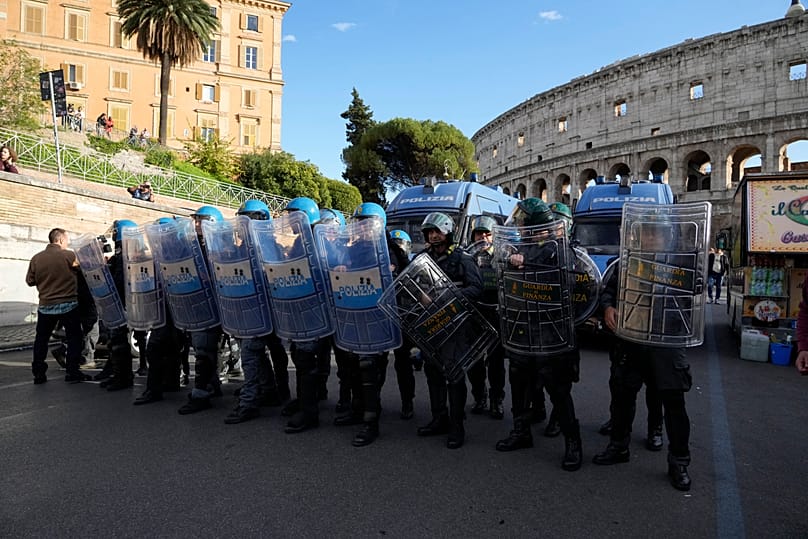
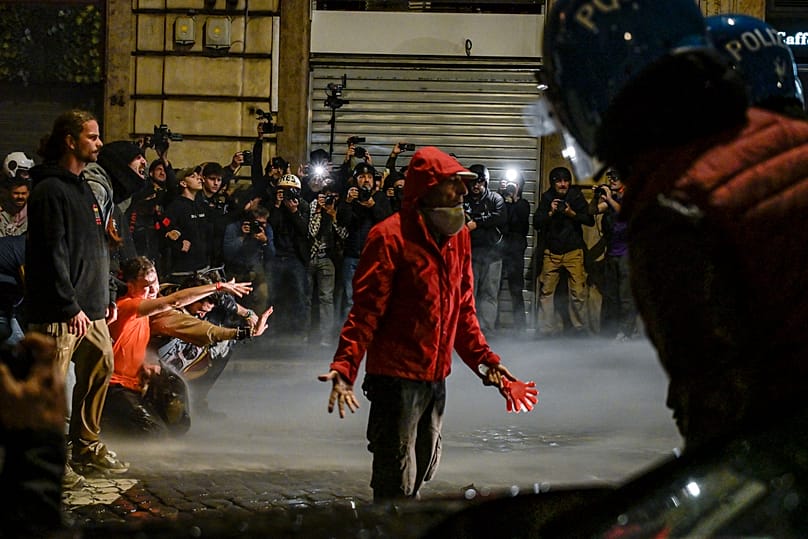
Rome: Clashes broke out on Saturday evening as protesters marched through the Italian capital. Near Largo di Santa Susanna, demonstrators confronted a police cordon, throwing bottles and setting off firecrackers. Several street signs were also knocked down. Police responded with water cannons.

Milan: Two separate demonstrations involving students, activist groups and pro-Palestinian protesters merged into a single large procession heading towards Piazza Leonardo da Vinci, home to the Polytechnic University of Milan.

Earlier, police blocked a march that had set off from the square towards the city centre, forcing demonstrators back towards Corso Venezia. Some participants subsequently joined a second procession that had started at the Piccolo Teatro.

Around 10,000 people were reportedly taking part in the combined march, which was expected to conclude at Piazza Leonardo da Vinci.

Turin: Tensions escalated as protesters clashed with police, prompting officers to deploy tear gas. After marching through the Aurora neighbourhood, demonstrators reached the Mosca Bridge, where police blocked their route towards the city centre.

Some protesters threw stones, bottles and smoke bombs at officers, who responded with tear gas. The procession later resumed along Via Cigna.

Bologna: Emergency services were called to Via Marconi following clashes between demonstrators and police. Paramedics treated an injured young protester at the scene.

Florence: Protesters threw firecrackers and glass bottles at police as tensions rose during a march through the city. Near the Santa Trinità Bridge, at the junction with Via Tornabuoni, some demonstrators attempted to break through a riot police cordon.

Italian authorities have deployed hundreds of additional soldiers and stepped up security across major cities on Saturday as a new wave of demonstrations raises fears of further violence following last weekend's clashes between protesters and police.

Protests are planned in Milan, Rome, Turin, Naples and several other cities, with demonstrators voicing anger over rising living costs, low wages, military spending and government policies.

Milan is on particularly high alert after violent unrest on 17 and 18 October, when clashes with police, vandalism and looting caused widespread damage in the city centre.

Prime Minister Giorgia Meloni's government has ordered the deployment of an additional 500 soldiers to Milan, reinforcing the security forces already stationed in the city.

Authorities have also introduced drone surveillance, railway station checks and rapid-response units to prevent further disorder.

Police carry out more than 150 searches ahead of protests

Italian police carried out more than 150 searches in Milan, Monza and around 20 other cities on Saturday morning as part of investigations into last weekend's violence.

The searches reportedly targeted individuals suspected of involvement in the unrest, including students and minors.

Interior Minister Matteo Piantedosi has suggested that the previous disturbances were coordinated, while authorities are investigating messages exchanged in online groups ahead of the latest demonstrations.

The newly formed "17 October Movement," which has been linked to the recent mobilisation, announced that previously advertised protest locations had been cancelled and that new meeting points would be communicated shortly before the marches.

The decision has complicated security preparations, with police warning of the possibility of spontaneous gatherings in several parts of the country.

Demonstrations spread from Rome to Turin and Naples

In Rome, protesters gathered for a national demonstration under the slogan "Keep Italy out of the war", opposing military involvement and increased defence spending.

In Turin, students and activist groups have called for a march against rearmament, rising fuel prices and the cost of living, while also demanding better access to housing, education and healthcare.

In Naples, demonstrators mobilised against economic hardship and rising prices.

Meanwhile, thousands were expected to march in Castel Volturno, near Naples, against plans to establish a migrant detention and repatriation centre. Religious organisations, charities, migrant groups and agricultural workers are among those supporting the protest.

Meloni government under pressure after violent unrest

The latest mobilisation comes a week after violent clashes in Milan and Turin prompted the government to announce tougher security measures.

Police said around 2,000 young people took part in the earlier unrest, which resulted in 45 arrests, including 34 minors.

Meloni has condemned the violence and pledged a tougher response to attacks on police officers and businesses.

The unrest has also renewed debate over economic inequality, social exclusion and the government's approach to public order.

Authorities remain concerned that Saturday's demonstrations could bring together student movements, trade unions and more radical activist groups, increasing the risk of further confrontations.

The protests are taking place alongside demonstrations elsewhere in Europe, including France, Spain, Portugal and Albania, where campaigners are mobilising over issues ranging from living costs to public services and government policies.

 

128 arrested after night of unrest and looting in Barcelona

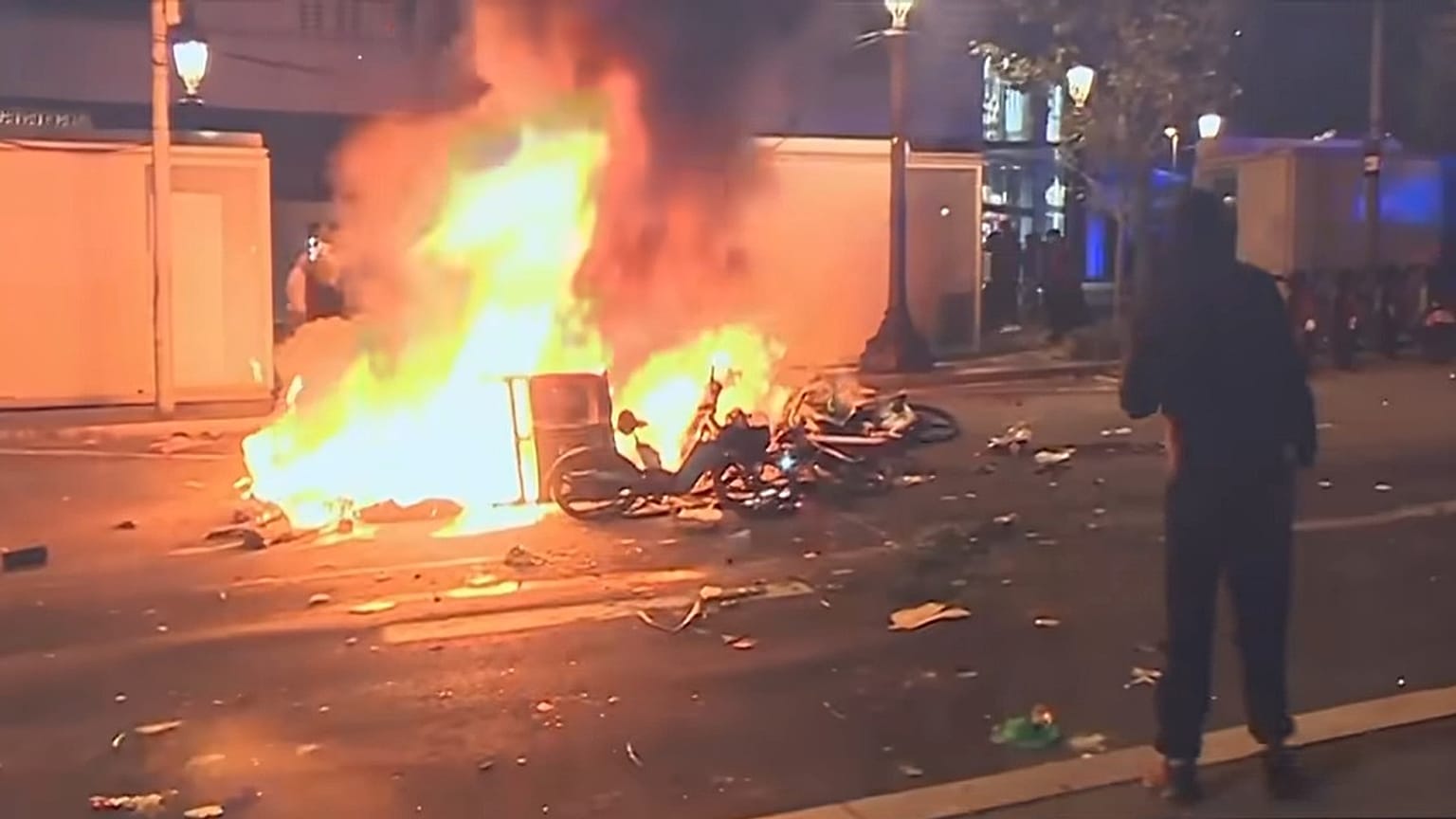
Riots in Barcelona on 24 October 2026.
Copyright Captura de pantalla de imágenes de 'RTVE'.

By Christina Thykjaer
Published on

Protesters threw stones and other heavy objects at officers, whilst several groups erected barricades, set fire to rubbish bins and smashed shop windows.

Barcelona city centre saw a night of chaos on Saturday as groups of young people clashed with police and shops were looted.

The unrest, which began late in the afternoon around the Plaça de Catalunya, led to 128 arrests, roughly a quarter of them minors, according to authorities. Fifteen police officers were also injured during the night.

The gathering, promoted on social media under the slogan "Instituts Indignats," aimed to bring the French youth movement "Lycéens Indignés" to the Catalan capital.

At its peak, the demonstration drew around 600 people, per Spanish media reports.

The disturbances started at around 6 pm, when several groups of young people, many dressed in black and wearing hoods, began vandalising street furniture. Riot police then moved in, prompting demonstrators to scatter through the adjoining streets, where clashes continued.

Protesters threw stones and other heavy objects at officers, whilst several groups erected barricades, set fire to rubbish bins and smashed shop windows. Police responded with charges to disperse participants as they worked to regain control of the area.

According to La Vanguardia, around 14 shops were looted. Clashes also caused damage to motorbikes, bicycles and bus shelters.

The violence forced numerous businesses to close and led the Guardia Urbana to restrict access to the Plaça de Catalunya. Train services stopping at Plaça Catalunya station were also temporarily halted.

Authorities condemn violence

The mayor of Barcelona, Jaume Collboni, condemned the incidents and announced that the city council would take part in legal proceedings to seek accountability for the damage caused.

"This will not be left as it is. We will go all the way," Collboni warned, adding that there could be consequences for the parents or legal guardians of the minors involved.

The president of the government of Catalonia, Salvador Illa, also condemned the unrest and defended the police response.

"Protesting is a democratic right," he said, although he stressed that violence cannot be justified as part of that right.

For her part, the Catalan interior minister, Núria Parlon, described the incidents as "gratuitous violence and vandalism" and insisted that those responsible were not defending any legitimate cause.

Both distanced the unrest from the housing rights encampment that has been set up in the Plaça de Catalunya for several weeks.


Protests held across Czechia after government pushes ahead to curtail public media financing

Protests held across Czechia after government pushes ahead to curtail public media financing
/ Million Moments for DemocracyFacebook
By Albin Sybera in Prague October 26, 2026

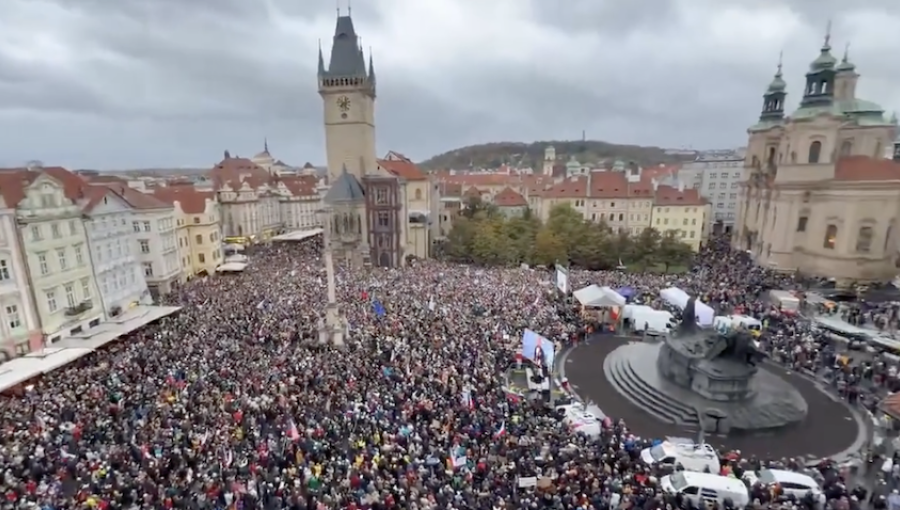
Tens of thousands attended anti-government protests held across Czechia on October 24 after Prime Minister Andrej Babiš' government unexpectedly pushed ahead with a vote to curtail public media financing by scrapping license fees.

The government-backed bill aims to replace license fees with a direct state budget, and has been a source of controversy since first tabled earlier this year, not least because it involves trimming the budget of Czech Television (CT) and Czech Radio (CRo).

A number of protests were held already against the changes to public media financing including including the mass rally on March 21 when around 200,000-250,000 Czechs rallied at the Letná plateau in Prague against the policies of the populist Babiš-led cabinet and his Ano party, which they fear threaten democratic standards in the country.

“We won’t give up the media” and “Media should not belong to politicians” read the banners carried by the protesters on October 24 in Brno, where about 4,000 protesters gathered. The rally was organised by the Million Moments for Democracy platform, which was behind the 2018-2019 mass protests against the previous cabinet led by Babiš.

“It is not just a technicality. It is about having media which would report freely, control those in power and provide verified information to all without a difference in the future as well,” the statement calling for the rally reads, while one of the organisers, Marija Wazi, warned that government-backed changes would trim the public media budget by CZK1.4bn a year (€57.5mn), CRo reported.

The largest rally was held in the capital Prague on October 25, which filled the historic Old Town square. It took place in response to the Babiš ruling coalition approving the draft bill in the first reading in the small hours (04:36) of October 24, which infuriated demonstrators who saw the unusual parliamentary session hour as a government effort to minimise public rage.

CT and CRo announced a strike to be held on November 3, while the Millions Moments for Democracy announced another mass rally for November 15.

Babiš accused the liberal Pirate Party and other parties campaigning against the decision of “scarring people, dividing society and inciting hatred”, claiming on his Facebook page that “it does not make sense that fees are mandatory for everyone”.

“Today everyone pays for the service they want to watch such as Netflix, Oneplay, HBO etc.,” he argued, dismissing claims the move is designed to tighten political control over the public broadcasters.

Media researchers reiterated their earlier warnings, however, that making public media dependent on the state budget would in fact lead to the increased dependency of the broadcaster on political pressures.

The move also alarmed international press institutions, including the International Press Institute and the European Broadcasting Union, and could send Czechia on a collision course with the EU for failing to secure financial sustainability of public service media and failing to comply with European Media Freedom Act.


Protests sweep across Europe from France to Albania, Italy, Spain and Portugal.


By Anna Kirchheim
Published on

Violence in earlier protests prompted authorities to take additional security measures, with massive deployments of police and even soldiers observed across several European capitals.

Protests over a range of issues have taken place in cities across Europe, from Milan and Madrid to Lisbon and Tirana. Demonstrators are taking to the streets over pensions, housing, education, corruption and opposition to war, reflecting a diverse mix of grievances across the continent.

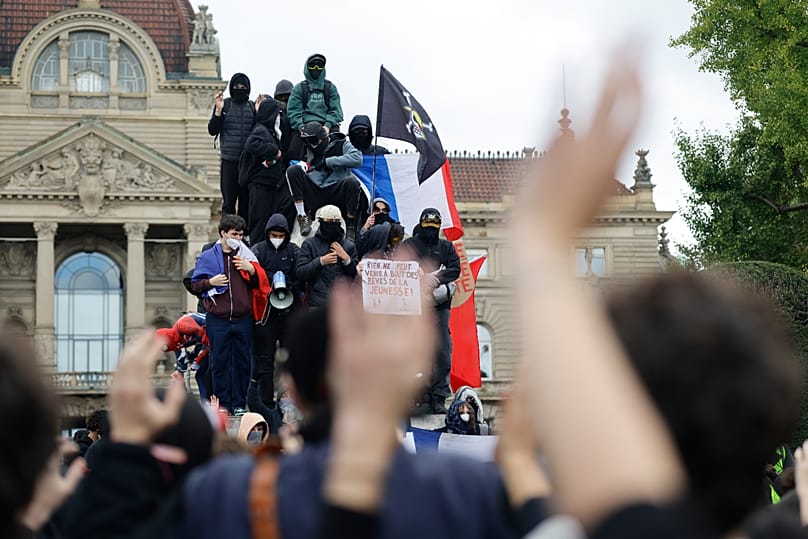
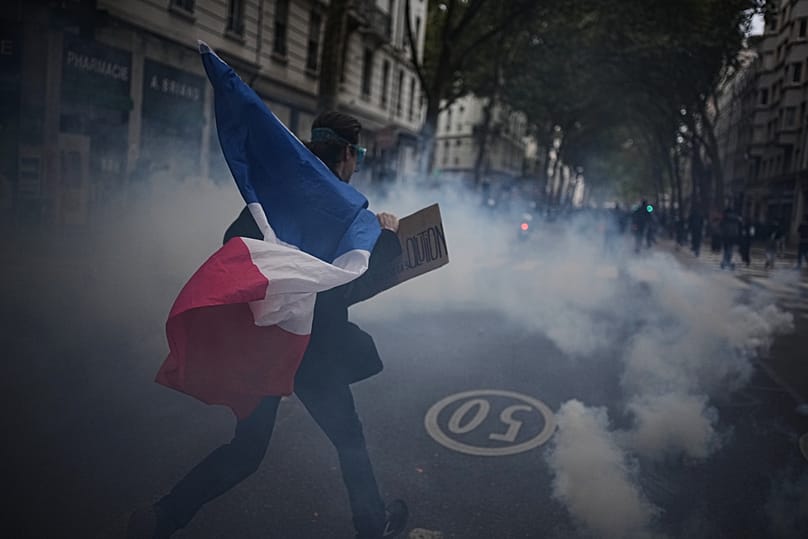
Despite precautions, bans and heavy policing the protests led to violent clashes in several cities in France - around 2,400 people have been arrested, while nearly 1000 members of the security forces were injured, as well 100 protesters and residents in Paris alone.

Protesters attend a demonstration against rising living costs in Strasbourg, France, Saturday, Oct. 24, 2026
Protesters attend a demonstration against rising living costs in Strasbourg, France, Saturday, Oct. 24, 2026 Copyright 2026 The Associated Press. All rights reserved
A protester holds a French flag during a demonstration against rising living costs in Lyon, France, Saturday, Oct. 24, 2026.
A protester holds a French flag during a demonstration against rising living costs in Lyon, France, Saturday, Oct. 24, 2026. Copyright 2026 The Associated Press. All rights reserved

Albania sees clashes between police and students, artists and opposition parties

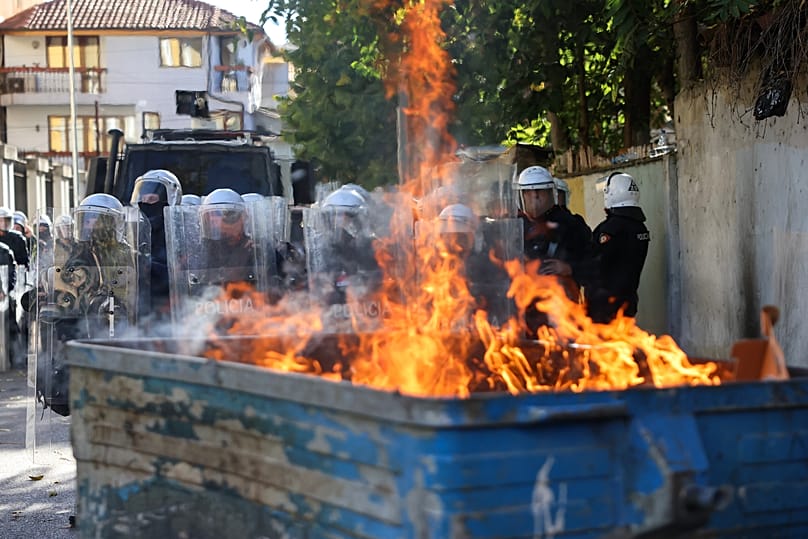
Thousands of people rallied for a fresh anti-government protest in the Albanian capital Tirana on Saturday, with police firing tear gas to disperse the crowd. In the latest of several clashes between police and protesters since mid-October, government buildings were attacked and dozens of demonstrators were detained. Authorities said that more than 300 protestors and police have been injured.

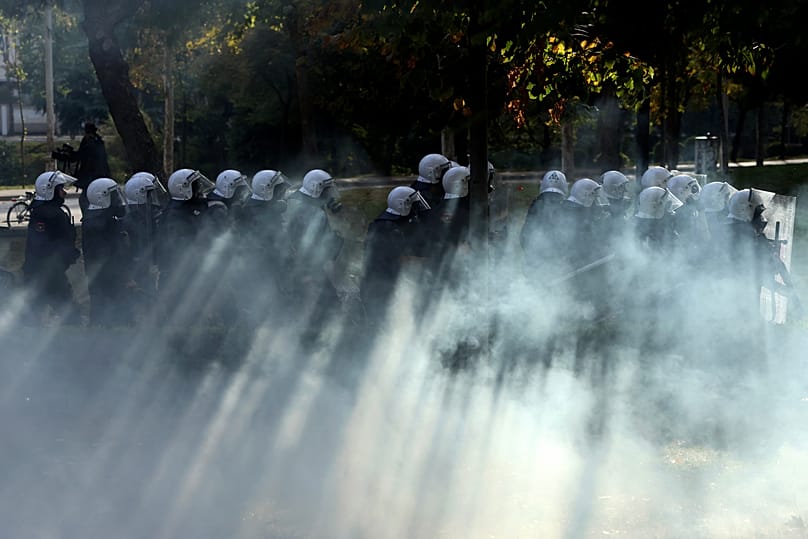
Riot police stand in formation behind a burning garbage can during an anti-government rally, in Tirana, Albania, Saturday, Oct. 24, 2026. (AP Photo/Hameraldi Agolli)
Riot police stand in formation behind a burning garbage can during an anti-government rally, in Tirana, Albania, Saturday, Oct. 24, 2026. (AP Photo/Hameraldi Agolli) Copyright 2026 The Associated Press. All rights reserved
Riot police advance during an anti-government rally in Tirana, Albania, Saturday, Oct. 24, 2026. (AP Photo/Hameraldi Agolli)
Riot police advance during an anti-government rally in Tirana, Albania, Saturday, Oct. 24, 2026. (AP Photo/Hameraldi Agolli) Copyright 2026 The Associated Press. All rights reserved

Clashes erupted between protesters and police across several Italian cities

Thousands took to the streets in Milan, Rome, Turin, Naples, Bologna and Florence with protester throwing bottles, stones and firecrackers.

Italian anti-riot police watch antiwar activists demonstrating against rearmament and Italy's involvement in wars in Rome, Saturday, Oct. 24, 2026,

Italian anti-riot police watch antiwar activists demonstrating against rearmament and Italy's involvement in wars in Rome, Saturday, Oct. 24, 2026, Copyright 2026 The Associated Press. All rights reserved

Italian police said in a statement they had carried out nine arrests and briefly detained 371 people during protests in eight cities on Saturday. Of the people who were detained and taken to police stations, 110 were minors, the statement added.

People attend a protest in Rome, Italy, Saturday, Oct. 24, 2026. (Valentina Stefanelli/LaPresse via AP)
People attend a protest in Rome, Italy, Saturday, Oct. 24, 2026. (Valentina Stefanelli/LaPresse via AP) LaPresse via AP

In Spain and Portugal, protesters marched for retirement rights and affordable housing

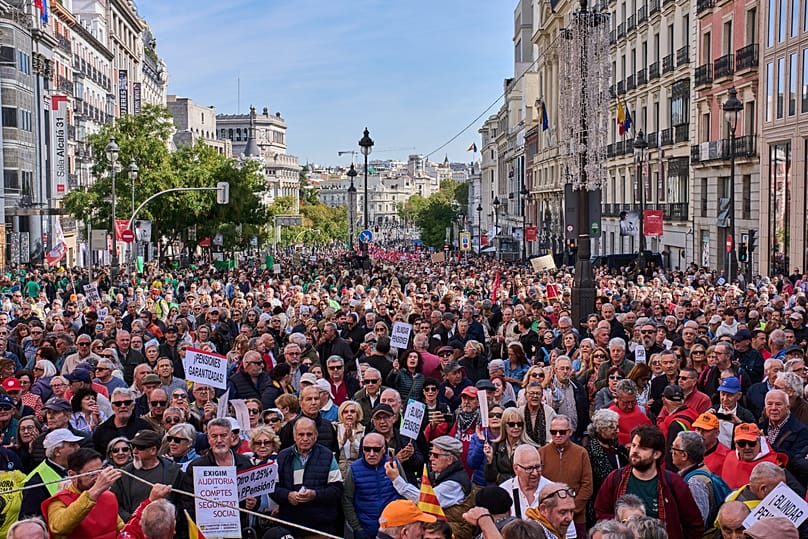
In Madrid the protesters' key demands include linking pension increases to actual inflation, raising the minimum pension to match the minimum wage, closing the gender pension gap and protecting the public pension system from privatisation.

Pensioners and supporters march to defend their retirement rights in Madrid, Spain, Saturday, Oct. 24, 2026. (AP Photo/Bernat Armangue)
Pensioners and supporters march to defend their retirement rights in Madrid, Spain, Saturday, Oct. 24, 2026. (AP Photo/Bernat Armangue) Copyright 2025 The Associated Press. All rights reserved

In Portugal affordable housing is the main demand

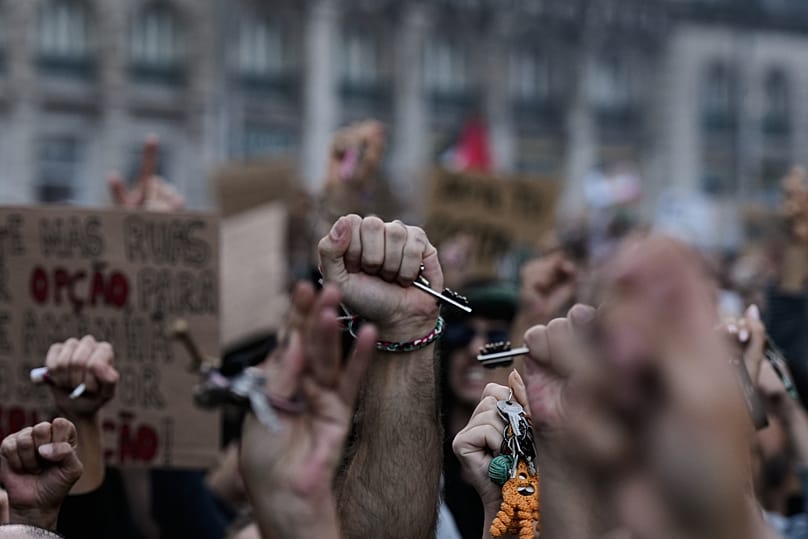
People hold keys during a protest to demand affordable housing in Lisbon, Saturday, Oct. 24, 2026. (AP Photo/Ana Brigida)
People hold keys during a protest to demand affordable housing in Lisbon, Saturday, Oct. 24, 2026. (AP Photo/Ana Brigida) Copyright 2026 The Associated Press. All rights reserved


Demonstrators wounded as police break up Lisbon and Porto housing protest camps

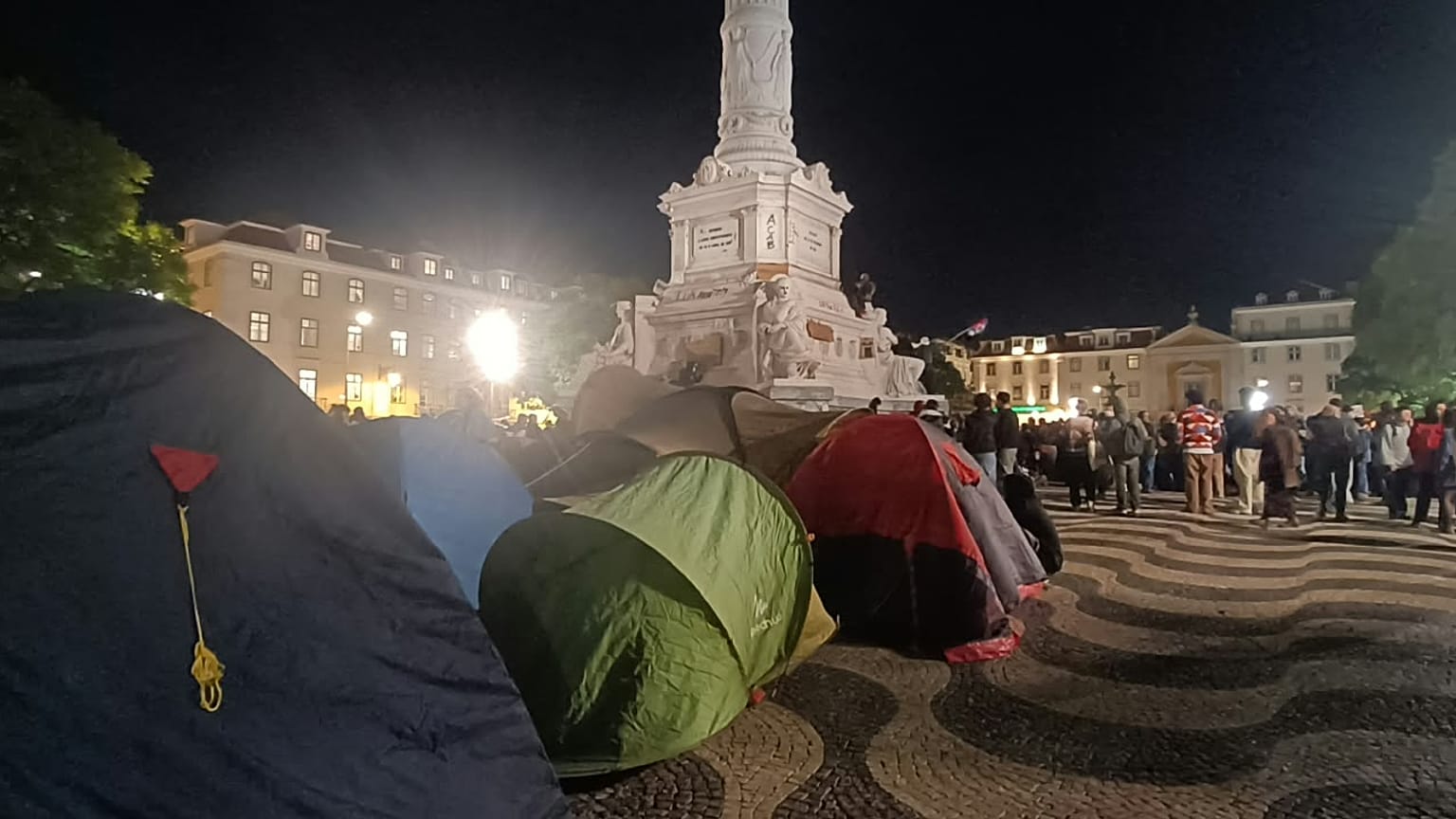
Tents at the Rossio camp in Lisbon set up after a protest against the housing crisis. 24.10.2026
Copyright Manuel Ribeiro/Euronews

By Manuel Ribeiro  & euronews
Published on


The ongoing confrontation between police and protesters demanding affordable housing turned violent overnight. Police again moved in against protest camps in Lisbon and Porto in the early hours of Sunday, with several arrests and injuries reported.

Protesters chanted "smells like a dictatorship" overnight into Sunday as police hit desmonstrators with batons in both the capital Lisbon and and the city of Porto, in an operation to dismantle tents set up to protest against skyrocketing housing prices.

In a message posted on X, the police said officers had "intervened early this morning... to put an end to these illegal encampments".

"Once dialogue ended, the operation led to 31 arrests for disobedience," the police added.

A spokeswoman for the protest camp in Porto told the Portuguese news agency Lusa there were 37 minor injuries and two arrests.

"It is the third night in which we are being repressed with a method of total intimidation that one would never expect in a democratic country governed by the rule of law," said Catarina dos Santos, speaking to reporters.

The Public Security Police (PSP) had warned earlier in the afternoon that it would not allow tents to remain overnight in Rossio.

Protest camps in main public squares a point of friction for weeks

The presence of tents in Rossio Square and Praça D. João I (in Porto) have been the main points of friction with the police during the past weeks of protest. As night fell, the demonstrators decided by majority to put up tents and stay overnight.

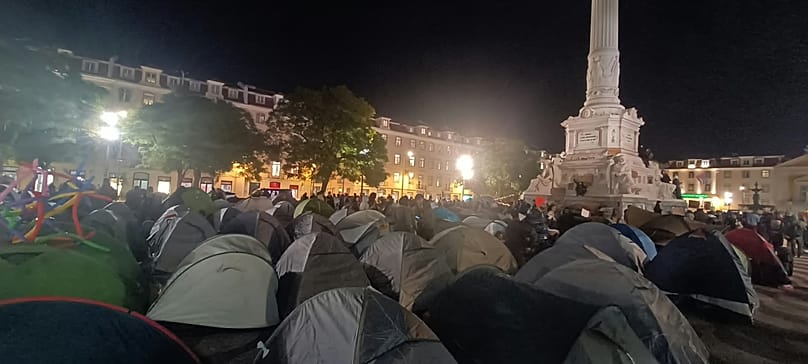
Around 130 tents were erected in Rossio Square in Lisbon.

130 tents erected in Rossio Square, Lisbon.
130 tents erected in Rossio Square, Lisbon. Manuel Ribeiro/Euronews

The operation to remove the tents began at around 1 am in both cities, after protesters started to notice what they called "disproportionate" police reinforcement, with canine units gathering in the squares in both locations.

"There were at least 20 crowd-control dogs, clearly agitated, and and a number of weapons pointed at us, and if this is not intimidating and serious, I don't know what is," lamented Catarina Santos, quoted by Lusa.

Shortly before 2 am on Sunday, the police contingent had both squares cordoned off and began moving in against the demonstrators, who had formed a human chain. Police used batons, while firecrackers were heard causing considerable confusion. In Praça D. João I, bystanders criticised the PSP's conduct and began to sing "Grândola Vila Morena", a song associated with the revolution of the 25 April that ended decades of dictatorship in 1974.

The "clean-up" operation in the squares was swift: the tents were removed immediately by the authorities and the protesters, who say they will return, dispersed to nearby squares.

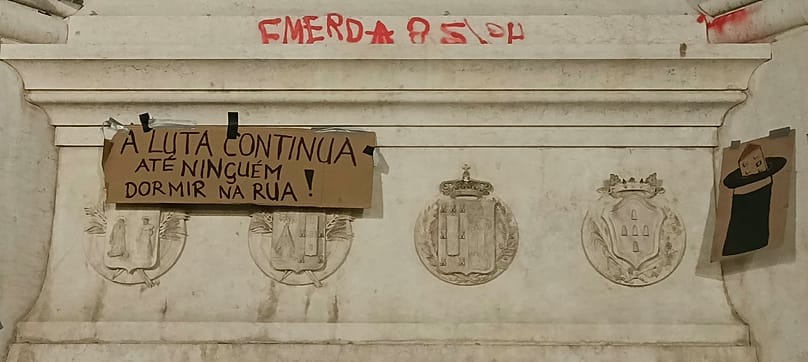
A banner placed on the statue of D. Pedro IV, in Rossio Square, reads, in Portuguese, 'The fight goes on until nobody sleeps on the streets'. Lisbon, 24.10.2026
A banner placed on the statue of D. Pedro IV, in Rossio Square, reads, in Portuguese, 'The fight goes on until nobody sleeps on the streets'. Lisbon, 24.10.2026 Manuel Ribeiro/Euronews

Protesters demand changes in new tenancy law and a cap on rents

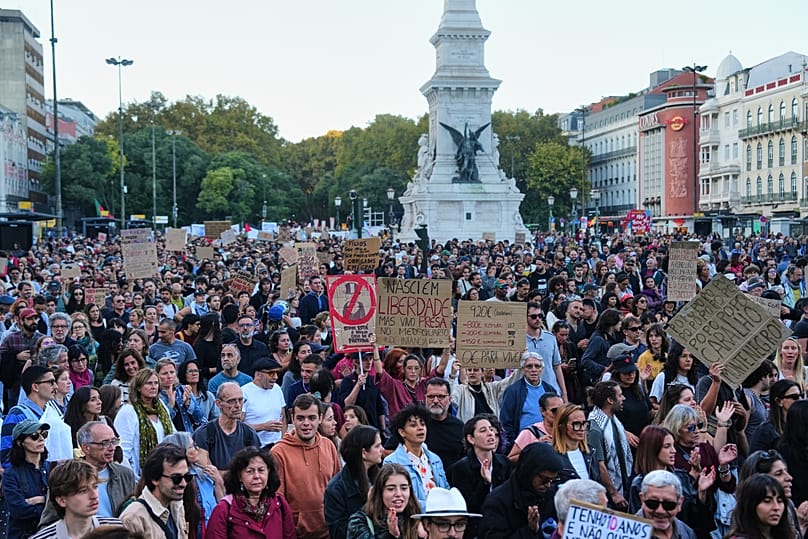
The Lisbon and Porto camp movements are calling for measures such as the reversal of the tenancy law, an end to evictions of people with no housing alternative, limits on the purchase of property by real-estate funds, the rehabilitation of vacant buildings and a ceiling on rents.

People march during a protest to demand affordable housing in Lisbon, Portugal, Saturday, Oct. 24, 2026. (AP Photo/Ana Brigida)
People march during a protest to demand affordable housing in Lisbon, Portugal, Saturday, Oct. 24, 2026. (AP Photo/Ana Brigida) Copyright 2026 The Associated Press. All rights reserved

Large crowds had turned out the previous day for peaceful demonstrations, accusing the government of failing to act to tackle Portugal's housing crisis


2.92 metres: German angler lands giant catfish from Polish reservoir

Oliver Schäfer and Kevin Cremers have caught a catfish measuring almost three metres in length.
Copyright anglerphoto // kevin_cremers27 // instagram


By Maja Kunert
Published on

Oliver Schäfer from the Eifel, together with his fishing partner, landed a 2.92‑metre catfish during a tournament in Poland. The fish is already well known among anglers.

In the moment when Oliver Schäfer from North Rhine-Westphalia feels the weight at the other end of his line, he quickly realises: this is no ordinary fish. The 34-year-old is competing in a predator fishing tournament in the Polish city of Rybnik, together with his Dutch fishing partner Kevin Cremers.

On 10 and 11 October, according to the newspaper BILD, 70 teams with around 150 anglers from all over Europe took part. Schäfer and Cremers had travelled there specifically for the event. They were using a special rod designed for large catfish and a soft-plastic lure, as Schäfer told the paper.

He only grasped how enormous his opponent was when the fish broke the surface for the first time. The struggle lasted more than 30 minutes. Cremers kept the boat on course against the wind, while Schäfer held on and fought the fish.

Measured and released again

On the shore, the tournament jury measured the animal: 292 centimetres. After that, the catfish was returned to the lake, as required by the tournament rules. Schäfer told BILD that the fish are carried to land on a tarpaulin so that their protective slime layer is not damaged.

The catch was not enough to secure overall victory. What counted was the total number of points. According to the Berliner Zeitung and the results list of the PZW Katowice angling association, the pair finished second with 28,930 points.

The same fish as last year?

The catfish already has a story. Media reports say participants assume it is the same animal that was landed at the tournament in October 2025. The Polish anglers Krzysztof Pyra and Adrian Gontarz also measured 292 centimetres back then. The Berliner Zeitung reports that the fish has not grown any longer since, but has become noticeably more robust.

The world body IGFA records catfish records by weight; there is no official list based on length. In 2023, according to Welt, Italian angler Alessandro Biancardi pulled a 2.85-metre catfish out of the River Po. Within the angling community, the Polish city of Rybnik in the Silesian Voivodeship is therefore regarded as the place where the longest known catfish has been caught.

Schäfer’s dream of a three-metre catfish is still alive even after this success, he told BILD – he says he is now just a hand’s breadth short.

Europe’s largest freshwater fish

According to Germany’s Federal Agency for Nature Conservation, the European catfish is the largest native freshwater fish on the continent. It can grow up to three metres in length and reach a weight of 150 kilograms. Striking features include its scaleless body, broad head and six barbels, which it uses to find its way in murky waters.

Its diet consists mainly of other fish; larger specimens occasionally prey on small water birds or mammals. For 2026, the national angling association, the Federal Agency for Nature Conservation and the Society for Ichthyology have chosen the catfish as Fish of the Year.

Benefiting from warming

Originally, the catfish was native mainly to the Danube and Rhine catchment areas. Stocking programmes dating back to the 19th century and waterways such as the Main-Danube Canal have since opened up many more habitats for the species, the agency says.

On top of that, the climate is helping it. As a warmth-loving species, the catfish benefits from rising water temperatures. Biologist Jürgen Geist told the magazine Focus that populations are increasing markedly, both in terms of their range and their density. Cold-loving species such as brown trout, on the other hand, are among the losers.

Warm water is also a key factor in Rybnik. The reservoir there serves as a cooling pond for a coal-fired power plant, and the heated water flows back into the lake. Because fish feed more actively at higher temperatures, catfish, carp and zander grow faster in these conditions, according to angler Oliver Schäfer.

Experts say the animals pose hardly any danger to humans. They have only small, rasp-like teeth, and outside the spawning season there is virtually no risk. In June 2025, a catfish around two metres long in the Brombachsee reservoir in Middle Franconia bit several swimmers and caused minor injuries.