It’s possible that I shall make an ass of myself. But in that case one can always get out of it with a little dialectic. I have, of course, so worded my proposition as to be right either way (K.Marx, Letter to F.Engels on the Indian Mutiny)
Tuesday, October 27, 2026
Op-Ed: US tariff war is fueling Vietnam’s coal boom
(The opinions expressed here are those of Gavin Maguire, a columnist for Reuters.)
A years-long trade war between the United States and China has helped shift manufacturing investment, factory output and export production into Vietnam, driving the Southeast Asian nation’s coal-fired electricity generation to record highs.
Vietnam’s coal plants generated 132.9 terawatt hours (TWh) of electricity during the first nine months of 2026, which is a 15% jump from the same months last year and the highest for that period on record, according to data from Ember.
A roughly 12% decline in year-to-date hydro power production due to below-normal rainfall this summer has been a key driver of the greater coal-fired activity, forcing utilities to offset stunted reservoir output with higher coal production.
But a larger factor has been the steady swell in Vietnam’s export-oriented manufacturing sector, which has grown rapidly within the past decade and lifted the country’s total electricity demand by nearly 50% since 2019.
In many respects, that manufacturing expansion can be traced back to Washington. US tariffs on Chinese imports since 2018 encouraged manufacturers to diversify production into lower-cost locations, with Vietnam emerging as one of the biggest winners.
The shift has helped supercharge Vietnam’s factory sector and power demand, but it has also tied an increasing volume of export production destined for the US market to a power system that still relies heavily on coal for electricity generation.
America’s factory floor
The switch in production origins shows up clearly in US trade data.
In 2018, US imports from China were roughly 10 times larger than imports from Vietnam. This year, monthly imports from the two countries have been nearly level.
When US imports from China hit their peak of roughly $539 billion, average monthly US trade flows to China were around $45 billion, data from LSEG shows.
During that same year, average US monthly trade flows to Vietnam were around $4 billion.
So far in 2026, average monthly US trade flows to China and Vietnam have been around $22.9 billion and $22 billion, respectively.
That more than 400% rise in the value of Vietnam’s monthly exports to the US helped fuel an economy-wide boom, with Vietnam’s gross domestic product (GDP) posting an average annual expansion of 7.4% since 2022, according to the International Monetary Fund.
That growth pace was one of the world’s fastest during that period, and in turn triggered sustained growth in Vietnam’s total electricity consumption, which expanded at an average rate of 6% a year between 2022 and 2025, data from Ember shows.
Coal-heavy power mix
Vietnam’s electricity system is heavily reliant on coal, with coal-fired power stations accounting for an average of around 49% of total utility supplies since 2019.
By comparison, coal accounts for around a third of electricity generation globally, which means that Vietnam has a substantially more coal-dependent power system than most.
However, coal’s share of Vietnam’s power mix can fluctuate significantly depending on the availability of alternative power sources in any given year.
For instance, coal only accounted for 38.5% of the power mix in 2022 thanks to strong hydro production that year as well as a surge in international coal prices, which spurred nearly all cost-sensitive power systems to pare back coal use.
So far in 2026, coal’s share has averaged nearly 52% of the generation mix due to the lowest hydro production tally since 2023.
That coal share is the highest for that period since 2020, and has resulted in a 16% jump in power sector emissions to a record 129 million metric tons of carbon dioxide and equivalent gases so far this year, data from Ember shows.
And with the peak hydro production period already passed, additional gains in both coal use and coal emissions are likely, which will help cement 2026 as a record for Vietnam’s coal power reliance.
Over the longer term, Vietnam does have significant non-coal power capacity under construction, including around 11 gigawatts (GW) of gas-fired power, 1.4 GW of new hydro capacity, and around 1.3 GW of wind capacity, according to Global Energy Monitor.
But there are also an additional 2.7 GW of new coal plants being built, with a further 2.6 GW planned after that.
That means that, having won a growing share of the US import demand, Vietnam looks set to primarily power that production with coal.
That in turn may serve to keep the cost of goods production relatively low, but comes with its own climate price tag that US importers may have to wrestle with as and when their supply chains come under scrutiny.
(Reporting by Gavin Maguire; Editing by Lincoln Feast.)
India gold demand strengthens on lower prices, festive purchases
Gold buying picked up in India this week as lower prices during the major Dussehra festival boosted purchases and lifted premiums, while physical demand in top consumer China was steady even as cautious consumers continued to curb jewellery spending.
International spot gold prices were on track to record their steepest weekly loss since June on Friday, having hit its lowest level since July 20 at $3,986.50.
Indians celebrated Dussehra this week, one of the country’s biggest gold-buying festivals.
“Retail sales saw a boost this week due to Dussehra, as many customers consider it auspicious to make at least a token purchase on this festive occasion,” a Mumbai-based bullion dealer with a private bank said.
Dealers quoted premium of up to $9 an ounce over official domestic prices this week, inclusive of 15% import and 3% sales levies, compared with a premium of up to $7 last week.
“Demand typically surges during Dussehra, with jewellery stores packed with customers,” said Chirag Thakkar, chief executive of bullion dealer Amrapali Group Gujarat.
However, Thakkar added that this year’s festive demand remained well below last year’s levels.
In China, bullion traded at premiums of $9 to $10 an ounce to the global benchmark price.
“While overall volumes are relatively light, the positive premium indicates that underlying appetite for physical gold remains intact,” said Bernard Sin, regional director, Greater China, MKS PAMP.
The country’s jewellery market remains weak due to low consumer confidence, which is weighing on jewellery demand, particularly among younger customers, said Rhona O’Connell, head of market analysis at Stone X.
China’s gold jewellery demand has remained under pressure so far in 2026, recording its weakest first-half demand in tonnage terms since 2006, according to a recent World Gold Council report.
In Singapore, gold was sold between a $1 discount to a $2 premium this week, while it traded from a $0.5 discount to a $2.50 premium in Hong Kong.
In Japan, gold was sold between a $0.15 discount and a $0.50 premium.
(Reporting by Sukanya Mitra in Bengaluru and Rajendra Jadhav in Mumbai; Additional reporting by Swati Verma; Editing by Sherry Jacob-Phillips)
ALUMINUM
Norsk Hydro flags higher smelting costs after quarterly profit miss
Norsk Hydro is one of the world’s largest aluminum producers.(Image courtesy of Norsk Hydro.)
Norwegian aluminium producer Norsk Hydro (OTCMKTS: NHYDY) on Friday reported a third-quarter core profit below market expectations and said it expected higher costs and lower realised metal prices at its smelting business in the fourth quarter.
Adjusted earnings before interest, taxes, depreciation and amortisation rose by half to 9.09 billion Norwegian crowns ($974.3 million), but missed analysts’ average forecast of 9.53 billion crowns in a company-compiled poll.
Hydro shares fell 6.2% in early Oslo trading to their lowest level in more than a year and were on track for their worst trading day since 2023.
Disruption to Gulf aluminium supplies has lifted the premiums European buyers pay for metal, while expanding alumina production in China and Indonesia has weighed on prices for the raw material used to make it.
Hydro is restarting smelting capacity in Slovakia and investing in Norwegian production of aluminium for Europe’s electricity grids as the region seeks more secure supplies.
Yet gas supply problems at its Brazilian refinery and a dispute over sales from its Qatar joint venture have exposed vulnerabilities in Hydro’s own operations.
Costs rising in fourth quarter
Hydro expects the premium it earns above benchmark aluminium prices to fall to between $550 and $600 a ton in the fourth quarter, from $673 in the previous three months.
Finance chief Trond Olaf Christophersen told analysts that premiums for extrusion ingots had fallen to about $850 a ton from around $1,000 in recent weeks, weighing on the broader premiums forecast.
The smelting division expects carbon costs to rise by 250-350 million crowns, alumina costs by 100-200 million crowns and fixed costs by 150-250 million crowns from the third quarter. It also expects higher sales volumes.
The Alunorte alumina refinery in Brazil has returned to full production, but Hydro maintained its estimate of a $90 million to $110 million fourth-quarter hit from buying gas above contracted prices.
That follows an around $85 million hit from gas supply disruptions and more expensive replacement purchases in the third quarter.
($1 = 9.3302 Norwegian crowns)
(Reporting by Jesus Calero in Gdansk, editing by Milla Nissi-Prussak)
US-backed group Congo mines deal with Glencore in ‘final phases’
Mutanda, the world’s largest cobalt mine, is responsible for a fifth of global output. (Image courtesy of Glencore.)
A US government-backed group has nearly completed the acquisition of stakes in Glencore Plc’s copper-cobalt mines in the Democratic Republic of Congo, according to a senior figure in the consortium.
Orion CMC was set up a year ago as a tool in the push by the US and allies to secure minerals deals around the world, targeting an eventual pool of $5 billion. In February, the venture announced a preliminary deal to purchase 40% of Glencore’s majority interests in a pair of major operations in Congo.
That transaction is in its “final phases,” Oskar Lewnowski, chief executive officer of specialist mining investor Orion Resource Partners, said in an interview on Bloomberg Television with Francine Lacqua. His firm was one of Orion CMC’s three founders alongside the US International Development Finance Corp. and Abu Dhabi’s L’imad Holding.
Saudi Arabia is also involved in Orion CMC, according to Lewnowski, who said he’s talking to “Asian allies” about joining the consortium. The venture aims to reduce dependence on China for a range of mineral products.
“We’re not looking to compete with China,” said Lewnowski. “We’re just looking to create a supply chain that doesn’t allow for monopolistic behavior by any one country.”
The executive said Orion CMC is advancing a deal to make an equity investment in Lifezone Metals Ltd.’s Kabanga nickel project in Tanzania, which was first reported by Bloomberg News in August. He said the group is also pursuing mining deals in Canada, Indonesia and Vietnam.
A transaction to back Chemaf SA, a copper-cobalt miner in Congo that’s been acquired by the US’s Virtus Minerals Inc., “is still possible” but Orion CMC is focused on closing the Glencore deal, according to Lewnowski.
Congo is the world’s second-biggest copper producer and largest source of battery metal cobalt. Chinese firms dominate output of both metals, which are often mined together in the central African country.
Copper traders are fixated on whether President Donald Trump will eventually move ahead with his proposals to place tariffs on imports. The administration is “fairly divided” on that question, said the Orion CEO.
But if tariffs don’t happen, “I think the US government probably takes a hard look at buying significant amount of tonnage that’s already in the United States and storing it.”
(By William Clowes and Francine Lacqua)
Metals traders reap bonanza with another year of record profits
Metals traders are earning billions of dollars in a second consecutive blowout year for the sector, with several top trading houses notching up record profits.
Trafigura Group, which competes with Glencore Plc for the title of the world’s largest metals trader, made a record profit of around $2 billion in metals trading in its financial year that ended in September, according to people familiar with the matter. Glencore, too, has been enjoying some of its best-ever profits, although its overall results have been marred by a $480 million provision related to its exposure to iron ore trader Radiant World.
The vast earnings haul has meant that the champagne was flowing freely at London Metal Exchange Week, the main annual gathering of the global metals industry, which concluded on Friday. Many individual traders said privately they are enjoying the best earnings of their careers, while simultaneously fielding job offers from rival companies, as well as newer entrants looking to grab a slice of the metals boom.
While many had expected fewer opportunities for metals traders after US President Donald Trump did not go ahead with tariffs on refined copper last summer, continued ambiguity over whether tariffs might yet be imposed has extended a bonanza available to traders shipping copper to the US. Meanwhile, metals including copper, gold and silver have soared to record highs, while the market for semi-processed copper concentrate — the bread-and-butter of many physical traders — has been unprecedentedly tight.
Trafigura’s metals division has had a record performance in trading, according to people familiar with the matter, who asked not to be identified as the results aren’t public. The trading house is still finalizing its results, which it usually reports in early December, and the audited profit numbers might be subject to adjustments and revaluations of assets like its smelting unit, Nyrstar, some of the people said.
Trafigura and Glencore both declined to comment.
Mercuria Energy Group, the most aggressive of a group of energy traders that have expanded in metals in the past few years, has also had a strong year. Mercuria’s annual operating profits are on track to match or exceed last year’s level above $300 million, people familiar with the matter said. The company has plowed more than $4 billion into metals deals everywhere from Congolese copper to Indonesian aluminum as it seeks to grow its footprint in the market.
IXM, the metals trading unit of miner CMOC Group Ltd., is also on track for a record year, according to a person familiar with the matter. CMOC’s half year report said that IXM had “strengthened physical trading, achieving a new record high for the same period in terms of operating revenue.”
Representatives for Mercuria and IXM declined to comment.
Vitol Group, the world’s largest commodity trader, which is also building a metals trading business, is on track for profits of more than $100 million this year, a person familiar with the matter said. While that is well ahead of its performance in metals last year, it remains behind key competitors including Mercuria.
Vitol is in talks to strengthen its metals team, people familiar with the matter said. It has hired Billy Henty, who previously worked at Mercuria and Citigroup Inc., to trade iron ore in Dubai. And Vitol executives have had discussions with former chief executive officer of IXM Kenny Ives. It’s unclear whether the conversation will go anywhere, and Ives has indicated he won’t consider a new job until 2027 at the earliest, the people said.
Vitol and Ives both declined to comment.
(By Jack Farchy, Archie Hunter and Alfred Cang)
ICYMI
US Department of Energy names helium to critical materials list
Helium tanks. AI-generated stock image by Anastasiia.
The U.S. Department of Energy (DOE) announced Friday that Secretary of Energy Chris Wright has designated helium as a critical material under the Energy Act of 2020.
The designation advances the Trump Administration’s commitment to freeing America from reliance on foreign sources of critical materials, strengthening domestic manufacturing, supporting American jobs, and securing the materials essential to U.S. economic and national security, the DOE said.
DOE determined that helium meets the statutory definition of a critical material due to its essential role in American manufacturing and growing exposure to supply chain risks. Helium’s unique properties make it indispensable to semiconductor production, with no viable substitutes in many critical applications.
Helium in the US is produced as a byproduct of natural gas processing in Kansas, Texas, Wyoming, Colorado, Arizona, New Mexico and Oklahoma. Kansas leads production, with plants refining crude and Grade-A helium from natural gas in fields in the Hugoton and Greenwood areas. Texas has large production and storage infrastructure, including the Panhandle-Hugoton fields, the Cliffside field, and storage caverns near Beaumont.
“Helium is essential to producing the semiconductors and advanced technologies that power our economy,” US Secretary of Energy Chris Wright said in a news release.
“By designating helium as a critical material, we are taking another step toward securing our supply chains, creating American jobs, and ensuring the United States leads the world in energy and technological innovation.”
Global demand for helium is growing faster than production, increasing supply risks for American manufacturers. Despite the nation’s abundant helium resources, limited refining capacity and lengthy permitting timelines continue to constrain US production.
Buried sediments prove Romans mined gold in Pyrenees
Researchers have confirmed that Roman miners used an extensive hydraulic system to extract gold from Spain’s eastern Pyrenees nearly 1,700 years ago, providing new evidence of ancient mining activity in the mountainous region.
The findings, first published in the journal Land, date sediments preserved in a reservoir at Les Guilleteres d’All, an archaeological site in Catalonia’s Cerdanya Valley. Researchers estimate the operation displaced about 2 million cubic metres of earth, leaving behind artificial ravines, trenches and a semicircular excavation about 300 metres wide.
Researchers from the University of A Coruña and the Autonomous University of Barcelona identified the remains of a water-management network that channelled water through gold-bearing sediments. The process eroded ancient alluvial deposits, allowing miners to recover fine particles of the precious metal.
The discovery strengthens evidence that Roman mining extended beyond major production centres such as Las Médulas in northwestern Spain. It also raises questions about how mineral extraction supported settlements and economic activity in the Pyrenees during the Roman Empire.
Dating the mines
The mining complex had long puzzled archaeologists because its distinctive terrain suggested Roman engineering, but researchers lacked direct evidence to establish when the infrastructure was used.
Excavations conducted between 2010 and 2022 uncovered a reservoir measuring about 4.5 metres across and 1.5 metres deep, supported by a dam built from large stone blocks. The structure stored and regulated water needed to wash gold-bearing material from the surrounding deposits.
After miners abandoned the system, sediment gradually accumulated inside the reservoir, preserving a record of its final stages of use.
Researchers analysed two sediment samples using optically stimulated luminescence (OSL), a dating technique that measures signals stored in mineral grains, particularly quartz, after their last exposure to sunlight.
The results placed sediment accumulation broadly between the second and fourth centuries CE, consistent with Roman occupation of the region.
However, the dates do not establish when gold extraction began or precisely when operations ceased. Because the samples came from deposits that accumulated after the reservoir fell out of use, they provide evidence for the infrastructure’s chronology rather than a complete operating history.
The scale of the operation nevertheless points to substantial engineering capabilities. Miners excavated channels and redirected water across difficult mountain terrain beneath peaks reaching nearly 2,900 metres.
Unlike underground mining, hydraulic extraction relied on controlled water flows to break down sediment and expose gold particles. The process transformed the landscape, leaving excavation fronts and artificial channels still visible today.
Roman connections
The findings could also help explain the economic importance of Iulia Libica, a Roman settlement near the mines that corresponds to present-day Llívia.
The settlement was the only documented Roman city in this part of the Pyrenees, and researchers suggest it may have helped administer the region’s natural resources.
Historical accounts support the possibility of local gold production. Roman author Pliny the Elder described mineral wealth in the Pyrenees, while poet Martial referred to gold associated with the area around Iulia Libica.
Archaeological discoveries provide additional context. At El Castellot de Bolvir, researchers identified a metalworking workshop, while excavations at a nearby Roman cemetery uncovered a gold bracelet weighing about 23 grams.
Although these discoveries do not establish a direct connection to Les Guilleteres, they suggest that precious metals and metalworking formed part of the region’s ancient economy.
Researchers also identified a possible chronological relationship between the decline of mining and changes at Iulia Libica. Parts of the settlement appear to have been abandoned during roughly the same period as the hydraulic infrastructure.
The evidence does not establish whether the mine’s closure contributed to the settlement’s decline or whether broader economic and political changes affected both.
Further archaeological work could clarify how the mining network operated, when extraction began and whether gold production was administered through Iulia Libica.
The findings establish a firmer timeline for Roman hydraulic mining in the eastern Pyrenees and provide a foundation for investigating the role of gold extraction in the region’s ancient economy.
Iron ore prices rangebound as investors weigh weakening demand against stimulus bets
Iron smelting. (Reference image by Hans Splinter, Flickr.)
Iron ore prices traded in a tight range on Monday as investors weighed seasonally weaker demand in China, the world’s top consumer, against bets on fresh stimulus from Beijing to bolster the world’s second-largest economy.
The most-traded iron ore contract on China’s Dalian Commodity Exchange (DCE) closed daytime trading up 0.07% at 671.5 yuan ($100.70) a metric ton.
The benchmark November iron ore on the Singapore Exchange slipped 0.1% to $90.45 a ton, as of 0845 GMT.
Consumption of the key steelmaking ingredient softened amid persistently weak steelmaker profitability, hampered by sluggish downstream demand and resilient feedstock prices.
The average daily hot metal output, a gauge of iron ore demand, fell 0.5% from the previous week to 2.32 million tons as of October 22, the lowest level since late March, data from consultancy Mysteel showed.
Chinese steelmakers remained cautious about restocking feedstocks, procuring on a hand-to-mouth basis, analysts at broker Zhengxin Futures said in a note.
Losses in ore prices were curbed though, by hopes of new stimulus from Beijing to shore up the economy.
While China’s third-quarter economic growth beat expectations and was on track to meet an annual target of 4.5%-5.0%, analysts say additional stimulus will be needed to boost growth in the first quarter of next year.
Other steelmaking inputs coking coal and coke fell 0.46% and 0.29%, respectively, as expectations of a faster supply recovery weighed on prices.
Steel benchmarks on the Shanghai Futures Exchange lost ground. Rebar shed 0.2%, hot-rolled coil dipped 0.41%, and stainless steel fell 0.66%.
($1 = 6.6680 Chinese yuan)
(Reporting by Amy Lv and Lewis Jackson; Editing by Rashmi Aich and Ronojoy Mazumdar)
Lithium’s $100B question: Who will build 134 new mines?
Salar de Uyuni, in Bolivia, is the world’s largest salt flat. (Stock image by Sharon Jones.)
Global lithium demand is expected to more than triple by 2050, requiring the equivalent of 134 new mines and more than $100 billion in investment as electric vehicle adoption accelerates, according to Benchmark Mineral Intelligence.
The London-based research firm forecasts consumption will climb to nearly 7 million tonnes of lithium carbonate equivalent (LCE) by mid-century from 2.11 million tonnes this year. At an average production capacity of 36,000 tonnes annually, the additional supply would require the equivalent of one new mine every two months over the next 24 years.
“The biggest challenge is sustaining that investment through price cycles, while competing for capital with AI, defence and the wider energy transition,” Cameron Perks, Benchmark’s product director for lithium, said in a statement.
The forecast highlights the scale of the mining industry’s challenge as governments push to electrify transportation and develop domestic battery supply chains. Financing constraints, lengthy permitting processes and competition for investment could complicate efforts to bring enough production online, particularly in Western markets seeking to reduce dependence on China.
Electric vehicles are expected to account for 76% of lithium demand by 2050, compared with 55% today. Batteries already represent 92% of consumption, up from about 70% in 2020.
Demand from stationary energy storage has expanded by more than 60% annually over the past two years, although Benchmark expects growth to moderate to roughly 5% a year through the end of the decade.
Supply shifts
Australia, the world’s largest lithium mining jurisdiction, is expected to account for 29% of global mined supply this year, but its share could decline to 20% by 2050 as existing operations deplete and competing regions expand production.
“Many of Australia’s mines will be depleting by 2050. Price volatility has made financiers hesitant, and the regulatory burden is growing,” Perks said. “It’s not too late, but if Australia doesn’t back growth, other regions will take that share.”
China is expected to maintain roughly a quarter of global mined production, supported by continued investment in domestic resources and its established position in the battery supply chain.
North America, meanwhile, could increase its share of mined lithium output to 13% by 2050 from just 1.7% this year. The region’s portion of global lithium demand from battery cell manufacturing is forecast to double to 12% over the same period.
Europe faces a similar supply challenge. Although the continent accounts for 7% of lithium demand from cell production, it contributes less than 1% of mined supply. Benchmark expects European mining output to reach 5.5% of the global total by 2050, still below its projected 8% share of cell manufacturing demand.
Developing new mines in both regions will be difficult, however, because some promising deposits require unproven technologies or face environmental and community opposition.
“These aren’t insurmountable, but they create significant delays, and they mean mines built in these regions simply cost more,” Perks said.
Recycling uncertainty
Benchmark’s outlook could prove conservative if government policies supporting electric vehicles and energy storage drive stronger-than-expected consumption.
Under its upside scenario, lithium demand could approach 9 million tonnes LCE by 2050, requiring the equivalent of approximately 180 new mines and more than $150 billion in investment.
Recycling offers the largest potential offset to new mining requirements. Benchmark expects recovered material to account for almost half of lithium supply by mid-century, although that projection depends on sufficient volumes of used batteries becoming available and recycling remaining commercially competitive.
Its capital expenditure analysis, which assumes recycling meets a substantial portion of future demand, estimates that approximately $64 billion will be needed to satisfy lithium requirements through 2040.
The timing of battery retirements remains a major uncertainty because materials cannot be recovered until batteries reach the end of their useful lives.
“Recycling will grow, but our base case asks a lot of it,” Perks said. “It’s limited by how quickly batteries reach end of life, and it still needs to compete with mines on cost. Every tonne that recycling doesn’t deliver has to come from a mine.”
The industry’s ability to finance new projects through volatile commodity cycles, while scaling up recycling capacity, will ultimately determine whether production can keep pace with the energy transition.
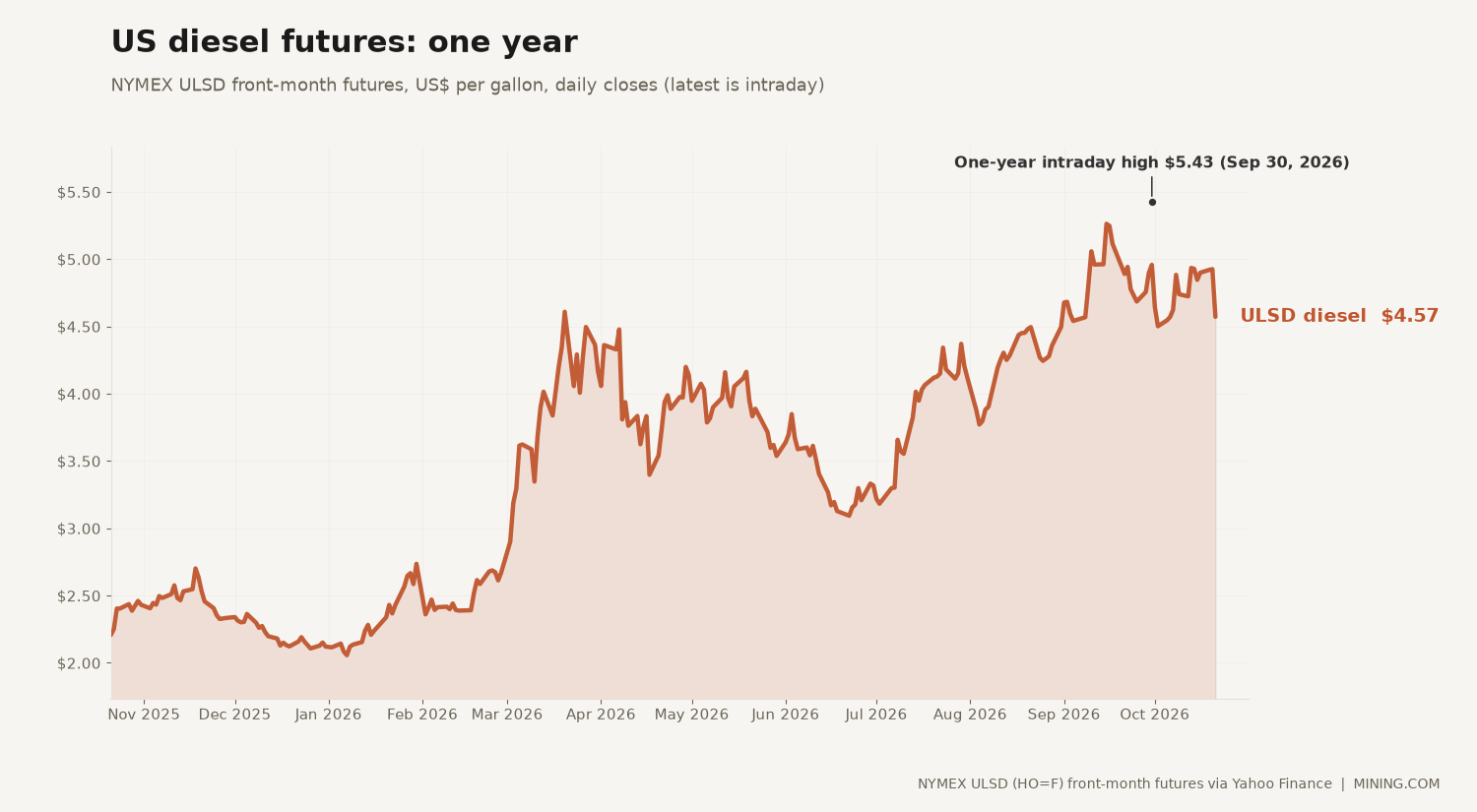
Soaring diesel prices have started to impact mining, rising production and transportation costs and influencing the pricing of metals around the globe, as the commodity market adjusts to tariffs and inflation.
Disruptions in the Strait of Hormuz have affected the transportation of liquefied natural gas (LNG) and other energy shipments, raising prices globally. The mining industry is impacted by this as fuel is essential to power up production and transport metals from the mine site to global markets.
Copper producers Antofagasta (LON: ANTO) and Capstone Copper (TSX: CS) have reported rising operating expenses, while gold miners Barrick Mining (NYSE: B) (TSX: ABX), Kinross Gold (TSX: K; NYSE: KGC) and Monument Mining (TSX-V: MMY) have relied on stronger bullion prices to protect margins.
Barrick’s gold production cost rose 17% between 2025 and 2026 in part because of higher fuel costs. With gold reaching record high prices, the company was still able to lift attributable adjusted EBITDA 51% year-on-year to $2.55 billion in Q2 2026.
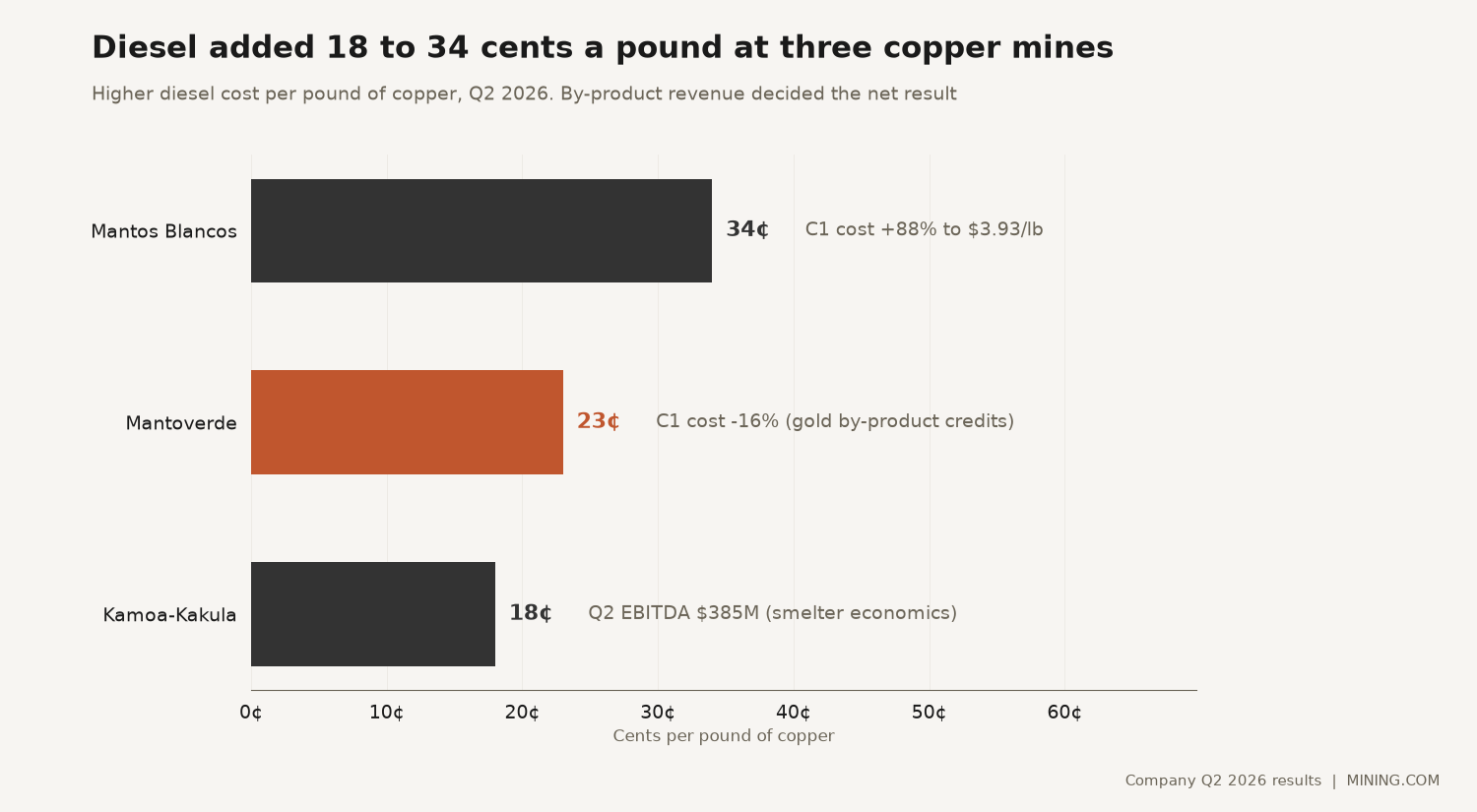
A similar phenomenon affected Ivanhoe Mines, as even with an 18¢/lb equivalent diesel cost increase, its Kamoa-Kakula copper mine generated $385 million of Q2 EBITDA, helped by stronger copper prices and smelter economics.
“Despite elevated global diesel prices during the quarter, the impact on our operating costs has been well contained,” Ivanhoes Mines founder and co-chairman Robert Friedland said in the 2026 Q2 results release. “Our world-class smelter at Kamoa-Kakula provides a natural hedge while flows through the Strait of Hormuz remain constrained.”
The results highlight a growing divide between miners with sufficient commodity-price gains or valuable by-products to absorb higher fuel bills and those more exposed to energy costs.
In March 2026, TD Cowen analysts warned that surging energy prices threatened to impact historic margin expansions, adding more pressures on cost guidance, similar to the impact seen in 2022 with the Russia-Ukraine invasion. They estimated that there would be a 15% increase in AISC year-on-year along with 22% higher all-in costs.
With interest rates rising and supply concerns easing, metals prices are also starting to fall and the industry might need to brace for impact.
Copper cost squeeze
Antofagasta increased its full-year copper cash cost guidance almost $0.3 to between $2.60 and $2.70 per pound, from $2.40 to $2.60, citing higher global diesel prices.
Capstone reported a 15% year-on-year increase in second-quarter C1 cash costs to $2.82/lb,partly driven by higher diesel and sulphuric acid expenses. The sharpest increase came at its Mantos Blancos copper mine, where C1 costs surged 88% to $3.93/lb, including about 34¢/lb attributable to higher mining costs, mainly from diesel.
At its Mantoverde copper-gold mine, stronger gold by-products helped to decrease C1 costs by 16% even with diesel prices adding 23¢/lb to the bill.
Ivanhoe also benefited from additional revenue at its Kamoa-Kakula complex in the Democratic Republic of Congo. Despite an 18¢-per-lb. increase in diesel costs, the operation generated $385 million in second-quarter EBITDA, supported by stronger copper prices and smelter economics.
Friedland said sulphuric acid sales covered the smelter’s operating costs during the quarter, providing another buffer against energy inflation.
The contrasting results illustrate how diversified revenue streams can offset rising energy bills, leaving producers without significant by-product credits more vulnerable to a downturn in copper prices.
Gold’s margin cushion
Gold producers have faced similar pressures, although record bullion prices have provided greater protection against rising operating expenses.
A World Gold Council (WGC) report on 2026 Q1 released in August pointed out that even with an exceptional quarter for gold miners, the Hormuz closure became a concern.
The impact depended upon location. WGC said that while diesel prices increased 54% in the US, in Australia it had almost doubled prices.
While some junior Australian mining operations had to suspend activities because of fuel constraints, larger companies didn’t share the same story.
According to the WGC, record gold prices generated unprecedented margins and cash flows in 2026 Q1, even with the conflict in the Middle East making production cost more expensive, the surge in the average gold price far exceeded the increase in costs. The Council warned that the industry’s resilience may be tested following the pullback in gold prices from their January peak.
Kinross (TSX: G) (NYSE: KGC), which has operations in North America, Latin America and Africa reported that its production cost of sales in 2026 Q2 had a 25% increase to $1,352 from $1,080, due to higher fuel costs. Their margin still increased 42% in the second quarter of this year, to $3,131 compared with the Q2 2025 margin of $2,204.
The price of gold and oil have historically had a mixed correlation but have risen together in periods of inflation and times of geopolitical conflict/instability, the TD March 2026 report said, resulting in disruptions to oil supply and a flight to safety.
Monument experienced an even sharper cost increase at its Selinsing gold operation in Malaysia. Its production costs rose more than 50%, from $814 to $1,243 per ounce, with diesel adding 57¢ per tonne mined.
Yet Monument’s gross margin increased 69% to $109.7 million from $65.1 million in 2025, demonstrating how higher gold prices have outweighed inflationary pressures.
Newmont (NYSE: NEM) also flagged its exposure to rising oil prices in its latest report, despite keeping production costs relatively low so far. The gold miner estimates that every $10-per-barrel increase in oil prices would add $110 million, or $21 per oz., to production costs. Newmont expects both output and costs to rise in 2027.
Fuel costs are also reshaping the competitive landscape for bulk commodities, where transportation accounts for a substantial share of expenses.
Rio Tinto (ASX, LON: RIO) recently said that it was taking advantage of being close to the Asian market to increase their iron ore shipments to the region as it would use less fuel than competitors in Latin America and Africa.
While iron ore and lower-margin commodities are much more exposed to the cost squeeze than gold or copper, this could be a possibility for those markets to focus more on close markets than global distribution while they try to manage fuel cost and supply.
Larger companies were safe from that first hit, but there were still concerns over how the disruption would impact future quarters.
The next margin test
Higher gold and copper prices have so far helped miners absorb rising fuel costs, but that protection could weaken as metal prices retreat.
With no clear timeline for the resumption of normal oil shipments through the Strait of Hormuz, prolonged fuel inflation threatens to put further pressure on operating margins, particularly for producers with limited exposure to higher-value commodities.
For TD analysts, companies could begin to evaluate fuel hedges to protect margins, particularly if moving through a heavier capital stripping phase or new construction project.
Upcoming third-quarter and full-year results will offer a clearer picture of the financial impact, revealing whether miners can contain rising expenses before they begin to outweigh gains from stronger commodity prices.
Lula’s Brazil win puts rare earths in Trump’s crosshairs
Lula celebrates a historic fourth term victory as Brazilian president, triumphing over far-right candidate Flávio Bolsonaro.(Image courtesy of Lula’s official X account.)
Brazilian President Luiz Inácio Lula da Silva’s election victory is set to reinforce government control over the country’s vast rare earth resources, raising the stakes for foreign miners and Washington’s efforts to reduce dependence on China.
Lula defeated far-right Senator Flávio Bolsonaro in Sunday’s closely contested runoff, securing a fourth nonconsecutive term if electoral authorities confirm the result. His next term begins Jan. 5, 2027, extending an industrial policy that seeks to keep more mineral processing and manufacturing in Brazil.
“This country will not accept being anyone’s backyard,” Lula said in his victory speech, signalling continued resistance to pressure from US President Donald Trump, whose administration has imposed higher tariffs on Brazilian goods.
The outcome reinforces Brazil’s recently established critical minerals strategy rather than signalling a major policy shift, according to Juan Ignacio Guzmán, CEO of GEM Mining Consulting.
“Lula’s win ultimately reinforces Brazil’s trajectory in recent years and, in particular, confirms the country’s critical minerals policy, which was launched in September of this year and is therefore still relatively new,” Guzmán told MINING.COM.
Brazil holds the world’s second-largest rare earth reserves, estimated at 21 million tonnes (Mt) by the US Geological Survey, trailing only China. That resource base makes the country an increasingly important target for Western governments seeking alternative supplies of materials used in electric vehicles, wind turbines and defence technologies.
Rare earth ambitions
Foreign investors are already positioning themselves to develop Brazil’s largely untapped rare earth potential, even as Lula’s government moves to strengthen oversight of strategic mineral assets.
Records from Brazil’s National Mining Agency through June show that foreign-owned companies filed 42% of the country’s 2,727 rare earth exploration applications, led by investors from Australia, the US and Canada.
More than 86% of the applications were submitted over the past three years, highlighting the rapid acceleration of interest in deposits that could help diversify supply chains dominated by China.
The country’s only commercial rare earth producer, Serra Verde, was acquired by USA Rare Earth (Nasdaq: USAR) in which the US government holds a 10% stake, underscoring Washington’s growing financial interest in Brazilian mineral production.
Guzmán said Lula’s approach would likely emphasize greater integration between mining and downstream industrial activities, particularly refining.
“If new rare earth mining projects are developed, the goal would ideally be not only to produce raw minerals or concentrates but also to carry out refining activities within Brazil,” he said.
Brazil’s critical minerals policy establishes a framework for greater government scrutiny of strategic mineral assets, including changes in corporate control and international supply agreements that could affect national economic or geopolitical security.
The measures could complicate acquisitions and investment decisions, particularly where transactions involve substantial foreign influence.
Adriano Drummond Trindade, a Brazilian mining lawyer and partner at Mattos Filho Advogados, said the industry’s principal concern is how the government will implement the new policy, rather than Lula’s re-election itself.
“Mining investors are used to governmental screening, as long it is predictable, applied with consistency and in timely fashion,” Trindade told MINING.COM.
He said the election gives the administration that negotiated the legislation in Congress responsibility for putting it into practice, providing continuity, but also placing greater importance on the forthcoming regulations.
“As long as the three factors mentioned above – predictability, consistency and timely response – are adequately factored in the forthcoming regulations and in practice, the re-election shall not adversely affect investment in mining,” Trindade said.
Antonia Godoy, policy and regulatory affairs analyst at Chilean consultancy Plusmining, said the impact on investor confidence would be mixed, as Brazil’s push to retain more value from its mineral resources creates both regulatory challenges and new opportunities.
“On the one hand, Lula’s push for a greater role for the state and for retaining more value within the country may raise red flags among investors, as it implies stricter requirements and a different investment model,” Godoy told MINING.COM.
She pointed to Lula’s difficult relationship with Congress as a potential constraint on more interventionist policies, arguing that the president will have limited room to manoeuvre and will need broad political agreements to advance his agenda.
At the same time, the government is offering incentives to encourage companies to establish processing and refining operations within Brazil.
Provisions include tax credits of up to 20% for eligible processing, transformation and urban-mining expenditures, capped at 1 billion reais ($192 million) annually from 2030 through 2034. Projects would require government approval to qualify.
“The government is working to create a favourable environment for the establishment and expansion of beneficiation, separation, processing, refining and advanced materials manufacturing in Brazil,” the Ministry of Mines and Energy told MINING.COM in a written statement.
The challenge will be attracting sufficient foreign
financing and technical expertise without imposing regulatory conditions that undermine project economics.
Washington tensions
Lula’s victory leaves Latin America’s two most populous countries, Brazil and Mexico, under left-of-centre leadership, complicating Trump’s efforts to expand US influence across the region.
Brazil, Latin America’s largest economy with annual GDP of about $2.6 trillion, has resisted Washington’s demands despite increased US tariffs. Lula’s renewed mandate suggests that tensions over trade and national sovereignty could persist.
The outcome contrasts with the approach advocated by Flávio Bolsonaro, who favoured closer ties with the Trump administration, including strategic cooperation on critical minerals.
Godoy sees a broader geopolitical consequence, arguing that Lula’s victory introduces a counterweight to the growing alignment between Washington and several Latin American governments over critical minerals.
She said recent electoral victories by leaders close to the US had been pushing the region towards a more uniform approach to Washington’s mineral security agenda, potentially limiting countries’ negotiating flexibility.
Guzmán, however, does not expect the political differences between Lula and Trump to significantly disrupt cooperation in the sector.
“Brazil is currently viewed as a strategic partner of the United States in the global race for critical minerals,” he said. “Therefore, I do not anticipate any major repercussions in this regard.”
Trindade also expects commercial interests to outweigh diplomatic friction, arguing that Brazil’s dependence on foreign capital limits how far the government can go in imposing additional conditions on mining investors.
“Even if the Lula administration may want to increase screening and add requirements for local industrialization to a certain degree, such measures cannot simply scare away such investment that is so needed for Brazil’s mining sector,” he said.
Washington has already signalled a willingness to support Brazilian processing and refining as part of its efforts to diversify critical minerals supply chains.
US embassy sources told MINING.COM in September that American representatives had signalled a willingness to support domestic processing and refining, recognizing that agreements focused solely on raw-material exports may not satisfy Brazilian authorities.
Trindade said US government agencies and private investors have continued pursuing opportunities in Brazil despite the introduction of the critical minerals policy and uncertainty surrounding the presidential election.
“Given that mining investment is long term and high risk, the need for investment in the sector usually supplants political tensions,” Trindade said.
Guzmán sees considerable scope for agreements combining US financing, technology transfers and long-term mineral supply contracts with Brazilian industrial development.
Such arrangements could help finance projects with tighter economics, provided domestic processing is technically and commercially viable.
The analyst cautioned that Brazil must also address regulatory uncertainty to attract the investment required.
“The Brazilian government should provide clearer and more stable regulatory frameworks regarding permitting, ownership rights, and supply commitments to the United States and other countries,” Guzmán said.
Lula’s political history suggests that industrial development and national sovereignty will remain prominent themes during what could be his final presidential term.
The veteran leader began his career as a union leader in the 1970s before helping establish the Workers’ Party. After three unsuccessful presidential campaigns, he won the presidency in 2002 and secured re-election in 2006.
He was succeeded in 2010 by former cabinet minister Dilma Rousseff, who won another term in 2014. Lula returned to power after defeating Jair Bolsonaro in 2022.
Sunday’s victory, coming shortly before his 81st birthday, may mark the final electoral triumph of a political career spanning five decades.
Mining companies will be looking at whether Lula can translate Brazil’s geological advantage into a competitive processing industry while maintaining the international partnerships needed to finance its development.
The potential for cooperation with Washington remains substantial, but its success will depend on how both governments balance strategic mineral security, commercial viability and Brazil’s ambitions to capture more value from its resources.