"At a moment when U.S. democracy is threatened by MAGA authoritarianism and deep inequality, doubling down on private-sector solutions while ignoring redistributive policy is a dangerous distraction," said one critic.

Critics of the so-called "abundance agenda" point to the huge crowds drawn by U.S. Sen. Bernie Sanders (I-Vt.) and Rep. Alexandria Ocasio-Cortez (D-N.Y.)—even in red states, like this April 14, 2025 rally inNampa, Idaho—as evidence that Democratic voters prefer candidates who focus on fighting corporatism.
(Photo: Natalie Behring/Getty Images)
Brett Wilkins
May 29, 2025
COMMON DREAMS
Democratic voters overwhelmingly prefer a populist program that takes on oligarchy and corporate power over the so-called "abundance agenda" that's all the rage among many liberals as party leaders examine why they lost the White House and Congress in 2024 and strategize about how to win them back.
That's according to a new Demand Progress poll of 1,200 registered voters "to test the resonance of the 'abundance agenda' being promoted as a potential policy and political refocus for the Democratic Party."
"What these voters want is clear: a populist agenda that takes on corporate power and corruption."
The poll revealed that 55.6% of all surveyed voters said they were somewhat or much more likely "to vote for a candidate for Congress or president who made the populist argument," compared with 43.5% who said they were likelier to cast their ballot for a candidate promoting the abundance agenda.
Among Democratic respondents, 32.6% said they were somewhat or much likelier to vote for abundance candidates, compared with 40.6% of Independents and 58.8% of Republicans. Conversely, 72.5% of surveyed Democrats, 55.4% of Independents, and 39.6% of Republicans expressed a preference for candidates with populist messaging.
"To get out of the political wilderness, and win over not just Democrats but also Independent and moderate voters, policymakers need to loudly state their case for helping middle- and working-class Americans," Demand Progress corporate power program director Emily Peterson-Cassin said in a statement Thursday.
"What these voters want is clear: a populist agenda that takes on corporate power and corruption," Peterson-Cassin added. "The stakes are too high for Democrats to fixate on a message that only appeals to a minority of independent and Democratic voters."
Inspired by San Francisco's YIMBY—or "yes-in-my-backyard"—movement to build as much market-rate housing as possible with scant consideration for the fact that only relatively wealthy people like themselves can afford to live there, New York Times columnist Ezra Klein and Atlantic staff writer Derek Thompson earlier this year published Abundance, which topped the Times' nonfiction bestseller list.
Klein and Thompson assert that well-meaning but excessive regulation in Democrat-controlled cities is thwarting progress, and that U.S. liberals' focus on blocking bad economic development has come at the expense of good development over the past half-century. They cite environmental and zoning regulations, as well as burdensome requirements attached to public infrastructure projects and housing construction, as some of the barriers to development.
The Demand Progress poll found that Republicans were much more likely to have a positive view of candidates embracing the abundance agenda. However, the movement has been gaining traction among centrist and even left-of-center Democrats in cities like San Francisco, where the Abundance Network, a YIMBY nonprofit, has become a major player in city politics and has bankrolled a tech-backed takeover of the local Democratic Party, as Mission Local's Joe Rivano Barros and others have detailed.
Leftist critics have pulled no punches in calling out the abundance agenda as neoliberalism dressed in progressive clothes.
"The abundance movement is a scam," Brandee Marckmann of the progressive San Francisco Education Alliance told Common Dreams on Thursday. "It's a rebranded Trumpian movement that punches down on working-class families. The only abundance these guys want is for themselves, and they want to line their pockets through political schemes that steal money from our public schools, public housing, and public transportation."
As Phoenix Project, a grassroots San Francisco group fighting dark money in politics, recently noted, "Ezra Klein and Derek Thompson's Abundance helped rebrand Reagan-era economics for a new generation, but behind the gloss lies a familiar web of tech, real estate, and right-wing influence."
"At a moment when U.S. democracy is threatened by MAGA authoritarianism and deep inequality, doubling down on private-sector solutions while ignoring redistributive policy is a dangerous distraction," the group added.
Pointing to the Demand Progress poll, The Lever's Veronica Riccobene wrote Thursday that "Democratic voters know who their real enemy is."
"A majority believe the 'big problem' in America is that corporations and their executives have too much economic and political power," she said. "It's not surprising, considering Sen. Bernie Sanders (I-Vt.) and Rep. Alexandria Ocasio Cortez (D-N.Y.) are pulling huge crowds on their 'Fighting Oligarchy' tour, even in deep-red states."
"Meanwhile, fewer Democratic voters believe the country's big problem is regulatory bottlenecking, a core argument of the neoliberal 'abundance' movement," Riccobene added.
As progressive political strategist Dan Cohen said in response to the new poll, "The voters are demonstrating that they understand the problem with quite a traditional view of American politics and economics: that there is too much power and influence in corporate hands and everyday Americans aren't getting their fair share."
"Democrats would be wise to listen to the voters and respond directly to those views with their rhetoric and actions," he added.
DC insider reveals how the 'super-rich' flipped the script on taxes — and how to fix it
SHAWN THEW/Pool via REUTERS
Former Secretary of Labor Robert Reich says middle and low-income U.S. taxpayers should not be paying wealthy Americans to finance debt Republicans are determined to heap upon them last week.
“I’m old enough to remember when the US’s super-rich financed the government with their tax payments,” Reich wrote in The Guardian. “Under Dwight Eisenhower … the highest marginal tax rate was 91%. … But since the Reagan, George W Bush and Trump 1 tax cuts, tax rates on the super-rich have plummeted. So instead of financing the government with their taxes, the super-rich have been financing the US government by lending it money.”
Reich points out that the majority of U.S. debt is not held by foreigners, that more than 70% of it is owned by Americans, and it is to these “super-rich” that taxpayers must pay incrementally more every year to cover the nation's ballooning debt.
And “[t]hey’ll pay even more interest on the growing debt – to the super-rich,” if Republicans pass the budget bill coursing through Congress, he warns, and “they’ll pay higher interest rates on all other long-term debt.” This will inevitably mean higher borrowing costs on everything from mortgages to auto loans as higher rates on treasury bonds filter through the U.S. economy.
In addition, the rising debt crisis gives lawmakers “even more excuse to do what they’re always wanting to do: slash safety nets. So many Americans could lose benefits they rely on, such as Medicaid and food stamps.”
But that debt crisis is still a very real argument, claims Reich, pointing out that Moody’s ratings firm announced the government’s rising debt levels would grow further if Republicans extended Trump’s 2017 tax cuts.
“So-called ‘bond vigilantes’ have already been selling the U.S. government’s debt, as the Republican tax package moves through Congress,” Reich said, and “they’re expected to sell even more, driving long-term interest rates even higher to make up for the growing risk of holding US debt.”
The solution? Reduce the federal debt by ending Trump tax cuts “that mainly benefit the wealthy and big corporations – and instead raise taxes on them.”
Read the full Guardian report here.
SHAWN THEW/Pool via REUTERS
May 31, 2025
COMMON DREAMS
Former Secretary of Labor Robert Reich says middle and low-income U.S. taxpayers should not be paying wealthy Americans to finance debt Republicans are determined to heap upon them last week.
“I’m old enough to remember when the US’s super-rich financed the government with their tax payments,” Reich wrote in The Guardian. “Under Dwight Eisenhower … the highest marginal tax rate was 91%. … But since the Reagan, George W Bush and Trump 1 tax cuts, tax rates on the super-rich have plummeted. So instead of financing the government with their taxes, the super-rich have been financing the US government by lending it money.”
Reich points out that the majority of U.S. debt is not held by foreigners, that more than 70% of it is owned by Americans, and it is to these “super-rich” that taxpayers must pay incrementally more every year to cover the nation's ballooning debt.
And “[t]hey’ll pay even more interest on the growing debt – to the super-rich,” if Republicans pass the budget bill coursing through Congress, he warns, and “they’ll pay higher interest rates on all other long-term debt.” This will inevitably mean higher borrowing costs on everything from mortgages to auto loans as higher rates on treasury bonds filter through the U.S. economy.
In addition, the rising debt crisis gives lawmakers “even more excuse to do what they’re always wanting to do: slash safety nets. So many Americans could lose benefits they rely on, such as Medicaid and food stamps.”
But that debt crisis is still a very real argument, claims Reich, pointing out that Moody’s ratings firm announced the government’s rising debt levels would grow further if Republicans extended Trump’s 2017 tax cuts.
“So-called ‘bond vigilantes’ have already been selling the U.S. government’s debt, as the Republican tax package moves through Congress,” Reich said, and “they’re expected to sell even more, driving long-term interest rates even higher to make up for the growing risk of holding US debt.”
The solution? Reduce the federal debt by ending Trump tax cuts “that mainly benefit the wealthy and big corporations – and instead raise taxes on them.”
Read the full Guardian report here.
Neoliberalism Cannot Be Rehabilitated
Deregulation. Privatization. Tax cuts. Free trade. Stagnant pay for most. A soaring stock market for the top. That’s the legacy of neoliberalism. It also brought us Trump. We cannot go back to that place. There's a better path.
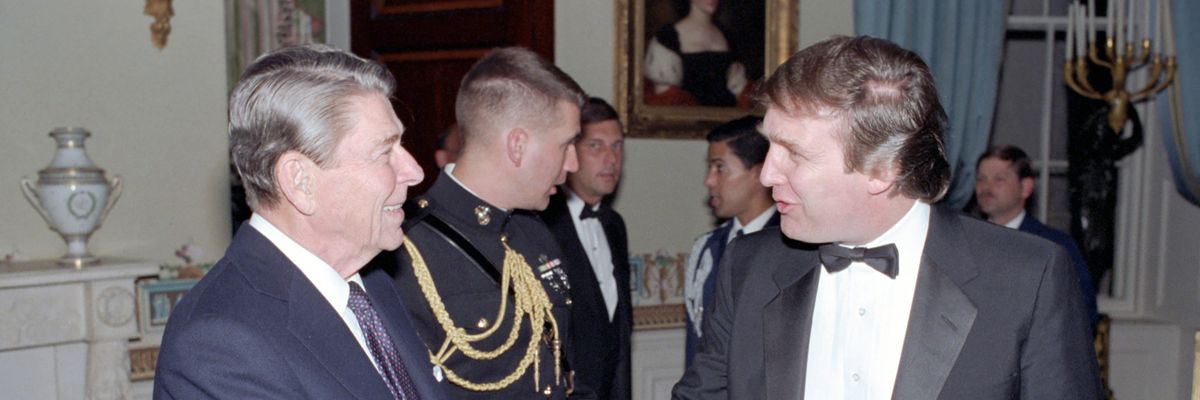
Then U.S. President Ronald Reagan (1911 - 2004) shakes hands with then-real estate developer and now U.S. President Donald Trump in a reception line in the White House's Blue Room, in Washington D.C. on November 3, 1987.
(Photo: White House Photo Office/PhotoQuest/Getty Images)
Robert Reich
May 30, 2025
Deregulation. Privatization. Tax cuts. Free trade. Stagnant pay for most. A soaring stock market for the top. That’s the legacy of neoliberalism. It also brought us Trump. We cannot go back to that place. There's a better path.
Then U.S. President Ronald Reagan (1911 - 2004) shakes hands with then-real estate developer and now U.S. President Donald Trump in a reception line in the White House's Blue Room, in Washington D.C. on November 3, 1987.
(Photo: White House Photo Office/PhotoQuest/Getty Images)
Robert Reich
May 30, 2025
Inequality Media
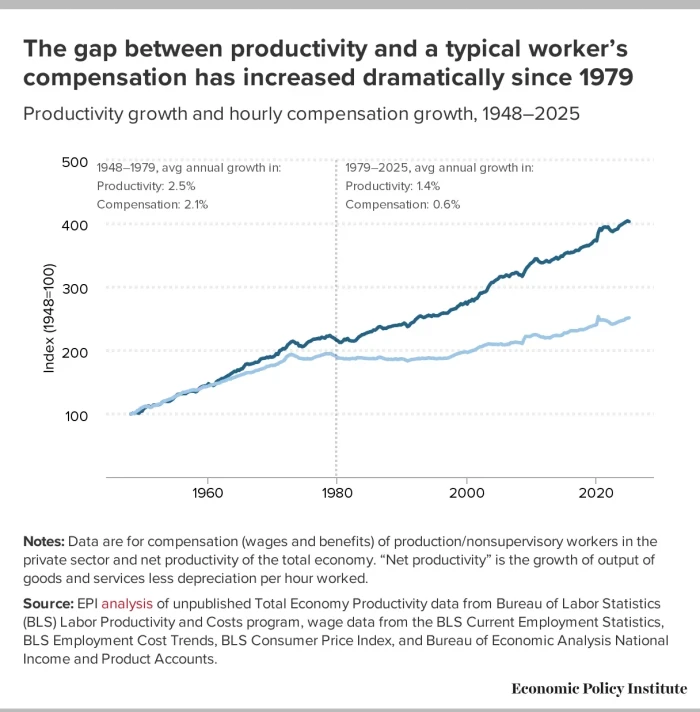
I rarely ask you to look at charts. Today is an exception. This one is from the Economic Policy Institute. It compares the typical American’s pay starting just after World War II (light blue line) with the nation’s increasing productivity since then (dark blue).
The chart shows the widening divergence between the rise of pay and the yields from productivity.
In the first three decades after World War II, the typical American’s pay rose in tandem with the nation’s growing productivity. The benefits from higher productivity were broadly shared.
But then, starting in the late 1970s and dramatically after 1980, pay barely grew, even as productivity continued to soar. The benefits from higher productivity went increasingly to the top.
Why?
I’ve been looking into this question for a long time.
I’ve also been living it, as head of policy for the Federal Trade Commission under Jimmy Carter, secretary of labor in the Clinton administration, and an economic adviser to Obama. I’ve chronicled this in my upcoming memoir, Coming Up Short.
Much of the answer has to do with a giant upward shift in power.
It started in 1971, with a memo written for the U.S. Chamber of Commerce by Lewis Powell exhorting corporations to play a far more active role in American politics. They did, and their increasingly active role paid off, at least for their CEOs and top investors.
It continued through Reagan’s tax cuts and deregulation, his legitimization of union bashing, and the emergence of corporate raiders who insisted that corporations maximize shareholder value above all else.
And onward through George H.W. Bush and Bill Clinton’s North American Free Trade Agreement, their support for China’s accession to the World Trade Organization, and their deregulation of Wall Street.
And then through George W. Bush’s tax cut — again, mainly for big corporations and wealthy individuals — and Barack Obama’s bailout of Wall Street after it nearly destroyed the world economy.
Deregulation. Privatization. Tax cuts. Free trade. Stagnant pay for most. A soaring stock market for the top.
That’s the legacy of neoliberalism.
It also brought us Trump — who exploited the anger and resentment stirred up by all this and pretended to be a strongman on the side of the working class (while quietly giving the emerging American oligarchy everything else it wanted, including a giant tax cut; he’s readying another as you read this).
Now some neoconservatives, posing as “moderates,” are hijacking the story and trying to rehabilitate neoliberalism.
Consider David Brooks, who wrote recently in The New York Times that:
— “wages really did stagnate, but they did so mostly in the 1970s and 1980s, not in the supposed era of neoliberal globalism.” (Brooks is wrong. Look at the above chart. Pay did begin to head up again in the 2000s but the pay-productivity gap has continued to widen.)
— there was “a return to higher productivity and higher wage growth, from 1994 to today. That is to say: Median wages have grown since NAFTA and the W.T.O., not declined.” (Wrong again. Look at the chart.)
— “the inequality gap is not as great as one might think.” (Well, I think it significant, and most analysts agree.)
— “the basic approach to economic policymaking that prevailed between 1992 and 2017 was sensible and … our job today is to build on it.” (Sensible only as compared to Trump’s first and second terms. But as I said, hardly sensible when you consider that widening inequality combined with unbridled globalization, deregulation, and union-bashing contributed to the rise of Trump.)
Neoliberalism should not and cannot be rehabilitated.
We need instead a strong, bold progressive populism that strengthens democracy and widens prosperity by:
— busting up big corporations,
— stopping Wall Street’s gambling addiction (e.g. replicating the Glass-Steagall Act),
— getting big money out of politics, even if this requires amending the Constitution,
— requiring big corporations to share their profits with their average workers,
— strengthening unions, and
— raising taxes on the super-wealthy,
— to finance a universal basic income, Medicare for all, and paid family leave.
Those now trying to rehabilitate neoliberalism won’t like any of this, of course, but we cannot return to the path we were on. It will just lead to more Trumps, as far as the eye can see.
© 2025 Robert Reich
Robert Reich
Robert Reich, is the Chancellor's Professor of Public Policy at the University of California, Berkeley, and a senior fellow at the Blum Center for Developing Economies. He served as secretary of labor in the Clinton administration, for which Time magazine named him one of the 10 most effective cabinet secretaries of the twentieth century. His book include: "Aftershock" (2011), "The Work of Nations" (1992), "Beyond Outrage" (2012) and, "Saving Capitalism" (2016). He is also a founding editor of The American Prospect magazine, former chairman of Common Cause, a member of the American Academy of Arts and Sciences, and co-creator of the award-winning documentary, "Inequality For All." Reich's newest book is "The Common Good" (2019). He's co-creator of the Netflix original documentary "Saving Capitalism," which is streaming now.
Full Bio >
I rarely ask you to look at charts. Today is an exception. This one is from the Economic Policy Institute. It compares the typical American’s pay starting just after World War II (light blue line) with the nation’s increasing productivity since then (dark blue).
The chart shows the widening divergence between the rise of pay and the yields from productivity.
In the first three decades after World War II, the typical American’s pay rose in tandem with the nation’s growing productivity. The benefits from higher productivity were broadly shared.
But then, starting in the late 1970s and dramatically after 1980, pay barely grew, even as productivity continued to soar. The benefits from higher productivity went increasingly to the top.
Why?
I’ve been looking into this question for a long time.
I’ve also been living it, as head of policy for the Federal Trade Commission under Jimmy Carter, secretary of labor in the Clinton administration, and an economic adviser to Obama. I’ve chronicled this in my upcoming memoir, Coming Up Short.
Much of the answer has to do with a giant upward shift in power.
It started in 1971, with a memo written for the U.S. Chamber of Commerce by Lewis Powell exhorting corporations to play a far more active role in American politics. They did, and their increasingly active role paid off, at least for their CEOs and top investors.
It continued through Reagan’s tax cuts and deregulation, his legitimization of union bashing, and the emergence of corporate raiders who insisted that corporations maximize shareholder value above all else.
And onward through George H.W. Bush and Bill Clinton’s North American Free Trade Agreement, their support for China’s accession to the World Trade Organization, and their deregulation of Wall Street.
And then through George W. Bush’s tax cut — again, mainly for big corporations and wealthy individuals — and Barack Obama’s bailout of Wall Street after it nearly destroyed the world economy.
Deregulation. Privatization. Tax cuts. Free trade. Stagnant pay for most. A soaring stock market for the top.
That’s the legacy of neoliberalism.
It also brought us Trump — who exploited the anger and resentment stirred up by all this and pretended to be a strongman on the side of the working class (while quietly giving the emerging American oligarchy everything else it wanted, including a giant tax cut; he’s readying another as you read this).
Now some neoconservatives, posing as “moderates,” are hijacking the story and trying to rehabilitate neoliberalism.
Consider David Brooks, who wrote recently in The New York Times that:
— “wages really did stagnate, but they did so mostly in the 1970s and 1980s, not in the supposed era of neoliberal globalism.” (Brooks is wrong. Look at the above chart. Pay did begin to head up again in the 2000s but the pay-productivity gap has continued to widen.)
— there was “a return to higher productivity and higher wage growth, from 1994 to today. That is to say: Median wages have grown since NAFTA and the W.T.O., not declined.” (Wrong again. Look at the chart.)
— “the inequality gap is not as great as one might think.” (Well, I think it significant, and most analysts agree.)
— “the basic approach to economic policymaking that prevailed between 1992 and 2017 was sensible and … our job today is to build on it.” (Sensible only as compared to Trump’s first and second terms. But as I said, hardly sensible when you consider that widening inequality combined with unbridled globalization, deregulation, and union-bashing contributed to the rise of Trump.)
Neoliberalism should not and cannot be rehabilitated.
We need instead a strong, bold progressive populism that strengthens democracy and widens prosperity by:
— busting up big corporations,
— stopping Wall Street’s gambling addiction (e.g. replicating the Glass-Steagall Act),
— getting big money out of politics, even if this requires amending the Constitution,
— requiring big corporations to share their profits with their average workers,
— strengthening unions, and
— raising taxes on the super-wealthy,
— to finance a universal basic income, Medicare for all, and paid family leave.
Those now trying to rehabilitate neoliberalism won’t like any of this, of course, but we cannot return to the path we were on. It will just lead to more Trumps, as far as the eye can see.
© 2025 Robert Reich
Robert Reich
Robert Reich, is the Chancellor's Professor of Public Policy at the University of California, Berkeley, and a senior fellow at the Blum Center for Developing Economies. He served as secretary of labor in the Clinton administration, for which Time magazine named him one of the 10 most effective cabinet secretaries of the twentieth century. His book include: "Aftershock" (2011), "The Work of Nations" (1992), "Beyond Outrage" (2012) and, "Saving Capitalism" (2016). He is also a founding editor of The American Prospect magazine, former chairman of Common Cause, a member of the American Academy of Arts and Sciences, and co-creator of the award-winning documentary, "Inequality For All." Reich's newest book is "The Common Good" (2019). He's co-creator of the Netflix original documentary "Saving Capitalism," which is streaming now.
Full Bio >

No comments:
Post a Comment