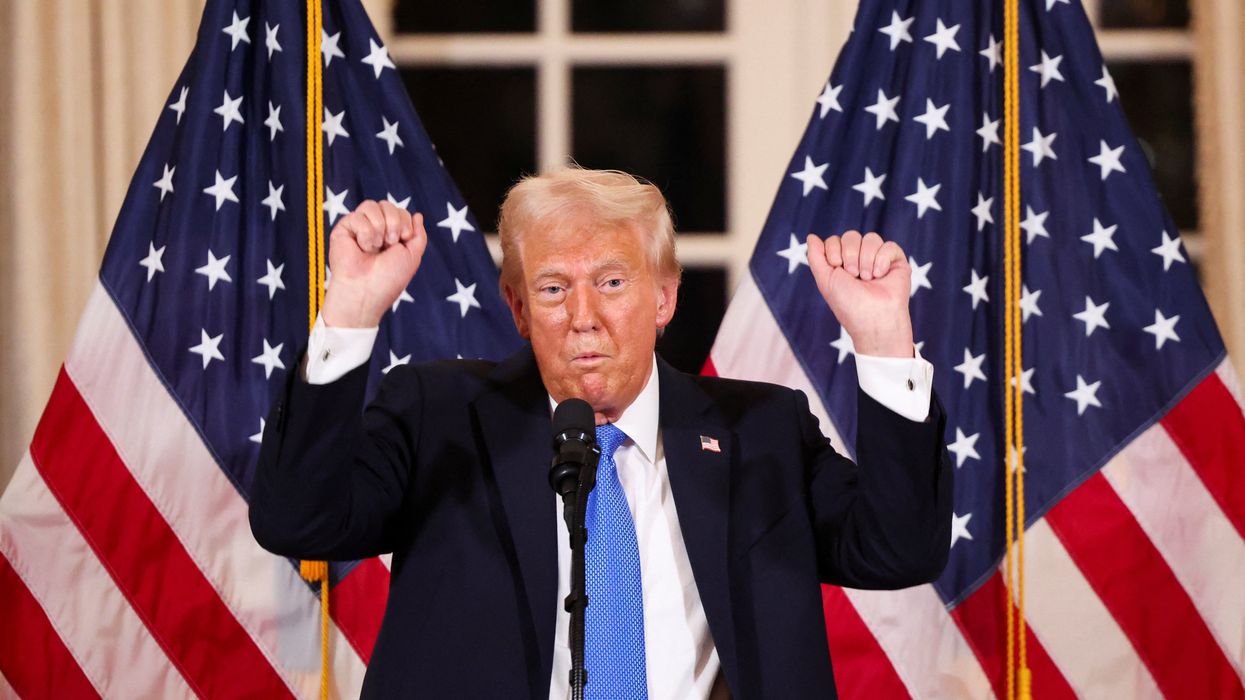
REUTERS/Kevin Lamarque
The Conversation
May 30, 2025 |
The American Revolution was a result of the tyranny experienced by colonists under the British monarchy. Many Americans had fled from Europe where they had been persecuted under the rule of powerful monarchs. The government produced by the revolution was designed to ensure no such tyranny could be reproduced in the newly formed United States.
The framers of the constitution created a checks-and-balances system of government to ensure that no single branch of the federal government (executive, judicial or legislative) could dominate the others. Each branch has powers to curtail or empower the others.
However, some Americans are concerned about a return of absolute rule due to the steps taken by Donald Trump’s second administration. This has sparked around 100 “no kings” protests all over the US, organised to coincide with Trump’s birthday on June 15.
Increasing presidential power
The second Trump administration has made a determined effort to strengthen presidential power and reduce oversight of the executive branch (the presidency). Achieving this could mean the president acting in an arbitrary manner similar to absolute monarchs of the past, free of congressional or judicial interference.
Trump’s “big beautiful bill”, which has been passed in the House of Representatives and now must go to the Senate, contains certain provisions that strengthen the role of the president and undermine the checks-and-balances system.
Previous presidents, such as Franklin D. Roosevelt during the New Deal era of the 1930s, had many of their executive orders cancelled by Supreme Court rulings. Over the last five months, the judiciary has ruled on the constitutionality of Trump’s executive actions, putting at least 180 on hold.
As a consequence, the president has continually questioned the validity of the courts to act. At last week’s West Point graduation ceremony, Trump claimed that last November’s election result “gives us the right to do what we wanna do to make our country great again”.
As Robert Reich, the former US secretary of labor, wrote recently, this “big beautiful bill” will remove the courts’ ability to hold executive officials in contempt and undermine any efforts to stop the administration. Supreme Court rulings could be ignored by the executive branch, and Congress would be unable to enforce its subpoenas and laws. “Trump will have crowned himself king,” Reich concluded.
Just like the judicial branch, the legislative branch (Congress) also has the ability to check the executive branch. Congress can override the presidential veto if both the House and Senate pass legislation with a two-thirds majority. And the executive branch (the president) cannot fund any initiatives without the budget being approved by Congress first.
But Trump and his supporters have minimised the impact that Congress can have on this particular bill by including all of the provisions within a budget reconciliation bill. This is a special legislative procedure that is designed to pass bills through Congress quickly.
Bills usually require 60 votes to bypass a filibuster – a tactic used by senators to delay voting on the bill by refusing to end the debate and speaking for exceptionally long times without a break.
But because this is a budget reconciliation, it only requires a majority – 51 votes – to pass the Senate. And because the Republicans have 53 seats in the Senate, Trump is confident the bill will pass without any Democratic interference.
The House narrowly passed the bill, despite some opposition from Republicans. And some Republican senators have also expressed concerns. But this is the latest move to centralise greater power within the presidency.
May 30, 2025 |
The American Revolution was a result of the tyranny experienced by colonists under the British monarchy. Many Americans had fled from Europe where they had been persecuted under the rule of powerful monarchs. The government produced by the revolution was designed to ensure no such tyranny could be reproduced in the newly formed United States.
The framers of the constitution created a checks-and-balances system of government to ensure that no single branch of the federal government (executive, judicial or legislative) could dominate the others. Each branch has powers to curtail or empower the others.
However, some Americans are concerned about a return of absolute rule due to the steps taken by Donald Trump’s second administration. This has sparked around 100 “no kings” protests all over the US, organised to coincide with Trump’s birthday on June 15.
Increasing presidential power
The second Trump administration has made a determined effort to strengthen presidential power and reduce oversight of the executive branch (the presidency). Achieving this could mean the president acting in an arbitrary manner similar to absolute monarchs of the past, free of congressional or judicial interference.
Trump’s “big beautiful bill”, which has been passed in the House of Representatives and now must go to the Senate, contains certain provisions that strengthen the role of the president and undermine the checks-and-balances system.
Previous presidents, such as Franklin D. Roosevelt during the New Deal era of the 1930s, had many of their executive orders cancelled by Supreme Court rulings. Over the last five months, the judiciary has ruled on the constitutionality of Trump’s executive actions, putting at least 180 on hold.
As a consequence, the president has continually questioned the validity of the courts to act. At last week’s West Point graduation ceremony, Trump claimed that last November’s election result “gives us the right to do what we wanna do to make our country great again”.
As Robert Reich, the former US secretary of labor, wrote recently, this “big beautiful bill” will remove the courts’ ability to hold executive officials in contempt and undermine any efforts to stop the administration. Supreme Court rulings could be ignored by the executive branch, and Congress would be unable to enforce its subpoenas and laws. “Trump will have crowned himself king,” Reich concluded.
Just like the judicial branch, the legislative branch (Congress) also has the ability to check the executive branch. Congress can override the presidential veto if both the House and Senate pass legislation with a two-thirds majority. And the executive branch (the president) cannot fund any initiatives without the budget being approved by Congress first.
But Trump and his supporters have minimised the impact that Congress can have on this particular bill by including all of the provisions within a budget reconciliation bill. This is a special legislative procedure that is designed to pass bills through Congress quickly.
Bills usually require 60 votes to bypass a filibuster – a tactic used by senators to delay voting on the bill by refusing to end the debate and speaking for exceptionally long times without a break.
But because this is a budget reconciliation, it only requires a majority – 51 votes – to pass the Senate. And because the Republicans have 53 seats in the Senate, Trump is confident the bill will pass without any Democratic interference.
The House narrowly passed the bill, despite some opposition from Republicans. And some Republican senators have also expressed concerns. But this is the latest move to centralise greater power within the presidency.
ABC NEWS: Trump makes the commencement speech at the West Point military academy.
Trump v the courts
Trump’s apparent belief that he is above the law has, in part, been supported by last year’s Supreme Court ruling which stated that former presidents had immunity from prosecution for official presidential acts. The Trump v United States decision decided such acts included command of the military, control of the executive branch, and execution of laws.
However, this week’s federal court ruling on the legality of Trump’s economic tariffs represents a setback to the administration’s efforts to strengthen presidential power. The Court of International Trade ruled that the White House’s use of emergency powers did not grant it the authority to impose tariffs on every country, and that the constitution states such power resides within Congress.
The Trump administration immediately said it would be appealing the decision. “It is not for unelected judges to decide how to properly address a national emergency,” Kush Desai, the White House deputy press secretary, said on the ruling, and that Trump would use “every lever of executive power” to “restore American greatness”.
All of which has led Trump to quote another authoritarian leader, Napoleon, on social media. His post – “He who saves his Country does not violate any Law” – was a clear rebuke to those who have tried to limit executive authority while he has been in office, and echoes that of former president Richard Nixon who, in an interview with David Frost about the Watergate scandal, argued that the constitution allowed the president to break the law.
This is an extension of the notion that Article II of the constitution has granted the president the authority to act without checks and balances when dealing with the executive branch. It is a theory much touted within Project 2025, believed to be the blueprint for the Trump presidency.
There are other historical comparisons that could be made of Trump’s authoritarian actions, such as the rule of Charles I of England (1625-49), who believed he could govern without consulting parliament except when he needed to raise taxes to conduct overseas campaigns. Ultimately, this led to a period of civil wars and the execution of the king for treason.
While none of these consequences are likely to be replicated, it is clear the US is currently in a constitutional crisis. The Supreme Court has a number of rulings to make on the judicial challenges to Trump’s executive authority. These will have generational consequences – but it is unclear in which way the court, where conservative judges have a 6-3 majority, will lean.
While Trump may not be seeking a crown for his head, he is certainly arguing that he has the right to control the executive branch in the way he sees fit, without any interference from Congress or the judiciary. This is not the separation of powers as prescribed by the framers of the US constitution, but more like the absolutism of medieval monarchs.

Dafydd Townley, Teaching Fellow in US politics and international security, University of Portsmouth
This article is republished from The Conversation under a Creative Commons license. Read the original article.
'Nothing can stop what is coming': MAGA staff fueling Trump's belief ‘he is a tool of God’

Adam Lynch
May 30, 2025
ALTERNET
Politico Magazine reporter Michael Kruse says President Donald Trump has always “seen himself as special, and he has always, of course, been notably self-aggrandizing,” but the president is now moving into a new phase.
“His rhetoric has gone from borderline nihilistic to messianic,” writes Kruse.
Many of Trump’s followers have described him as “chosen,” or “anointed,” or a “savior,” or “the second coming” or “the Christ for this age.” Only now Kruse says Trump is in on it and his “narcissism and grandiosity has metastasized into notions of omnipotence, invincibility and infallibility.”
READ MORE: No administration has ever been this corrupt – and you just can't look away anymore
And that matters, says Kruse, “because it offers a window into how he is approaching his second term — even more emboldened, even more unilaterally oriented, even more apparently uncheckable and untouchable than the first.”
“I run the country and the world,” Trump told The Atlantic last month.
“I have no reason to doubt that he would … prefer to believe he was saved [from assassination] by a supreme being because he himself is special rather than the would-be assassin was a lousy shot or he got lucky,” said former Trump consultant and publicist Alan Marcus to Kruse in an interview. “… His world is fantasy, scripted like a movie — not biblical unless, of course, that helps bring a particular scene or chapter to life.”

Marie Griffith, the director of the John C. Danforth Center on Religion and Politics tells Kruse it is likely a combination of “opportunism and genuine belief” driving the president’s evolving self-view, while author Stephen Mansfield (‘Choosing Donald Trump: God, Anger, Hope, and Why Christian Conservatives Supported Him’, 2018, by Baker Publishing) said Trump probably believes “he is a tool of God.”
And now, four months into his term, Kruse says “Trump is on a spree of a show of supremacy.”
“He’s pledged a ‘Golden Age.’ He’s punished Trump and MAGA unbelievers. He’s exacted or attempted to exact subservience and acquiescence from media execs and tech titans and major law firms and top universities and both chambers of Congress that he and his party control,” Kruse writes. “He’s tried to command the global economy and crack intractable issues of war and peace as if he were wielding a scepter over subjects far and wide.”
Kruse notes a point from journalist Ezra Klein that a big difference between Trump’s first and second terms is the willingness of his staff to buy into the belief, too. The first group was “perfectly comfortable thinking: President Donald Trump is very wrong about this. His judgment is bad. His impulses need to be foiled. We are the resistance inside the Trump administration,” said Klein. “In Trump 2.0 … there is both a sense that they’re there to serve him but also a sense there is something in Trump … that exists beyond argumentation,” Klein said.
One late Wednesday post from Trump on Truth Social features a meme of the president walking confidently down a dark city street.
“HE’S ON A MISSION FROM GOD,” read the words. “NOTHING CAN STOP WHAT IS COMING.”
“Does the president mean with the post of this meme,” Kruse says he asked White House communications director Steven Cheung, “that he’s literally on a mission from God?”
“As people of faith, we are all on missions from God,” Cheung responded. “The President has the biggest mission — to Make America Great Again and to help bring peace across the world. And he’s doing just that.”
Read the full Politico Magazine report here.
And now, four months into his term, Kruse says “Trump is on a spree of a show of supremacy.”
“He’s pledged a ‘Golden Age.’ He’s punished Trump and MAGA unbelievers. He’s exacted or attempted to exact subservience and acquiescence from media execs and tech titans and major law firms and top universities and both chambers of Congress that he and his party control,” Kruse writes. “He’s tried to command the global economy and crack intractable issues of war and peace as if he were wielding a scepter over subjects far and wide.”
Kruse notes a point from journalist Ezra Klein that a big difference between Trump’s first and second terms is the willingness of his staff to buy into the belief, too. The first group was “perfectly comfortable thinking: President Donald Trump is very wrong about this. His judgment is bad. His impulses need to be foiled. We are the resistance inside the Trump administration,” said Klein. “In Trump 2.0 … there is both a sense that they’re there to serve him but also a sense there is something in Trump … that exists beyond argumentation,” Klein said.
One late Wednesday post from Trump on Truth Social features a meme of the president walking confidently down a dark city street.
“HE’S ON A MISSION FROM GOD,” read the words. “NOTHING CAN STOP WHAT IS COMING.”
“Does the president mean with the post of this meme,” Kruse says he asked White House communications director Steven Cheung, “that he’s literally on a mission from God?”
“As people of faith, we are all on missions from God,” Cheung responded. “The President has the biggest mission — to Make America Great Again and to help bring peace across the world. And he’s doing just that.”
Read the full Politico Magazine report here.


No comments:
Post a Comment