Charlie Kirk's AI resurrection ushers in a new era of digital grief
“I’m Charlie. My faith cost me my life, but now I stand forever in glory,” the AI-generated Kirk says.
(RNS) — AI-generated versions of the conservative Christian activist are popping up online after his killing — as well as in church services.
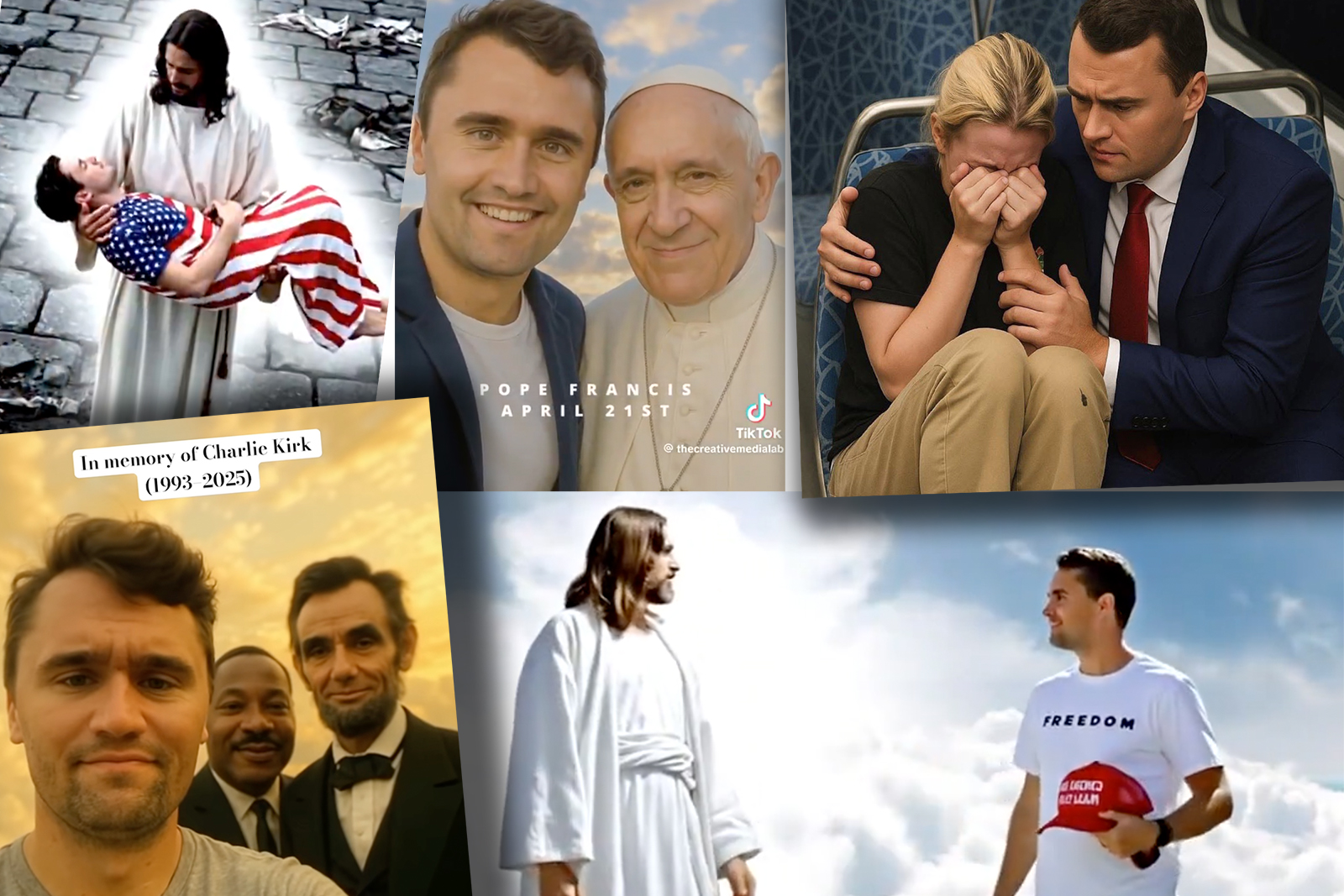
Recent AI-generated content of Charlie Kirk found on social media. (RNS illustration)
Jack Jenkins
September 17, 2025
(RNS) — Megachurch pastor Jack Graham was in the middle of his Sunday message to Prestonwood Baptist Church in Plano, Texas, this past weekend when he paused to cue up an unusual sermon illustration. After encouraging people to respond to the killing of conservative Christian activist Charlie Kirk by turning to God, he instructed the congregation to listen to a roughly minute-long audio clip of what sounded like Kirk delivering a short speech.
“Hear what Charlie is saying regarding what happened to him this past week,” Graham said.
As the clip, which encouraged listeners to “pick up your cross, and get back in the fight,” ended, the congregation burst into applause. A few seconds later, they rose to their feet in a standing ovation.
But the clip they listened to was not, in fact, Charlie Kirk from beyond the grave. As Graham made clear when he introduced the segment, the congregation was listening to a production generated entirely by artificial intelligence: The clip, which has gone viral online, was a cloned version of Kirk’s voice delivering what appeared to be an AI-generated response from a chatbot asked what Kirk would say in the wake of his own death.
It’s unclear where the video originated, but at least two other large evangelical Protestant churches — Dream City Church in Arizona and Awaken Church, San Marcos in California — also played it during their services that day. Pastors at both churches made clear the clips were AI; even so, the segment triggered applause each time.
The message was part of a wave of AI-generated content that flooded social media in the wake of Kirk’s killing, with supporters and even Kirk’s former colleagues sharing images, videos and audio messages that featured the felled activist and that were made by artificial intelligence. Amid outrage over Kirk’s killing and debate about his legacy, the surge, which has been most visible on social media platforms, showcased a new form of public mourning and remembrance, one in which the dead are grieved with hyperreal but entirely fictional reconstructions crafted in seconds by AI services.

Congregants listen to AI-generated audio of Charlie Kirk, Sept. 13, 2025, at Prestonwood Baptist Church in Plano, Texas. (Video screen grab)
AI-generated images and videos of Kirk appeared within hours of his death, some growing in popularity over the next few days. Many featured religious themes, a byproduct of Kirk’s own personal and political shift toward evangelical Christianity near the end of his life.
Imagining Kirk in heaven was a common theme. In one clip, which has racked up hundreds of thousands of views on Facebook and X, Kirk stares into a camera as soft piano music plays.
“I’m Charlie. My faith cost me my life, but now I stand forever in glory,” the AI-generated Kirk says.
The fictional Kirk then introduces four historical Christian martyrs and saints — Paul, Stephen, Andrew and Peter. These, also AI-generated characters, briefly recount their own stories of martyrdom before the AI Kirk urges listeners to root themselves in a “Bible-believing church,” join in a “spiritual” battle and “overwhelm the world with Jesus.”
Other clips are shorter, but more direct. One depicts an AI-generated Kirk taking selfies in heaven with prominent Americans who were assassinated, such as Presidents Abraham Lincoln and John F. Kennedy as well as the Rev. Martin Luther King Jr. As the digital Kirk poses with the historical icons in a cloudy vista, “Knocking on Heaven’s Door” plays in the background.
Many AI-generated clips depict Kirk with Jesus Christ. One shows Kirk sitting in the same tent where he was shot and killed, but then suddenly leaping out of his chair and running up a staircase to a smiling Jesus. Another features an AI-generated Kirk praying on a park bench as Scripture is flashed across the screen and “Come Jesus Come” by CeCe Winans plays in the background. Eventually, a radiant Jesus arrives, and the two embrace.
Yet another shows Jesus and Kirk, holding a Make America Great Again hat, walking toward the camera among the clouds.
”Welcome, my son,” Jesus says, embracing the AI Kirk. “Your work is done. Come rest.”
Apparent AI-generated images have even been used by Kirk’s former co-workers. Andrew Kolvet, who produced “The Charlie Kirk Show” and has hosted the program multiple times since Kirk’s killing, posted what appears to be an AI-generated image of Kirk alongside other assassinated Americans from U.S. history such as King and Lincoln, as well as Jesus Christ. (The image sparked criticism, with detractors noting that the real-life Kirk criticized King. The Rev. Bernice King, one of Martin Luther King Jr.’s daughters, said of the image, “there are so many things wrong with this.”)

(Screen grab)
Depictions of famous figures in heaven, or even in relationship with Jesus, are hardly unusual. But the particular utilization of AI to commemorate Kirk — with content flooding the internet within hours of his death — may be an outgrowth of the technology’s wide use among devotees of President Donald Trump. That includes the Trump administration itself: On several occasions, AI-generated images and memes have appeared on official government accounts.
As Charlie Warzel, who writes on technology and media, observed in The Atlantic in August, the “high-resolution, low-budget look of generative-AI images appears to be fusing with the meme-loving aesthetic of the MAGA movement.”
Warzel added: “At least in the fever swamps of social media, AI art is becoming MAGA-coded. The GOP is becoming the party of AI slop.”
Kirk, of course, was an avid Trump supporter who played a significant role in helping the president return to power, and some of the AI-generated content that proliferated after the activist’s death has been tied to conservative causes. Many images, for instance, linked Kirk’s death to the stabbing of Iryna Zarutska, a Ukrainian refugee whose slaying on a bus in Charlotte, North Carolina, became a source of outrage for Kirk and other conservatives shortly before Kirk’s own assassination. One widely shared image shows an AI-generated Kirk comforting Zarutska as she sits on the bus where she was killed, bleeding. At least one person created a video version of the image that features the hymn “How Great Thou Art.” A similar AI-generated video shows Kirk embracing Zarutska on the bus as they both flap newly grown angel wings.
Another AI-generated video pushed a pro-Israel message — a topic that has sparked division among conservatives, and which Kirk was reportedly trying to mitigate shortly before his death. In the video, an AI-generated Kirk, adorned with angel wings and a white robe, speaks from heaven as he declares: “I’m in a better place now, but America and Israel will never be the same.” The AI Kirk insists that the U.S. and Israel are both based on “faith, on freedom, on family,” shortly before a bald eagle is shown landing on his head as he stands in front of Israeli and U.S. flags.
Despite their viral nature, it’s unclear precisely what role these virtually enhanced remembrances play in the lives of those who mourn Kirk’s death. But social media boosters of the creations often frame them as a form of catharsis: On TikTok, influencer Taylor Diazmercado posted a short video of herself last week reacting to the AI-generated audio clip of Kirk — which she clearly labeled as such — that would later be used in churches. As an entirely fabricated voice speaks lines Kirk never said in life, Diazmercado can be seen visibly weeping, frequently wiping away tears as she nods along in-between sobs.
Beneath the video, which had 123,000 likes as of Wednesday (Sept. 17), she added a short caption: “What a man.”

At Charlie Kirk's memorial, religion, politics and antagonism toward liberals combine
(RNS) — A who’s who of right-wing figures, conservative dignitaries, Trump administration officials and Trump himself regaled a sprawling crowd of tens of thousands with speeches that mixed religious appeals with personal remembrances of Kirk.
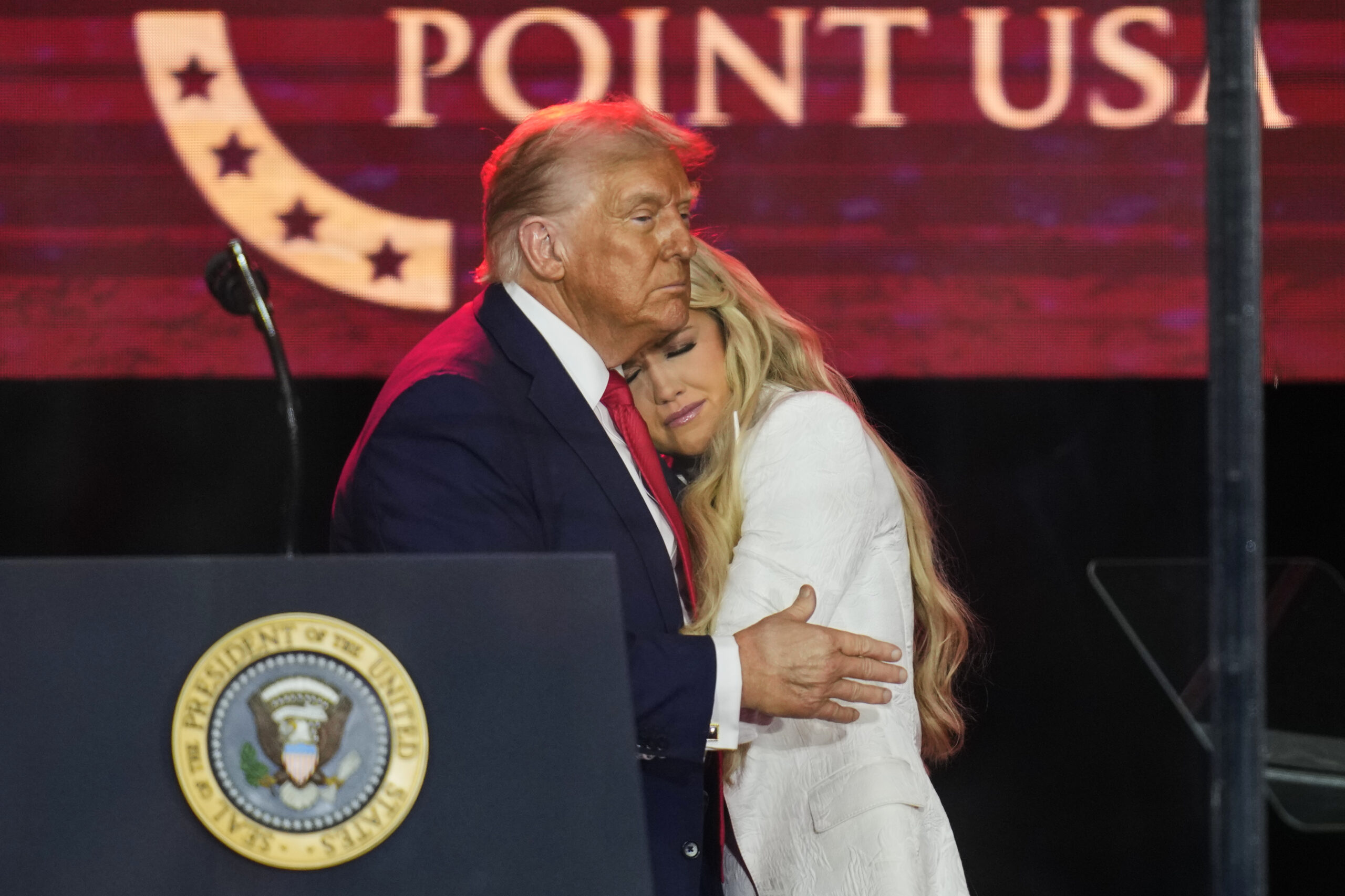
President Donald Trump embraces Erika Kirk at a memorial for conservative activist Charlie Kirk, Sept. 21, 2025, at State Farm Stadium in Glendale, Ariz. (AP Photo/John Locher)
Jack Jenkins
September 22, 2025
RNS
(RNS) — Shortly before the speaking program began at State Farm Stadium in Glendale, Arizona, on Sunday (Sept. 21) to kick off the massive memorial service honoring conservative activist Charlie Kirk, a group of prominent Christian musicians onstage sang a rendition of the hymn “It Is Well With My Soul.”
As the first notes of song filled the space, thousands of attendees silently began to raise four different signs. Two referenced Scripture, and others referenced Turning Point USA, the political organization Kirk founded. The placards were emblazoned with contrasting colors and assigned to different sections of the crowd, with the ultimate effect of transforming the stadium into precise stripes of red, white and blue — the colors of the American flag, two of which hung on either side of the gargantuan stage.
It was the beginning of what quickly became an unapologetic fusion of conservative Christianity — particularly evangelicalism, Kirk’s chosen religious tradition — and President Donald Trump’s style of conservative politics, sometimes delivered by prominent representatives of the United States government. Over the course of roughly five hours, a who’s who of right-wing figures, conservative dignitaries, Trump administration officials and Trump himself regaled a sprawling crowd of tens of thousands with speeches that mixed religious appeals with personal remembrances of Kirk. In many cases, the speeches also included criticism of liberals and progressives, whom some blamed for Kirk’s death even as investigators have yet to determine an explicitly political motive for the shooter.
The event’s religious and political subtext was ubiquitous from the jump, when the Rev. Rob McCoy — the only clergy member to address the crowd from the podium — opened the program. Explaining that Kirk viewed McCoy, the recently retired pastor of Godspeak Calvary Chapel in Thousand Oaks, California, as his personal pastor, McCoy argued Kirk would have wanted Christianity to be a focus of his memorial.
“Charlie wanted his savior to be the guest of honor,” McCoy said. “He wanted all of you to receive this gift from him.”
After adding that Kirk “saw politics as an on-ramp to Jesus,” McCoy shifted into a kind of altar call, urging people in the crowd to stand if they wanted “to receive Jesus as their savior.” The pastor then directed those standing to use a QR code projected on the screen above him to access resources from TPUSA Faith, a project McCoy helped co-found with Kirk, that would “give you everything you need to walk this walk with Christ,” he said.
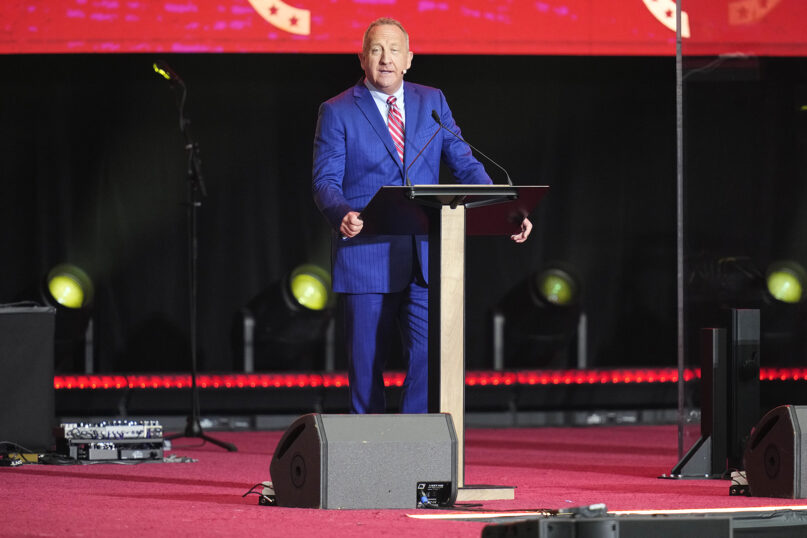
The Rev. Rob McCoy speaks at a memorial for conservative activist Charlie Kirk, Sunday, Sept. 21, 2025, at State Farm Stadium in Glendale, Ariz. (AP Photo/John Locher)
During the first section of the program, several of Kirk’s former TPUSA co-workers celebrated people they said embraced Christianity as a result of Kirk’s death — a common claim repeated by Kirk’s supporters over the past week.
“Charlie Kirk was a prophet — not the fortunetelling kind that could predict the future, but the biblical kind,” said TPUSA spokesperson Andrew Kolvet, who produced “The Charlie Kirk Show” and regularly appeared on the program alongside Kirk. Kolvet said he now thinks of Kirk’s appearances on college campuses, such as the event in Utah where he was killed, as “tent revivals.”
Faith was also at the center of the address delivered by Erika Kirk, Charlie Kirk’s widow and the newly appointed head of TPUSA. Her emotional address did not avoid politics but contrasted with other speeches by focusing primarily on her relationship with Kirk and pausing to make a powerful point about forgiveness. As tears rolled down her face, Erika, who is Catholic, publicly forgave the man who has been accused of killing her husband earlier this month.
“On the cross, our savior said, ‘Father, forgive them for they not know what they do,’” said Erika Kirk, who wore a cross necklace. “That man, that young man: I forgive him.”

People listen as Erika Kirk, seen on a stadium screen, speaks at a memorial for her late husband conservative activist Charlie Kirk, Sunday, Sept. 21, 2025, at State Farm Stadium in Glendale, Ariz. (AP Photo/John Locher)
Her tone was a departure from speeches that filled other sections of the program, in which references to Christianity were directed outward at ideological enemies on the left or speakers openly encouraged the crowd to go after political opponents.
Vice President JD Vance, a Catholic, said Kirk knew “it is better to be persecuted for your faith than to deny the kingship of Christ,” and Vance suggested that the felled activist — who was known for debating political opponents and casting aspersions on those he disagreed with in ways that have been condemned by some faith leaders in other traditions in recent days — would want his political work to continue.
“I think (Kirk) would encourage me to be honest that evil still walks among us — not to ignore it for the sake of a fake kumbaya moment, but to address it head-on,” said Vance, who has credited Kirk with helping him become Trump’s running mate in 2024, and ultimately vice president
Vance was also one of at least five speakers who declared Kirk to be a Christian martyr.
“For Charlie, we must remember that he is a hero to the United States of America and he is a martyr for the Christian faith,” Vance said.
Another speaker, conservative activist Benny Johnson, also called Kirk a martyr and compared him to Stephen, the first Christian martyr described in the Bible. Johnson then encouraged political figures in the crowd to go after their political opponents.
“Rulers wield the sword for the protection of good men and for the terror of evil men,” Johnson said, referencing a passage from the biblical Book of Romans. “May we pray that our rulers here, rightfully instituted and given power by our God, wield the sword for the terror for evil men in our nation in Charlie’s memory.”
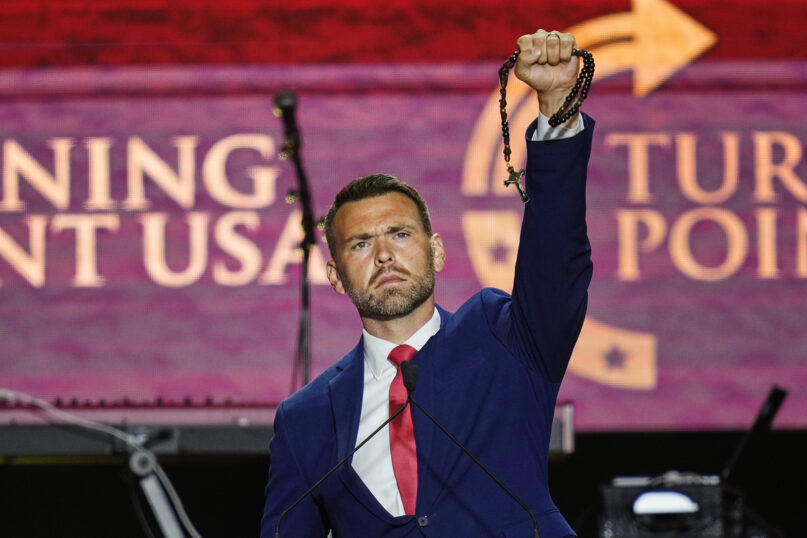
Jack Posobiec holds up a rosary as he speaks at a memorial for conservative activist Charlie Kirk, Sunday, Sept. 21, 2025, at State Farm Stadium in Glendale, Ariz. (AP Photo/John Locher)
Jack Posobiec, a far-right activist and conspiracy theorist who regularly appeared on Kirk’s podcast, began his speech by walking onstage holding a rosary — something he has done in the past while making controversial comments. He likened Kirk to Moses, saying the activist “brought us to the promised land,” and argued Kirk’s killing will save “Western civilization” by “returning the people to Almighty God.”
Posobiec concluded his message by shouting at the crowd, urging them to engage in “spiritual warfare” on Kirk’s behalf and “put on the full armor of God.”
Posobiec was echoed by Pete Hegseth, the U.S. secretary of war who belongs to a denomination co-founded by Pastor Doug Wilson, a self-described Christian nationalist. Hegseth described Kirk as “a citizen who had the biblical heart of a soldier of the faith, who put on, every single day, the full armor of God with a smile as the Scriptures tell all Christ followers to do.”
Hegseth then said that, in the wake of Kirk’s death, “it’s our turn,” and urged the crowd to “live worthy of Charlie Kirk’s sacrifice, and put Christ at the center of your life, as he advocated for giving his.”
Other speakers included conservative commentator Tucker Carlson, an Episcopalian, who said Kirk was “ultimately a Christian evangelist”; Secretary of State Marco Rubio, a Catholic, who argued Kirk would want attendees at the service to be inspired to embrace Christianity and who then recited a lengthy, paraphrased version of the Apostles’ Creed; and White House deputy chief of staff for policy Stephen Miller, a Jewish man who railed against Trump’s ideological opponents, using a series of conflict metaphors, before declaring “God is on our side.”
Arguably the least religious speech of the day was delivered by Trump, a self-described nondenominational Christian. After walking out to pyrotechnics — a common feature at TPUSA events — while recording artist Lee Greenwood sang “God Bless the U.S.A.,” Trump described Kirk not as a Christian martyr but a martyr for “American freedom.”
Amid the ensuing 45-minute speech, during which Trump appeared to repeatedly deviate from his prepared remarks to discuss topics unrelated to Kirk or his death, the president joked that he struggles with the kind of Christian principles Kirk would want him to embrace, such loving one’s enemies.
“I hate my opponent and I don’t want the best for them,” Trump said. He then turned to Erika Kirk, saying, “I’m sorry, Erika.”
Trump said he agreed with Kirk that the U.S. needed a “spiritual reawakening.” Like many of the speakers, the president envisioned a specific kind of religious revival sparked by Kirk’s killing. Trump — whose administration has been criticized and sued by a broad spectrum of religious groups — appeared to tie a surge of faith to support for his administration’s core policy objectives, namely, its widespread crackdown on immigration and deployment of federal agents and troops into U.S. cities in response to disputed claims of surging crime.
“We have to bring back religion to America because without borders, law and order, and religion, you really don’t have a country anymore,” Trump said, sparking applause. “We want religion brought back to America. We want to bring God back into our beautiful USA like never before.”
“I hate my opponent and I don’t want the best for them,” Trump said.
(RNS) — A who’s who of right-wing figures, conservative dignitaries, Trump administration officials and Trump himself regaled a sprawling crowd of tens of thousands with speeches that mixed religious appeals with personal remembrances of Kirk.
President Donald Trump embraces Erika Kirk at a memorial for conservative activist Charlie Kirk, Sept. 21, 2025, at State Farm Stadium in Glendale, Ariz. (AP Photo/John Locher)
Jack Jenkins
September 22, 2025
RNS
(RNS) — Shortly before the speaking program began at State Farm Stadium in Glendale, Arizona, on Sunday (Sept. 21) to kick off the massive memorial service honoring conservative activist Charlie Kirk, a group of prominent Christian musicians onstage sang a rendition of the hymn “It Is Well With My Soul.”
As the first notes of song filled the space, thousands of attendees silently began to raise four different signs. Two referenced Scripture, and others referenced Turning Point USA, the political organization Kirk founded. The placards were emblazoned with contrasting colors and assigned to different sections of the crowd, with the ultimate effect of transforming the stadium into precise stripes of red, white and blue — the colors of the American flag, two of which hung on either side of the gargantuan stage.
It was the beginning of what quickly became an unapologetic fusion of conservative Christianity — particularly evangelicalism, Kirk’s chosen religious tradition — and President Donald Trump’s style of conservative politics, sometimes delivered by prominent representatives of the United States government. Over the course of roughly five hours, a who’s who of right-wing figures, conservative dignitaries, Trump administration officials and Trump himself regaled a sprawling crowd of tens of thousands with speeches that mixed religious appeals with personal remembrances of Kirk. In many cases, the speeches also included criticism of liberals and progressives, whom some blamed for Kirk’s death even as investigators have yet to determine an explicitly political motive for the shooter.
The event’s religious and political subtext was ubiquitous from the jump, when the Rev. Rob McCoy — the only clergy member to address the crowd from the podium — opened the program. Explaining that Kirk viewed McCoy, the recently retired pastor of Godspeak Calvary Chapel in Thousand Oaks, California, as his personal pastor, McCoy argued Kirk would have wanted Christianity to be a focus of his memorial.
“Charlie wanted his savior to be the guest of honor,” McCoy said. “He wanted all of you to receive this gift from him.”
After adding that Kirk “saw politics as an on-ramp to Jesus,” McCoy shifted into a kind of altar call, urging people in the crowd to stand if they wanted “to receive Jesus as their savior.” The pastor then directed those standing to use a QR code projected on the screen above him to access resources from TPUSA Faith, a project McCoy helped co-found with Kirk, that would “give you everything you need to walk this walk with Christ,” he said.
The Rev. Rob McCoy speaks at a memorial for conservative activist Charlie Kirk, Sunday, Sept. 21, 2025, at State Farm Stadium in Glendale, Ariz. (AP Photo/John Locher)
During the first section of the program, several of Kirk’s former TPUSA co-workers celebrated people they said embraced Christianity as a result of Kirk’s death — a common claim repeated by Kirk’s supporters over the past week.
“Charlie Kirk was a prophet — not the fortunetelling kind that could predict the future, but the biblical kind,” said TPUSA spokesperson Andrew Kolvet, who produced “The Charlie Kirk Show” and regularly appeared on the program alongside Kirk. Kolvet said he now thinks of Kirk’s appearances on college campuses, such as the event in Utah where he was killed, as “tent revivals.”
Faith was also at the center of the address delivered by Erika Kirk, Charlie Kirk’s widow and the newly appointed head of TPUSA. Her emotional address did not avoid politics but contrasted with other speeches by focusing primarily on her relationship with Kirk and pausing to make a powerful point about forgiveness. As tears rolled down her face, Erika, who is Catholic, publicly forgave the man who has been accused of killing her husband earlier this month.
“On the cross, our savior said, ‘Father, forgive them for they not know what they do,’” said Erika Kirk, who wore a cross necklace. “That man, that young man: I forgive him.”
People listen as Erika Kirk, seen on a stadium screen, speaks at a memorial for her late husband conservative activist Charlie Kirk, Sunday, Sept. 21, 2025, at State Farm Stadium in Glendale, Ariz. (AP Photo/John Locher)
Her tone was a departure from speeches that filled other sections of the program, in which references to Christianity were directed outward at ideological enemies on the left or speakers openly encouraged the crowd to go after political opponents.
Vice President JD Vance, a Catholic, said Kirk knew “it is better to be persecuted for your faith than to deny the kingship of Christ,” and Vance suggested that the felled activist — who was known for debating political opponents and casting aspersions on those he disagreed with in ways that have been condemned by some faith leaders in other traditions in recent days — would want his political work to continue.
“I think (Kirk) would encourage me to be honest that evil still walks among us — not to ignore it for the sake of a fake kumbaya moment, but to address it head-on,” said Vance, who has credited Kirk with helping him become Trump’s running mate in 2024, and ultimately vice president
Vance was also one of at least five speakers who declared Kirk to be a Christian martyr.
“For Charlie, we must remember that he is a hero to the United States of America and he is a martyr for the Christian faith,” Vance said.
Another speaker, conservative activist Benny Johnson, also called Kirk a martyr and compared him to Stephen, the first Christian martyr described in the Bible. Johnson then encouraged political figures in the crowd to go after their political opponents.
“Rulers wield the sword for the protection of good men and for the terror of evil men,” Johnson said, referencing a passage from the biblical Book of Romans. “May we pray that our rulers here, rightfully instituted and given power by our God, wield the sword for the terror for evil men in our nation in Charlie’s memory.”
Jack Posobiec holds up a rosary as he speaks at a memorial for conservative activist Charlie Kirk, Sunday, Sept. 21, 2025, at State Farm Stadium in Glendale, Ariz. (AP Photo/John Locher)
Jack Posobiec, a far-right activist and conspiracy theorist who regularly appeared on Kirk’s podcast, began his speech by walking onstage holding a rosary — something he has done in the past while making controversial comments. He likened Kirk to Moses, saying the activist “brought us to the promised land,” and argued Kirk’s killing will save “Western civilization” by “returning the people to Almighty God.”
Posobiec concluded his message by shouting at the crowd, urging them to engage in “spiritual warfare” on Kirk’s behalf and “put on the full armor of God.”
Posobiec was echoed by Pete Hegseth, the U.S. secretary of war who belongs to a denomination co-founded by Pastor Doug Wilson, a self-described Christian nationalist. Hegseth described Kirk as “a citizen who had the biblical heart of a soldier of the faith, who put on, every single day, the full armor of God with a smile as the Scriptures tell all Christ followers to do.”
Hegseth then said that, in the wake of Kirk’s death, “it’s our turn,” and urged the crowd to “live worthy of Charlie Kirk’s sacrifice, and put Christ at the center of your life, as he advocated for giving his.”
Other speakers included conservative commentator Tucker Carlson, an Episcopalian, who said Kirk was “ultimately a Christian evangelist”; Secretary of State Marco Rubio, a Catholic, who argued Kirk would want attendees at the service to be inspired to embrace Christianity and who then recited a lengthy, paraphrased version of the Apostles’ Creed; and White House deputy chief of staff for policy Stephen Miller, a Jewish man who railed against Trump’s ideological opponents, using a series of conflict metaphors, before declaring “God is on our side.”
Arguably the least religious speech of the day was delivered by Trump, a self-described nondenominational Christian. After walking out to pyrotechnics — a common feature at TPUSA events — while recording artist Lee Greenwood sang “God Bless the U.S.A.,” Trump described Kirk not as a Christian martyr but a martyr for “American freedom.”
Amid the ensuing 45-minute speech, during which Trump appeared to repeatedly deviate from his prepared remarks to discuss topics unrelated to Kirk or his death, the president joked that he struggles with the kind of Christian principles Kirk would want him to embrace, such loving one’s enemies.
“I hate my opponent and I don’t want the best for them,” Trump said. He then turned to Erika Kirk, saying, “I’m sorry, Erika.”
Trump said he agreed with Kirk that the U.S. needed a “spiritual reawakening.” Like many of the speakers, the president envisioned a specific kind of religious revival sparked by Kirk’s killing. Trump — whose administration has been criticized and sued by a broad spectrum of religious groups — appeared to tie a surge of faith to support for his administration’s core policy objectives, namely, its widespread crackdown on immigration and deployment of federal agents and troops into U.S. cities in response to disputed claims of surging crime.
“We have to bring back religion to America because without borders, law and order, and religion, you really don’t have a country anymore,” Trump said, sparking applause. “We want religion brought back to America. We want to bring God back into our beautiful USA like never before.”
Opinion
At Charlie Kirk's memorial, Christian artists play a role as GOP's political messengers
(RNS) — Political activists have recruited Christian musicians to sell policy, and Christian musicians have used their concerts to condemn abortion and support sexual abstinence campaigns.
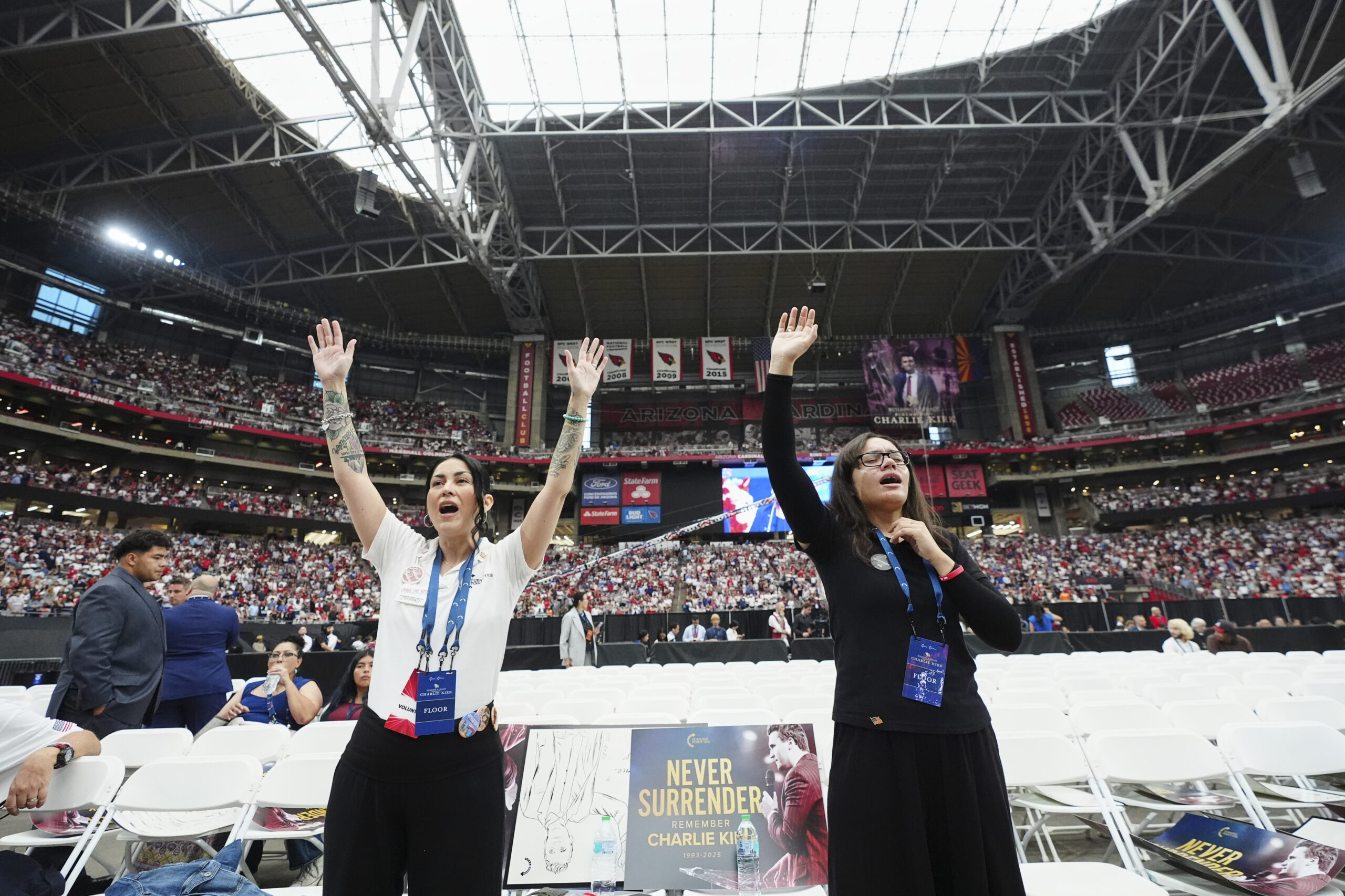
Women listen during a worship song before the start of a memorial for conservative activist Charlie Kirk, Sept. 21, 2025, at State Farm Stadium in Glendale, Ariz. (AP Photo/Ross D. Franklin)
Leah Payne
September 22, 2025
(RNS) — On Sunday (Sept. 21), as conservative activist Charlie Kirk was eulogized in Glendale, Arizona, by luminaries of the American right, Christian music superstars Chris Tomlin, Brandon Lake, Phil Wickham, Kari Jobe Carnes and Cody Carnes led the mourners in singing contemporary worship songs as well as old standbys. In the days since his Sept. 10 assassination, other prominent Christian musicians such as Michael W. Smith and Matthew West have memorialized Kirk as a “true patriot” doing “the work of the Lord,” a martyr inspiring future generations of Christians to “carry the banner of Christ.”
This outpouring will not surprise anyone familiar with the business of contemporary Christian music — known familiarly as CCM — the predominantly white evangelical Christian devotional pop music that has often gone hand in hand with conservative activism.
Since its birth in the late 1970s, CCM has encouraged conservative political activism, and it has thrived on marketing a religiously inspired American patriotism. (Black gospel music, on the other hand, has not followed these patterns.) It took a while for CCM to find its political niche: In the early days of the industry, CCM artists participated in a broad array of political and social activism, from ending nuclear armament to Farm Aid, and raised money for AIDS patients.
As CCM grew as a business, however, the most successful political and social efforts were those aligned with the GOP platform.
Through the 1980s, 1990s and 2000s, top-selling Christian music reliably repeated top priorities of the Republican National Committee. Christian music promoted the pro-life movement, abstinence-only education in public schools and — especially after 9/11 — enthusiastically articulated American exceptionalism. Christian artists often framed their support for these causes apocalyptically; Jesus was coming soon, the logic went, and therefore, the time for mincing words about abortion or sex ed was over. Direct pleas for Christian causes were what was needed at the end of time.
Savvy evangelical political activists came to see in CCM a critical “soft power” that could be used to shape American foreign and domestic policy, and Christian musicians were recruited to use their concerts to collect purity pledges in support of True Love Waits’ abstinence-only sex education, as well as donations to support charities like World Vision and Compassion International.
In the early aughts, Mark D. Rodgers, staff director for the Senate Republican Conference and former chief of staff to then-Sen. Rick Santorum, recognized that CCM stars offered a powerful gateway into a vast network of evangelical activists and media producers. A longtime Capitol Hill insider, Rodgers drew upon the evangelical strategist James Davison Hunter’s argument that Christians should be a “faithful presence” in “elite levels of sectors that shape worldview.”
In an interview for “God Gave Rock & Roll to You: A History of Contemporary Christian Music,” Rodgers explained how CCM artists fit into activist efforts. “Who are the elites of our day?” he reasoned. “If we are talking about strategically engaging sectors that shape worldview, it felt to me like art and entertainment was a sector that should be a priority.”
Beginning in 2001, Rodgers pursued connections with both mainstream entertainers and CCM artists, attending the GMA Dove Awards (the Christian music scene’s Grammys), conversing with leading figures and hosting political briefings. For Rodgers, this strategy was grounded in a conviction: “Politics is downstream of culture,” he said. “Christian artists play a role with their craft in shaping world view, moral imagination, what we love, and what we hate.”
When U2’s Bono began lobbying American politicians for African debt relief, Rodgers instead mobilized evangelicals through their own cultural icons, arguing that “the strategic way to reach evangelicals is to recruit evangelicals,” specifically by mobilizing Christian music artists. Rodgers was among those who encouraged Bono to promote his nonprofit DATA (Debt, AIDS, Trade, Africa) by meeting with a cross-section of CCM stars in December 2002.
When CCM stars spoke about DATA at their concerts and lobbied Congress to forgive African debt, officials assumed they spoke for their festival audiences. Their advocacy helped generate bipartisan support for President George W. Bush’s PEPFAR initiative in 2003, which launched billions of dollars in U.S. aid to Africa.
Republican partnerships with Christian artists have continued in the intervening years, and the Trump administration has actively courted well-known CCM artists along with Christian artists who write and perform music used in evangelical liturgy, known as “worship music,” such as Tomlin and the Carneses. By inviting them to the White House, and now including them at Kirk’s memorial service, conservative activists are capitalizing on the very effective power of Christian music to be the soundtrack of the religious right.
The soft power of Christian musicians like the Carneses has arguably grown over the years because, in many ways, Christian musicians in the 2020s have an even more direct access to their fans than they did in the aughts. They no longer need fans to come to concerts: Through social media platforms like Instagram and TikTok, their access to the faithful has grown exponentially, increasing their value to conservative political organizations.
For their part, Christian musicians like megastar Forrest Frank seem determined not to view their support for Kirk or their place in the conservative media-verse as “political.” Instead, Frank frames Kirk’s death through the lens of the end times. The day after the assassination, Frank shared a video of himself weeping as he watched Kirk praise his music and declared “Jesus is Lord.”
The following day, Frank reported a loss of 30,000 Instagram followers. Unfazed by the exodus, he reflected on Kirk’s death through his own anticipation of the Second Coming. The loss of followers, Frank reckoned, was nothing compared with saving souls at the end of time, and Frank, along with many other Christian artists, recognized Kirk as a fellow witness. “Today is the day,” the singer told his remaining 6 million followers. “The hour is at hand.” On Wednesday, Frank debuted a new song about the ordeal: “JESUS IS COMING BACK SOON.”
(Leah Payne is author of “God Gave Rock and Roll to You: a History of Contemporary Christian Music” and director of Candler School of Theology’s Summer Institute for Global Charismatic-Pentecostal Studies. The views expressed in this commentary do not necessarily reflect those of Religion News Service.)

At Charlie Kirk's memorial, Christian artists play a role as GOP's political messengers
(RNS) — Political activists have recruited Christian musicians to sell policy, and Christian musicians have used their concerts to condemn abortion and support sexual abstinence campaigns.
Women listen during a worship song before the start of a memorial for conservative activist Charlie Kirk, Sept. 21, 2025, at State Farm Stadium in Glendale, Ariz. (AP Photo/Ross D. Franklin)
Leah Payne
September 22, 2025
(RNS) — On Sunday (Sept. 21), as conservative activist Charlie Kirk was eulogized in Glendale, Arizona, by luminaries of the American right, Christian music superstars Chris Tomlin, Brandon Lake, Phil Wickham, Kari Jobe Carnes and Cody Carnes led the mourners in singing contemporary worship songs as well as old standbys. In the days since his Sept. 10 assassination, other prominent Christian musicians such as Michael W. Smith and Matthew West have memorialized Kirk as a “true patriot” doing “the work of the Lord,” a martyr inspiring future generations of Christians to “carry the banner of Christ.”
This outpouring will not surprise anyone familiar with the business of contemporary Christian music — known familiarly as CCM — the predominantly white evangelical Christian devotional pop music that has often gone hand in hand with conservative activism.
Since its birth in the late 1970s, CCM has encouraged conservative political activism, and it has thrived on marketing a religiously inspired American patriotism. (Black gospel music, on the other hand, has not followed these patterns.) It took a while for CCM to find its political niche: In the early days of the industry, CCM artists participated in a broad array of political and social activism, from ending nuclear armament to Farm Aid, and raised money for AIDS patients.
As CCM grew as a business, however, the most successful political and social efforts were those aligned with the GOP platform.
Through the 1980s, 1990s and 2000s, top-selling Christian music reliably repeated top priorities of the Republican National Committee. Christian music promoted the pro-life movement, abstinence-only education in public schools and — especially after 9/11 — enthusiastically articulated American exceptionalism. Christian artists often framed their support for these causes apocalyptically; Jesus was coming soon, the logic went, and therefore, the time for mincing words about abortion or sex ed was over. Direct pleas for Christian causes were what was needed at the end of time.
Savvy evangelical political activists came to see in CCM a critical “soft power” that could be used to shape American foreign and domestic policy, and Christian musicians were recruited to use their concerts to collect purity pledges in support of True Love Waits’ abstinence-only sex education, as well as donations to support charities like World Vision and Compassion International.
In the early aughts, Mark D. Rodgers, staff director for the Senate Republican Conference and former chief of staff to then-Sen. Rick Santorum, recognized that CCM stars offered a powerful gateway into a vast network of evangelical activists and media producers. A longtime Capitol Hill insider, Rodgers drew upon the evangelical strategist James Davison Hunter’s argument that Christians should be a “faithful presence” in “elite levels of sectors that shape worldview.”
In an interview for “God Gave Rock & Roll to You: A History of Contemporary Christian Music,” Rodgers explained how CCM artists fit into activist efforts. “Who are the elites of our day?” he reasoned. “If we are talking about strategically engaging sectors that shape worldview, it felt to me like art and entertainment was a sector that should be a priority.”
Beginning in 2001, Rodgers pursued connections with both mainstream entertainers and CCM artists, attending the GMA Dove Awards (the Christian music scene’s Grammys), conversing with leading figures and hosting political briefings. For Rodgers, this strategy was grounded in a conviction: “Politics is downstream of culture,” he said. “Christian artists play a role with their craft in shaping world view, moral imagination, what we love, and what we hate.”
When U2’s Bono began lobbying American politicians for African debt relief, Rodgers instead mobilized evangelicals through their own cultural icons, arguing that “the strategic way to reach evangelicals is to recruit evangelicals,” specifically by mobilizing Christian music artists. Rodgers was among those who encouraged Bono to promote his nonprofit DATA (Debt, AIDS, Trade, Africa) by meeting with a cross-section of CCM stars in December 2002.
When CCM stars spoke about DATA at their concerts and lobbied Congress to forgive African debt, officials assumed they spoke for their festival audiences. Their advocacy helped generate bipartisan support for President George W. Bush’s PEPFAR initiative in 2003, which launched billions of dollars in U.S. aid to Africa.
Republican partnerships with Christian artists have continued in the intervening years, and the Trump administration has actively courted well-known CCM artists along with Christian artists who write and perform music used in evangelical liturgy, known as “worship music,” such as Tomlin and the Carneses. By inviting them to the White House, and now including them at Kirk’s memorial service, conservative activists are capitalizing on the very effective power of Christian music to be the soundtrack of the religious right.
The soft power of Christian musicians like the Carneses has arguably grown over the years because, in many ways, Christian musicians in the 2020s have an even more direct access to their fans than they did in the aughts. They no longer need fans to come to concerts: Through social media platforms like Instagram and TikTok, their access to the faithful has grown exponentially, increasing their value to conservative political organizations.
For their part, Christian musicians like megastar Forrest Frank seem determined not to view their support for Kirk or their place in the conservative media-verse as “political.” Instead, Frank frames Kirk’s death through the lens of the end times. The day after the assassination, Frank shared a video of himself weeping as he watched Kirk praise his music and declared “Jesus is Lord.”
The following day, Frank reported a loss of 30,000 Instagram followers. Unfazed by the exodus, he reflected on Kirk’s death through his own anticipation of the Second Coming. The loss of followers, Frank reckoned, was nothing compared with saving souls at the end of time, and Frank, along with many other Christian artists, recognized Kirk as a fellow witness. “Today is the day,” the singer told his remaining 6 million followers. “The hour is at hand.” On Wednesday, Frank debuted a new song about the ordeal: “JESUS IS COMING BACK SOON.”
(Leah Payne is author of “God Gave Rock and Roll to You: a History of Contemporary Christian Music” and director of Candler School of Theology’s Summer Institute for Global Charismatic-Pentecostal Studies. The views expressed in this commentary do not necessarily reflect those of Religion News Service.)

Kirk Assassination Puts the U.S. Left in Danger
Tuesday 16 September 2025, by Dan La Botz
The assassination of Charlie Kirk, the 31-year-old leader of the far-right youth organization Turning Point USA has intensified the political polarization in the United States and has led to calls by Trump’s Make America Great Again (MAGA) movement to call for the elimination of the left from American political life.
Kirk was assassinated by a single rifle shot while speaking at Utah Valley University in Orem, Utah. Within two days, Tyler Robinson, a 22-year-old student, turned himself in to the police and was charged with the murder.
Following Kirk’s killing, President Donald Trump in a national address stated, “For years, those on the radical left have compared wonderful Americans like Charlie to Nazis and the world’s worst mass murderers and criminals. This kind of rhetoric is directly responsible for the terrorism that we’re seeing in our country today, and it must stop right now.” Laura Loomer, who influences Trump, wrote, “We must shut these lunatic leftists down. Once and for all. The Left is a national security threat.”
Kirk was a devoted follower and friend of President Donald Trump who saw his organization Turning Point USA as the youth group of the MAGA movement. In 2024, the group mobilized young people to vote for Trump, helping him to win the presidential election.
Kirk was a white Christian nationalist who routinely suggested that Black people, especially Black women, were intellectually inferior. He argued that Jews were responsible for the Great Replacement of white Americans by people of color. He said that women should reject feminism and submit to their husbands. He believed that LGBT people violated God’s Biblical law. While claiming to be an advocate of free speech, Kirk’s Turning Point USA maintained a “professor watchlist” aimed at driving progressive professors out of academia. He stated that Muslims would kill every Jew on earth. He said that Palestine did not exist and asserted that claims of starvation of children in Gaza were fake news. He dismissed climate change, falsely claiming there was no scientific consensus on its cause.
Tyler Robinson, grew up in a Christian, Republican family in Utah. He was an excellent student, like video games, and had become interested in politics, but was apparently not a member of any organization. He reportedly confessed to the murder, but if he is the murderer, we don’t know why he killed Kirk.
But we have some clues. Some unfired cartridges found near the rifle used in the shooting had been engraved: One read, “Hey fascist! Catch.” Another read, “Bella ciao,” a lyric from a song of the Italian anti-fascist resistance of World War II. So, perhaps Robinson had become an anti-fascist who wanted to kill the leading youth organizer of an American fascist movement. If so, we think he made a terrible mistake.
We socialists have always rejected individual acts of terror, such as assassinations. First, large organizations or social movements are not likely to change direction or to be stopped by the killing of one person. On the contrary, the murder of a charismatic and popular leader like Kirk could create a martyr around whom people will organize.
Second, assassination leads to repression such as we are witnessing now, as rightwing agitators, politicians, and the government take advantage of the murder to call for a purge of leftists in America.
We on the left, as well as progressives and liberals, are in danger. Even before Kirk’s killing, Trump was sending troops to American cities. Several right-wingers on social media now call for a civil war. Leaders of armed, violent groups like the Oath Keepers and the Proud Boys have called upon their members to mobilize. We will have to be vigilant and to organize to defend our organizations and our rights, while continuing to oppose Trump, the Republicans, and the far-right.
14 September 2025
Attached documentskirk-assassination-puts-the-left-in-danger_a9176.pdf (PDF - 905.2 KiB)
Extraction PDF [->article9176]
Dan La Botz was a founding member of Teamsters for a Democratic Union (TDU). He is the author of Rank-and-File Rebellion: Teamsters for a Democratic Union (1991). He is also a co-editor of New Politics and editor of Mexican Labor News and Analysis.
International Viewpoint is published under the responsibility of the Bureau of the Fourth International. Signed articles do not necessarily reflect editorial policy. Articles can be reprinted with acknowledgement, and a live link if possible.
Tuesday 16 September 2025, by Dan La Botz
The assassination of Charlie Kirk, the 31-year-old leader of the far-right youth organization Turning Point USA has intensified the political polarization in the United States and has led to calls by Trump’s Make America Great Again (MAGA) movement to call for the elimination of the left from American political life.
Kirk was assassinated by a single rifle shot while speaking at Utah Valley University in Orem, Utah. Within two days, Tyler Robinson, a 22-year-old student, turned himself in to the police and was charged with the murder.
Following Kirk’s killing, President Donald Trump in a national address stated, “For years, those on the radical left have compared wonderful Americans like Charlie to Nazis and the world’s worst mass murderers and criminals. This kind of rhetoric is directly responsible for the terrorism that we’re seeing in our country today, and it must stop right now.” Laura Loomer, who influences Trump, wrote, “We must shut these lunatic leftists down. Once and for all. The Left is a national security threat.”
Kirk was a devoted follower and friend of President Donald Trump who saw his organization Turning Point USA as the youth group of the MAGA movement. In 2024, the group mobilized young people to vote for Trump, helping him to win the presidential election.
Kirk was a white Christian nationalist who routinely suggested that Black people, especially Black women, were intellectually inferior. He argued that Jews were responsible for the Great Replacement of white Americans by people of color. He said that women should reject feminism and submit to their husbands. He believed that LGBT people violated God’s Biblical law. While claiming to be an advocate of free speech, Kirk’s Turning Point USA maintained a “professor watchlist” aimed at driving progressive professors out of academia. He stated that Muslims would kill every Jew on earth. He said that Palestine did not exist and asserted that claims of starvation of children in Gaza were fake news. He dismissed climate change, falsely claiming there was no scientific consensus on its cause.
Tyler Robinson, grew up in a Christian, Republican family in Utah. He was an excellent student, like video games, and had become interested in politics, but was apparently not a member of any organization. He reportedly confessed to the murder, but if he is the murderer, we don’t know why he killed Kirk.
But we have some clues. Some unfired cartridges found near the rifle used in the shooting had been engraved: One read, “Hey fascist! Catch.” Another read, “Bella ciao,” a lyric from a song of the Italian anti-fascist resistance of World War II. So, perhaps Robinson had become an anti-fascist who wanted to kill the leading youth organizer of an American fascist movement. If so, we think he made a terrible mistake.
We socialists have always rejected individual acts of terror, such as assassinations. First, large organizations or social movements are not likely to change direction or to be stopped by the killing of one person. On the contrary, the murder of a charismatic and popular leader like Kirk could create a martyr around whom people will organize.
Second, assassination leads to repression such as we are witnessing now, as rightwing agitators, politicians, and the government take advantage of the murder to call for a purge of leftists in America.
We on the left, as well as progressives and liberals, are in danger. Even before Kirk’s killing, Trump was sending troops to American cities. Several right-wingers on social media now call for a civil war. Leaders of armed, violent groups like the Oath Keepers and the Proud Boys have called upon their members to mobilize. We will have to be vigilant and to organize to defend our organizations and our rights, while continuing to oppose Trump, the Republicans, and the far-right.
14 September 2025
Attached documentskirk-assassination-puts-the-left-in-danger_a9176.pdf (PDF - 905.2 KiB)
Extraction PDF [->article9176]
Dan La Botz was a founding member of Teamsters for a Democratic Union (TDU). He is the author of Rank-and-File Rebellion: Teamsters for a Democratic Union (1991). He is also a co-editor of New Politics and editor of Mexican Labor News and Analysis.
International Viewpoint is published under the responsibility of the Bureau of the Fourth International. Signed articles do not necessarily reflect editorial policy. Articles can be reprinted with acknowledgement, and a live link if possible.


No comments:
Post a Comment