Trump pushes link between Tylenol use and autism despite no scientific evidence
US President Donald Trump on Monday urged pregnant women to 'tough it out' and shun Tylenol over an unproven link to autism, while also calling for major changes to childhood vaccines. Medical experts say the sweeping advice is unsupported by evidence and risks undermining decades of public health consensus.
Issued on: 23/09/2025
By: FRANCE 24
Debate ongoing
The Food and Drug Administration was far more muted than Trump on the topic, saying in a letter to physicians that "a causal relationship has not been established" and that scientific debate was ongoing.
A literature review published last month concluded there was reason to believe a possible link between Tylenol exposure and autism existed – but many other studies have found an opposite result.
Researchers behind the August report cautioned that more study is needed and that pregnant women should not stop taking medication without consulting their doctors.
David Mandell, a psychiatric epidemiologist at the University of Pennsylvania, told AFP that research suggests the possible risks posed by taking Tylenol while pregnant seem "to be lower than the risk of having an uncontrolled infection during pregnancy."
Anti-vax 'threat' to children
Identifying the root of autism – a complex condition connected to brain development that many experts believe occurs for predominantly genetic reasons – has been a pet cause of Trump's health chief, Robert F. Kennedy Jr.
Kennedy for decades has spread debunked claims that vaccines cause autism.
On Monday he touted the drug leucovorin, a form of vitamin B first used to alleviate chemotherapy side effects, as an "exciting therapy" that could help children with the disorder whose symptoms vary widely across a spectrum.
The FDA on Monday said it was approving the drug's tablet form to help a subset of children who have "cerebral folate deficiency".
Vaccines were also on the rambling agenda of Trump's conference.
He ardently repeated anti-vax movement talking points as top figures in the administration, including Kennedy, nodded along.
He sowed doubt over standard vaccines including the MMR shot – which covers measles, mumps and rubella – and implied he would end the common use of aluminium in vaccines, the safety of which has been widely studied.
And the president pushed for a major change to the routine vaccine schedule given to infants, insisting without evidence that there's "no reason" to vaccinate newborns against the incurable, highly contagious Hepatitis B.
That statement stands in direct contradiction of broad medical consensus formed over decades. Many experts say the best way to prevent maternal transmission of the disease, which can cause liver damage and cancer, is to vaccinate babies within the first day of life.
Trump's push comes days after an influential advisory panel handpicked by Kennedy stopped short of advising to delay the first dose of Hepatitis B vaccine by one month.
They deemed more discussion was necessary – offering temporary relief to many experts across public health who said postponing that shot could have dire results.
"Spacing out or delaying vaccines means children will not have immunity against these diseases at times when they are most at risk," said Susan Kressly, president of the American Academy of Pediatrics, on Monday.
"Any effort to misrepresent sound, strong science poses a threat to the health of children."
(FRANCE 24 with AFP)
US President Donald Trump on Monday urged pregnant women to 'tough it out' and shun Tylenol over an unproven link to autism, while also calling for major changes to childhood vaccines. Medical experts say the sweeping advice is unsupported by evidence and risks undermining decades of public health consensus.
Issued on: 23/09/2025
By: FRANCE 24
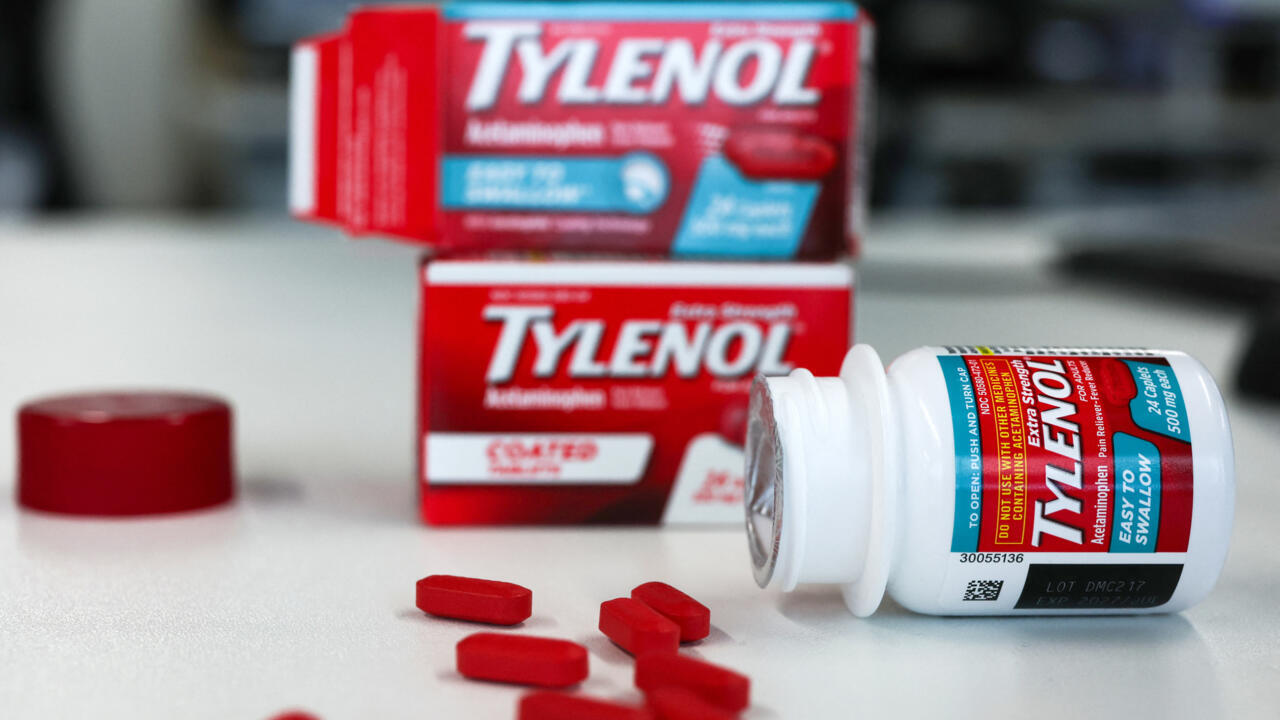
Tylenol packages and caplets are displayed, in Los Angeles, California, on September 22, 2025. © Valérie Macon, AFP
US President Donald Trump on Monday vehemently insisted that pregnant women should "tough it out" and avoid Tylenol over an unproven link to autism, and urged major changes to the standard vaccines administered to babies.
The Republican leader's announcement rife with sweeping yet unsubstantiated advice came as the White House has vowed to revolutionise health in the United States, and as experts across medicine and science voice broad concern over the administration's initiatives that appear intent on unravelling decades of medical consensus.
Medical groups including The American College of Obstetricians and Gynecologists have long cited acetaminophen – the primary ingredient in Tylenol – as among the safest painkillers to take during pregnancy.
But Trump, who hammered on his message in increasingly emphatic terms, insisted that "taking Tylenol is not good" and to "fight like hell not to take it."
He said pregnant women should "tough it out," and that only an "extremely high fever" would justify taking the over-the-counter medicine.
That's not true: fever and pain can pose serious threats to both the mother and the developing fetus.
Arthur Caplan, the head of NYU's medical ethics division, called Trump's display "dangerous," "unscientific" and "full of misinformation."
"I worry that pregnant women are going to feel guilty if they took Tylenol. They're going to feel they let down their babies. They're going to feel that they were unethical in terms of trying to treat fever. That's just not fair, and it's not anything that anybody should be feeling," Caplan told AFP.
US President Donald Trump on Monday vehemently insisted that pregnant women should "tough it out" and avoid Tylenol over an unproven link to autism, and urged major changes to the standard vaccines administered to babies.
The Republican leader's announcement rife with sweeping yet unsubstantiated advice came as the White House has vowed to revolutionise health in the United States, and as experts across medicine and science voice broad concern over the administration's initiatives that appear intent on unravelling decades of medical consensus.
Medical groups including The American College of Obstetricians and Gynecologists have long cited acetaminophen – the primary ingredient in Tylenol – as among the safest painkillers to take during pregnancy.
But Trump, who hammered on his message in increasingly emphatic terms, insisted that "taking Tylenol is not good" and to "fight like hell not to take it."
He said pregnant women should "tough it out," and that only an "extremely high fever" would justify taking the over-the-counter medicine.
That's not true: fever and pain can pose serious threats to both the mother and the developing fetus.
Arthur Caplan, the head of NYU's medical ethics division, called Trump's display "dangerous," "unscientific" and "full of misinformation."
"I worry that pregnant women are going to feel guilty if they took Tylenol. They're going to feel they let down their babies. They're going to feel that they were unethical in terms of trying to treat fever. That's just not fair, and it's not anything that anybody should be feeling," Caplan told AFP.
Debate ongoing
The Food and Drug Administration was far more muted than Trump on the topic, saying in a letter to physicians that "a causal relationship has not been established" and that scientific debate was ongoing.
A literature review published last month concluded there was reason to believe a possible link between Tylenol exposure and autism existed – but many other studies have found an opposite result.
Researchers behind the August report cautioned that more study is needed and that pregnant women should not stop taking medication without consulting their doctors.
David Mandell, a psychiatric epidemiologist at the University of Pennsylvania, told AFP that research suggests the possible risks posed by taking Tylenol while pregnant seem "to be lower than the risk of having an uncontrolled infection during pregnancy."
Anti-vax 'threat' to children
Identifying the root of autism – a complex condition connected to brain development that many experts believe occurs for predominantly genetic reasons – has been a pet cause of Trump's health chief, Robert F. Kennedy Jr.
Kennedy for decades has spread debunked claims that vaccines cause autism.
On Monday he touted the drug leucovorin, a form of vitamin B first used to alleviate chemotherapy side effects, as an "exciting therapy" that could help children with the disorder whose symptoms vary widely across a spectrum.
The FDA on Monday said it was approving the drug's tablet form to help a subset of children who have "cerebral folate deficiency".
Vaccines were also on the rambling agenda of Trump's conference.
He ardently repeated anti-vax movement talking points as top figures in the administration, including Kennedy, nodded along.
He sowed doubt over standard vaccines including the MMR shot – which covers measles, mumps and rubella – and implied he would end the common use of aluminium in vaccines, the safety of which has been widely studied.
And the president pushed for a major change to the routine vaccine schedule given to infants, insisting without evidence that there's "no reason" to vaccinate newborns against the incurable, highly contagious Hepatitis B.
That statement stands in direct contradiction of broad medical consensus formed over decades. Many experts say the best way to prevent maternal transmission of the disease, which can cause liver damage and cancer, is to vaccinate babies within the first day of life.
Trump's push comes days after an influential advisory panel handpicked by Kennedy stopped short of advising to delay the first dose of Hepatitis B vaccine by one month.
They deemed more discussion was necessary – offering temporary relief to many experts across public health who said postponing that shot could have dire results.
"Spacing out or delaying vaccines means children will not have immunity against these diseases at times when they are most at risk," said Susan Kressly, president of the American Academy of Pediatrics, on Monday.
"Any effort to misrepresent sound, strong science poses a threat to the health of children."
(FRANCE 24 with AFP)
Fact-checking Trump's claims of a link between Tylenol and autism
Issued on: 23/09/2025 - FRANCE24

Donald Trump made sweeping statements urging Americans not to use the over-the-counter painkiller Acetaminophen during pregnancy, saying it had links to autism. But he provided little scientific evidence to back this up. He also made sweeping statements about there being "virtually no autism" amongst the Amish or in Cuba. Most dangerously, he also repeated disproved claims about vaccines causing autism. Vedika Bahl fact-checks these claims in Truth or Fake.
Issued on: 23/09/2025 - FRANCE24
Donald Trump made sweeping statements urging Americans not to use the over-the-counter painkiller Acetaminophen during pregnancy, saying it had links to autism. But he provided little scientific evidence to back this up. He also made sweeping statements about there being "virtually no autism" amongst the Amish or in Cuba. Most dangerously, he also repeated disproved claims about vaccines causing autism. Vedika Bahl fact-checks these claims in Truth or Fake.
Copyright ASSOCIATED PRESS
By Marta Iraola Iribarren
Published on 23/09/2025 - EURONEWS
The European Medicines Agency (EMA) joined a chorus of medical opinion stating on Tuesday that paracetamol is safe to use during pregnancy and that there is no evidence linking it to autism, contrary to claims made this week by the US president.
On Monday, the White House stated that it had identified a connection between the use of paracetamol in pregnancy – marketed in the US as Tylenol – and autism in children.
US President Donald Trump went further, claiming that Tylenol "is no good" and that pregnant women should "fight like hell" to avoid taking it. He had teed up the news over the weekend, saying “I think we found an answer to autism”.
The EMA stated that there is no evidence to support these claims. “There is no new evidence that would require changes to the current EU recommendations for use,” an agency spokesperson told Euronews.
In 2019, the Agency reviewed studies on the neurodevelopment of children exposed to paracetamol during pregnancy and concluded that the findings were inconclusive, with no evidence of a link to neurodevelopmental disorders.
The EMA now states that extensive data from pregnant women who used paracetamol during pregnancy shows no increased risk of malformations in the developing foetus or in newborns – information already included in product labelling in the EU.
“When needed, paracetamol can be used during pregnancy. However, the advice is to use it at the lowest effective dose, for the shortest possible time and as infrequently as possible,” the spokesperson added.
As with all medicines, the EMA and national competent authorities in the EU carry out continuous safety monitoring of products containing paracetamol.
The announcement from the Trump administration followed a pledge by US health secretary Robert F. Kennedy Jr in April to identify the cause of autism by September.
As Euronews previously reported, the United States’ announcement also prompted backlash from child health experts.
Researchers widely believe autism is caused by a combination of genetic and environmental factors, including advanced parental age, prenatal exposure to air pollution, and low oxygen levels around the time of birth.
On Monday, the White House stated that it had identified a connection between the use of paracetamol in pregnancy – marketed in the US as Tylenol – and autism in children.
US President Donald Trump went further, claiming that Tylenol "is no good" and that pregnant women should "fight like hell" to avoid taking it. He had teed up the news over the weekend, saying “I think we found an answer to autism”.
The EMA stated that there is no evidence to support these claims. “There is no new evidence that would require changes to the current EU recommendations for use,” an agency spokesperson told Euronews.
In 2019, the Agency reviewed studies on the neurodevelopment of children exposed to paracetamol during pregnancy and concluded that the findings were inconclusive, with no evidence of a link to neurodevelopmental disorders.
The EMA now states that extensive data from pregnant women who used paracetamol during pregnancy shows no increased risk of malformations in the developing foetus or in newborns – information already included in product labelling in the EU.
“When needed, paracetamol can be used during pregnancy. However, the advice is to use it at the lowest effective dose, for the shortest possible time and as infrequently as possible,” the spokesperson added.
As with all medicines, the EMA and national competent authorities in the EU carry out continuous safety monitoring of products containing paracetamol.
The announcement from the Trump administration followed a pledge by US health secretary Robert F. Kennedy Jr in April to identify the cause of autism by September.
As Euronews previously reported, the United States’ announcement also prompted backlash from child health experts.
Researchers widely believe autism is caused by a combination of genetic and environmental factors, including advanced parental age, prenatal exposure to air pollution, and low oxygen levels around the time of birth.

No comments:
Post a Comment