Opinion
Religious freedom for psychedelic users? Not without Indigenous truth.
(RNS) — The doors for the spiritual use of psychedelics were opened by struggles over peyote for Native Americans.
(Photo by Katherine Hanlon/Unsplash/Creative Commons)
Christine McCleave
September 23, 2025
(RNS) — The recent controversy over an Episcopal priest who was dismissed for promoting psychedelics for spiritual awakening raises urgent questions about how organized religion in America relates to psychedelics. The debate has focused on the safety of these drugs and church authority and doctrine, while ignoring Indigenous Americans’ long history with such medicines and the church’s long, painful history of suppressing them.
Concerns about priests and others becoming psychedelic shamans are valid. Ordination does not grant medical or cultural expertise, and clergy are not automatically qualified to lead plant medicine ceremonies. Indigenous communities, on the other hand, hold deep intergenerational knowledge of these medicines, rooted in protocols of respect and responsibility. Without a similar foundation, even well-meaning Christian leaders indeed risk causing harm, and it makes sense to regulate those who promote psychedelics. Yet the question remains: How will organized religion engage with psychedelics without perpetuating appropriation and erasure of Indigenous people?
RELATED: Episcopal Church removes priest who founded Christian psychedelic society
For centuries, Christian institutions, the Episcopal Church included, criminalized, demonized and worked to eradicate Indigenous traditions that relied on these medicines, even as they thrived by absorbing pagan practices to attract members. Their attempts now to consider or adjudicate practices so long associated with Indigenous spirituality betray theological contradictions and spiritual hypocrisy.
For over a decade, I have researched the harm caused by church-run Indian boarding schools on Native children in the U.S. — institutions designed to erase language, culture and ceremonies, leaving deep scars of post-traumatic stress disorder and other trauma that still affect our communities today. My research showed that these traumas were intentional, rooted in the belief that Indigenous spirituality was a threat to be eliminated. These same abuses were perpetrated around the globe, particularly in the Brazilian Amazon, where the psychedelic substance ayahuasca originates. For communities still healing from church-run attempts to erase language and ceremony, sudden clerical enthusiasm for psychedelics can reopen wounds rather than build trust.
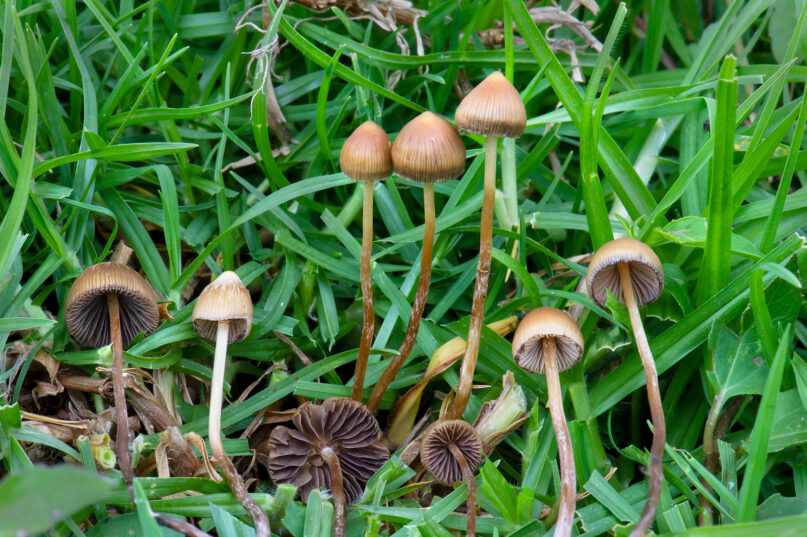
Psilocybe mexicana mushrooms in Veracruz, Mexico, on July 2, 2019.
For churches to embrace psychedelics without acknowledgment, accountability or reparations now is not only culturally insensitive — it worsens these harms and triggers past trauma.
Legally, much of the wider debate about the spiritual use of psychedelics turns on “religious freedom.” Many advocates of psychedelics favor the Religious Freedom Restoration Act model, in which groups seek exemptions for sacramental use. These pathways rely on legal ground first carved out by Indigenous peoples whose traditions were explicitly targeted by federal bans.
Today’s “religious freedom” advocates include syncretic Brazilian ayahuasca churches operating in the U.S. (such as União do Vegetal and Santo Daime) and a growing number of self-described psychedelic churches whose attorneys petition the Drug Enforcement Administration for RFRA exemptions. What they are pushing for through court orders or Drug Enforcement Agency recognition is narrow but powerful: the right to import, possess and administer otherwise prohibited sacraments such as ayahuasca/DMT and sometimes psilocybin or mescaline, as religious exercise.
The RFRA strategy began with a legal case brought by two Native American Church members who were denied unemployment benefits after being fired for sacramental peyote use. In the resulting 1990 U.S. Supreme Court decision, Employment Division v. Smith, the justices held that neutral, generally applicable laws could apply to religious practice without violating the First Amendment. The backlash was bipartisan: Congress enacted RFRA to restore the “compelling interest/least restrictive means” test for burdens on religion (later limited to the federal government).
In 1994, Congress separately amended the American Indian Religious Freedom Act to explicitly protect Native ceremonial peyote. In 2006, in Gonzales v. O Centro, the Supreme Court applied RFRA to uphold a church’s sacramental ayahuasca, requiring the government to justify prohibitions case by case, and today the DEA processes RFRA petitions for religious exemptions.
In short: The legal door newer groups now walk through was opened by struggles over peyote for Native Americans.
That history also reveals a double standard. Indigenous spiritual practices involving peyote or other medicines continue to face stigma, legal barriers and threats to their supply. This reversal of justice benefits new psychedelic religions, while tribal nations in the U.S. remain vulnerable despite treaty rights and the American Indian Religious Freedom Act.
Today, psychedelics are being recognized as tools for spiritual renewal. But for Indigenous peoples, they are not “new frontiers” or experimental sacraments — they are living traditions that survived generations of suppression. The church should honor this legacy. True healing will not come from adopting what was once condemned but from mending relationships and respecting the knowledge of those who kept these traditions alive.
RELATED: After a decade of controversy, clergy psychedelic study is published
If Christianity genuinely wants to engage with psychedelics, it must repent. It needs to confront its history of suppressing Indigenous spiritual practices and take concrete steps toward reconciliation. This includes recognizing the origins of these medicines, supporting Indigenous sovereignty and conservation, and centering Indigenous voices in discussions about law, theology and practice. Anything less risks repeating history — not as healing, but as another chapter of colonial exploitation.
(Christine Diindiisi McCleave, a member of the Turtle Mountain band of Ojibwe who holds a Ph.D. in Indigenous studies, is the former CEO of the National Native American Boarding School Healing Coalition. The views expressed in this commentary do not necessarily reflect those of Religion News Service.)
Magic mushrooms invent active compound twice
A new study shows that different types of mushrooms use completely different methods to produce the psychoactive substance psilocybin
image:
Two paths lead to the same molecule: Independently of each other, different genera of ‘magic mushrooms’ have developed two different enzyme pathways that produce the same psychoactive substance, psilocybin – a rare example of convergent evolution in natural product biosynthesis.
view moreCredit: Tim Schäfer, Leibniz-HKI
“This concerns the biosynthesis of a molecule that has a very long history with humans,” explains Prof. Dirk Hoffmeister, head of the research group Pharmaceutical Microbiology at Friedrich Schiller University Jena and the Leibniz Institute for Natural Product Research and Infection Biology (Leibniz-HKI). “We are referring to psilocybin, a substance found in so-called ‘magic mushrooms’, which our body converts into psilocin – a compound that can profoundly alter consciousness. However, psilocybin not only triggers psychedelic experiences, but is also considered a promising active compound in the treatment of therapy-resistant depression,” says Hoffmeister.
Two paths, one molecule
The study, which was conducted within the Cluster of Excellence ‘Balance of the Microverse’, shows for the first time that fungi have developed the ability to produce psilocybin at least twice independently of each other. While Psilocybe species use a known enzyme toolkit for this purpose, fiber cap mushrooms employ a completely different biochemical arsenal – and yet arrive at the same molecule. This finding is considered an example of convergent evolution: different species have independently developed a similar trait, but the ‘magic mushrooms’ have gone their own way in doing so.
Searching for clues in fungal genomes
Tim Schäfer, lead author of the study and doctoral researcher in Hoffmeister’s team, explains: “It was like looking at two different workshops, but both ultimately delivering the same product. In the fiber caps, we found a unique set of enzymes that have nothing to do with those found in Psilocybe mushrooms. Nevertheless, they all catalyze the steps necessary to form psilocybin.”
The researchers analyzed the enzymes in the laboratory. Protein models created by Innsbruck chemist Bernhard Rupp confirmed that the sequence of reactions differs significantly from that known in Psilocybe. “Here, nature has actually invented the same active compound twice,” says Schäfer.
However, why two such different groups of fungi produce the same active compound remains unclear. “The real answer is: we don’t know,” emphasizes Hoffmeister. “Nature does nothing without reason. So there must be an advantage to both fiber cap mushrooms in the forest and Psilocybe species on manure or wood mulch producing this molecule – we just don’t know what it is yet.”
“One possible reason could be that psilocybin is intended to deter predators. Even the smallest injuries cause Psilocybe mushrooms to turn blue through a chemical chain reaction, revealing the breakdown products of psilocybin. Perhaps the molecule is a type of chemical defense mechanism,” says Hoffmeister.
More tools for biotechnology
Although it is still unclear why different fungi ultimately produce the same molecule, the discovery nevertheless has practical implications: “Now that we know about additional enzymes, we have more tools in our toolbox for the biotechnological production of psilocybin,” explains Hoffmeister.
Schäfer is also looking ahead: “We hope that our results will contribute to the future production of psilocybin for pharmaceuticals in bioreactors without the need for complex chemical syntheses.” At the Leibniz-HKI in Jena, Hoffmeister’s team is working closely with the Bio Pilot Plant, which is developing processes for producing natural products such as psilocybin on an industry-like scale.
At the same time, the study provides exciting insights into the diversity of chemical strategies used by fungi and their interactions with their environment. It thus addresses central questions of the Collaborative Research Center ChemBioSys and the Cluster of Excellence ׅ‘Balance of the Microverse’ at Friedrich Schiller University Jena, within the framework of which the work was carried out and funded by the German Research Foundation (DFG), among others. While the CRC ChemBioSys investigates how natural compounds shape biological communities, the Cluster of Excellence focuses on the complex dynamics of microorganisms and their environment.
Psilocybe cubensis grows worldwide in tropical and subtropical regions, including Central and South America, Southeast Asia, and Oceania. The mushroom prefers moist, fertilizer-rich soils and contains the psychoactive substance psilocybin, which is currently being researched as an active compound for the treatment of therapy-resistant depression.
Credit
Felix Blei, Leibniz-HKI
Journal
Angewandte Chemie International Edition
Article Title
Dissimilar Reactions and Enzymes for Psilocybin Biosynthesis in Inocybe and Psilocybe Mushrooms

No comments:
Post a Comment