
From the deserts of Banni in Kutch, Sindhi singers paid homage to Shah Abdul Latif, with Dr Rita Kothari curating the performance 'Shah jo raag' marking first anniversary of 'The Lost Homeland of Sindh'. Photo-credit Sindhi Culture Foundation
October 16, 2025
By Raju Mansukhani
New English translation of ‘Ittehad’ for global audiences
As the moon rose above the tree-line around the historic Dara Shukoh Library in Dr Ambedkar University campus in Delhi, a lively recital and soulful musical rendering of Shah Abdul Latif’s poetry added to the mystique of an evening under the skies.
It was October 5, 2025 and the first anniversary celebrations of the ‘Lost Homeland of Sindh’ were off to a rousing start. For those who may not be aware, ‘Lost Homeland of Sindh’ is the permanent gallery within The Partition Museum and established by the Bengaluru-based Sindhi Culture Foundation. The performances by Sindhi musicians from the Kutch heartland – Mazharuddin Ali, Rabjibhai, Akbar Mutva and Sikander – brought to life the Sindhi Sufi poetry of the 18th century for twenty-first century audiences.
Seated on the dais with the musicians was Dr Rita Kothari, an academician-translator-writer who curated the ‘Shah jo Raag’ concert and explained nuances of Shah’s poetry as Mazhar and Rabjibhai held forth, singing their hearts out. At least three generations of Sindhis in the audience seemed lost in the moment where they could find nuggets of their own legacies in the lyrics layered with mysticism and the Sufi messages of unity, infinity, love, longing and the dignity of surrender.
Undoubtedly the star of the evening was Guli Sadarangani, born in 1906 and she passed away in 1994. As Dr Rita writes in the Introduction to the English translation of Ittehad – A Life Together, released by Zubaan Books to mark the first anniversary of ‘Lost Homeland of Sindh’, “Guli was hyper visible in her time but invisible and unknown in ours. Strange and paradoxical though it may seem, her subsequent invisibility is not entirely separate from the negative attention she received during her time. Guli Sadarangani was the first woman writer of Sindh.”
Unique achievement in 1941
The mention of ‘first’ is enough to make anyone take note of the uniqueness and pioneering achievement it must have been in her time. Ittehad was first published in 1941, and much later in 1983 it was republished and expanded as Melaapi Jeevan (a title in Hindi meaning ‘a harmonious life’). In these decades lies the story of India, undivided and then divided, and Guli who had made waves in the 1940s later lapsed into anonymity as Sindh became part of Pakistan while the Sindhis migrated to the new Republic of India and, then later, joined the stream of global migrants.
As the translator of Ittehad – A Life Together into English, Dr Rita Kothari provides new readers with insights and learnings of not just Guli’s life time but also the challenges of writing in India of the 1940s and 1950s when the tasks of nation-building were burdened with social-cultural divisions, the aftermath of riots and bloodshed. Marriages between Hindus and Muslims have been a thorny, prickly and explosive subject, especially when it is a Hindu woman and a Muslim man who exercise their freedom to love and be united in matrimony. The 1941 version of the novel carried the story of Asha and Hamid, an idealistic couple committed to creating a new and secular India.
“Guli Sadarangani must have faced ire from her Hindu community also for propagating a marriage between Asha and Hamid. Such was the momentum of opposition and coverage in the newspapers of Karachi and Hyderabad against Ittehad that in the future, no mention of the novel would be made without the word ‘controversial’,” explained Dr Rita who is a professor of English at Ashoka University and the co-director of the Ashoka Centre for Translation.
She has worked extensively on the Sindhi experiences of the Partition in 1947; in many ways, she and Guli may have been generations apart but they share similarities and intersections of life-experiences, gender politics and sexuality which give Ittehad yet another dimension. Moreover, post-Partition, the Sindhi community was geographically dispersed, having to fight for their survival in strange lands. Literature or literary activities were not a priority in those times, consequently Sindhi literature remained restricted to a small group of writers, and an even smaller group of readers.

Filled with despair
Guli Sadarangani, in the preface to the 1941 edition of Ittehad, is conscious of the pitfalls of Indian society. She wrote, “the exploitation of the poor by the rich, the oppression of women by men and the atrocities of caste fill me with despair. God knows when our country will cease to be enslaved by such oppression. In the name of dharma or religion, lawlessness prevails. I feel we are descending into an abyss. What do we even mean by religion? Things that cause damage and actions that are inimical to religion, we define as religious and fan animosities. Honestly, the Hindu is bringing a bad name to his religion and the Muslim to his. Stalwarts like the great poet Tagore, Sri Aurobindo, and Mahatma Gandhi understood religion more deeply than most, don’t you agree?”
These powerful, bold and progressive thoughts expressed by Guli in the 1940s were discussed at the on-stage Baithak (or discussion) on the 5th October anniversary, when Dr Rita Kothari was joined by Anamika, Manju Mukul, and Aanchal Malhotra in conversation with Aditya Vikram Shrivastava. What they shared on stage spanned the domains of idealism and love, the challenges of cosmopolitanism and modernity not just in Guli’s time and age, but also contemporary India and its vast Asian neighbourhood which continues its struggle against patriarchy, the stiffening of social ties and relationships, with women having to negotiate through such complexities in the post-colonial age. As Aanchal Malhotra, a young historian who has dedicated years of research towards Partition studies, said “Desire, love, equality, freedom – these are questions which are being asked by women today.”
The questions that Guli Sadarangani raised, and the plea she made through her writings remain so relevant, poignant and touching till date. “When I hear about instances of Hindu-Muslim enmity,” she wrote in the 1941 preface, “I pray from the depths of my heart for a young person to take up and give a clarion call for a union of the two communities. Given the current conditions in Sindh, I feel it is the need of the hour that a new young leadership emerges from the Sindhis. Our Sindh has long followed the path of Sufism, and I have faith that it will once again reassert that path over the dissensions that characterize our times. Sindh will become an exemplar for India. May our Sindh take a lead in this union, this Ittehad.“
The Lost Homeland
The gallery title – The Lost Homeland of Sindh – itself brims with tears, traumas and the tough times which the Sindhis have experienced for eight long decades, reducing several generations into poverty and penury. It took a gutsy, determined Aruna Madnani, managing trustee of Sindhi Culture Foundation, to undertake journey of reclaiming whatever she could of this huge inheritance of loss. Her thoughts are evident at the message posted at the gallery, stating: “the exhibition offers a poignant journey into the tangible and intangible history of a displaced community. This is especially significant because unlike Punjab and Bengal, Sindh was never partitioned and hence Sindhis in India remain bereft of their home, homeland and their cultural heritage. Moreover, the Sindhi experience of Partition has received less public attention than that of other regions of the subcontinent.”
She felt that the exhibition, a labour of love for her, was a bridge between generations, “enlightening younger Sindhis about their ancestors’ spirit of enterprise and resilience, and the rich cultural legacy left behind in Sindh. The exhibition aims to evoke a sense of belonging among Sindhis scattered across the globe, offering a glimpse of their roots and heritage. Through experiential multimedia films, talks, poetry readings and festivals, it aims to create a space for cultural reconnection and understanding.”
Said Aruna, “I am grateful to my grandparents and my parents – in particular my grandmother Lilavati Asrani and my father Dr Shyam Bulchandani – who shared their happy memories and stories of Sindh and I developed that love for the land of my ancestors. When the Sindhi Culture Foundation began taking shape, my father and other family members were keen to help with funds and resources but were not wanting to put their name out in the public.” This sense of social responsibility and doing good for the society while remaining anonymous, or behind the scene, is typically a Sufi trait demonstrated by Aruna’s family.
In the elegantly-produced brochure of the Partition Museum, ‘The Lost Homeland of Sindh’ gallery is described as showcasing the vibrant homes of pre-Partition Sindh, and through the shared and syncretic spaces, where life once revolved around close-knit neighbourhoods. Rich woodwork, intricate carvings, and architectural details reflect the distinctive craftsmanship of Sindhi builders and artisans. A defining feature of the gallery is ‘Windows to Sindh’, a 45-minute video installation that offers visitors a mesmerising low-flying visual tour of present-day Sindh, viewed through the archways of an authentic Shikarpuri muhari (or balcony). It was made possible with the generosity of vloggers and the artist group called CAMP. The gallery is dedicated to the Virwani family, with memorabilia donated by Sindhi Partition survivors, Seth Rai Bahadur Kishin Chand Asrani, Savitri and Sunderdas Mirchandani.
The Partition Museum in Delhi itself has been the brainchild of The Arts and Cultural Heritage Trust or TAACHT which had set up its first Partition Museum in Amritsar in 2017, marking the 70th anniversary of India’s Independence, and the saga of Sindhis without their homeland, without their entire world left behind in the newly-created country of Pakistan.
Into Guli’s real world
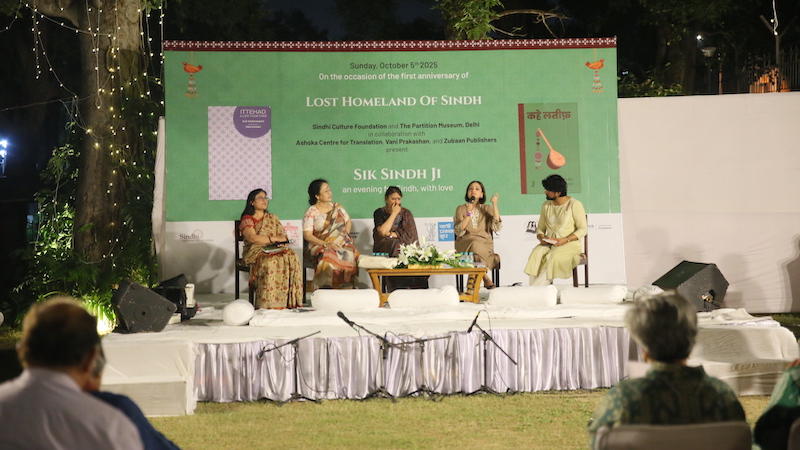 Dr Rita Kothari was joined by Anamika, Manju Mukul, and Aanchal Malhotra in conversation with Aditya Vikram Shrivastava: A new life for Ittehad in English. Photo-credit: Sindhi Culture Foundation
Guli Sadarangani, as Dr Rita Kothari narrates in the well-researched introduction of Ittehad – A Life Together, “belonged to a well-heeled, educated class among the Sindhi Hindus. Unusually for her time, Guli Kripalani had a ‘love marriage’ with Ramchandani Naraindas Sadarangani, a lawyer and freedom fighter. Like the Kayasthas of Uttar Pradesh and Nagars of Gujarat, the Amils have had a long-standing tradition of education and reform. Some of the Amils of Karachi and Hyderabad were as westernized as the Parsis of Bombay…Guli belonged to the socially privileged caste and class, and the liberalism that characterises Ittehad is tied to the emancipatory goals that the Amils attached to education.” Emancipation in real life may have been a reality but in as a writer, a woman writer and being the first among the Sindhis, Guli Sadarangani remained absent from all archives, including those of women writers in India, said Dr Rita.
“I believe Partition divided humanity,” wrote Guli in the preface to the 2nd edition now titled Melaapi Jeevan, “the poison of Partition has spread throughout the country. Even Pakistan is divided into two halves, and Allah knows what will happen in the future. This proves that Mr Jinnah’s two-nation theory is thoroughly damaging. Truly speaking, humans are bereft of humanity. Greed, avarice, selfishness and ego were the reasons behind Partition. The urgent need is for the Hindus and Muslims to live up to the high ideals of their respective religions and co-exist. Ittehad is need, melaapi jeevan is need. That can only happy through brotherhood, love, and peace. No religion teaches hatred and enmity.” Decades of rolled by and Guli Sadarangani’s closing words still remain relevant, significant, important and so painfully close to our bones.
Raju Mansukhani
Raju Mansukhani, based in New Delhi, is a researcher-writer on history and heritage issues; a media consultant with leading museums, non-profits, universities and corporates in India and overseas. Contributing regular columns, book reviews and features in the media he has drawn attention of the new generations to critical issues and personalities of Indian and Asian history. Over the last three decades he has authored books on diverse subjects including the media, palace architecture, sports and contemporary history. Through in-depth documentaries, he has profiled leading Asian public figures highlighting their research and publications.
These powerful, bold and progressive thoughts expressed by Guli in the 1940s were discussed at the on-stage Baithak (or discussion) on the 5th October anniversary, when Dr Rita Kothari was joined by Anamika, Manju Mukul, and Aanchal Malhotra in conversation with Aditya Vikram Shrivastava. What they shared on stage spanned the domains of idealism and love, the challenges of cosmopolitanism and modernity not just in Guli’s time and age, but also contemporary India and its vast Asian neighbourhood which continues its struggle against patriarchy, the stiffening of social ties and relationships, with women having to negotiate through such complexities in the post-colonial age. As Aanchal Malhotra, a young historian who has dedicated years of research towards Partition studies, said “Desire, love, equality, freedom – these are questions which are being asked by women today.”
The questions that Guli Sadarangani raised, and the plea she made through her writings remain so relevant, poignant and touching till date. “When I hear about instances of Hindu-Muslim enmity,” she wrote in the 1941 preface, “I pray from the depths of my heart for a young person to take up and give a clarion call for a union of the two communities. Given the current conditions in Sindh, I feel it is the need of the hour that a new young leadership emerges from the Sindhis. Our Sindh has long followed the path of Sufism, and I have faith that it will once again reassert that path over the dissensions that characterize our times. Sindh will become an exemplar for India. May our Sindh take a lead in this union, this Ittehad.“
The Lost Homeland
The gallery title – The Lost Homeland of Sindh – itself brims with tears, traumas and the tough times which the Sindhis have experienced for eight long decades, reducing several generations into poverty and penury. It took a gutsy, determined Aruna Madnani, managing trustee of Sindhi Culture Foundation, to undertake journey of reclaiming whatever she could of this huge inheritance of loss. Her thoughts are evident at the message posted at the gallery, stating: “the exhibition offers a poignant journey into the tangible and intangible history of a displaced community. This is especially significant because unlike Punjab and Bengal, Sindh was never partitioned and hence Sindhis in India remain bereft of their home, homeland and their cultural heritage. Moreover, the Sindhi experience of Partition has received less public attention than that of other regions of the subcontinent.”
She felt that the exhibition, a labour of love for her, was a bridge between generations, “enlightening younger Sindhis about their ancestors’ spirit of enterprise and resilience, and the rich cultural legacy left behind in Sindh. The exhibition aims to evoke a sense of belonging among Sindhis scattered across the globe, offering a glimpse of their roots and heritage. Through experiential multimedia films, talks, poetry readings and festivals, it aims to create a space for cultural reconnection and understanding.”
Said Aruna, “I am grateful to my grandparents and my parents – in particular my grandmother Lilavati Asrani and my father Dr Shyam Bulchandani – who shared their happy memories and stories of Sindh and I developed that love for the land of my ancestors. When the Sindhi Culture Foundation began taking shape, my father and other family members were keen to help with funds and resources but were not wanting to put their name out in the public.” This sense of social responsibility and doing good for the society while remaining anonymous, or behind the scene, is typically a Sufi trait demonstrated by Aruna’s family.
In the elegantly-produced brochure of the Partition Museum, ‘The Lost Homeland of Sindh’ gallery is described as showcasing the vibrant homes of pre-Partition Sindh, and through the shared and syncretic spaces, where life once revolved around close-knit neighbourhoods. Rich woodwork, intricate carvings, and architectural details reflect the distinctive craftsmanship of Sindhi builders and artisans. A defining feature of the gallery is ‘Windows to Sindh’, a 45-minute video installation that offers visitors a mesmerising low-flying visual tour of present-day Sindh, viewed through the archways of an authentic Shikarpuri muhari (or balcony). It was made possible with the generosity of vloggers and the artist group called CAMP. The gallery is dedicated to the Virwani family, with memorabilia donated by Sindhi Partition survivors, Seth Rai Bahadur Kishin Chand Asrani, Savitri and Sunderdas Mirchandani.
The Partition Museum in Delhi itself has been the brainchild of The Arts and Cultural Heritage Trust or TAACHT which had set up its first Partition Museum in Amritsar in 2017, marking the 70th anniversary of India’s Independence, and the saga of Sindhis without their homeland, without their entire world left behind in the newly-created country of Pakistan.
Into Guli’s real world
Dr Rita Kothari was joined by Anamika, Manju Mukul, and Aanchal Malhotra in conversation with Aditya Vikram Shrivastava: A new life for Ittehad in English. Photo-credit: Sindhi Culture FoundationGuli Sadarangani, as Dr Rita Kothari narrates in the well-researched introduction of Ittehad – A Life Together, “belonged to a well-heeled, educated class among the Sindhi Hindus. Unusually for her time, Guli Kripalani had a ‘love marriage’ with Ramchandani Naraindas Sadarangani, a lawyer and freedom fighter. Like the Kayasthas of Uttar Pradesh and Nagars of Gujarat, the Amils have had a long-standing tradition of education and reform. Some of the Amils of Karachi and Hyderabad were as westernized as the Parsis of Bombay…Guli belonged to the socially privileged caste and class, and the liberalism that characterises Ittehad is tied to the emancipatory goals that the Amils attached to education.” Emancipation in real life may have been a reality but in as a writer, a woman writer and being the first among the Sindhis, Guli Sadarangani remained absent from all archives, including those of women writers in India, said Dr Rita.
“I believe Partition divided humanity,” wrote Guli in the preface to the 2nd edition now titled Melaapi Jeevan, “the poison of Partition has spread throughout the country. Even Pakistan is divided into two halves, and Allah knows what will happen in the future. This proves that Mr Jinnah’s two-nation theory is thoroughly damaging. Truly speaking, humans are bereft of humanity. Greed, avarice, selfishness and ego were the reasons behind Partition. The urgent need is for the Hindus and Muslims to live up to the high ideals of their respective religions and co-exist. Ittehad is need, melaapi jeevan is need. That can only happy through brotherhood, love, and peace. No religion teaches hatred and enmity.” Decades of rolled by and Guli Sadarangani’s closing words still remain relevant, significant, important and so painfully close to our bones.
Raju Mansukhani
Raju Mansukhani, based in New Delhi, is a researcher-writer on history and heritage issues; a media consultant with leading museums, non-profits, universities and corporates in India and overseas. Contributing regular columns, book reviews and features in the media he has drawn attention of the new generations to critical issues and personalities of Indian and Asian history. Over the last three decades he has authored books on diverse subjects including the media, palace architecture, sports and contemporary history. Through in-depth documentaries, he has profiled leading Asian public figures highlighting their research and publications.

No comments:
Post a Comment