Trump, Farage and the right’s free speech hypocrisy

14 October, 2025
Left Foot Forward
What’s behind the Trump administration’s transatlantic provocations on UK free speech and who does the dark agenda really belong to?
The ‘free speech’ debate is wrapped in confusion. Political commentators agonise over questions such as ‘ Does the UK really have free speech? Are we too strict? Not strict enough? How can the US be so self-contradictory? And how do we negotiate with the US in this incredibly difficult and sensitive territory?
Donald Trump’s attitude to the free speech debate seems baffling. We witness the glaring contradiction of his administration relentlessly condemning European countries for restricting free speech, allegedly in a North Korean way, whilst simultaneously silencing dissenters, including their own news media and beloved comedians.
We can’t credit Trump with a logical brain, but the hypocrisy is barefaced. We feel equally bewildered on hearing Trumpworld expressing grief and rage at so-called ‘radical left attacks’ such as Charlie Kirk’s murder, whilst barely registering cases where the politics are reversed, like the far-right extremist Vance Boelter’s recent murder of a Democrat lawmaker. No flags were flown at half-mast. Trump could barely recall it.
What’s behind this preposterous hypocrisy?
The US first amendment on free speech is regulated in areas such as obscenity, child pornography, certain employment and other legal contexts. But the amendment fully protects hate speech. It’s a slightly grey area since speech that incites imminent lawless action or “potential violence” isn’t protected.
However, most of what would qualify as hate speech in other western countries is “legally protected” in the US. As regards the specific domain of hate speech, speakers have an absolute right to express any opinion about other people or institutions, however dangerous. In this domain, speech contains no red lines; anything goes.
This absolutist notion of hate speech binds it to other parts of the American psyche, including prevailing culture of r contempt for gun control. The freedom of citizens to speak and act as they please must be ring-fenced, whether or not it leads to harm, and should have the same unfettered, wild-west powers as the right to bear arms. To be truly American, words like guns, should remain unrestricted.
By contrast, in the UK and elsewhere, hate speech is regulated, a restraint which embeds two reasonable assumptions: Hate speech is a punishable offence because it is capable of causing psychological harm. Being told ‘you should be raped’ is a harmful speech act, whether rape happens or not.Even if we dispute the capacity of hate speech in itself to cause harm – the ‘it’s only words’ argument – it can trigger harmful physical actions. It’s why the court jailed Lucy Connolly for suggesting migrant hotels should be set alight, and why online attacks on MPs mean they need increased physical security. Jo Cox was murdered because ‘mere words’ led to a physical act.
Moral ladders and the free speech continuum
Regulated hate speech is vastly more complex and controversial than the absolute freedoms US haters enjoy because it is constrained by moral norms. What counts as morally acceptable occupies a response continuum and becomes relativised to who is speaking. At one end of the continuum is speech which is unacceptable to almost everyone (for example, endorsing paedophilia). One step further along we have e.g. rape threats, unacceptable to most (though secret chat happens about both activities).
Further along is, for example, racially abusive speech. At this point consensus starts to crumble on what constitutes hate speech and what should be penalised. Racists justify their verbal attacks using a muddled set of grounds: ‘it’s just words and so isn’t harmful’; ‘it’s just an emotional expression of legitimate frustration’; ‘it’s true (and therefore should be said)’; ‘regardless of whether or not it’s true or harmful, punishing me is a violation of my right to free speech’.
This messy grab-bag of excuses is often deployed, tacitly or explicitly, jointly or in part, to justify the use of hate speech.
When we move to the domain of, for example, anti-trans or misogynist hate speech the picture becomes even cloudier, with some believing its wrongness isn’t up for debate , and others claiming that it absolutely is.
Disparate starting points
Here, one person’s hate speech is another’s reasonable debate topic. Thus ‘trans person x isn’t a woman’ is, for some, a putative fact, for others, a discussion subject, and, for others, an instance of hate speech that undermines x’s core sense of identity and encourages dangerous anti-trans behaviour. Different groups are at different points on the moral ladder and hence occupy different positions on what counts as acceptable.
The domain of acceptability in hate speech constantly changes cultural shape but is expanding alarmingly with the rightward shift in attitudes. ‘Ethnic minorities should leave the country’ is racist hate speech for some but not for others. For advocates, such controversial statements can be further tamed with the handy new prefix ‘I’m not racist but …’
For all these reasons, democracies struggle with the cultural sensitivities around hate speech and with implementing workable, meaningful regulations. It’s precisely this complexity that makes the ‘free speech’ debate ripe for exploitation by the far-right.
Trump: ‘free speech’ king
It’s puzzling and alarming that, as Adam Bienkov notes, the repression of free speech is happening “in a country whose own constitution explicitly protects [it]”. But the truth is that Trump’s regime doesn’t want free speech as such. They want two other things instead.
They want to claim ‘free speech’ as part of their wholesale expropriation of the democratic narrative. Like ‘liberalism, sovereignty and justice’, genuine free speech, they argue, truly belongs to America but is absent from European ‘faux democracies’. It’s ‘us (not them) who truly value this fundamental freedom’.
But crucially, Trump’s regime also wants to restrict the use of free speech, including the absolute right to express hatred, to supporters of their own far-right ideology.
Challengers are not, it turns out, entitled to this freedom. With true irony, far-right ideologues fall back on the regulatory notions they despise to silence dissenters. “Attorney General Pam Bondi’s warning that the administration will “absolutely target anyone using hate speech” applies only to those, including Democrats, seeking to contest the administration’s own hate-driven racist, misogynist, anti-diversity, world view.
Making sense of the hypocrisy
Herein then lies some background for Trumpworld’s massively hypocritical use of ‘free speech’. They have weaponised their expropriated, idealised notion of absolute free speech as a mechanism for pumping out their own ideological far-right propaganda through the world’s communication arteries. This flow helps to undermine democracy and bolster the ‘superiority’ of Trumpworld.
At the same time, they borrow the notion of regulated free speech when challenged to suppress dissent. This restriction enables Trumpworld to distribute the wide-ranging contempt it harbours without obstacles, in particular those presented by democratic free speech regulation. It “secures the licence to speak with impunity, [free from] the consequences of that expression”, Nesrine Malik argues.
We see this multi-purpose weaponisation of free speech in the Trump administration’s response to Connolly’s jail sentence. Their complaint that it constitutes an “infringement of Lucy’s freedom of expression” leans on the absolutist notion that there should be no restraints on what people can say. It also portrays the UK as a repressive regime whose ‘faux free speech regulations’ result in the imprisonment of ‘innocent people’. All of this endorses and amplifies Connolly’s dangerous message.
Similarly, Trump’s assertion, during his UN speech, that Sadiq Khan ‘wants to implement Sharia law’, looks, particularly to the Muslim community, like hate speech, likely to accelerate dangerous anti-Muslim behaviour. But Trump was able to spread his anti-Muslim message by falling back on his presumed entitlement to peddle hate speech with absolute impunity.
Farage makes the one-way direction of this entitlement clear. He has a long history of arguably racist commentary in which he explicitly links immigrants with terrorism and expresses anti-Muslim views.
When Starmer recently called a Reform policy “racist”, Farage objected that it “will incite the radical left” and “directly threaten the safety of his campaigners”. Here Farage is effectively framing Starmer’s comment as hate speech. Like Bondi, he is appealing to our regulated notions of free speech to silence critics of his own presumed exclusive right to freely disseminate his poisonous rhetoric.
Chiming in
This rhetoric has leaked into our cultural bloodstream over time and now features on our moving ladder of moral norms.
When UK voices agree with Trump’s and Farage’s dog whistle attacks, they are availing themselves of the various mutually inconsistent excuses described earlier: saying ‘Kahn wants Sharia law for London’ is just ‘stating an innocent fact’. ‘Calling for migrant hotels to be set alight’ is just ‘words’ or ‘an expression of legitimate frustration’. ‘Punishing Connolly and those who defend her constitutes an attack on our civil liberties’.
The ‘free speech’ debate is wrapped in confusion. Political commentators agonise over questions such as ‘ Does the UK really have free speech? Are we too strict? Not strict enough? How can the US be so self-contradictory? And how do we negotiate with the US in this incredibly difficult and sensitive territory?
Donald Trump’s attitude to the free speech debate seems baffling. We witness the glaring contradiction of his administration relentlessly condemning European countries for restricting free speech, allegedly in a North Korean way, whilst simultaneously silencing dissenters, including their own news media and beloved comedians.
We can’t credit Trump with a logical brain, but the hypocrisy is barefaced. We feel equally bewildered on hearing Trumpworld expressing grief and rage at so-called ‘radical left attacks’ such as Charlie Kirk’s murder, whilst barely registering cases where the politics are reversed, like the far-right extremist Vance Boelter’s recent murder of a Democrat lawmaker. No flags were flown at half-mast. Trump could barely recall it.
What’s behind this preposterous hypocrisy?
The US first amendment on free speech is regulated in areas such as obscenity, child pornography, certain employment and other legal contexts. But the amendment fully protects hate speech. It’s a slightly grey area since speech that incites imminent lawless action or “potential violence” isn’t protected.
However, most of what would qualify as hate speech in other western countries is “legally protected” in the US. As regards the specific domain of hate speech, speakers have an absolute right to express any opinion about other people or institutions, however dangerous. In this domain, speech contains no red lines; anything goes.
This absolutist notion of hate speech binds it to other parts of the American psyche, including prevailing culture of r contempt for gun control. The freedom of citizens to speak and act as they please must be ring-fenced, whether or not it leads to harm, and should have the same unfettered, wild-west powers as the right to bear arms. To be truly American, words like guns, should remain unrestricted.
By contrast, in the UK and elsewhere, hate speech is regulated, a restraint which embeds two reasonable assumptions: Hate speech is a punishable offence because it is capable of causing psychological harm. Being told ‘you should be raped’ is a harmful speech act, whether rape happens or not.Even if we dispute the capacity of hate speech in itself to cause harm – the ‘it’s only words’ argument – it can trigger harmful physical actions. It’s why the court jailed Lucy Connolly for suggesting migrant hotels should be set alight, and why online attacks on MPs mean they need increased physical security. Jo Cox was murdered because ‘mere words’ led to a physical act.
Moral ladders and the free speech continuum
Regulated hate speech is vastly more complex and controversial than the absolute freedoms US haters enjoy because it is constrained by moral norms. What counts as morally acceptable occupies a response continuum and becomes relativised to who is speaking. At one end of the continuum is speech which is unacceptable to almost everyone (for example, endorsing paedophilia). One step further along we have e.g. rape threats, unacceptable to most (though secret chat happens about both activities).
Further along is, for example, racially abusive speech. At this point consensus starts to crumble on what constitutes hate speech and what should be penalised. Racists justify their verbal attacks using a muddled set of grounds: ‘it’s just words and so isn’t harmful’; ‘it’s just an emotional expression of legitimate frustration’; ‘it’s true (and therefore should be said)’; ‘regardless of whether or not it’s true or harmful, punishing me is a violation of my right to free speech’.
This messy grab-bag of excuses is often deployed, tacitly or explicitly, jointly or in part, to justify the use of hate speech.
When we move to the domain of, for example, anti-trans or misogynist hate speech the picture becomes even cloudier, with some believing its wrongness isn’t up for debate , and others claiming that it absolutely is.
Disparate starting points
Here, one person’s hate speech is another’s reasonable debate topic. Thus ‘trans person x isn’t a woman’ is, for some, a putative fact, for others, a discussion subject, and, for others, an instance of hate speech that undermines x’s core sense of identity and encourages dangerous anti-trans behaviour. Different groups are at different points on the moral ladder and hence occupy different positions on what counts as acceptable.
The domain of acceptability in hate speech constantly changes cultural shape but is expanding alarmingly with the rightward shift in attitudes. ‘Ethnic minorities should leave the country’ is racist hate speech for some but not for others. For advocates, such controversial statements can be further tamed with the handy new prefix ‘I’m not racist but …’
For all these reasons, democracies struggle with the cultural sensitivities around hate speech and with implementing workable, meaningful regulations. It’s precisely this complexity that makes the ‘free speech’ debate ripe for exploitation by the far-right.
Trump: ‘free speech’ king
It’s puzzling and alarming that, as Adam Bienkov notes, the repression of free speech is happening “in a country whose own constitution explicitly protects [it]”. But the truth is that Trump’s regime doesn’t want free speech as such. They want two other things instead.
They want to claim ‘free speech’ as part of their wholesale expropriation of the democratic narrative. Like ‘liberalism, sovereignty and justice’, genuine free speech, they argue, truly belongs to America but is absent from European ‘faux democracies’. It’s ‘us (not them) who truly value this fundamental freedom’.
But crucially, Trump’s regime also wants to restrict the use of free speech, including the absolute right to express hatred, to supporters of their own far-right ideology.
Challengers are not, it turns out, entitled to this freedom. With true irony, far-right ideologues fall back on the regulatory notions they despise to silence dissenters. “Attorney General Pam Bondi’s warning that the administration will “absolutely target anyone using hate speech” applies only to those, including Democrats, seeking to contest the administration’s own hate-driven racist, misogynist, anti-diversity, world view.
Making sense of the hypocrisy
Herein then lies some background for Trumpworld’s massively hypocritical use of ‘free speech’. They have weaponised their expropriated, idealised notion of absolute free speech as a mechanism for pumping out their own ideological far-right propaganda through the world’s communication arteries. This flow helps to undermine democracy and bolster the ‘superiority’ of Trumpworld.
At the same time, they borrow the notion of regulated free speech when challenged to suppress dissent. This restriction enables Trumpworld to distribute the wide-ranging contempt it harbours without obstacles, in particular those presented by democratic free speech regulation. It “secures the licence to speak with impunity, [free from] the consequences of that expression”, Nesrine Malik argues.
We see this multi-purpose weaponisation of free speech in the Trump administration’s response to Connolly’s jail sentence. Their complaint that it constitutes an “infringement of Lucy’s freedom of expression” leans on the absolutist notion that there should be no restraints on what people can say. It also portrays the UK as a repressive regime whose ‘faux free speech regulations’ result in the imprisonment of ‘innocent people’. All of this endorses and amplifies Connolly’s dangerous message.
Similarly, Trump’s assertion, during his UN speech, that Sadiq Khan ‘wants to implement Sharia law’, looks, particularly to the Muslim community, like hate speech, likely to accelerate dangerous anti-Muslim behaviour. But Trump was able to spread his anti-Muslim message by falling back on his presumed entitlement to peddle hate speech with absolute impunity.
Farage makes the one-way direction of this entitlement clear. He has a long history of arguably racist commentary in which he explicitly links immigrants with terrorism and expresses anti-Muslim views.
When Starmer recently called a Reform policy “racist”, Farage objected that it “will incite the radical left” and “directly threaten the safety of his campaigners”. Here Farage is effectively framing Starmer’s comment as hate speech. Like Bondi, he is appealing to our regulated notions of free speech to silence critics of his own presumed exclusive right to freely disseminate his poisonous rhetoric.
Chiming in
This rhetoric has leaked into our cultural bloodstream over time and now features on our moving ladder of moral norms.
When UK voices agree with Trump’s and Farage’s dog whistle attacks, they are availing themselves of the various mutually inconsistent excuses described earlier: saying ‘Kahn wants Sharia law for London’ is just ‘stating an innocent fact’. ‘Calling for migrant hotels to be set alight’ is just ‘words’ or ‘an expression of legitimate frustration’. ‘Punishing Connolly and those who defend her constitutes an attack on our civil liberties’.
Know your bully
Whilst regulated free speech seeks to protect citizens against harm, it is perceived by the far right as an obstacle to the regressive, authoritarian world order they are intent to roll out. Condemning Europe’s ‘free speech failures’ is like cargo hauliers complaining about blocked shipping lanes. The far right’s abusive double standards undermine constraints on the global free flow of their propaganda and on the temerity of anyone wanting to challenge them.
Our UK struggle with how to apply truly democratic, ethically regulated free speech is a good struggle – a necessary, negotiated part of the grown-up complexity and nuance of living with others in a genuine democracy. But we must keep clear sight of the precise ways in which authoritarian bullies are exploiting the principle of free speech for their own ends.
Claire Jones writes and edits for West England Bylines and is co-ordinator for the Oxfordshire branch of the progressive campaign group, Compass
Right-Wing Watch
Smear of the week – right-wing meltdown over Gary Neville’s flag comments, once again exposes right’s ‘free speech’ hypocrisy
Smear of the week – right-wing meltdown over Gary Neville’s flag comments, once again exposes right’s ‘free speech’ hypocrisy
12 October, 2025
Left Foot Forward
“Free speech, anyone?”
TweetShareWhatsAppMail
The usual suspects in the right-wing press flew into predictable hysteria this week, over Gary Neville’s comments on the Union Jack and St. George’s flags. Once again, the self-appointed champions of ‘free speech’ revealed how little they actually value it, especially when it comes from voices they dislike.
The former Manchester United and England footballer sparked a frenzy after posting a video in which he suggested that patriotic symbols like the Union Jack have become associated with division and hostility, particularly among what he described as “angry, middle-aged white men.”
Neville linked this surge in aggressive nationalism to Brexit, far-right protests outside asylum seeker hotels, and tensions after the terrorist attack on the Heaton Park Hebrew Congregation synagogue during Yom Kippur.
“It’s turning the country on itself,” Neville warned in the video, which quickly racked up over 1.2 million views.
The Daily Express gushingly reported that Neville was being ‘taunted’ after images emerged of Union Jacks and St. George’s crosses tied to lampposts outside his Hotel Football in Manchester. The story framed this petty prank as some kind of public rebuke, ignoring the fact that Neville had called for the removal of a flag from a construction site he is redeveloping, not a ban on flags altogether.
It seemed the Daily Mail had initiated the panic, with the Express noting how an anonymous worker had told the Mail that staff were required to attend mandatory “toolbox talks”- routine safety briefings – to enforce a ban on “political messaging”, with dismissal as a possible consequence.
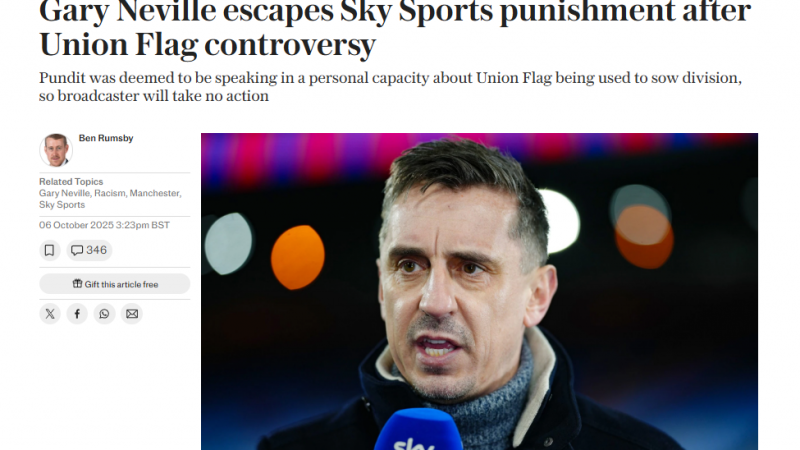
The Telegraph, meanwhile, went for a different angle, running with the headline: “Gary Neville escapes Sky Sports punishment after Union Flag controversy.”
The article made it clear that it had been deemed that Neville had spoken in a personal capacity, not as a Sky pundit, so therefore the broadcaster won’t take further action. But that didn’t stop the paper running with the implication that some sort of disciplinary action should have been considered.
But it was GB News’ presenter Carole Malone who went headfirst off the deep end.
“People like Gary Neville are part of the reason evil Islamists now live among us in Britain,” she said in an inflammatory rant.
She accused him of being an ‘idiot’ and sympathising with “Islamists who want us destroyed” over “patriotic Britons,” before descending into a tirade of personal insults:
“The poor sap is labouring under the illusion he has a brain – a political brain – when he’s embarrassingly devoid of any political nous.
“In fact, he’s a bit like his superhero, Keir Starmer, who has as much political aptitude as your average gnat. Both are so out of touch with the people of this country that they’re a joke.”
Her attack not only misrepresents Neville’s views but also dangerously conflates criticism of nationalism with sympathy for terrorism, a line of thinking that surely should have no place in responsible media.
What this latest media meltdown truly exposes is the hollow core of right-wing media’s free speech crusade. When Gary Neville expresses a personal, critical opinion, backed by real-world examples of how nationalism can fuel division, the same outlets that shout about “cancel culture” and “woke censorship” scramble to silence or mock him.
The irony wasn’t lost on observers, and reader wrote:
“Very well said Gary Neville. Although it does seem to have got a lot of “patriots” very upset. Mainly middle-aged white men.
“Free speech, anyone?”
Left Foot Forward
“Free speech, anyone?”
TweetShareWhatsAppMail
The usual suspects in the right-wing press flew into predictable hysteria this week, over Gary Neville’s comments on the Union Jack and St. George’s flags. Once again, the self-appointed champions of ‘free speech’ revealed how little they actually value it, especially when it comes from voices they dislike.
The former Manchester United and England footballer sparked a frenzy after posting a video in which he suggested that patriotic symbols like the Union Jack have become associated with division and hostility, particularly among what he described as “angry, middle-aged white men.”
Neville linked this surge in aggressive nationalism to Brexit, far-right protests outside asylum seeker hotels, and tensions after the terrorist attack on the Heaton Park Hebrew Congregation synagogue during Yom Kippur.
“It’s turning the country on itself,” Neville warned in the video, which quickly racked up over 1.2 million views.
The Daily Express gushingly reported that Neville was being ‘taunted’ after images emerged of Union Jacks and St. George’s crosses tied to lampposts outside his Hotel Football in Manchester. The story framed this petty prank as some kind of public rebuke, ignoring the fact that Neville had called for the removal of a flag from a construction site he is redeveloping, not a ban on flags altogether.
It seemed the Daily Mail had initiated the panic, with the Express noting how an anonymous worker had told the Mail that staff were required to attend mandatory “toolbox talks”- routine safety briefings – to enforce a ban on “political messaging”, with dismissal as a possible consequence.
The Telegraph, meanwhile, went for a different angle, running with the headline: “Gary Neville escapes Sky Sports punishment after Union Flag controversy.”
The article made it clear that it had been deemed that Neville had spoken in a personal capacity, not as a Sky pundit, so therefore the broadcaster won’t take further action. But that didn’t stop the paper running with the implication that some sort of disciplinary action should have been considered.
But it was GB News’ presenter Carole Malone who went headfirst off the deep end.
“People like Gary Neville are part of the reason evil Islamists now live among us in Britain,” she said in an inflammatory rant.
She accused him of being an ‘idiot’ and sympathising with “Islamists who want us destroyed” over “patriotic Britons,” before descending into a tirade of personal insults:
“The poor sap is labouring under the illusion he has a brain – a political brain – when he’s embarrassingly devoid of any political nous.
“In fact, he’s a bit like his superhero, Keir Starmer, who has as much political aptitude as your average gnat. Both are so out of touch with the people of this country that they’re a joke.”
Her attack not only misrepresents Neville’s views but also dangerously conflates criticism of nationalism with sympathy for terrorism, a line of thinking that surely should have no place in responsible media.
What this latest media meltdown truly exposes is the hollow core of right-wing media’s free speech crusade. When Gary Neville expresses a personal, critical opinion, backed by real-world examples of how nationalism can fuel division, the same outlets that shout about “cancel culture” and “woke censorship” scramble to silence or mock him.
The irony wasn’t lost on observers, and reader wrote:
“Very well said Gary Neville. Although it does seem to have got a lot of “patriots” very upset. Mainly middle-aged white men.
“Free speech, anyone?”

No comments:
Post a Comment