A Festival of Obsequiousness
Trump at the Knesset and Sharm el-Sheikh
Wednesday 15 October 2025, by Gilbert Achcar
If the scenes of Donald Trump’s celebration at the Israeli Knesset and in Sharm el-Sheikh were staged for cinematic or theatrical exploitation, they would undoubtedly rank among the worst productions in history. These two spectacles formed a single festival of adulation, unprecedented for any US president or, any leader elected through a free election, for that matter. They are more reminiscent of the praise showered upon despots in their own country or within their empire – like the North Korean leader’s adulation at home or the cult of personality surrounding Stalin in the Soviet Union’s republics and satellite states.
However, from this perspective, the obsequiousness displayed at the Knesset was in fact more genuine than that at the Sharm el-Sheikh summit. As Benjamin Netanyahu told his American friend, it was an outcome of “the covenant between our two promised lands” – thus hinting at the shared features of the US and Israel as settler-colonial states born from genocidal warfare against native populations. Today, the historical parallels between the two states are complete. Moreover, there is no question that Trump has been the most supportive US president of the Zionist state, and not just of the state itself, but also of Netanyahu’s neofascist rule, a political character Trump himself shares.
The US president reciprocated the Israeli prime minister’s adulation by praising him, emphasizing his contribution to the peace plan Trump announced in his presence in Washington just two weeks earlier. Trump’s impudence even extended to asking the Israeli president, who was seated alongside him, to pardon Netanyahu for the corruption charges he is facing, dismissing them with a flippant remark: “Cigars and champagne, who the hell cares about that?” Trump was referring to the bribe charges against Netanyahu ($260,000), which are quite modest indeed compared to the lavish gifts Trump himself received from foreign governments, especially from the Gulf monarchies – reflecting a broader global pattern of corruption.
As a former political advisor to Netanyahu predicted in an interview quoted by a Financial Times correspondent last Friday: “There’s no better campaigner for Netanyahu than Trump. His address to [the Knesset] will be the start of the election campaign.” Indeed, Trump has effectively launched Netanyahu’s re-election campaign, which is set to culminate in the Knesset elections to be held within a year from now. Ultimately, the biggest beneficiaries of the US president’s plan and visit are not just Trump himself, basking in sycophantic praise from both Netanyahu and the Israeli opposition leader, but Netanyahu as well.
The Trump Plan, in fact, is the result of an agreement between the two men, in reaction to the negotiations that quickly stalled after the initial prisoner exchange following the truce declared just before Trump’s second inauguration, last January. Trump demanded that Hamas release all its hostages at once, preventing it from using their gradual release as a bargaining means. He then gave Netanyahu the green light to resume military operations and continue Israel’s destruction and occupation of Gaza’s remaining residential areas. As Israeli military action escalated, the Trump administration pressured regional governments so that they exert in turn their pressure on Hamas, ultimately compelling the movement to release its remaining captives, largely diminishing its ability to affect the Strip’s future – or the broader Palestinian cause.
This release of the last Israeli detainees has lifted a significant burden from Netanyahu’s shoulders, as it was a key rallying point for the popular movement against him. He was caught between the hammer of the opposition and the anvil of allies even more right-wing than him. Once again, like at the beginning of the year, Netanyahu used US pressure as a pretext to accept what his allies had resisted. The two key leaders of the Zionist ultraright ended up attending the Knesset session and applauding both Trump and Netanyahu. The Israeli prime minister and his allies are fully aware that Trump’s plan is destined to fail, while Hamas and all other Palestinian fractions now lack the leverage to impede Israel’s further encroachment and occupation of those parts of Palestine it has yet to formally annex (see “The ‘Deal of the Millennium’ After the ‘Deal of the Century, Al-Quds Al-Arabi, 30 September 2025).
As for the Sharm el-Sheikh ceremony, it was less a celebration of Trump’s “greatness” and more a reflection of the weirdness of world leaders fawning over him. To believe that their praise was sincere, one would need to doubt their mental abilities, particularly when one considers the humiliation Trump has subjected many of them to. No US president before Trump has treated the global stage with such disdain and yet no one has been the object of such obsequiousness. This shows that, in this era of political decay, naked power politics, and the rise of neofascism, many contemporary rulers are willing to abandon their dignity and submit to those with more power and wealth.
As for the proud Palestinian people, they have spent a century proving their refusal to submit to their oppressors – whether the British Mandate authorities or the Zionist government. They will not kiss Donald Trump’s hand or show him “appreciation”, no matter what those who claim to represent them may do. They will not submit to the so-called Peace Council chaired by Trump, which includes figures like Tony Blair, George W. Bush’s partner in the occupation of Iraq. Instead, the Palestinian people will continue their struggle for full rights, undiminished. It is time for them to draw lessons from the Karitha (severe catastrophe) of today, as well as from yesterday’s Nakba, and find a way to regain the momentum they achieved during the two glorious popular intifadas of 1936 and 1988 – the high points of their long history of resistance.
14 October 2025
Translated from the Arabic original published in Al-Quds al-Arabi for the author’s blog. Feel free to republish or to publish in other languages, with mention of the source.
Attached documentsa-festival-of-obsequiousness_a9216.pdf (PDF - 909.7 KiB)
Extraction PDF [->article9216]
Gilbert Achcar grew up in Lebanon. He is currently Professor of Development Studies and International Relations at the School of Oriental and African Studies (SOAS) in London. A regular and historical contributor to the press of the Fourth International, his books include The Clash of Barbarisms. The Making of the New World Disorder (2006), The Arabs and the Holocaust: The Arab-Israeli War of Narratives (2012), The People Want: A Radical Exploration of the Arab Uprising (2022). His most recent books are The New Cold War: The United States, Russia and China, from Kosovo to Ukraine (2023) and the collection of articles Israel’s War on Gaza (2023). His next book, Gaza, A Genocide Foretold, will come out in 2025. He is a member of AntiCapitalist Resistance in Britain.
International Viewpoint is published under the responsibility of the Bureau of the Fourth International. Signed articles do not necessarily reflect editorial policy. Articles can be reprinted with acknowledgement, and a live link if possible.
Scott Ritter: A Palestinian Victory!
Scott Ritter: “… what everybody’s forgetting is that the basic terms of this deal are the same terms that Hamas has been laying out since October 7th. And now these terms are being met. And uh, this is a Hamas victory.”
The Convenient Lie
Complicity, Citizenship, and the Genocide in Palestine
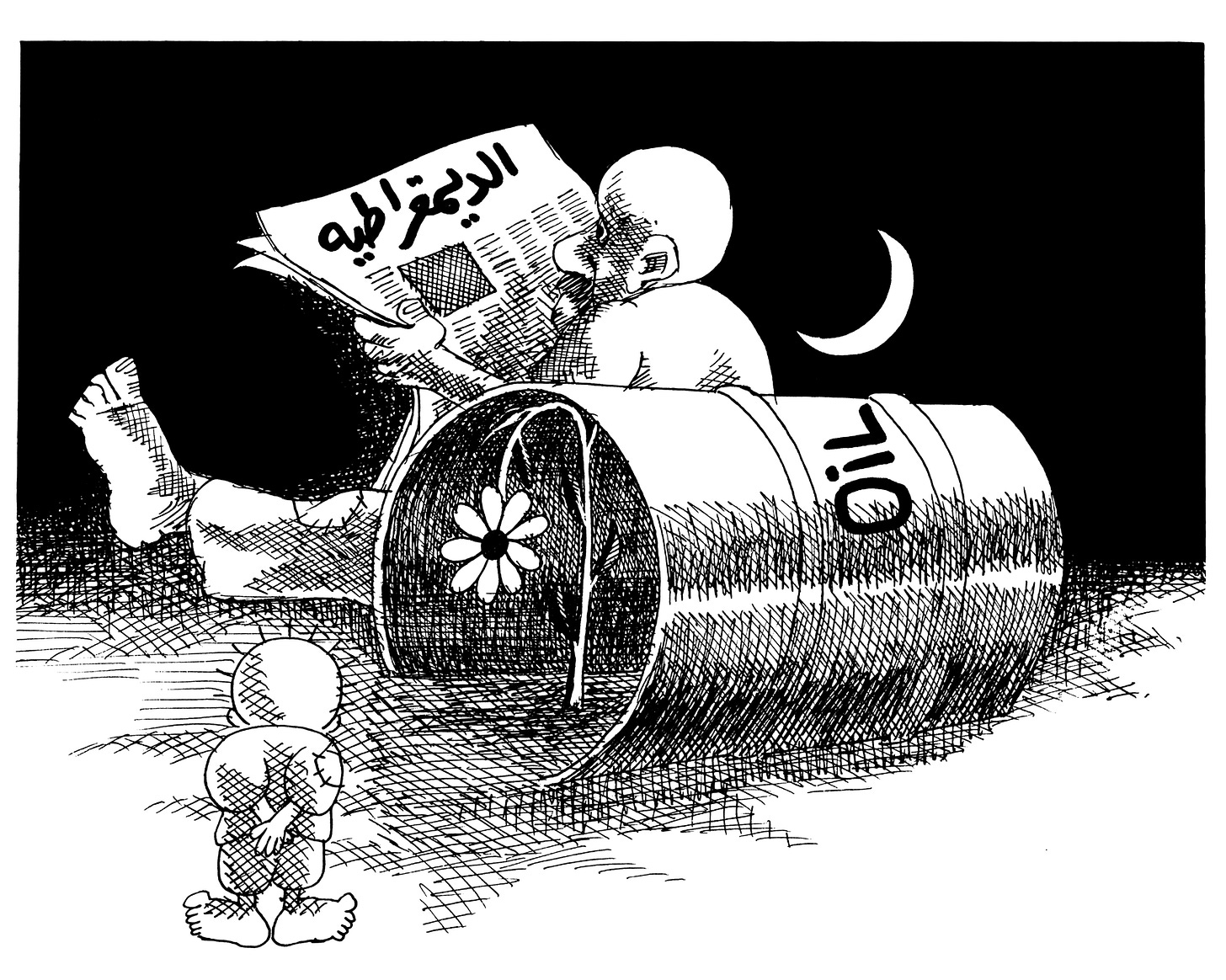
Newspaper: Democracy.
The case of death is not at all the cause of the dead, it’s the cause of the living.
— Ghassan Kanafani, from the novel Men Under the Sun
My people are fearless and the gallows to each person among us is the instance that precedes the dawn of a new day for all of us … Prosecutor! Understand that when one of us enters the nation’s battle of destiny, he takes into consideration all possible results. But above all, he places his confidence in the determination of the people to win victory.
— Ghassan Kanafani, from the story “A Heroine from My Country”
They tell you this is a “conflict.” A “complex issue.” A tragedy happening “over there.”
They are lying.
What is happening in Gaza, in Palestine, is the logical, bloody conclusion of a global system of exploitation—a system sustained not by monsters, but by the convenient, daily complicity of those who benefit from it most: the citizen-consumers of the West.
This complicity is masked by a grand, soothing lie: the lie of democratic citizenship.
The state and its subjects have entered a symbiotic pact of bad faith. The theory goes like this: in a democracy, the citizen is sovereign. The government’s actions are an expression of the popular will. Therefore, the citizens are responsible. This is the idealistic shell. Let us crack it open and examine the actual, pathetic reality inside.
The state, functioning as the capitalist class’s executive committee, depends on this lie as its foundational fiction. It is the democratic alibi that launders imperial violence into policy. The weapons shipped to fuel genocide are stamped with the seal of “democratic principles,” their bloody purpose blessed by the hollow ritual of the ballot. This is the dictatorship of the elite, a regime of class power wearing the convincing mask of popular consent—a specific apparatus designed to vaporize the accountability of the capitalist and imperialist classes, dispersing it as a fine mist of collective guilt over the populace.
But why do the masses accept this lie?
Because it is an anesthetic.
Having already swallowed the primordial myth of capitalist democracy—that freedom is consumption and power is a ballot—this smaller lie of passive citizenship is the necessary sedative that numbs the pain of their own powerlessness and the horror conducted in their name.
Here we must be Kanafanian in our clarity. To be a “citizen” of the metropole is, in practice, to be a consumer. And the consumer’s paradise is built on the graveyards of the Global South. Your stability, your cheap energy, your endless stream of goods, is subsidized by the control and immiseration of others. To truly confront this would shatter the consumer’s world. The cognitive dissonance would be unbearable.
And so, the lie administers the necessary anesthetic. The recited alibis of impotence (“What power do I have?”) are the superstructure of a material bargain. This is the highest stage of false consciousness: the willed surrender of agency for the comforts of the labor aristocracy. It is a transaction: the consumer trades their revolutionary potential for moral oblivion, outsourcing conscience to the state and NGOs—the very managers of the crisis—who, in return, guarantee the sanctity of the shopping aisle.
This is the “citizenshipness” we are sold: a hollowed-out identity, a safety valve for dissent. Protest, write your representative, cast your vote—then return to your consumption. The system allows you to perform concerns without ever threatening the foundations of your comfort. It is a brilliant, cynical management of dissent.
Thus, the genocide and the ongoing Nakba in Palestine are not an aberration. It is the system working as intended. The bombs falling on Rafah, Occupied Palestine, are funded by the taxes of the Western citizenry. The diplomatic cover is provided in their name. Their silence—or more accurately, their fragmented, ineffective noise—is the permission slip.
The connection is not metaphorical; it is material. The luxury lifestyle and the genocide are two outputs of the same machine. One is the direct, concentrated violence of imperialism. The other is the diffuse, structural violence of an exploitative global order. They require each other.
To the real socialists among us, the conclusion is clear: Spontaneous protest is not enough. Moral outrage is not enough. The working classes of the imperial core have been bought off with crumbs from the colonial plunder. They will not achieve revolutionary consciousness on their own. The task falls to an organized political party—those who see through the lie—to break the hypnotic spell of consumer citizenship. To organize, not to plead. To expose the comfort, to make the machinery of complicity grind to a halt.
And to the Palestinians, the path is one of steadfast, rooted resistance. The Palestinian struggle is not a plea for Western sympathy. It is an anti-colonial/imperial war. It is the absolute negation of the lie. Every act of resistance, from the stone to the slogan, is a truth-telling, exposing the brutal reality that the capitalist West so desperately masks with its talk of “complexity” and “citizenship.”
The question is not whether the Western citizen is complicit. The question is whether they will continue to choose the convenience of the lie over the difficult truth of their own justice—a justice that is inextricably linked to the justice and liberation of Palestine. To end the genocide there, they must first kill the complacent consumer within themselves.
There is no other way.
The lie is convenient.
The truth is justice.
Choose.

No comments:
Post a Comment