Tis the Seasons: Midsummer in Midwinter With the Bard
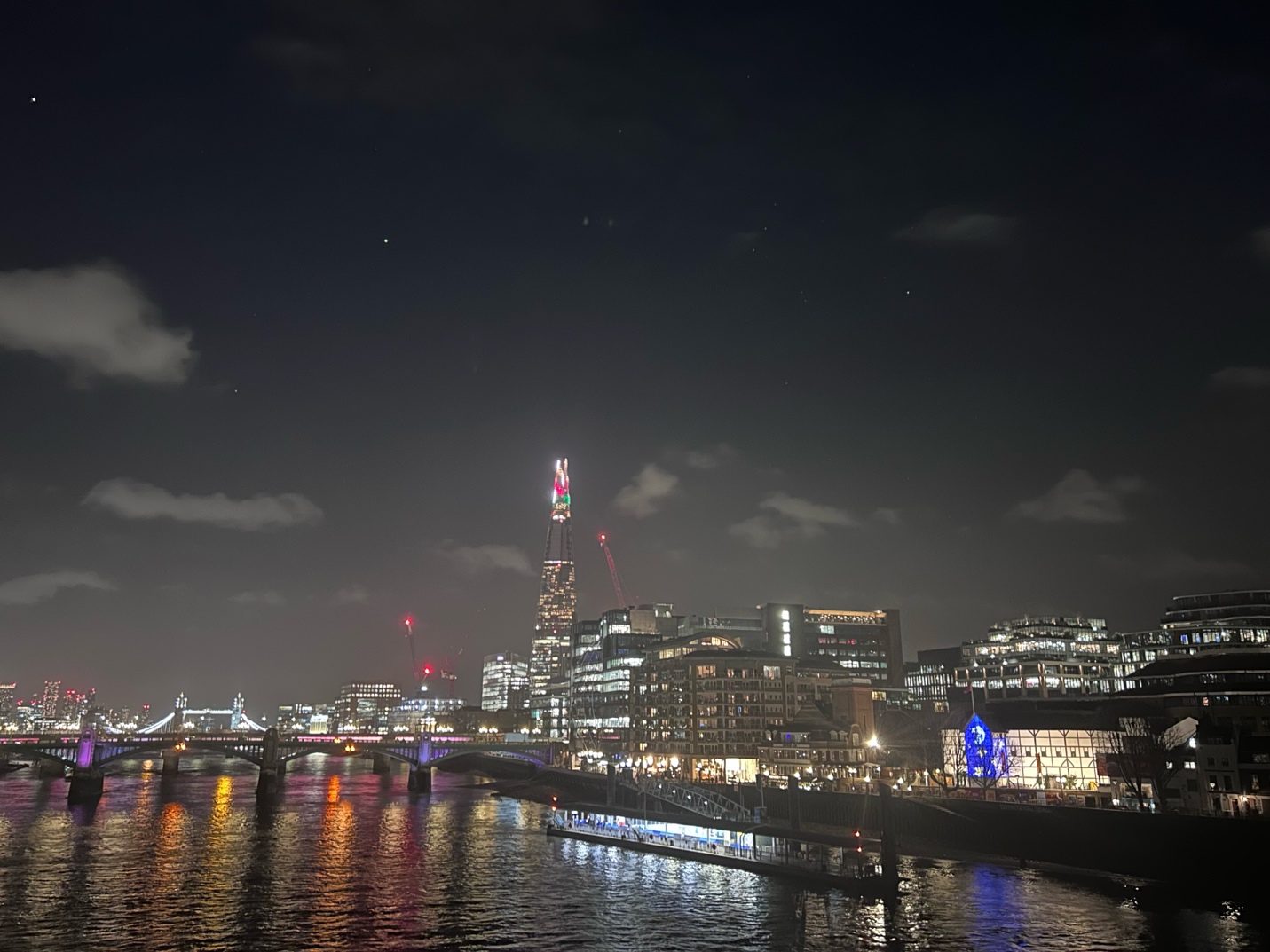
Globe Theatre to the right, with The Shard rising center, and lighted Tower Bridge downriver. Photo: David Yearsley.
Shakespeare’s A Midsummer Night’s Dream, now at the Sam Wanamaker Theatre on London’s Southbank, might seem to make for oddly out-of-season fare. Yet the play itself conjures calendric confusion and climate catastrophe.
In the midst of a speech delivered in the second act, Titania, Queen of the Amazons, mocks the expectations of “human mortals” who “want their winter here.” She concludes her weather report with an imagistic whirlwind that blows ill not just for the characters and setting of Shakespeare’s theatrical imagination (the Duke and eager-to-hook-up kids of Athens and its nearby wood thick with fairies), but also for those watching in the theatre, then and now:
The seasons alter: hoary-headed frosts
Fall in the fresh lap of the crimson rose,
And on old Hiems’ thin and icy crown
An odorous chaplet of sweet summer buds
Is, as in mockery, set. The spring, the summer,
The childing autumn, angry winter, change
Their wonted liveries, and the mazèd world
By their increase now knows not which is which.
Before that blast, Titania’s words had already proved prescient of the deteriorating present, what with the floods and evacuations of the Pacific Northwest just the latest set piece of doom, the the theatrics of the evening news serving up the entertainment, either freezing cold or searing hot, way wet or super dry, furious Nature letting loose her devastations at the wrong time of year:
Therefore the winds, piping to us in vain,
As in revenge have sucked up from the sea
Contagious fogs, which, falling in the land,
Hath every pelting river made so proud
That they have overborne their continents.
The utterer is a faerie queen, but for us carbonivorous moderns, her verdict is unambiguous. The problem is anthropogenic:
And this same progeny of evils comes
From our debate, from our dissension;
We are their parents and original.
Puck sums up the environmental, emotional stupidity in the play’s most famous line: “Lord, what fools these mortals be!”
Tucked against the River Thames directly across from St. Paul’s Cathedral, the Wanamaker is part of the Globe complex, a project that began with a reconstruction, finished in 1997, of Shakespeare’s original theatre of that name that stood just around the corner from the current location. Open to the elements, the Globe now hosts performances from May to October. The half-timbered Elizabethan front of the building shines whitely among the concrete blocks, old wharf buildings converted to luxury flats, towers of glass and steel spread along the riverfront.
Finished in 2014, the Wanamaker is a reconstruction of a later 17th-century theatre. It was named after the expatriate American actor and director, Sam Wanamaker, who, in the early 1950s, fled the New World—and its Blacklist—for the Old. Chagrined that his native country had several replicas of Shakespeare’s theater but none existed in England, Wanamaker fought tirelessly for the new Globe, finished a few years after his death.
Inside the Wanamaker Theatre the players do their business on a stage not raised much off ground level. Behind them a flat, neo-classically decorated façade that hearkens back to Roman theatres and their Italian Renaissance counterparts is cut through with an arched portal in the center and square doorways to either side. Through these the actors enter and exit, when they’re not appearing from out of the audience. The auditorium seats just 340 in a ground floor with a few tiered benches at the back, and a steeply raked balcony of a few rows above from which spectators look almost directly down on the action. The feeling of the space is cozy, connected, the close quarters encouraging interaction and improvisation with the audience.
There is no curtain to be raised, but half a dozen large chandeliers with real candles (I didn’t see how they were lit) are lowered when the performance begins. There is some electric safety and background lighting, too, but the flicker and glow of the candles add to the warmth and welcome of its magic.
The Globe complex is also right next to the brick behemoth of the Tate Modern, one of the world’s most popular contemporary art museums housed in the decommissioned and repurposed Bankside Power Station that, across a couple of postwar decades, burned vast reserves of oil that blackened skies while also warming Londoners and, ultimately, the earth. How fitting that this pipsqueak theatre dropped into place as if from 1599 could shout Shakespeare’s warnings up at the giant square smokestack and the much higher towers of finance across the river in the City of London. They weren’t listening, but it was still worth the shouting.
The show did not begin with a mouse that roared, but with a fairy in tights and tutu eating a banana. Puck, played with a winning mix of severity and ineptitude by Sergo Vares, strode onto a stage painted all severe white—not of cuddly Christmas snow but a place of penitence and seemingly fantasy-free. This Midsummer was cast completely against type.
Puck proceeded to perch on a banquet table, pulled out the banana and peeled it deliberately and ate it even more deliberately in four emphatic bites. This opening bit took a good two minutes—an eternity when one remembers, as one always does, that in a Shakespeare play there are five acts and hundreds of lines to get through. This literal chewing of the scenery didn’t seem like the best use of theatrical time. The point, I guess, was to show the madness of a globalized system that gets you tropical fruit any time of year. Nero fiddled while Rome burned. Puck ate a banana, while Athens and then the world did the same.
Before that bit of anarchic, slo-mo anachronism, the prelude had been provided from the gallery directly above the stage by music director Richie Hart at his keyboard playing soft-focus, shape-shifting Christmas carols—like canned music of the uncanny. Throughout the next text-truncated two-and-a-half hours, Hart also occasionally picked up his guitar, deployed a wooden clapper at moments of on-stage magic, and even blew a trumpet as the midsummer’s/midwinter’s dream dissolved back into the “reality” of the first illusion (Athens). While doing all that, he also led his quartet in clever and meaningful scene-setting and -changing effects and atmospherics: violinist Alice Barron’s melodies tickled the unconscious with high harmonics and whispered sweet-somethings; Carina Cosgrave on contrabass elicited doubts and desires and danced along with trippy ballet music of craggy expressionistic cool. Percussionist Kiyomi Seed trembled insinuations and evoked terrors, the ego of her own contrabass bow drawing out the id of her bass drum, not to mention her talents with the other psychoanalytic-acoustic tools of her trade.
Aided and abetted by these excellent musicians, the production played up the inherent violence of its misogynistic MacGuffin—that Hermia (the ardent and aggrieved Tiwa Lade) must wed Demetrius (craven, caddish Lou Jackson) or be killed or dispatched to a nunnery. The actors took double roles as humans and fairies, the forest hijinks rendered as a darkly comic nightmare awakened from back in the theatrical present at the close of the play, which is itself a dream, as Shakespeare reminds us at the end of the proceedings.
That initial banana was immediately followed by a Colt .45 wielded by deranged, dictatorial Duke Theseus (the manic, maniacal Michael Marcus). He stuck the sidearm to the throat of his betrothed, Hippolyta (Hedydd Dylan, who refused to be intimidated in that role and was also indomitable as Titania, portrayed by her as a Goth dominatrix). The gunplay-within-the-play returned at the close in a Sam Peckinpah–style bloodbath, the nuptial presentation of Pyramus and Thisbe not coming up to snuff, so its hero (the brazen and red-bearded Danny Kirrane as Bottom, the weaver of the original repurposed as head chief with an elevated palate for the herbs of the Shakespeare garden) and director (Jack Humphrey proud yet pathetic Quince/Egeus) both got snuffed out. Blood is at its theatrical best against a white background, just as snow shimmers more alluringly above the black like that of the ebony upright piano twice shelled on stage so that young lovers could croon pop songs at it—the only major misstep in this production, though harder to forgive in a play rich with its own songs.
The Midsummer-Midwinter had turned somber by the end, but no less edifying and entertaining for that change in the weather.
After the show, we walked across the Millennium Footbridge over the Thames towards St. Paul’s. One of the skyscrapers nearby was crowned by a green neon Christmas tree decked with blinking snow. It was nearly 60 degrees Fahrenheit at 10 at night in December: downright summery.
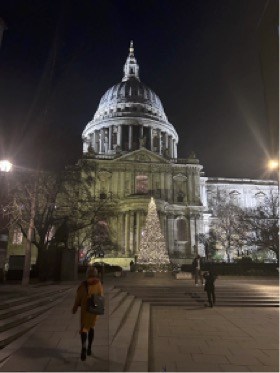
St. Paul’s Cathedral. Photo: David Yearsley.

No comments:
Post a Comment