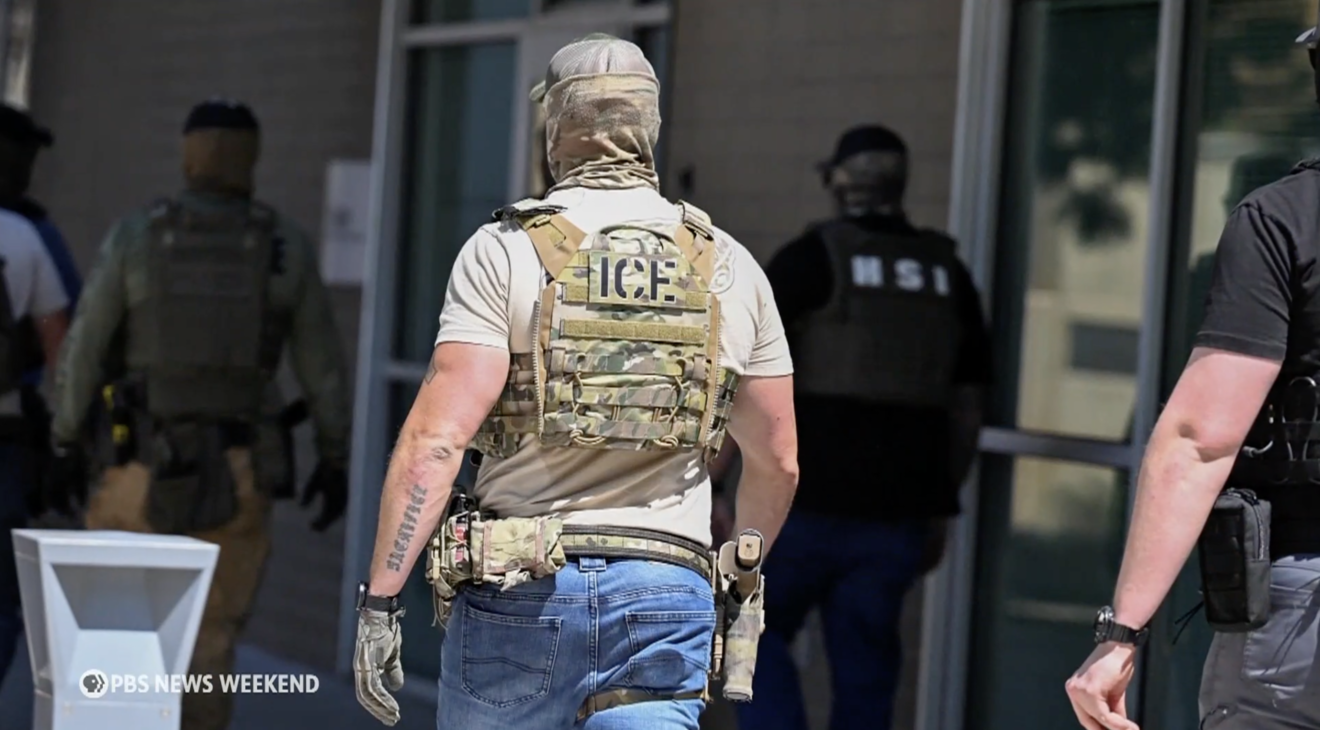
When concerned residents of the New Orleans metro area stepped out into the streets with their whistles and phone cameras over the weekend, ready to protest and document the Trump administration’s unwelcome assault on immigrant communities, they faced both widespread digital surveillance by state and federal authorities and a vague state law that makes hindering federal immigration enforcement a crime punishable by up to one year of hard labor in a Louisiana prison.
Championed by Republicans and signed by Louisiana Gov. Jeff Landry, Act 399 went into effect August 1 and now looms over New Orleans as Immigration and Customs Enforcement (ICE) and Border Patrol continue their latest invasion of a Democrat-led city as part of President Donald Trump’s mass deportation campaign. The new law makes “any act intended to hinder, delay, prevent, or otherwise interfere with federal immigration enforcement” a crime.
On December 3, the ACLU of Louisiana filed a lawsuit challenging Act 399 on behalf of a local group, which stopped conducting know-your-rights trainings after organizers feared they could be criminalized under the law’s broad language. Louisiana’s attorney general conceded in a court filing that Act 399 covers “only actual obstruction of justice — conduct, especially violent conduct,” and not constitutionally protected speech.
Act 399 went into effect August 1 and makes “any act intended to hinder, delay, prevent, or otherwise interfere with federal immigration enforcement” a crime.
The ACLU of Louisiana dropped the lawsuit on December 5 after the judge and both sides agreed on the attorney general’s interpretation of the law. While the lawsuit focused on the First Amendment rights of groups holding community defense trainings for immigrants and their families, the clarification also offered a green light for activists to deploy resistance tactics seen in other cities targeted by ICE.
Videos shared online show residents gathering for a series of protests over the past week against ICE deployments in New Orleans that began on December 3. In suburbs like Kenner, a working class city with a large immigrant population and a local police chief who works directly with ICE, activists on the ground said caravans of vehicles coordinated by ICE watch activists followed ICE patrols with whistles and bullhorns, warning anyone who could be profiled as undocumented that federal agents were nearby. Coalitions organized know-your-rights trainings for documenting immigration arrests and set up a hotline for reporting ICE activity to a network of neighborhood response groups. Businesses across the city posted signs refusing entry to ICE and Border Patrol.
“What we are hearing from our clients is exactly what we have seen in other cities — folks are being arrested indiscriminately, targeted for the color of their skin, the language that they speak, the location where they are working,” said Homero Lopez, legal director of Immigration Services and Legal Advocacy in New Orleans, in a press conference with local leaders on December 5.
Meanwhile, a digital surveillance fusion center shared by federal law enforcement and state police is keeping tabs on the online activity of residents and protesters as ICE and Border Patrol fan out across the New Orleans metro area, according to records obtained by the Associated Press. The records showed agents monitoring message boards and social media posts “around the clock” to provide updates on the community’s response and criticisms of the immigration crackdown in New Orleans.
“Online opinions still remain mixed, with some supporting the operations while others are against them,” noted an intelligence briefing circulated early Sunday to law enforcement and obtained by the Associated Press. Previous intelligence bulletins noted “a combination of groups urging the public to record ICE and Border Patrol” as well as “additional locations where agents can find immigrants.”
A local activist who declined to be identified for fear of retaliation from law enforcement said many immigrant families are unable to work and shop for basic necessities due to the crackdown and concerns over racial profiling.
However, New Orleanians have survived hurricanes and other disasters together, and already existing mutual aid networks sprang into action to deliver groceries and help people access medical care and other needs. “People are getting rides, people are getting food, people are being accompanied — that is not an issue because people know how to do mutual aid here,” the activist told Truthout.
Jeremy Jong, a staff attorney with the immigrant rights group Al Otro Lado in New Orleans, said both Act 399 and the digital surveillance are designed to stifle speech and dissent.
“It appears that there is a real chilling effect,” Jong said in an interview. “Obviously the government surveilling essentially everyone is super concerning. It’s frankly infuriating that tax money is going to this fusion center that just monitors what everyone is saying on social media.”
Jong said many people in southern Louisiana may have heard about Act 399 or a separate state law restricting the filming of police officers — the latter was temporarily blocked by a federal court in January — but they may not understand how these attempts at repression impact their constitutional rights.
“We want to tell people they have the First Amendment right to go out there and blow a whistle and follow them around and record them — these are all things that are essentially protected by the First Amendment,” Jong told Truthout. “But we get a lot of questions like, ‘but I don’t know, it could be illegal.’”
Jong said he recently spoke to members of a church in the New Orleans area who were worried that they could be prosecuted under Act 399 if they refused to let ICE agents enter the church without a warrant. Jong noted that ICE still needs a warrant to enter private property under the Fourth Amendment of the Constitution, which protects everyone in the United States against unreasonable search and seizure. Shortly after taking office, Trump ended a longstanding policy that prohibited ICE from making arrests at schools, churches, and other sensitive public locations.
“It’s designed to scare people into giving up rights that they otherwise have,” Jong said.
“This system depends on people being scared, people unthinkingly complying.”
Steadfast in their repudiation of Trump’s deportation efforts — as well as of Border Patrol Commander Greg Bovino, who has been heckled by protesters and workers in viral videos as he patrols New Orleans — Crescent City residents are not easily intimidated. Jong pointed out that the Trump administration’s stated goal is to arrest 5,000 undocumented people in the New Orleans area, but the records obtained by the Associated Press show only 38 arrests were made during the first two days of the operation.
Of the 38 people arrested, only about a third had a criminal record, further undermining ICE’s debunked claims that immigration sweeps are focused on public safety threats. The total number of people arrested for civil immigration violations in New Orleans has not been publicly reported despite demands from city leaders. Masked ICE and Border Patrol agents also ignored pleas from city leaders not to conceal their identities in public.
Jong said people across the metro area are asserting their rights when confronted by federal agents, making it more difficult for ICE and Border Patrol to make indiscriminate arrests at Home Depots and construction sites, for example.
“People can’t go to work, people can’t make rent, can’t go to the doctor’s office — that’s terrible, but one silver lining is it gives us the opportunity to talk to people and say, ‘no, you have rights, and if everyone asserts their rights, these terrible calamities can be resisted,’” Jong said. “It’s really nice to see people feel empowered, to just say no, to withdraw their consent, because this system depends on people being scared, people unthinkingly complying.”
ICE Prisons are Getting Deadlier
December 12, 2025
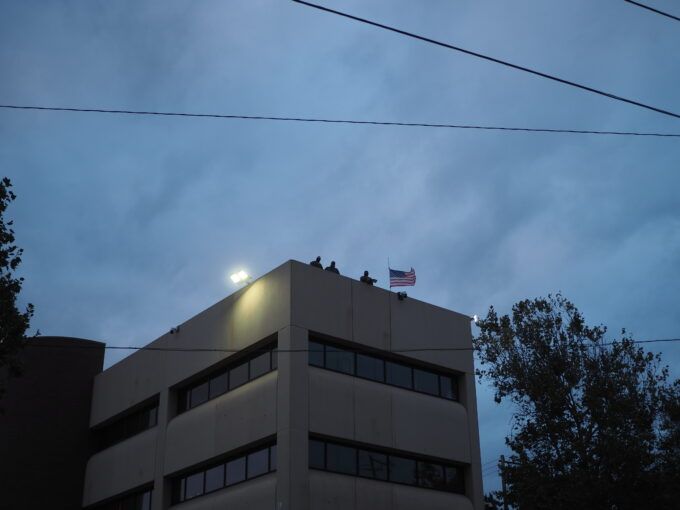
Federal agents on the roof of the ICE facility in Portland, OR. Photograph by Nathaniel St. Clair
Gabriel Garcia-Aviles was a 56-year-old grandfather with a work permit who’d been living in the U.S. for over 30 years. He was a beloved member of his Southern California community.
This fall, Immigration and Customs Enforcement (ICE) agents detained Garcia-Aviles and sent him to the Adelanto immigration detention center. He died around a week later, with ICE only informing his family that he was in critical condition once he was on his deathbed.
At the hospital, his daughter Mariel found him “unconscious, intubated,” and with “dried blood on his forehead.” He had “a cut on his tongue and blood on his lips” and “broken teeth and bruising on his body,” according to reporting from L.A. Taco. No clear cause of death was given, leaving his family shattered and still searching for answers.
That’s the second death this year at Adelanto.
Ismael Ayala-Uribe, a 39-year-old former DACA recipient from Orange County, lived in the U.S. for nearly 35 years. ICE apprehended him while he was working at a car wash and sent him to Adelanto on August 22. He died a month later of an abscess after reportedly being denied lifesaving medical treatment.
ICE didn’t inform his family that he’d been hospitalized. They only learned of Ayala-Uribe’s death the following day after a police visit.
At least 25 people have died in ICE custody since President Trump returned to office, making 2025 the deadliest year for people in ICE custody since 2004. Over 65,000 others remain detained, also the highest number in years. Immigrants with no criminal record remain the largest group in immigration detention. According to ProPublica, ICE has also detained over 170 U.S. citizens this year.
Adelanto, owned and operated by the GEO Group, is among ICE’s sprawling network of mostly private, for-profit detention facilities notorious for human rights abuses. But it’s hardly alone.
From the Krome Detention Center in Florida to the Karnes County detention facility in Texas, people in ICE custody are routinely subjected to abysmal conditions and medical neglect. The detention population has increased by 50 percent this year, which experts have warned could lead to more deaths.
Rights groups have been issuing warnings like these for years.
In 2024, the ACLU and Physicians for Human Rights examined the deaths of 52 people who died in ICE custody between 2017 to 2021 and concluded that 95 percent of those deaths would have been “preventable or possibly preventable” with appropriate medical care. The researchers also found ICE’s oversight and accountability mechanisms “critically flawed.”
These problems have only worsened as immigration arrests have escalated as part of the Trump administration’s anti-immigrant agenda. Recent U.S. Senate investigations uncovered dozens of cases of medical neglect, insufficient or rotten food, foul water, and pregnant women forced to sleep on the floor in ICE detention facilities this year.
Watchdog groups and lawmakers have found that ICE has repeatedly failed to comply with its own protocols, ignored congressional inquiries, and denied members of Congress entry to facilities, even though they have the authority to conduct unannounced oversight visits.
ICE acts increasingly like a rogue agency, refusing to follow U.S. and international law. Yet the “Big Beautiful Bill” Trump signed this year includes $45 billion for ICE to build new prisons housing adults and children, which all but ensures more abuses and preventable deaths. Meanwhile, private prison companies continue to profit.
It doesn’t have to be this way. More oversight would help safeguard civil and human rights. But ultimately Congress must defund and dismantle ICE, end the unnecessary and inhumane system of immigration detention, and create more legal pathways to citizenship, among other reforms.
Legislation recently introduced by U.S. Reps. Pramila Jayapal and Adam Smith would be a step forward. If passed, it would repeal mandatory detention and phase out privatized detention.
As more families are ripped apart, our nation of immigrants stands at a crossroads. It can continue on this path of extreme cruelty and systemic abuse, or it can uphold human rights and dignity for all people.

No comments:
Post a Comment