It’s possible that I shall make an ass of myself. But in that case one can always get out of it with a little dialectic. I have, of course, so worded my proposition as to be right either way (K.Marx, Letter to F.Engels on the Indian Mutiny)
Friday, March 06, 2026
Pan American’s largest silver mine just got bigger
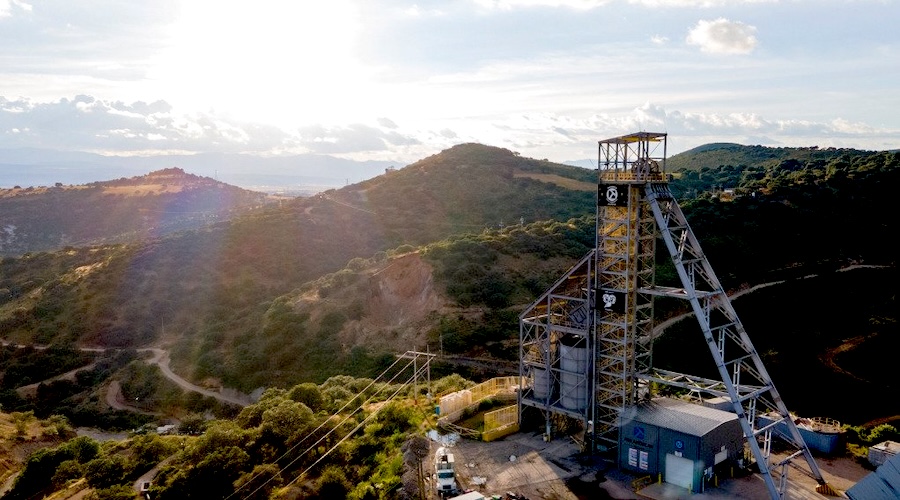
Pan American Silver (TSX, NYSE: PAAS) has discovered at least four new high-grade veins at its La Colorada silver mine in Zacatecas, Mexico, following a recent exploration campaign.
Drilling in the southeastern and eastern Candelaria zones identified the Filomena, Nicolasa, Bernardina and Josefina veins, along with associated contact-related replacement mineralization, the company said. Approximately 40% of drill holes from the campaign returned silver assays exceeding 1,000 g/t.
Emerson said the high-grade intercepts indicate potential to expand mineral resources at the operation. Pan American expects to incorporate the new drilling data into its mineral reserve and mineral resource update scheduled for the end of June.
The discoveries also support Pan American’s revised strategy for a phased development plan at La Colorada focused on higher-grade zones within both the vein system and the skarn deposit.
The company continues to invest in Mexico despite it operates in an increasingly volatile environment. At least 22 states experienced unrest following the death of drug cartel leader Nemesio Oseguera last month.
Recent cartel-linked incidents — including the late January abduction of 10 Vizsla Silver (TSX, NYSE: VZLA) workers and the killing of some of them — highlight the strategic importance of Mexico’s mining industry, particularly for silver, TD Cowen mining analysts said in a February report.
Relative calm has since returned after authorities deployed soldiers and National Guard personnel to restore order, but tensions remain elevated, according to British security risk management firm MS Risk.
Top silver miner
Pan American Silver ranks among the leading silver and gold producers in the Americas, with operations in Canada, Mexico, Peru, Brazil, Bolivia, Chile and Argentina. The company also holds a 44% joint venture interest in the Juanicipio mine in Mexico and owns the Escobal mine in Guatemala, which remains on care and maintenance, along with several exploration and development projects across the region.
The company recently met its full-year 2025 production guidance, delivering a record 22.8 million ounces of silver, including 7.3 million ounces in the fourth quarter as operations strengthened across its portfolio.
Teck charges Korea Zinc more for silver and germanium
Canadian miner Teck Resources agreed with Korea Zinc Co. to sell its zinc concentrates at a slightly higher processing fee in 2026, while charging more on silver and germanium after a surge in prices for both metals.
The treatment charge that Korea Zinc will receive for smelting semi-processed ores known as concentrates rose to $85 a ton this year, according to three people familiar with the matter, who asked not to be identified due to the commercial sensitivity of the matter.
That’s a small rebound from this year’s $80-a-ton fee, which was the lowest benchmark level for the zinc industry in more than 50 years. Low processing fees tend to hit zinc smelters hard, as treatment charges have historically accounted for about a third of their revenues.
Still, Korea Zinc registered record profits in 2025, thanks to a stellar rally in prices for silver and other minor metals, which are also contained in the concentrates it buys from Teck and other miners. Revenues from those byproducts surpassed its zinc revenues in 2025, as silver prices rallied 150% over the course of the year.
Germanium plays a crucial role in defense systems and other advanced technologies, and prices have surged since China placed export controls on it and other critical minerals starting in 2023. It rallied 75% last year.
Korea Zinc is one of the biggest producers of critical minerals outside China, and it plans to start germanium production at a new plant from 2028. It also supplies 5% of the world’s silver, and many of its byproducts originate from Teck’s Red Dog project in Alaska, which is the world’s biggest zinc-lead mine. Red Dog’s output can’t currently be sold on competitive terms in China due to tariffs on incoming US goods.
Miners offer smelters concessions on pricing to cover the cost of recovering zinc, silver and other metals, but in this year’s deal Teck and Korea Zinc agreed to lower the content threshold at which silver will become payable, one of the people said.
That will boost Teck’s share of revenues from the silver it produces, and for the first time the Canadian miner will also charge for the germanium contained in its concentrates, the person said.
Teck declined to comment. Korea Zinc did not respond to requests for comment.
(By Julian Luk)
Pentagon sought fresh supply of 13 critical minerals day before Iran attack
The US military asked mining companies on Friday to help boost domestic supplies of 13 critical minerals used to make semiconductors, weapons and other products, a document reviewed by Reuters showed.
The request, the day before the US and Israel launched strikes on Iran, is the latest example in recent weeks of Washington’s push for more access to the materials used widely in warfare.
The Pentagon asked members of the Defense Industrial Base Consortium (DIBC), a group of more than 1,500 companies, universities and others that supply the military, for proposals to be submitted by March 20 for projects that could mine, process or recycle select minerals, the document showed.
There was no immediate indication whether the timing was intentionally coordinated to coincide with the start of the strikes on Iran.
The list of 13 minerals sought includes arsenic, bismuth, gadolinium, germanium, graphite, hafnium, nickel, samarium, tungsten, vanadium, ytterbium, yttrium and zirconium.
The US is reliant on imports for most of the 13. China is a dominant global producer of all of them.
The Pentagon asked for detailed information on the costs, including labor and material, needed to build a mine or processing facility. Projects could be awarded development funds ranging from $100 million to over $500 million, according to the request.
The document did not specify why only those 13 minerals were chosen. Some — including germanium, graphite and yttrium — have been subject to export restrictions by China, the top global producer.
Yttrium shortages, especially, have set off alarm bells throughout the aerospace industry. One of the 17 rare earths, yttrium is used in coatings that keep engines and turbines from melting at high temperatures. Without regular application of these coatings, engines cannot be used.
Nickel is a widely traded metal and Indonesia is the top global producer. Yet Jakarta has been throttling exports of the metal used widely in stainless steel and battery production.
The White House, DIBC and Pentagon did not immediately respond to requests for comment.
Latest request
DIBC’s request is just the latest attempt by the Trump administration to increase US supply of key critical minerals. China has been using its market control as diplomatic leverage in ongoing trade disputes with Washington.
Last month, Trump officials launched a $12 billion minerals stockpile backed by the US Export-Import Bank and proposed a preferential minerals trading bloc with more than 50 allies.
The administration has also taken equity stakes in rare earths miner MP Materials, Lithium Americas, and copper-and-cobalt developer Trilogy Metals.
Separately on Wednesday, the Defense Logistics Agency, which buys a range of goods for the US military, asked for information from miners on potentially acquiring lithium, chromium and tellurium for military stockpiles.
(By Ernest Scheyder, Jarrett Renshaw and Polina Devitt; Editing by Veronica Brown, Chizu Nomiyama, Peter Graff and Diane Craft)
US Antimony receives $27M Defense Production Act funding
The US Defense Department, in alignment with the Trump administration’s critical minerals strategy, has made a $27 million investment into United States Antimony (NYSE-A: UAMY).
The funds would allow the company to enhance, innovate and expand domestic extraction, processing, and refinement of antimony, a statement released by the now-called Department of War said.
The US government considers antimony as a mineral that’s critical to its economic and national security, for its uses in many modern industrial applications.
At the moment, the Texas-based US Antimony is the only fully integrated producer of this mineral outside of China and Russia, operating a large smelting facility in Montana capable of producing 5 million lb. of metals.
“For too long, DOW has depended on overseas sources for its critical mineral production,” Mike Cadenazzi, Assistant Secretary of War for Industrial Base Policy, said. “This investment will address risk in one of our most critical munitions and materials supply chains.”
Funds for expansion, exploration
US Antimony is expected to use the funds to modernize and expand its existing Montana facility to increase its capacity to refine and produce antimony necessary for flame retardants, batteries, munitions, and other defense applications.
The investment is also intended to support the company’s plans to establish domestic antimony excavation and extraction in Alaska, where it has assembled a 35,000-acre land package comprising over 120 mining claims.
By securing domestic feedstock, US Antimony has positioned itself to enable full vertical integration across the supply chain from ore extraction to mid-stream floatation capabilities to finished antimony products, it said.
Shares of US Antimony were little moved on Thursday. Trading at $9.70 apiece in New York, the company has a market capitalization of approximately $1.37 billion.
The $27 million investment would come from the Defense Production Act (DPA) Title III funds, part of the Ukraine Supplemental Appropriations Act of 2022. It is one of three investments made by the DPA Purchases Office since the beginning of fiscal 2026
Deployment of the funds was initially targeted for last year but was delayed due to the US government shutdown, the longest in history.
US Defense Department seeks information to expand metal stockpiles
Aerial view of the US Department of Defense. Stock image.
The US Defense Department is seeking information for the potential stockpiling of five critical minerals, as the country steps up efforts to reduce risks in the supply chain and bolster domestic feedstock.
The Defense Logistics Agency on Wednesday issued notices seeking information for lithium, nickel, tin, chromium and tellurium respectively, including details of interested vendors, products specifications, sources of materials and market conditions, according to notices published on the website Wednesday. The DLA is responsible for managing the National Defense Stockpile, which secures metals for US military needs.
The Pentagon’s requests came as the procurement of metals has become a political priority for the US in order to slash reliance on Chinese supplies. Most recently, the White House announced Project Vault, a $12 billion stockpiling initiative for the private sector.
The agency said it is making inquiries ahead of the potential acquisition for 550 tons of lithium carbonate, 3,500 tons of nickel, 1,978 tons of London Metal Exchange-grade tin, 37 tons of tellurium and 4,500 short tons of chromium. It also made inquiries about the reprocessing or remelting of 1,978 tons of tin ingots affected by so-called tin pest, a phenomenon where the metal degrades into a powdered form in cold temperatures. That amount of tin would cost nearly $100 million, based on LME prices.
The DLA said the notices are for planning purposes only and the deadline to submit the responses is by March 19, adding that companies responded should not expect to receive feedback regarding submissions.
(By Annie Lee)
Critical minerals drive new commodity supercycle: Sprott
Copper, uranium and other strategic metals lead resource markets. (Stock image by agnormark.)
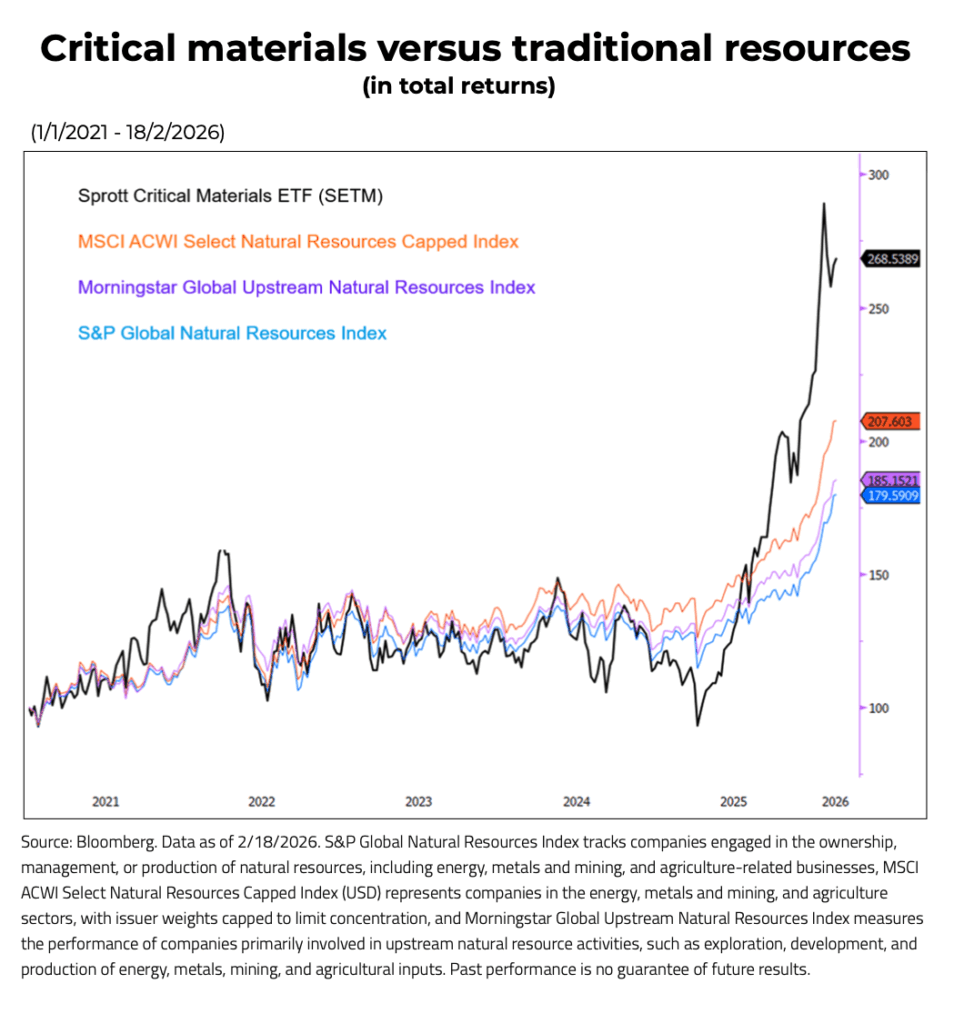
Governments and investors are increasingly treating critical materials such as copper and uranium as strategic assets, helping drive what Sprott says could be the early stages of a new commodity bull market.
Commodity markets entered 2026 with renewed momentum as resource equities broke above long-term trading ranges after years of underrepresentation in global portfolios. According to a Sprott report released this week, the emerging cycle differs sharply from past booms, with structural forces such as deglobalization, fiscal expansion and rising geopolitical tensions reshaping demand for raw materials.
Rather than mirroring the China-driven construction boom of 2000–2014 or the inflation-led rally of the 1970s, the emerging cycle is being powered by investment in electricity systems, digital infrastructure and energy security.
Governments are increasingly prioritizing control over critical supply chains, pushing materials tied to electrification, defence and advanced infrastructure into strategic territory.
Within the broader resource sector, performance has begun to diverge sharply. Materials tied directly to electrification, power generation and energy security are outperforming traditional bulk commodities that dominated earlier cycles.
The report highlights that the Sprott Critical Materials ETF (SETM) has significantly outperformed broader natural resource benchmarks since April 2025, underscoring growing investor focus on metals essential to modern infrastructure.
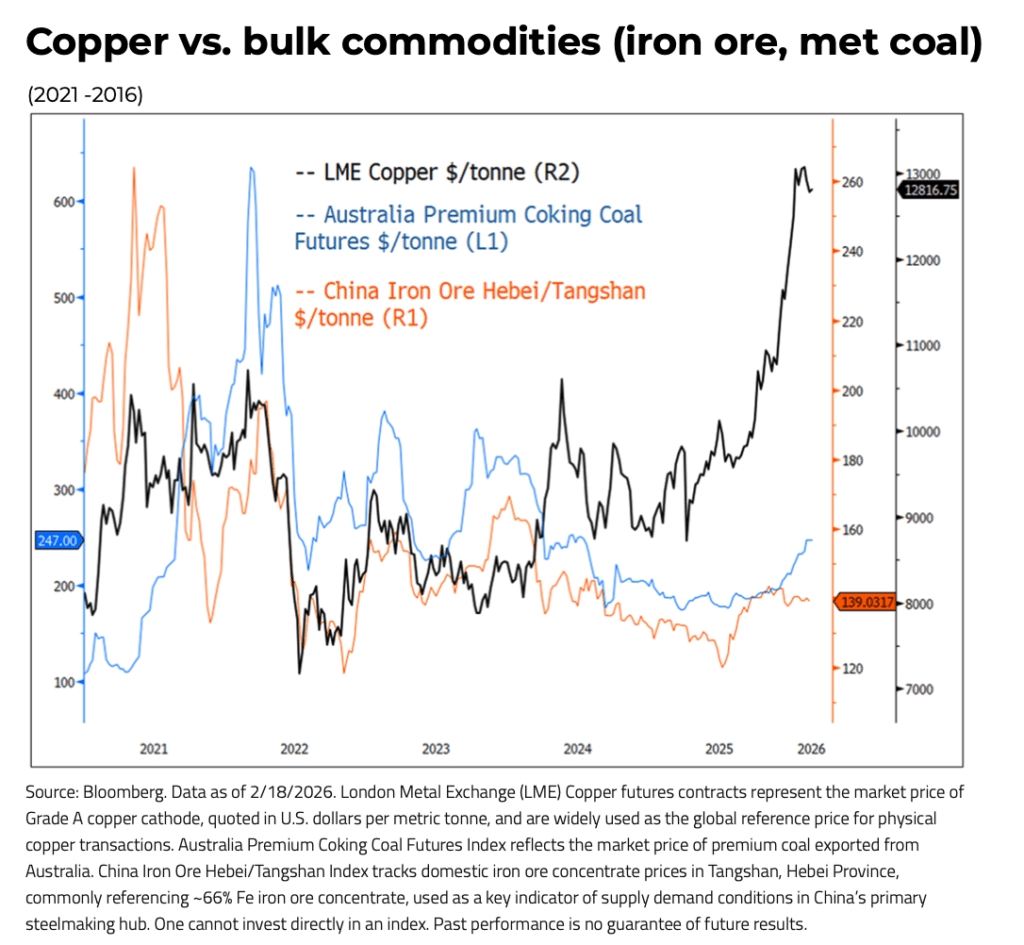
Copper sits at the centre of this shift., helping tighten its supply-demand balance relative to construction-focused bulk commodities. According to Sprott, copper-focused producers have increasingly outperformed large diversified miners whose earnings remain more closely tied to iron ore and other bulks.
Uranium over oil
Energy markets show a similar divergence. Oil markets still face ample supply and a long-term decline in consumption intensity relative to global GDP. Uranium, by contrast, is entering the cycle with constrained supply and strengthening demand as countries revisit nuclear power.
Sprott says the renewed interest in nuclear energy is driven primarily by energy security rather than environmental policy. Governments are extending reactor lifespans, planning new capacity and rebuilding long-term uranium contract coverage on the back of rising geopolitical tensions.
Beyond copper and uranium, the firm sees favourable fundamentals for other critical materials including lithium, rare earth elements and silver. Lithium and rare earths are essential for batteries and high-efficiency motors, while silver benefits from both industrial demand and its role as a monetary metal.
The report argues that critical minerals are increasingly being valued not only by traditional supply-demand dynamics but also by their strategic importance to national security and technological infrastructure.
Despite the shift, many resource allocations still emphasize broad exposure to sectors that dominated earlier cycles, such as chemicals, forest products and agriculture. Sprott says this lag in recognition is typical in the early stages of commodity bull markets.
The firm expects investment in power generation, electricity grids, data centres and mineral supply chains to drive demand over a multi-year horizon. At the same time, long project lead times and a decade of underinvestment in new supply could keep markets tight.
Targeted exposure to critical minerals may therefore offer stronger returns than broad commodity allocations, Sprott says. The firm highlights investment vehicles such as the Sprott Critical Materials ETF (NASDAQ: SETM), which focuses on companies deriving at least 50% of revenue or assets from critical materials, and the actively managed Sprott Active Metals & Miners ETF (NYSE: METL).
While volatility remains likely, Sprott believes the structural forces reshaping the global economy could support sustained outperformance for select commodities and mining companies tied to electrification and energy security.
Cove Capital, Saudi conglomerate to collaborate on critical minerals
US-based private investment firm Cove Capital LLC has partnered with Saudi industrial conglomerate Tariq Abdel Hadi Abdullah Al-Qahtani & Brothers Company (AHQ) on the joint development of critical minerals assets.
A memorandum of understanding (MOU) was signed on Thursday establishing the framework for collaboration to identify, evaluate, acquire, finance and operate critical minerals projects globally.
The partnership is intended to strengthen secure, allied-aligned supply chains serving both the US and Saudi Arabia, while advancing broader bilateral industrial cooperation, the companies said in a statement.
Specifically, Cove Capital and AHQ will jointly evaluate upstream and midstream critical minerals assets, form project-level joint ventures or special purpose vehicles, and develop downstream refining, processing and manufacturing capacity in both regions.
They will also explore the establishment of a dedicated critical minerals investment fund focused on deploying capital into strategic mining assets and advanced processing technologies.
The collaboration aligns with Saudi Arabia’s Vision 2030 objectives to expand its mining sector, localize industrial capacity and position the Kingdom as a global hub for minerals processing. It also aligns with ongoing US initiatives to strengthen domestic and allied supply chains for critical minerals that are foundational to national defense and economic resilience.
Under the agreement, the parties intend to pursue diversified financing structures, including participation from Saudi institutional and sovereign capital, engagement with US development finance institutions, potential alignment with the recently announced $12 billion US critical minerals stockpile initiative.
A joint steering committee will be established to review opportunities and oversee coordination, with specific projects to be governed by definitive agreements executed separately, the companies said.
“This MOU represents a meaningful step in aligning US and Saudi industrial capabilities around critical minerals that underpin modern defense systems, advanced manufacturing, and emerging technologies. AHQ brings significant industrial strength and regional leadership,” Pini Althaus, chairman and CEO of Cove Capital, commented.
Founded in 2015, Cove Capital is focused on identifying and investing in critical minerals assets across the globe. To date, it has established a large presence in Central Asia through a 70% ownership in a tungsten mining joint venture in Kazakhstan.
“Critical minerals are central to the Kingdom’s industrial transformation and to global economic stability. In Cove Capital, we are partnering with what we view as the leading US critical minerals investment and development group, given its track record of advancing world-class projects,” Abdulmalik Tariq Alqahtani, chief executive of AHQ, added.
USA Rare Earth to buy remaining Round Top stake for $73M
USA Rare Earth (Nasdaq: USAR) will acquire the remaining minority interest in the Round Top rare earth deposit in Texas in a $73 million all-stock deal, securing full control of a key US source of critical minerals.
The Oklahoma-based company is purchasing all outstanding shares of Texas Mineral Resources (OTCMKTS: TMRC) for about 3.8 million shares of USA Rare Earth common stock.
Shares of USA Rare Earth rose about 1% in pre-market trading following the announcement.
The deal will make USA Rare Earth the sole operator of the Round Top project, which the company says is the largest known US source of heavy rare earth elements, as well as gallium and beryllium.
“This acquisition secures a vital pillar in our strategy to build the world’s leading globally integrated, non-China critical mineral technology platform,” USA Rare Earth CEO Barbara Humpton said in a statement.
USA Rare Earth has accelerated its development timeline for the Texas project as demand for domestic critical minerals grows. Last year, the company said it expected commercial production to begin in late 2028, two years earlier than its previous target, citing faster progress at its processing facilities and rising US demand.
In January, the US Commerce Department agreed to support a $1.6 billion debt-and-equity financing package in exchange for a 10% stake in the company. The funding is intended to help build the Texas mine and a magnet manufacturing facility aimed at supplying the defence and high-tech sectors.
Mine-to-magnet
The push aligns with broader US policy efforts to expand domestic critical mineral production and reduce reliance on China, which dominates the global supply chain. President Donald Trump invoked emergency powers last year to accelerate development of US-based critical mineral resources.
USA Rare Earth describes itself as a mine-to-magnet solution designed to challenge China’s grip on the permanent magnet supply chain. Under its Accelerated Mining Plan, the company expects to extract nearly 40,000 tonnes per day of rare earth and critical mineral feedstock by 2030.
The boards of both companies have approved the transaction, which is expected to close in the third quarter.
South32 Hermosa project closer to US federal approval
South32’s Hermosa project area. (Image by South32).
South32 (ASX: S32) moved closer to securing federal approval for its Hermosa zinc-silver project in Arizona after the US Forest Service released a Final Environmental Impact Statement and Draft Record of Decision indicating it intends to allow development on National Forest land.
The draft decision marks a key step in the federal permitting process because parts of the proposed mine and supporting infrastructure would sit on land within the Coronado National Forest. If finalized, the authorization would allow the company to expand development beyond privately held property and build key infrastructure on federal land.
The documents also trigger a formal review period for eligible stakeholders who previously submitted public comments. After that process, the agency may issue a final decision that would clear the way for construction of several project components.
The Final Environmental Impact Statement supports the agency’s preferred development alternative and includes technical analysis completed during years of environmental review. The plan would allow South32 to build a primary access road, a secondary dry-stack tailings facility and part of a 138 kV transmission line on National Forest land, with the power line to be constructed by UniSource Energy Services.
Hermosa was the first mining development accepted into the federal FAST-41 permitting program, which accelerates reviews for large infrastructure projects deemed strategically important to the US economy.
“This Draft Record of Decision reflects years of listening, collaboration and real changes shaped by community input,” said Pat Risner, president of South32 Hermosa. “The draft decision affirms our design and development approach, including mitigation measures described in the Final Environmental Impact Statement that were informed through agency and public consultation.”
As part of the review process, the Forest Service conducted an independent analysis of Hermosa’s Mine Plan of Operations released in 2024 alongside baseline environmental data collected over several years and feedback gathered during the National Environmental Policy Act comment period.
The agency concluded that the selected development alternative best meets the project’s objectives while minimizing environmental impacts. The plan includes a primary access road designed to avoid traffic near the town of Patagonia, a section of the 138 kV transmission line, an updated dry-stack tailings facility and a direct water discharge system high in the Patagonia Mountains intended to recharge the aquifer and support wildlife.
According to the Forest Service, the selected alternative would produce the smallest land surface disturbance while reducing impacts to air quality, water resources, cultural sites, recreation areas, wildlife habitat and nearby communities compared with other options studied.
State permits secured
South32 has already secured required state permits from the Arizona Department of Environmental Quality for initial surface infrastructure located on private land.
“This outcome reflects a thorough, transparent process that affirms South32 Hermosa’s design and commitments are compatible with the long-term management of public lands and sets the stage for the final authorization process ahead,” director of environment and permitting Brent Musslewhite said.
Beyond regulatory requirements, the company has committed to nearly 140 additional conservation, mitigation and monitoring measures developed with federal agencies, Indigenous Nations and community stakeholders. South32 plans to operate the project under an adaptive management framework and a no-net-loss biodiversity standard designed to strengthen environmental protections as scientific understanding evolves.
The commitments also underpin ongoing negotiations toward a Community Protection and Benefits Agreement with local governments.
The Draft Record of Decision begins a 45-day objection period followed by a potential 45-day resolution process before the Forest Service issues a final decision. South32 expects the Final Record of Decision in July and said it will continue engaging with regulators and communities during the review period.
Designed with a surface footprint of about 750 acres, the Hermosa project is expected to use roughly 90% less water than many regional mining operations and could support up to 900 jobs at peak production while generating long-term investment in surrounding communities.
Codelco, Microsoft team up on AI & analytics initiatives
Signing of the MoU took place on Thursday, with Codelco chief executive Rubén Alvarado and Microsoft Latin America president Tito Arciniega in attendance. Credit: Codelco
Codelco is teaming up with Microsoft on various initiatives in artificial intelligence, advanced analytics, automation and digital security to improve its copper mining operations.
A memorandum of understanding was signed on Thursday to establish a framework for this collaboration, which is expected to run for 18 months initially and will include joint governance for strategic and operational tracking.
The joint initiatives will cover areas such as intensive data use, AI for decision-making, autonomous operations, automation of critical processes and cybersecurity strengthening. The partnership also envisions both companies participating in early testing of new solutions.
The agreement builds on a working relationship between the world’s largest copper producer and a “Big Tech” leader spanning over 27 years, during which they have developed projects across multiple areas. This new phase seeks to incorporate cutting-edge tools under high standards of cybersecurity and data protection, they said.
“Working with a world-class technological leader like Microsoft consolidates our leadership in the future of mining. Faced with an accelerated digital transformation, we have to process and consider large volumes of operational data,” Codelco CEO Ruben Alvarado said in a news release.
“This alliance with Codelco reflects the potential that artificial intelligence represents to advance development in the mining sector and Chilean market, facilitating safer, more efficient and sustainable operations with a focus on people, productivity and long-term value for the company and country,” Tito Arciniega, president of Microsoft Latin America, added.
Argentina copper venture hires RBC on $630M mine project
An Argentine copper venture controlled by Zonda Metals GmbH has appointed a unit of Royal Bank of Canada as an adviser as it weighs financing options for a $630 million copper-gold project in Mendoza province.
PSJ Cobre Mendosino will choose among the financing proposals it’s received in the coming months, under the advice of RBC Capital Markets, Fabian Gregorio, who heads the venture, told Bloomberg News on Wednesday.
The project, previously known as San Jorge, has applied to join Argentina’s investment incentive regime after securing environmental approval and as it finalizes engineering.
It would be a first for the wine-making province of Mendoza. If the revived venture — rejected 14 years ago — manages to navigate the remaining permitting and keep communities on side, it could pave the way for other projects to tap vast mineral potential in an area long seen as off limits to mining. It would also strengthen Argentina’s bid to become a new copper hub as the global wiring metal market tightens. Argentina’s cradle of Malbec wine is warming up to copper mining
(By James Attwood)
New Kazakhstan controls spur Canadian uranium explorer exit
A Kazatomprom uranium exploration site in Kazakhstan. Credit: Kazatomprom
Laramide Resources (TSX, ASX: LAM), one of the few Western companies to explore for uranium in Kazakhstan in recent years, is leaving the country as regulatory changes tighten restrictions on foreign participation.
State miner Kazatomprom (LSE: KAP) – the world’s top uranium producer – confirmed in late December the Kazakhstan government changed its Subsoil Use Code, giving the miner priority rights to exploration licences in prospective areas. Most projects must be done in joint ventures and the new law states that Kazatomprom gets at least 75% in them.
“This rule is going to keep any company from wanting to explore in Kazakhstan, not that there were a lot before either,” Red Cloud Securities analyst David Talbot told The Northern Miner by email. The changes amount to “de facto nationalization of the uranium industry in Kazakhstan,” he said.
Kazakhstan, historically integrated into the Soviet system with production largely directed to Moscow, now supplies much of the Western uranium market. Its move to strengthen state control over the sector through legal channels is a potential risk to supply that could support higher prices.
Laramide’s hopeful entry
In 2024, Laramide entered a three-year option agreement with Kazakh company Aral Resources to explore on more than 5,500 sq. km in the Chu-Sarysu Basin in southern Kazakhstan. The site is adjacent to Kazatomprom’s Inkai JV mine it holds with Canadian producer Cameco (TSX: CCO; NYSE: CCJ) and the Budenovskoye JV the state miner holds with Russia.
On Dec. 24, the Toronto-based explorer received the final permits to start drilling its 15,000-metre program. But two days later, Kazakh President Kassym-Jomart Tokayev signed into law the Subsoil Use Code changes.
“We had three rigs ready to go, basically on standby, we had all the people ready to go, we had the targets and unfortunately we never went out and drilled anything and had to walk away,” Laramide CEO Marc Henderson told The Northern Miner in an interview. The company announced on Jan. 20 it had ended its option agreement with Aral.
Henderson had heard rumours about the legal changes for a while and he realized last fall that the “dramatic decision” was going to be enacted.
“It would be like Newmont going to the US government saying there’s a lot of gold here, why don’t you ban everyone else in Nevada except us. Except [in this case] it’s not for gold, it’s something critical that the world needs, like uranium.”
Asked to specify which part of the law spurred Laramide to leave the country, Henderson responded with a scenario where the company made a major discovery and approached Kazatomprom about its interest in a JV to potentially mine uranium.
“We thought the range that we were going to end up negotiating would be 30% to 50%,” he said. “[But] they made it law that the new terms that they had to have were between 75% and 90%. That was just a completely different deal.” Why the amendments?
The code changes are “essential for the systematic modernization of Kazakhstan’s subsoil use regulations,” a Kazatomprom spokesperson told The Northern Miner by email.
“The revisions are intended to optimize the management of strategic resources, providing the framework necessary to reinforce Kazakhstan’s global market presence.”
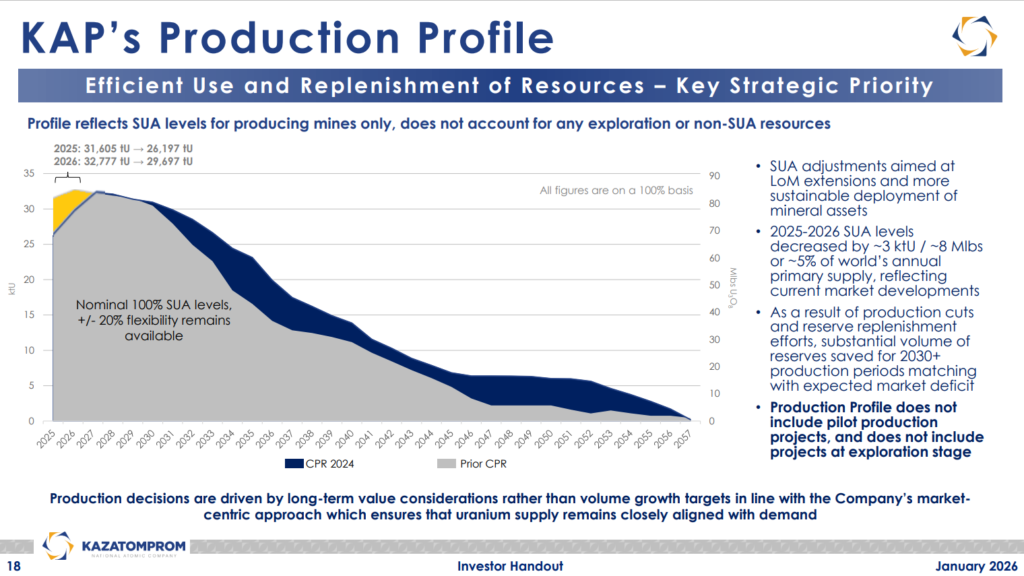
Henderson noted that Kazatomprom revealed its dwindling reserves in an investor’s presentation deck. A January deck showed that its production resource base would peak this year, then begin a rapid decline in a few years, with complete exhaustion by 2057.
Credit: Kazatomprom
Kazatomprom board chair Meirzhan Yussupov suggested as much to the Central Asia-focused Kursiv business publication in December.
The amendments are needed, Kursiv reported, as higher prices could attract higher-cost producers, reducing Kazakhstan’s advantage and depleting its reserves.
In addition, Kazakhstan’s Atomic Energy Agency said it needs the underground use amendments so it has enough fuel sources for planned nuclear power plants, according to reporting from Radio Free Europe’s Russian service on Feb. 9. Greenfield exploration loss
Laramide incurred no costs to leave Kazakhstan and for now plans to re-focus on its projects in Australia and the southwest US.
Still, Henderson thinks it’s a loss for global greenfield uranium exploration that one of the world’s most prospective jurisdictions is now effectively closed to Western investment.
“The uranium sector is woefully behind on greenfield exploration,” he said. “The prospectivity in uranium to find things of any scale is very, very small. And not all of those are jurisdictions where you want to go on vacation, or where you’re comfortable with the politics.”
Australia’s C29 Metals (ASX: C29) is another Western company that was exploring for uranium in Kazakhstan. It acquired the Ulytau project in 2024. But C29 announced it was ending operations there in late November after regulators rejected its application for exploration rights, according to Minex Forum, a U.K.-based mining conference platform focused on Eurasian markets. C29 did not respond to a request for comment from The Northern Miner.
How will producers fare?
Western majors like Cameco, France’s Orano and Japan’s Sumitomo Corp. and Kansai Electric Power could face similarly difficult conditions in Kazakhstan.
Cameco’s contract in the Inkai JV – in which it holds a 40-60 interest with Kazatomprom – ends in 2045. Orano is in a 51-49 interest arrangement with Kazatomprom in Katco, made up of the South Tortkuduk/Muyunkum operation.
While Kazatomprom said existing subsoil use agreements are unaffected, contract extensions or production increases would require Kazatomprom to hold at least 90% of the JV. Alternatively, the foreign partner could keep its interest by transferring uranium conversion and enrichment technologies to Kazatomprom and build downstream capacity.
Of the non-Western producers in the country, seven are Kazakh, two are Russian, two are Chinese and one is Kyrgyz. Most production projects are held in JVs.
“This is part of the ongoing expectation that Kazakh uranium will be increasingly destined for eastern destinations (Russia, China), and less available to the West,” Red Cloud’s Talbot said. “It would impact the Chinese, Russians, Orano, Cameco and others – essentially reducing their interest and production.”
A Cameco spokesperson said in emailed comments to The Northern Miner that the company’s subsoil use agreement in the Inkai JV is valid until 2045 and Cameco has transferred refinery and conversion technology to its partner.
“Foreign interests requiring a new subsoil use agreement or an extension of a current agreement will face the requirement to increase state ownership,” the spokesperson said. “While the change in legislation is certainly impactful more broadly in the market, our agreement remains in place for the next 20 years.”
Pivot to East, spot prices
Talbot noted that global production as such might not be affected by Astana’s legal changes, and he expects all long-term uranium sales contracts would be intact, “but future contracts would likely be focused to an even greater extent on Chinese and perhaps Russian customers.”
In terms of the uranium spot price, which soared about 33% from late November until late January, when it peaked at $101.55 per lb., Talbot suggested Kazakhstan’s policy change could play a bullish role.
“Uncertainty surrounding uranium security of supply is often a catalyst for rising uranium price,” he said. “This could be very good for uranium prices, and potential M&A as western producers scramble for future production.”
NexGen eyes summer 2026 build for huge Rook I uranium mine
The Rook I uranium project in Saskatchewan’s Athabasca Basin. Credit: NexGen Energy
NexGen Energy (TSX, NYSE: NXE; ASX: NXG) said it will start construction this summer of its Rook uranium mine in northern Saskatchewan, the largest development-stage uranium deposit in Canada.
The C$2.2 billion capex build plan for Rook I comes on the same day the Canadian Nuclear Safety Commission (CNSC) approved NexGen’s environmental assessment and construction licence, and just weeks after the regulator’s two-part hearing process concluded. Located in the uranium-rich Athabasca basin’s southwest, Rook I is about 900 km northwest of Regina.
“Current expectations are for a four-year construction period,” Canaccord Genuity Capital Markets analyst Katie Lachapelle said in a note on Thursday. “We expect NexGen to release a detailed construction schedule in the near-term.”
The approval follows one of the most rigorous regulatory processes conducted for a resource project in the world, NexGen CEO and founder Leigh Curyer said in a release.
“This milestone is the result of the NexGen team’s steadfast and unrelenting focus over 12 years understanding and delivering our objectives honestly and incorporating a culture of excellence,” he said.
Top uranium producer
Rook I, anchored by the high-grade Arrow deposit, could produce almost 30 million lb. of uranium oxide (U3O8) per year over the first half of its 11-year life, according to a feasibility study published in 2021.
That capacity would make it the top uranium mine by output in North America, ahead of Cameco’s (TSX: CCO; NYSE: CCJ) producing McArthur River and Cigar Lake mines in Saskatchewan.
NexGen’s construction milestone also coincides with other developments for uranium players in the province over the past several weeks.
Denison Mines (TSX: DML) last week announced the start of construction of its Phoenix mine, Canada’s first in-situ recovery operation for the nuclear fuel. Last month, Paladin Energy (TSX, ASX: PDN) received environmental impact statement approval from the Saskatchewan for its Patterson Lake South project.
All three projects would rank in the top five largest operations in the Athabasca basin by reserve size if they become producing mines.
C$6.3B value
NexGen shares fell 3% to C$16.77 apiece on Thursday afternoon in Toronto amid a broad market decline, valuing the company at C$10.1 billion ($7.4 billion).
In a uranium spot price case of $95 per lb., Rook I has a net present value (at an 8% discount) of C$6.32 billion and an internal rate of return of 45%. The Arrow deposit hosts probable reserves of 4.57 million tonnes grading 2.37% U3O8 for 240 million lb. of U3O8.
NexGen Energy has received the final regulatory approval for the Rook I uranium project in northern Saskatchewan, and will begin construction later this year.
(Image: NexGen)
The Canadian Nuclear Safety Commission (CNSC) decision to issue the Licence to Prepare Site and Construct the proposed uranium mine and mill came 14 business days after the conclusion of the last part of the regulator's two-part hearing process. The licence - which is valid until 31 March 2036 - covers site preparation and construction activities under Canada's Nuclear Safety and Control Act: operation of the facility would need NexGen to submit another licence application which would be subject to a future licensing hearing and decision.
Rook I is described by NexGen as the largest development-stage uranium project in Canada. Centred on the Arrow deposit, a high-grade uranium deposit discovered by the company in 2014, the project is in the southern Athabasca Basin, about 155 km north of the town of La Loche. The project is situated on Treaty 8 territory, the Homeland of the Métis, and is within territories of the Denesųłiné, Cree, and Métis.
The Arrow deposit has a resource estimate of 357 million pounds U3O8 (137,319 tU) in the measured and indicated mineral resources category, grading 3.10% U3O8. Probable mineral reserves have been estimated at 240 million pounds U3O8, grading 2.37% U3O8. A 2021 NI 43-101 feasibility study for the project envisages production of up to 14 million kilograms of U3O8 annually for 24 years.
The project received environmental approval from the Province of Saskatchewan in November 2023, and, with all approvals now secured, NexGen said it is set to begin construction. A final investment decision has already been made, and the team, procurement, engineering, vendors, contractors and capital are in place to commence construction activities with advanced site and shaft sinking preparation. Construction will officially begin in this summer, the company said, and construction is expected to take four years to complete.
NexGen founder and CEO Leigh Curyer said the CNSC's approval "represents one of the most rigorous and comprehensive regulatory processes undertaken for a resource project globally" and, as well as acknowledging NexGen's team, expressed the company's "sincere gratitude" to its Indigenous Nation partners, local communities, Premier Scott Moe and the Government of Saskatchewan, Government partners, regulatory bodies, and stakeholders who have contributed to the advancement of the project over the past decade.
"The world is changing fast, and NexGen's Rook I is now ready to be a significant contributor to global requirements for nuclear energy and Canada's role as an energy superpower. As global demand for reliable, clean, baseload nuclear energy continues to accelerate at an unprecedented pace, uranium is the critical fuel for powering industrial electrification and the digital infrastructure of tomorrow. Simply put, energy is the key to our global growth," Curyer said.
In February, Reuters reported that NexGen had held preliminary talks with data centre providers about securing finance for a new mine. Speaking to investors in NexGen's fourth quarter conference call on 4 March - one day before the CNSC announcement - Curyer said the first 12 months of construction is expected to cost around CAD300 million (USD219 million). NexGen is well funded to begin construction thanks to already completed equity raises and offtake agreements. Further offtake agreements are already in advanced negotiation, with contracts expected to be announced this year, he said, but the start of construction or production will not be dependent on those new contracts being in place.
"We know exactly what we're doing every day of that 48-month process, who's doing it, who's responsible for it within NextGen," Curyer said. "And as I said, once we're in that basement rock, the highest risk around cost and schedule has been mitigated."
Curyer told investors the company would issue a detailed construction timeline once the licensing process had concluded.
Canada and India Sign Landmark Uranium Deal Worth $2.6B
Canada is expanding trade with India as Prime Minister Mark Carney seeks to reduce reliance on the U.S. after 2025 tariffs, aiming to double non-U.S. exports within a decade.
Major energy and commodities deals were signed, including a 10-year uranium supply agreement between Cameco and India.
Canada and India are pursuing deeper economic ties, with plans for a free-trade agreement targeting $70B in bilateral trade.
Ever since Donald Trump slapped tariffs on Canadian goods on Feb. 1, 2025, Prime Minister Mark Carney has been encouraging trade with nations other than the United States.
The former central banker turned politician wants to double non-US exports over the next decade.
Towards that goal, Carney met with Indian Prime Minister Narendra Modi in Delhi on Monday as part of a four-day trip to deepen trade and diplomatic ties.
The centerpiece was a deal between the Indian government and Saskatchewan-based uranium producer Cameco (TSX:CCO) to supply nearly 22 million pounds of uranium for nuclear energy generation between 2027 and 2035.
Also, British Columbia coal producer Elk Valley Resources — majority-owned by Glencore (LSE:GLEN) — will sell 1.2 million tonnes of coal to India worth hundreds of millions of dollars. (CBC News)
Emerging from a set of meetings with India Prime Minister Narendra Modi earlier in the day, Carney announced that a new $2.6-billion agreement had been struck between India and Saskatchewan that will see the Prairie province supply it with uranium, which India needs for nuclear power generation.
The 10-year deal, set to begin in 2027, is part of what the Prime Minister’s Office calls a new “strategic energy partnership,” which was one of the outcomes expected out of Canada’s renewed interest in working with India.
The uranium contract with Saskatoon-based Cameco was one of the 10 commercial deals, some of which were years and months old, that Carney’s office said totalled around of $5.5 billion that he touted as signs of a deepened relationship.
Many of them have to do with Canadian companies expanding into India and vice-versa.
The two leaders also announced plans for a new free-trade deal, where the goal is to double two-way trade to $70 billion over the next four years. Carney has appointed a chief negotiator and said he wants to see the agreement happen by the end of the year.Related: Trump’s Secret Weapon in the Rare Earth War
To that end, Carney’s office outlined how Canada and India signed five memorandums of understanding to commit to working towards deeper collaborations, with at least two dealing specifically with the areas of critical minerals and “diversifying supply chains.”
Carney has faced criticism at home for courting the Indian government, including inviting Modi to the G7 leaders’ summit in Alberta last year. During Carney’s trip to Delhi, Modi accepted an invitation to visit Canada. The Prime Minister’s Office reports that Canada and India have interacted more this year than in any of the last 20 years.
The diplomatic U-turn is welcome news to the Canadian business community, which likes the certainty of trade agreements.
Relations under former Prime Minister Justin Trudeau plummeted after he accused the Indian government of orchestrating violent crimes in Canada such as the killing of a prominent Sikh activist in 2023.
Some Indian diplomats were expelled from Canada, but India has denied any involvement in his death.
The Royal Canadian Mounted Police subsequently alleged India was behind incidents of extortion, mainly in BC, Alberta and Ontario.
Along with uranium and coal, Carney also touted current and upcoming LNG projects in British Columbia that could help meet India’s expected doubling of population by 2040.
“Canada is well-positioned to contribute, as a reliable supplier of the world’s lowest-carbon, responsibly produced LNG (liquefied natural gas) from our West Coast,” he said in his remarks, via CTV News.
Made at the 2026 Prospectors & Developers Association of Canada (PDAC) annual convention in Toronto, the announcement is the second round of partnerships and investments under the Critical Minerals Production Alliance. The first round was announced in October 2025.
The Canadian Press reported that Deals include up to $7 million to Greenland Resources' Malmbjerg project in Greenland, $9.1 million to Cyclic Materials Inc.'s rare earths elements recycling centre in Kingston, Ont. and $16.7 million for First Phosphate's Bégin-Lamarche demonstration and feasibility project in Saguenay–Lac-Saint-Jean, Que.






 Credit: Kazatomprom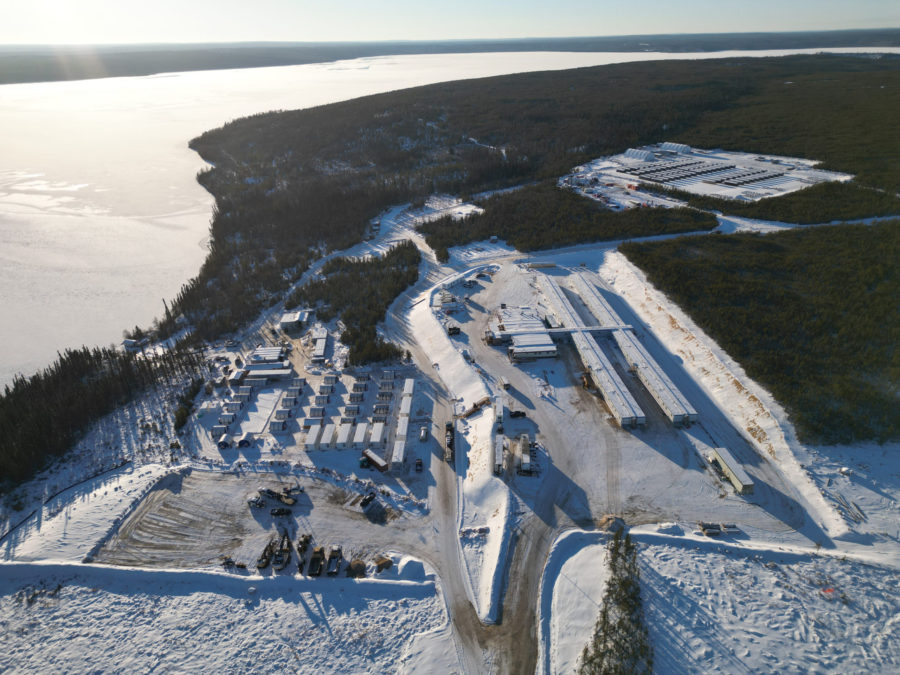
_75011.jpg)