Bible-belt state refuses to share 'crucial' info on measles outbreaks
Paul Monies,
Paul Monies,
Oklahoma Watch
January 5, 2026
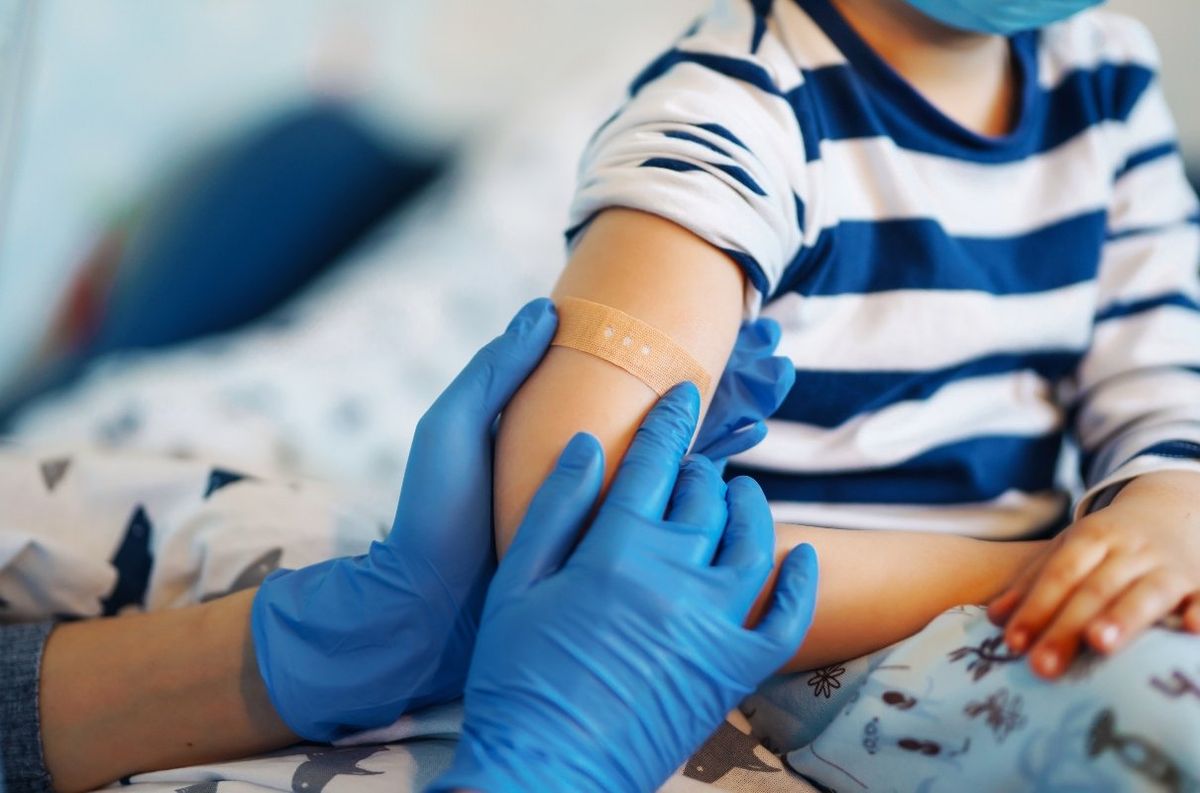
A child after being vaccinated. (Shutterstock)
Outbreaks of measles and whooping cough in Oklahoma have led to calls for greater transparency from the Oklahoma State Department of Health as the state stands alone in only sharing measles cases on a statewide basis.
Infectious disease and public health experts said the timely sharing of cases with the public can help communities mitigate the spread of disease.
Dr. George Monks, a Tulsa dermatologist and former president of the Oklahoma State Medical Association, has been trying for months to get the state Health Department to share more data. He’s employed social media cajoling, open records requests and complaints to the attorney general’s public access counselor, to no avail.
“This data is crucial for Oklahoma families to make informed decisions about their health, whether it be vaccine choice or avoiding high-risk areas,” Monks said. “Withholding that county-level measles data could delay the community response, especially since it is so contagious.”
To date, Oklahoma has recorded 17 cases of measles in 2025. Nationally, the United States has had the highest number of measles cases in three decades. More than 800 of the 2,000 U.S. cases this year came in Texas back in the spring, although South Carolina is dealing with a current outbreak.
Measles is a highly contagious, airborne virus with symptoms including rashes, high fevers, coughs, runny nose and red, watery eyes. The virus spreads through the air when an infected person coughs or sneezes. It can linger for up to two hours in a room after exposure.
Monks first requested measles case data by county in March, along with agency communications with the federal Centers for Disease Control and Prevention about a measles outbreak in Oklahoma. The state Health Department provided some email correspondence with CDC, but it cited a section of the federal Health Insurance Portability and Accountability Act, or HIPAA, in declining to release county measles data. Monks shared his requests and responses with Oklahoma Watch.
In its Oct. 30 letter siding with the state Health Department, the attorney general’s office said the agency’s response was reasonable and noted its website has statistical information related to measles and potential public exposure.
“Based on the information available to me at this time, I conclude that OSDH has a good-faith legal basis to deny access to the records sought by Dr. Monks,” wrote Anthony Sykes, the attorney general's public access counselor.
Oklahoma is the only state not providing measles cases by county or on a regional level, according to researchers at Johns Hopkins University. They published a study in September in JAMA, the journal of the American Medical Association, detailing their efforts to develop the U.S. Measles Tracker.
Kansas only withholds county-level measles data if the cases are fewer than five, the researchers noted. Tennessee, Utah and Iowa provide regional case data, but not by county.
“Single measles cases often represent the leading edge of potential outbreaks, making their rapid identification crucial for public health response,” the researchers said in a supplemental paper describing their methodology. “Geographic specificity, even for small case counts, enables public health officials to implement targeted contact tracing and exposure notifications.
“Many state health departments routinely report individual measles cases in public communications, press releases, and exposure notifications, establishing precedent that individual case disclosure serves legitimate public health purposes.”
Oklahoma used to disclose county-level measles cases as recently as 2019, during the last major measles outbreak. Media reports from that outbreak show measles in Okmulgee County.
In an emailed response to questions from Oklahoma Watch, the state Health Department said its public data is sufficient to inform local communities of potential exposure to measles.
It provides overall case counts, vaccination status, age range, median age of cases and any public exposure settings identified through investigation of a measles case.
“Identified exposure locations are what pose a risk of spread to the public, and the county of residence may not always reflect the population or communities that may be at risk during a public health investigation,” the agency said.
The state Health Department didn’t directly address questions on how other states are able to report county measles data. The agency said it continues to rely on its interpretation of federal HIPAA laws and Oklahoma’s public health code in not releasing county-level measles data.
“Accordingly, OSDH has the discretion to determine the manner in which statistical communicable disease data may be released to the public to the extent that such release is in compliance with de-identification and disclosure requirements of HIPAA,” the department said in the email.
Echoes of COVID
The debate over how and when to share infection data echoes those in the first year of the COVID-19 pandemic. Oklahoma was slow to share community-level infection data. Even then, it provided county-level case information.
In those first few months of the pandemic, Oklahoma Watch requested de-identified COVID-19 data from the state Health Department, including by city and ZIP code. Officials initially denied the request based on federal and state privacy laws, although those laws include exemptions to allow de-identified data. As the pandemic escalated, state health officials eventually provided localized data for COVID infections on an online data dashboard.
The state Health Department said it used a risk-based approach to reporting COVID-19 cases to make recommendations around public gatherings and school closures.
“The only way to implement such a system was to report ZIP code-level data,” the department said. “For measles, using exact public setting location and time provides individuals the information necessary to communicate the risk to the public. Again, it’s all about risk and managing it in such a way as to balance the public’s need to know with our obligation to protect an individual’s health information.”
The state Health Department sent out potential measles exposure alerts earlier this year. The alerts included the addresses of stores and restaurants an infected person had visited.
Oklahoma public health officials withholding of county-level measles data contrasts with the state’s tracking for West Nile virus, a mosquito-borne disease. The state Health Department’s infectious disease website includes the number of cases and county of incidence for that virus.
“I don’t get it,” Monks said. “They’re citing these privacy concerns (for measles), but there’s no patient data assigned to this. It’s all just aggregate data. I don’t get how they can come down on one side and then a different side based on the infectious disease.”
The state Health Department said decisions about releasing county-level data are made based on a number of factors, including overall case count, population of the county and case investigation impact.
“For some diseases, like West Nile, it is important that the public is aware of the geographic location of the case to communicate the risk of disease to the public,” the agency said. “The majority of diseases publicly reported on our website are stratified by their respective region, rather than county-level, to help protect patient privacy, while still providing the public with a geographic distribution of disease burden.”
Monks continues to request disease data from the Health Department. He’s asked for more information about pertussis, commonly called whooping cough, and tuberculosis.
“This is a really important time to get this data out to the public,” Monks said. “In Oklahoma, this is the worst whooping cough outbreak in 70 years and the worst measles outbreak we’ve had in 35 years.”
Monks said it's a policy decision, not necessarily a public health decision, to withhold detailed data about respiratory disease outbreaks. Monks, who describes himself as a Reagan Republican, suspects some state leaders don’t want to raise the ire of the federal Health and Human Services Department under the leadership of Robert F. Kennedy Jr., a longtime vaccine skeptic.
“From the Republican standpoint, some have taken this position that this is a political football, and they really want to get away from pro-vaccinations and pro-science, especially in a primary,” Monks said.
This article first appeared on Oklahoma Watch and is republished here under a Creative Commons Attribution-NoDerivatives 4.0 International License.
January 5, 2026
A child after being vaccinated. (Shutterstock)
Outbreaks of measles and whooping cough in Oklahoma have led to calls for greater transparency from the Oklahoma State Department of Health as the state stands alone in only sharing measles cases on a statewide basis.
Infectious disease and public health experts said the timely sharing of cases with the public can help communities mitigate the spread of disease.
Dr. George Monks, a Tulsa dermatologist and former president of the Oklahoma State Medical Association, has been trying for months to get the state Health Department to share more data. He’s employed social media cajoling, open records requests and complaints to the attorney general’s public access counselor, to no avail.
“This data is crucial for Oklahoma families to make informed decisions about their health, whether it be vaccine choice or avoiding high-risk areas,” Monks said. “Withholding that county-level measles data could delay the community response, especially since it is so contagious.”
To date, Oklahoma has recorded 17 cases of measles in 2025. Nationally, the United States has had the highest number of measles cases in three decades. More than 800 of the 2,000 U.S. cases this year came in Texas back in the spring, although South Carolina is dealing with a current outbreak.
Measles is a highly contagious, airborne virus with symptoms including rashes, high fevers, coughs, runny nose and red, watery eyes. The virus spreads through the air when an infected person coughs or sneezes. It can linger for up to two hours in a room after exposure.
Monks first requested measles case data by county in March, along with agency communications with the federal Centers for Disease Control and Prevention about a measles outbreak in Oklahoma. The state Health Department provided some email correspondence with CDC, but it cited a section of the federal Health Insurance Portability and Accountability Act, or HIPAA, in declining to release county measles data. Monks shared his requests and responses with Oklahoma Watch.
In its Oct. 30 letter siding with the state Health Department, the attorney general’s office said the agency’s response was reasonable and noted its website has statistical information related to measles and potential public exposure.
“Based on the information available to me at this time, I conclude that OSDH has a good-faith legal basis to deny access to the records sought by Dr. Monks,” wrote Anthony Sykes, the attorney general's public access counselor.
Oklahoma is the only state not providing measles cases by county or on a regional level, according to researchers at Johns Hopkins University. They published a study in September in JAMA, the journal of the American Medical Association, detailing their efforts to develop the U.S. Measles Tracker.
Kansas only withholds county-level measles data if the cases are fewer than five, the researchers noted. Tennessee, Utah and Iowa provide regional case data, but not by county.
“Single measles cases often represent the leading edge of potential outbreaks, making their rapid identification crucial for public health response,” the researchers said in a supplemental paper describing their methodology. “Geographic specificity, even for small case counts, enables public health officials to implement targeted contact tracing and exposure notifications.
“Many state health departments routinely report individual measles cases in public communications, press releases, and exposure notifications, establishing precedent that individual case disclosure serves legitimate public health purposes.”
Oklahoma used to disclose county-level measles cases as recently as 2019, during the last major measles outbreak. Media reports from that outbreak show measles in Okmulgee County.
In an emailed response to questions from Oklahoma Watch, the state Health Department said its public data is sufficient to inform local communities of potential exposure to measles.
It provides overall case counts, vaccination status, age range, median age of cases and any public exposure settings identified through investigation of a measles case.
“Identified exposure locations are what pose a risk of spread to the public, and the county of residence may not always reflect the population or communities that may be at risk during a public health investigation,” the agency said.
The state Health Department didn’t directly address questions on how other states are able to report county measles data. The agency said it continues to rely on its interpretation of federal HIPAA laws and Oklahoma’s public health code in not releasing county-level measles data.
“Accordingly, OSDH has the discretion to determine the manner in which statistical communicable disease data may be released to the public to the extent that such release is in compliance with de-identification and disclosure requirements of HIPAA,” the department said in the email.
Echoes of COVID
The debate over how and when to share infection data echoes those in the first year of the COVID-19 pandemic. Oklahoma was slow to share community-level infection data. Even then, it provided county-level case information.
In those first few months of the pandemic, Oklahoma Watch requested de-identified COVID-19 data from the state Health Department, including by city and ZIP code. Officials initially denied the request based on federal and state privacy laws, although those laws include exemptions to allow de-identified data. As the pandemic escalated, state health officials eventually provided localized data for COVID infections on an online data dashboard.
The state Health Department said it used a risk-based approach to reporting COVID-19 cases to make recommendations around public gatherings and school closures.
“The only way to implement such a system was to report ZIP code-level data,” the department said. “For measles, using exact public setting location and time provides individuals the information necessary to communicate the risk to the public. Again, it’s all about risk and managing it in such a way as to balance the public’s need to know with our obligation to protect an individual’s health information.”
The state Health Department sent out potential measles exposure alerts earlier this year. The alerts included the addresses of stores and restaurants an infected person had visited.
Oklahoma public health officials withholding of county-level measles data contrasts with the state’s tracking for West Nile virus, a mosquito-borne disease. The state Health Department’s infectious disease website includes the number of cases and county of incidence for that virus.
“I don’t get it,” Monks said. “They’re citing these privacy concerns (for measles), but there’s no patient data assigned to this. It’s all just aggregate data. I don’t get how they can come down on one side and then a different side based on the infectious disease.”
The state Health Department said decisions about releasing county-level data are made based on a number of factors, including overall case count, population of the county and case investigation impact.
“For some diseases, like West Nile, it is important that the public is aware of the geographic location of the case to communicate the risk of disease to the public,” the agency said. “The majority of diseases publicly reported on our website are stratified by their respective region, rather than county-level, to help protect patient privacy, while still providing the public with a geographic distribution of disease burden.”
Monks continues to request disease data from the Health Department. He’s asked for more information about pertussis, commonly called whooping cough, and tuberculosis.
“This is a really important time to get this data out to the public,” Monks said. “In Oklahoma, this is the worst whooping cough outbreak in 70 years and the worst measles outbreak we’ve had in 35 years.”
Monks said it's a policy decision, not necessarily a public health decision, to withhold detailed data about respiratory disease outbreaks. Monks, who describes himself as a Reagan Republican, suspects some state leaders don’t want to raise the ire of the federal Health and Human Services Department under the leadership of Robert F. Kennedy Jr., a longtime vaccine skeptic.
“From the Republican standpoint, some have taken this position that this is a political football, and they really want to get away from pro-vaccinations and pro-science, especially in a primary,” Monks said.
This article first appeared on Oklahoma Watch and is republished here under a Creative Commons Attribution-NoDerivatives 4.0 International License.
By Dr. Tim Sandle
SCIENCE EDITOR
DIGITAL JOURNAL
January 4, 2026

Numerous European nations have scrapped mask-wearing rules even as Covid cases have surged - © TT NEWS AGENCY/AFP Johan NILSSON
Three leading public health and social psychology experts have warned that many countries, including the UK, are failing to apply vital lessons from the COVID-19 pandemic as influenza cases surge. In the UK, hospitals are facing mounting winter pressures.
Similarly, the U.S. has seen the number of influenza cases climb significantly in December, coming after the most severe flu season since 2018. There have been an estimated 7.5 million influenza cases and 81,000 hospitalizations (as of the end of December 2025).
The three experts have written to the British Medical Journal. They are Professors Stephen Reicher (University of St Andrews), Martin McKee (London School of Hygiene & Tropical Medicine), and Stephen Griffin (University of Leeds). The three academics argue that simple, proven measures of vaccination, isolation, and ventilation are being neglected, leaving the public vulnerable as flu spreads.
The experts call for a layered approach to infection control, combining vaccination, isolation, ventilation, masks, and hygiene.
“There are important differences in who and how flu hits,” says Professor Griffin in a statement sent to Digital Journal. “But we trivialise those differences at our peril. The lessons we learnt during COVID still apply.”
However, uptake of the flu vaccine remains poor. By late November, only 40% of under‑65s at risk had received the jab, compared to 70% of over‑65s, pregnant women, and young children.
“Vaccines aren’t perfect, but at scale they keep schools open and hospitals coping,” Griffin adds.
Both the World Health Organization and the U.S. Centers for Disease Control and Prevention (CDC) recommend yearly vaccination for nearly all people over the age of six months, especially those at high risk.
The flu jab works by injecting each individual with a tiny amount of an inactive flu virus. In response to this, the body’s immune system makes proteins called antibodies to help fight what it thinks is an infection.
Isolation is another key factor. Many workers cannot afford to stay home when sick. UK statutory sick pay remains under £120 a week, far below Germany’s eight weeks of full salary.
“Telling people to isolate is a suggestion, not a practical response, unless government support is provided,” explains McKee.
Ventilation is the third pillar. Despite calls for investment in clean air systems in schools, offices, and public buildings, little has changed.
“We hoped COVID would make clean air central to the 21st century as clean water was to the 20th. That hope has failed,” clarifies Reicher.
The experts stress that winter pressures demand more than individual responsibility. Governments must institute support measures that make it possible for people to do the right thing.
“The challenge isn’t knowing what to do,” Reicher concludes. “It’s making it possible for everyone to do it. Governments must act to support responsible behaviour, or schools will close, hospitals will be overwhelmed, and lives will be lost.”
The supporting article ‘Vaccinate, Isolate, Ventilate: will we ever learn the lessons from COVID?’ is published in the in the British Medical Journal (free to view)

No comments:
Post a Comment