Ewan Gleadow
January 14, 2026

European countries were urged by a political analyst to cut ties with Donald Trump's America as the threats to Greenland continue.
Trump has suggested his administration will take Greenland "the easy way or the hard way" and has refused to rule out boots on the ground action. The president should be taken at his word according to columnist Alexander Hurst, who urged EU countries to stand their ground and choose the rest of Europe over Trump.
Hurst, writing in The Guardian, suggested EU leaders must stand against the new image of the US as an "active and hostile" threat to friendly nations. He wrote, "Will its leaders have the courage to tell the full truth – that the US isn’t simply abandoning its allies and destroying the international order but is now in the position of active and hostile predation by force – and more importantly, to act on it?"
"Donald Trump has already set the tone by saying the US will seize Greenland 'one way or the other', and no part of the triumvirate around him is trying to hide their imperial intentions any more."
Trump's rhetoric has made it clear where he stands too, with the president suggesting it is just his own "morality" that will affect his decision making the world over. Hurst added, "When Trump says that the only constraint on his exercise of power is “my own morality”, that means there is no constraint."
"Like Vladimir Putin, he will keep grabbing until someone imposes a limit on him." Hurst has since urged European countries to "maintain a space of democracy and the rule of law in a world that is rapidly reverting to imperialism, oligarchy, and the rule of power".
He wrote, "By boldly detaching from the US now, visibly and decisively, Europe might even send a resuscitative shock through the US’s ailing democratic corpus."
"Only Americans can save their country from a descent into something even uglier and deadlier than what we are witnessing already. But for everyone’s sake, theirs included, Europe must cut the cord now, and not follow them into the storm."
How Greenland Became the Most Dangerous Real Estate on Earth
- The U.S. demand for control of Greenland is framed as an obligation of the NATO alliance, leading European diplomats to scramble for a deal that reaffirms Danish sovereignty while satisfying American political demands.
- The supposed "win" of accessing Greenland's vast potential rare-earth mineral wealth is undermined by the atrocious unit economics and massive infrastructure gap, which would require a significant subsidy from Europe to make mining commercially viable.
- By threatening to coerce a NATO ally into ceding territory, the US risks defaulting on the "Rules-Based International Order" and losing the moral leverage to condemn Russian or Chinese expansionism.
The United States will officially begin negotiations to dismantle the Western world's operating system in just about 30 minutes or so...and oil prices are up just over 1% in anticipation.
The meeting, which will take place at the Eisenhower Executive Office Building, will include Vice President JD Vance, Secretary of State Marco Rubio, and the foreign ministers of Denmark and Greenland.
The official agenda serves up standard diplomatic fare: "Arctic security," "strategic partnership," and "resource development."
But the reality in the room is far more brittle...
President Trump has made his position clear, stating on Air Force One that anything shy of U.S. control of Greenland is "unacceptable."
He has suggested that NATO "should be leading the way for us to get it," framing the acquisition not as a request, but as an obligation of the alliance.
Whatever the diplomats call it, the pricing model of the partnership has fundamentally changed.
For decades, the Atlantic alliance operated on a fixed-cost basis. Member states provided political alignment and base access in exchange for a predictable security guarantee. That fixed rate has now effectively floated. The new cost of doing business with Washington includes a premium to hedge against the unpredictability of the executive branch.
It's a volatility tax, effectively.
A Variable Rate on Article 5
To understand the urgency in Brussels, you have to look at the mechanics of the security guarantee.
NATO was designed as a binary instrument: you are either protected, or you are not. Article 5 is the bedrock. But recent signals from Washington, specifically the refusal to rule out unilateral action regarding Greenland, have introduced a variable into that equation.
The "strategic patience" that characterized European responses for the last few years has evaporated. Following the capture of Venezuela’s Nicolás Maduro by the U.S. military on Jan. 3, the theoretical risk of American kinetic action has been repriced as a tangible one.
Danish Prime Minister Mette Frederiksen has been unequivocal, warning that a military move on Greenland would mean "everything stops," signaling the effective end of the alliance.
Her concerns were echoed by EU Defense Commissioner Andrius Kubilius, who warned that such an event is "unprecedented in the history of NATO."
"The normal rulebook doesn’t work anymore," a former Danish MP noted regarding the discussions.
This has forced European capitals into a defensive crouch. When a German Defense Minister is compelled to discuss "options at Europe’s disposal" regarding a close ally, the alliance is no longer operating on a foundation of implicit trust. It is operating on a transactional basis.
Mining the Ice: The Myth of "Turnkey" Riches
The deal likely to emerge today relies on two pillars: security spending and resources.
The resource component, specifically the promise of critical minerals, is being framed as the "win" that could de-escalate tensions. The narrative suggests that by cutting the U.S. in on Greenland’s mineral wealth, the strategic hunger for rare earth elements can be sated.
However, from an industrial standpoint, this narrative hits a literal wall of ice.
GooglePreferredSource]
Greenland possesses vast potential reserves. The U.S. Geological Survey estimates the island holds the world's second-largest deposit of rare-earth oxides, including significant amounts of neodymium and dysprosium, which are critical for EV motors and F-35 fighter jets.
But potential is not production. To date, there are zero active rare earth mines in Greenland.
The barrier isn't just bureaucratic; it is thermodynamic. Greenland spans 2.17 million square kilometers, 80% of which is covered by ice. The "unit economics" of mining here are atrocious compared to competitors in Australia or Brazil.
- The Infrastructure Gap: There are no roads connecting Greenland’s towns. Every piece of heavy machinery must be shipped in by sea or flown in by helicopter. Industry analysis suggests that developing a mine in the Arctic incurs capital costs (CapEx) 150% to 300% higher than in temperate regions.
- The Power Problem: There is no grid to plug into. A mine requires a dedicated power plant, likely importing diesel in a zone where fuel freezes, or building renewables in a place with three months of darkness.
Ian Lange, an economist at the Colorado School of Mines, put it bluntly: "Everybody's just been running to get to this endpoint [of production]. And if you go to Greenland, it's like you're going back to the beginning."
If the EU plans to double its investment in these projects to satisfy U.S. demands, it represents a massive subsidy. It is a transfer of public funds to make a project commercially viable, not because the market demands it, but because the politics require it. We are essentially watching Europe offer to build a money-losing mine to buy geopolitical stability.
Access vs. Ownership: The Strategic Paradox
The second pillar of the proposed deal is a ramp-up in Arctic security infrastructure.
Secretary General Mark Rutte has laid the groundwork, stating that the alliance is discussing ways to "bolster Arctic security." This aligns with the long-standing U.S. demand for Europe to shoulder a greater share of the defense burden.
But a closer look reveals a paradox in the U.S. position.
If the goal is purely strategic access, denying space to Russia and China, the United States already has it.
The U.S. military operates the Pituffik Space Base (formerly Thule), a cornerstone of North American missile defense. The 1951 Defense of Greenland Agreement grants the U.S. substantial rights to operate on the island. The U.S. can already project power, monitor the GIUK gap (Greenland-Iceland-UK), and deter adversaries.
The demand for "title" or "ownership," rather than "access," suggests that the driver here is not purely strategic utility. It is about formalizing a sphere of influence on a map.
Inheriting a Frozen Liability
Beyond the bad math of the mines, there is a practical question of stewardship largely absent from American political discourse.
Greenland is a semi-autonomous territory with a distinct culture and a complex social safety net underpinned by Danish subsidies. If the island's status were to change, the financial burden of that stewardship would shift to Washington.
EU Commission President Ursula von der Leyen backed this view, stating firmly that "Greenland belongs to its people," and insisting that any decision rests with them, not foreign capitals.
Historically, the U.S. has a poor track record of managing its territories.
Places like Puerto Rico or Guam have struggled with chronic underinvestment in infrastructure and poverty rates far higher than the mainland average.
For the U.S. taxpayer, the acquisition would mean inheriting a massive, frozen liability. We would acquire a territory that requires significant annual subsidies to maintain basic services, with a return on investment that might be decades away.
Ripping Up the 1945 Contract
But the most dangerous line item on this ledger isn't financial. It is structural.
If the United States were to coerce a NATO ally into ceding territory, whether through economic arm-twisting or the implicit threat of force, it would trigger a default on the post-war security order.
We often talk about the "Rules-Based International Order" as an abstract concept. In practice, it is a contract. The United States drafted the contract in 1945, and the core clause was simple: borders are not to be changed by force, and the sovereignty of allies is inviolable.
By threatening to seize Greenland, Washington is effectively ripping up that contract.
French President Emmanuel Macron has been one of the few leaders to speak plainly on the stakes, warning that "the law of the strongest cannot rule the world" and noting the "unprecedented consequences" if an ally's sovereignty is violated.
Even the UK, often the bridge between Europe and Washington, has drawn a line. Prime Minister Keir Starmer reportedly told Trump to keep his "hands off Greenland," aligning London firmly with Copenhagen.
The immediate casualty would be moral leverage.
For years, the United States has rallied the world to condemn Russian expansionism in Ukraine and Chinese assertiveness in the South China Sea. If the U.S. annexes Greenland, that moral argument evaporates.
The Solvency of the West
As the foreign ministers sit down in the Eisenhower Executive Office Building today, they are attempting to price a transaction that was never meant to be sold.
The U.S. will likely push for guaranteed mineral rights and a "security premium" funded by Europe. Denmark and the EU will offer these concessions in a desperate bid to buy another year of sovereignty.
But as the ink dries on whatever joint statement emerges, the real story is what happens next. The fixed-rate mortgage of the Atlantic Alliance is gone. We are now in a variable-rate world, and the market is volatile.
By Michael Kern for Oilprice.com
Greenland Turns Into an Alliance Problem, Not a Strategic Asset
- European officials: a U.S. military move on Greenland would rupture NATO.
- What had been a strategic discussion about Arctic access, radar coverage, and basing has shifted into a test of alliance limits.
- Besides security concerns, oil reserves keep Greenland relevant to Washington even when no one is drilling.
European officials are now publicly warning that a unilateral U.S. military move on Greenland would rupture NATO. Greenland has responded by saying any defence activity must sit inside the alliance, and Denmark has backed that position publicly ahead of senior-level talks with Washington.
This is no longer being handled through Denmark and NATO behind closed doors. Allies are now saying in public what they will and will not accept. They will not accept a U.S. military presence or control in Greenland outside NATO structures. They will not accept bilateral arrangements that bypass Denmark or Greenlandic consent. They will not accept public pressure or unilateral moves on a sovereignty issue that has always been managed collectively.
The tone coming out of Washington has made this harder. Cartoon-style White House posts about Greenland may play to a domestic audience, but they land badly with allies who are already drawing lines. When European officials are warning openly about NATO breaking, they are reacting not just to policy signals, but to how those signals are being delivered.
What had been a strategic discussion about Arctic access, radar coverage, and basing has shifted into a test of alliance limits. Once those limits are stated in public, they become harder to walk back, even if interests still overlap.
Washington wants Greenland for practical reasons. It sits between North America and Europe and anchors early-warning systems, missile tracking, and control of North Atlantic and Arctic air and sea approaches. It offers space for runways, sensors, and support infrastructure that cannot be replicated elsewhere and sits next to routes that matter for military movement, shipping, undersea cables, and communications. It is also one of the few Arctic locations fully inside Western political and legal space at a time when Russia is active across the region and China is looking for access through investment and infrastructure.
Part of the value is simply keeping others out. And sitting underneath all of that is energy. The Arctic is estimated by the U.S. Geological Survey to hold around 90 billion barrels of undiscovered oil. Greenland’s offshore basins are part of that estimate. Those barrels are expensive and slow to develop, but they exist, and that alone keeps Greenland relevant to Washington even when no one is drilling.
Greenland also carries a longer-term oil dimension that policymakers never fully lose sight of. The Arctic holds a large pool of undiscovered oil, and Greenland’s offshore basins are part of that landscape. Those barrels have remained untouched because they are expensive and slow to develop. It wasn’t necessary. But when governments start worrying about where future supply could come from, and under whose control it would sit, places like Greenland resurface as options that remain on the table when alliances break down.
By Charles Kennedy for Oilprice.com
Is Greenland’s Oil Really Worth It?
- Greenland Energy and 80 Mile PLC plan two onshore wells in Greenland’s Jameson Land by the summer of 2026, the first exploration wells since 2011.
- Independent estimates put unrisked recoverable resources in Greenland at ~4 billion barrels, with ~1.2 billion barrels targeted by the initial wells.
- The project’s revival coincides with renewed U.S. strategic interest in Greenland, despite the contested island’s post-2021 ban on new oil licensing.
Greenland’s long-dormant oil story has resurfaced, once again with US interests at the forefront. Greenland Energy and 80 Mile PLC plan to drill two onshore wells in eastern Greenland’s Jameson Land basin by the summer of 2026, the island’s first hydrocarbon drilling in more than a decade. Independent estimates put unrisked recoverable resources at around 4 billion barrels, with much larger oil-in-place figures cited by project partners. The return of American companies also coincides with renewed US geopolitical interest in Greenland, even as the island’s government maintains an anti-oil stance while honouring pre-2021 licences.
Greenland’s hydrocarbons history has been marked by interchanging waves of optimism followed by frustration and retreat. The first licences, awarded in 1975 to US majors including Amoco, Chevron, ARCO and Mobil, were relinquished within a decade after disappointing results. Later licensing efforts in the 1980s and 1990s also failed to ultimately reach the exploration drilling stage. Interest resurfaced between 2006 and 2014, when offshore rounds drew international oil companies, often alongside Greenland’s state firm NunaGreen, before fading again as oil prices collapsed. No new licences have been awarded since 2018. In July 2021 Greenland’s government Naalakkersuisut announced a ban on all new oil and gas licensing, citing climate objectives and environmental risk.
With international oil companies losing their faith in any basins offshore Greenland, the onshore Jameson Land basin has been front and centre to the island’s promised oil bounty. After all, Jameson Land is the only area on the island ever licensed for onshore oil exploration. Covering 7,027 km2, the licences were awarded in 2014 to the UK-based exploration company White Flame Energy through an international tender process. Greenland’s 2021 moratorium on new oil and gas licensing did not revoke permits that were already in force, allowing Jameson Land’s exploration and exploitation licences to continue under their original contractual terms. Ownership of the project has since shifted without altering its legal status. In 2024, 80 Mile PLC (UK) acquired White Flame Energy and its Jameson Land licences. As part of the transaction, the Greenland authorities approved a 4-year extension to the first licence sub-periods, effectively resetting the clock and reaffirming their legal validity.
Momentum has started to build in 2025. In March, 80 Mile struck a financing deal with March GL, a privately held Texas-based firm, under which March GL agreed to fund 100% of the costs for two exploration wells planned to reach depths of about 3,500 metres.
That arrangement was later embedded in a broader corporate restructuring. In September, March GL agreed to merge with Greenland Exploration and Pelican Acquisition Corporation to form Greenland Energy, a US-listed vehicle that will hold a 70% economic interest in Jameson Land, leaving 80 Mile with 30%. The transaction implies a combined project valuation of about $337 million. According to a 2025 assessment by independent oil advisory Sproule ERCE, the basin could contain around 4 billion barrels of unrisked recoverable oil. The purely Greenland-focused driller will spud its exploration well (OPW-1) over the summer months, with the second wildcat following immediately thereafter, jointly targeting a prospective resource of roughly 1.2 billion barrels. This would mark Greenland’s first exploration drilling since 2011.
Operational preparations are progressing cautiously. Greenland’s authorities have allowed the transport of heavy drilling equipment to the licence area, but approvals for permanent infrastructure such as ports or base camps have not yet been granted. Greenland Energy has contracted Halliburton for logistical and drilling services, with Stampede Drilling (US) and IPT Solutions (US) supporting rig operations and project management.
The growing role of US-based companies adds an unavoidable geopolitical undertone. Texas-based March GL entered the Jameson Land project in March 2025, a move that coincided with a renewed surge of US political interest in Greenland under President Trump’s administration, who has repeatedly framed the island as strategically vital to US economic and security interests. While the timing may be coincidental, it is difficult to ignore that American capital moved into Greenland’s only active oil project just as Washington’s attention returned to the Arctic. 80 Mile’s chief executive Roderick McIllree has been explicit in distancing the project from US state involvement, stressing that the participation of American firms reflects technical capability rather than political backing and that all regulatory engagement remains strictly between the licence holders and Naalakkersuisut.
Many obstacles facing the project remain challenging to the extent of being deal breakers. First, Greenland’s oil exploration is a complete greenfield project with no previous history of successful wells. The island has no oil infrastructure, barely has any domestic hydrocarbon demand and minimal transport capacity. All refined fuels are imported, primarily from Denmark and Norway, meaning any commercial production would be export-dependent and require Arctic-specific export facilities.
Secondly, geography compounds the challenge. Jameson Land lies within the Arctic Circle, where seismic and drilling operations are limited to a short summer window. Sliding glaciers and harsh weather conditions add logistical and safety risks for onshore operations, compounded by drifting sea ice that complicates project logistics. Exploration data coverage is sparse: only around 15 offshore and 6 onshore wells have ever been drilled across Greenland, and none since 2011.
Thirdly, economics are equally fragile. Greenland exploration peaked when oil prices exceeded $100/bbl, and interest evaporated after the 2014–2016 price collapse as capital shifted toward lower-cost shale and deepwater developments elsewhere. Similar retreats followed periods of low prices in the 1990s. Even a sizable discovery would face high breakeven thresholds, long development timelines and uncertain access to financing in a world increasingly hostile to frontier oil.
Finally, politics and social risk weigh heavily. Greenland’s economy is strongly reliant on fishing, while oil spills in Arctic conditions are notoriously difficult to contain and clean up. Public concern over environmental damage and threats to livelihoods was central to the 2021 moratorium. The government now requires multi-billion-dollar financial guarantees from licence holders to cover potential spill cleanup costs, a further deterrent for insurers and lenders. While licences remain legally enforceable, Greenland’s policy stance is openly anti-oil, creating a governance paradox that additionally cools down the optimism among potential investors. Should president Trump make a move on Greenland, the only realistic path to reviving (and potentially commercialising) its oil industry would be a fundamental shift in the legal and regulatory framework of the island toward US standards. Under the current regime, policy barriers and financial security requirements create red flags large enough to shy away from investment even before geological risks are considered.
Jameson Land’s sole advantage lies in its onshore nature, which makes it cheaper and potentially safer than offshore Arctic projects. Climate change is extending drilling seasons and easing logistics, though that same reality sharpens political and environmental scrutiny. What turns the project from a niche greenfield project into a geopolitical signal is the timing: US-based companies moved in just as Washington renewed its interest in Greenland’s strategic value. Whether that alignment proves incidental or consequential, 2026 will test not only the basin’s geology and economics, but also how far Greenland’s oil ambitions can advance in an era of climate politics and rising Arctic competition – when the story finally moves from paper to drilling.
By Natalia Katona for Oilprice.com
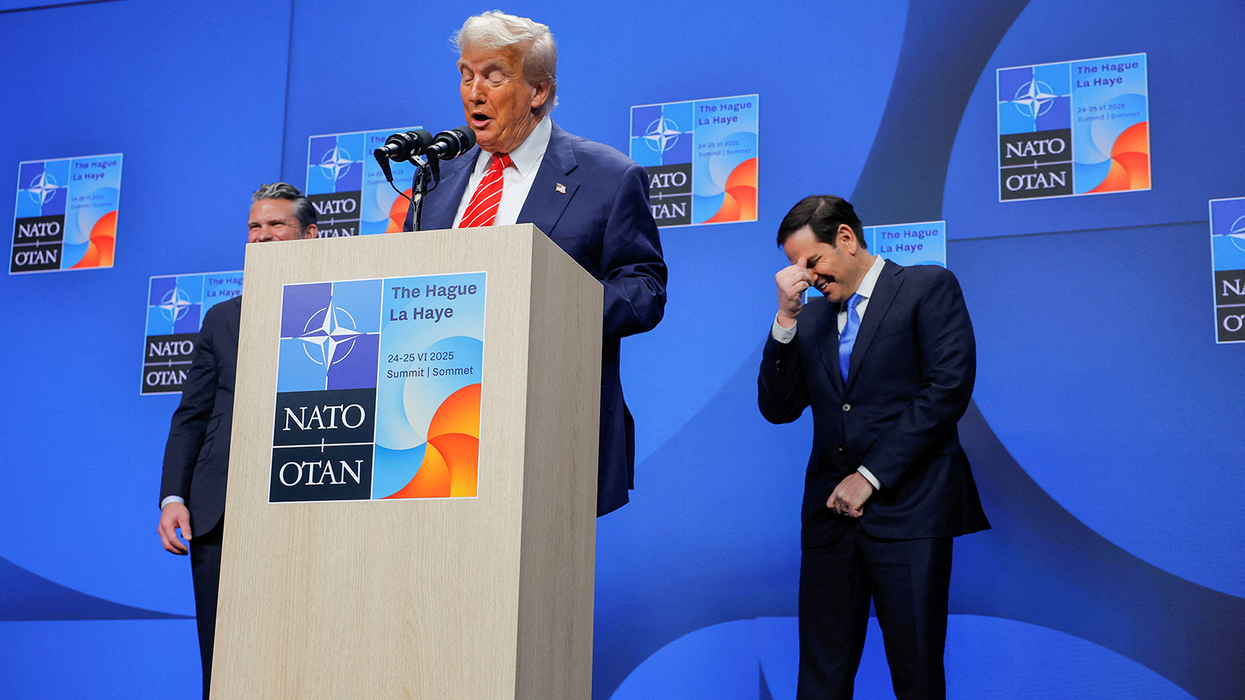
U.S. President Donald Trump speaks at a press conference, as Secretary of Defense Pete Hegseth and Secretary of State Marco Rubio react to a Sky News reporter's question about NATO Secretary General Mark Rutte calling President Trump 'daddy', at the NATO summit in The Hague, Netherlands, June 25, 2025. REUTERS/Brian Snyder
President Donald Trump issued a warning to NATO on Wednesday morning.
Taking to Truth Social, Trump wrote, "The United States needs Greenland for the purpose of National Security. It is vital for the Golden Dome that we are building. NATO should be leading the way for us to get it. IF WE DON’T, RUSSIA OR CHINA WILL, AND THAT IS NOT GOING TO HAPPEN! Militarily, without the vast power of the United States, much of which I built during my first term, and am now bringing to a new and even higher level, NATO would not be an effective force or deterrent - Not even close! They know that, and so do I. NATO becomes far more formidable and effective with Greenland in the hands of the UNITED STATES.
Anything less than that is unacceptable. Thank you for your attention to this matter! President DJT"
Russia and China are closer to the United States land through Alaska than they are to Greenland.
The U.S. also already has a Space Force base on Greenland. The Island is also part of NATO since it is part of Denmark. So, if Greenland is attacked by China and Russia NATO is attacked and all members will fight back.
Russian President Vladimir Putin has long sought to eliminate NATO, Business Insider explained in a report after the invasion of Crimea.
"Trump declares war on Greenland, Denmark, and NATO. Will someone remove this man from office before he has the armed forces killing and dying all over the world. Well, we do now. This is much worse. Putin over Nato? I take NATO. National healthcare. But I was born into the big lie," commented a self-described intelligence worker named John Burden.
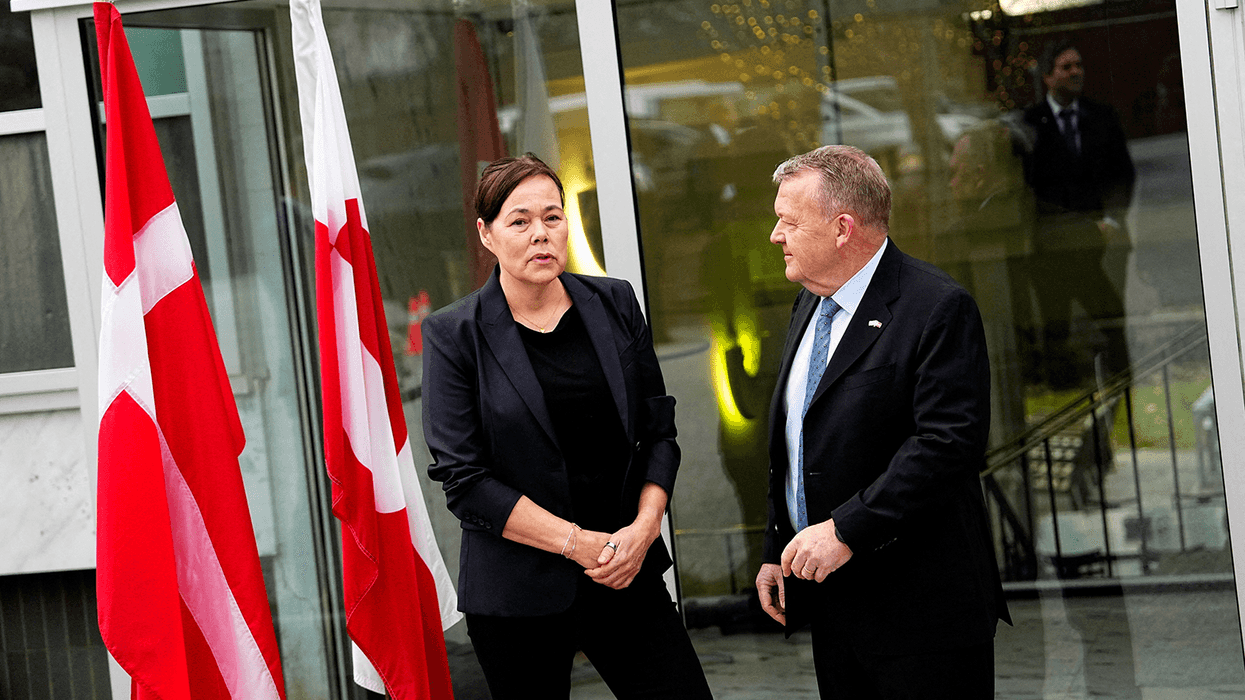
Denmark's Foreign Minister Lars Loekke Rasmussen and Greenland's Foreign Minister Vivian Motzfeldt at the Danish embassy for a meeting with US leaders January 14, 2026.
A possible war with NATO is escalating after Denmark made it clear to military leaders that if the United States fires on its forces, Danish defenders must fight back.
The comments come after Stephen Miller, a top aide to President Donald Trump, told CNN that there were only 30,000 residents of Greenland, leading him to conclude that no one would fight back against the United States if it took over the Arctic island.
“Danish military units have a duty to defend Danish territory if it is subjected to an armed attack, including by taking immediate defensive action if required,” Danish Defense Command spokesperson Tobias Roed Jensen, said when speaking to The Intercept.
The 1952 royal decree applies to the Kingdom of Denmark, of which Greenland is still a part.
Such an order ensures that “Danish forces can act to defend the Danish kingdom in situations where Danish territory or Danish military units are attacked, even if circumstances make it impossible to await further political or military instruction,” Jensen added.
Swedish Prime Minister Ulf Kristersson confirmed the news on X, saying that Swedish Armed Forces officers were also joining the Danish military.
"Together, they will prepare for upcoming elements within the framework of the Danish exercise Operation Arctic Endurance. It is at Denmark's request that Sweden is sending personnel from the Armed Forces," he said, according to a translation on X.
Thus far, Denmark’s willingness to stand up to the U.S. has not deterred orders from the Trump administration.
“One way or the other, we’re going to have Greenland,” Trump announced on Sunday.
Trump has also claimed that Russian and Chinese “destroyers and submarines” are “all over the place” in Greenland. He has argued that if the U.S. does not take Greenland, they will. Trump maintains that owning the island is the only way to protect it, even though, as part of NATO, the United States is already obligated to defend it.
Rep. Randy Fine (R-Fla.) backed him up on it by introducing legislation authorizing the use of force to annex Greenland, even if that meant leaving NATO and starting a war with Europe.
Trump’s critics responded with their own legislation, the No Funds for NATO Invasion Act, which would bar any federal dollars from being used to invade a NATO member state. Congress’s remaining leverage over Trump is its control of the budget.
Trump mocked, “Their defense is two dog sleds."
Though that isn't entirely accurate. Despite the small size of the Greenland military, Denmark and NATO could be sent to protect the island from the U.S.
Reporter Benjamin Alvarez, U.S. Correspondent for Deutsche Welle, confirmed that the soldiers were sent quickly.
Sweden's "Expressen" reported that the Swedish Armed Forces are arriving in Greenland on Wednesday, a Google translation of the article said.
Oddly, the State Department approved "a possible Foreign Military Sale to the Government of Denmark of maritime patrol and reconnaissance aircraft worth an estimated $1.8 billion," said The Intercept.
The foreign ministers of Denmark and Greenland are meeting Wednesday with Secretary of State Marco Rubio.
Read the full report here.
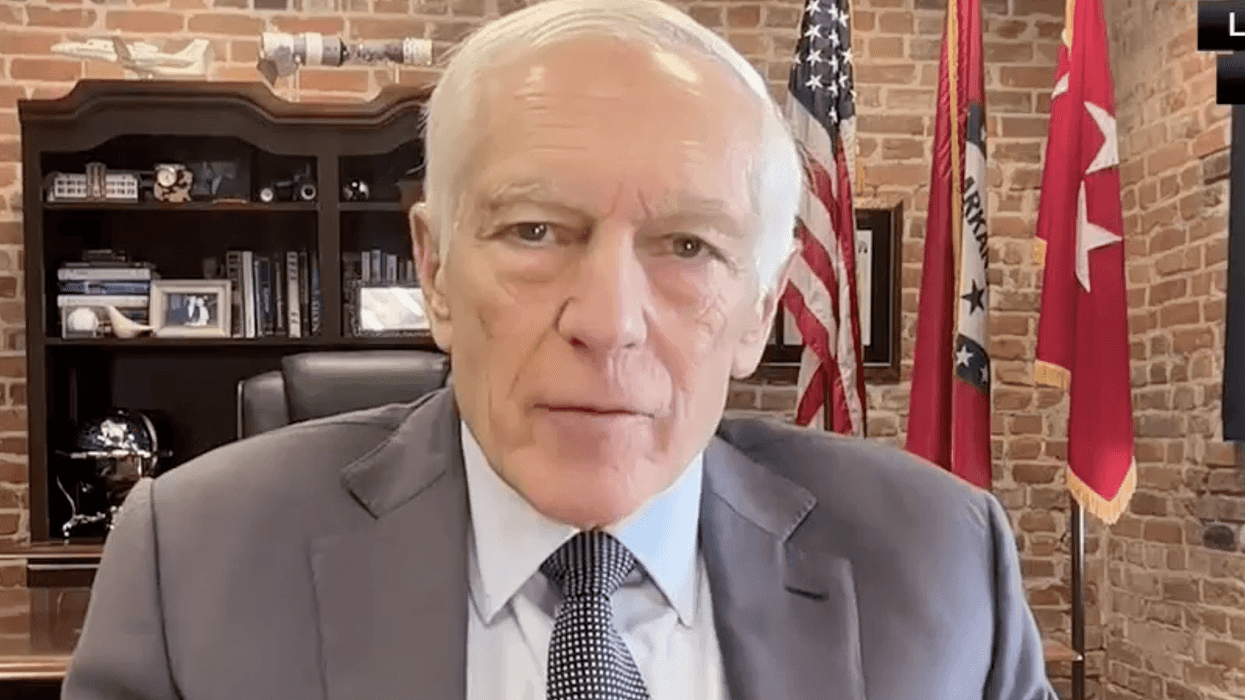
Retired 4-star general Wesley Clark on CNN on January 14, 2026
Retired U.S. General Wesley Clark, former Supreme Allied Commander of Europe, said that there is no reason for the United States to take over Greenland to accomplish national security goals.
Greenland, which already has a Space Force base on the island, has called in soldiers from Denmark and Sweden to support it in a possible military conflict with the U.S.
"It would certainly seem to be the case that you could set up an arrangement and put the bases in that you want. You could do the patrols. You can bring the Danes in with you in a joint headquarters. You could call it national security control of Denmark, [but it] doesn't have to necessarily mean ownership. Just have the control. You could also set up the same arrangement with, let's say, economic exploration of minerals in Greenland. So there are different ways to go at this other than simply saying you've got to own the territory," Clark explained.
CNN host Boris Sanchez was curious about why Trump would pursue a kind of hostile takeover of a NATO ally.
Clark noted that Trump has indicated it makes him more comfortable to own Greenland because he thinks that Russia and China will take the Arctic island. Doing so would trigger a war with NATO, which includes the United States.
"But, you know, he's the president. That's what he wants to do. There are alternatives to this that would be more palatable. I think it has put a lot of stress on NATO," he added.
Clark explained that he's not aware of the specific details about Trump's plans to understand why simply "putting assets in Greenland would be less effective than, let's say, legal ownership of the territory. the territory."
"I do feel that these relationships in the Arctic are changing," he continued. "Russia is up there, and they're challenging us. China wants the Northwest Passage over the top of Siberia to get to Europe on a shorter route. There's a lot of challenges in the Arctic coming. And the United States really hasn't prepared for it very well."
He noted that the U.S. doesn't have icebreakers like Russia does.
"We need to work in the Arctic, but we can have all the access we need under the existing arrangements in Greenland, it seems to me," Clark said. "So, maybe there's something here that we don't see."
He added that he hopes the meeting with Secretary of State Marco Rubio "turns out the right way and gives us whatever shred of additional control that we need."
NATO could set up an Arctic command, he said, as an option.
"But again, this proliferates commands, and the Pentagon has been trying to reduce the number of commands. But there are many ways to go after this," he closed.
Watch the segment below:
Spectral Threats: China, Russia and Trump’s Greenland Rationale
The concerns about China and Russia seizing Greenland retells the same nonsense President Donald Trump promoted in kidnapping the Venezuelan President Nicolás Maduro and his wife. Looking past the spurious narcoterrorism claims against the former leader, it fell to the issue of who would control the natural resources of the country. If we don’t get Venezuelan oil now and secure it for American companies, the Chinese or the Russians will. The gangster’s rationale is crudely reductionist, seeing all in a similar vein.
The obsession with Beijing and Moscow runs like a forced thread through a dotty, insular rationale that repels evidence and cavorts with myth: “We need that [territory],” reasons the President, “because if you take a look outside Greenland right now, there are Russian destroyers, there are Chinese destroyers and, bigger, there are Russian submarines all over the place. We are not gonna have Russia or China occupy Greenland, and that’s what they’re going to do if we don’t.” On Denmark’s military capabilities in holding the island against any potential aggressor, Trump could only snort with macho dismissiveness. “You know what their defence is? Two dog sleds.”
This scratchy logic is unsustainable for one obvious point. Were Russia or China to attempt an occupation of Greenland through military means, Article V of the North Atlantic Treaty would come into play, obliging NATO member states, including the United States, to collectively repel the effort. With delicious perversity, any US effort to forcibly acquire the territory through use of force would be an attack on its own security, given its obligations under the Treaty. In such cases, it becomes sound to assume, as the Danish Prime Minister Mette Frederiksen does, that the alliance would cease to exist.
Such matters are utterly missed by the rabidly hawkish Deputy Chief of Staff Stephen Miller, who declared that, “Nobody’s going to fight the United States militarily over the future of Greenland.” It was up to the US “to secure the Arctic region, to protect and defend NATO and NATO interests” in incorporating Greenland. To take territory from a NATO ally was essentially doing it good.
Given that the United States already has a military presence on the island at the Pituffik Space Base, and rights under the 1951 agreement that would permit an increase in the number of bases should circumstances require it, along with the Defence Cooperation Agreement finalised with Copenhagen in June 2025, much of Miller’s airings are not merely farcical but redundant. Yet, Trump has made it clear that signatures and understandings reflected in documents are no substitute for physically taking something, the thrill of possession that, by its act, deprives someone else of it. “I think ownership gives you a thing that you can’t do, whether you’re talking about a lease or a treaty,” he told the New York Times. “Ownership gives you things and elements that you can’t get from just signing a document.”
What, then, of these phantom forces from Moscow and Beijing, supposedly lying in wait to seize the frozen prize? “There are no Russian and Chinese ships all over the place around Greenland,” states the very convinced research director of the Oslo-based Fridtjof Nansen Institute, Andreas Østhagen. “Russia and/or China has no capacity to occupy Greenland or to take control over Greenland.”
Danish Foreign Minister Lars Lokke Rasmussen is similarly inclined. “The image that’s being painted of Russian and Chinese ships right inside the Nuuk fjord and massive Chinese investments being made is not correct.” Senior “Nordic diplomats” quoted in the Financial Times add to that version, even if the paper is not decent enough to mention which Nordic country they come from. “It is simply not true that the Chinese and Russians are there,” said one. “I have seen the intelligence. There are no ships, no submarines.” Vessel tracking data from Marine Traffic and LSEG have so far failed to disclose the presence of Chinese and Russian ships near the island.
Heating engineer Lars Vintner, based in Greenland’s capital, Nuuk, wondered where these swarming, spectral Chinese were based. “The only Chinese I see,” he told Associated Press, “is when I go to the fast food market.” This sparse presence extends to the broader security footprint of China in the Arctic, which remains modest despite a growing collaboration with Russia since the 2022 invasion of Ukraine. These have included Arctic and coast guard operations, while the Chinese military uses satellites and icebreakers equipped with deep-sea mini submarines, potentially for mapping the seabed.
However negligible and piffling the imaginary threat, analysts, ever ready with a larding quote or a research brief, are always on hand to show concern with such projects as Beijing’s Polar Silk Road, announced in 2018, which is intended as the Arctic extension of its transnational Belt and Road initiative. The subtext: Trump should not seize Greenland, but he might have a point. “China has clear ambitions to expand its footprint and influence in the region, which it considers… an emerging arena for geopolitical competition.” Or so says Helena Legarda of the Mercator Institute for China Studies in Berlin.
The ludicrous nature of Trump’s claims and acquisitive urges supply fertile material for sarcasm. A prominent political figure from one of the alleged conquerors-to-be made an effort almost verging on satire. “Trump needs to hurry up,” mocked the Deputy Chairman of the Russian Security Council and former President Dmitry Medvedev. “According to unverified information, within a few days, there could be a sudden referendum where all 55,000 residents of Greenland might vote to join Russia. And that’s it!” With Trump, “that’s it” never quite covers it.
Ewan Gleadow
January 14, 2026
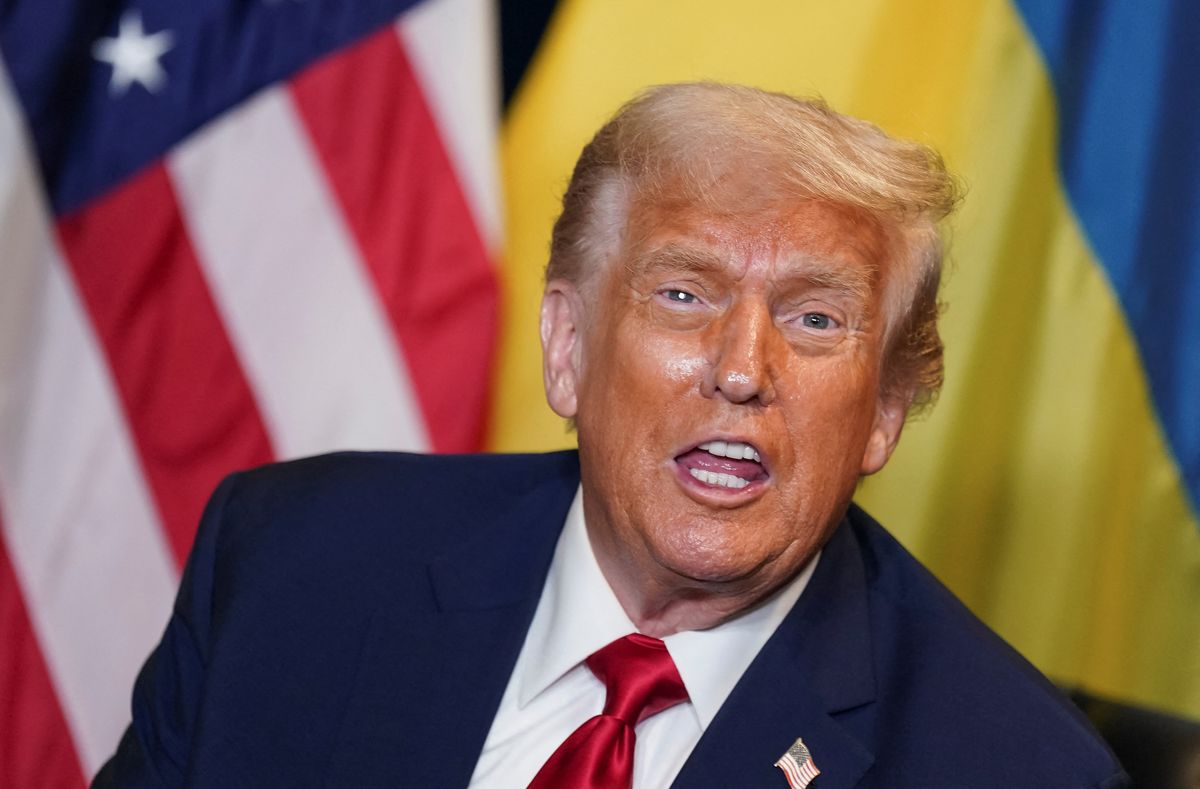
President Donald Trump speaks as he meets with Ukrainian President Volodymyr Zelenskiy (not pictured) during the 80th United Nations General Assembly, in New York City, New York on Sept. 23, 2025. REUTERS/Al Drago
Donald Trump's voter base is starting to turn on him as his biggest supporters question his reasoning for a potential invasion of a foreign ally.
The president made it clear that he wanted to take the Kingdom of Denmark's territory of Greenland in a move that would allegedly bolster national security. Natural mineral deposits have also been cited as a reason for the Trump administration's interest by some political commentators.
Those who voted for Trump in the 2024 election believe the president has no right to threaten military action against the country, and that the administration should not interfere in Greenland. A collection of Trump voters, speaking to the New York Times, voiced their opposition to the administration's continued push for territory.
Heather, a 55-year-old Republican, said that the administration's actions in Venezuela are understandable but there is no need for Greenland to be in the conversation. She said, "In Venezuela, we need to go in and not just take him [President Nicolás Maduro] out. We need to get rid of his entire cabinet, everybody that was underneath him that is following in his footsteps and start afresh."
"But also, Venezuela is hopefully more for the people’s sake, to end the suffering for them. Greenland just seems more of a – why are we there? What do we need from Greenland? I mean, there’s no conflict there. Can we just bring the focus back to somewhere else in America?"
Fellow Republican voter Bill, 62, suggested there was an argument to be made for the natural resources on Greenland but that a want for those did not give Trump a right to use the military against the country. He said, "Greenland has resources that Trump wants to be able to take advantage of. But what gives him the right to go in militarily and take it?"
Daniel,. 54, says there is an obvious comparison between Trump's threats to Greenland and what Putin is "doing to Ukraine." He added, "What gives him the right to do that as well? So it just doesn't feel right. It's a negative impact, I believe, on the United States."
Bill added, "And if he does go into Greenland with force, if you read today’s news, they talk about how all of the NATO countries over there are not happy with that. That could spell the end of NATO."
Trump, in a recent post to Truth Social, reiterated the US needs Greenland "for the purpose of National Security. It is vital for the Golden Dome that we are building."
Ewan Gleadow
January 14, 2026
RAW STORY
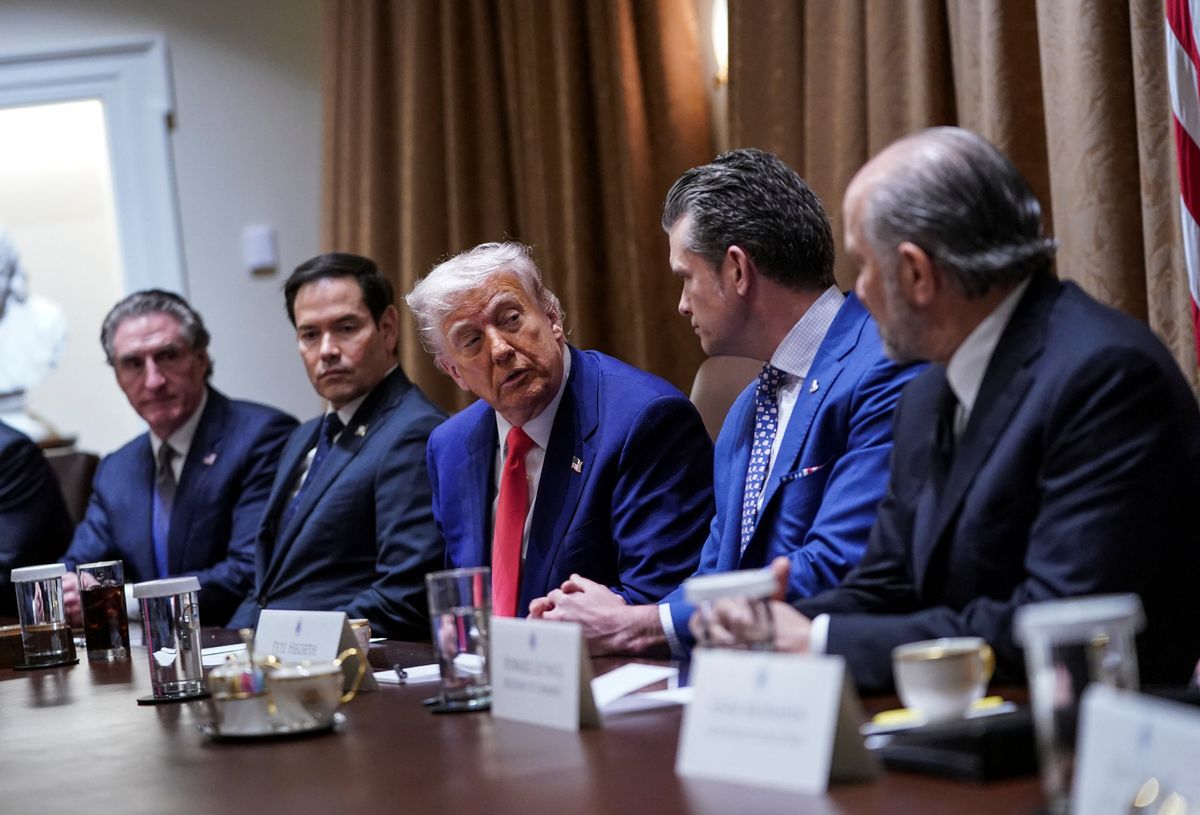
U.S. President Donald Trump attends a cabinet meeting at the White House in Washington, D.C., U.S., April 10, 2025. REUTERS/Nathan Howard
Donald Trump may be convinced to leave Greenland alone should Europe "repackage" security measures and "put a big bow on top" of a potential deal.
The president made it clear he wanted the Kingdom of Denmark's territory for security reasons but has faced resistance from NATO nations. A European Union diplomat familiar with the details of one proposed plan has suggested it could be enough to convince Trump to leave Greenland alone if other nations can make security assurances.
Speaking to Politico, the unnamed insider said, "If you can smartly repackage Arctic security, blend in critical minerals, put a big bow on top, there’s a chance." They added that "this is always how things have gone" when negotiating on defense.
But another diplomat says Trump will not be as easily swayed as some are hoping. The insider suggested the Make America Great Again slogan had become "a geographical concept; he wants to go down in history as the man who has made America ‘greater’ — in geographical terms".
German Defense Minister Boris Pistorius has since warned that, should Trump approve military action in Greenland, it would be unlike anything the organization had dealt with since its founding in 1947.
Minister Pistorius said, "It would be an unprecedented situation in the history of NATO and any defense alliance. EU Defense Commissioner Andrius Kubilius and Danish Prime Minister Mette Fredriksen have both said NATO "would stop" should Trump breach its rules.
A third unnamed diplomat added, "This is serious - and Europe is scared." EU countries have already been urged to "cut the cord" with Trump's administration should he pursue an invasion of Greenland.
Alexander Hurst, writing in The Guardian, suggested EU leaders must stand against the new image of the US as an "active and hostile" threat to friendly nations.
He wrote, "Will its leaders have the courage to tell the full truth – that the US isn’t simply abandoning its allies and destroying the international order but is now in the position of active and hostile predation by force – and more importantly, to act on it?"
"Donald Trump has already set the tone by saying the US will seize Greenland 'one way or the other', and no part of the triumvirate around him is trying to hide their imperial intentions any more."
Robert Davis
January 13, 2026
RAW STORY
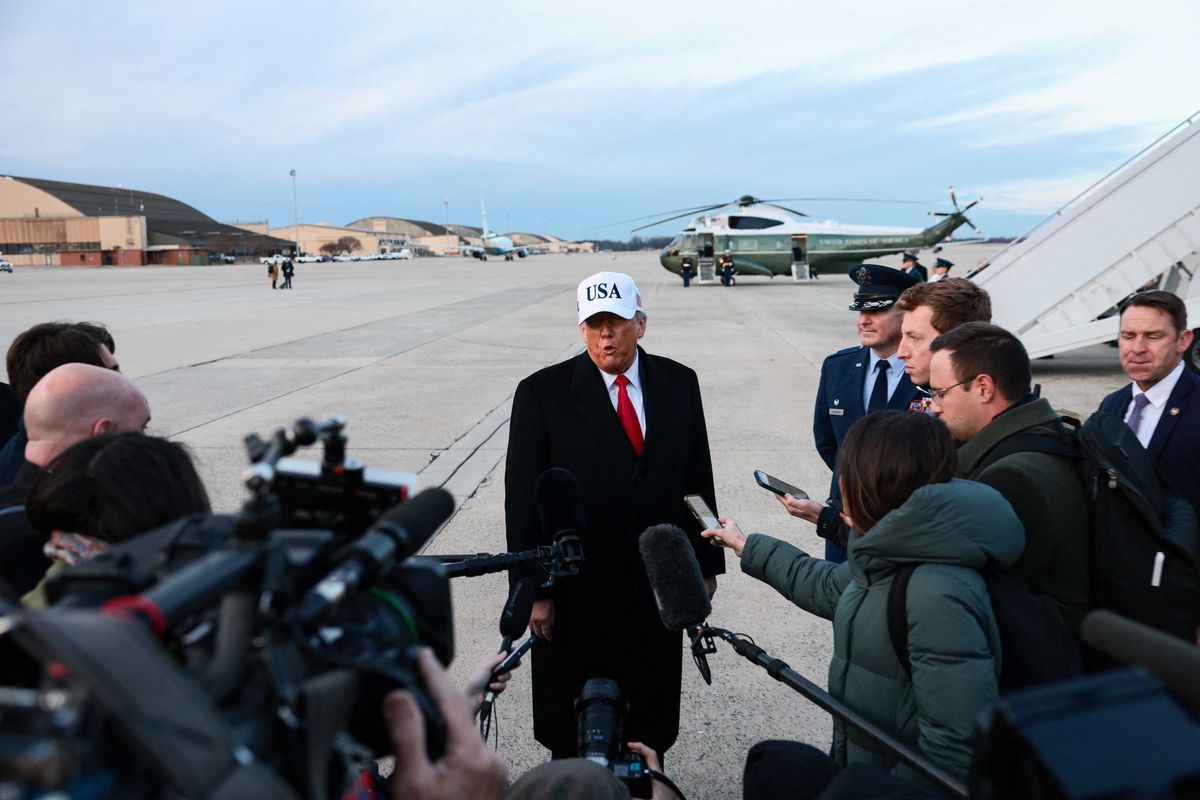
U.S. President Donald Trump speaks to reporters, on his return from Detroit, Michigan, at Joint Base Andrews, Maryland, U.S., January 13, 2026. REUTERS/Evelyn Hockstein
President Donald Trump threatened yet another foreign leader on Tuesday during a press gaggle at Joint Base Andrews after returning to Washington, D.C. from a brief trip to Detroit.
Earlier in the day, Greenland Prime Minister Jens-Frederik Nielsen said his country would rather stay as part of Denmark than become part of the U.S. Nielsen's comments come at a time when Trump has upped the ante against Greenland, saying the U.S. needs to control the island nation for its own national security.
Nielsen's comments apparently didn't sit well with Trump, who was asked to respond to them during the press gaggle.
"That's their problem," Trump said. "I disagree with them. I don't know who he is, don't know anything about him, but that's going to be a big problem."
Nielsen is just the latest foreign leader that Trump has threatened in recent weeks. He has also threatened the Colombian President Gustavo Petro and Mexican President Claudia Sheinbaum over their country's drug policies. The threats followed Trump's middle-of-the-night operation to capture Venezuelan President Nicolás Maduro and bring him to the U.S. to stand trial for narco-terrorism charges.
The Trump administration's moves against foreign officials also come at a time when the administration has faced accusations its seeking to distract from the ongoing release of the Jeffrey Epstein files. Recently released files painted Trump's relationship with the disgraced financier and convicted sex criminal in an unsavory light.

No comments:
Post a Comment