US urges partners and allies to increase critical minerals supply chain resiliency
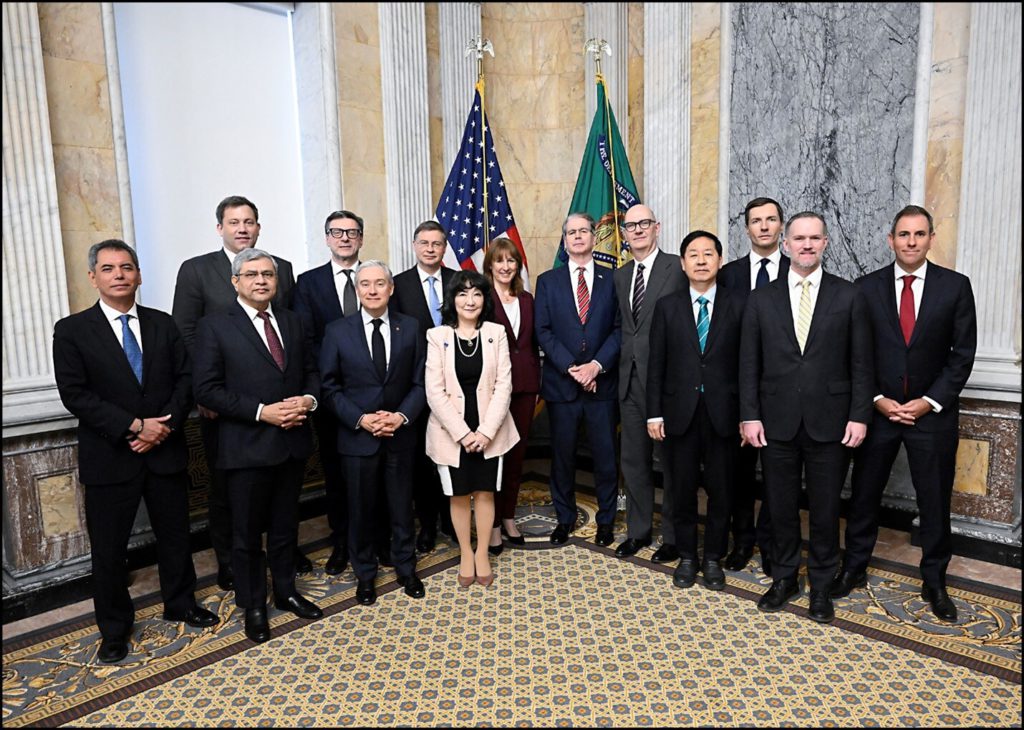
US Treasury Secretary Scott Bessent held a meeting on Monday with ministers from different US partners and allies, urging those nations to increase their supply chain resiliency, the Treasury Department said.

Bessent hosted his counterparts in Washington “to discuss solutions to secure and diversify supply chains for critical minerals, especially rare earth elements,” the department said in a statement.
A US official said on Sunday that Bessent was going to urge those countries to step up their efforts to reduce reliance on critical minerals from China, which has imposed strict export controls on rare earths.
Bessent expressed optimism nations will pursue “prudent derisking over decoupling,” and that they understand the need to remedy current deficiencies in critical minerals supply chains, the department said.
The meeting had representatives from Australia, Canada, the European Union, France, Germany, India, Italy, Japan, Mexico, South Korea and the United Kingdom, the Treasury Department said.
Together, they account for 60% of global demand for critical minerals.
China dominates the critical minerals supply chain, refining between 47% and 87% of copper, lithium, cobalt, graphite and rare earths, according to the International Energy Agency. These minerals are used in defense technologies, semiconductors, renewable energy components, batteries and refining processes.
Last week, China banned exports of items destined for Japan’s military that have civilian and military uses, including some critical minerals.
(By Kanishka Singh; Editing by Jamie Freed)
The Critical Minerals Conundrum: Why Reducing Reliance on China is So Hard
- A global competition for critical minerals, essential for energy and tech sectors, has become a central concern for national security and is redefining global geopolitics.
- China maintains a near-monopoly on the refining of rare earth minerals, supplying 85–95 percent of the world's refined supply, a position it has used as a geopolitical bargaining chip.
- In response to China's leverage, countries like Japan and the United States are accelerating efforts to develop alternative supply chains, including deep-sea mining trials and increased resource diplomacy in emerging economies.
A race for critical minerals is redefining global geopolitics as world powers rush to shore up supply chains of the finite materials that power the energy and tech sectors. Demand for rare earth metals and other critical minerals has seen a meteoric rise in recent years as the world increasingly electrifies and the tech sector becomes ever more robust and omnipresent. Due to the central role of these ingredients in global and national economies, competition for these supply chains is far more than just a commercial concern – it’s become a central platform for national security for many countries.
According to Lexology, this shift from private to public went into overdrive in 2025, and shows no signs of slowing down. “Governments are stepping directly into project development, deploying public capital, tightening investment controls and forming new alliances to secure access to key minerals,” reports the law business research and information platform. “These developments are reshaping how projects are financed, regulated and progressed and are creating a more complex landscape for developers, investors and advisers navigating critical minerals markets,” the brief goes on to say.
These projects are being prioritized on a global scale because the current critical minerals landscape is characterized by an extreme level of concentration. China alone has dominated the global market since the late 1990s, and now supplies about 85–95 percent of the world’s refined rare earth minerals thanks to a near-monopoly on refining capacities. At a global level, Chinese refineries supply 68 percent of cobalt, 65 percent of nickel, and 60 percent of EV-battery-grade lithium. A handful of other countries are also sitting on significant reserves of critical minerals, but lack infrastructure to process them in an efficient or cost-effective manner.
And China is not afraid to weaponize this geopolitical leverage for political gain. Beijing has used its critical minerals trade as a bargaining chip throughout the ebbs and flows of Donald Trump’s trade war with Xi Jinping, and is now threatening to cut off supplies to Japan due to the latter country’s support for a free Taiwan – a hot-button issue for China, which seeks to annex the independent island nation.
In response, Japan is looking for innovative ways to ease its dependence on Chinese supply chains. This month, Japan launched the world’s first deep-sea mining trial to extract rare earth minerals from 6 kilometers below sea level. This ambitious project has been a long time in the making, but couldn’t be setting sail at a more critical time. "After seven years of steady preparation, we can finally begin the confirmation tests. It's deeply moving," Shoichi Ishii, the head of the government-backed project, recently told Reuters. "If this project succeeds, it will be of great significance in diversifying Japan's rare earth resource procurement," he added.
Japan is not the only country trying to reduce its dependence on Chinese supply chains. China has also threatened to cut off supplies to the United States amid an ongoing trade dispute, and the United States is expected to retaliate. Semafor reports that U.S. Treasury Secretary Scott Bessent is expected to apply pressure to other G7 nations – together representing 60% of global rare earths demand – to ramp up their own efforts to wean themselves off of Chinese imports.
However, reducing reliance on Chinese supply chains is far easier said than done. Until alternative supply chains are developed, Chinese rare earths are essentially the only (affordable) game in town. Plus, these minerals are only available in certain geographies, and establishing access can be a political minefield. While Japan is endeavoring to find new ways of producing these materials domestically, China and the United States are focusing on working their ways into emerging economies that have rich deposits of these increasingly valuable materials.
China, for its part, has spent decades building up relationships and industries across the globe through its expansive Belt and Road program. The United States, by comparison, lags far behind in such traditional trade relations and economic diplomacy, leading to Trump’s current “takeover” approach to catching up, as seen in the case of Greenland and Venezuela.
By Haley Zaremba for Oilprice.com
- A global competition for critical minerals, essential for energy and tech sectors, has become a central concern for national security and is redefining global geopolitics.
- China maintains a near-monopoly on the refining of rare earth minerals, supplying 85–95 percent of the world's refined supply, a position it has used as a geopolitical bargaining chip.
- In response to China's leverage, countries like Japan and the United States are accelerating efforts to develop alternative supply chains, including deep-sea mining trials and increased resource diplomacy in emerging economies.
A race for critical minerals is redefining global geopolitics as world powers rush to shore up supply chains of the finite materials that power the energy and tech sectors. Demand for rare earth metals and other critical minerals has seen a meteoric rise in recent years as the world increasingly electrifies and the tech sector becomes ever more robust and omnipresent. Due to the central role of these ingredients in global and national economies, competition for these supply chains is far more than just a commercial concern – it’s become a central platform for national security for many countries.
According to Lexology, this shift from private to public went into overdrive in 2025, and shows no signs of slowing down. “Governments are stepping directly into project development, deploying public capital, tightening investment controls and forming new alliances to secure access to key minerals,” reports the law business research and information platform. “These developments are reshaping how projects are financed, regulated and progressed and are creating a more complex landscape for developers, investors and advisers navigating critical minerals markets,” the brief goes on to say.
These projects are being prioritized on a global scale because the current critical minerals landscape is characterized by an extreme level of concentration. China alone has dominated the global market since the late 1990s, and now supplies about 85–95 percent of the world’s refined rare earth minerals thanks to a near-monopoly on refining capacities. At a global level, Chinese refineries supply 68 percent of cobalt, 65 percent of nickel, and 60 percent of EV-battery-grade lithium. A handful of other countries are also sitting on significant reserves of critical minerals, but lack infrastructure to process them in an efficient or cost-effective manner.
And China is not afraid to weaponize this geopolitical leverage for political gain. Beijing has used its critical minerals trade as a bargaining chip throughout the ebbs and flows of Donald Trump’s trade war with Xi Jinping, and is now threatening to cut off supplies to Japan due to the latter country’s support for a free Taiwan – a hot-button issue for China, which seeks to annex the independent island nation.
In response, Japan is looking for innovative ways to ease its dependence on Chinese supply chains. This month, Japan launched the world’s first deep-sea mining trial to extract rare earth minerals from 6 kilometers below sea level. This ambitious project has been a long time in the making, but couldn’t be setting sail at a more critical time. "After seven years of steady preparation, we can finally begin the confirmation tests. It's deeply moving," Shoichi Ishii, the head of the government-backed project, recently told Reuters. "If this project succeeds, it will be of great significance in diversifying Japan's rare earth resource procurement," he added.
Japan is not the only country trying to reduce its dependence on Chinese supply chains. China has also threatened to cut off supplies to the United States amid an ongoing trade dispute, and the United States is expected to retaliate. Semafor reports that U.S. Treasury Secretary Scott Bessent is expected to apply pressure to other G7 nations – together representing 60% of global rare earths demand – to ramp up their own efforts to wean themselves off of Chinese imports.
However, reducing reliance on Chinese supply chains is far easier said than done. Until alternative supply chains are developed, Chinese rare earths are essentially the only (affordable) game in town. Plus, these minerals are only available in certain geographies, and establishing access can be a political minefield. While Japan is endeavoring to find new ways of producing these materials domestically, China and the United States are focusing on working their ways into emerging economies that have rich deposits of these increasingly valuable materials.
China, for its part, has spent decades building up relationships and industries across the globe through its expansive Belt and Road program. The United States, by comparison, lags far behind in such traditional trade relations and economic diplomacy, leading to Trump’s current “takeover” approach to catching up, as seen in the case of Greenland and Venezuela.
By Haley Zaremba for Oilprice.com

No comments:
Post a Comment