International solidarity, not liberal imperialism, is the only way to stop Trump’s global class war.'
By Ashley Smith ,
January 24, 2026
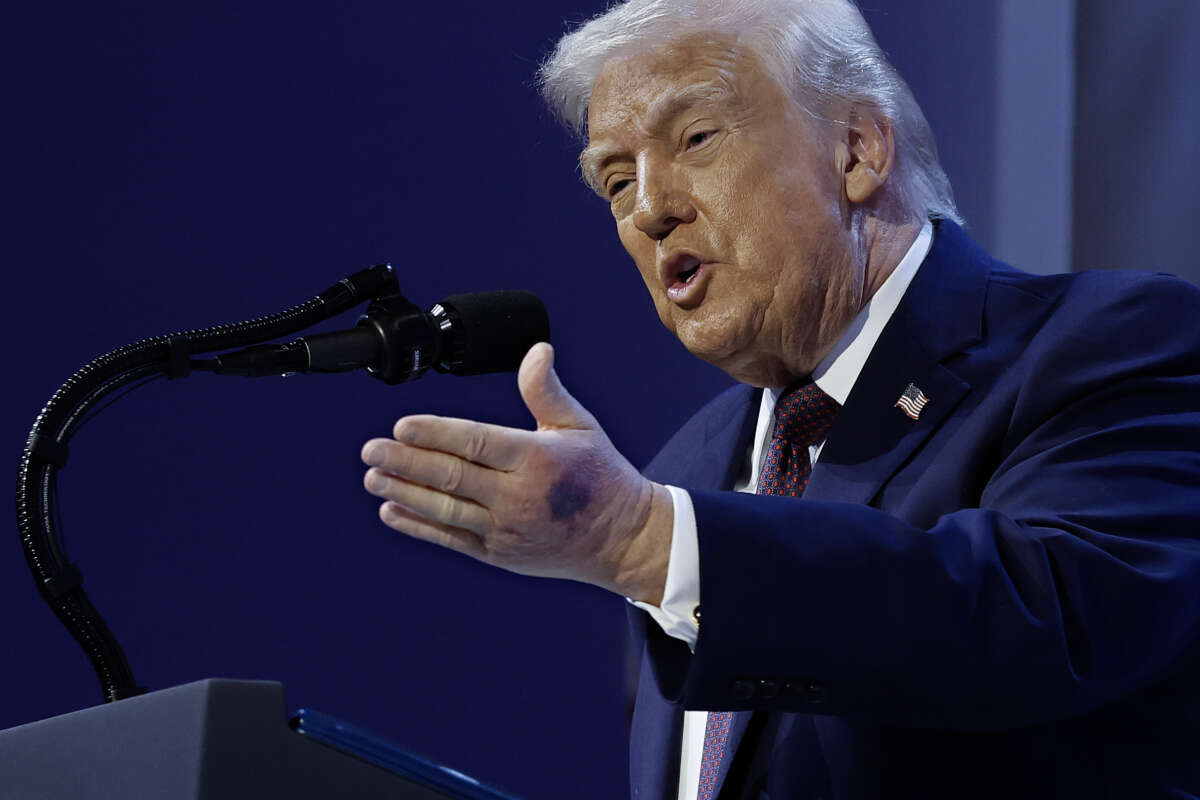
Donald Trump speaks during a signing ceremony for the “Board of Peace” at the World Economic Forum (WEF) on January 22, 2026, in Davos,
Somodevilla / Getty Images
President Donald Trump’s National Security Strategy (NSS) is the crudest articulation yet of his authoritarian nationalist project. It promises to smash the so-called rules-based international order Washington has superintended since the end of the Cold War. The U.S., of course, repeatedly violated that order’s stated principles, like sovereignty and self-determination, most recently with the Biden administration’s support for Israel’s genocidal war in Gaza.
Despite its hypocrisy, the U.S. had attempted to integrate the world’s states into multilateral economic and political institutions, forge alliances to deter, contain, or overthrow its rivals, and police countries and regions torn apart by its program of free trade globalization. Trump claims that such liberal imperialism overextended the U.S., caused its relative decline, and enabled the rise of its competitors, especially China. His Secretary of State, Marco Rubio, declared, “The postwar global order is not just obsolete, it is now a weapon being used against us.”
To restore U.S. power, Trump’s NSS announces a new Trump Corollary to the Monroe Doctrine, a so-called Donroe Doctrine. Instead of global hegemony, it aims to carve out an exclusive U.S. sphere of influence in the Western Hemisphere, install pliant regimes, plunder their resources, and wield state power against migrants. The strategy as a whole has already born bitter fruit; Trump’s ICE agents killed immigrant solidarity activist Renee Good, his special forces carried out a coup in Venezuela, and his administration threatens to annex Greenland. His strategy will bring not “peace through strength,” but class war, brutal scapegoating of the oppressed, and imperial rivalry over the division of global capitalism.
The Return of Great Power Conflict
Trump’s strategy is a response to today’s asymmetric multipolar order. While the U.S. remains the dominant imperialist power, it faces a global imperial rival in China, an outsized regional power in Russia, and a host of lesser ones like Iran and Brazil. The U.S., China, and Russia have become more assertive of their interests, spurring military aggression as each stakes claims in their regions.
Russia invaded Ukraine to rebuild its former empire and challenge NATO’s hegemony in Europe. China has projected its power in the Asia-Pacific region, threatening Taiwan and clashing with, among others, Japan, the Philippines, and, behind them all, the U.S. Washington backed Israel to crush Hamas and destroy Iran’s so-called axis of resistance to reassert U.S. dominance over Middle East’s strategic energy reserves, which China relies on to fuel its economy.
In response to these developments, Washington abandoned its grand strategy of superintending global capitalism to confront its great power rivals. The Obama administration started this shift with its Pivot to Asia to contain China and plan to reset relations with Russia, but those both failed. In his first term, Trump introduced a new strategy of illiberal hegemony focused on great power competition with China and Russia, but his regime’s incompetence and divisions prevented its implementation, leaving the U.S. weaker, its allies alienated, and rivals emboldened.
The Biden administration tried to refurbish U.S. imperialism, rebuild Washington’s alliances, and defend the so-called rules-based international order. Biden exploited Russia’s invasion of Ukraine to rally its allies together against both Moscow and Beijing. But he undermined this project with his support for Israel’s genocidal war on Gaza, which enabled China and Russia to expose Washington’s hypocrisy.
Despite its hypocrisy, the U.S. had attempted to integrate the world’s states into multilateral economic and political institutions, forge alliances to deter, contain, or overthrow its rivals, and police countries and regions torn apart by its program of free trade globalization. Trump claims that such liberal imperialism overextended the U.S., caused its relative decline, and enabled the rise of its competitors, especially China. His Secretary of State, Marco Rubio, declared, “The postwar global order is not just obsolete, it is now a weapon being used against us.”
To restore U.S. power, Trump’s NSS announces a new Trump Corollary to the Monroe Doctrine, a so-called Donroe Doctrine. Instead of global hegemony, it aims to carve out an exclusive U.S. sphere of influence in the Western Hemisphere, install pliant regimes, plunder their resources, and wield state power against migrants. The strategy as a whole has already born bitter fruit; Trump’s ICE agents killed immigrant solidarity activist Renee Good, his special forces carried out a coup in Venezuela, and his administration threatens to annex Greenland. His strategy will bring not “peace through strength,” but class war, brutal scapegoating of the oppressed, and imperial rivalry over the division of global capitalism.
The Return of Great Power Conflict
Trump’s strategy is a response to today’s asymmetric multipolar order. While the U.S. remains the dominant imperialist power, it faces a global imperial rival in China, an outsized regional power in Russia, and a host of lesser ones like Iran and Brazil. The U.S., China, and Russia have become more assertive of their interests, spurring military aggression as each stakes claims in their regions.
Russia invaded Ukraine to rebuild its former empire and challenge NATO’s hegemony in Europe. China has projected its power in the Asia-Pacific region, threatening Taiwan and clashing with, among others, Japan, the Philippines, and, behind them all, the U.S. Washington backed Israel to crush Hamas and destroy Iran’s so-called axis of resistance to reassert U.S. dominance over Middle East’s strategic energy reserves, which China relies on to fuel its economy.
In response to these developments, Washington abandoned its grand strategy of superintending global capitalism to confront its great power rivals. The Obama administration started this shift with its Pivot to Asia to contain China and plan to reset relations with Russia, but those both failed. In his first term, Trump introduced a new strategy of illiberal hegemony focused on great power competition with China and Russia, but his regime’s incompetence and divisions prevented its implementation, leaving the U.S. weaker, its allies alienated, and rivals emboldened.
The Biden administration tried to refurbish U.S. imperialism, rebuild Washington’s alliances, and defend the so-called rules-based international order. Biden exploited Russia’s invasion of Ukraine to rally its allies together against both Moscow and Beijing. But he undermined this project with his support for Israel’s genocidal war on Gaza, which enabled China and Russia to expose Washington’s hypocrisy.
Trump’s Authoritarian Nationalism
Trump’s new Donroe Doctrine decisively breaks with the grand strategy the U.S. has pursued since the end of the World War II. It retreats from the pursuit of global hegemony to restore U.S. power within its borders, claim exclusive hegemony over the Western Hemisphere, and establish “a balance of power” against its imperial rivals. At home, the Trump administration aims to rebuild U.S. domestic manufacturing, particularly in high tech and AI, through a program of protectionist tariffs, tax cuts, incentives for corporate investment, and deregulation. To divide and conquer working class resistance, it scapegoats oppressed groups, in particular migrants. Underscoring its determination to split the multiracial, multinational working class, the NSS declares the “era of mass migration is over.”
Abroad, its main goal is to establish neocolonial dominance in the Western Hemisphere. To enforce this naked imperialist goal, it plans to boost the Pentagon budget, if Trump is to be believed, to $1.5 trillion, which would be used to build a high tech military and shield North America with a new “Golden Dome” capable of intercepting nuclear missiles, giving the U.S. the ability to start a nuclear war without fear of retribution. That will enflame the ongoing nuclear arms race between the U.S., China, and Russia. At the same time, Trump demands that U.S. allies shoulder the burden of their own defense, compelling them to raise military spending, setting off regional arms races.
The NSS adopts transactional relations with both allies and rivals, and at least rhetorically deescalates conflict with China and Russia, apparently accepting their hegemony over their own spheres of influence.
Trump promises this strategy will end forever wars and secure peace. The NSS even claims he’s already ended eight conflicts and intends to conclude another in Ukraine. That is simply false; the ceasefires he’s brokered are either a sham like the one in Gaza, where Israel continues its bombing and siege, or he had little to nothing to do with them like the one between India and Pakistan.
Moreover, Trump’s actual policies prove that he’s an old-fashioned warmonger. He backed Israel’s genocide, bombed Iran’s nuclear facilities, ordered an airstrike on a village in Nigeria on Christmas, and staged a coup in Venezuela to seize control of the country’s oil. And his new strategy will enflame more imperial conflict with China and Russia over the division of the world into spheres of influence. Remember, the last epoch of great powers fighting to establish empires led directly to World War I and World War II.
Shouting and Wielding a Big Stick
The NSS prioritizes the Western Hemisphere, Asia, and Europe, while downplaying the Middle East and, in keeping with Trump’s anti-Black racism, almost entirely ignores Africa. In the Western Hemisphere, it invokes as its precedent Theodore Roosevelt’s Corollary to the Monroe Doctrine, which the “Rough Rider” used to justify gunboat diplomacy, coups, and occupations throughout Latin American and the Caribbean in the early 20th century. Trump’s Donroe Doctrine pledges to bolster Washington’s allies, replace antagonists with quisling regimes, and claim exclusive access to their markets and resources, especially fossil fuels and rare earths.
While the NSS never names its rivals in the region, except with euphemisms like “Non-Hemispheric competitors,” its main one is obviously China. Beijing has established itself as a key economic power in the region; it invests huge sums of money through its Belt and Road Initiative (BRI), imports raw materials from a variety of countries, and exports finished products back to them. In the process, China has established alliances with countries like Brazil, which is part of the BRICS alliance, as well as Venezuela, which it depended on before Trump’s coup for 4 percent of its oil.
In response to China’s encroachment in Washington’s backyard, Trump has pressured states to exclude China and its companies. In one example, he forced Panama to leave the Belt and Road Initiative and is demanding that it end its contract with the Hong Kong-based Hutchison Ports, which operates terminals near the Panama Canal. In another, he seized six tankers and cut off Venezuela’s oil exports to China after overthrowing Maduro.
Unsurprisingly, Beijing has objected to Trump’s attempt to squeeze it out of the Western Hemisphere. Foreign ministry spokesperson Mao Ning denounced Trump’s abduction of Maduro, saying, “The US’ brazen use of force against Venezuela and its demand that the country dispose of its oil resources under an ‘America First’ principle constitute [a] typical act of bullying, seriously violate international law, gravely infringe upon Venezuela’s sovereignty, and severely harm the rights of the Venezuelan people. China strongly condemns such actions. I would like to stress that the legitimate rights and interests of China and other countries in Venezuela must be protected.”
Trump’s threat to seize Greenland has further enflamed rivalries not only with China and Russia, but also NATO countries. These states are engaged in a scramble for the Arctic’s territory, military basing rights, shipping lanes, and natural resources. Already, Denmark, which rules over Greenland, has declared that U.S. seizure of the island would spell the end of NATO. In an unprecedented development, several NATO members have deployed troops in Greenland in support of Denmark against the U.S. Russia has also objected to Trump threat to seize the island and police the Arctic.
Imperial Conflict in the Asia-Pacific
In the Asia-Pacific, Trump’s NSS sustains Washington’s commitment to containing China, but it downplays their conflict, holding out hope for commercial deals to rebalance their trade relations, a dramatic climbdown for an administration that had previously launched an all-out trade war with Beijing. China forced Trump to back down. It cut off its exports of rare earth minerals, which are essential for the U.S. automobile and defense industry, and stopped its imports of soybeans from U.S. agribusinesses, a crucial electoral constituency for the GOP.
Facing economic and electoral disaster, Trump chickened out, lowered tariffs on China from 100 percent to 30 percent, still a record high but with countless carveouts and loopholes. For its part, China opposes tariffs and wants free trade to secure markets for its massive export industry. At this point, Trump is trying to avoid a fall out with China in the run up to April’s trade talks in Beijing. Treasury Secretary Scott Bessent reportedly intervened in the drafting of the NSS to mute criticisms of China, overriding hawks like Elbridge Colby and Marco Rubio.
Nevertheless, the Trump administration realizes that China is Washington’s main imperial rival. For now, it wants to cut a trade deal, while it overcomes its vulnerabilities, especially its inability to independently extract and process rare earths. To address this, the administration has bought stakes in mining companies while U.S. lawmakers consider investing billions in new processing plants. Once the U.S. finds a way either to manufacture rare earths on its own or to access them through secure supply chains, it will be in a stronger position to confront China.
For now, the NSS upholds current U.S. policy, pledging to maintain its military in the region, support its allies, and cut trade deals with them, while pressuring them all to increase their defense spending. It maintains strategic ambiguity as to whether it would defend Taiwan in the event of a Chinese invasion but the administration has committed to selling Taiwan arms to defend itself. That puts it at odds with China’s assertion of imperial power in the Asia Pacific.
In response, Beijing is trying to overcome its dependence on the U.S. and Taiwan for its high end computer chips, plowing money into its own manufacturing system. It even opted to reject the use of Nvidia’s second most advanced chips, pushing its companies to use domestically produced ones instead. It is also diversifying its exports market in Asia, Europe, Latin America, and Africa to make up for those lost in the U.S. because of Trump’s tariffs.
To enforce its economic power, Beijing increased its defense spending by 7.2 percent in 2025 to over $318 billion and has escalated its military exercises around Taiwan and throughout the region. That has in turn further fueled the regional arms race, making war between it and various powers like the Philippines in the South China Sea and Japan in the East China Sea more likely and potentially deadly.
Backing Europe’s Far Right and Placating Russian Imperialism
While Trump’s strategy seemingly upholds the status quo in Asia, it smashes it in Europe. The NSS criticizes the EU for its allegedly lax immigration policies that supposedly compromise its white, Christian identity. This is all nonsense. EU member countries, whether ruled by the establishment or the right, have increasingly blocked, detained, jailed, and deported migrants.
Trump’s NSS also denounces the EU’s regulations, which restricts U.S. multinationals’ operations on the continent. He is pressuring it to gut its Digital Markets Act and Digital Services Act, which The American Prospect reports, “require tech companies to take down illegal content on their platforms, restrict the transfer of user data to multiple platforms run by the same companies, refrain from ‘steering’ users toward their own products, and allow for fair competition in app stores and interoperable social media sites.” One of Trump’s on-and-off allies, Elon Musk, called for the abolition of the EU after X was hit with a $140 million fine for violating its digital rules.
The NSS also references the EU’s establishment parties’ refusal to enter into coalition governments with the right and their censorship of hate speech, while calling on Europe to pursue “strategic stability” with Russia.
To secure this rapprochement with Moscow, Trump is trying to force Ukraine into a land for peace deal that rewards Russia’s colonial aggression. He’s willing to concede Moscow a sphere of influence in its former empire in exchange for lucrative deals for minerals, natural gas, and oil in both Ukraine and Russia, perhaps under the illusion that he can pry Moscow away from Beijing. That’s why Putin’s spokesperson praised the NSS as “consistent with our vision” and “gratifying.”
At the same time, Trump’s demand that Washington’s NATO allies shoulder their own security burden will force them into an arms race with Russia. Already, in response to pressure from Trump, NATO members have agreed to increase their military budgets to 5 percent of GDP, while they are imposing austerity, making their working classes pay for the new militarism.
Fantasies of Peace in the Middle East
In contrast to the Western Hemisphere, Asia Pacific, and Europe, the NSS gives little attention to the Middle East, which has been main focus of U.S. imperialism since 9/11. The administration hopes to capitalize on Israel’s genocide in Gaza, decimation of Iran’s so-called axis of resistance, and Washington and Tel Aviv’s destruction of Tehran’s nuclear program. It wants to push countries to join the Abraham Accords, normalize their relations with Israel, cut commercial deals, and thereby bring stability to the region.
In reality, Israel is a pariah state, and the Middle East remains an explosive tinder box of conflicts within and between its countries. The region’s rulers preside over the same deep class inequalities and national oppressions that provoked the Arab Uprisings in 2011 and will set off more waves of revolt for democracy, justice, and equality. Moreover, imperial rivalries, especially between the U.S. and China, will persist as they angle for access to the Middle East resources, markets, and growing finance capital.
The current uprising in Iran against economic inequality and skyrocketing inflation is a taste of the class and social struggles to come. The U.S. and Israel have tried to exploit this revolt for their own purposes, threatening military action against Tehran. Trump has also announced 25 percent tariffs on any country that trades with Iran, including China, India, and the United Arab Emirates. A spokesperson for Beijing responded, saying, “China firmly opposes any illicit unilateral sanctions and long-arm jurisdiction and will take all necessary measures to safeguard its legitimate rights and interests.” This conflict threatens to disrupt Trump’s attempt to calm relations with Beijing before their trade talks. Thus, contrary to Trump’s wishful thinking, the U.S. will remain preoccupied with the Middle East and North Africa.
Liberal Imperialism Offers No Solution
Trump has shattered the old rules-based order and opened a new epoch of great power rivalry for the division of the world and its states into neocolonial spheres of influence. In this titanic conflict, deputy chief of staff, Stephen Miller argues, the U.S. will operate with the assumption that “we live in a world … that is governed by strength, that is governed by force, that is governed by power. These are the iron laws of the world since the beginning of time.” In this situation, as Thucydides put it, “the strong do what they can and the weak suffer what they must.”
Washington’s foreign policy establishment and the Democratic Party have denounced Trump’s Donroe Doctrine, arguing that it will compromise Washington’s ability to contain China and Russia. They hope to resurrect Joe Biden’s strategy — implement a new industrial policy, enact neoliberal deregulation to restore abundance, and rebuild alliances to assert their collective global hegemony. But, under Biden, that program did not restore manufacturing, failed to improve the lives of working class and oppressed people, and led not to peace but continued imperial rivalry between the U.S., China, and Russia as well as genocidal war in Gaza.
The left must oppose both Trump’s authoritarian nationalism and the Democrats’ liberal imperialism and fight for international solidarity from below against all imperialist states. We in the U.S. have to oppose our own government, which remains the most powerful and deadly force in the world. Our responsibility is to organize a movement against the two sides of Trump’s authoritarian nationalism, his war at home against migrants and his war abroad from his coup in Venezuela to his threats against Colombia, Cuba, and Greenland. In doing so we can build multiracial, multinational working-class struggle — like the general strike in Minneapolis — that has the power to stop Trump in his tracks.
At the same time, we should extend our solidarity to the struggles of workers and oppressed people in countries such as China, Russia, and Iran. Such solidarity must include support for all oppressed nations’ right to self-determination, regardless of which imperialist power rules over them. That means championing struggles for liberation from Palestine to Puerto Rico, Ukraine, and Taiwan.
In such struggles from below against imperialism, exploitation, and oppression a new international left can be forged that offers an alternative to the right and the capitalist establishment. Their system offers nothing but crisis, militarism, and war. Now more than ever, we need to start building a fight for a world that puts people and the planet first.
This article is licensed under Creative Commons (CC BY-NC-ND 4.0), and you are free to share and republish under the terms of the license.
Ashley Smith is a socialist writer and activist in Burlington, Vermont. He has written in numerous publications including Truthout, The International Socialist Review, Socialist Worker, ZNet, Jacobin, New Politics, and many other online and print publications. He is currently working on a book for Haymarket Books entitled Socialism and Anti-Imperialism.

No comments:
Post a Comment