The George Floyd uprising laid foundations for the politicized networks of care that are organizing against ICE now.
January 23, 2026
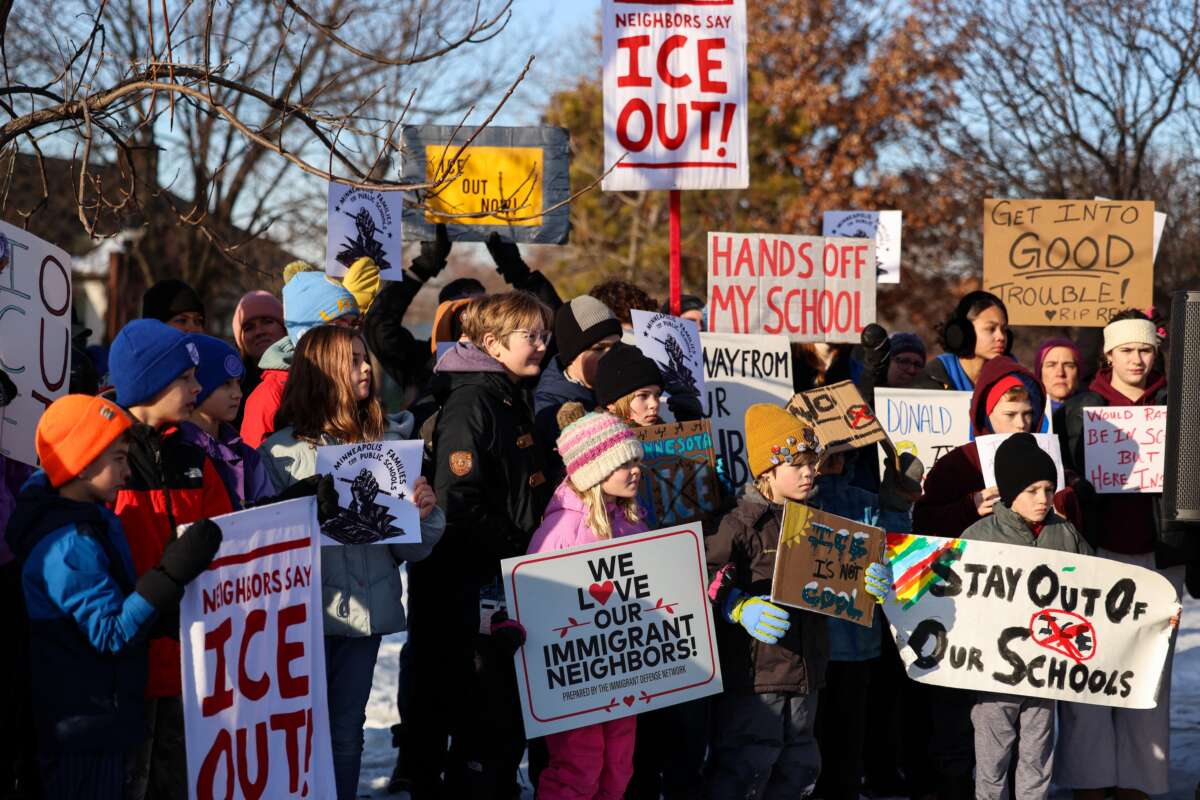
People pause for a minute of silence during a press conference organized by the group "Minneapolis Families for Public Schools," in Minneapolis, Minnesota, on January 9, 2026.CHARLY TRIBALLEAU / AFP via Getty Images
Organizers in Minneapolis are in a whirlwind right now. We are facing what appears to be — so far — the biggest deployment of Immigration and Customs Enforcement (ICE) cops in one city in the agency’s existence. The brutality and ubiquity of the agents have become central features of the city’s life, as have the massive networks of resistance and protection being built in opposition to them. The work here is incredibly urgent, and it is full of grief, connection, fear, and possibilities.
Many people stepping up to oppose ICE and protect their neighbors weren’t previously connected with each other; many are new to organizing or new to this kind of organizing. People have different politics. Some have undefined politics. Some interpret how to act with aligned politics in completely different ways. At its core, all of the anti-ICE work that both established and emerging formations in Minneapolis are doing is an attempt at community safety, at taking care of our neighbors and ourselves. What kind of world that attempt envisions — what the horizon we can see before us looks like — is worth taking a moment to think about.
We move in the direction that our steps take us. On its face, this is an obvious statement, but in our movements, it can be very easy to lose track of whether a step is moving us all toward greater justice or is, in fact, reinforcing systems that need to be destroyed. Many of our steps right now (forging stronger communities of care, opposing state violence, rejecting colonial borders) are intrinsically oriented toward liberation, but we still need to pause when possible to ground ourselves in the world we are trying to build. Doing so can help us ensure we follow our liberatory orientation more boldly.
Abolition provides a horizon that can orient people both in how to respond to each other with care, and in how to collectively respond to state violence with integrity.
Building a Collective Response
In response to the Trump administration’s federal policing escalation in Minneapolis — and across the Twin Cities — residents have organized at a monumental scale. Community members in Minneapolis have built a vast rapid response network; patrols near schools, churches, mosques, immigrant-owned businesses, and even vulnerable intersections; witness and response to ICE presence wherever else it occurs; large-scale food and supply deliveries; an infrastructure of safer transportation; and care webs for loved ones who are left behind after ICE abductions. Many of these systems sprung to life along the paths laid down by the 2020 uprising after the police-perpetrated killing of George Floyd.
Organizers in Minneapolis are in a whirlwind right now. We are facing what appears to be — so far — the biggest deployment of Immigration and Customs Enforcement (ICE) cops in one city in the agency’s existence. The brutality and ubiquity of the agents have become central features of the city’s life, as have the massive networks of resistance and protection being built in opposition to them. The work here is incredibly urgent, and it is full of grief, connection, fear, and possibilities.
Many people stepping up to oppose ICE and protect their neighbors weren’t previously connected with each other; many are new to organizing or new to this kind of organizing. People have different politics. Some have undefined politics. Some interpret how to act with aligned politics in completely different ways. At its core, all of the anti-ICE work that both established and emerging formations in Minneapolis are doing is an attempt at community safety, at taking care of our neighbors and ourselves. What kind of world that attempt envisions — what the horizon we can see before us looks like — is worth taking a moment to think about.
We move in the direction that our steps take us. On its face, this is an obvious statement, but in our movements, it can be very easy to lose track of whether a step is moving us all toward greater justice or is, in fact, reinforcing systems that need to be destroyed. Many of our steps right now (forging stronger communities of care, opposing state violence, rejecting colonial borders) are intrinsically oriented toward liberation, but we still need to pause when possible to ground ourselves in the world we are trying to build. Doing so can help us ensure we follow our liberatory orientation more boldly.
Abolition provides a horizon that can orient people both in how to respond to each other with care, and in how to collectively respond to state violence with integrity.
Building a Collective Response
In response to the Trump administration’s federal policing escalation in Minneapolis — and across the Twin Cities — residents have organized at a monumental scale. Community members in Minneapolis have built a vast rapid response network; patrols near schools, churches, mosques, immigrant-owned businesses, and even vulnerable intersections; witness and response to ICE presence wherever else it occurs; large-scale food and supply deliveries; an infrastructure of safer transportation; and care webs for loved ones who are left behind after ICE abductions. Many of these systems sprung to life along the paths laid down by the 2020 uprising after the police-perpetrated killing of George Floyd.
We Can Honor Renee Nicole Good’s Life by Abolishing Death-Making Institutions
Those of us who see ourselves in Renee Good can take this moment to deepen our solidarities with all who are policed. By Holly Krig , Truthout January 13, 2026
During the onset of the COVID-19 pandemic, and the uprising that followed when several grocery stores were destroyed, Minneapolis learned to organize food delivery and other forms of care for people who couldn’t access them, and that work is relevant again. Neighborhoods dusted off dormant Signal groups, and community members are reaching out to collaborate with people they first connected with in 2020 over joint demonstrating and safety planning. One noteworthy mark of continuity is the Sanctuary Supply Depot, which emerged to care for encampment residents after they were evicted from a vacant hotel that volunteers called the Minneapolis Sanctuary. They have continued encampment supply distribution through years of Minneapolis Police Department harassment, and through the current escalation of immigration policing.
The collective enemy we are protecting our neighbors from is state violence.
Lessons of 2020 are now being expanded upon. While building rapid response practices, community members are also attempting to train and be trained, make connections with other organizations and cities, and provide support for each other’s material and emotional needs. Groups are absorbing (while trying to practice both safety and hospitality) a vast number of people — across all the city’s neighborhoods — who were previously not connected to each other, and maybe not involved with organizing at all.
Like a lot of organizing, and particularly similar organizing in other cities like Chicago, our efforts don’t always succeed. We can’t always keep our neighbors from being abducted, or from the other kinds of violence ICE cops bring with them. As Kelly Hayes wrote, sometimes we arrive too late, or can do little but witness excruciating moments of violence — against community observers like Renee Nicole Good, as well as against those the observers have gathered to protect.
Reflecting on those moments, Hayes wrote: “A lot of people are looking to Chicago right now, because the work we’re doing — the work you’re doing, if you’re wearing a whistle, protesting in the streets, practicing mutual aid, or responding to ICE alerts — is helping people around the U.S. imagine a meaningful response to the threats they face. People who feel frozen or stuck, or who have no idea how they would respond to such an onslaught, are getting a sense of what they’re made of.”
Our collective organizing matters, whether or not we are ultimately able to reverse ICE’s massive escalation. Minneapolis is providing a meaningful response to the current wave of authoritarian violence, and we are all being shaped by that response. The massive infrastructure of mutual aid that is operating in Minneapolis is by its nature politicized. The collective enemy we are protecting our neighbors from is state violence, and state surveillance of our networks is a constant threat that even the newest volunteer must reckon with. The waves that follow ours will be shaped by the work we’re doing, and what everyone can learn from it.
Every day, we help get kids to and from their schools when their parents can’t safely leave home.
And sometimes we do foil an abduction or a deportation. Every day, we help get kids to and from their schools when their parents can’t safely leave home. We ensure that people can worship in their mosques and churches with less fear. We network and fundraise to sustain workers and immigrant-run businesses when their workplaces are not safe or have lost their customer base. Each person protected from state violence or given tools to heal from it is a sacred victory and a piece of the world we want to build together. By protecting our neighbors from ICE, we are practicing abolition, even if some of our fellow practitioners might balk at that description.
In addition to the material impacts of the mutual aid and safety work community members are doing, this moment has brought policy opportunities. Organizations, local and national, are demanding that Congress defund ICE and that the officer who killed Renee Good be fired. Even feckless politicians have felt pressure to demand that ICE leave Minnesota. It is a moment of opportunity to multiply the scale of the abolition we’re practicing and protect many more people from this type of terror and violence.
This, too, resonates with the 2020 uprising. As Mariame Kaba said: “People in moments of whirlwind look for stuff. Your job, if you’re a consistent organizer who’s consistently organizing across time, is to make sure that one of the things people pick up can be your thing.”
Earlier Organizing That Led Us Here
Abolitionists in Minneapolis, often in the direct lineage of Kaba’s work, knew a moment like this was coming. We have learned how systems of criminalization intersect and reinforce each other. We prepared for this moment, learning from the response of other cities to ICE and from abolitionist organizing in our own city.
Before, during, and after the 2020 uprising, local organizations like Reclaim the Block and Black Visions put forth the demand to defund the Minneapolis Police Department — to fund communities, not cops — building on the local work of MPD 150 and the lineage of other cities like Chicago. In 2020, organizers explicitly linked that demand to the community care networks that were emerging as existing systems failed us.
By protecting our neighbors from ICE, we are practicing abolition.
Other organizations, too, like MIRAC and Unidos, prepared for this moment, training individuals and groups in ICE watch tactics. They learned from practices that had emerged in Chicago, Los Angeles, and North Carolina. That work, as Mariame Kaba recently wrote, connects to a lineage of watching cops: “Los Angeles activists in the mid-60s, for example, launched ‘Community Alert Patrols’ — volunteers in cars who followed the LAPD in Black neighborhoods to observe and take photographs. Just as ICE agents hate being filmed today, so the LAPD loathed the patrols and saw them as radical and dangerous precisely because they were effective in discouraging brutality and false charges.”
While explicitly abolitionist organizing doesn’t have the prominence that it did in the 2020 uprising, that organizing has directly influenced current responses, from the community support work to the shared language of protest to the policy response that people assume is possible. Organizers can bring defund and abolish demands to movement spaces and policy makers with a prominent reference point. And they are. Nationwide January polling showed that 46 percent of respondents support abolishing ICE, an explicitly abolitionist policy demand, up sharply from 27 percent last July and higher than the percentage who currently don’t favor abolishing ICE, 43 percent. Democratic proposals to fund increased training for ICE cops have been widely dismissed as counterproductive, informed by the increased conversations about abolition since 2020.
Grounding Ourselves in Abolitionist Visions
Abolition is a practice. When we do any of this collective work, we are trying to put our politics into practice. When we instead find ourselves tempted to practice surveillance of our neighbors or punitive responses to each other’s attempts, or to allow feelings to birth carceral policy, abolition gives us the clarity to reorient ourselves.
How can we ground our work in abolition in a way that radiates outward, that extends the care we are building for immigrant families to all our neighbors, with no exceptions?
We can reorient ourselves because, while it is a practice, abolition is also a horizon. Abolition shows us the kind of world we want to live in. It is one without imprisonment, policing, or surveillance — by city, state, or federal cops or by cops in our hearts — no matter what kind of cops we’re struggling against in the moment.
The horizon of abolition can also help us navigate complex conversations as we work with our communities on this inherently anti-carceral project. How can we ground our work in abolition in a way that radiates outward, that extends the care we are building for immigrant families to all our neighbors, with no exceptions? How can this work strengthen and mutually reinforce our efforts to support our criminalized and incarcerated neighbors, our poor neighbors, and our houseless neighbors?
With abolition’s vision, we can evaluate whether our practices will lead toward a world with more or less policing, surveillance, and imprisonment. When policies are proposed, by elected officials or by movements, we can evaluate those as well. If we enact those policies, if we take those steps, if we practice those things more, will we be emptying cages or filling them?
This article is licensed under Creative Commons (CC BY-NC-ND 4.0), and you are free to share and republish under the terms of the license.
Those of us who see ourselves in Renee Good can take this moment to deepen our solidarities with all who are policed. By Holly Krig , Truthout January 13, 2026
During the onset of the COVID-19 pandemic, and the uprising that followed when several grocery stores were destroyed, Minneapolis learned to organize food delivery and other forms of care for people who couldn’t access them, and that work is relevant again. Neighborhoods dusted off dormant Signal groups, and community members are reaching out to collaborate with people they first connected with in 2020 over joint demonstrating and safety planning. One noteworthy mark of continuity is the Sanctuary Supply Depot, which emerged to care for encampment residents after they were evicted from a vacant hotel that volunteers called the Minneapolis Sanctuary. They have continued encampment supply distribution through years of Minneapolis Police Department harassment, and through the current escalation of immigration policing.
The collective enemy we are protecting our neighbors from is state violence.
Lessons of 2020 are now being expanded upon. While building rapid response practices, community members are also attempting to train and be trained, make connections with other organizations and cities, and provide support for each other’s material and emotional needs. Groups are absorbing (while trying to practice both safety and hospitality) a vast number of people — across all the city’s neighborhoods — who were previously not connected to each other, and maybe not involved with organizing at all.
Like a lot of organizing, and particularly similar organizing in other cities like Chicago, our efforts don’t always succeed. We can’t always keep our neighbors from being abducted, or from the other kinds of violence ICE cops bring with them. As Kelly Hayes wrote, sometimes we arrive too late, or can do little but witness excruciating moments of violence — against community observers like Renee Nicole Good, as well as against those the observers have gathered to protect.
Reflecting on those moments, Hayes wrote: “A lot of people are looking to Chicago right now, because the work we’re doing — the work you’re doing, if you’re wearing a whistle, protesting in the streets, practicing mutual aid, or responding to ICE alerts — is helping people around the U.S. imagine a meaningful response to the threats they face. People who feel frozen or stuck, or who have no idea how they would respond to such an onslaught, are getting a sense of what they’re made of.”
Our collective organizing matters, whether or not we are ultimately able to reverse ICE’s massive escalation. Minneapolis is providing a meaningful response to the current wave of authoritarian violence, and we are all being shaped by that response. The massive infrastructure of mutual aid that is operating in Minneapolis is by its nature politicized. The collective enemy we are protecting our neighbors from is state violence, and state surveillance of our networks is a constant threat that even the newest volunteer must reckon with. The waves that follow ours will be shaped by the work we’re doing, and what everyone can learn from it.
Every day, we help get kids to and from their schools when their parents can’t safely leave home.
And sometimes we do foil an abduction or a deportation. Every day, we help get kids to and from their schools when their parents can’t safely leave home. We ensure that people can worship in their mosques and churches with less fear. We network and fundraise to sustain workers and immigrant-run businesses when their workplaces are not safe or have lost their customer base. Each person protected from state violence or given tools to heal from it is a sacred victory and a piece of the world we want to build together. By protecting our neighbors from ICE, we are practicing abolition, even if some of our fellow practitioners might balk at that description.
In addition to the material impacts of the mutual aid and safety work community members are doing, this moment has brought policy opportunities. Organizations, local and national, are demanding that Congress defund ICE and that the officer who killed Renee Good be fired. Even feckless politicians have felt pressure to demand that ICE leave Minnesota. It is a moment of opportunity to multiply the scale of the abolition we’re practicing and protect many more people from this type of terror and violence.
This, too, resonates with the 2020 uprising. As Mariame Kaba said: “People in moments of whirlwind look for stuff. Your job, if you’re a consistent organizer who’s consistently organizing across time, is to make sure that one of the things people pick up can be your thing.”
Earlier Organizing That Led Us Here
Abolitionists in Minneapolis, often in the direct lineage of Kaba’s work, knew a moment like this was coming. We have learned how systems of criminalization intersect and reinforce each other. We prepared for this moment, learning from the response of other cities to ICE and from abolitionist organizing in our own city.
Before, during, and after the 2020 uprising, local organizations like Reclaim the Block and Black Visions put forth the demand to defund the Minneapolis Police Department — to fund communities, not cops — building on the local work of MPD 150 and the lineage of other cities like Chicago. In 2020, organizers explicitly linked that demand to the community care networks that were emerging as existing systems failed us.
By protecting our neighbors from ICE, we are practicing abolition.
Other organizations, too, like MIRAC and Unidos, prepared for this moment, training individuals and groups in ICE watch tactics. They learned from practices that had emerged in Chicago, Los Angeles, and North Carolina. That work, as Mariame Kaba recently wrote, connects to a lineage of watching cops: “Los Angeles activists in the mid-60s, for example, launched ‘Community Alert Patrols’ — volunteers in cars who followed the LAPD in Black neighborhoods to observe and take photographs. Just as ICE agents hate being filmed today, so the LAPD loathed the patrols and saw them as radical and dangerous precisely because they were effective in discouraging brutality and false charges.”
While explicitly abolitionist organizing doesn’t have the prominence that it did in the 2020 uprising, that organizing has directly influenced current responses, from the community support work to the shared language of protest to the policy response that people assume is possible. Organizers can bring defund and abolish demands to movement spaces and policy makers with a prominent reference point. And they are. Nationwide January polling showed that 46 percent of respondents support abolishing ICE, an explicitly abolitionist policy demand, up sharply from 27 percent last July and higher than the percentage who currently don’t favor abolishing ICE, 43 percent. Democratic proposals to fund increased training for ICE cops have been widely dismissed as counterproductive, informed by the increased conversations about abolition since 2020.
Grounding Ourselves in Abolitionist Visions
Abolition is a practice. When we do any of this collective work, we are trying to put our politics into practice. When we instead find ourselves tempted to practice surveillance of our neighbors or punitive responses to each other’s attempts, or to allow feelings to birth carceral policy, abolition gives us the clarity to reorient ourselves.
How can we ground our work in abolition in a way that radiates outward, that extends the care we are building for immigrant families to all our neighbors, with no exceptions?
We can reorient ourselves because, while it is a practice, abolition is also a horizon. Abolition shows us the kind of world we want to live in. It is one without imprisonment, policing, or surveillance — by city, state, or federal cops or by cops in our hearts — no matter what kind of cops we’re struggling against in the moment.
The horizon of abolition can also help us navigate complex conversations as we work with our communities on this inherently anti-carceral project. How can we ground our work in abolition in a way that radiates outward, that extends the care we are building for immigrant families to all our neighbors, with no exceptions? How can this work strengthen and mutually reinforce our efforts to support our criminalized and incarcerated neighbors, our poor neighbors, and our houseless neighbors?
With abolition’s vision, we can evaluate whether our practices will lead toward a world with more or less policing, surveillance, and imprisonment. When policies are proposed, by elected officials or by movements, we can evaluate those as well. If we enact those policies, if we take those steps, if we practice those things more, will we be emptying cages or filling them?
This article is licensed under Creative Commons (CC BY-NC-ND 4.0), and you are free to share and republish under the terms of the license.

Jonathan Stegall
Jonathan Stegall is a designer, and a faith-rooted organizer and abolitionist in Minneapolis.

Anne Kosseff-Jones
Anne Kosseff-Jones is an editor, writer, and organizer in Minneapolis.

No comments:
Post a Comment