Rules-based trade with US is ‘over’: Canada central bank head
 |
| Bank of Canada Governor Tiff Macklem |
AFP
January 28, 2026
Ben Simon
The era of rules-based trade with the United States is “over,” Canada’s central bank governor said Wednesday, echoing a stark warning from the the country’s prime minister that President Donald Trump’s impact on global trade is permanent.
Bank of Canada Governor Tiff Macklem made the comments during an interest rate announcement which held the key rate at 2.25 percent, citing “unpredictable” US trade policies.
Macklem has repeatedly warned that the bank’s efforts to forecast the Canadian economy had grown increasingly difficult given the tariffs imposed and threatened by Trump.
On Wednesday he made clear that he agrees with Prime Minister Carney, who told the World Economic Forum last week that there would be no going back to a pre-Trump normal in the US-led international system.
“It’s pretty clear that the days of open rules-based trade with the United States are over,” Macklem told reporters.
In a speech that has captured global attention, Carney said “nostalgia is not a strategy,” urging middle-sized powers who have previously benefitted from the stability of US economic dominance to recognize that a new reality had set it.
More than 75 percent of all Canadian exports go to the United States and the country remains uniquely vulnerable to Trump’s protectionism.
Macklem said Canadian growth remains stunted by US policy.
Trump’s global sectoral tariffs have hit Canada’s auto, steel, aluminum and lumber industries hard.
But the most severe disruptions may be yet to come, Macklem stressed.
Trump has so far broadly adhered to the existing North American free trade agreement, which he signed and praised during his first term.
With the United States‑Mexico‑Canada Agreement (USMCA) still holding, more than 85 percent of all bilateral trade has remained tariff‑free.
But talks on updating that deal are set for this year and the Trump administration has indicated it could seek major changes, or may move to scrap the pact entirely, an outcome that would upend the Canadian economy.
“The upcoming review of the (USMCA) is an important risk,” Macklem said.
– US fed independence –
Macklem also took aim at Trump’s apparent efforts to exert political influence on the US Federal Reserve.
“The US Federal Reserve is the biggest, most important central bank in the world and we all need it to work well,” Macklem said.
“A loss of independence of the Fed would affect us all,” he warned, but stressed that for Canada the consequences of a politically influenced Federal Reserve would likely be far-reaching, given the integrated nature of the neighboring economies.
An independent Federal Reserve is “good for America,” Macklem said.
Trump has been seeking to oust Fed Governor Lisa Cook over mortgage fraud allegations. He has also spoken out on the administration’s investigation into chairman Jerome Powell over the bank’s headquarters renovation.
In a rare rebuke this month, Powell criticized the threat of criminal charges against him, saying this was about whether monetary policy would be “directed by political pressure or intimidation.”
January 28, 2026
Ben Simon
The era of rules-based trade with the United States is “over,” Canada’s central bank governor said Wednesday, echoing a stark warning from the the country’s prime minister that President Donald Trump’s impact on global trade is permanent.
Bank of Canada Governor Tiff Macklem made the comments during an interest rate announcement which held the key rate at 2.25 percent, citing “unpredictable” US trade policies.
Macklem has repeatedly warned that the bank’s efforts to forecast the Canadian economy had grown increasingly difficult given the tariffs imposed and threatened by Trump.
On Wednesday he made clear that he agrees with Prime Minister Carney, who told the World Economic Forum last week that there would be no going back to a pre-Trump normal in the US-led international system.
“It’s pretty clear that the days of open rules-based trade with the United States are over,” Macklem told reporters.
In a speech that has captured global attention, Carney said “nostalgia is not a strategy,” urging middle-sized powers who have previously benefitted from the stability of US economic dominance to recognize that a new reality had set it.
More than 75 percent of all Canadian exports go to the United States and the country remains uniquely vulnerable to Trump’s protectionism.
Macklem said Canadian growth remains stunted by US policy.
Trump’s global sectoral tariffs have hit Canada’s auto, steel, aluminum and lumber industries hard.
But the most severe disruptions may be yet to come, Macklem stressed.
Trump has so far broadly adhered to the existing North American free trade agreement, which he signed and praised during his first term.
With the United States‑Mexico‑Canada Agreement (USMCA) still holding, more than 85 percent of all bilateral trade has remained tariff‑free.
But talks on updating that deal are set for this year and the Trump administration has indicated it could seek major changes, or may move to scrap the pact entirely, an outcome that would upend the Canadian economy.
“The upcoming review of the (USMCA) is an important risk,” Macklem said.
– US fed independence –
Macklem also took aim at Trump’s apparent efforts to exert political influence on the US Federal Reserve.
“The US Federal Reserve is the biggest, most important central bank in the world and we all need it to work well,” Macklem said.
“A loss of independence of the Fed would affect us all,” he warned, but stressed that for Canada the consequences of a politically influenced Federal Reserve would likely be far-reaching, given the integrated nature of the neighboring economies.
An independent Federal Reserve is “good for America,” Macklem said.
Trump has been seeking to oust Fed Governor Lisa Cook over mortgage fraud allegations. He has also spoken out on the administration’s investigation into chairman Jerome Powell over the bank’s headquarters renovation.
In a rare rebuke this month, Powell criticized the threat of criminal charges against him, saying this was about whether monetary policy would be “directed by political pressure or intimidation.”
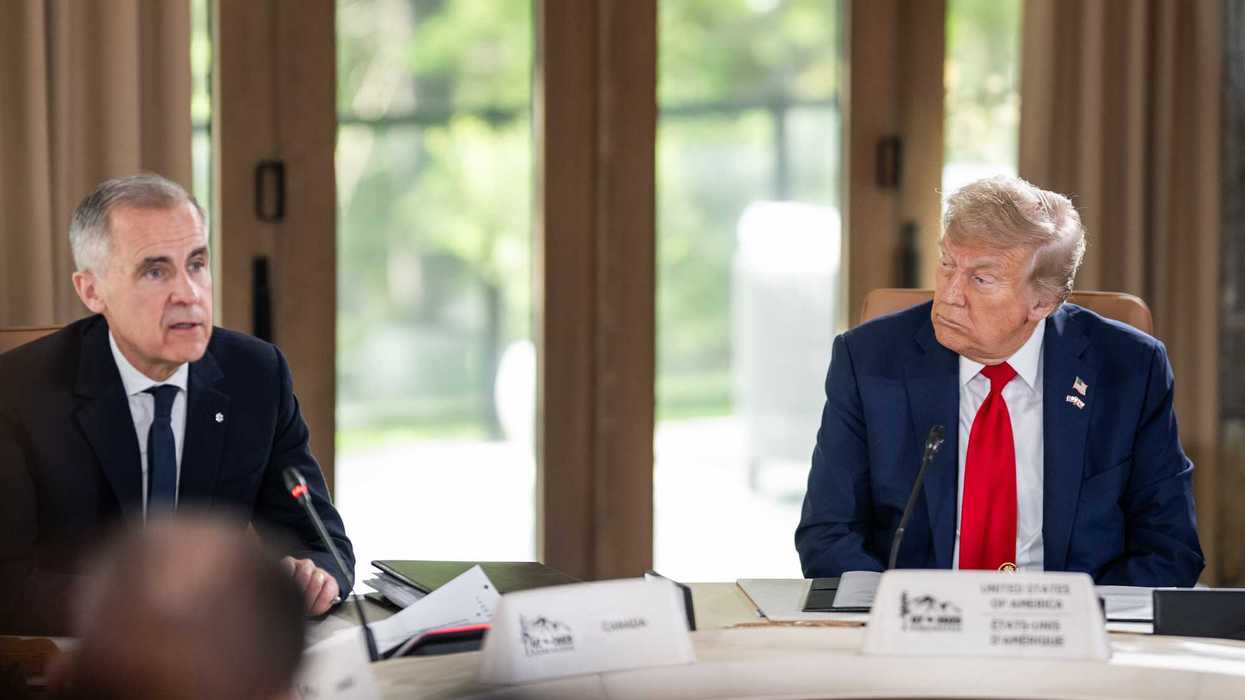
U.S. President Donald Trump with Canadian Prime Minister Mark Carney in Kananaskis, Alberta, Canada on June 16, 2025 (Official White House Photo by Daniel Torok/Flickr)
January 28, 2026
ALTERNET
During the 2026 World Economic Forum (WEF) in Davos, Switzerland, U.S. President Donald Trump and Canadian Prime Minister Mark Carney exchanged public criticism over trade and foreign policy.
Carney delivered a speech arguing that Trump's foreign and economic policies are undermining global alliances. He stated that this is causing a "rupture" in international relationships.
The Canadian prime minister told attendees, "For decades, countries like Canada prospered under what we called the rules-based international order. We joined its institutions, we praised its principles, we benefited from its predictability. And because of that, we could pursue values-based foreign policies under its protection. Even an imperfect system had profound benefits — as long as America remained both strong and virtuous."
Following Carney's speech, Trump withdrew Canada's invitation to join his Board of Peace.
Economist Paul Krugman published a column on January 27 criticizing Trump's Canada policies. Krugman argues that the U.S.-Canada relationship has deteriorated since Trump returned to power.
"We are talking about a rupture with a neighbor that was, until Trump returned to power, one of our closest allies and remains our second most important trading partner," Krugman writes. "Trump has been criticizing Canada since early last year, claiming that Canada had a $200 billion trade surplus and arguing that getting energy and auto parts from Canada constituted a U.S. subsidy to the country."
Krugman states, "For the record, trade between the U.S. and Canada is roughly balanced, and cutting off this trade would be severely damaging to both economies."
Krugman attributes Trump's approach to personal and geopolitical factors. He argues that by making a trade deal with China, Canada is reducing its dependence on the United States, which Trump opposes.
Paul Krugman's full Substack column is available at this link.
During the 2026 World Economic Forum (WEF) in Davos, Switzerland, U.S. President Donald Trump and Canadian Prime Minister Mark Carney exchanged public criticism over trade and foreign policy.
Carney delivered a speech arguing that Trump's foreign and economic policies are undermining global alliances. He stated that this is causing a "rupture" in international relationships.
The Canadian prime minister told attendees, "For decades, countries like Canada prospered under what we called the rules-based international order. We joined its institutions, we praised its principles, we benefited from its predictability. And because of that, we could pursue values-based foreign policies under its protection. Even an imperfect system had profound benefits — as long as America remained both strong and virtuous."
Following Carney's speech, Trump withdrew Canada's invitation to join his Board of Peace.
Economist Paul Krugman published a column on January 27 criticizing Trump's Canada policies. Krugman argues that the U.S.-Canada relationship has deteriorated since Trump returned to power.
"We are talking about a rupture with a neighbor that was, until Trump returned to power, one of our closest allies and remains our second most important trading partner," Krugman writes. "Trump has been criticizing Canada since early last year, claiming that Canada had a $200 billion trade surplus and arguing that getting energy and auto parts from Canada constituted a U.S. subsidy to the country."
Krugman states, "For the record, trade between the U.S. and Canada is roughly balanced, and cutting off this trade would be severely damaging to both economies."
Krugman attributes Trump's approach to personal and geopolitical factors. He argues that by making a trade deal with China, Canada is reducing its dependence on the United States, which Trump opposes.
Paul Krugman's full Substack column is available at this link.
'I meant what I said': Canadian PM accuses Trump admin of lying about phone call
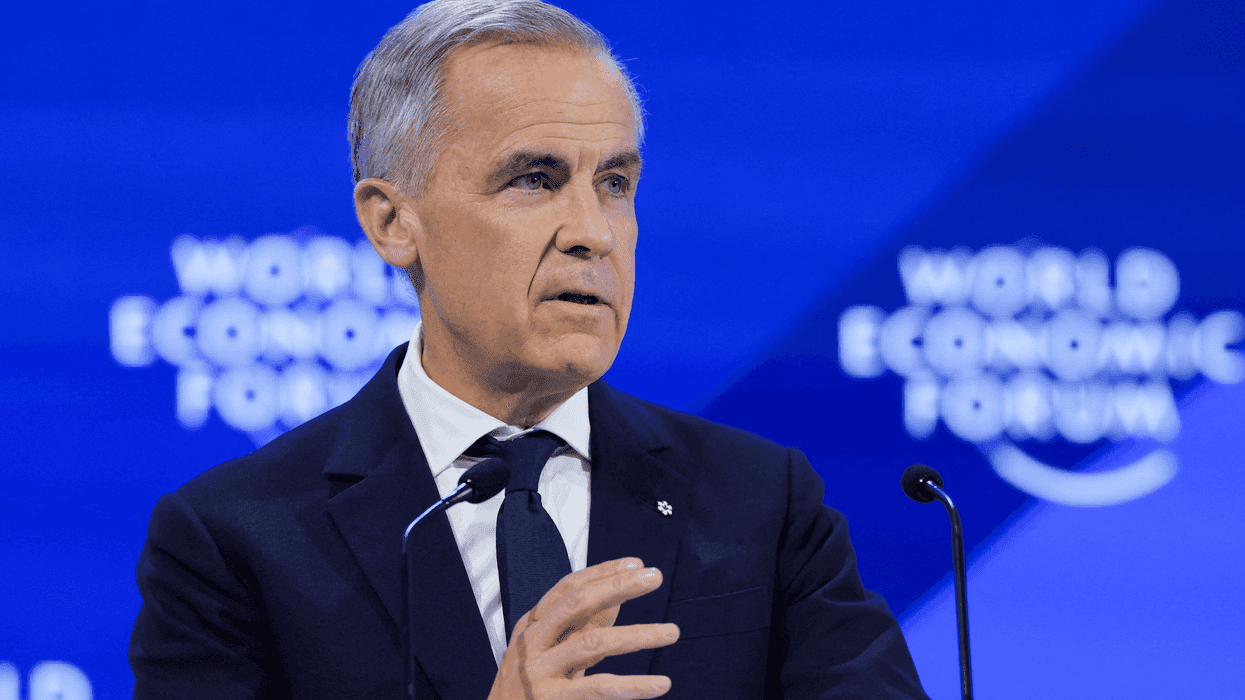
Canada's Prime Minister Mark Carney speaks during the 56th annual World Economic Forum (WEF) meeting in Davos, Switzerland, January 20, 2026.
"To be absolutely clear, and I said this to the president, I meant what I said in Davos," Carney said. "It was clear it was a broader set of issues that Canada was the first country to understand the change in U.S. trade policy that he had initiated. And we’re responding to that."
"We had a very good conversation on a wide range of subjects, ranging from the situation in Ukraine, in Venezuela, Arctic security," he added. "We discussed as well what Canada is doing, positively, and this is the context of our discussion, what Canada is doing positively to build new partnerships around the world."
Canada's Prime Minister Mark Carney speaks during the 56th annual World Economic Forum (WEF) meeting in Davos, Switzerland, January 20, 2026.
REUTERS/Denis Balibouse/File Photo
January 27, 2026
ALTERNET
Canadian Prime Minister Mark Carney is calling out a top official in President Donald Trump's administration and dismissing the claim that he had walked back some of his incendiary Davos speech in a phone call with the president, according to The New Republic.
During a Monday evening appearance on Fox News, Treasury Secretary Scott Bessent claimed that Carney and Trump had spoken over the phone earlier in the day, and that the prime minister had been "very aggressively walking back some of the unfortunate remarks he made at Davos." This came as the president had been ramping up tariff threats against Canada in the wake of Carney's head-turning speech.
In an address to the World Economic Forum in Davos, Switzerland, Carney argued that the era of American hegemony over the world order was at an end, owing to Trump's antagonistic treatment of allies since returning to the White House and his demand to take over Greenland from Denmark. He further argued that the middle power nations of the world must now band together to pursue their goals, rather than counting on the backing of the U.S.
The speech instantly became a hot-button topic, with a recent New York Times Opinion headline from Ezra Klein proclaiming it as the "most important foreign policy speech in years." It seemed to ruffle Trump's feathers as well, as he later went off on Canada in his own Davos speech, suggesting that Canada ought to be "grateful” for the “freebies" it gets from the U.S. and claiming that "Canada lives because of the United States."
Speaking to reporters on Tuesday, Carney rebuked Bessent for mischaracterizing his phone call with the phone call with the president. While the prime minister called the conversation a positive one, he also stressed that he did not back down from the points made in his speech.
Canadian Prime Minister Mark Carney is calling out a top official in President Donald Trump's administration and dismissing the claim that he had walked back some of his incendiary Davos speech in a phone call with the president, according to The New Republic.
During a Monday evening appearance on Fox News, Treasury Secretary Scott Bessent claimed that Carney and Trump had spoken over the phone earlier in the day, and that the prime minister had been "very aggressively walking back some of the unfortunate remarks he made at Davos." This came as the president had been ramping up tariff threats against Canada in the wake of Carney's head-turning speech.
In an address to the World Economic Forum in Davos, Switzerland, Carney argued that the era of American hegemony over the world order was at an end, owing to Trump's antagonistic treatment of allies since returning to the White House and his demand to take over Greenland from Denmark. He further argued that the middle power nations of the world must now band together to pursue their goals, rather than counting on the backing of the U.S.
The speech instantly became a hot-button topic, with a recent New York Times Opinion headline from Ezra Klein proclaiming it as the "most important foreign policy speech in years." It seemed to ruffle Trump's feathers as well, as he later went off on Canada in his own Davos speech, suggesting that Canada ought to be "grateful” for the “freebies" it gets from the U.S. and claiming that "Canada lives because of the United States."
Speaking to reporters on Tuesday, Carney rebuked Bessent for mischaracterizing his phone call with the phone call with the president. While the prime minister called the conversation a positive one, he also stressed that he did not back down from the points made in his speech.
"To be absolutely clear, and I said this to the president, I meant what I said in Davos," Carney said. "It was clear it was a broader set of issues that Canada was the first country to understand the change in U.S. trade policy that he had initiated. And we’re responding to that."
"We had a very good conversation on a wide range of subjects, ranging from the situation in Ukraine, in Venezuela, Arctic security," he added. "We discussed as well what Canada is doing, positively, and this is the context of our discussion, what Canada is doing positively to build new partnerships around the world."

No comments:
Post a Comment