
'I'm very concerned': Marco Rubio triggers alarms of 'war' from intel lawmakers
Nicole Charky-Chami
February 24, 2026
RAW STORY
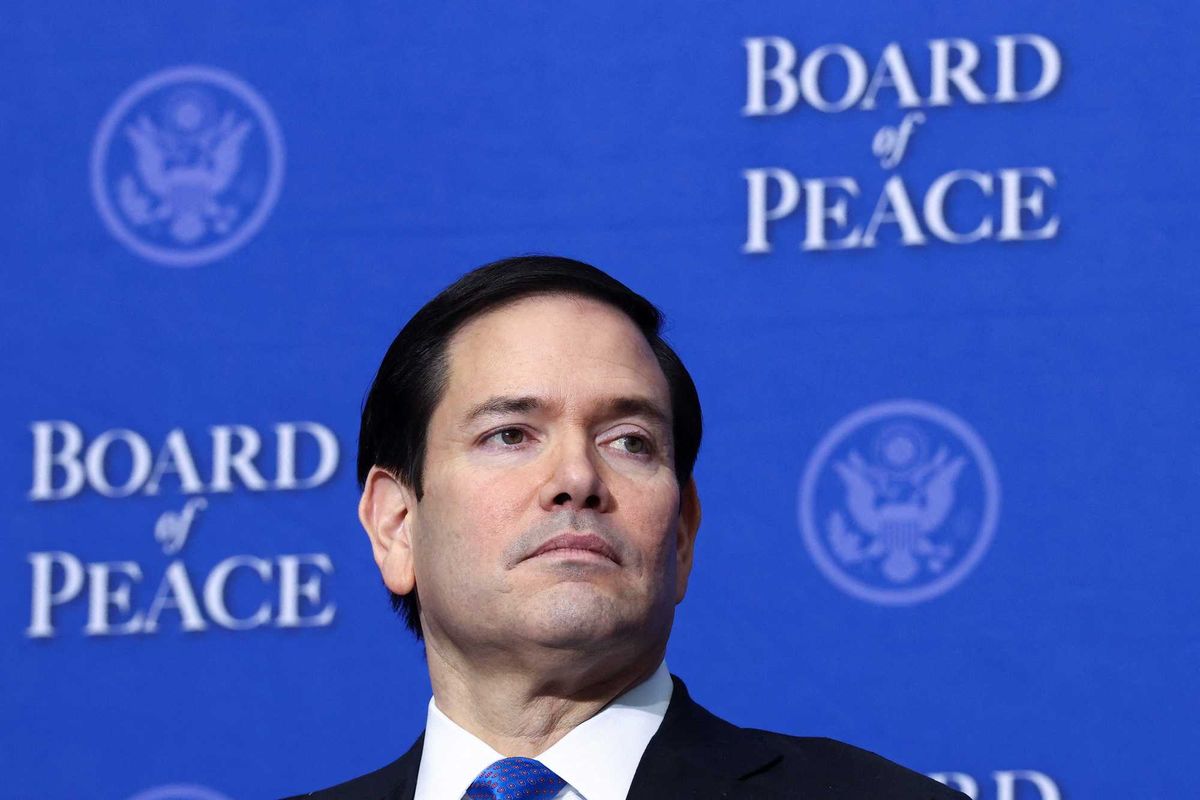
Secretary of State Marco Rubio listens as U.S President Donald Trump (not pictured) speaks at the inaugural Board of Peace meeting at the U.S. Institute of Peace in Washington, D.C. on Feb. 19, 2026. REUTERS/Kevin Lamarque
Secretary of State Marco Rubio held an unusual briefing on Tuesday that raised concerns among intel lawmakers over whether the U.S. may launch military attacks on Iran.
Rubio's private meeting was held virtually just hours before President Donald Trump's State of the Union address and included both Senate and House lawmakers, including high-ranking members of the House and Senate Intelligence Committees, Politico reported. The move has raised questions over the Trump administration's decision to take military action in the Middle East.
Rep. Jim Himes (D-CT) expressed alarm over Rubio's comments.
"Rep. Jim Himes, top Intel Committee Dem, on Trump and Iran: 'I'm very concerned. Wars in the Middle East don't go well for presidents, for the country, and we have not heard articulated a single good reason for why now is the moment to launch yet another war in the Middle East,'" Sahil Kapur, senior national political reporter for NBC News, wrote on X.
House Minority Leader Hakeem Jeffries (D-NY) shared his apprehension about Trump's previous statements on Iran and what could happen next. Last year Trump had claimed that U.S. military strikes in Iran had dismantled the country's nuclear program.
"What happened to Iran's nuclear program being 'completely and totally obliterated'?... Donald Trump's words, not our words. Clearly he was lying to the American people or he's lying right now," Jeffries said in an interview with reporters that was shared by journalist Aaron Rupar on X.
February 24, 2026
RAW STORY
Secretary of State Marco Rubio listens as U.S President Donald Trump (not pictured) speaks at the inaugural Board of Peace meeting at the U.S. Institute of Peace in Washington, D.C. on Feb. 19, 2026. REUTERS/Kevin Lamarque
Secretary of State Marco Rubio held an unusual briefing on Tuesday that raised concerns among intel lawmakers over whether the U.S. may launch military attacks on Iran.
Rubio's private meeting was held virtually just hours before President Donald Trump's State of the Union address and included both Senate and House lawmakers, including high-ranking members of the House and Senate Intelligence Committees, Politico reported. The move has raised questions over the Trump administration's decision to take military action in the Middle East.
Rep. Jim Himes (D-CT) expressed alarm over Rubio's comments.
"Rep. Jim Himes, top Intel Committee Dem, on Trump and Iran: 'I'm very concerned. Wars in the Middle East don't go well for presidents, for the country, and we have not heard articulated a single good reason for why now is the moment to launch yet another war in the Middle East,'" Sahil Kapur, senior national political reporter for NBC News, wrote on X.
House Minority Leader Hakeem Jeffries (D-NY) shared his apprehension about Trump's previous statements on Iran and what could happen next. Last year Trump had claimed that U.S. military strikes in Iran had dismantled the country's nuclear program.
"What happened to Iran's nuclear program being 'completely and totally obliterated'?... Donald Trump's words, not our words. Clearly he was lying to the American people or he's lying right now," Jeffries said in an interview with reporters that was shared by journalist Aaron Rupar on X.
Iran Motivates Trump's Opposition to Transfer of Diego Garcia
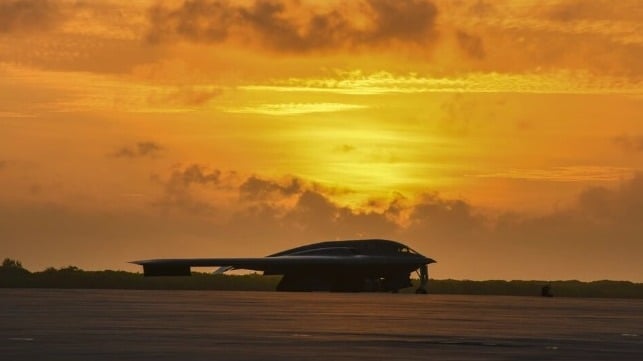
In a further twist to the Diego Garcia saga, Trump has issued a clear and unambiguous statement on the United States’ attitude towards the proposed Mauritius-United Kingdom sovereignty transfer deal over the British Indian Ocean Territories (BIOT), and the US Naval Support Facility on Diego Garcia in particular.
In a recent post, President Trump says it would be a surrender to Chinese interests to transfer BIOT to Mauritius, which would not be able to fend off Chinese pressure to compromise the continued operations of the Diego Garcia base. He makes the point that there is no decision in international law which requires the United Kingdom to give the archipelago to Mauritius, only pressure from what he describes as ‘woke’ internationalist interests. He urged the United Kingdom at this late stage to drop the deal. Karoline Leavitt, the White House press secretary, has confirmed that the post represents official US policy.
In his post, President Trump also referenced the critical strategic value of the US base on Diego Garcia, saying that ‘Should Iran decide not to make a deal, it may be necessary for the United States to use Diego Garcia, and the airfield located in Fairford, in order to eradicate a potential attack by a highly unstable and dangerous regime – an attack that would potentially be made on the United Kingdom, as well as other friendly countries.” President Trump has therefore linked the status of Diego Garcia with British authorization for the use of its bases in any potential attack on Iran.
The character of US force deployments into the Middle East has changed dramatically in recent days, switching from a ‘defend and respond’ character to preparedness to carry first strikes if negotiations with the Iranians fail to produce results.
A US delegation has been in Port Louis, the capital of Mauritius, to discuss the deal. They may be able to provide reassurance to Prime Minister Navin Ramgoolam, whose government is facing difficulties over corruption allegations, that Mauritius will not lose out financially if the deal is scrapped and modifications are made to current arrangements instead.
The UK government at the same time is having to deal with the arrival on the Île de Coin, the main island in the BIOT atoll of Peros Banhos, of Misley Mandarin, First Minister-elect of the BIOT, and his father Michel. The Chagossian returnees were issued with a notice to leave the island by the BIOT police shortly after landing.
The British government has a delicate political decision to make this week on whether to pursue the expulsion of the pair, given that Michel was born on Île de Coin. Under the terms of the present deal, Michel would see the place of his birth transferred to Mauritius without consultation or his consent. The deportation order was issued on the authority of Nishi Dholakia, the British Commissioner for BIOT.
In the latest developments, a court has permitted the re-settlers to remain on Île de Coin pending a hearing challenging the expulsion order. In the meantime, they are cleaning up the abandoned church and attempting to make other buildings habitable. The UK government has not timetabled a return of the enabling legislation to the House of Lords, and has confirmed that they are ‘thinking again’ about the legislation.
There is some speculation in the United Kingdom that President Trump’s change of heart over Diego Garcia has been prompted by British Prime Minister Sir Kier Starmer’s refusal to give permission for airstrikes on Iran to be mounted from British bases – until there have been substantive discussions on the rationale behind any such attack and what the post-action plan might be. In the meantime, the First Minister elect of the Chagos Islands, Misley Mandarin, currently still in residence on Île de Coin, has given full permission for President Trump to use Diego Garcia in any such attack.
Report: Iran Nears Deal to Buy Supersonic Antiship Missiles From China
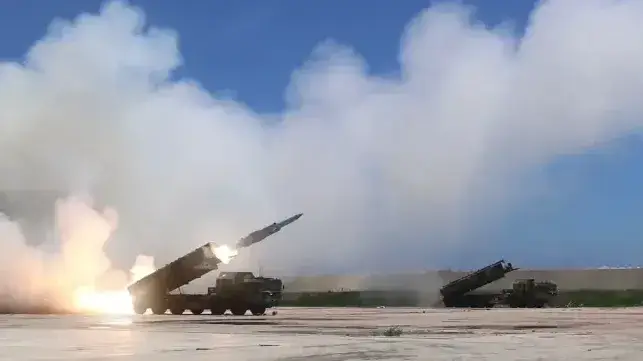
Iran may be closing on a deal to buy supersonic antiship missiles from China, which would complicate planning for the U.S. Navy in waters of the Persian Gulf, Strait of Hormuz and Gulf of Oman.
According to Reuters, the Iranian government is close to a purchase of the Chinese CM-302 missile system, based on China's YJ-12. While not the most modern type in the swiftly-evolving Chinese inventory, it is considered a capable antiship cruise missile. The CM-302 is the export variant of the design, and has a warhead payload of up to 550 pounds and a range of about 150 nutical miles. The original version can attain speeds somewhere in excess of Mach 2, potentially as high as Mach 4. The YJ-12 has reportedly been deployed in shore-battery configuration at China's giant bases in the Spratly Islands. Pakistan's navy currently fields the ship-launched export variant of the missile.
The missile's high speed in the terminal phase reduces the amount of time that the target vessel has to react and defend itself. It is expected that in Chinese service, the YJ-12 would be air-launched in large volleys for a saturation effect, but even one supersonic YJ-12 missile - programmed to conduct spiral evasive maneuvers as it closes in - would pose a stress test for an advanced warship's defenses.
Six Iranian government officials confirmed the talks to Reuters, and said that negotiations have been under way for the past two years.
"It’s a complete gamechanger if Iran has supersonic capability to attack ships in the area," Iran expert Danny Citrinowicz of Israel’s Institute for National Security Studies told New York Post. "These missiles are very difficult to intercept."
Other possible elements of the deal could include man-portable surface to air missiles (MANPADS), a threat to low-flying aircraft and helicopters. Per the report, the negotiations could extend to anti-ballistic missile systems or antisatellite missiles - some of the most technically-advanced weapons on earth. Approval of such a transfer would signify a high level of trust in Iran's ability to keep the technology secret.
No word of the deal's completion has emerged yet; even if terms are agreed, it would take time for China to deliver the equipment and provide the adequate training to enable its use. The U.S. is already gearing up for potential military action in Iran, and discussions of a possible limited strike have been widely reported.
Separately, Iran has reportedly signed a deal with Russia for the transfer of $590 million worth of man-portable antiaircraft missiles, according to the Financial Times. The arrangement covers 500 launch units and 2,500 missiles for the Verba MANPADS system, a modern guided missile launcher weighing just 38 pounds. Iran's weapons exports to Russia - like long-range attack drones used against Ukraine - may cover the cost of the transaction. For Navy aviators, Verba would be an unwelcome nuisance at altitudes up to 15,000 feet, the highest altitude lock range of any known MANPADS device. It is designed to be resistant to modern infrared countermeasures.

No comments:
Post a Comment