Why Myanmar’s Election Matters for India’s Northeast
Thursday 5 February 2026, by Sushovan Dhar
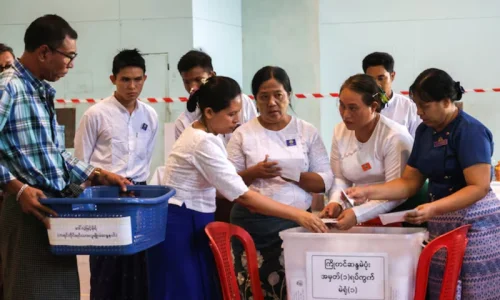
The election marks a new phase in the junta’s attempt to legitimise repression at home while stabilising its authority across borders. [1]
This Sunday marks the final round of Myanmar’s three-phase general election, yet it hardly resembles a democratic contest. Held amidst a brutal civil war, the process has unfolded with its outcome largely predetermined. The military-backed Union Solidarity and Development Party (USDP) has already secured the bulk of contested seats, and when combined with the 25 per cent of parliamentary seats reserved for unelected military appointees, the generals who seized power in February 2021 are guaranteed effective control of the legislature. The election, in other words, does not resolve Myanmar’s political crisis; it codifies the military’s dominance within a constitutional façade.
Far from signalling a return to civilian rule, the election marks a new phase in the junta’s attempt to legitimise repression at home while stabilising its authority across borders.
Manufacturing Legitimacy
The defining features of the current polls are now well established: the dissolution of parties that secured an overwhelming mandate in 2020; the mass exclusion of entire townships from the voting process; forced mobilisation through threats of conscription, imprisonment, and loss of livelihood; and polling conducted amidst airstrikes, armed clashes, and military occupations. The regime has predetermined the outcomes by hollowing out participation and sharply reducing turnout. What is being staged is not a contest for power but a performance of order. Under such conditions, elections strengthen authoritarian rule. They permit violence to be reframed as law enforcement, dissent to be criminalised as anti-constitutional activity, and resistance to be redefined as terrorism against an ‘elected’ state. The shift is not from coercion to consent but from emergency rule to juridified repression.
By holding elections without resolving the internal crisis, the Myanmar junta seeks to stabilise itself rather than the country. Territorial fragmentation remains intact, with large areas beyond junta control. Armed resistance has not diminished; in many regions, it has expanded. In a sense, the election does not bridge the legitimacy gap but exposes it. And authoritarian regimes confronted with such gaps rarely compromise—they escalate.
Such behaviour has consequences that cannot be contained within Myanmar’s borders. The normalisation of repression and the prolongation of war spread instability instead of eliminating it. Border regions become zones where conflict is displaced outward, where humanitarian crises, militarisation, and political exceptionalism accumulate. It is here that the regional consequences of Myanmar’s sham election come sharply into focus.
Northeast: A Frontier of Spillover
For India’s Northeast, Myanmar’s election is not an abstract question of democratic norms but a concerning political development unfolding next door. The regions of Myanmar most affected by conflict—Sagaing, Chin, Kachin, and northern Shan—border Mizoram, Manipur, Nagaland, and Arunachal Pradesh. The continuation of civil war across this frontier transforms the Northeast into a neighbouring theatre of consequence.
In Mizoram, the impact is most visible in the steady presence of Chin refugees fleeing violence and repression. Mostly sheltered by community networks and church-based solidarity, these refugees no longer face temporary emergency displacement. The junta’s election strategy forecloses the possibility of return. Repression is no longer episodic; it is institutionalised. Yet the Indian state continues to deny refugee recognition, refusing a national legal framework and leaving border states to manage a permanent humanitarian situation through ad hoc means. The contradiction between state-level accommodations and the union government’s militarisation is likely to deepen.
Manipur is situated at the intersection of Myanmar’s civil war and India’s internal fractures, posing a significant risk. The presence of ethnic groups living across the border and the state’s own unresolved political conflicts exacerbate an already volatile situation. Hindutva-inflected security narratives and domestic power equations easily instrumentalise external instability in a context of acute internal violence and political breakdown. The dominant narrative recasts cross-border movement as infiltration and labels refugees as security threats. Ethnic kinship is redefined as external interference. This approach recreates a politics of suspicion that feeds militarism, exceptional laws, and the erosion of civil space.
(Un)Free Movement Regime
The acceleration of border fencing along the India–Myanmar frontier, the suspension of the Free Movement Regime, and the resurgence of citizenship anxieties are often presented as separate responses to security concerns. In reality, the normalisation of war in Myanmar provides a rationale for a unified framework of governance. The junta’s assertion of electoral legitimacy provides a veneer of political justification for this shift: a violent neighbour is no longer depicted as a failing state but as a sovereign authority with whom borders must be secured, populations categorised, and mobility regulated.
The dismantling of the Free Movement Regime marks a decisive break with the social and historical reality of the frontier. For centuries, cross-border movement among Naga, Kuki-Chin-Zomi, and other communities functioned as the basis of everyday life. Its suspension reframes historical and cultural continuity as illegality; mobility becomes suspicion, and kinship becomes a security risk. In this context, refugees fleeing repression in Myanmar are easily folded into a language of infiltration, particularly in states already fractured by ethnic conflict.
These anxieties do not exist in isolation. They intersect with citizenship issues—most notably the NRC—whose logic rests on documentary proof, bureaucratic enumeration, and exclusion. Even where the NRC is not formally implemented, its shadow looms large. The effect is anticipatory compliance: communities internalise the fear of being rendered illegal, foreign, or expendable. The border thus ceases to be merely a line of defence; it becomes a device for reordering belonging itself.
Militarisation of the Region
Under these conditions, militarisation ceases to be exceptional and becomes a mode of governance in its own right. Security forces do not simply enforce the border; they regulate movement, livelihoods, and political expression. Exceptional measures—checkpoints, surveillance, armed patrols, and emergency laws—become routinised. What is portrayed as protection against external threats, in essence, serves internal disciplining.
This has profound consequences for the Northeast states. The region is not governed through political mediation or democratic negotiation, but through a permanent security lens. Development is subordinated to control; citizenship to verification; peace to manageability. The rhetoric of connectivity and ‘Act East’ is quietly displaced by a buffer-zone logic, where stability is defined not by justice or consent but by the mere absence of visible disorder.
Repression Beyond Borders
In this sense, Myanmar’s sham election does not merely justify repression within its frontiers; it helps entrench a political order within India’s Northeast where coercion substitutes for politics. Militarisation becomes the default grammar of rule—not because it resolves conflict, but because it renders conflict administratively governable. Myanmar’s sham election and its repressive consequences have the potential to trigger sustained refugee flows, deeper militarisation, and ethnic polarisation in India’s Northeast.
What is striking in this trajectory is the quiet role of the Indian state. Treating Myanmar’s election as inevitable and prioritising security coordination over political distance, New Delhi actively participates in the normalisation of authoritarian rule rather than acting as a neutral observer of its consequences. Border fencing, refugee denials, and the suspension of mobility regimes are not merely defensive responses; they are political choices that align India’s border governance with the junta’s logic of control. In doing so, the Indian state helps translate Myanmar’s internal repression into a regional order structured around surveillance, exclusion, and managed instability.
Analysing this only as a foreign policy issue misses the point. The Northeast is not merely adjacent to Myanmar’s crisis; it is structurally exposed to it. Authoritarian elections do not end wars—they reorganise them, and their consequences travel outward across borders that repression alone cannot seal.
23 January 2026
Source: Northeast Now
Footnotes
[1] Photo: Far from signalling a return to civilian rule, the election marks a new phase in the junta’s attempt to legitimise repression at home while stabilising its authority across borders.
Sushovan Dhar is an activist and trade unionist and a supporter of the Fourth International in India.


No comments:
Post a Comment