It’s possible that I shall make an ass of myself. But in that case one can always get out of it with a little dialectic. I have, of course, so worded my proposition as to be right either way (K.Marx, Letter to F.Engels on the Indian Mutiny)
Most Americans, even those who most appreciate AI, strongly support more regulation of it, a new survey by Johns Hopkins University researchers finds.
More than 70% of Americans want the right to interact with a human rather than an AI in medical, legal, educational and government settings. This proposed regulation and others were endorsed across party lines and by both regular users of AI and novices.
Most Americans, even those who most appreciate AI, strongly support more regulation of it, a new survey by Johns Hopkins University researchers finds.
More than 70% of Americans want the right to interact with a human rather than an AI in medical, legal, educational and government settings. This proposed regulation and others were endorsed across party lines and by both regular users of AI and novices.
“What was surprising to us in this new poll was that daily users of AI, and people who view AI positively, also want regulation,” said Christopher Honey, a computational cognitive neuroscientist at Johns Hopkins and a member of the university’s Data Science and AI Institute.
In April and May, more than 2,000 people in the United States were asked their views on artificial intelligence. Questions explored how people generally felt about the technology, how much they trusted it in personal and workplace settings, and about their support for new laws being considered across the country.
Americans’ overall feelings about AI are split: about one third positive, one third negative, and one third mixed. These overall attitudes varied greatly with how often people use AI: 80% of skilled daily users feel positively about AI versus 24% of people who have only tried it a few times.
Younger people were more positive about AI: 41% of adults ages 18 to 29 had a positive overall view, compared with 18% of adults 60 and older. At the same time, younger people felt more pressure to use AI at work: nearly 50% of working adults ages 18 to 29 reported feeling pressure to use AI, compared with about 20% of adults ages 60 and older.
Republicans and Democrats felt similarly about the technology.
Most Americans strongly support “right to a human” laws which would allow them to opt out of AI interactions. People want to deal with people when it comes to medical care (79%), legal proceedings (76%), and education (74%).
Americans strongly support more rules to protect their privacy and to make AI more transparent:
75% want to be told when they’re interacting with AI
73% want to ban AI from using individuals’ faces and voices
68% want labels on AI-generated images and video
Americans trust AI for certain tasks more than others:
Look up factual information: 67% trust AI somewhat or a great deal
File taxes: 42% trust it somewhat or a great deal
Create art or music: 57% trust it somewhat or a great deal
Be a coworker: 32% trust it somewhat or a great deal
Manage retirement: 33% trust it somewhat or a great deal
Provide medical advice: 63% don’t trust it much or at all
Teach high school: 69% don’t trust it much or at all
Decide a court case: 81% don’t trust it much or at all
Drive a car: 76% don’t trust it much or at all
Most Americans strongly support “right to a human” laws which would allow them to opt out of AI interactions. People want to deal with people when it comes to medical care (79%), legal proceedings (76%), and education (74%).
Credit
Johns Hopkins University
About six in ten U.S. adults expect AI to widen inequality over the next decade. There was broad support for a “digital dividend,” which is a small monthly payment to every American adult that is funded by a tax on large tech companies: this was endorsed by Republicans (52%), Democrats (60%) and political independents (52%).
As AI advances, about four in 10 Americans expect the large technology companies to reap the biggest gains in power. Fewer than 1 in 10 expect individuals to gain the most power. And nearly 1 in 5 Americans think that it will be the AI systems themselves.
“We were interested to hear the national voice as the public tries to understand these problems. What are people thinking and feeling?” said Rolando Masís-Obando, a computational neuroscientist who uses AI to study how people think and remember. “We are taking the pulse of the nation with this poll and we want to run this every year to see how opinions change over time.”
The findings will be presented and discussed at The Future of Our Realities 2026 conference on June 20 at the Hopkins Bloomberg Center in Washington, DC.
The work was supported by a Johns Hopkins University Nexus Award.
Open-source artificial intelligence is reshaping the future of humanity: Scientists question, if the world is ready
Open-source artificial intelligence is advancing faster than the world can govern it, and the consequences could reshape the future of sustainability, democracy, and global development. In a new comment published in Nature Communications, an international team of researchers warns that without coordinated action, open-source AI could also increase environmental pressures, deepen technological inequalities, and facilitate the spread of misinformation.
Open-source artificial intelligence (AI) is rapidly becoming a powerful tool for tackling some of the world's most pressing challenges, from climate change and food security to energy access and sustainable development. Min Chen, the lead author and a professor at Nanjing Normal University, emphasizes: 'Open-source AI implementation strategies must now evolve. We therefore propose four governance actions to manage opportunities while reducing the uncertainties associated with open-source AI.'
In the comment, more than 20 researchers therefore propose four governance actions to ensure that open-source AI contributes positively to the Sustainable Development Goals (SDGs) while minimizing environmental, social, and political risks.
Prajal Pradhan, co-author and associate professor at the University of Groningen, highlights: 'Its openness enables researchers, governments, and communities worldwide to adapt AI solutions to local needs, making it a promising accelerator of the Sustainable Development Goals (SDGs), but not without effective governance.'
To ensure open-source AI benefits society rather than creating new problems, the researchers identify four practical areas where action is urgently needed.
1. Integrate sustainability across the entire AI lifecycle
AI models rely on massive data centers, energy-intensive computing, and increasingly scarce raw materials. The researchers argue that the environmental costs of AI should be assessed across its entire lifecycle, i.e., from manufacturing computer chips to running large-scale AI systems.
For example, if an AI model helps cities to reduce energy use, those sustainability benefits should be weighed against the electricity and resources required to build and operate the AI system.
2. Develop SDG-focused evaluation frameworks
Many AI applications claim to support sustainability goals, but there are few systematic ways to verify these claims. The researchers therefore call for better tools and datasets that can measure how AI affects issues such as poverty reduction, food security, climate action, and inequality. Such frameworks would help policymakers distinguish genuinely beneficial AI applications from those that might create unintended social or environmental harms.
3. Strengthen accountability and governance
As AI-generated content becomes more difficult to distinguish from reality, stronger safeguards are needed. The researchers point to growing concerns over deepfakes, manipulated images, and AI-generated misinformation. They argue that governments, developers, and users must share responsibility for ensuring transparency, including clear labeling of synthetic content and stronger accountability when AI systems are misused.
4. Expand global cooperation and knowledge sharing
The researchers stress that unequal access to computing infrastructure, data, and technical expertise risks deepening global inequalities. They advocate for open-access platforms aligned with FAIR principles (Findability, Accessibility, Interoperability, and Reusability) and for stronger collaboration between global AI initiatives and regional research centers. In doing so, users from all over the world can access open platforms to upload locally relevant data and apply shared or pre-trained AI models to analyze context-specific challenges related to the SDGs.
Open-source AI beyond 2030
The comment resonates with discussions at the India Artificial Intelligence Impact Summit, held in February 2026, where policymakers and experts emphasized the growing importance of practical AI applications and their societal impact.
The researchers summarize that open-source AI could become a transformative force in shaping the post-2030 global sustainability agenda. By enabling more localized, inclusive, and evidence-based decision-making, open-source AI could help shift sustainability governance away from top-down systems toward more participatory approaches, bringing science, academia, civil society, governance, and the private sector together.
Klaus Hubacek, co-author and professor at the University of Groningen, concludes: 'Governance decisions made today will determine whether open-source AI becomes a driver of sustainable and equitable development or a source of new inequalities and environmental pressures.'
Reference: Min Chen, Kai Wu, Prajal Pradhan, Cameron Allen, Stefano Nativi, Klaus Hubacek, Alexey Voinov, Felix Creutzig, Tatiana Filatova, Niklas Boers, Michael Meadows, Peilong Ma, Frank Biermann, Hans Joachim Schellnhuber, John Ludden, Maria Paradiso, Michael Batty, Huadong Guo, Min Cao, Peng Hou, and Guonian Lü. (2026): Steering Open-Source AI to Accelerate the Sustainable Development Goals.
Steering Open-Source AI to Accelerate the Sustainable Development Goals
Article Publication Date
11-Jun-2026
"Age of robots making human-like judgments, KAIST solves key challenge in physical AI
“Robots that make judgments like humans are coming faster than we think.” A core technology that will accelerate the era where robots understand human intentions and choose the correct actions on their own has been developed in South Korea.
The Korea Advanced Institute of Science and Technology (KAIST)
< (From left) Professor Chang D. Yoo, Tung M. Luu (PhD candidate, first author) at the back center, and Hwanhee Kim (M.S candidate, second author) at the front right >
The research team's paper has been accepted to ICML (International Conference on Machine Learning) 2026, the world's most prestigious AI conference, which will be held at COEX in Seoul this July. It was selected for an Oral presentation, an honor given to only the top 0.7% (168 papers) out of all submitted papers (23,918 papers), recognizing the excellence of the research. ICML is considered one of the most influential international conferences in the fields of AI and machine learning. Recently, AI technology is rapidly evolving beyond generative AI that writes text and draws pictures into the era of 'Physical AI,' which moves actual machines and acts in the real world. Representative examples include robots that perform dangerous tasks in factories instead of humans, autonomous vehicles that judge road situations on their own, and medical robots that perform delicate surgeries. However, there was a barrier that had to be overcome for the practical application of physical AI. It is the problem of learning human-level evaluation criteria to judge whether the actions performed by a machine match human intentions and which actions are more desirable. For example, when a surgical robot performs suturing or an autonomous vehicle passes through a complex intersection, the AI must choose the most appropriate action among numerous options. To achieve this, a 'Reward Function' that reflects human preferences and judgment criteria is required. However, until now, humans had to directly evaluate thousands to tens of thousands of action data points to build this, which required an enormous amount of time and cost. The research team focused on the way humans learn new tasks after seeing just a few demonstrations. VOTP, developed by the research team, helps AI understand human-preferred action patterns on its own with just a few videos of good and bad examples. Even without humans evaluating a vast amount of data one by one as before, AI can understand human judgment criteria and expand its learning to various situations. The core idea of this research is that intelligent machines such as robots or autonomous vehicles can quickly grasp human intents with only a small number of videos containing human preferences. The algorithm developed for this purpose proved its effectiveness and generalization performance through extensive experiments across various environments and tasks. This method can significantly reduce human feedback and data construction costs required for physical AI development. Since robots, autonomous vehicles, and industrial machinery can learn actions that meet human expectations with only a small number of examples, it is expected to drastically shorten development time and costs. The technology can be widely applied not only to robot arm control, humanoid robots, autonomous vehicles, smart factories, drones, and surgical robots, but also to AI agents that directly operate computers. In particular, it is expected to be utilized as a core foundational technology for all physical AI systems that need to learn human intention and satisfaction.
Professor Chang D. Yoo said, "The core of physical AI is making machines understand human intentions and choose the correct actions," and added, "Since VOTP can learn human judgment criteria with only a small number of videos, it is a core technology that will accelerate the era of robots making human-like judgments." This research, in which PhD student Tung M. Luu from the School of Electrical Engineering participated as the first author, was selected as an Oral presentation paper at ICML (International Conference on Machine Learning) 2026, the world's most prestigious AI conference. ※ Paper Title: Video-Based Optimal Transport for Feedback-Efficient Offline Preference-Based Reinforcement Learning, Paper File: https://sanctusfactory.com/data/file/publications/202606091714078906.pdf This research was conducted with support from the Institute for Information & Communication Technology Planning & Evaluation (IITP) and the National Research Foundation of Korea (NRF), funded by the Ministry of Science and ICT."
< VOTP Overview Diagram >
< VOTP Research Image (AI Generated) >
Credit
KAIST
Method of Research
Meta-analysis
Subject of Research
Not applicable
Article Title
Video-Based Optimal Transport for Feedback-Efficient Offline Preference-Based Reinforcement Learning
AI and digitisation transform fight against global extinction, landmark report reveals
Royal Botanic Gardens, Kew’s State of the World’s Plants and Fungi 2026 report reveals the true scale of the biodiversity crisis has not yet been fully understood, but rapid data and technology advances offer hope.
The Royal Botanic Gardens, Kew has completed its Digitisation Project, with more than 7 million plant and fungal specimens now readily and freely accessible via Kew's Data Portal. The data unlocked through the programme will help scientists around the globe with their research.
In a seismic shift since Kew’s inaugural State of the World’s report ten years ago, the sixth State of the World’s Plants and Fungi report, published 16 June 2026, brings together expertise from over 400 scientists across 40 countries to explore how new technology is transforming the race to save nature. The report argues technology can be nature’s ally, with digital tools exposing critical gaps in scientific knowledge and highlighting where action is most urgently needed to safeguard plants and fungi.
Plants and fungi underpin all life on Earth, regulating climate, storing carbon and supplying food and medicines. Without reliable data on what species exist, where they occur globally and the impacts of a changing climate, this report warns that conservation efforts may overlook the most vulnerable species, and opportunities for new medicines and sustainable future crops may be lost.
Professor Alexandre Antonelli, Executive Director of Science at RBG Kew, says: ‘This report provides an incredibly rich and exciting preview of the future of plants and fungi. Scientists, practitioners and anyone with a keen interest in biodiversity are now being equipped with unprecedented data and tools to learn and contribute in ways that are faster, better and more impactful than ever before. The digital revolution is breaking down the barriers of physical distance and access, catalysing more equitable collaboration at a truly global level. While documenting and protecting all life on Earth remain formidable challenges, digitisation and accompanying technologies make me increasingly hopeful that we’ll succeed.’
Technology – nature’s ally?
Despite the scale of the crisis, the report identifies a major turning point driven by rapid advances in AI, digitisation and global data-sharing. For centuries, scientists worldwide have pressed, dried and labelled plants and fungi collected from every corner of the Earth, inaccessible to most. Until now. Thanks to technological developments, millions of preserved plant and fungal specimens are being digitised and analysed at unprecedented scale, allowing researchers to compare material remotely, correct misidentified species and uncover previously hidden biodiversity, transforming conservation efforts and offering hope for the future. For example:
In Costa Rica, researchers increased the country’s known fungal diversity by nearly 20% by combining published records with digitised collections, providing new insights into how climate influences fungal distribution and establishing critical baselines for future research.
AI can ‘learn’ how to identify challenging plants such as sedges and peat mosses that have microscopic distinguishing features, helping taxonomists identify species more quickly and pinpoint those that could be new to science.
Smartphone images of an unusual plant were sent to scientists at Kew by researchers working in peatlands in the Republic of Congo. These indicated it could be a new species in the genus Sabicea. Digital imagery and real-time collaboration can support new species descriptions when combined with physical and digitised specimens, particularly in remote or under-surveyed regions.
Scientists at Kew’s Millennium Seed Bank and the Morton Arboretum (USA) have shown that digitised data on where and how seeds were collected can be used to estimate the genetic diversity held in seed banks, helping experts make better-informed decisions around restoring habitats and reintroducing threatened plant species to the wild.
Digitisation record
The report comes as Kew completes a groundbreaking project, funded principally by the UK government through Defra, digitising all 7.4 million herbarium and fungarium specimens in its collections. If all specimen images were laid end to end, they would stretch for nearly 3,000 km – far enough to reach from Kew to the fringes of eastern Canada. What is emerging from those cupboards and boxes is extraordinary: species new to science, new understandings of the past, the fingerprints of climate change hidden in flowers pressed a century ago and more. Digitisation helps us discover new life, understand loss, track change, unlock collections, share knowledge more fairly and understand challenges more clearly, helping us find new solutions to protecting and understanding life on Earth. This new online resource provides researchers, policymakers and conservationists worldwide free access to one of the world’s most comprehensive botanical and fungal resources.
Mary Creagh, Minister for Nature at the Department for Environment Food and Rural Affairs (Defra) says: ‘It was an honour to be invited to scan the final specimen in Kew’s extraordinary 7.4 million-strong herbarium and fungarium collection. Making this important data globally accessible isn’t just a scientific milestone, but it also unlocks a treasure trove of useful knowledge. With Defra’s support, this kind of digital transformation is putting vital biodiversity data into the hands of researchers, policymakers and conservationists everywhere, helping us act faster and more fairly to protect nature, adapt to climate change and support sustainable livelihoods.
The tide is turning on over 400 years of inequality in science
While new technologies are creating unprecedented opportunities, the report warns that major gaps in global biodiversity data continue to limit global action.
Despite growing international efforts, fewer than 16% of the world’s herbarium specimens have currently been imaged and made available digitally1, leaving huge blind spots in our understanding. The gaps are particularly pronounced in parts of the Global South, where little known and under-digitised ‘silent herbaria’ impact global biodiversity models and climate predictions, and conservation decisions are therefore being made using incomplete or biased information. In Honduras, digitised herbarium records revealed that around 33% of the total species recorded from protected areas were missing from conservation management plans, while poorly connected collections in countries such as Nigeria remain largely invisible to global biodiversity science, despite holding vitally important information.
However, well targeted investments can make a difference. For instance, the Today’s Flora for Tomorrow project has digitised 37,000 specimens from Madagascar, helping to ensure Malagasy scientists can access and use these plant and fungal specimens and their data to understand and conserve Madagascar’s rich biodiversity.
Landy Rajaovelona, Senior Botanist at Kew Madagascar, says: 'Madagascar is one of the world’s most extraordinary biodiversity hotspots, yet many of its plant and fungal species remain undocumented, understudied and increasingly at risk. By digitising our physical collections, we unlock a treasure of knowledge spanning centuries, offering invaluable insights into today’s biodiversity.
‘This work, undertaken in collaboration with the Botanical and Zoological Park of Tsimbazaza (PBZT) on behalf of the TAN herbarium, is transforming biodiversity records into accessible digital resources. We are taking active steps towards assessing extinction risks, effective conservation, and training the next generation of Malagasy scientists. And by making the biodiversity data more accessible to local and international expertise such as researchers, decision-makers, and conservationists we can help ensure that Madagascar’s unique plants continue to inspire discovery, support livelihoods, and sustain healthy ecosystems for generations to come.’
New technologies can also help shift power, credit and scientific capacity back to the countries of origin, and for the first time in modern history, many holotypes (the original reference specimen used to name a new species for the first time) are remaining in the countries where they were collected. The report reveals the average distance between where a holotype specimen was collected and the herbarium it is now stored in has dropped by 70%, from nearly 9,000 km at the start of the 19th century to 2,654 km at the start of the 21st century. Digitised collections are also uncovering the hidden contributions of overlooked collectors, including those made by women to twentieth-century fungal science, WW1 soldiers collecting plants on the front line, citizen scientists and Indigenous communities. Digitising ethnobotanical collections 2 has revealed little-known uses, preserved traditional knowledge, connected communities with their past, and is fostering collaborative and intercultural studies.
The true scale of extinction has been underestimated
29,748 species of plants and 411 species of fungi are now threatened with extinction3, yet only a fraction of known species have been assessed (18% of plants and 0.6% of fungi). Fewer than 1,000 plant species have been formally declared extinct; many more are likely to have disappeared. Consequently, the true scale of extinctions has likely been underestimated.
The challenge is compounded by the fact that over 100,000 plant species and more than 2 million fungal species are unknown to science (less than 10% of fungal life has been described to date), many of which could become extinct before being named and understood. More than 4,600 plant and 7,800 fungal species were named as new to science in 2024 and 2025 (including Purpureocillium atlanticum, a fungus found in Brazil’s Atlantic Forest erupting from a trapdoor spider that it had infected and consumed). However, the process of naming a species as new to science can be very slow, exemplified by the ghost palm of Borneo (Plectocomiopsis hantu) which was named 92 years after it was first collected. What’s more, the rate at which new plant species are named has remained constant for decades, and while for fungi the rate is higher, we are still barely scratching the surface. Scientists warn the pace needs to increase as taxonomy is now effectively in a race against extinction. Digitisation and mathematical models can significantly help speed up the naming of new species and extinction assessments.
The report also recognises the need to fundamentally rethink how extinction is assessed, highlighting that traditional approaches – which treat species as either living or extinct – fail to reflect reality. In practice extinction is often uncertain, with many species rare, poorly recorded or under-surveyed, making absence hard to prove. Consequently, the ‘unknown loss of biodiversity’ – the unrecorded loss of both known and unknown species – is a significant knowledge gap (coined the Katuš shortfall), and a dangerous blind spot for conservation.
To address this, scientists propose the use of probability models, using digitised herbarium records, sighting histories and statistical models to estimate whether a species is truly extinct or simply undetected. These approaches are already used widely in animal conservation but have only recently begun to be applied to plants and fungi, with the potential to reveal a large hidden gap between real versus documented extinctions. They can similarly be used to predict the probability that species and populations will go extinct in the future, helping focus conservation efforts.
Climate change is altering nature’s timing in complex and unpredictable ways
Digitised herbarium specimens have also facilitated new work in the tropics and Arctic – areas which are understudied largely due to logistical challenges. The first comprehensive global study of flowering time, which used AI to analyse eight million digitised herbarium specimens, reveals flowering has shifted by an average of 2.5 days per decade over the past century. These changes are not uniform, with flowering happening earlier or later depending on the location, revealing climate change is altering nature’s timing in complex and unpredictable ways. In some regions, shifts appear to be driven not just by temperature, but by changing rainfall patterns. The length and synchronicity of flowering seasons is also being affected, disrupting long-established relationships between plants and pollinators. For example:
In India’s Western Ghats, an important forest tree (Terminalia paniculata) has shown a marked decline in synchronised flowering, dropping from 79% in the 1950s to 47% in the 1990s, threatening pollinators and wider ecosystem stability.
In the Canadian Arctic, plant flowering times are changing inconsistently between species, and the flowering season is getting shorter. These seemingly small changes can have major consequences at the global scale.
A genomic revolution in fungi
For the first time, scientists are producing high-quality genomes (comparable to fresh material) from very old specimens, some up to 180 years old. By effectively unlocking genomes frozen in time, this breakthrough opens the use of centuries of preserved specimens in fungaria worldwide, making historical fungarium specimens a genomic goldmine for new medicines, protecting crops and predicting disease outbreaks.
With more than 90% of fungal species still unknown to science, this ability to unlock the secrets of known species could transform our understanding of one of the most important kingdoms of life and lead to a multitude of new uses. This breakthrough also underpins a much bigger ambition, as Kew, along with UK partners, embarks on a project to create the world’s largest fungal genome library. It aims to sequence thousands of species, including many that are rare, extinct in the wild, or have never been sampled for DNA sequencing.
Irina Druzhinina, Senior Research Leader in Fungal Diversity & Systematics at RBG Kew, says: ‘Fungal taxonomy remains one of science's most exhilarating frontiers of discovery even though it may also be the most daunting one we face.’
A call for global collaboration
The report concludes that improving, connecting and sharing biodiversity data globally is one of the fastest and most cost-effective ways to strengthen conservation efforts. Linking herbaria, seed banks and management plans digitally can dramatically improve conservation outcomes and enable faster, more targeted action to prevent extinctions. Brazil’s highly coordinated digital biodiversity infrastructure that connects specimen databases, virtual herbaria, taxonomic resources and conservation tools exemplifies how better-connected data can drive faster, more effective action, rapidly identify biodiversity gaps and uncover overlooked species.
However, the report stresses it is essential that this sharing is equitable. Digitisation and AI could amplify existing errors, biases and inequalities if underlying data are not expanded and improved, and therefore there is a critical need for standardised practices, better training and coordinated international action.
As Martin Cheek, Senior Research Leader at RBG Kew says: ‘The potential for AI is enormous, but it is still currently potential.’
The report therefore calls for novel partnerships between the technology sector and environment organisations, alongside calls to governments and funders to invest in under‑resourced collections. By working together, we can collectively accelerate our understanding of biodiversity, prevent its loss and guide its recovery.
Digitised specimens such as this can help scientists studying global phenology patterns, make conservation assessments and use new AI tools to help plug gaps in the taxonomy.
Digitisation is allowing scientists to uncover untold stories, such as that of the plants collected by World War I servicement, including this specimen of Sinapis alba collected in the Mesopotamia region in 1918.
Abram Anders (above, standing), associate professor of English and the Jonathan Wickert Professor of Innovation at Iowa State University, talks with undergraduate students during an experimental "AI and Writing" course at Iowa State.
Credit: Photo by Christopher Gannon/Iowa State University.
AMES, Iowa — Writing with AI can look deceptively simple. Effortless, even.
Type in a prompt and a polished paragraph appears in seconds. Tidy, confident, clean.
But that apparent ease is also deceiving, says Abram Anders, associate professor of English and the Jonathan Wickert Professor of Innovation at Iowa State University.
“Writing with AI doesn’t take the work out of writing,” he said. “It changes it.”
In a new study published in Computers and Composition, Anders and co-author Emily Dux Speltz, an Iowa State alum and assistant professor in the Department of Humanities & Communication at Embry-Riddle Aeronautical University, suggest the biggest hurdle in teaching students to write with AI isn’t the technology — it’s the students’ assumptions about what writing is.
“Students often expect AI to function as a shortcut, but the truth is, AI-assisted writing demands more thought from students, not less,” said Anders, who also serves as associate director of the Student Innovation Center at Iowa State. “As a tool, AI only handles the surface-level writing, and the real heavy lifting — idea formation, judgment, revision strategy and quality control — remains with the student writer.”
Crossing threshold concepts
To conduct the study, Anders and Dux Speltz designed an experimental “AI and Writing” course that followed 38 undergraduate students from 22 majors as they learned to collaborate with generative AI tools over the course of two semesters. The students completed structured assignments, reflected on their process and documented how their thinking changed as they experimented with AI tools.
At the start of the course, Anders said students carried a variety of assumptions, including “better tools should require less effort” and “AI will do the work for me.” But reality quickly challenged those beliefs, he added, with one student reflecting, “I had to learn how to think about my thinking.”
What also emerged, the researchers found, were three “threshold concepts” — or big ideas — that students need to understand before they can write effectively with AI.
The first? Writing with AI is experimental, and students must learn to try, test and tinker.
“AI isn’t going to provide a ‘perfect’ answer or automatically spit out what you need,” Anders said. “It requires trial and error — trying, testing, revising and trying again.”
The researchers said some students reported they initially treated AI like a search engine: enter a vague prompt, accept whatever comes back. But as the course progressed, they learned that effective prompting required planning, clarity and rhetorical awareness — the same skills strong writers use without AI.
Which brings us to the second threshold concept: writing with AI still requires human expertise.
“AI writes in confident sentences, uses the right tone and sounds smart,” Anders said. “But that polish can trick students into trusting it, even when it’s wrong, shallow or missing the point entirely.”
This potential pitfall is sometimes to referred as the “fluency trap,” Anders said.
However, once students learn to read AI content critically and question it, they begin to see that fluency is not the same as understanding.
“It’s crucial that students learn to interrogate what AI produces and not just edit it,” Anders said. “This means checking claims, refining logic and ensuring the writing aligns with different expectations related to different disciplines — all work that requires human judgment.”
This also leads into the idea of ownership, which Anders and Dux Speltz address with a third threshold concept: writing with AI should ultimately augment human agency, not replace it.
“Students must recognize that while AI can generate text, it can’t generate purpose — only the writer can do that,” Anders said. “Generative AI can’t decide what it’s arguing, what matters or why the writing exists. It’s a tool that requires human direction, judgement and boundaries.”
The researchers describe this as a shift from “outsourcing work to orchestrating it.”
“After crossing the third threshold concept, students are using AI to explore possibilities, test ideas and refine thinking rather than to avoid the cognitive load of writing,” Anders said.
Why this research matters now
As AI tools become more common in academic, professional and everyday writing, Anders and Dux Speltz say students will not only need technical proficiency, but also a deeper understanding of how writing works.
“AI changes the workflow, but it doesn’t change the fact that writing is thinking,” Anders said. “Students still have to make decisions, set direction and shape meaning.”
Students who moved through the thresholds as part of the “AI and Writing” course reported becoming more reflective, more critical and more intentional about their choices, the researchers said, and instead of treating AI as a shortcut, they began using it to evaluate ideas, explore alternatives and strengthen their arguments — a shift that mirrors the demands of real-world writing.
“When students learn to direct AI rather than depend on it, they become stronger writers, and that’s the skill that will matter long after the tools change,” Anders said.
Threshold concepts for writing with AI: Experimentation, expertise, agency
To discover new physics, AI may need to “unlearn” the old one
A new study explores how transfer learning reduces the cost of cosmological simulations while revealing the risks of “negative transfer” in the search for physics beyond the standard model
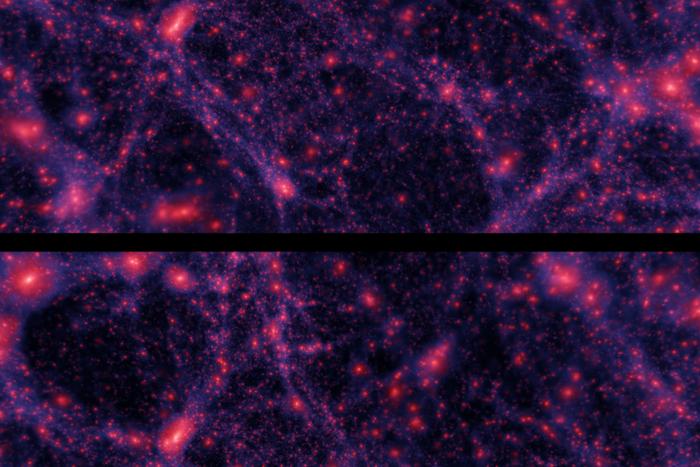
Two images from the Quijote simulations used in this study. The panels show the same region of the Universe, but in different cosmological models. The top image corresponds to the standard ΛCDM model, while the bottom image shows a universe with massive neutrinos and modified gravity. The differences are subtle, but they reveal how changes in the underlying physics can affect the formation and distribution of cosmic structures.
A study in the Journal of Cosmology and Astroparticle Physics (JCAP) explores how a machine-learning strategy known as transfer learning could dramatically reduce the computational cost of searching for new physics beyond the standard cosmological model — while also revealing an unexpected risk: sometimes AI systems can become too reliant on what they already know.
Artificial intelligence is widely used in cosmology to analyze the universe. But testing theories beyond the standard cosmological model, known as ΛCDM, remains computationally extremely demanding.
Although ΛCDM successfully describes many properties of the universe — from its expansion to the distribution of galaxies — physicists know it is probably incomplete. Recent observations hint that phenomena such as massive neutrinos, modified gravity or evolving dark energy could point toward new physics beyond the current model. Testing these alternatives requires running huge numbers of high-precision simulations of virtual universes under different physical assumptions, often demanding enormous computational resources.
Transfer learning, basically a shortcut
The new paper investigates whether transfer learning— a technique in which AI systems reuse knowledge acquired from one task to accelerate learning in another — can make this process far more efficient.
In this case, researchers first trained a neural network on simulations based on ΛCDM — this is known as pretraining — and then adapted it to more complex cosmological models that include possible new physics.
“It’s basically a shortcut,” explains Adrian Bayer a cosmologist at the Flatiron Institute and Princeton University, co-author of the study. “Usually people train the AI directly on the most computationally expensive simulations. What we do instead is first use simpler and less expensive ΛCDM simulations to give the AI an idea of what’s happening, and only afterward move to the more complex models.”
The idea resembles studying a difficult subject by first reading an introductory textbook. “You first read a basic book to get an idea of the knowledge,” says Bayer, “and then move to the really complicated book.”
According to Veena Krishnaraj, undergraduate student at Princeton University, first author of the paper, this strategy avoids forcing the AI to “digest everything at once.” The results show that this approach can work remarkably well. In some cases, transfer learning reduced the number of expensive simulations needed by more than a factor of ten.
Negative transfer
But the study also uncovered a more subtle phenomenon known as negative transfer.
Returning to Bayer’s textbook analogy, it is a bit like studying medicine from an introductory textbook and then encountering a rare disease whose symptoms resemble a common illness: prior knowledge helps most of the time, but it can also push the reader toward the wrong interpretation.
Something similar can happen with AI systems. Sometimes the effects produced by new physics closely resemble patterns already associated with the standard cosmological model. In these cases, the AI tends to interpret the new information using categories learned during pretraining, making it harder — rather than easier — to recognize genuinely new effects.
The researchers observed this behavior in simulations involving massive neutrinos. Certain effects produced by neutrino mass closely resemble variations associated with an existing ΛCDM parameter known as σ8, which describes how strongly matter clusters across the universe. As a result, the pretrained network initially struggled to distinguish between the two effects.
“The negative transfer is not random. It is driven by underlying physical degeneracies in the model,” says Krishnaraj. In other words, different physical parameters can produce very similar observable effects, making it difficult for the AI to disentangle them correctly. “So this is something we need to be aware of and try to mitigate,” she concludes.
The work highlights both the promise and the risks of applying “foundation model” strategies — conceptually similar to those behind modern generative AI and large language models — to fundamental physics. As the authors write in the paper, pretraining can accelerate inference, “but may also hinder learning new physics.”
For now, the method has been tested on simulations, laying the groundwork for application to real observational data. The researchers see it as a powerful tool for future cosmological surveys, which in the coming years will generate unprecedented amounts of high-precision data about the universe.
The paper "Transfer Learning Beyond the Standard Model" by Veena Krishnaraj, Adrian E. Bayer, Christian Kragh Jespersen, Peter Melchior is now available in JSTAT.
Journal
Journal of Cosmology and Astroparticle Physics
Method of Research
Data/statistical analysis
Article Title
Transfer Learning Beyond the Standard Model
Article Publication Date
10-Jun-2026
KAIST launches Mind Care & Growth Center, an integrated mental health platform for the AI era
KAIST announced the official launch of the KAIST Mind Care & Growth Center (KMCG), a new integrated platform that strengthens mental health support for students and faculty while advancing digital mental health research. To mark the occasion, KAIST hosted
The Korea Advanced Institute of Science and Technology (KAIST)
KAIST announced the official launch of the KAIST Mind Care & Growth Center (KMCG), a new integrated platform that strengthens mental health support for students and faculty while advancing digital mental health research. To mark the occasion, KAIST hosted an international symposium titled "Human Behavior and Mental Health" on June 10, 2026, at the Cho Su-mi Hall in the Chang Young Shin Student Activity Center on its main Daejeon campus.
The symposium drew significant interest from both academia and the public, with pre-registration reaching capacity within just one week of opening. More than 300 KAIST faculty members, researchers, students, and global digital health experts attended, underscoring the urgent demand for advanced mental health frameworks in the era of artificial intelligence.
A Unified Hub for Integrated Mental Health Support
The KMCG consolidates psychological counseling, psychiatric care, and crisis intervention services that were previously dispersed across campus, expanding and reorganizing the existing student counseling center. By eliminating the inconvenience of navigating multiple support channels, the center provides more systematic, seamless, and consistent care under one roof.
Going beyond a traditional counseling center, the KMCG serves as a living laboratory that fuses real-world mental health expertise with KAIST's research capabilities. Researchers from artificial intelligence, brain science, industrial design, digital humanities, mathematics, and computer science collaborate to develop and evaluate new approaches to mental health support — delivering evidence-based interventions to students, gathering practice-based insights, and continuously improving services.
Keynote: Global Collaboration with UCSF Neuroscape
The keynote address was delivered by Professor Adam Gazzaley, Founder and Executive Director of Neuroscape at the University of California, San Francisco (UCSF), and co-founder of Akili Interactive, developer of EndeavorRx — the world's first FDA-authorized prescription video game treatment.
Professor Gazzaley presented the latest advances in digital mental health, including VR-based cognitive training and multimodal biosensing. Neuroscape's interdisciplinary model — integrating clinical neuroscience, engineering, design, and AI — stands as a leading example of the convergence research that KMCG seeks to promote, and serves as a benchmark for building a multidisciplinary mental health innovation ecosystem at KAIST.
Based on the real-world clinical experiences of 311 Korean psychiatrists, the study found that generative AI may help organize emotions, support self-care, and improve access to treatment — but may also create risks such as overdependence, reinforcement of distorted beliefs, and potentially dangerous situations depending on patient vulnerability and context of use.
In subsequent lightning talk sessions, KAIST faculty from mathematics, brain engineering, AI, computer science, industrial design, and digital humanities presented future research directions and discussed opportunities for global collaboration with Neuroscape.
New Research: Generative AI as a Clinically Ambivalent Technology
In parallel with its service mission, the KMCG is already generating impactful scientific insights. Center Director Dooyoung Jung recently co-authored a study with Professor Chul-Hyun Cho of Korea University College of Medicine, published on June 2, 2026, in the Journal of Medical Internet Research (JMIR), examining the impact of generative AI on psychiatric practice.
The research team described generative AI as a "clinically ambivalent technology" and emphasized that it should assist, not replace, human therapists. Safe adoption requires technological reliability, clinical validation, crisis response systems, and robust governance by medical professionals.
Leadership Perspectives
Dooyoung Jung, Director of the KMCG, stated: "A healthy mind is the foundation for achieving outstanding research. We will develop the Mind Care & Growth Center into a platform that leads mental health solutions for universities across Korea."
KAIST President Kwang Hyung Lee remarked: "In an era where artificial intelligence is replacing even high-level human intellectual labor, our greatest concern is not technological deficiency, but the potential erosion of human-centered values and culture. Technology must remain a tool guided by human wisdom and philosophy — not the other way around."
As AI becomes more deeply embedded in everyday life, the KMCG is positioned to address new mental health challenges arising from AI dependency while harnessing digital technology in ways that support human flourishing. Pre-registration for the symposium has closed, but interested members of the public were welcome to attend on-site. Some services and amenities were limited.
Related Publication
Title: Mapping Practice-Based Signals of Generative AI in Psychiatric Care: Qualitative Study of Korean Psychiatrists' Experiences, Interpretations, and Implementation Priorities
Journal: Journal of Medical Internet Research (JMIR), June 2, 2026
DOI: 10.2196/96556
Authors: Myungsung Kim (UNIST, co-first author), Yoosuk An (Seoul National University / National Traffic Rehabilitation Hospital, co-first author), Chul-Hyun Cho (Korea University, co-corresponding author), Dooyoung Jung (KAIST, co-corresponding author)
<Structure of Item-by-Item Topic Analysis and Co-occurrence Analysis>
<Key Connections Among Clinical Signals, Interpretations, and Priority Implementation Tasks for Generative AI>
<An AI-generated image of a psychiatrist consulting with a patient who uses AI.>
KAIST breaks a major AI bottleneck with liquid cooling technology 10 times more efficient than the previous record
Professor Sung Jin Kim’s team embeds liquid-cooling channels thinner than a human hair inside silicon chips, enabling cooling of 2 kW per 1 cm² with room-temperature water - 3D coolant distributing channels shorten the travel paths like a distributed
The Korea Advanced Institute of Science and Technology (KAIST)
AI data centers are often described as “power-hungry giants.” Not only do artificial intelligence computations consume enormous amounts of electricity, but a significant amount of energy is also required to cool the semiconductor chips that heat up during operation. As AI chips continue to deliver higher performance, the amount of heat they generate is increasing rapidly. As a result, conventional air cooling and external copper heat spreaders are approaching their practical limits. To address this challenge, KAIST research team has developed an ultra-high-efficiency liquid-cooling technology that cools semiconductor chips from within.
KAIST (President Kwang Hyung Lee) announced on the 16th that a joint research team led by Professor Sung Jin Kim of the Department of Mechanical Engineering and Professor Ikjin Lee of the School of AI and Computing has developed a highly efficient liquid-cooling technology that directly cools high-heat-flux semiconductor chips using room-temperature water. The researchers achieved this by embedding liquid-cooling channels, thinner than a human hair, directly inside a silicon semiconductor chip. The team successfully maintained the chip temperature below 100°C even under extreme heat-generation conditions exceeding 2,000 watts per square centimeter (W/cm²).
The researchers focused on a manifold microchannel structure embedded directly inside a silicon chip. Microchannel cooling removes heat through microscopic fluid channels that are smaller than a human hair. In conventional designs, coolant must travel through numerous microchannels from one end of the chip to the other. This long flow path increases flow resistance and requires greater pumping power to circulate the coolant.
The manifold structure developed by the research team distributes coolant through multiple inlet channels and then collects it through multiple outlets. An analogy can be drawn to a logistics network: instead of shipping all goods from a single origin to a distant destination, multiple distribution centers are strategically placed to shorten transportation distances. Because the coolant travels only a short distance within each channel, flow resistance is reduced and the required pumping pressure becomes much lower. At the same time, coolant is supplied more uniformly throughout the chip, helping maintain a highly uniform temperature distribution across the entire device.
The key innovation of this work is not simply making the microchannels smaller. The researchers systematically optimized the channel width, height, number, arrangement, and coolant flow rate to maximize cooling performance while minimizing energy loss. To achieve this, they employed a multi-fidelity optimization framework, first using a rapid one-dimensional model to explore a broad design space and then refining selected designs with high-fidelity simulations.
Through this approach, the team simultaneously optimized cooling performance, pressure drop, and temperature uniformity. As a result, they successfully identified an optimal design within an enormous design space that had previously been difficult to explore because of computational limitations.
Existing MMC research faced a problem where the coolant was concentrated in some channels while not being sufficiently supplied to others. The research team optimized the structure so that the coolant flows evenly through all channels. To achieve this, they analyzed numerous design proposals by utilizing both a simple computational model and precise simulations, successfully identifying the optimal structure that enhances cooling performance while reducing energy loss.
The optimized structure was then fabricated in an actual silicon semiconductor chip and experimentally validated. Under the same temperature-rise condition, the cooling system achieved a coefficient of performance (COP) of 106,000. This is approximately ten times higher than the previous world-leading result of around 10,000 reported in Nature (van Erp et al.) in 2020. In practical terms, it means that only about one-tenth of the pumping power is required to remove the same amount of heat.
Notably, this performance was achieved without relying on phase-change cooling, nanoscale surface modifications, or expensive materials such as diamond. Ordinary room-temperature water was used as the coolant. In addition, the device was fabricated using a low-temperature process below 350°C that is compatible with conventional semiconductor manufacturing. This means the technology could be implemented in existing semiconductor foundries without requiring major additional equipment investments.
The technology is expected to help address thermal management challenges in a wide range of high-heat-flux electronic systems, including AI accelerators, high-performance computing (HPC) systems, three-dimensional semiconductor packaging, power electronics, and defense electronics. In particular, data centers are increasingly constrained not only by computing performance but also by cooling power consumption and cooling infrastructure requirements. Technologies that reduce pumping power at the chip level could therefore play an important role in improving the energy efficiency of next-generation data centers and alleviating thermal bottlenecks.
Professor Sung Jin Kim said, “As the performance of AI semiconductors and advanced electronic packaging becomes increasingly limited by heat, we expect this technology to serve as a foundational cooling solution for future high-performance computing systems.”
The study was co-first-authored by Young Jin Lee, ChulHyun Hwang, and Hansol Lee from the Department of Mechanical Engineering at KAIST. The research was published on June 15 in the international journal Energy Conversion and Management.
Paper title: Highly energy-efficient manifold microchannel for cooling electronics with a coefficient of performance over 100,000
DOI: 10.1016/j.enconman.2026.121422
<Fabricated cooling device, experimental results, and applications>
Credit
KAIST
This research was supported by the Mid-Career Researcher Program of the National Research Foundation of Korea (NRF), funded by the Ministry of Science and ICT (Grant No. 2021R1A2C3011944), and by the Specialized Research Laboratory Program for Ultra-High-Heat-Flux Cooling Systems of the Korea Research Institute for Defense Technology Planning and Advancement (KRIT), funded by the Defense Acquisition Program Administration (Grant No. KRIT-CT-22-022).
The TITO AI model learns to fast-forward in time at a faster rate than conventional numerical simulations, enabling researchers to characterise the physical properties of molecules more quickly. The model paves the way for faster testing of new drugs in the future.
Credit: Chalmers University of Technology | Juan Viguera Diez and Simon Olsson
A new AI model has become so good at predicting how molecules evolve over time that, in the future, it could speed up the costly and time-consuming process of testing new drugs. In the long term, this technology could facilitate the development of medicines and new treatments, as promising drug candidates are able to be identified more quickly and with greater accuracy. The findings are being presented in a new Swedish study published in Science Advances.
Developing a new drug often takes over ten years from the initial idea to the finished medicine before it reaches patients. A large proportion of both the cost and the time involved is concentrated in the early stages, as a multitude of tests must be carried out to identify the most promising candidates. Often, several studies are required in which thousands of molecules are screened – but only a fraction of them go on to the next stage.
Traditionally, the movements of molecules have been simulated using what is known as molecular dynamics, in which researchers calculate the forces between all the atoms step by step and move them a tiny bit at a time. For the calculations to be stable, each step must be extremely short, approximately one femtosecond (10⁻¹⁵ seconds). Since the processes that are of interest for drug development take place over much longer timescales, billions of steps are required, which makes the simulations computationally very demanding.
Major changes brought about by AI
The use of AI now enables researchers to detect molecular changes without having to perform numerical calculations. Machine learning can speed up each step of the calculation, and generative models can be used to directly generate plausible molecular structures without simulating their motion.
A group of researchers from Chalmers University of Technology and the University of Gothenburg, Sweden, has now taken another step forward by developing a new AI model that could, in the long term, make drug development testing even more efficient. The new model is more than 10,000 times faster than conventional simulations.
‘What sets our AI model apart is that it learns the underlying dynamics over longer time scales. It not only provides insights into the shapes that molecules take on, but also into how quickly and through which pathways these molecular transitions occur. As far as we know, this is the first time this has been done in a way that works for many different molecules,’ says Simon Olsson, research leader and Associate Professor in the Department of Computer Science and Engineering at Chalmers University of Technology and the University of Gothenburg.
Thousands of molecules have been tested
The study examined over 12,500 organic molecules, such as those containing carbon, nitrogen, hydrogen and oxygen atoms. Over a thousand short peptides were also studied: molecules consisting of short chains of amino acids that make up proteins. The AI model learned how the molecules typically behave and was therefore able to fast-forward through the simulations. The results are still consistent with the laws of physics.
‘We train the model using simulated examples of how the atoms in a molecule move over time. Based on these sequences, the model learns the underlying rules governing the movement of the molecules and can then predict how new molecules will behave,’ says Simon Olsson.
The researchers compared the model’s results and conclusions with previous studies of molecular evolution.
‘We validated the results using extensive post-processing simulations to corroborate them using standard numerical algorithms. And they are consistent with one another,’ says Simon Olsson.
Changes can be predicted
Although the AI model is not based on real images, the researchers describe the results as a way to jump between scenes in ‘molecular movies,’ instead of watching every frame in sequence.
The AI model forms the basis for the computational predictions that the researchers then make in the laboratory.
‘There, we measure very specific things: the properties of the molecules, how “happy” they are to be in a particular solution, or whether, for example, they want to pass through a membrane into a cell---but this still lies in the future,’ says Simon Olsson.
One major strength is that the model can be applied to molecules it has never encountered during its training, as it has learnt general rules governing molecular motion rather than memorising individual systems.
‘There is a certain pattern that the model helps us to identify. The AI model is based on a number of examples, in which it only observes what happens over a period of tens of nanoseconds. Nevertheless, it can predict the properties and changes in molecules that occur over a period a thousand times longer. So, with the help of artificial intelligence, we can work out what is likely to happen in the `molecular future`. It can predict how molecules change even though it has never seen the process unfold,’ says Simon Olsson.
Of interest for the pharmaceutical industry
‘In order to be able to predict the physical phenomena exhibited by molecules, we need to understand the underlying physics of how the system behaves. I believe we are among the first to demonstrate this in a general sense and show that it is possible,’ says Juan Viguera Diez, an industrial doctoral student at AstraZeneca, in the Department of Computer Science and Engineering at Chalmers and the University of Gothenburg, and lead author of the article.
Researchers are seeing considerable interest from industry in simulations that more accurately reflect reality and enable new drugs to be developed more quickly. As the new AI model can speed up molecular simulations, where large numbers of potential molecules need to be tested, the research team hopes it will be an important step towards more efficient drug development.
‘In the long term, AI models like ours could help to identify promising drug candidates more quickly and improve accuracy in the early stages. The research study shows what is currently possible. This will hopefully pave the way for the development of more general techniques, which may ultimately facilitate the development of new drugs and new treatments, and, in a broader sense, also improve our understanding of diseases,’ says Juan Viguera Diez.
More about the AI model
The TITO (Transferable Implicit Transfer Operators) AI model is a deep generative modelling framework that learns the statistical rules governing molecular motion directly from simulation data. It makes it possible to predict how atomic configurations (the way atoms are arranged and relate to one another spatially within a molecule) evolve over time scales much more rapidly than conventional numerical simulations.
The method has currently been tested on small molecular systems in simplified solvent models and at a specific temperature. It is now being developed further for more complex and realistic systems.
Simon Olsson, Associate Professor in the Department of Computer Science and Engineering, Chalmers University of Technology and the University of Gothenburg, Sweden, simonols@chalmers.se
Simon Olsson speaks English, Danish and German. At Chalmers, we have podcast studios and filming equipment on-site and can assist with requests for TV, radio, or podcast interviews.
Illustration caption: The TITO AI model learns to fast-forward in time at a faster rate than conventional numerical simulations, enabling researchers to characterise the physical properties of molecules more quickly. The model paves the way for faster testing of new drugs in the future.
Illustration credit: Chalmers University of Technology | Juan Viguera Diez and Simon Olsson
Banner image caption: The researchers’ new AI model could eventually pave the way to faster testing in drug development. The new model is up to around 10,000 times faster than conventional simulations.
Cleveland: The third annual Cleveland Discovery and Innovation Forum, hosted by Cleveland Clinic and IBM, highlighted progress in applying quantum computing and AI to healthcare and life sciences research. The forum brought together global leaders in healthcare, science and technology to share insights into how advanced computing is accelerating discovery and shaping the future of patient care.
The one-day event, held today on Cleveland Clinic’s Main Campus, featured more than 30 speakers from academia, industry, foundations, venture capital and government. Discussions focused on the growing impact of AI and quantum computing in tackling some of the most complex challenges in healthcare and life sciences research.
“The Cleveland Discovery and Innovation Forum highlighted how AI and quantum computing are advancing research across every stage of disease – from prevention and early detection to treatment,” said Lara Jehi, M.D., Cleveland Clinic’s Chief Research Information Officer. “Cleveland Clinic is at the forefront of applying quantum computing to life sciences research. Through this forum and our broader research efforts, we are helping define how advanced computing can unlock new scientific insights and ultimately improve care for patients around the world.”
The forum also highlighted five years of progress by Cleveland Clinic’s and IBM’s Discovery Accelerator, a partnership focused on advancing the pace of biomedical research through high-performance computing, AI and quantum computing. Since its launch, the Discovery Accelerator has supported more than 50 projects, contributed to multiple peer-reviewed publications and developed an innovative education curriculum aimed at building the skilled workforce needed for the future.
“As we mark five years of our collaboration with Cleveland Clinic, we are seeing how quantum and AI can work together to transform biomedical research — modeling molecular interactions, refining machine learning for personalized care, and pushing the boundaries of what's achievable across healthcare and life sciences,” said Alessandro Curioni, Ph.D., IBM Fellow and Vice President, Algorithms and Applications, IBM Research.
The agenda included keynote presentations, panel discussions and fireside chats led by Cleveland Clinic and IBM executives alongside international leaders. Featured speakers included Eric Isaacs, Ph.D., of Research Corporation for Science Advancement; Curtis Priem, Rensselaer Polytechnic Institute and co-founder of NVIDIA; Alex Shalek, Ph.D., MIT; Sergii Strelchuk, University of Oxford;Serpil Erzurum, M.D., Cleveland Clinic; Alessandro Curioni, Ph.D., IBM; and Percy Carter, Pfizer.
Sessions included panels on applied quantum computing and its role in building a world-class research and healthcare ecosystem, and how AI and quantum computing can realize the potential of personalized therapy as well as a fireside chat on visionary leadership and advanced computational methods in healthcare.
The forum also featured a project showcase from Cleveland Clinic and IBM researchers, including recent work modeling a protein of more than 12,000 atoms, the largest protein structure known to be simulated on a quantum computer. The findings underscore the growing potential of quantum computers as scientific tools for solving fundamental problems in biology, chemistry and life sciences.
Several research announcements and updates were shared during the event and highlighted Cleveland Clinic’s steadfast progress in shaping quantum computing applications in medicine, and building the Ohio Discovery Corridor through its Cleveland Innovation District. These included:
2026 Global Quantum + AI Challenge: Details were shared on the international competition launched by the Quantum Insider and Cleveland Clinic. The year-long program is designed to bridge the gap between quantum theory and real-world impact, and unites enterprises, start-ups and research teams to accelerate the adoption of advanced computing technologies in industries where innovation drives competitive advantage. Cleveland Clinic’s challenge is titled: Unlocking Undruggable Targets: Quantum Simulation of Allosteric Signal Propagation. The challenge will award $200,000 across five enterprise challenges, with $40,000 allocated per challenge. Applications are now open: https://quantumaiportal.thequantuminsider.com/
Cleveland Clinic Quantum Catalyzer Program: Updates on this year’s program, which provides quantum access to start-up companies, as well as Kipu. The Kipu project will focus on a breakthrough quantum algorithm to simulate protein folding, helping researchers better understand disease and develop new treatments. Earlier this year, the competitive program selected EntangleBio, Polaris Quantum Biotech and Singularity Quantum. This year’s selected companies will also receive up to $250,000 from K5 Tokyo Black Fund with an in-kind match from Cleveland Clinic.