Thursday, October 29, 2020

CANADA
Ethics watchdog clears Morneau of accepting gift from WE Charity


OTTAWA — The federal ethics watchdog has cleared former finance minister Bill Morneau of failing to disclose a gift from WE Charity.
© Provided by The Canadian Press

In a letter to Morneau, ethics commissioner Mario Dion says he accepts that the former minister "genuinely believed" he had paid for the entire cost of two trips he and family members took in 2017 to view WE's humanitarian projects in Ecuador and Kenya.

As soon as Morneau became aware last summer that WE had in fact covered $41,000 worth of expenses for the trips, Dion says he reimbursed the charity.

Because he immediately took "the appropriate corrective measures," Dion concludes: "I am of the view that you did not accept a gift from WE Charity."

Craig Kielburger, who co-founded WE with his brother, Marc, hailed Dion's decision, saying in a statement that “we have always maintained that these trips were done in good faith and welcome this important clarification of the facts.”

Morneau reimbursed the money shortly before testifying on the WE affair at the House of Commons finance committee in July.

Dion says WE's invitation to view the projects was intended to encourage Morneau's wife to donate to the charity. He accepts Morneau's explanation that he was not involved in her subsequent choice to make two large donations through the family foundation.

While he's dropping his probe into this aspect of the former minister's conduct, Dion says he continues to investigate whether Morneau breached the Conflict of Interest Act by failing to recuse himself from the cabinet decision to pay WE Charity $43.5 million to manage a since-cancelled student grant program.

Dion is also investigating Prime Minister Justin Trudeau's failure to recuse himself, despite his own family's close ties to WE.

WE's involvement in the student services grant triggered immediate controversy when announced in late June. WE withdrew from the program a few days later and the program was eventually cancelled.

In what Kielburger called a further effort to correct "inaccurate information" about the charity promulgated by opposition parties and the media, WE released Thursday the results of what it said were investigations by non-partisan experts into the charity's overall conduct and into the student grant program in particular.

WE said the reports were commissioned by the Stillman Foundation, a U.S.-based charity.

Matt Torigian, former deputy solicitor general of Ontario, concluded the government asked WE to submit a proposal, considered the ability of other organizations to run the program and its ultimate choice of WE was "not predetermined."

After reviewing all the organization's finances, forensic accountant Al Rosen dismissed suggestions that the charity was in dire financial straits before being awarded the contract or that there were financial irregularities in its operations from which the Kielburger brothers stood to benefit.

“These financial findings stand in stark contrast to many public allegations launched against the organization by members of Parliament, Canadian media, and select critics,” Rosen wrote.

Morneau resigned abruptly from politics in August, as the WE affair continued to engulf the government. There were also reports of tensions between Morneau and Trudeau over massive spending on pandemic relief.

The following day, Trudeau prorogued Parliament for six weeks — a move opposition parties charged was intended to shut down committee investigations into the WE affair.

Since Parliament's resumption in September, the Liberals have been filibustering opposition attempts to reopen those committee investigations.

However, there is no mention of the WE affair in a report to Parliament explaining the decision to prorogue — a new requirement introduced by the Trudeau government ostensibly to prevent abuse of the prorogation procedure.

The report echoes Trudeau's explanation at the time, that the government needed to prorogue in order to come back with a throne speech outlining its plan for coping with the ongoing COVID-19 pandemic and rebuilding the shattered economy.

"Five and a half months into this pandemic — the greatest challenge Canadians have faced since the Second World War — the people of Canada deserved to know that the federal government had a bold and comprehensive plan to get them through whatever challenge would come next," the report says.

"In order for this to be the case, our government was duty-bound and honour-bound to ensure we had the continued confidence of the House of Commons. We needed to outline a clear, realistic plan on which parliamentarians would have the opportunity to vote.

"This was the only clear and transparent way to ensure that the federal government could continue to provide the support on which Canadians were relying."

This report by The Canadian Press was first published Oct. 29, 2020.

Joan Bryden, The Canadian Press

Note to readers: This is a corrected story. A previous version said former finance minister Bill Morneau became aware in August that WE Charity had in fact covered $41,000 worth of expenses for the trips. It was in July.
New ‘black neutron star’ stuns astronomers with its spectacular death

By Josh K. Elliott Global News
Posted June 24, 2020
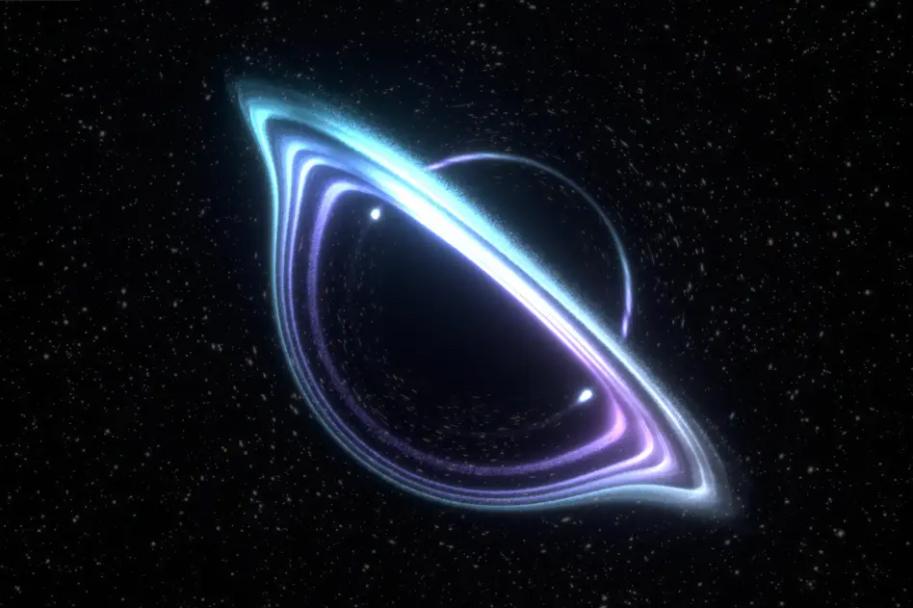
Artistic rendering of the GW190814 event, in which a smaller compact object is swallowed by a nine-times-more-massive black-hole. Alex Andrix via EGO
VIDEO https://vimeo.com/413180380

What happens when a star dies?

Astronomers thought they had it all figured out. A dying star either fades into a simmering white dwarf, explodes and then shrinks into a super-dense neutron star or collapses into an all-consuming black hole, depending on its mass.

However, gravitational waves detected last year suggest that a black hole may have devoured an extremely rare form of dead star — one that was heavier than a neutron star, but lighter than the lightest black hole.

Astronomers say this mystery object is the first they’ve ever seen in the “mass gap” between their definitions of neutron star and black hole. That means it might be some sort of black neutron star or — to borrow the title of a Soundgarden song — a black hole sun.

Researchers detected the object’s demise last August through the U.S.-based LIGO antenna and Virgo, a similar project in Italy for monitoring the gravitational waves of huge nearby objects in space. The cosmic event sent out ripples in space-time some 780 million years ago that included hints about the mystery object’s size, according to the findings published Tuesday in the Astrophysical Journal Letters.

Scientists had suspected that objects like this one might exist, but they’d never seen one before. Now they’ll have more information to go looking elsewhere for similar objects.

“We’ve been waiting decades to solve this mystery,” study co-author Vicky Kalogera, of Northwestern University, said in a news release from LIGO. “We don’t know if this object is the heaviest known neutron star or the lightest known black hole, but either way it breaks a record.”

READ MORE: Big Bang 2: Black hole creates biggest space explosion since time began

Stars and black holes are measured in terms of their size relative to our sun — a unit called solar mass. The largest-known neutron stars have a maximum solar mass of 2.5, while the smallest black holes start at a solar mass of five.

The mystery object had a solar mass of about 2.6, placing it in that theoretical in-between zone. It was devoured by a black hole with a solar mass of 23, and together they formed an even bigger black hole that sent invisible gravitational waves rippling toward Earth. Astronomers labelled the event “GW190814.”

The discovery could transform scientists’ understanding of space and the way massive binary objects come together and circle one another, according to Charlie Hoy, a PhD student at Cardiff University who was part of the study.

“We can’t rule out any possibilities,” Hoy told BBC News. “We don’t know what it is and this is why it is so exciting, because it really does change our field.”

Patrick Brady, a professor and spokesperson for the LIGO Scientific Collaboration, said the discovery should help scientists spot more of these “mass gap” objects in the future.

“The mass gap may in fact not exist at all, but may have been due to limitations in observational capabilities,” he said in the LIGO news release. “Time and more observations will tell.”

Researchers say the event was hard to see via telescopes because the two objects would not have shone any light. The smaller object also likely wouldn’t have gone out with a bang because the black hole probably devoured it all at once.

“I think of Pac-Man eating a little dot,” Kalogera said. “When the masses are highly asymmetric, the smaller neutron star can be eaten in one bite.”


READ MORE: Why a blurry picture of a black hole matters

Hoy says the findings will help LIGO and Virgo scientists fine-tune their instruments so they can see more such events.

The scientists behind the discovery did not provide a new classification for the mysterious object — but whatever they eventually choose, it’ll make for a good band name in the future.

The LIGO facility first detected gravitational waves in 2016, confirming a key theoretical part of Albert Einstein’s theory of relativity. The U.S.-based LIGO and Virgo, in Italy, have detected dozens of gravitational waves since that first discovery.

3:44 Scientists discusses how proof of gravitational waves was discovered

Each wave is generated by a grand cosmic event, such as the collision of two black holes or — in last year’s case — a black hole eating something that doesn’t fit into an existing category. The waves are sent out in the seconds before two huge space objects collide with one another.

University of Chicago professor Daniel Holz, who was not part of the study, told the New York Times that the discovery is incredible because black holes and neutron stars are “polar opposites” in a sense.

“A neutron star is composed of the densest matter in the universe, and in some sense is the ultimate star,” he told the Times. “A black hole is just warped space time. It doesn’t even have a physical surface!”


2:32 Scientists confirm first direct evidence of gravitational waves

Holz, who is a member of the LIGO collaboration, said that in one way, black holes aren’t even part of our universe because nothing can ever escape them.

“What is astounding is that, despite their profound differences, in this particular case we can’t tell which is which,” he said.

“Lots of theorists are now sharpening their pencils to try to explain what we’ve seen.”


GLOBAL VIDEOS 
Can Liberty Oil maverick's corporate culture survive the U.S. shale bust?

By Liz Hampton 
© Reuters/ANTHONY ANDORA Handout photo of Chris Wright

DENVER (Reuters) - Chris Wright stands out as an oilman who might be more at home in Silicon Valley than the shale fields of North Dakota.

A mountain climber and Massachusetts Institute of Technology graduate who stationed his oilfield firm in Denver, he saw opportunity in the high employee turnover at hydraulic fracturing providers. 

Nine years later, Wright is running the second-biggest fracking company in North America and preparing for a battle to keep the unconventional culture he has built at Liberty Oilfield Services Inc . The challenge will be to maintain its free-wheeling style while grappling with a major acquisition and the oil industry's worst bust.

 In September, Wright bought Schlumberger's North American frack business by swapping a 37% stake in Liberty. The deal puts Liberty second in the U.S. behind Halliburton Co in what was a $20 billion-a-year market before the coronavirus crushed global fuel demand, according to estimates from consultancy Spears & Associates.

Liberty and rival fracking firms have been hit hard. U.S. shale oil companies have cut budgets up to 30%, halting most new drilling and pushing several oilfield firms out of the business.


Just a third of the multimillion dollar frack fleets working in the top U.S. shale field before March are still active, estimates consultancy Primary Vision.

 Liberty reported a $49 million third-quarter loss as revenue fell 71% from a year-earlier to $147.5 million.

HIGH ENERGY BOSS

Wright combines tech savvy and a wildcatter's passion for the oil business, said employees and executives familiar with the company. His downtown Denver headquarters echoes tech startups with industry get-togethers, ping pong tables and craft beer on tap, unlike the sprawling corporate campuses at larger rivals Schlumberger and Halliburton.

"The main advantage of any company is culture," Wright said in an interview in which he choked up when discussing staff cuts.


Wright must battle to keep Liberty's distinctive corporate style as hundreds of Schlumberger workers join the business. Schlumberger staff waiting to hear who will be transferred to Liberty are enthused at the prospect, said one.

Wright made a media splash last year when he drank fracking fluid on a radio talk show to demonstrate it was not dangerous. 

A CORPORATE SHILL DID THAT WITH DDT TRYING TO PROVE RACHEL CARSON WRONG

His teams are well respected in the industry.

"They hire go-getters,” said an employee at another oilfield services firm who has worked alongside Liberty but could not be identified because he was not authorized to speak to the media. "They were extremely innovative," the person said.

Customers liked his hands-on approach after the deal to buy Schumberger was announced. He sent individual video messages to customers, and then spent the next day addressing employees and explaining the deal - something that impressed customers, according said Maynard Holt, CEO at investment banker Tudor, Pickering, Holt & Co, who attended one of Wright's town halls following the deal.

His leadership style, "high personal connectivity, passion, opinions based on real analysis, energetic," said Holt, which stand out among energy executives.

STANDOUT RETURNS

Wright formed Liberty in 2011 after struggling to secure efficient services for his shale production business. He became convinced there would be strong demand for a company that could keep experienced staff through the industry's boom-bust cycles.

"If we have low turnover and good culture, we'll be much better" than existing suppliers, he recalled thinking. He set out to build a tolerant team culture that would keep people, which includes flexible working policies.

Liberty has generated "some of the best if not the best full-cycle returns in the business," said James West, a senior managing director at investment firm Evercore ISI. Liberty has stayed "on the leading edge of efficiency gains and technology prowess" under Wright, said West.

The company's return on invested capital averaged 27% between 2012 and 2019, estimates West, compared with 11% for the Philadelphia Oilfield Service Index <.OSX>. 

           SURPLUS VALUE  

Return on revenue per employee was $794,866 in 2019, according to data from Refinitiv, versus $389,704 at larger rival Halliburton.

PAINFUL YEAR

Wright got through the 2008 and 2016 oil downturns without cutting staff. He pledged at the time to do his utmost to avoid layoffs, recalled his mother, Gayla Wright, in an interview.

"I'll cut whatever it takes to pay those people," he confided to her during the 2008 price rout.


But this year, the industry's worst downturn has forced deep cuts. Facing a 90% decline in revenues as producers pulled back spending, Wright and other executives cut their pay 30%, then halved staffing on its frack fleets.

Chad Crofford, who lost his job in April after about three years as a Liberty employee, said he harbors no ill will and believes Wright's values made his stay worthwhile.

"It's more of a family than a company," he said. "With Chris, you can really tell he has his heart in it," said Crofford. 
THE GIG ECONOMY SOCIAL ECOLOGY IS POST MODERN PATERNALISTIC OWENISM 

After leaving the company, Crofford wrote to Wright and thanked him for the opportunity to work at Liberty and was recently hired back on.

Wright, who at age 27 started his first company, a technology firm that mapped underground fractures for oil producers, said he does not underestimate the difficulties ahead.

"I'm going to age more than one year next year," Wright, now 55, said. "It's going to be a challenge."

(Reporting by Liz Hampton in Denver; editing by Gary McWilliams and Marguerita Choy)
Two ‘murder hornet’ queens captured in Washington state sting

By Josh K. Elliott Global News
Posted October 29, 2020 


WATCH: Washington State authorities captured two Asian giant hornet queens, known as "murder hornets," on Wednesday, four days after officials eradicated the first nest found in Blaine, just south of the Canadian border, on Oct. 24 
https://globalnews.ca/news/7429274/murder-hornet-queen-nest/

God save the queens — for research purposes.

Wildlife officials in Washington have captured two so-called “murder hornet” queens, following a major operation to wipe out the invasive species’ first known nest in the United States.

You might even call the operation a “sting,” as it took a bit of subterfuge to finally capture the Asian giant hornet queens. Entomologists trapped three hornet drones last week, then tagged them with radio trackers and followed them back to their nest.

The nest was located inside a tree in Blaine, Wash., just south of the border with British Columbia.

State wildlife officials wrapped the tree in plastic and vacuumed up the colony on Oct. 24, then toppled the tree on Wednesday to dig the queen out of hiding.
1:25 Scientists remove 98 murder hornets from Washington state nest near B.C. border
https://globalnews.ca/news/7429274/murder-hornet-queen-nest/

Entomologists actually found two queens inside the nest, the Washington State Department of Agriculture says. The queens were either two “virgins” preparing to strike out and found their own colonies, or one virgin and one old queen who may have spawned the nest.

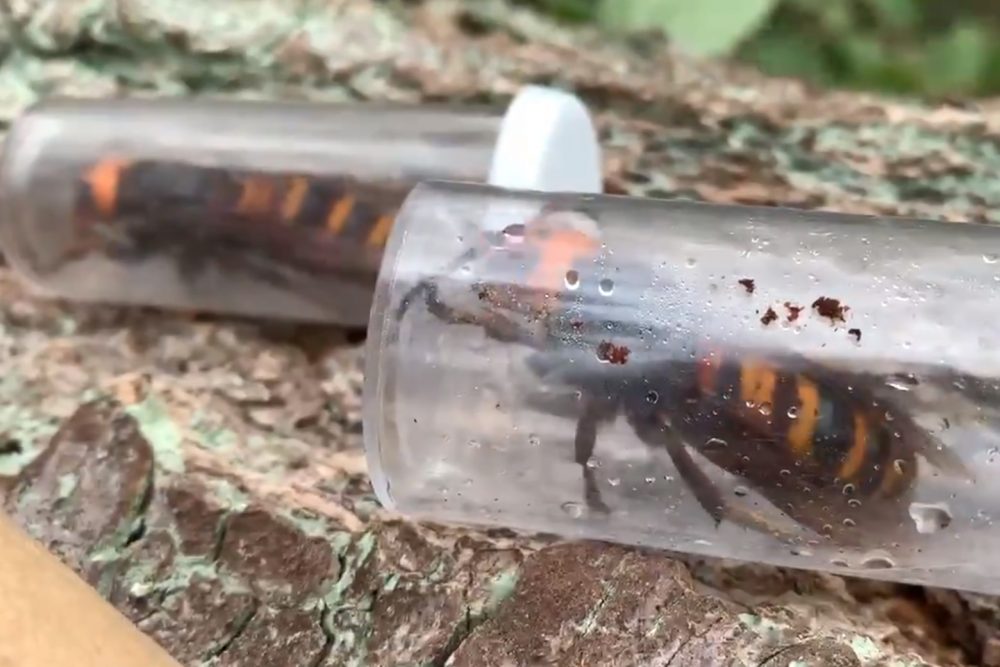
Officials shared video of the captured queens on Wednesday. The video shows the two black-and-yellow, thumb-sized behemoths crawling around inside separate glass vials.

Two captive Asian giant hornet queens are shown in Washington state on Oct. 28, 2020. Washington State Department of Agriculture

Entomologists captured 13 live hornets in addition to the queens. They also killed 85 more by sucking them up with high-tech vacuums.

Asian giant hornets are native to China and Japan but they started spreading into North America last year, sparking fear that they might decimate vulnerable honey bee hives in the U.S. and Canada. The first ones were spotted near Nanaimo, B.C., in August 2019.

The insects were nicknamed “murder hornets” earlier this year, and that name is well-deserved. A handful of the armoured hornets can wipe out an entire honeybee colony in an afternoon, slaughtering the bees one by one while shrugging off hundreds of stings. The hornets then capture the honeybees’ young and bring them back to the nest for food.

READ MORE: Asian giant hornet is death on wings for bees in North America

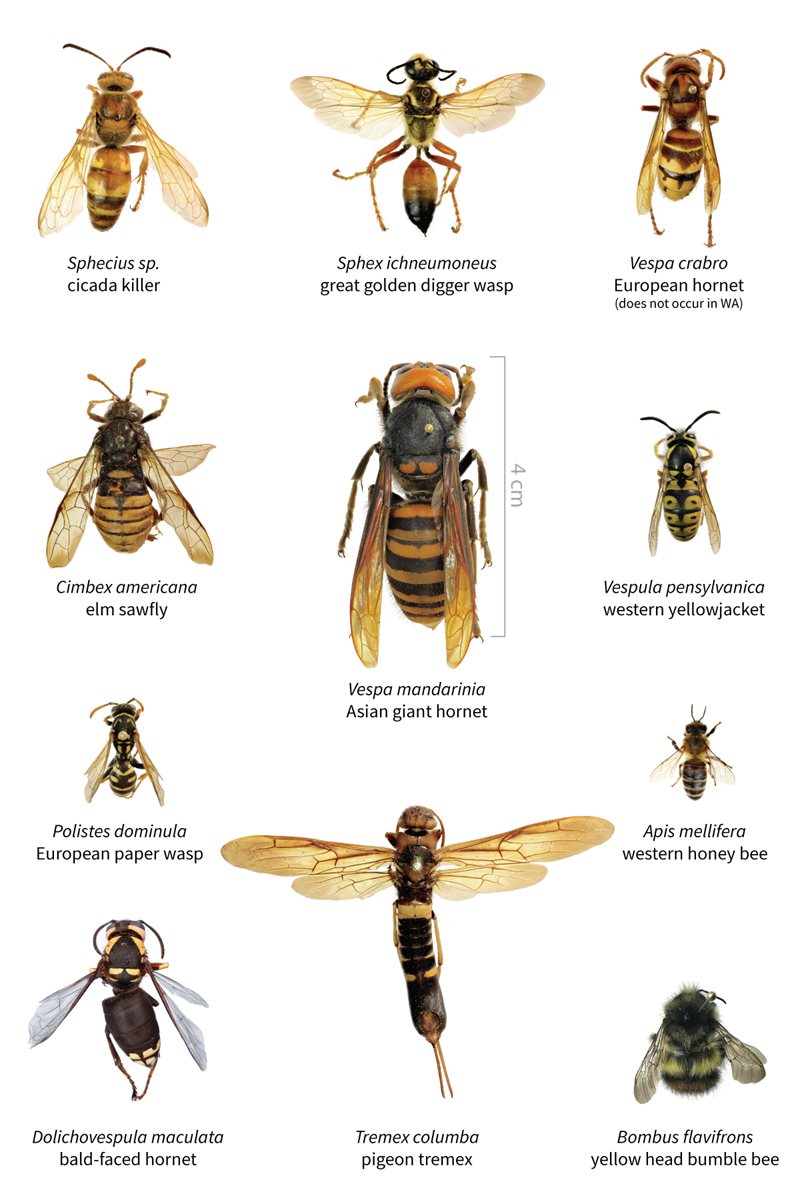
Murder hornets are relatively huge when compared to the bees they prey upon. Each one measures four to five centimetres (1.5 to 2 inches) long, and has a toxic stinger that can cause excruciating pain for humans. One victim described the sting as a “red-hot thumbtack” earlier this year.

Their heads are completely yellow with two big, black eyes. Their bodies are black and their abdomens are striped black and yellow.

This handout chart shows the Asian giant hornet compared to other North American insects. Washington State Department of Agriculture

The hornets do not pose a major threat to humans, despite their threatening nickname. They are unlikely to sting unless they feel the nest is threatened; dozens of people die in Asia each year after stumbling upon a nest without protection

Washington entomologists wore state-of-the-art suits to deal with the hornets this week. Their puffy white outfits looked like a cross between a spacesuit and a hazmat suit, and were designed to protect them from swarms of stinging murder hornets.

Entomologists hold a canister containing dozens of Asian giant hornets after eradicating a nest in Washington state on Oct. 24, 2020. Washington State Department of Agriculture

Wildlife officials are hailing the operation as a good first step in the fight against the Asian giant hornet.

Officials in the U.S. and Canada have been setting traps for the hornets along the West Coast since last year.
1:27 Why arrival of ‘Murder hornet’ in North America could cause danger for bees, concerns for humans https://globalnews.ca/news/7429274/murder-hornet-queen-nest/

The first confirmed nest in Canada was wiped out last fall on Vancouver Island.

Anyone who sees one of the Asian giant hornets in B.C. is urged to immediately contact the Invasive Species Council of B.C. at 1-888-933-3722, or submit information through its website.
Scans reveal failed planet-turned-asteroid worth up to $10,000 quadrillion

By Josh K. Elliott Global News
Posted October 29, 2020 


WATCH: The asteroid 16 Psyche, named for the ancient Greek goddess of the soul, is one of the most mysterious objects in our solar system.

The wealth is out there.

A single asteroid floating through our solar system might be worth more than the Earth’s entire global economy, based on new scans conducted with the Hubble Space Telescope.

The extremely rare asteroid, dubbed 16 Psyche, is thought to be the once-molten metal core of a planet that never quite formed, according to NASA. It’s a gigantic potato-shaped object floating in the asteroid belt between Mars and Jupiter, measuring about 232 kilometres wide.

It would probably be bigger than Nova Scotia if it were placed in the Atlantic Ocean, based on NASA’s estimated dimensions.

READ MORE: NASA spacecraft grabs rock from speeding Bennu asteroid in historic first

Most asteroids are composed of ice and rock, but a new study suggests asteroid 16 Psyche might be almost entirely made of metal — though it’ll probably be a long time before humans figure out how to mine it.

“We’ve seen meteorites that are mostly metal, but Psyche could be unique in that it might be an asteroid that is totally made of iron and nickel,” lead author Tracy Becker, of the Southwest Research Institute, said in a statement.

“Earth has a metal core, a mantle and crust. It’s possible that as a Psyche protoplanet was forming, it was struck by another object in our solar system and lost its mantle and crust.”

In other words, it might be like a smashed Kinder Surprise egg: all prize, no chocolate shell.


Space Talk: Asteroid mining

Becker and her team pointed the Hubble telescope at 16 Psyche and scanned its surface on two separate occasions. They used the Hubble’s spectrograph to examine the asteroid on the ultraviolet (UV) spectrum, which makes it much easier to spot metals from afar.

The scans revealed that 16 Psyche’s surface is almost entirely composed of iron, with several big splotches of iron oxide, or rust, splashed across it.

Becker and her team pointed out that iron tends to light up brightly on UV scans, so even a small amount would dominate their observations.

Nevertheless, the images add to the growing body of evidence that 16 Psyche might be a rare hunk of metals dating back to the birth of the solar system.

If the object is a failed planet, it could offer researchers some insight into the molten metal core at the centre of the Earth. Our planet’s inner core is basically a liquid sphere of nickel and iron measuring 2,442 kilometres in diameter, according to NASA.

The space agency is already planning to launch a spacecraft toward the asteroid in 2022, in hopes of scraping its surface to find out if all that glitters is iron.

Lindy Elkins-Tanton, NASA’s lead scientist on the mission, told Global News in 2017 that the asteroid might be worth up to US$10,000 quadrillion.

That’s a one with 19 zeroes after it.

However, she also said there’s no plan — and no technology — to bring the floating treasure trove back to Earth. Yet.

“Even if we could grab a big metal piece and drag it back here … what would you do?” she said.

Elkins-Tanton and her team will launch their Psyche mission in 2022, then use Mars’ gravity to slingshot the spacecraft toward the asteroid for a 2026 arrival.

“What makes Psyche and the other asteroids so interesting is that they’re considered to be the building blocks of the solar system,” Becker said.

“To understand what really makes up a planet and to potentially see the inside of a planet is fascinating. Once we get to Psyche, we’re really going to understand if that’s the case, even if it doesn’t turn out as we expect.”

‘Queen of the Ocean’: Massive great white shark spotted off Nova Scotia

By Josh K. Elliott Global News
Posted October 6, 2020 


WATCH: OCEARCH researchers on an expedition off the coast of Nova Scotia found a giant great white shark which they believe to be nearly 50 years old. They've named it “Queen of the Ocean.”
https://globalnews.ca/video/rd/5b7c5b54-07de-11eb-aaca-0242ac110004/?jwsource=cl

A massive, 50-year-old great white shark has been tagged off the coast of Nova Scotia, in a rare encounter that scientists compared to a royal visit.

Researchers with OCEARCH, an NGO dedicated to tracking great whites on the Atlantic Ocean, reported tagging a huge female shark as part of their studies over the weekend.

“We named her ‘Nukumi,’ pronounced noo-goo-mee, for the legendary wise old grandmother figure of the Native American Mi’kmaq people,” OCEARCH wrote on Facebook. The organization also dubbed her “Queen of the Ocean” in a separate post on Twitter.

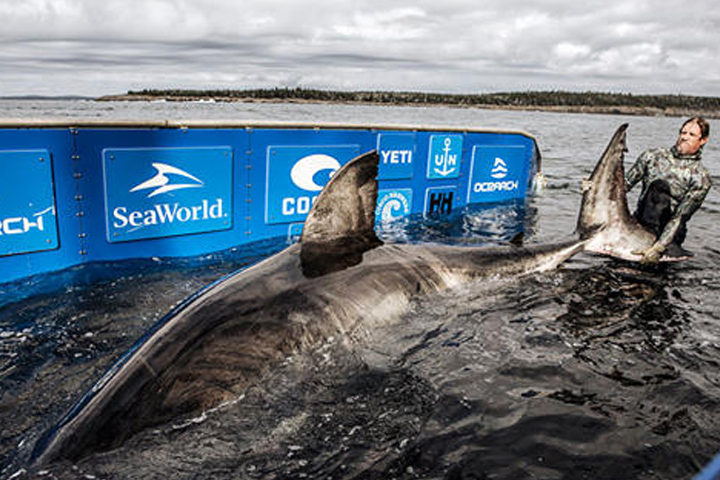
The mature female shark weighed in at a whopping 1.6 metric tonnes (3,541 pounds) and measured about 5.2 metres (17 feet, 2 inches) long. That’s well above the average size of an adult great white, which usually measures between 4.5-4.8 metres long.

Researchers hauled the shark out of the water last week, tagged it, then released it safely back into the ocean.

They say the shark is the largest they’ve tagged in the North Atlantic to date.

A large great white shark, dubbed Nukumi, is shown in this handout photo shared by OCEARCH on Oct. 3, 2020. Chris Ross/OCEARCH

Expedition leader Chris Fischer described tagging five sharks, including Nukumi, in a video from Nova Scotia’s West Ironbound Island on Saturday.

Fischer described Nukumi as a “proper ‘Queen of the Ocean,’ matriarch of the sea, balance-keeper of the future. A grandmother.”

“It’s really humbling to stand next to a large animal like that,” he said. “When you look at all the healed-over scars and blotches and things that are on her skin, you’re really looking at the story of her life, and it makes you feel really insignificant.”

Fischer hailed West Ironbound Island as a great spot for examining great whites at various stages of their development.

“The diversity of the sharks is very interesting here,” he said. “Both males and females, both immature and mature.”
2:09Concerns rise in Nova Scotia after Maine shark attack
Concerns rise in Nova Scotia after Maine shark attack

OCEARCH researchers have tagged dozens of sharks over the course of their expedition. The trackers ping every so often and feed the data back to OCEARCH’s dedicated website, where anyone can follow the sharks’ migratory patterns online.

The system has yielded a wealth of information about great whites, including their habit of migrating between the waters of Florida and Nova Scotia. The project has also revealed some of the sharks’ favourite breeding grounds.

Users can track all of the sharks or simply follow Nukumi on her royal travels.
0:38Massive shark caught and tagged off Nova Scotia

OCEARCH’s latest big fish still pales in comparison to Deep Blue, another mature female great white that’s been spotted a handful of times off the West Coast. That shark is said to be about 6.1 metres (20 feet) long.

Great whites are descended from the largest known ocean predator in history, carcharodon megalodon. The megalodon lived between 3.6 to 23 million years ago and measured roughly three times as long as a modern great white.

If great whites like Nukumi are the queens of the ocean, then megalodon would have been empress of the waves.
Massive coral reef ‘tower’ found off coast of Australia

Josh K. Elliott 

A towering, blade-like column of coral has been discovered in the Great Barrier Reef, marking the first time in more than 100 years that a new, distinct structure has been found in the area near Australia.
© Schmidt Ocean Institute/YouTube 
Part of a coral reef tower is shown off the coast of Australia on Oct. 25, 2020.

Researchers with the Schmidt Ocean Institute stumbled upon the living tower while mapping the ocean floor with a robot on Oct. 20.

The structure they found is larger than the Empire State Building, measuring 1.5 kilometres wide at its base and rising 500 metres up from the ocean floor. The giant column of coral is 40 metres below the surface at its shallowest point, and would be tough to spot from a boat cruising over it.

They say it's the first stand-alone coral reef to be found on the Great Barrier Reef since the 1800s.


“We are surprised and elated by what we have found,” expedition leader Dr. Robin Beaman said in a statement.

“To find a new half-a-kilometre tall reef in the offshore Cape York area of the well-recognized Great Barrier Reef shows how mysterious the world is just beyond our coastline," added Dr. Jyotika Virmani, executive director of the Schmidt Ocean Institute.

Beaman and her team sent a robot called SuBastian down to explore the tower on Oct. 25, in a mission they live-streamed over YouTube.

Their digital map of the tower shows it rearing up from the ocean floor in a dramatic spike, with sides far steeper than the surrounding terrain.

The video shows the robo-sub picking over bits of coral on the ocean floor, then slowly ascending along the tower's wall. It pauses many times along the way to pick samples and inspect bits the reef.

"To not only 3D-map the reef in detail, but also visually see this discovery with SuBastian is incredible," Beaman said.

"It's a big reef not to have known about," added Tom Bridge, the expedition's principal investigator, in an interview with The Guardian.


The Great Barrier Reef is a massive marine park spanning more than 344,000 square kilometres off Queensland, Australia. It's home to more than 1,500 species of fish and hundreds of coral species, although studies have found that climate change is killing off parts of it by heating up the ocean.

Most of the reef hangs together in one main body, but there are a few distinct structures that stand apart, including this latest tower.

Wendy Schmidt, co-founder of the non-profit Schmidt Ocean Institute, hailed the discovery as another in a long line of achievements for the expedition.

"This unexpected discovery affirms that we continue to find unknown structures and new species in our ocean," she said.

"Thanks to new technologies that work as our eyes, ears and hands in the deep ocean, we have the capacity to explore like never before. New oceanscapes are opening to us, revealing the ecosystems and diverse life forms that share the planet with us."

The expedition previously discovered a massive, jellyfish-like entity strung together into a giant tentacle in April.


The 12-month mission is slated to wrap up in November.

Mutant crayfish clones take over cemetery after aquarium escape

By Josh K. Elliott Global News
Posted October 26, 2020
A marbled crayfish is shown in this file photo.
Ranja Adriantsoa/State of Michigan

What has 10 legs, mutant DNA, a voracious appetite and a cray-cray sex life?

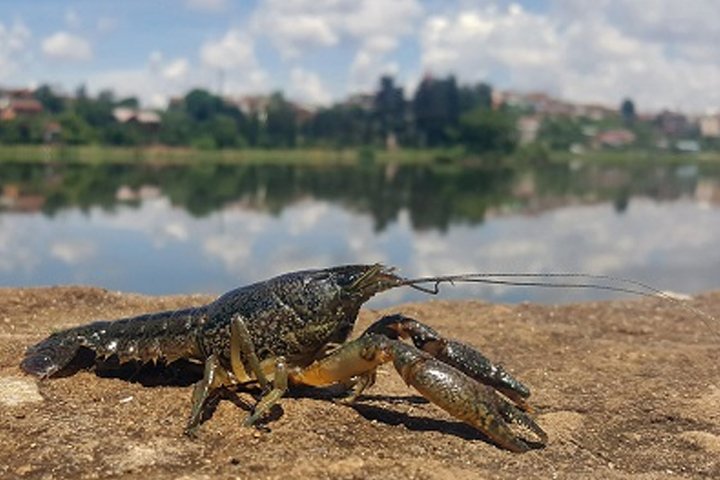
An unnatural freak known as the marbled crayfish has taken over a cemetery in Belgium, where the suspected aquarium escapee has cloned itself into an unkillable swarm of crustacean copies.


The attack of the clones is playing out at Schoonselhof cemetery in Antwerp, according to the Flemish Institute for Nature and Woodland Research (INBO). Hundreds of crayfish have infested every pond, pool, stream and puddle in the area, destroying the natural balance and threatening other species, Antwerpe Television reports.

“It’s impossible to round up all of them,” Kevin Scheers of the INBO told the Brussels Times. “It’s like trying to empty the ocean with a thimble.”

It’s a scenario that experts have worried about for years. The super invasive crayfish species can eat just about anything, live just about anywhere and reproduce just about whenever it wants — and it don’t need no man.

The crayfish clones itself through parthenogenesis, a form of asexual reproduction. Every member of the species is female, and it lays eggs that hatch without sperm to fertilize them. Every one of its offspring is genetically identical to one another, and to the parent.

The first marbled crayfish is thought to have emerged from pet breeders in Germany in the 1990s. It’s very similar to the slough crayfish from Florida, though it’s unclear exactly how the slough gave rise to this self-cloning hybrid.

The invasive species has sparked concerns in the European Union, the United States and Canada, though it’s a hard creature to stamp out of the pet trade. They grow up to 12 centimetres long and are extremely easy to care for and breed, which makes them an attractive pet for many collectors.


“Someone apparently had the animal in their aquarium, and then set it free in a canal,” Scheers told the Brussels Times.

It’s unclear when the crayfish first arrived the the cemetery, which is home to more than 1,500 graves for soldiers who died in the First and Second World Wars.

Several Canadians are among those buried at the site.

Scheers was at the cemetery last week trying to round up as many crayfish as possible.

The frustrated environmentalist had only one message for the public: don’t release your pets into public waterways. There’s no telling what damage they might do — or what chaos they might cause — outside of your fish tan

WHAT'S WORSE THAN FALLING INTO A SINKHOLE?

'He couldn't move': New York City man falls into sinkhole full of rats


THE LOVECRAFT REREAD

The Weight of History and Also Cannibalism: “The Rats in the Walls”

 and 

Welcome back to the Lovecraft reread, in which two modern Mythos writers get girl cooties all over old Howard’s original stories.

Today we’re looking at “The Rats in the Walls,” written in August-September 1923, and first published in the March 1924 issue of Weird Tales. You can read it here.

Spoilers ahead.

“These rats, if not the creatures of a madness which I shared with the cats alone, must be burrowing and sliding in Roman walls I had thought to be of solid limestone blocks […] unless perhaps the action of water through more than seventeen centuries had eaten winding tunnels which rodent bodies had worn clear and ample. […] But even so, the spectral horror was no less; for if these were living vermin why did not Norrys hear their disgusting commotion?”

Summary: Delapore is last of his line, for his only son has died of injuries received during WWI. Grief-stricken, he devotes himself to restoring Exham Priory, his family’s former seat in England. It’s tumbled to ruin since the early 1600s, when Walter de la Poer killed father and siblings and fled to Virginia. Walter was more honored than despised for his actions—the cliff-perched priory was an object of fear long before it passed to the de la Poers.

Neighbors still hate Exham Priory, but antiquarians prize it for its peculiar architecture. A Druidic or pre-Druidic temple is its basis. The Romans built on top of that, followed by the Saxons and Normans. The original cult’s rites infiltrated the Romans’ Cybele worship and the Saxons’ early Christianity. A dubious monastic order planted oddly extensive gardens and terrified the populace. Previously of unsullied reputation, the de la Poers inherited the curse with their acquisition. Family members of a certain temperament, including those by marriage, appeared to form an inner cult; members of healthier inclinations tended to die young.

Delapore collects country tales of bat-winged devils holding Sabbath at the priory, of unsolved disappearances, of Lady Mary de la Poer killed by her husband and mother-in-law, with the blessings of their confessor. The most dramatic stories involve an army of rats that burst from Exham after Walter deserted it, devouring livestock and hapless humans before dispersing.

But Delapore’s a skeptic. He braves the antipathy of neighbors unhappy with his return and reclaims the “de la Poer” spelling; only his son’s war-time friend, Captain Edward Norrys, welcomes and assists him. Delapore lives with Norrys for two years while workmen restore the priory, medieval glory improved by cleverly camouflaged modern amenities. He moves in with seven servants, his beloved black cat whose unfortunate name starts with N (hereafter referred to as Cat With an Unfortunate Name or CWUN for short), and eight other felines he’s collected.

His study of family history is soon disrupted by the cats’ restlessness. A servant fears rodents, but there’ve been no rats in the priory for three hundred years, and mice have never strayed into the high walls. Nevertheless, Delapore begins to hear nightly scurrying in the walls of his tower bedroom, and CWUN is driven to frenzy trying to get at them. By their noise, the rats are heading downward, and the other cats congregate at the subcellar door, howling. Traps are sprung, but capture nothing. Only Delapore and the cats hear the rats, a fact which intrigues Norrys.

He and Delapore camp in the subcellar, where Roman inscriptions grace the walls. Several altar-like blocks date from the aboriginal temple. Delapore has a recurring dream in which he sees a twilit grotto and a swineherd driving fungous beasts of loathsome aspect. Norrys laughs when the dream wakes Delapore screaming, but he might sober if he knew whose features Delapore finally spied on one of the beasts.

Nor does Norrys hear the subsequent scurry of rats, cascading downward—as if the subcellar isn’t the priory’s lowest point. CWUN claws the central altar; when Norrys scrapes lichen from its base, a draught reveals some passage hidden beyond.

They debate leaving the mystery alone or braving whatever lurks below. A middle course seems wisest: Call in experts. They round up suitable authorities, including archaeologist Brinton and psychic Thornton. No scurrying rats disturb Delapore’s return; Thornton suggests they’ve already done their job leading Delapore to… something. Probably something delightful, we’re sure.

Brinton shifts the altar. The party descends into a grotto lit by rifts in the cliff-face. It extends into darkness, but they see enough: a sea of skeletons, more or less humanoid. Most are lower on the evolutionary scale than Piltdown man, and some are quadrupeds—the flabby beasts of Delapore’s dream! Structures dot the grottoscape, from prehistoric tumuli to an English building with seventeenth-century graffiti which appears to have been a butcher shop. The diet of the various cults is clear but doesn’t bear pondering.

CWUN stalks through these horrors unperturbed. Delapore wanders toward refuse pits in which rats must have feasted before hunger drove them to marauding frenzy. In the depths beyond, he hears rodent scurrying. He runs forward in an ecstasy of fear. The rats will lead him ever on, even to caverns where Nyarlathotep, mad and faceless, howls to the piping of amorphous flute-players!

Three hours later the investigators come on Delapore muttering in every tongue from modern English through Latin to primordial grunts. He’s crouched over Norrys’ half-eaten body, plump and flabby as that fungous beast that wore his features. CWUN tears at his master’s throat.

They destroy Exham Priory soon afterwards. Delapore, confined to an asylum, denies he ate Norrys. It must have been the rats, the demon rats that even now race behind his cell’s padding, the rats they can’t hear, the rats in the walls.

What’s Cyclopean: Delapore dreams of “fungous, flabby beasts.” Lovecraft uses so many words very exactly (including “cyclopean,” most of the time); inquiring minds would like to know exactly what he thinks “fungous” means.

The Degenerate Dutch: You’d think CWUN would be the main item here—it’s certainly the one that people tend to remember. But then there’s “the negroes howling and praying” at the arrival of the Union, clearly distraught at the disruption to their own beloved way of life (or not). And there’s the carefully laid out evolutionary ladder between ape and humans of supreme sensitivity. Evolution: it does not do what you think it does. “You” in this case being early 20th century eugenicists.

Mythos Making: Just when you think it’s all going to be Cybele and the Magna Mater, there’s a rant about Nyarlathotep. And of course, as always, cats stand ready to fight against whatever horrors present themselves.

Libronomicon: No books, but lots of half-effaced Roman carvings and some English graffiti.

Madness Takes Its Toll: De la Poer ends up in an asylum, actually a relatively rare fate for Lovecraft’s narrators.

Ruthanna’s Commentary

It’s a well-replicated psychological finding that taboo words are extremely distracting—if you want people to forget the details of something, put it next to an obscenity. And indeed, the only thing I remembered of this story was the cat’s name, and that there were horrible rat-like things far underground. Which is too bad, because it’s actually an extremely effective horror story.

After “Silver Key,” I’m primed to appreciate a good Mythos story. Real-world current events and sensible scientific protocol make a solid contrast for the horror beneath the cliff, and for the narrator’s own psychological breakdown. Warren G. Harding really did die of a heart attack that week. Calling in archaeologists is, in fact, the right thing to do upon discovering a new layer of construction underneath your already impressively layered house—although Lovecraft resists the temptation, for once he could have gotten away with calling the place “ancient.” (Exham Priory reminds me of Rome’s San Clemente—the sort of place that will give anyone shivers, of pleasure or awe or fear according to their wont, thinking about the weight of human habitation.)

Although we only get one call-out to the “traditional” Mythos gods, we get echoes—or premonitions—of several other stories. There are parallels with “The Lurking Fear,” which he wrote less than a year earlier: old house, scary family, and apified humans. Then there are the “quadruped things,” implied to have human ancestry themselves… if the De la Poers aren’t Martense relatives, do they carry a little K’n-yan blood? The Mound won’t be written for another 6 years, but I wouldn’t be shocked if the underground setting there drew a bit on this one.

Some of the most interesting connections are with “The Festival,” also yet-to-be-written at this point, though not by much—he finished Rats in September 1923 and wrote Festival in October. And here’s an underground cavern of slightly ambiguous reality, alongside the image of an oily river filled with horrors—and Nyarlathotep howling, faceless, to the piping of amorphous idiot flute players. Maybe he howls as a tower of green flame?

Cybele is the only known Phrygian goddess, later incorporated into the worship of Gaia and Demeter. In Greece there were mystery cults to her, with much drinking and carousing, and Atys was her eunuch shepherd-consort. Orgies were probably not out of the question. Rats seem unlikely given that they tend to eat grain rather than produce it. But the “Great Mother” probably sounded pretty scary to ’20s readers (and would still sound scary to many modern readers, albeit not those who usually read Lovecraft in the first place), whereas modern genre readers are used to the Pagan-with-the-serial-numbers-filed-off religions mostly being good guys. Not to mention readers who are actually Neopagan. No comment on whether Cybele’s modern worship involves drinking, carousing, etc. Probably not rats and vast underground edifices, though—those things are expensive.

Other interesting references—Trimalchio is a 1st century CE Roman satirical character, who throws lavish feasts including one at which the guests act out his funeral. Roman themes run through the story, to mostly good effect.

The ending is intriguing, and more effective for the rest of the story’s groundedness. Delapore’s already said, very rationally, that he needs to choose his words carefully—and then starts running through a landscape grown suddenly amorphous, crying about Nyarlathotep, channeling ancestral voices of increasing antiquity—and perhaps becoming, or invoking, or manifesting rats that no one else can hear. The rats are suddenly amorphous as well, both descriptively (gelatinous!) and metaphorically (the rats of war who ate his son). Cosmic horror, once again, maps to a more immediate and personal apocalypse.

Anne’s Commentary

“The collective unconscious comprises in itself the psychic life of our ancestors right back to the earliest beginnings. It is the matrix of all conscious psychic occurrences, and hence it exerts an influence that compromises the freedom of consciousness in the highest degree, since it is continually striving to lead all conscious processes back into the old paths.”

— Carl Jung, “The Significance of Constitution
and Heredity in Psychology” (1929)

“So we beat on, boats against the current, borne back ceaselessly into the past.”

— F. Scott Fitzgerald, The Great Gatsby (1925)

I’m not sure whether Lovecraft ever became a big fan of Gatsby, but we do know he was aware of Jung—in Supernatural Horror in Literature, he notes that Irvin Cobb introduces “possible science” into a story about a man who reverts to an ancestor’s language when hit by a train. The ancestor was hit by a rhino, nature’s purest locomotive analog.

Delapore definitely loses his “freedom of consciousness” when caught up in the cataract of ancestral memory that is Exham Priory. That ancestry extends into the “hereditary” memory of the species, as it variously shambled and strode on two legs or devolved to quadruped wallowing, the better to munch on coarse vegetables and provide haunches for Exham cultists. Significantly, the de la Poers were perfectly respectable until they took over the priory. Something strange happened then, but not, I infer, for the first time. Whatever haunts the place—whatever psychically pervades it—seems to pervert the susceptible among any occupying group, twisting the Romans’ Cybele-worship and the Saxons’ Christianity into versions of the original religion. Which was what? Something older than Druids, sounds like. Some archetype of darkness and anticivilization, suitably embodied in cannibalism.

I’m thinking occult expert Thornton was right. Certain forces prevail in Exham Priory, that used the ghostly rats to lead Delapore to the heart of his heritage. To bear him relentlessly into the past until it possesses him and pours out his throat in all the tongues the priory has known. Could be the “certain forces” are inherent to humanity—the collective unconscious which is our psychic history, or the anarchic beast that contends with the angelic side of our natures. Could also be—a Mythosian notion—that the ultimate source of evil is in fact a core reality which is amoral and chaotic, a mad and faceless god serenaded by idiots without shape or, one supposes, a great sense of rhythm.

Interesting that Delapore refers to this god as Nyarlathotep rather than Azathoth, whom the description better fits. Maybe Delapore doesn’t know his Outer Gods very well, or maybe Nyarlathotep wears his Azathothian avatar for the Exham folks, or maybe we’re just still early days, Mythos-wise, with deific classification in its primitive stages.

Anyhow, on to the animals. Lovecraft named Delapore’s cat after his own beloved pet, and then there’s the Ward family cat, Nig, and at least two notable black kittens in the Dreamlands stories, maybe fortunately left without names. He loved him some cats, and gives this one a starring role, at the same time acknowledging the trope of the animal-more-psychically-sensitive-than-humans. CWUN rises in the end to unperturbed observer of the grotto’s horrors, “winged Egyptian god” darting toward the heart of the mysteries, and avenging spirit leaping at his own master’s throat—or maybe a harsh savior, trying to bring that master back to himself. The rats are kind of sympathetic, with their tiny little bones mixed up with the grosser skeletons. After all, they were just obligingly cleaning up the charnel pits. It wasn’t their fault the food source played out, forcing them to look for fresh provender. They make for cool, slithery, scampery ghosts, too.

But we’ll have to wait for “Dreams in the Witch-House” for the ultimate Lovecraft rodent.

Animalistic but with clear human origins is the grotto livestock. In Lovecraft’s universe, people are pretty quick to devolve into the bestial—see also the Martenses of “Lurking Fear” and (at least to the pre-sympathetic narrator) the hybrids of Innsmouth. What does it mean that Delapore sees Norrys’ features on one beast? Seems probable that the Norrys family has a long history in the Exham area. Did some of them fall prey to the priory cult? Ironic, then, that Norrys should befriend Delapore, and that he should end up a Delapore’s dinner himself.

The wealth of detail in this short story could make a long novel. What about the squishy white thing John Clave’s horse stepped on, and Lady Margaret Trevor de la Poer, kid-bane? What of Randolph Delapore, voodoo priest? What of the great rat-tsunami itself? On the whole Lovecraft does a good job balancing background and immediate plot; the details intrigue rather than distract, and they remain a tantalizing bunny buffet for us latter day plot-scavengers.

Next week, we continue wending our way through Randolph Carter’s story—and learn what happens when you edit fanfic of your own stuff—in Lovecraft and E. Hoffman Price’s “Through the Gates of the Silver Key.”


Ruthanna Emrys’s neo-Lovecraftian novelette “The Litany of Earth” is available on Tor.com, along with the more recent but distinctly non-Lovecraftian “Seven Commentaries on an Imperfect Land.” Her work has also appeared at Strange Horizons and Analog. She can frequently be found online on Twitter and Livejournal. She lives in a large, chaotic household—mostly mammalian—outside Washington DC.

Anne M. Pillsworth’s short story “Geldman’s Pharmacy” received honorable mention in The Year’s Best Fantasy and Horror, Thirteenth Annual Collection. “The Madonna of the Abattoir” is published on Tor.com, and her first novel, Summoned, is available from Tor Teen. She currently lives in a Victorian trolley car suburb of Providence, Rhode Island.


Indian agency raids home of journalist, activists in Kashmir

SRINAGAR, India — India’s premier investigating agency on Wednesday said it raided 10 locations in Indian-controlled Kashmir, including the offices and residences of a journalist and two prominent activists, triggering concerns of a crackdown on information and a free press in the disputed region
© Provided by The Canadian Press

The National Investigation Agency said in a statement it searched the premises of Agence France-Presse’s Kashmir correspondent Parvaiz Bukhari, offices of rights activist Khurram Parvez and Parveena Ahanger, and the region's leading daily Greater Kashmir, along with a non-profit group, and seized “several incriminating documents and electronic devices."

The agency said it was investigating “non-profit groups and charitable trusts” that were collecting funds and using them for “carrying out secessionist and separatist activities” in the disputed region.

A police official privy to the raids said the investigators confiscated telephones, laptops and storage devices from journalist Bukhari and rights defender Parvez. The official spoke on the condition of anonymity because they were not authorized to speak publicly.

Parvez’s organization, Jammu and Kashmir Coalition of Civil Society has written scathing reports about brutality involving some of the hundreds of thousands of Indian troops in the region. It has highlighted the expansive powers granted to them which it says led to a culture of impunity and widespread rights abuse in the region.

Former chief minister of Jammu and Kashmir, Mehbooba Mufti said the raids on activist Parvez and the Greater Kashmir office were “another example of the Government of India’s vicious crackdown on freedom of expression and dissent.”

The raids came days after Indian authorities sealed the office of an English daily, Kashmir Times, causing outrage from journalists and condemnation from global media watchdogs. Authorities said the office was sealed due to administrative reasons but journalists said the move aimed to throttle the free press.

Kashmir is divided between India and Pakistan, and both claim the region in its entirety. Most Kashmiris support the rebel goal of uniting the territory, either under Pakistani rule or as an independent country.

Earlier on Tuesday, India enacted new laws that allow any of its nationals to buy land in the disputed region, a move that exacerbates concerns of residents and rights groups who see such measures as a settler-colonial project to change the Muslim-majority region’s demography.

Until last year, Indians were not allowed to buy property in the region. But in August 2019, Prime Minister Narendra Modi’s government scrapped the disputed region’s special status, annulled its separate constitution, split the region into two federal territories — Ladakh and Jammu-Kashmir, and removed inherited protections on land and jobs. The move triggered widespread anger and economic ruin amid a harsh security clampdown and communications blackout.

Tuesday’s laws, part of a series of Modi’s hard-line Hindu-nationalist policies, also authorize the Indian army to declare any area as “strategic” for operational and training purposes against the Kashmiri rebels.

On Wednesday, the region’s main pro-freedom conglomerate denounced the new laws and called for a strike on Oct. 31. Pro-India politicians from the region accused India of putting Kashmir’s land “up for sale.”

The federal government said the decision was made to encourage development and peace in the region.

Since August 2019, the Indian government has imposed overarching restrictions in the region which critics say has eroded press freedom.

Several journalists have been arrested, beaten, harassed and sometimes even investigated under anti-terror laws. A controversial new media law gave the government more power to censure independent reporting.

The Kashmir Editors Guild in a statement Wednesday said it was concerned over the “mounting costs of being a journalist in Kashmir” and hoped the region’s media is “permitted to function without hassles and hurdles.”

Reporters Without Borders, a global media watchdog, in August said “press freedom violations by the Indian authorities in Kashmir is unworthy of a democracy.”

Aijaz Hussain And Sheikh Saaliq, The Associated Press