Monday, November 16, 2020


The Truth about “The Truth about Today’s Anarchists”

The Truth about “The Truth about Today’s Anarchists”

A response to a New York Times article that repeated conspiracy theories about anarchists manipulating the Black Lives Matter movement. This article was originally published by Crimethinc.

Yesterday, Farah Stockman from the New York Times editorial board published an article claiming to be “The Truth About Today’s Anarchists.” It draws on the work of an amateur conspiracy theorist, a poorly researched report from a nonprofit including a former Republican state attorney general and a former NYPD chief, a couple interviews with politicians and reformers, decontextualized and misleading references to two of our own publications, and regurgitated right-wing talking points to argue that violent anarchists are somehow controlling the ongoing countrywide protests but don’t care about Black lives.

What follows is a detailed rebuttal of this dangerously irresponsible article. Fortunately, initial reactions on social media suggest that the reading public has largely seen through its distortions. Nonetheless, we want to take the opportunity to reply in full—because despite its absurdity, the article touches on critical issues that deserve to be addressed. This is an opportunity to set the record straight, to explain why many anarchists have participated in these protests, and to elaborate our vision for a freer world.

For more on this subject, consult our earlier article, “This Is Anarchy: Eight Ways the Black Lives Matter and Justice for George Floyd Uprisings Reflect Anarchist Ideas in Action.

“The Truth about Anarchists”

How did Stockman learn this “truth”? She does not appear to have spoken to a single anarchist in the course of her research, though there are thousands she could have approached. The article’s primary source is Jeremy Lee Quinn, an amateur conspiracy theorist posing as an investigative journalist. He claims to have gone undercover during black bloc protests in several cities over a period of months, and has now posted a website full of videos and disjointed rants as “a non-partisan source of information on riot Direct Action [sic] and how it may succeed under the cover of protest.” Last week, this self-described “centrist” reached out to Enrique Tarrio, the head of the Proud Boys, the group of violent extreme-right thugs who Trump called on to “stand by” during his debate with Joe Biden on Tuesday. Addressing Tarrio, Quinn claimed that “the establishment media has completely dropped the ball” and implied that he had penetrated “a fog of propaganda that obscured how the insurrectionist Anarchists (Antifa) have worked.”

Stockman bought Quinn’s story wholesale, casting him as the humble hero of a crusade to save a peaceful protest movement from violent mobs of white anarchists who are working to undermine it for their own agendas. In her account, these anarchists are actually coordinating the unrest through social media, “hiding in plain sight” and conducting a “violent insurgency” under the guise of the legitimate peaceful movement, while relying on the liberal media and duped public to minimize the threat they pose. Black protest leaders who are working for constructive change resent these efforts to appropriate their struggles, but are powerless to stop them. Unless they are checked, Stockman implies, they will not only delegitimize the movement in the eyes of the public, but escalate their violence and mayhem.

Does this sound familiar? That’s because it comes directly from President Donald Trump—who began tweeting that anarchists were behind the protests within their first days—and Attorney General Bill Barr and Homeland Security Director Chad Wolf, who have worked tirelessly to divide and conquer the movement against police and white supremacy by continuously trying to change the subject to alleged anarchist criminals and antifa “terrorists.”

The problem is that it’s nonsense. Worse, it’s a pack of lies. Any self-respecting journalist who repeats it should be ashamed.

Permit us to detail why.

Our colleagues at It’s Going Down have published a lengthy thread going into many of the specific problems with Quinn’s reporting in detail, most of which we will pass over here.

The Roots of the Narrative

So why is a seemingly critical journalist repeating these absurd and harmful stories? On what basis does she make these claims?

Rhetoric about the role of white anarchists as “agitators” surfaced in the first days of the rebellion in Minneapolis. It had existed as a trope for years before the Floyd protests, often used as a wedge to shut out militant participation and centralize control over tactics in protest campaigns. As the rebellion spread from Minneapolis across the US and beyond, participants actively discussed racial, political, and tactical dynamics in the streets. Despite initial reports blaming white agitators for violence, most subsequent accounts recognized that the riotous crowds have been multiracial; that “outside agitator” narratives were false; and that anarchists made up only a small part of most large demonstrations. Black anarchists have been actively participating in the rebellions from the very beginning, and making it clear that neither Black reformists nor white anarchists are calling the shots. Even the government’s own reports acknowledged that their “antifa” bugaboo had no significant organizing role in the protests, while emphasizing that both countless threats and numerous acts of actual violence were carried out by Trump’s extreme right defenders.

Of course, some anarchists have participated alongside thousands of other people in black blocs that have confronted police and attacked symbols of state violence. The use of confrontational tactics continues to be a controversial issue as the movement evolves. But any moral calculation would recognize that the real issue here is the widespread and thoroughly documented violence committed against protesters, rather than by them. While a range of opinions exists in the movement over how effective confrontational protest tactics usually are and how best to respect our different approaches without undermining others’ goals, it’s clear that our most urgent shared need is to defend ourselves against the attacks intended to terrorize the movement. Protestors have suffered tens of thousands of arrests and countless acts of unprovoked brutality at the hands of police across the country, including the murders of dozens of people by police, National Guardsmen, and right-wing vigilantes. For self-styled “journalists” like Quinn, these facts are unworthy of mention, eclipsed by a single-minded insistence on blaming the “violence” of the protests on anarchists.

Stockman disingenuously reports that Quinn’s investigations were prompted by his concern that anarchists’ militant tactics “would set off a backlash that could help get President Trump re-elected.” It is unlikely that this was a sincere concern for someone so eager to collaborate with the Proud Boys. Quinn’s shocking conclusion, Stockman breathlessly reports, was that the “mayhem” following Floyd’s murder “wasn’t mayhem at all”—rather than the “spontaneous eruption of anger at racial injustice” that countless reports described, the uprising was “strategically planned, facilitated and advertised on social media by anarchists.”

This claim is absurd—and frankly racist. To insist that a small group of white anarchists somehow managed to coordinate a multiethnic movement that brought tens of millions of Americans into the streets and direct it to their own ends smacks of the worst conspiracy theory thinking. Anarchists of various ethnicities certainly supported, promoted, and participated in the protests, and in some instances modeled confrontational tactics that became contagious. But the most spirited efforts would have been meaningless without the autonomous efforts of countless millions of others. Groups of anarchists planned their own participation, but none directed the movement as a whole. Anarchists provided material support and ideas—but they provided them to a horizontal movement drawing on the skills and energy of countless others. Anarchists advertised protests through social media, like most of the other participants, but by any reckoning the participation of self-identified anarchists, online or in the streets, was dwarfed by the crowds with whom anarchists shared many values and desires but no distinct ideology. To claim otherwise misunderstands the nature of leaderless movements, overestimates the power and influence of a single strand in a diverse web, and denies the agency and leadership of countless others without whom the movement could not have happened.

Quinn’s transparent agenda as an attention-seeking aspiring pundit explains his efforts to deceive. But why did Stockman fall for it?

She cites an account CrimethInc. published describing the siege of the Third Precinct in Minneapolis—though she either failed to understand the text, or willfully misrepresents it. She summarizes the text as a prescription for “Asymmetric Warfare 101,” suggesting that black bloc property destruction was used to prompt police violence against “innocent demonstrators” in hopes that this would delegitimize police. In fact, the anonymously submitted text describes how, without central coordination, shared goals, or political ideology, a wide range of different people spread out over a vast area achieved one of the most memorable victories of the entire movement, inspiring resistance around the globe. In misrepresenting her sources, Stockman echoes Fox News, which also misrepresented this report as a prescriptive program to provoke violence, citing an account of an event marked by the diversity of its participants as evidence of a shadowy anarchist conspiracy pulling the strings.

“Network Contagion”

So if Stockman did not talk to anarchists and did not pay much attention to the anarchist sources she cites, what information convinces her to believe Quinn’s account of the anarchists as puppeteers controlling the protests?

Stockman uncritically repeats the conclusions of a report by the Network Contagion Research Institute, a non-profit that claims to have “no political agenda.”1
The report’s co-authors include a former Republican state attorney general, a former NYPD chief, and a handful of academics, none of whom have ever studied anarchism. It uses a range of dubious associations through word clouds and quantitative analyses of tweets and Reddit posts to imply that what it calls “militant anarcho-socialists” are “using social media to instigate widespread violence against political opponents and law enforcement.”

Over the past months of protest, no one has documented “widespread violence” by anarchists against political opponents or law enforcement, while the widespread violence by far-right groups and law enforcement against protestors has been widely documented. So how do they make this case?

Take Figure 4, a “word cloud” showing associations between different key terms on Reddit. The term cop, it turns out, is associated with “reactive outrage and violent depictions in terms like ‘indiscriminate’ and ‘gestapo.’” That’s right—when anarchists post online that cops are indiscriminately beating protestors and using gestapo tactics, according to these brilliant researchers, it’s the anarchists who are being violent. It would be less violent, presumably, to pretend that police never beat anyone at all.


First of all, Chapo Trap House fans on reddit are hardly identical with the US anarchist movement. But what do you expect from throwing money at a former Republican state attorney general and a former NYPD chief to study a topic they know nothing about?

Section 2 warns that anarchists are spreading memes that include “tactical information” such as links that promote “the use of encrypted communication.” So when anarchists share information on how anyone can protect their privacy against surveillance, this is presented as proof of violent intentions.

Section 2.1 shows that during the protests, “anarcho-socialists” used online forums “to recruit support and followers like other extremist groups do.” Very insightful! Clearly, the fact that many people were curious to hear from radicals who want to see an end to police violence during a wave of protests against police violence is hard evidence that anarchists are equivalent to jihadi and white supremacist groups. Figure 14 shows that the number of tweets about July 25, which some had identified as a day of protest, peaked on—you guessed it, July 25. Brilliant work here, folks. Worse still, the hashtag in question, “#J25,” could have been used by anyone on the internet aiming to designate this date, not just protesters.

Figure 17 reproduces a tweet calling for the Seattle police chief to be “sacked,” like an earlier chief who was fired during protests in 1999; but the report’s caption falsely claims that the tweet “calls for sacking the police precinct,” then blames this tweet for having incited violence against the building. So when anarchists call for a public official to be fired, we are inciting violence? One might more precisely speak about the violence being done to common sense in a report of this caliber.

This is particularly embarrassing—they misrepresent the explicit meaning of the tweet, conflating sacking—i.e., firing—a police chief with sacking—i.e., laying siege to—a police precinct.

The report with “no political agenda” concludes by echoing Trump’s line equating white nationalists to anti-fascists, ominously predicting that “attacks on vital infrastructure” and “the possibility of a mass-casualty event” may be imminent if these nefarious anarcho-socialists are allowed to continue unchecked. There have been no precedents for “mass-casualty events” linked to anarchists in the United States for a full century, though white supremacists have carried out a large number of mass killings in the past decade alone.

Apart from the willfully poor-quality “research” in this absurd report, its framing and conclusions are lifted straight out of Attorney General Barr and Fox News’s playbook. When anarchists call out state violence, accuse them of being violent for doing so; when anarchists share non-violent self-defense tactics, cite this as evidence of violent intent; make spurious comparisons between diametrically opposed groups based on superficial similarities to heighten fear; pack in some misleading numerical data, and conclude by projecting sensationalized fantasies of apocalyptic violence to justify repression.

This is the report that New York Times editorialist Stockman urges us to “check out.” She is correct in noting that the report “will almost certainly catch the attention of conservative media and William Barr’s Department of Justice,” whose agenda she is apparently keen to promote.

So shoddy research, copyediting, and argumentation are not the sole province of self-styled amateur sleuths like Jeremy Lee Quinn. These characterize practically all of the material available from hostile think tanks, as well. In both cases—as in the case of Stockman’s own work—the studies only exist to fulfill an external agenda, so there is no incentive to rigorous research.

Would you look at that—the frequency of tweets with the hashtag “J25” peaked around… July 25. Clearly this must be hard evidence of central coordination and terroristic intent!

“Anarchy Got Results”

Then comes the strangest part of the article. In a rare moment of honesty, Stockman soberly assesses the impact of the riots, and concludes, “Anarchy got results.”

Of course, as we’ve pointed out, it would be absurd for anarchists to take credit for a widespread, wildly diverse rebellion that was not led by any group nor driven by any single ideology. But it would be accurate to describe the decentralized, leaderless, tactically diverse, direct action-based movement as “anarchy.” This is what anarchists have been calling for all along: egalitarian, horizontal, voluntary movements.

While lamenting the destruction caused by rioting in Minneapolis, Stockman acknowledges that she was wrong to think that “looting and arson would derail the urgent demands for racial justice.” In fact, media attention was captivated and public support soared precisely in response to the fiercest moments of struggle.

But, Stockman notes, more recently, there has been a decline in public support (which is to say white support; Black support has held steady, according to the poll she cites) for the Black Lives Matter protests. What’s the reason for this?

For Stockman, it’s because “insurrectionary anarchy brings diminishing returns.” In other words, it’s the fault of those who continue to courageously confront police in the streets. Apparently, the same public that once praised rioters now increasingly condemns them as time passes.

But this doesn’t make much sense. The fiercest rioting by far took place in the first weeks of the uprising, when public support was solidly at its highest. While a few locations such as Portland have maintained continuous militant protest, they’re the exception; the widespread looting and property destruction that marked the early days in Minneapolis, Los Angeles, New York City, and beyond have ceased. It seems senseless to lay blame for any shift in support at the feet of the small number of militant protestors who are still involved.

What has changed, rather, is that Trump, Barr, and the right-wing media have conducted a relentless campaign to discredit the protests. It’s a classic counter-insurgency strategy: if you can’t repress a movement, try to delegitimize, divide, and conquer it. The primary tactic they have employed has been labeling anyone who opposes the status quo “anarchists” or “antifa,” spelling out the implication that they are all terrorists and criminals, and spreading the lie that anarchists are somehow in control of the whole thing. This has been surprisingly successful. They’ve managed to get everyone from Joe Biden to liberal protest leaders to join them in condemning the most radical participants, sowing discord and weakening the movement. This is the key reason why support for the protests has declined among white people specifically—and to be even more precise, only among white Trump supporters.

Stockman’s editorial plays right into this counter-insurgency strategy. Her text perfectly exemplifies the dynamics that have led to a decline in conservative white support for the movement. It is a part of the exact problem she bemoans.

“Anarchists Complicate Life”

At that point, Stockman levies serious charges against anarchists: anarchists “complicate life for those working within the system to halt police violence.” She cites a few Black politicians and activists who disagree with or have been criticized by anarchists.

This is important, and we should not sweep it under the rug. There are serious differences of opinion in the movement regarding strategy and tactics, regarding working within systems versus rejecting and dismantling them, and regarding whose perspectives should be centered in resolving these disagreements. In these debates, many white radicals, including some anarchists, have been obnoxious or arrogant, unaware of their privilege, and disrespectful to more experienced or directly impacted organizers. This is inexcusable, and it should be challenged. Anarchists’ desires for a world without hierarchies should inspire them to forge interdependent, accountable relationships with other communities in struggle, to listen respectfully and learn from others in the movement even when they disagree, and to be conscious of how their actions impact others. There is a long way to go to build the bonds of trust across lines of difference necessary to forge durable, powerful movements that challenge the dynamics of white supremacy within and beyond them.

But Stockman’s discussion does not help us to do this constructively. It ignores the many important conversations that have happened in the streets, community meetings, and online regarding how best to resolve political differences. It neglects how the movement’s divisions over strategy and tactics do not break down neatly as a split between white anarchists and Black peaceful protestors, but between older and younger Black activist generations and along other lines as well. And Stockman’s account champions a single path to social change around racism and policing—reform in collaboration with police and local government—which has proved remarkably ineffective at actually stopping racist police violence.

Furthermore, it assumes that all anarchists are white and that we are not directly impacted by police violence or white supremacy. Vanessa Taylor’s brilliant article on Black anarchists in the recent protests explains how the presence of Black anarchists

“complicates the notion of an ‘outside agitator’—to describe anarchists as random white people outside of Black and otherwise oppressed communities is to erase Black anarchists—as well as the ‘peaceful’ protester narrative that others try to conjure to oppose Trump.”

But, she provocatively asks, “Why is there an obligation to be peaceful if you are dying?” According to a Dallas anarchist named Tina,

“Trump labeling protesters as anarchists is another form of white supremacy at work. Blackness is already anarchy in white folks’ minds. I don’t think a Black person necessarily has to call themselves an anarchist to be one, because in the land where whiteness is law and order you are already one.”

Centering Black anarchist experiences breaks down the binary logic of Stockman’s article, forcing us to understand political differences in a multiracial movement through a different lens.

To Stockman, because anarchist approaches aim to prevent the consolidation of power in the hands of politicians and activists, they can only be destructive, never constructive. On this basis, she accuses anarchists of being “fickle allies,” since even “if they help you get into power, they will try to oust you the following day, since power is what they are against.”

This is as close as she gets to the truth. Anarchists are not trying to get anyone into power over anyone else. Anarchists are trying to get everyone into power at once—to create egalitarian relationships based on cooperation and mutual respect, not force and domination. This is a real difference between Stockman and the anarchists she smears. The question is how to resolve it.

Building a New Order

Stockman’s concluding assessment accuses anarchists of being “experts at unraveling an old order but considerably less skilled at building a new one.” Yet had she actually spoken to a single anarchist in her exposition of “the truth” about them, she would have gotten quite a different picture. From the first moments that the COVID-19 pandemic arrived in North America, anarchists immediately mobilized to form mutual aid networks, drawing on extensive experience doing disaster relief and protest support. These became some of the most popular and urgently needed institutions helping to ensure community survival while our rulers bickered and dragged their feet. Beyond their immediate practical value, mutual aid networks model an anarchist vision of a self-organized world of freely shared resources rooted in an ethic of solidarity—a vision anarchists have been promoting for decades through Really Really Free Markets, Food Not Bombs meals, and many other institutions meant to build a new world.

Stockman did not trouble herself to learn who anarchists are, what anarchists actually believe, or how anarchists put it into practice. It was easier for her to copy and paste from Trump’s playbook, backed up by her source—who, his claims to be an “infiltrator” notwithstanding, clearly knows even less than she does.

Why Insurrection?

But Stockman has saved the worst for last. The article concludes by claiming that for anarchists, “it’s not really about George Floyd or Black lives, but insurrection for insurrection’s sake.”

This kind of demonizing, divide-and-conquer language is offensive and harmful to all who are striving to cooperate across lines of difference. It’s also absurd and inaccurate.

First and foremost: Stockman herself acknowledged just a few paragraphs before that anarchy got results—her words, not ours! How can she possibly justify claiming that anarchists are only interested in insurrection for insurrection’s sake? Given that the reforms she praises have been tried many times without making a dent in police killings, it might be more accurate to conclude that reformers are the ones who are only interested in reform for reform’s sake—perhaps because they want to preserve the positions of the reformers in the power structure. By contrast, one could argue that the people who rioted after George Floyd’s killing, including the handful of insurrectionary anarchists among them, apparently did so because that was the most effective thing they believed they could do to force a national reckoning with racist police murder. As Stockman herself admitted, so-called peaceful protests didn’t attract media attention, didn’t result in institutional changes, and didn’t compel the country to confront the racist brutality that characterizes Black experiences with police every day.

If Stockman had the courage to take her own observations seriously, then, she might be in the streets rioting, rather than drawing a salary trying to sow division in movements that have finally started to push back effectively against police violence.

Insurrectionary anarchists believe that disrupting the normal functioning of the state and the economy can open up spaces of possibility for people to relate to each other differently, to imagine a different world, to experiment with new ways of organizing daily life. The uprisings have shown that this is possible. From protests to autonomous zones to police-free neighborhoods, the spaces that confrontational tactics have opened up over the past year have helped transform abolition from a pipe dream to a possibility that warrants serious discussion and debate. They’ve served as laboratories for freedom—obviously not utopias, but places we can start to remake the world together. There are serious problems, including how to preserve safety and resolve conflict, how to accommodate differing visions, and how to meet everyone’s basic needs outside of the economy. But it’s a start—rather than repeating the old rituals endlessly, always reaching the same dead ends—and it’s only possible as a consequence of making a dramatic break with the present.

We can’t speak for other anarchists, but we can speak for ourselves. Yes, we have goals that extend beyond obtaining justice for George Floyd alone. We want to see a world in which all Black lives are valued and no one need fear being killed or terrorized by police—and we believe that to get there will require directly confronting the violent systems of power responsible for Floyd’s death, everywhere, not merely securing criminal charges for the latest killers. We live in a world in which the capitalist economy keeps almost all poor people under the heels of bosses and landlords—particularly Black and brown poor folks. So we’re fighting to transform the economy, too—because Black Lives Matter is just an empty slogan if we ignore the poverty that makes so many people’s lives a constant struggle. And while we’re at it, we can’t forget the ways that the same structures of policing hold our borders in place, dehumanize migrants, and inflame xenophobia—or the role of the US military in policing the entire globe to secure access to oil and raw materials—or how incipient fascism in the United States imitates similar authoritarianism from Brazil to Turkey to Russia.

The point isn’t to distract from the central issues that prompted the uprising. The point is to tackle these problems at their roots, we have to understand that there are no single issues, and truly systematic change involves more than charging a few killer cops or passing a few local reforms. To change anything, we have to change everything.

On the subject of insurrectionary anarchism, Stockman cherry-picks two sentences from Episode 9 of the Ex-Worker podcast, released seven years ago:

“We are not sure if the socialist, communist, democratic, or even anarchist utopia is possible. Rather, some insurrectionary anarchists believe that the meaning of being an anarchist lies in the struggle itself and what that struggle reveals.”

She takes these lines out of context to accomplish her purpose: implying that anarchists only care for destruction. In context, however, this quotation describes the process of how movements grow and evolve. As the Zapatistas say, we make the path by walking. That is—what shows us how to move forward isn’t an abstract utopian vision, but the concrete experiences of people resisting oppression together in the streets and in our everyday lives.

This doesn’t mean that we don’t fight to win or that we don’t care about the outcome. Of course we do! Our lives and the lives of our loved ones, our dignity and our freedom, our most cherished ideals—we know that all of these are at stake and more.

Rather, it means that we recognize that the struggle for freedom was going on long before we were born and will continue long after we’re gone. If you think the US is a fundamentally just society and all that is needed is just to make a couple tweaks to keep cops from killing quite so often, then you can imagine political struggle as a simple means to a simple end. But for those of us who intend to spend our whole lives working towards a freer and more egalitarian world, we have to find meaning in the struggle itself lest despair consume us. Like the fighters in the French resistance to the Nazis, we don’t need hope to keep fighting; resistance to tyranny is a way of life. The anarchist hypothesis is that we can still find ways to forge meaningful lives in the struggle against police brutality, racial injustice, economic exploitation, ecological destruction, encroaching fascism, and worse. This does not come from believing that total change is just around the corner—though we cherish the moments when it feels that way. Rather, it comes from believing that acting against oppression is always ennobling and worthwhile, and provides the most meaningful foundation we can imagine for our relations with others.

So let the New York Times side with Trump, Barr, and other right-wing conspiracy theorists. It won’t stop us, and it won’t stop the movements that we have always supported without ever seeking to control. We know what matters. We have not forgotten all the lives lost to the everyday violence of American policing, nor the sacrifices of those who came before us.

As we head into the frightening weeks ahead, with fascism or civil war looming closer than ever, we don’t know how things will turn out. But whatever happens, we will be in the streets, fighting for freedom while there is still breath in our lungs. To all the readers of the Times who have the sense to see through Stockman’s shoddy journalism—who seek the real truth about today’s anarchists—we look forward to meeting you there.

  • 1.Incidentally, the NCRI is funded by George Soros’s Open Society Foundation. Not only have anarchists never received the checks from George Soros that right-wing media assured us he would be sending, he’s actually underwriting “research” intended to justify the repression of social movements.

 

Anarchism and the Spanish revolution - 

Helmut Wagner

Anarchism and the Spanish revolution - Helmut Wagner

An article written by the German council communist Helmut Wagner in April 1937 criticizing extensively the political developments in Spain during the civil war and within it the role played by the anarchists and their organizations. This article first appeared in Ratekorrespondenz, the official publication of the Gruppe Internationaler Kommunisten (GIK) based in Holland, before appearing in Paul Mattick's International Council Correspondence in June of that same year.

Anarchism and the Spanish Revolution

The heroic struggles of the Spanish workers against the fascists is a milestone in the development of the international class movement of the proletariat. Simultaneously, this struggle put an end to the hitherto uninterrupted course of victorious fascism and initiated a new period of growing class struggles.

But this is not the only reason the Spanish Civil War is of great importance to the proletariat. Its significance lies also in the fact that it put to test the theories and tactics of anarchism and anarcho-syndicalism.

Spain has always been the classical land of anarchism. The enormous influence which anarchist doctrines gained in Spain can be understood only in relation to the peculiar class structure of the country. Proudhon's theory of individual and independent handicrafts, as well as Bakunin's application of the same theory to factories, found wholehearted support by small peasants, land, and city workers. The anarchist doctrines were embraced by large sections of the Spanish proletariat and the acceptance of these doctrines was responsible for the spontaneous uprising of the workers against the fascist insurrection.

We do not mean to say, however, that the development of the struggle was also determined by anarchist ideology or that it reflects the aim of the anarchists. On the contrary, we shall presently point out that the anarchists were compelled to give up many of their old cherished ideas and accept instead compromises of the worst kind. In analyzing this development, we shall prove that anarchism is incapable of solving the problems of the revolutionary class struggle. The anarchist tactics employed in Spain were unfit to cope with the situation, not because the movement was too small to allow for practical application but because the anarchist methods of organizing the various phases of the struggle were in contradiction to the objective reality. This stage of development reveals striking similarities with the Russian Bolsheviks of 1917. Just as the Russian Bolsheviks were forced to abandon, step by step, their old theories until, finally, they were compelled to exploit the workers and peasants with bourgeois-capitalist methods, so the anarchists in Spain are now forced to accept measures which formerly had been denounced by them as being centralist and oppressive. The development of the Russian Revolution has shown the incorrectness of the Bolshevik theories in solving the problems of the proletarian class struggle, and, similarly, the Spanish Civil War reveals the unfitness of the anarchist doctrines.

It seems to us of great enough importance to point out the mistakes made by the anarchists, largely because their valiant fight has induced many workers — who clearly see the treacherous role played by the representatives of the Second and Third Internationals — to believe that the anarchists are right after all. From our point of view, this is a great danger, as it tends to increase the confusion already rampant within the working class.

We consider it our duty to show, from the Spanish example, that the anarchist argumentation against Marxism is wrong; that, on the contrary, it is the anarchist doctrine which has failed. When it comes to understanding a certain situation, or to show ways and methods within a given revolutionary struggle, Marxism still takes the lead, and stands in sharp contrast to the pseudo-Marxism of the Second and Third International parties.

The weakness of the anarchist theories was shown first by the anarchist organizations on the question organizing for political power. According to anarchist theory, the revolutionary victory would be assured and guaranteed by placing the management of the factories in the hands of the unions. The anarchists never attempted to take away the power from the Popular Front government. Neither did they work toward organization of a political soviet power. Instead of propagandizing the class struggle against the bourgeoisie, they preached class harmony to all groups belonging to the anti-fascist front. When the bourgeoisie began to curtail the power of the workers' organizations, the anarchists joined the new government, which, according to anarchist theories is a major deviation from their basic principles. They tried to rationalize this move with the excuse that, on account of the collectivization, the new people's front government does not represent a political power, as it did before, but is merely an economic one, because its members are representatives of the unions to which, however, members of the petty bourgeois Esquerra also belonged. The anarchists argued: because the power lies in the factories, and the factories are controlled by the unions, therefore the power lies in the hands of the workers. How this actually works out we shall see below.

During the time the anarchists belonged to the government, the decree to dissolve the militia was issued. The incorporation of the militia, and the regular army, the suppression of the POUM in Madrid, were decreed with their approval. The anarchists helped to organize a bourgeois political power, but did nothing toward the formation of proletarian political power.

It is not our intention to make the anarchists responsible for the development of the anti-fascist struggle and its diversion into a bourgeois blind alley. Other factors are responsible, in particular the passive attitude of the workers in other countries. What we most severely criticize is the fact that the anarchists have ceased to work toward a real proletarian revolution and that they identify themselves with the present development. They have thereby smoke-screened the position of the workers against the bourgeoisie, and given rise to illusions for which, we are afraid, they themselves will have to pay very dearly in the future.

The tactics of the Spanish anarchists have found a number of critics in the foreign libertarian groups; some of these critics even accuse them of betraying anarchist ideals. But as these critics fail to see the actual situation their Spanish comrades are facing, they remain purely negative. It could not be otherwise. The anarchist doctrines simply cannot answer the questions that revolutionary practice raises. No participation in the government, no organization of political power, syndication of production, these are the basic anarchist slogans.

With such slogans it is utterly impossible to deal effectively with the interests of the proletarian revolution. The Spanish anarchists fell back into bourgeois practices because they were unable to replace their unrealizable slogans with revolutionary proletarian ones. Precisely for this reason, the foreign libertarian critics and advisers could not offer any solution, for these problems can be solved only on the basis of Marxian theory.

The most extreme position among the foreign anarchists is taken by the Dutch anarchists (excepting the Dutch Anarcho-Syndicalists of the NSV - Netherlands Syndikalist Vuband). The diehard anarchists of Holland refuse every fight which employs military weapons, because such struggle stands in contradiction to the anarchist ideal and goal. They deny the existence of classes. Although they cannot refuse to express their sympathy with the fighting anti-fascist masses. In reality, their position means a sabotage of the struggle. They denounce all action which purports to help the Spanish workers, such as sending weapons to them. The heart of their propaganda is this: everything must be done to prevent spreading the conflict to other European countries. They propagate "passive resistance", a la Gandhi, whose philosophy, translated to the objective reality, means the surrender of defenseless workers to the fascist butchers.

The oppositional anarchists maintain that centralized power within the proletarian dictatorship or military staff will lead to another form of suppression of the masses. The Spanish anarchists retaliate by pointing out that they (in Spain) do not work for centralized political power; on the contrary, they favor syndication of production, which precludes exploitation of workers. They sincerely believe that the factories are in the hands of the workers and that it is unnecessary to organize all the factories on a centralized and political basis. The actual development, however, has proven already that centralization of production is taking place and the anarchists are forced to adjust themselves to the new conditions even against their own will. Everywhere that the anarchist workers neglect to organize their power politically and centralistically in the factories and communes, the representatives of the bourgeois-capitalist parties, including the Socialist and Communist parties, will undertake it. This means that the unions, instead of being controlled directly by the workers in the factories, will be ruled according to laws and decrees issued by the bourgeois-capitalist government.

II

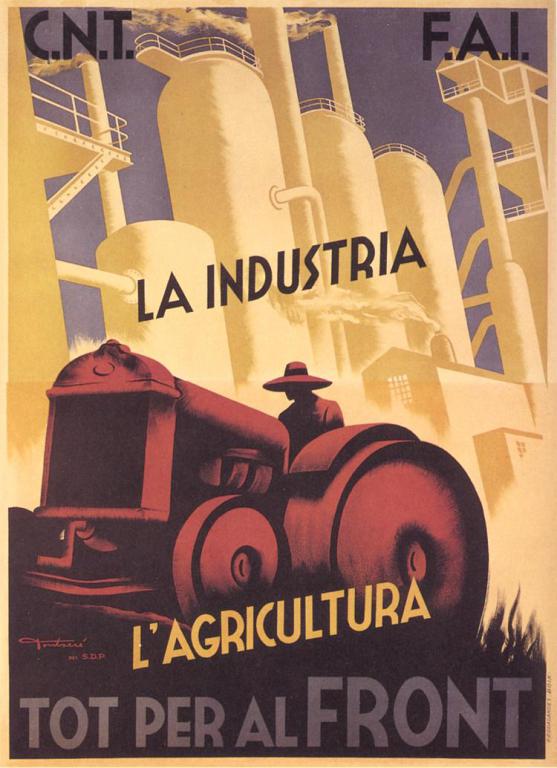
From this viewpoint, the question arises: is it true that the workers in Catalonia possessed the power in the factories after the anarchists had syndicated production? To answer this question, we need only to quote a few paragraphs from the pamphlet, "What is the CNT and FAI?" (The Official CNT and FAI publication).

Quote:
The management of the collectivized factories lies in the hands of the factory councils, which are elected in the general factory assembly. This council shall consist of from five to fifteen members. The term of official service on the councils is two years. . .
Quote:
Factory councils are accountable before the plenary assembly of the enterprise and the general council of its branch of industry. Together with the general council of its industrial branch they are in charge of regulating production. They also determine questions of compensation, sanitary conditions, health care, etc.
Quote:
Every factory council chooses a director. In factories with more than 500 workers, the choice must be approved by the council of that industry. With the approval of the workers, each factory appoints a delegate of the factory council to the Council of Industry of the Generalitat. The factory council reports regularly to the factory assembly and the council of that industry on its activities and plans.
Quote:
In case of incompetence or refusal of the performance of the assigned tasks, the assembly of the factory or the Industry Council can force the resignation of the members of the factory council.
Quote:
If a member of the factory council is forced to resign by the Industry Council (IC) against the will of the workers, then they may appeal the decision before the IC. The IC will then make a decision after having heard the report of the Anti-fascist General Economic Council.
Quote:
The General Economic Council, which brings together the different branches of industry, consists of four representatives from the factory councils, eight representatives of the various unions (respecting the proportionality of all political groups), and four technicians. The latter are appointed by the Anti-fascist General Economic Council. This council is headed by a member of the Council of Industry of the Generalitat.
Quote:
The General Economic Council has the following tasks: organizing production, evaluating costs, eliminating competition between enterprises, finding out the demand for industrial products, as well as studying the domestic and foreign markets, evaluating the profitability and consolidation of enterprises, reorganizing production methods, controlling prices, establishing central markets, acquiring means of production and raw materials, granting credits, creating technical laboratories, making production and consumption statistics, replacing the foreign raw materials for local products, etc.

It does not require much thought to realize that these proposals leave all economic functions in the hands of General Economic Council (GEC). As we have seen, the GEC consists of eight representatives from the unions, four from the Anti-fascist General Economic Council, in their capacity as technicians, and four representatives of the factory councils. The Anti-fascist GEC was formed at the beginning of the revolution and is composed of representatives of the unions and the petit bourgeoisie (Esquerra Republicana de Catalunya, etc.). Only the four factory council delegates can be counted upon as direct representatives of the workers. We must also emphasize that in case of withdrawal of the factory committee representatives, the Ministry of Industry of the Generalitat and the Anti-Fascist General Economic Council have a decisive influence. The GEC may dismiss members of the opposition in the council against which workers may appeal to the council of Industry, but the power of decision rests with the Anti-fascist GEC. Factory councils organize working conditions, but they are responsible not only to the workers in the factory, but also to the Industry Council. The factory council can appoint the director, but for large enterprises the consent of the Council of Industry of the Generalitat is needed.

In short, we can say that today the workers have little say about the control and organization of factories. In reality, the unions govern. We will investigate what this means.

From the few facts mentioned, we cannot share the enthusiasm of the CNT about the "social development". "In public offices beat the life of a real constructive revolution", writes Rosselli in What is the CNT and the FAI? (p. 38 and 39 of the German edition). From our point of view, the heartbeats of a revolution do not pulsate in public office, but in the factories. In the offices throb the heart of a different life, that of bureaucracy.

We do not criticize the facts. The facts, realities, are determined by circumstances and conditions that are beyond the control of particular groups; that Catalan workers have failed to establish the dictatorship of the proletariat is no fault of theirs. The main reason is to be found in the confused international situation that puts the Spanish workers in opposition to the world. In such conditions it is impossible for the Spanish proletarian to free himself from his petit bourgeois ally. The revolution was doomed before it really began.

No, we do not criticize the facts. We do, however, criticize the anarchists for confusing the conditions in Catalonia with socialism. All those who tell workers of socialism in Catalonia, partly because they believe it, partly because they do not want to lose their influence on events, prevent workers from seeing what is actually happening in Spain. They do not understand the revolutionary principles and thus render more difficult the development of a revolutionary struggle.

Spanish workers cannot effectively fight the leadership of the union, as this would mean the complete collapse of the military fronts. They have no other alternative. They must fight the fascists to save their lives, and must accept any aid regardless of where it comes from. They do not wonder whether the result of all this is socialism or capitalism; they only know they have to fight until the bitter end. Only a small section of the proletariat is consciously revolutionary.

So long as the unions organize the revolutionary struggles, the workers will support them; that this leads to a compromise with the bourgeoisie is undeniable, and is regarded as a necessary evil. The slogan of the CNT, "First victory over the fascists and then revolution", expresses the sentiment still prevailing among militant workers. But this feeling can also be explained by the general backwardness of the country that not only makes possible, but forces the proletariat into compromise with the bourgeoisie. From this it follows, then, that the character of the revolutionary struggle is undergoing profound changes and, instead of pointing to the overthrow of the bourgeoisie, it leads to the consolidation of a new capitalist order.

Foreign Help Strangulates the Revolution

The working class in Spain struggles not only against the fascist bourgeoisie, but against the bourgeoisie of the entire world. The fascist countries, Italy, Germany, Portugal and Argentina, support the Spanish fascists in this struggle with all means at their disposal. This fact alone suffices to make the victory of the revolution in Spain impossible. The enormous power of the enemy state is too strong for the Spanish proletariat. If the Spanish fascists, with their enormous power, haven’t won up to now, and have suffered military defeats on several fronts, it is because the anti-fascist government has been supplied with modern weapons from abroad. While Mexico, from the beginning, has supplied ammunition and weapons on a small scale, the support of Russia began only after five months of war. Help came after the fascist troops, equipped with modern Italian and German weapons, and further aided by the fascist countries, forced back the anti-fascist militias. From this resulted the possibility for further fighting. Another consequence was that Germany and Italy were forced to send more arms and even troops. Hence, these countries have more and more influence on the political situation. With such development of events, France and England, anxious because of their relationship with its colonies, could not remain indifferent. In light of these developments, the Spanish war takes on the character of an international conflict between the great imperialist powers, who openly or covertly involve themselves in the war in order to preserve or gain new positions of dominance. The two hostile fronts in Spain are being supported with arms and material aid. It is impossible to predict when and where this fight will end.

While the Spanish workers are saved thanks to foreign aid, the revolution is being dealt its death blow. Modern foreign weapons contribute to the military battle and, consequently, the Spanish proletariat is subjected to imperialist interests, and primarily to Russian interests. Russia does not help the Spanish government to advance the revolution, but to prevent the growing influence of the Italians and Germans in the Mediterranean. The detention of Russian ships and their cargo clearly designates what Russia can be expected to allow when it permits the victory of Italy and Germany.

Russia tries to become entrenched in Spain. We indicate only how, as a result of Russian pressure, the Spanish workers gradually lose their influence on the course of events, how the militia committees are dissolved, the POUM excluded from the government, and the hands of the CNT tied.

For months now, weapons and munitions have been denied to the POUM and CNT on the Aragon front. This shows that the power upon which the Spanish anti-fascists depend materially also controls the struggle of the Spanish workers. They may try to rid themselves of Russian influence, but they cannot do without Russian help and, ultimately, will have to accept all its demands. So long as workers outside of Spain do not rebel against their own bourgeoisie and, through these actions, give aid to the revolutionary struggle within Spain, Spanish workers will be compelled to sacrifice their socialist aspirations.

The actual cause of the internal defeat of the Spanish Revolution must be sought in the fact that the Spanish workers depend on material help from the capitalist countries (and more specifically, the Russian state-capitalism). If the revolution should spread over a wide enough area, and if, for example, it would affect England, France, Italy, Germany, Belgium, then things would be very different. Only if the counter-revolution in the main industrial areas of Europe were crushed, as it has been in Madrid, Catalonia, and Asturias, would the power of the fascist bourgeoisie shatter. White Guard troops would continue to pose a threat to the revolution in the reactionary areas, but they could no longer defeat it. Troops which do not have their base in relatively large industry will soon lose their power. If the proletarian revolution occurred within the major industrial areas of Europe, workers would not depend upon foreign capitalist powers. They could seize all power. So, again, we assert that the proletarian revolution can only achieve victory if it is international. If it is confined to a small region, then it will be crushed by the military, or degenerate by being used towards imperialist interests. If the proletarian revolution is sufficiently strong internationally, then it need not fear degenerating towards state or private capitalism. In the following section, we will address the issues that would arise in such circumstances.

The Class Struggle in “Red” Spain

Although we noted in the previous section how the international situation forced the Spanish workers to make compromises with the bourgeoisie, this does not mean that the class struggle in “Red” Spain has ended. On the contrary, it continues behind the curtain of the anti-fascist Popular Front, and is proved by the assaults of the bourgeoisie on each one of the bastions of workers' committees, by the continuous strengthening of the position of the government. Workers in "Red" Spain cannot be indifferent to this process; for their part, they should try to maintain the positions they’ve won to prevent further intrusion of the bourgeoisie and give a new revolutionary direction to the events.

If workers in Catalonia do not fight against the advances of the bourgeoisie, their absolute defeat is certain. If the Popular Front government were to beat the fascists, it would use all its power to push back the proletariat into its former position. The struggle between the working class and the bourgeoisie will continue in conditions much worse for the proletariat; because the "democratic" bourgeoisie, after the victory over the fascists, will then make use of all its forces in the anti-proletarian struggle. The systematic breakdown of the power of the workers has been carried out for months, and in the speeches of Largo Caballero, one can already recognize what the workers can expect from the current government once they have achieved victory for it.

We have stated that the Spanish revolution can only achieve victory if it becomes international. But the Spanish workers cannot wait for the revolution to begin in other parts of Europe; they cannot expect help which, so far, has consisted of nothing other than good intentions. Now they have to defend their cause, not only against the fascists, but against their own bourgeois allies. The organization of power is, in the present circumstances, a pressing need.

How does the Spanish workers’ movement answer this question? The only organization that provides a concrete response to this question is the POUM. It propagandizes for the election of a general congress of councils, out of which will emerge a truly proletarian government.

To this, we say that there is still not the basis for a proposal of this type. The so-called "workers' councils" that have not yet been eliminated, are largely influenced by the government, which has intensified control over their composition. However, the congressional election would not guarantee the power of workers on production. Social power means more than just government control. Only if the proletarian power penetrates all social life can it maintain itself. The central political power, however great its importance, is simply a link in the scale of power that is rooted in every sphere of social life.

If workers are to organize their power against the bourgeoisie, they must begin their task from the bottom. First, they must release their factory organizations from the influence of political parties and unions, because the latter binds workers to the current government and, therefore, to capitalist society. They should try to influence, through their factory organizations, every sphere of social life. Only on this basis is it possible to build a proletarian power; only from this basis can the forces of the working class function in harmony.

The Economic Organization of the Revolution

The question of political and economic organization of the revolution cannot be separated. The anarchists, who denied the need for a political organization, could not provide an adequate solution to the problem of economic organization. Such questions as the coordination of work in different factories with the movement of goods, are interrelated issues that have to do with the formation of the political power of the workers. The power of the workers in the factories cannot be maintained without the building of a political workers’ power, and the latter cannot be maintained as workers’ power if it is not rooted in the organization of the factory councils. So, having demonstrated the need to build a political power, the question arises as to the form of proletarian power, how it is integrated with society, and how it is rooted in the factories.

Suppose the workers of the main industrial areas, for example, in Europe, had seized power and largely crushed the military power of the bourgeoisie. Then the greatest external threat to the revolution would have been eliminated. But how are the workers, as collective owners of the factories, to face the problem of setting in motion production in order to satisfy society’s needs? Raw materials are necessary for this. But where do they come from? And after making the products, where are they sent? Who needs them?

None of these problems can be solved if every factory were to work on its own. The raw materials for the factories come from all over the world and the resulting products are consumed worldwide. How are workers to know from whom they must obtain their raw materials? How are they to find consumers for their products? Products cannot be produced at random. Workers cannot supply raw materials and products if they do not know that they will be used appropriately. If economic life is not to collapse immediately, then we must find a way to organize the movement of goods produced.

Herein lies the difficulty. In capitalism, this task is performed by the market, by money. In the market, the capitalists, as product owners, will meet each other; here the needs of society are determined. Money is the measure of those needs. Prices express the approximate value of the products. In communism, these economic forms that are born from and are bound to private property will disappear. Hence, the question arises: how to establish and determine social needs in communism?

We know that the free market can fulfill its role only in a very limited way. The needs of the market measures are not determined by the actual needs of the people, but by the purchasing power of the owners and the amount of wages received by workers. In communism, the real needs of the masses will be satisfied and not only those that depend upon the contents of their pockets.

It is clear that the actual needs of the masses cannot be determined by a bureaucratic apparatus either, but by the workers themselves. The first question before us is not whether workers are able to do this, but who has the disposal of the products of society. If a bureaucratic apparatus is to determine the needs of the masses, then a new instrument of power over the working class is created. Therefore, it is essential that workers unite in consumers’ cooperatives and thereby create the organism that gives expression to their needs. The same is true in the factories. The workers united in the factory organizations will establish the amount of raw materials needed for the goods they have to produce. There is only one way to establish the real needs of the masses in communism: the organization of producers and consumers, that is, the organization of workers into factory organizations and consumer cooperatives.

It does not suffice that workers know what they need for their subsistence and for the factories to know the required amount of raw materials. Factories exchange their products; there is a change of matter, the products themselves undergo transformations that follow different phases, through various factories, until they enter the sphere of consumption. To enable this process, it is not enough to determine the quotas, but to administer them as well. Thus we come to the second mechanism that should replace the free market; that is, the general social accounting. This accounting should contemplate the reports obtained from the different factories and consumer cooperatives in a precise way, so that it offers a clear view of the needs and possibilities of meeting them by society.

If a central accounting institution is not formed, then the total production would be plunged into chaos when private ownership of the means of production is abolished along with the free market. The free market cannot be abolished before organizing the production and distribution of goods by cooperatives of producers and creating the central accounting institution.

Russia demonstrated how the "free market", despite all the measures taken by the Bolsheviks to suppress it, maintained itself, because the mechanisms that were supposed to replace it did not work. In Spain, the inability of organizations to establish a communist production is clearly demonstrated by the existence of the free market. The old form of property ownership has changed its face now. Instead of the personal property of the means of production, the unions have assumed the role of the former owners in a slightly modified form. The form has changed, but the system remains. Property has not been abolished. Exchange of goods has not disappeared. That is the great danger that threatens the Spanish revolution from within.

The main task of the workers is to find a new way of distributing goods. If they maintain the current forms, they would open the door to the full restoration of capitalism. In case the workers achieve a centralized distribution of products, then they have the task of keeping the central apparatus under control. This apparatus, which is created solely for statistical purposes and registration, contains the possibility of appropriating the functions of power for itself and constituting an instrument of power that can be utilized against the workers. This development would be the first step in the direction of state-capitalism.

Taking Over of Production by the Unions

This trend has been clearly discerned in Spain. The leaders of the unions are able to dispose of the apparatus of production. They also have a decisive influence on the military formations. The influence of workers on the economic life does not go beyond the influence of their unions. How limited this influence is can be demonstrated by the measures of the unions, which failed to materialize into a serious attack against private property.

If workers take over the regulation of economic life, one of their first actions will be directed against the parasites. The fact that everything can be bought with money, and that money is the magical power which opens all doors, will disappear. Among the first actions of the workers will be, without a doubt, to create a kind of job card. This card will only by obtainable by those who perform useful work. (The adoption of special measures for the elderly, sick, children, etc., will certainly be needed).

In Catalonia this did not happen. Money remains the medium of exchange for products. Some control over the movement of products had also been introduced, which did not impede workers from having to bring their scarce possessions to pawn shops, while the estate owners were offered guarantees and an income of 4% of their capital (L'Espagne Antifasciste, October 10).

There is no denying that the unions were unable to do otherwise without jeopardizing the unity of the anti-fascist front, and that they believed they’d surely gain back all they had given up once they had defeated the anti-fascists and made all the necessary reforms. The libertarian character of the CNT would guarantee this.

But those who argue this make the same mistakes as the various Bolshevik factions, both left and right. The measures taken so far clearly demonstrate that the workers have no power. How can one defend the point of view that the same union apparatus which dominates the workers, will, after the defeat of the fascists, voluntarily cede power to the workers?

Certainly, the CNT is libertarian. But even if we assumed that the leaders of this organization would be willing to give up their power when the military situation permits, what sort of change would this amount to? Power is neither in the hands of this or that leader; power is in the hands of the great apparatus composed of "bosses", of all the classes which dominate key positions as well as minor. They would be able, at the moment of being displaced from their privileged positions, to turn the entire production system upside down. Here the same problem that played such a crucial role in the Russian Revolution is presented. The bureaucracy sabotaged the whole of economic life so long as workers exercised control of the factories. The same is true of Spain.

All the enthusiasm that the CNT has for the idea of the right to self-management within the factories does not change the fact that union committees continue to play the role of the employer and, therefore, are forced to function as exploiters of labor. The wage system is upheld in Spain. Only one thing has changed: the wage labor that once served the capitalist, now serves the unions. To demonstrate this, we extract the following paragraphs from an article entitled "The Revolution Organizes Itself" (L'Espagne Antifasciste, No. 24, November 28, 1936):

Quote:
The provincial Plenum of Granada, Guadix held on the 2nd, 3rd, and 4th of October 1936, adopted the following resolutions:

5. The Committee of Syndical Unity exercises control over all production by acquiring the necessary materials for farming, planting and harvesting.

6. As a basis for relations with other regions, each committee shall perform the exchange of goods equating the value of the products at current prices.

7. To expedite its task, the committee should compile statistics of the people who are unable to work and those who are, in order to know who can be counted upon, and how much food, according to the size of each family, is to be rationed.

8. All expropriated land will be collectivized. The only land which will not be collectivized is the land whose owners demonstrate a physical and professional capacity which suffices to extract the maximum possible productivity.

(Moreover, the land of smallholders cannot be confiscated. All seizures are to take place with the presence of the organs of the CNT and UGT).

These resolutions must be understood as a kind of plan, according to which the Unitary Syndical Committee will organize agricultural production. At the same time, we must clearly stress that the management of small farms, as well as the management of big farms, which must ensure maximum rentability, remains in the hands of their former owners. The remaining land is to be turned over for communal purposes. Meaning they must be under the control of the union committees. Furthermore, the Syndical Unity Committee has control over the whole production. But there’s not a word about the role of the producers themselves in this new organization of production. This problem does not seem to exist for the UGT. The only see in their function the establishment of another form of management; namely, the management of the SUC, which remains on the basis of wage labor. Thus, the maintenance of the wage system determines the development of the proletarian revolution. If workers remain wage workers, as before, albeit in the service of a committee formed by their own union, their position in the production system would remain the same. The social revolution will be displaced from its trajectory because of the struggle for economic management of the unions or parties, which will inevitably begin. The question thus arises: to what extent should the union be considered the real representative of workers? In other words, what influence will the workers have over the union committees that dominate economic life?

Reality teaches us that workers lose all their influence or control over these organizations, even in the best of cases, if all workers are organized in the CNT and the UGT and they themselves choose the committees, as these are gradually changing, since they function as independent organs of power. The committees formulate all guidelines governing production and distribution without being accountable to the workers who’ve raised them to these functions, and cannot be replaced at any time, at the behest of the workers. They have the right to dispose of all necessary means of production for labor and products, while the worker receives a certain amount in wages, in proportion to the labor performed. The problem of Spanish workers is, at present, to preserve the power over the union committees that govern production and distribution. Here we see how the anarcho-syndicalist propaganda, produces the opposite effect: the anarcho-syndicalists argue that all obstacles have been overcome when the unions direct production. They only see the danger of the formation of bureaucracy in the state organs, but not in the unions. They believe their libertarian ideals somehow preclude that outcome.

But, contrarily, it has been demonstrated, and not only in Spain, that libertarian ideals disappear as soon as material necessities are presented. Even the anarchists confirm the development of bureaucracy, L'Espagne Antifasciste in its first issue in January, reproduced an article of Tierra y Libertad (organ of the FAI), from which we extract the following:

Quote:
The last plenary session of the Regional Federation of anarchist groups in Catalonia (...) has made clear the point of view of the anarchists against the current situation. We describe each of the resolutions commenting briefly.

The following paragraph is taken from one of the comments:

Quote:
4. It is necessary to abolish the parasitic bureaucracy that has developed considerably in the municipal and state agencies.
Quote:
The state is the eternal breeding ground for a certain strata: the bureaucracy. At present, the situation is becoming serious. It drags us through channels that endanger the revolution. Collectivization of farms, the establishment of councils and committees become the breeding ground for a new bureaucracy developed from within the workers themselves. Ignoring the aims of socialism and divorced from the spirit of the revolution, those elements who run the shops or industries outside the control of the unions, quite often act as bureaucrats with absolute authority and behave as new employers. In the state offices and local agencies, one can see the growth of these "office artists”. This situation needs to end. It is the task of unions and workers to curb this trend toward the expansion of bureaucracy. It is the union which should solve this problem. Parasitism must disappear from the new society. Our immediate duty is to begin to fight with our most effective weapons.

But driving out the bureaucracy through the unions would be like overthrowing the devil with the aid of Beelzebub; because it is the conditions of power and not idealistic dogmas which determine all the new developments. Spanish anarcho-syndicalism, nourished by anarchist doctrines, expounds free communism and is against all forms of centralized power; however, its own power is concentrated in the unions and therefore these organizations are the means by which anarcho-syndicalists will realize "free" communism.

Anarcho-Syndicalism

We have seen that the theory and practice of the Spanish anarcho-syndicalists are totally different. This was obvious when the CNT and the FAI were only able to maintain their positions by disavowing, step by step, their previous anti-political stance and at the same time, is now reflected in the "economic structure" of the revolution.

Theoretically, they are the vanguard of a "free" communism. However, in order to move the "free" enterprises to the interests of the revolution, they have been forced to rob these enterprises of their autonomy and subordinate production to a central management. Practice compels the total abandonment of the theory, which means that the theory is unfit for practice.

We will find an explanation for this discrepancy at once if we subject to thorough analysis the theories of "free communism”, which are ultimately premised on the ideas of Proudhon, adapted by Bakunin to modern production methods.

Proudhon's conception of socialism, which he advanced a hundred years ago, is nothing more than an idealistic conception of the petit bourgeoisie who considered free competition among small enterprises as the ideal goal of economic development. Free competition was automatically to do away with all the privileges that emerged through the money-monopolies of banks and the real-estate monopolies of large landowners. This way, control from above would be rendered unnecessary; profits would disappear and each person would receive “all the fruits of their labor,” according to Proudhon because profits are generated only through the monopoly of big business (trade). “I do not pretend to abolish private property but to socialize it; that is, reduce it to small enterprises and deprive it of its power.” Proudhon is not opposed to private property rights as such; he sees "real freedom" in free disposal of the fruits of labor and condemns private property only as a privilege and power of the masters (Proudhon and Socialism, by Gottfried Solomon, p. 31). For example, in order to abolish the monopoly of financial capital, Proudhon advocates for the establishment of a central credit bank for the mutual credit of the producers, so that the cost of credit is done away with. This paragraph reminds us of L'Espagne Antifasciste, October 10:

Quote:
The CNT union of bank employees in Madrid proposes the immediate processing of all credit banks into institutions for granting free credits to the working class; that is, with an interest of 2% annual compensation ...

However, the influence of Proudhon on syndicalist conceptions is not limited to these relatively unimportant questions. His idea of socialism is the foundation of the entire anarcho-syndicalist doctrine, with only slight changes regarding modern and highly industrialized conditions.

The conception of the CNT simply classifies enterprises as independent units in their "socialism with free competition". It’s true, the syndicalists do not desire to return to small-scale enterprises. They propose the liquidation of small enterprises, or to let them die a natural death when they cease to function rationally. However, substituting Proudhon’s "small enterprises" for "large enterprises", and "artisans" with "unionized workers", provides a clear enough picture of the CNT’s brand of socialism.

The Necessity for Planned Production

In reality, these theories are utopian. They are particularly inapplicable to the conditions in Spain. Free competition at this stage of development is no longer possible, much less in a state of war and chaos, as in Catalonia. Where a number of enterprises or whole communities liberated and made themselves independent of the rest of the productive system — indeed, only to exploit the consumers of their goods — now the CNT and the FAI must suffer the consequences of their economic theories. They were forced to this step by the need to remain united in the anti-fascist front which, if broken, would be a serious danger in a time when the civil war requires the unification of all forces. They knew no other way out than that already applied by the Bolsheviks and Social Democrats: the abolition of the autonomy of enterprises and their subordination to a central management. The importance of this initiative is not at all diminished by the fact that this management is established through their own union. If workers are nothing other than waged workers employed in the system of centralized production, then this is, despite what the CNT says, a system operating according to capitalist principles.

This contradiction between theory and anarchist practice is primarily due to their inability to provide a solution to the biggest problem of the proletarian revolution, as it concerns the economic organization; that is, how and in what way is the share of the total output of the productive system to be determined for each member and participant? According to anarchist theory, the amount by independent enterprises or free individuals would be determined through the use of "free capital", through market production and return on total value through exchange. This principle is maintained even when, years ago, the need for a planned production and therefore a central accounting institution were obvious. The anarcho-syndicalists see the necessity of planning within economic life and believe it would prove impossible without a central accounting institution responsible for the statistical formalization of production factors and social needs. However, they forget to clarify the basis of statistical needs. It is a proven fact that production cannot be statistically established and organized on a planned basis without a unit of measurement applicable to the products.

Bolshevik vs. Communist Mode of Production

Communism means production according to the general needs of the masses. The question of how much an individual can consume and how many raw materials and intermediate goods should be distributed among the different factories cannot be resolved by the capitalist monetary system. Money is the expression of certain types of private property relations. Money assures a relative share of the social product to its possessor. This applies to both individuals and enterprises. However, in communism there is no private ownership of the means of production, although each individual is entitled to a share of the social wealth for consumption, and every factory should have the raw materials and means of production necessary. How this will be accomplished, the syndicalists answer only vaguely, hiding behind statistical methods. But therein lies one of the biggest problems of the proletarian revolution. If workers would simply leave that determination to a "statistical bureau”, then they would create a power over which they themselves would lose control. On the other hand, the regulation of production is impossible if workers in the factories are simply entitled to any amount of goods.

We must, therefore, address the following problem: how can we unite, putting into accord, both principles which appear contradictory at first glance, all power to the workers, which means a concentrated federalism, and the planned regulation of production, which entails the greatest possible degree of centralization? We can answer this two-fold question only by considering the real foundation of social production as a whole. Workers contribute one thing to society: their labor-power. In a society without exploitation, as communist society, no other measure than the individual labor-power contributed to society can be valid for receiving from society the means of existence.

During the production process, raw materials are converted into commodities by adding labor-power to the mix. A statistical bureau today would be utterly incapable of ascertaining the amount of labor embodied in any given product. The product has passed through many hands, in addition to the immense number of machines, tools, raw materials and half-finished products that have been employed in its creation. While it’s possible for a central statistical office to collect the data necessary for a clear picture, comprising all the branches of the entire production process, individual factories and enterprises are much better situated to determine the amount of labor crystallized in the finished products by calculating the labor-time embodied in raw materials as well as that which is required for the production of new goods. Since all enterprises are interconnected in the production process, it is easy for individual enterprises to determine the total labor-time required for a finished product from the available data. Moreover, it is quite easy to calculate the labor-time socially necessary on average by dividing the total labor-time expended by the sum of products obtained. This is the final determining factor for the consumer. To obtain a product, he will simply need to demonstrate that he has contributed to society in a different way, the amount of labor-time crystallized in the consumer product that he wants for consumption. This precludes exploitation. Each receives what he has contributed; that is, the same amount of socially necessary labor-time. In communism, there is no room for a central statistical bureau to determine the “share” of the social product corresponding to the different categories of workers.

The quantity for consumption of each worker is not determined from "above"; each worker himself determines how much work he may demand from society. There’s not another choice in communism; at least not during the first phase. Statistical bureaus can serve only administrative purposes. These bureaus can, for example, calculate the average social values from the data obtained from the factories, but these bureaus are to be regarded as enterprises in and of themselves, like any other. They would have no privilege. Communism could not exist where a central bureau exercised executive functions; in such circumstances, there could exist only exploitation, oppression, capitalism.

We wish to emphasize two points: 1) that should another dictatorship arise, this dictatorship could not be separated from the principles of production and distribution which govern society; 2) if labor-time is not the measure of production and distribution, but economic activity is regulated by a "statistical bureau" that determines the "ration" that workers are intended, then in that situation a hybrid system of exploitation would be operating.

The syndicalists are unable to respond adequately to the question of the distribution. Only once, in the discussion on economic reconstruction in L'Espagne Antifasciste (December 11, 1936), is it addressed:

Quote:
As it concerns the introduction of a medium of exchange resembling the present-day money and which would function in order to facilitate exchanges, these means of exchange would be administered through a ‘credit council’.

The need for a unit of calculation to carry out the evaluation of social needs and to serve, at the same time, as a unit of measure for consumption and production are completely overlooked. The means of exchange have, in this case, only the function of facilitating exchanges. How this will be accomplished is something that remains a mystery. And no mention is made either about the unit of measurement for expressing the value of the products in these means of exchange. There is no indication of how to quantify the needs of the masses, whether through factory councils or consumer organizations, or through technicians in the administrative offices. On the other hand, the technical equipment of the productive apparatus has been dealt with extensively. Thus, economic problems become technical problems for syndicalists.

There is a close relationship between the syndicalists and the Bolsheviks in this regard: their main focus has been on the technical organization of production. The only difference between the two is the greater naiveté of the syndicalists. Both elude the question of the formation of new economic laws of motion. Only the Bolsheviks are able to respond specifically to the question of the technical organization, which results in absolute centralization under the direction of a dictatorial apparatus. The syndicalist, meanwhile, in his desire for "the autonomy of enterprise units” fail to resolve even this problem. In fact, when faced with this problem, they sacrifice the workers’ right to self-management in trying to resolve it.

The right of the workers to self-management over the factories and enterprises on the one hand, and the centralization of management of production, on the other, are incompatible to the extent that the foundations of capitalism, money and commodity production, remain in place, and a new mode of production, based on the socially necessary labor-time, has not yet replaced them. Workers cannot achieve this with the aid of parties, but only by their own action.

https://libcom.org/library/anarchsm-spanish-revolution